Friday, October 26, 2012

Evidence of Viking Outpost Found in Canada

Evidence of Viking Outpost Found in Canada

Sharpeners may be smoking guns in quest for New World's second Viking site.

Heather Pringle
for National Geographic News
Published October 19, 2012
 
Part of our weekly "In Focus" series—stepping back, looking closer.

For the past 50 yearssince the discovery of a thousand-year-old Viking way station in Newfoundlandarchaeologists and amateur historians have combed North America's east coast searching for traces of Viking visitors.

It has been a long, fruitless quest, littered with bizarre claims and embarrassing failures. But at a conference in Canada earlier this month, archaeologist Patricia Sutherland announced new evidence that points strongly to the discovery of the second Viking outpost ever discovered in the Americas.

While digging in the ruins of a centuries-old building on Baffin Island (map), far above the Arctic Circle, a team led by Sutherland, adjunct professor of archaeology at Memorial University in Newfoundland and a research fellow at the University of Aberdeen in Scotland, found some very intriguing whetstones. Wear grooves in the blade-sharpening tools bear traces of copper alloys such as bronze—materials known to have been made by Viking metalsmiths but unknown among the Arctic's native inhabitants.

Taken together with her earlier discoveries, Sutherland's new findings further strengthen the case for a Viking camp on Baffin Island. "While her evidence was compelling before, I find it convincing now," said James Tuck, professor emeritus of archaeology, also at Memorial University.

Archaeologists have long known that Viking seafarers set sail for the New World around A.D. 1000. A popular Icelandic saga tells of the exploits of Leif Eriksson, a Viking chieftain from Greenland who sailed westward to seek his fortune. According to the saga, Eriksson stopped long enough on Baffin Island to walk the coast—named Helluland, an Old Norse word meaning "stone-slab land"—before heading south to a place he called Vinland.

In the 1960s two Norwegian researchers, Helge Ingstad and Anne Stine Ingstad, discovered and excavated the Viking base camp at L'Anse aux Meadows (map) on the northern tip of Newfoundland—the first confirmed Viking outpost in the Americas. Dated to between 989 and 1020, the camp boasted three Viking halls, as well as an assortment of huts for weaving, ironworking, and ship repair.

Viking Yarn
As reported in the November issue of National Geographic magazine, Sutherland first caught wind of another possible Viking way station in 1999, when she spotted two unusual pieces of cord that had been excavated from a Baffin Island site by an earlier archaeologist and stored at the Canadian Museum of Civilization in Gatineau, Quebec.

Sutherland noticed that the strands bore little resemblance to the animal sinew Arctic hunters twisted into cordage. The cords turned out to be expertly woven Viking yarn, identical in technique to yarn produced by Viking women living in Greenland in the 14th century.

The discovery prompted Sutherland to scour other museum collections for more Viking artifacts from Baffin Island and other sites. She found more pieces of Viking yarn and a small trove of previously overlooked Viking gear, from wooden tally sticks for recording trade transactions to dozens of Viking whetstones. (Also see "Viking Weapon Recycling Site Found in England.")

The artifacts came from four sites, ranging from northern Baffin Island to northern Labrador, a distance of a thousand miles (1,600 kilometers). Indigenous Arctic hunters known as the Dorset people had camped at each of the sites, raising the possibility that they had made friendly contact with the Vikings. [See my prior post tonight regarding Dorset culture and possible bear cult.']

Intrigued, Sutherland decided to reopen excavations at the most promising site, a place known as Tanfield Valley on the southeast coast of Baffin Island. In the 1960s U.S. archaeologist Moreau Maxwell had excavated parts of a stone-and-sod building there, describing it as "very difficult to interpret." Sutherland suspected that Viking seafarers had built the structure.

Clues Etched in Bronze, Brass, and Iron
Since 2001 Sutherland's team has been exploring Tanfield Valley and carefully excavating surviving parts of the mysterious ruins. They have discovered a wide range of evidence pointing to the presence of Viking seafarers: pelt fragments from Old World rats; a whalebone shovel similar to those used by Viking settlers in Greenland to cut sod; large stones that appear to have been cut and shaped by someone familiar with European stone masonry; and more Viking yarn and whetstones. And the stone ruins bear a striking resemblance to some Viking buildings in Greenland.

Still, some Arctic researchers remained skeptical. Most of the radiocarbon dates obtained by earlier archaeologists had suggested that Tanfield Valley was inhabited long before Vikings arrived in the New World. But as Sutherland points out, the complex site shows evidence of several occupations, and one of the radiocarbon dates indicates that the valley was occupied in the 14th century, when Viking settlers were farming along the coast of nearby Greenland.

In search of other clues to help solve the mystery, Sutherland turned to the Geological Survey of Canada. Using a technique known as energy dispersive spectroscopy, the team examined the wear grooves on more than 20 whetstones from Tanfield Valley and other sites. Sutherland and her colleagues detected microscopic streaks of bronze, brass, and smelted iron—clear evidence of European metallurgy, which she presented October 7 at a meeting of the Council for Northeast Historical Archaeology in St. John's, Canada.

Norse-Native American Trade Network?
Sutherland speculates that parties of Viking seafarers travelled to the Canadian Arctic to search for valuable resources. In northern Europe at the time, medieval nobles prized walrus ivory, soft Arctic furs, and other northern luxuries—and Dorset hunters and trappers could readily stockpile such products. Helluland's waters teemed with walruses, and its coasts abounded in Arctic foxes and other small fur-bearing animals. To barter for such goods, Viking traders likely offered bits of iron and pieces of wood that could be carved into figurines and other goods, Sutherland says.

If Sutherland is correct, the lines of evidence she has uncovered may point to a previously unknown chapter in New World history in which Viking seafarers and Native American hunters were partners together in a transatlantic trade network. "I think things were a lot more complex in this part of the world than most people assumed," Sutherland said. James Tuck agreed. "It's pretty convincing that there was a much larger Norse presence in the Canadian Arctic than any of us thought."

[....and in news about 20 years from now, those runes carved on a large stone in Minnesota will be proven to be REAL after all...]

Evidence of Possible Dorset Culture Bear Cult

Way cool!  Shades of Shardik...  This is a long article, settle in with a coffee.  It's a sort of overview of the discoveries of Jorgen Meldgaard in NE Canada during the 1950's-'60's. 

Mysterious bear figurines baffle archaeologists

October 18, 2012 - 06:17
 
Small bear figurines have led researchers on the trail of hitherto unknown pre-Inuit rituals, indicating that these people practiced a bear cult.
 
By Ditte Svane-Knudsen
 
the 1950s, the now deceased Danish archaeologist Jørgen Meldgaard made a mysterious discovery in northeastern Canada:
 
A small, headless bear figurine, carved from a walrus tusk, was lying leaning up against the back wall of a stone fireplace in an old settlement. The bear had been positioned in a way that made it look as though it was ‘diving’ into the fireplace.
 
At the time, this little figurine didn’t cause much of a stir. It was just one out of a long series of discoveries that Meldgaard made during his field trips to the Igloolik region of Arctic Canada and Greenland in the 1950s and 1960s.
 
But when researchers at the Danish National Museum recently gained access to Meldgaard’s surviving diaries, records and photos, they realised that the discovery of the bear figurine was indeed quite sensational.
Humans and animals were close
Their examination of the material revealed that the small bear figurine could be an important key to understanding how people from more than 1,000 years ago viewed the relationship between animals and humans.
 
”The figurine provides us with information about some previously unknown 1,000-year-old rituals, which suggest that the Pre-Inuit, also known as the Dorset people, imagined that humans were related to certain animals in a way that’s very far from what we would imagine in today’s Western world,” says Ulla Odgaard, a senior researcher at the National Museum.
 
“Apparently, the Dorset people in Greenland and Canada didn’t see any antagonism between humans and animals,” she adds.
 
“Humans were not superior to animals; rather, it was a symbiotic co-existence. Bears and other animals functioned as mediators between mankind and the world of spirits.”
The Dorset way of thinking is also known from other early cultures
In other words, the finds reveal a belief in which animals – bears in particular – are our brothers, whose lives blend in with our own.
 
The way the Dorset culture viewed the relationship between humans and animals is known as animism – a phenomenon also known from other cultures.
 
“We know that the relationship between bears and humans has been crucial in all pre-modern cultures. This applies almost as far back in time as we can trace – all the way back to the very earliest renderings of the world that humans have created,” says Odgaard's colleague at the National Museum, Martin Appelt.
 
For instance, we see this relationship expressed in small carvings and cave paintings of humans and bears from the hunter-gatherer culture.
 
“Many cultures have combined human and animal features in their illustrations – e.g. a figurine of a bear with a falcon’s body, where the underside depicts a carved human head,” he says.  On many figurines from early cultures, the skeleton is cut so that it’s visible outside the body – and that’s also the case with Meldgaard’s bear figurine.
 
According to Appelt, this bears witness to a belief that the difference between humans and animals only lies in the skin they’re wearing, so to speak.
 
“So an animal is also a person – only with a different skin. And some of them have probably been regarded as spirits – i.e. people in a parallel universe to ours.”
The bear was something special
The apparent fact that bears were regarded as something special could be because the bear, along with man, is one of the few animals that were believed to transcend and travel between the worlds of land and sea.
 
Another explanation may be that humans and bears could change roles depending on the situation: sometimes it was the man who hunted the bear and sometimes it was vice versa.
The discovery of another bear was an eye opener
Meldgaard also found another bear figurine in a nearby settlement.  This bear stood upright with its head sticking up and the body half buried in the gravel.
 
Underneath it they found a fireplace, which suggests that this bear apparently was about to rise up from the fireplace.  The combination of both of the bear figurines’ interaction with the fireplaces led the Odgaard to believe that this could be a sign of rituals.
 
Carved bear figurines and the symbolism of rising and diving bears is also known in other parts of the world, for instance in Siberia, where resurrection rituals have been performed for millennia, says Odgaard.
 
Here, the bear was the mythical ancestor that every year travels to the upper world to secure the liberation of the animals’ souls, so that humans again can hunt them.
The fireplace was the gateway to other worlds
Legends from Siberia indicate that humans could communicate with the world of spirits through the fireplace. In other words, the fireplace may have been regarded as a gateway to other worlds. [Hmmm...sounds rather like the 'flue network' from the Harry Potter books...]
 
Bears are also known from Neolithic petroglyphs in Siberia and numerous finds of bear heads or headless bear figurines in the Arctic region. But none of these have been found in a ritual context like the two from Igloolik.
Bear figurines could explain lack of finds of burial sites
Since the ritual with fireplaces appears to stretch across time and space, the researchers believe the finds are of far greater importance than previously thought.
 
The bear figurines on the fireplaces are not only some of the few physical vestiges testifying to the Dorset culture’s view of life and death that archaeologist have ever come across.  The figurines may also help explain an old mystery – why archaeologists only rarely find burial sites from the earliest settlers in Greenland and Arctic Canada.
Dorset people may have dismembered their dead
Among the thousands of unique and spectacular objects that Jørgen
Meldgaard and his colleagues excavated in the Canadian settlements
in the 1950s and 60s, the many fine carvings made from walrus tusks,
reindeer antler and driftwood are particularly interesting to archaeologists.
These include small carvings of humans, human-like creatures and
various animals, but also figures which seem to contain traits from both
humans and animals. The figures reveal a belief in which animals – bears
in particular – are our brothers, whose lives blend in with ours.
(Photo: The National Museum of Denmark).
Although there’s no shortage of ancient Inuit tales about the special relationship between humans and animals, the oral sources tend to dry out once we start moving toward the millennia before the Inuit settled in Arctic Canada and Greenland.
 
“We have so far had glaringly few archaeological finds from pre-Inuit graves on other ritual elements that could increase our understanding of how the pre-Inuit people viewed their world,” says Appelt.
“This is where the bear figurines suddenly make many pieces fall into place. Suddenly we understand the many other figures with bear heads or headless bears in a completely different way.”
 
That the two bear figurines from the fireplaces have their skeletons carved on the outside of their bodies also confirms a suspicion the archaeologists have had that Dorset people probably dismembered their dead and scattered them out on the fields or sunk them in the sea, so they would end up as animal food – like we’re seeing in e.g. today’s Nepal and Tibet.
 
“This suspicion is compounded by the fact that the few bones we’ve actually found from the Dorset culture are not whole skeletons, but simple elements – a jaw, a thighbone, etc.  This suggests that the Dorset people had a completely different view of skeletons and bodies from what we have today – which the carvings of external skeletons on the bear figurines testify to.”
Rituals transcend space and time
Appelt says that the bear figurines from Igloolik are forcing archaeologists to think outside the box.
 
“We archaeologists prefer to work from the hypothesis that we can define various periods in history and that there is a clear division between space and time. But the figurines reveal that this is not the case here,” says Appelt.
 
“Some phenomena, such as animism and the rituals with the fireplaces and the dismemberment of the dead, transcend time and space – which is why you simply need to view them in bits of several 100,000 years if they are to be understood and make sense.”
Time and space not enough to understand the past
The archaeologist explains that when you look at archaeological finds across the world, there are so many overlaps where rituals transcend across cultures, time and space that there seems to be a connection.
 
"It’s very strange! And many archaeologists will surely find it unreasonable to think this way as an archaeologist – because how can things be connected in this way?” says Appelt.
 
”I don’t have the answer. There’s no answer book here. But I think the two headless bear figurines prove that it’s not always right to view history from within the narrow confines of time, space and traditions.
 
The next step for Odgaard, Appelt and their colleagues is to create an overview of Meldgaard’s records and publish the most important scientific findings.
 
Facts
 
The Dorset people in Greenland and Canada (c. 700 to 1,200 AD) is an archaeological term for a non-Inuit people group from Greenland.

The Dorset culture preceded the Inuit culture in Arctic North America. Archaeologists believe the people migrated from Siberia and Alaska between 4,000 years ago and until the birth of Christ.
Iniuit legends mention Tunitt (singular Tuniq) or Sivullirmiut (‘The first inhabitants’) as a people who were displaced by the Inuit.

Archaeologists, however, doubt whether or not the Inuit met with the Dorset culture, although there is a general consensus that the two groups have lived in the same area for a period.

Dorset culture became extinct around 1902 – probably as a result of a change in climate and living conditions, but also because they were ousted by the Inuit.

16th Unive (Hoogeveen)

For years, I always spelled Hoogeveen wrong. I usually came up with something similar to "Hogheven" - er...

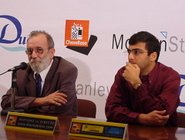
This illustrious tournament has traditionally featured at least one strong female chessplayer.  For many years, it was, more often than not, GM Judit Polgar.  This year is no different - one of the higest-rated female players in the world is playing in the 16th Unive.  Current women's world chess champion GM Hou Yifan of China is in the invitational along with GM Hikaru Nakamura of the USA, and GMs Sergei Tiviakov and Anish Giri of the Netherlands (I think they are the highest-rated players in the Netherlands, but do not quote me on that!)  Giri is a young phenom.  Tiviakov transplated himself years ago and has been a steady performer for his new homeland.  Nakamura is the #1 player in the USA and one of the top-10 highest rated players in the world.

Here are the current standings, courtesy of coverage at The Week in Chess:

16th Unive Crown Hoogeveen (NED), 21-27 x 2012cat. XVIII (2687)
1234
1.Nakamura, HikarugUSA2775**½.1½1½2806
2.Tiviakov, SergeigNED2656½.**½½½132753
3.Giri, AnishgNED26930½½½**½.22625
4.Hou, YifangCHN26230½½0½.**2562

Today, Hou Yifan drew her game with Nakamura, an impressive feat. 

Several chess femmes are playing in the Open (78 players).  There is one more round to go.  WGM Alina L'Ami, whom Goddesschess sponsored to play in the 2011 City of Montreal Chess Championships, is the top female thus far with 4.0/8 and is currently in 35th place overall.  Her husband, GM Erwin L'Ami, is tied for 2nd place with four other players, at 6.0/8.

Monday, October 22, 2012

Hales Corners Challenge XVI: Photographs and Postscript

Hi all.

Hales Corners Challenge XVI was a great success from my perspective.  Darlings!  This is the very first time we ever had to SEND YOU MORE MONEY to cover all the prizes won by the chess femmes!  Like, totally HOO-RAY! 

This has been a very sad time for me, and earlier it was a very trying summer.  But right now is also a very happy time.  Last night Tom Fogec stopped by and personally delivered to me an autograph of GM Josh Friedel, written on the back of a flyer for Hales Corners Challenge XVI.  As you all know, Josh Friedel is one of our few American-minted GMs!  I had posted at the Hales Corners Chess Club blog some weeks before wondering if I might be able to get his autograph -- half joking at the time because of course I wouldn't have thought twice about barging right up to him with pen and paper in hand :)  Tom also told me that all of the chess femmes got together to have their photographs taken, those who played in the Open, and those who played in the Reserve, and that Allen Becker would be sending those to me. It brought good tears to my eyes.

Those photographs were in my email tonight when I got home from a night-out with those wild and crazy chicks with whom I share bus rides to and from work downtown, five days a week.  We are the Rocking Crazy Cougars (or is that Crazy Cougars in Rocking Chairs...), amongst other names, except for "Thelma" because she's only 32 and far too young to be in Cougar territory.  But we're teaching her how to hunt...

Oops, straying from the point here!  It was wonderful to be with supportive, caring friends.  I've had overwhelming support, in fact, and your sympathy and caring have been a life-line during a very dark time.  Of course, one does not just wave one's magic wand and get over the death of a dearly beloved friend, companion, husband-in-everything-but-on-paper, not to mention a business partner and key component of what makes up Goddesschess.  But with such overwhelming support of friends and fans and sympathetic hearts, one carries on.  I'm no doofus.  I know when I have it good.  As Elie-Mae timely reminded me, these are blessings and I didn't even recognize them, like DOH, Jan!  I've been so used to having such wonderfulness in my life, you see.

Okay, enough hokey stuff.  Hey, I'm here, I'm one tough broad even if I can't play myself out of a paper bag on a chessboard!  Of course that makes no sense to anyone who doesn't play chess...

I love these photos!  Thanks so much, chess dudes and chess femmes!

These are the 9 chess femmes who played in the Reserve Section. Oh, me bad.  I SHOULD recognize all of you, but I don't -- maybe a wee bit too much wine with those Cougars I went out with earlier tonight... or - and I plead guilty - just a crappy memory.
 
I DO recognize, on the far right, the beautiful Anne Ulrich (standing, with her hand on the chessboard), and to her immediate left is Pat Foat, who has two chessplaying sons -- hey Pat, good to see you again, sorry to have missed you in person! I do hope we'll have a chance to mix it up OTB at Challenge XVII, but if we don't, let's go out to lunch during the break and schmooze.  And next to Pat is my buddy Ellen Wanek a/k/a Elie-Mae, who runs chess programs in Sheboygan, WI.  Okay, all the rest of you chess femmes, you're young enough to be my granddaughters.  Hmmmm....  Please wear name-tags the next time I see you.  In LARGE PRINT, please.  Hugs to all of you and thank you SO MUCH for coming out and supporting this wonderful local tournament.  CHESS FEMME POWER!!!!

These are, of course, the beautiful ladies who played in the Open. Oh - please excuse Robin Grochowski on the left and Tom Fogec on the right.  Obviously they are no ladies, ahem.  You guys!  You crack me up!  The chess femmes from left to right:  Alena Huang; Rachel Ulrich; Anupama Rajendra; Sandra Pahl. Rah Rah, chess femme power! 

 
I'm too tired to put all the math here that Robin G. presented me with earlier today in an email. Suffice to say, I KNEW we'd owe money this time because of course - wouldn't you know it - after all the tournaments Goddesschess had been depositing funds ahead of time with the Southwest Chess Club to cover potential chess femme prizes during the Hales Corners Chess Challenges, and we always got refunds back -- THIS TIME -- YES, LET ME SHOUT IT OUT AGAIN --THIS TIME (Can I Hear A Gospel Choir, PLEASE! giving me a big HMMMMMMMM and an AMEN) -- WE DIDN'T HAVE ENOUGH ON DEPOSIT! 

Woo woo! 

Thank you so much, chess femmes.  Smooches to all of you.

Sunday, October 21, 2012

2011 Deadly Earthquake in Spain Caused by Groundwater Removal

Evidence provided in the study.  And yet the energy industry in the USA refuses to acknowledge that increasing earthquakes in and around sites of oil removal where so-called "fracking" is being used (water being pumped into fissures deep underground) is likewise causing those increasing quakes although, according to the article "Scientists have known for decades that pumping water into the Earth can set off small earthquakes."  DUH!

When will we finally learn that when it's ALL about the money, it's NEVER good for mankind in general...

Deadly Spain Earthquake Triggered By Groundwater Removal

 
Groundwater removal triggered the unusually shallow and deadly earthquake that hit Lorca, Spain, in 2011, according to a new study.
Scientists have known for decades that pumping water into the Earth can set off small earthquakes. But this is the first time that removing water has been identified as an earthquake trigger, researchers said. Both the size and the location of the quake were influenced by groundwater pumping, the study found.
"The fact that the very tiny stress changes due to normal processes, such as the extraction of groundwater, could have an effect on very large systems such as faults, that's very surprising," said Pablo González, lead study author and a postdoctoral scholar at the University of Western Ontario in Canada.
The researchers were also able to precisely calculate the physical changes that generated the quake. The results will help seismologists better understand the physics that control when an earthquake starts and stops — an important step in predicting when and where a quake will occur, and its size.
"We need observations of this sort to calibrate physical models" of faults, said Jean-Philippe Avouac, a geologist at Caltech in Pasadena, Calif., who was not involved in the study. "The initiation and arrest of [fault] ruptures are something we are trying to constrain," he told OurAmazingPlanet.
 
Small quake, devastating effect
The May 5, 2011, earthquake was a relatively moderate magnitude 5.1. Quakes of this size usually don't cause significant damage in developed countries. A 2006 earthquake of magnitude 4.8 near Lorca did not cause any deaths.
But the 2011 quake ruptured only 0.6 miles (1 kilometer) below the Earth's surface, which meant the earthquake's energy was concentrated at the surface. Nine people were killed and dozens were injured, and both unreinforced masonry, like medieval churches, and modern buildings were damaged.
Thanks to previous research work in Spain, González suspected the quake's shallow epicenter could be related to groundwater extraction near Lorca. The groundwater table south of Lorca has dropped as much as 820 feet (250 meters) since 1960.

"When the tragic event occurred, we asked ourselves if the earthquake might be related to the subsidence. The earthquake was very shallow, and moreover, this pattern of subsidence was bounded by the fault," González told OurAmazingPlanet.

Linking subsidence to fault rupture

Using data from satellite imagery and GPS stations, González and his colleagues first confirmed the quake occurred on the Alhama de Murcia fault. Then, they calculated how the crust responded to removing the weight of the water. Releasing the load increased the stress on the Alhama de Murcia fault by a few tens of kilopascals — less than atmospheric pressure — the study found.

During the quake, the fault broke only in areas where removing groundwater increased stress on the fault. From this correlation, González inferred that the groundwater removal not only helped trigger the quake, but also controlled the size of the fault rupture and the earthquake's magnitude.
However, the amount of energy released by the quake far exceeded that built up by groundwater extraction. Thus, the earthquake released both stress caused by groundwater extraction and several centuries of regional deformation, the study concludes. Southeastern Spain is near the plate boundary region that separates the Eurasia and Africa tectonic plates.
The findings were detailed in the Oct. 21 issue of the journal Nature Geosciences.

Saturday, October 20, 2012

Hales Corners Challenge XVI - Final Standings

A record number of chess femmes participated in the Hales Corners Chess Challenge XVI today, hosted by my adopted chess Club, Southwest Chess Club, in Milwaukee, Wisconsin. 

I am working off of information provided at the Southwest Chess Club's blog. I'm not sure of the names of all of the chess femmes, only that four played in the Open and nine played in the Reserve.  The prior record was eleven chess femmes.  I am very happy with this great turnout. 

Here are the rankings of the Open and Reserve sections as reported by the USCF -- note: as Tom Fogec explained to me tonight (October 21st) the highest rated players who finish with the same score are listed from highest ELO to lower, without regard to tie breaks that determine actual finish position!  So, in the case of tie scores, the person you see listed as number 1 isn't necessarily the winner.  I didn't know this, oops!

OPEN:

No. Name St Rate Rd 1 Rd 2 Rd 3 Rd 4 Score

1. Friedel, Joshua Ed (1)........ NH 2566 W22 W30 W5 D2 3.5
2. Boor, Carl Brandon (2)........ IL 2361 W47 W11 W10 D1 3.5
3. Williams, William (4)......... WI 2223 W7 D12 W15 W14 3.5
4. Becker, Allen J (8)........... WI 2064 W32 D14 W33 W8 3.5


7. Ulrich, Rachel J (17)......... WI 1892 L3 W40 W35 W29 3.0 (clear top chess femme finisher)
16. Rajendra, Anupama (24)........ WI 1820 L12 W31 W42 D9 2.5
39. Huang, Alena (39)............. WI 1517 W26 L6 L23 L24 1.0
41. Pahl, Sandra R (43)........... WI 1450 L19 L26 L24 W46 1.0

Rachel Ulrich is the real deal!  She won three of four and wins a Goddesschess cash prize of $120.00, in addition to a modest gift bag and free entry to Hales Corners Challenge XVII, should she choose to enter.

Anupama Rajendra won two games and drew one, for a total Goddesschess cash prize of $100.00.

Alena Huang and Sandra Pahl each won a game, good for $40.00 cash each from Goddesschess. 

RESERVE:

No. Name St Rate 1 2 3 4 Score

1. Sydlewski, Dean (2)........... WI 1517 W9 W10 W17 D3 3.5

5. Saycocie, Vanisa (10)......... WI 1283 L2 W20 W19 W15 3.0 (Goddesschess prize $60)
6. Ulrich, Anne E (12)........... WI 1242 D3 W25 W24 D2 3.0 (Goddesschess prize $60)

9. Huang, Sabrina (11)........... WI 1249 L1 W21 W29 D11 2.5 (Goddesschess prize $50)
20. Pandey, Ritika (26)........... WI 877 W33 L5 W16 L7 2.0 (Goddesschess prize $40)
22. Wanek, Ellen Ann (28)......... WI 838 L13 L33 W35 W28 2.0 (Gpoddesschess prize $40)
25. Bepar, Naisha (16)............ WI 1082 -H- L6 L8 W34 1.5 (Goddesschess prize $20)
26. Vootkur, Manisha (19)......... WI 1028 L16 L7 W32 -U- 1.0 (Goddesschess prize $20)
30. Pandey, Divya (30)............ WI 746 L28 W35 L7 L18 1.0 (Goddesschess prize $20)
34. Foat, Patricia J (35)......... WI 306 L19 L31 -B- L25 1.0 (Goddesschess prize $20)

Updated October 21, 2012:

I added the names of Divya Pandey and Ritika Pandey to the Reserve chess femmes, I did not have them on the list last night.

Congratulations to all of the ladies.  On tie-breaks, Anne Ulrich, whom I met a few Challenges ago, is the recipient of a Goddesschess gift bag and receives free entry to the next Hales Corners Challenge should she choose to enter, in addition to her cash prize. 

As you can see, the ladies did very well!  ALL of them won prizes, I couldn't be more pleased.  For the first time ever, we'll have to put MORE into our prize pot!!!  Woo woo!

I hope this is the an indication that the future of chess femmes participating in the Hales Corners Challenges will just keep growing and growing and growing.

I understand photographs from Challenge XVI are on the way.  That means I've got to figure out how to publish them here.  Evidently, all of a sudden I ran up against a LIMIT on images I had no idea existed before a few days ago.  So now Google wants money from me for a supposedly FREE blog, and if I do not pay up, I cannot post any further images at this blog.

My choices are limited.  I can either start a new blog or pay the extortion to add more images to this blog and continue it forward.  Of course, the extortion could increase at any time, as extortionists tend to do.

So, I'm not sure what I'm going to do at the present time. 

Friday, October 19, 2012

2012 European Club Cup - Women

Game featured at The Week in Chess:

GM Hou, Yifan (2605) - GM Kosteniuk, Alexandra (2490)
17th European Club Cup w Eilat ISR (1.1), 2012.10.11
1.e4 c6 2.d3 d5 3.Nd2 e5 4.Ngf3 Bd6 5.d4 exd4 6.exd5 Nf6 7.dxc6 Nxc6 8.Be2 O-O 9.Nb3 Re8 10.O-O Bg4 11.h3 Bxf3 12.Bxf3 Be5 13.Nc5 Rc8 14.Nd3 Bb8 15.Bg5 h6 16.Bh4 g5 17.Bg3 Bxg3 18.fxg3 Qd6 19.Rf2 Kg7 20.Qd2 Qxg3 21.Raf1 Re7 22.c3 Ne5 23.cxd4 Nc4 24.Qb4 Rcc7 25.Rc1 Ne3 26.Rxc7 Rxc7 27.Qd2 Nf5 28.Ne5 Nd6 29.Rf1 Qh4 30.Qd3 Qg3 31.Qd2 Nf5 32.Qd3 Nd6 33.Qd2 Nf5 34.Qd3 Qf4 35.Bxb7 Qxd4+ 36.Qxd4 Nxd4 37.Ba6 Rc2 38.Rf2 Rc1+ 39.Rf1 Rc2 40.Rf2 Rc1+ 41.Kh2 h5 42.Rd2 Nf5 43.Rf2 Nd6 44.Bd3 h4 45.Rf1 Rc7 46.g3 Re7 47.Nf3 Re3 48.Ba6 hxg3+ 49.Kxg3 Nf5+ 50.Kh2 g4 51.hxg4 Nxg4+ 52.Kh3 Ne5 53.Bb7 Nd6 54.Ba8 f5 55.Kg3 Nd3 56.Kh4 Kf6 57.b3 Re8 58.Rd1 Rxa8 59.Rxd3 Ne4 0-1

Lest anyone forget, GM Alexandra Kosteniuk was the 12th Women's World Chess Champion...

From chess-results.com:

Ranking crosstable

Rk.Team12345678 TB1 TB2 TB3
1Cercle d'Echecs de Monte-Carlo * 34414261.022.0
2Mika * 3310225.018.5
3Ugra1 * 129184.315.0
4SHSM-Nashe Nasledie13 * 228196.016.5
5AVS2 * 447199.818.0
6Ashdod0½2½½ * 3591.09.0
7Chigorin Club½½20 * 33101.39.0
8Rishon Le-Zion01½½011 * 052.34.0
Annotation:
Tie Break1: Matchpoints (2 for wins, 1 for Draws, 0 for Losses)
Tie Break2: FIDE-Sonneborn-Berger-Tie-Break
Tie Break3: points (game-points)
 
de Monte-Carlo was once again a veritable powerhouse -- as one can see from the list of players:
 

Team-Composition with round-results

1. Cercle d'Echecs de Monte-Carlo (RtgAvg:2578, Captain: Almira Skripchenko / TB1: 14 / TB2: 261)
Bo.NameRtgFED1234567Pts.GamesRtgAvg
1GMHou Yifan2605CHN011½114.562409
2GMKoneru Humpy2607IND1½½111½5.572383
3GMMuzychuk Anna2587SLO½½½1114.562334
4GMCramling Pia2514SWE1½½11½4.562334
5IMSkripchenko Almira2437FRA1113.032022
2. Mika (RtgAvg:2472, Captain: Anahit Vardapetyan / TB1: 10 / TB2: 225)
Bo.NameRtgFED1234567Pts.GamesRtgAvg
1GMDanielian Elina2476ARM½10½½½14.072415
2GMHarika Dronavalli2512IND½0½½1114.572393
3IMMkrtchian Lilit2456ARM1½½½½1½4.572336
4IMJavakhishvili Lela2444GEO10½11115.572244
3. Ugra (RtgAvg:2397, Captain: Pavel Lobach / TB1: 9 / TB2: 184.25)
Bo.NameRtgFED1234567Pts.GamesRtgAvg
1WGMKovanova Baira2408RUS00½1001.562452
2WGMGirya Olga2454RUS11½½½½½4.572410
3IMRomanko Marina2365RUS½½½½½02.562408
4WGMShadrina Tatiana2361RUS11½110½5.072308
5WIMBezgodova Maria2177RUS½11.521958
4. SHSM-Nashe Nasledie (RtgAvg:2444, Captain: Elder Mukhametov / TB1: 8 / TB2: 196)
Bo.NameRtgFED1234567Pts.GamesRtgAvg
1GMKosteniuk Alexandra2490RUS1½½1½14.562428
2IMGunina Valentina2514RUS0110½13.562432
3IMKovalevskaya Ekaterina2405RUS½½½½½13.562407
4WGMKashlinskaya Alina2368RUS001012.052295
5IMSavina Anastasia2303RUS10½1½3.052185
5. AVS (RtgAvg:2512, Captain: Vladmir Georgiev / TB1: 7 / TB2: 199.75)
Bo.NameRtgFED1234567Pts.GamesRtgAvg
1GMStefanova Antoaneta2493BUL0½½½12.552464
2GMLahno Kateryna2551UKR1½01114.562366
3GMCmilyte Viktorija2528LTU0½½½113.562395
4WGMPogonina Natalija2476RUS½½½113.552317
5IMMuzychuk Mariya2474UKR0101114.062196
6. Ashdod (RtgAvg:2228, TB1: 5 / TB2: 91)
Bo.NameRtgFED1234567Pts.GamesRtgAvg
1IMKlinova Masha2324ISR½½½½½02.562421
2IMBorsuk Angela2260ISR½½00001.062447
3WIMVasiliev Olga2240ISR11½00002.572380
4WIMTsifanskaya Ludmila A2087ISR½1½00½2.562240
5WFMDotan Valeria2064ISR½000.532214
7. Chigorin Club (RtgAvg:2277, Captain: Andrei Lukin / TB1: 3 / TB2: 101.25)
Bo.NameRtgFED1234567Pts.GamesRtgAvg
1IMBodnaruk Anastasia2425RUS½½½½½002.572423
2WIMBronnikova Elizaveta2244RUS½½1½0002.572419
3WIMIvkina Olga2266RUS011½00½3.072329
4Ivanova-Skripova Tatiana2173RUS½0½00001.072263
8. Rishon Le-Zion (RtgAvg:2036, TB1: 0 / TB2: 52.25)
Bo.NameRtgFED1234567Pts.GamesRtgAvg
1WIMEfroimski Marsel2162ISR½½½00001.572468
2Reprun Nadejda2143ISR½000½001.072443
3Vardi Shlomit2010ISR000000.052450
4Federovski Adi1829ISR00½0000.562291
5Lahav Michal1732ISR0½½1.032227

Votive Offerings Uncovered to Goddess Juno

From Gazetta del Sud Online (English)

Tomb raiders lead to new archaeological find

19/10/2012

Votive offerings to Juno from 4th to 2nd century BC

 
ANSA) – Rome, October 19 - Investigations into the activities of four tomb raiders in the Alban hills near Rome have led to the discovery of a previously unknown site containing ancient Roman votive offerings. The ex-votos date from the fourth to the second century BC and include life-sized statues and depictions of parts of the human anatomy in terracotta offered to the ancient Roman goddess Juno. Police caught the tomb robbers in action as they were stealing the devotional objects from a natural cavity in a tufa wall near Lanuvio and Genzano that did not appear on archaeological maps of the area. The cavity appears to be linked to a nearby sanctuary dedicated to Juno the Saviour via a network of caverns and tunnels. The discovery is considered important as it testifies to the existence of a workshop once producing prestigious terracotta objects in the area. Investigators believe the stolen ex-votos were destined for the international collectors' market. Police found other ancient artefacts including sepulchral items mostly dating to the Etruscan era during their search of the tomb raiders' homes.

Donald Alexander McLean - Obituary

From The Montreal Gazette

Donald Alexander (Sandy) McLean
Published October 18, 2012

Peacefully at home, on October 12, 2012 at age 61. A fine musician, composer and dedicated youth worker, son of the late Donald McLean and Thérèse Bouthililer, Don is survived by his sister Anne, A private memorial will be held Sunday, October 21. For details, phone 514 918 1116


A fine turn-out is expected at the memorial on Sunday. 

For those of you who may not know who Don was, he was a principal in the Goddesschess Partnership from its inception.  Don also was the webmaster of the Goddesschess website for many years, until intractable technical problems and ill health (on both our parts) led to the decision to take Goddesschess offline in June, 2012.  We had intended to resurrect Goddesschess at another internet service provider.  Now, the guts of Goddesschess are locked up inside of one of Mr. Don's computers.

Goddess willing, I will get it back online, even if nothing new is ever added to it again.  I'm no techy -- I don't understand things about computers and uploads and downloads and websites and such.  Goddesschess was Don's baby for several years, including his wonderful weekly summary of interesting-news items, "Random Round-Up." 

To Don McLean's extended family members, if you should ever read this, and if are interested in receiving a Family Tree that I prepared as a gift a few years back for Mr. Don, please contact me via this blog.  If I find you on the tree or you can provide me with evidence that you are a relative (I have some names and some memories that Mr. Don passed on over the years), I'll be happy to mail you a printed copy.  It's EXTENSIVE.

If we do not know where we came from, how do we know where we're going...

Hales Corners Challenge XVI

Hello everyone.

Tomorrow the Hales Corners Chess Challenge XVI will take place in Milwaukee, Wisconsin.

I wish - well, we have a record-number of chess femmes playing in this event -- 13!  Four in the Open and nine in the Reserve.  I was scheduled to play in the Reserve, but right now my heart just is not in anything, so I withdrew early last week.  So, I'm not counted in that big 13.  Before this Challenge, the highest-ever number of femmes that participated in a Challenge was 11.  So a new record has been set, thanks to you all.

I must give kudos to my friends at Southwest Chess Club.  They have been very supportive and understanding during this time.  Tonight one of their members stopped by the house and picked up the gift bags to be presented to the top female finisher in each of the Open and Reserve sections.  Thanks so much for your support.

And - there is STILL TIME TO REGISTER TO PLAY, because there is open registration tomorrow morning before play starts (SEE details below)!!!!!


GM Josh Friedel will be playing, and we're expecting another great turnout.

Goddesschess Prizes for Females in Addition to Above Prizes, Open: $40 per win/$20 per draw; Reserve: $20 per win/$10 per draw (and highest-scoring female in each section wins free entry into HCC XVII).
 
Life Master Sheldon Gelbart will be on hand throughout the tournament to analyze games for tournament participants

ENTRY FEE
: $35 – Open; $25 – Reserve
(both sections $5 more after October 17, 2012)
Comp Entry Fee for USCF 2200+: Entry fee subtracted from any prizes won
SITE REGISTRATION
: 8:30 a.m. – 9:30 a.m.

ROUNDS
: 10 am -- 1 pm -- 3:30 pm -- 6 pm

Pairings by WinTD---No Computer Entries---No Smoking

PRIZES
 
OPEN - RESERVE

1st—$325 1st—$100
2nd—$175 2nd—$75
A—$100 D—$50
B & Below—$75 E & Below—$40

Goddesschess Prizes for Females in Addition to Above Prizes

Open: $40 per win/$20 per draw; Reserve: $20 per win/$10 per draw


Goddess willing, I will be playing in Challenge XVII, in April, 2013.

Some Memories of Don McLean

I offer this photo montage of our last time together, which was December, 2011-January, 2012 when Don and I travelled to Spain after Christmas. 

We re-visited many places in Madrid and also the beautiful ancient city of Toledo that we first visited in October, 2002, shortly after the death of our friend and mentor, IM Dr. Ricardo Calvo, who was a well-known player in Spain for many years and a noted chess historian. 

This trip, we had a deeper appreciation for the beauty we'd seen the first time, examined more things in depth, and saw new things as, feeling more comfortable in this city we'd visited before, we ventured forth further away from known territory and saw many new things.  Our only regret was that the Archaeological Museum was closed for renovations, something neither of us had foreseen and therefore hadn't thought to check ahead of time online! 

After so many years together, we communicated in shorthand and often, we didn't even have to speak.  We'd just look at each other and know what the other was feeling about what we were seeing, doing, feeling.  Often, we shared dreams.  I had no premonition, though, that Don was going to die.  Now, all is emptiness.  I did not realize that Madrid/Toledo would be the last trip I would ever take with Mr. Don.


Click to play this Smilebox slideshow
Create your own slideshow - Powered by Smilebox
This digital slideshow personalized with Smilebox

I may put a few more of these together.  There's a lot to review over the past 13 years.  You'll just have to bear with me.

Saturday, October 13, 2012

Don McLean of Goddesschess Passed Away

In his sleep, Thursday night/Friday morning.  I received notification from his twin sister, Anne, earlier today.  Don was 61.

Don (his Canadian friends and family knew him as Sandy) was the long-time webmaster and creative force behind Random Round-Up at the Goddesschess website.  The website was taken off line earlier this summer when we started experiencing technical difficulties with our server and couldn't get them resolved.  Then some serious health problems hit both of us around the same time, although Don had been sick for several months before with what he called "the flu."  We shared atrial fibrillation together, both diagnosed around the same time in June.  I thought we had both been on the path to recovery together.  I was wrong.  Way wrong. 

Don and I first met in December, 1998 and became engaged in November, 2003.  We were friends and fighters both and shared deep connections in ways words cannot describe.  Although we decided not to marry in 2010, we remained deeply bonded. Our last adventure together was in January this year, our second trip to Madrid and Toledo, where Mr. Don wore me out with his go-go-go!  I did many blog entries from Madrid and posted many photographs.


Mr. Don took this photo of our shadows way up a hill at Rentiro Park in Madrid.  I am on the left, holding my ever-present tote bag.  Mr. Don is on the right holding his videocam.  The photo looks like we (or our shadows) are on bases, like chess pieces. 


Don hard at work in the family room at the second laptop (my house) before we left for Madrid a few days later, in January.  He was bundled up in a hoodie and an afghan.  He was often cold here (I keep my heat at 64-65, but I'm used to it), and liked nothing better than snuggling in front of the fireplace in the front room.


This photo was taken with my very ancient browny camera in October 2002 during our first trip to Madrid, at the gift shop on the Royal Palace grounds while we were waiting for our tour to be called.  There was a cache of swords and like all good swashbucklers, Mr. Don went straight for them.


Mr. Don, waiting at Milwaukee airport for our flight to Chicago en route to Madrid, January this year.  We had to get there EARLY and had breakfast before going through security. 

I am shutting down for awhile.  The Summer from Hell has turned into the Autumn of my Worst Nightmares.

Friday, October 12, 2012

Russian Nazca Lines?

Interesting...

LiveScience.com/Image copyright 2012 Geoeye, copyright 2012 GIS Innovatsia, courtesy Google Earth.
A historical Google Earth image from 2007 showing the animal-shaped geoglyph in Russia, which may predate
Peru's famous Nazca Lines.

Mysterious Elk-Shaped Structure Discovered in Russia


A huge geoglyph in the shape of an elk or deer discovered in Russia may predate Peru's famous Nazca Lines by thousands of years.

The animal-shaped stone structure, located near Lake Zjuratkul in the Ural Mountains, north of Kazakhstan, has an elongated muzzle, four legs and two antlers. A historical Google Earth satellite image from 2007 shows what may be a tail, but this is less clear in more recent imagery.

Excluding the possible tail, the animal stretches for about 900 feet (275 meters) at its farthest points (northwest to southeast), the researchers estimate, equivalent to two American football fields. The figure faces north and would have been visible from a nearby ridge.

"The figure would initially have looked white and slightly shiny against the green grass background," write Stanislav Grigoriev, of the Russian Academy of Sciences Institute of History & Archaeology, and Nikolai Menshenin, of the State Centre for Monument Protection, in an article first detailing the discovery published last spring in the journal Antiquity. They note that it is now covered by a layer of soil.

Fieldwork carried out this past summer has shed more light on the glyph's composition and date, suggesting it may be the product of a "megalithic culture," researchers say. They note that hundreds of megalithic sites have been discovered in the Urals, with the most elaborate structures located on a freshwater island about 35 miles (60 km) northeast of the geoglyph.

Discovery & excavation

A man named Alexander Shestakov first discovered the glyphs using satellite images. He alerted researchers, who sent out a hydroplane and paraglider to survey the giant structure.

This has since progressed to an on-the-ground excavation by a team led by Grigoriev. They've found that the stone architecture of the geoglyph is quite elaborate. When they excavated part of a hind leg the largest stones were on the edges, the smaller ones inside. This past summer they also found the remains of passageways and what appear to be small walls on the hoof and muzzle of the animal.

"The hoof is made of small crushed stones and clay. It seems to me there were very low walls and narrow passages among them. The same situation in the area of a muzzle: crushed stones and clay, four small broad walls and three passages," Grigorievwrote in an email to LiveScience. He cautioned that his team didn't excavate all the way down to the bottom of the walls, not wishing to damage the geoglyph.

Dating the geoglyph

Among the finds from the excavations are about 40 stone tools, made of quartzite, found on the structure's surface. Most of them are pickaxe-like tools called mattocks, useful for digging and chopping. "Perhaps they were used to extract clay," he writes in the email.

The style of stone-working called lithic chipping used on one artifact dates it to the Neolithic and Eneolithic (sixth to third millennia B.C.), though Grigoriev says the technology is more typical of the Eneolithic, between the fourth and third millennia B.C.

If that date is correct, it would make the geoglyph far older than Peru's Nazca Lines, the very earliest of which were created around 500 B.C. Grigorievadded that current studies of ancient pollen at the site will help to narrow down the age.

In the Antiquity journal article, Grigoriev and Menshenin point out that palaeozoological studies show that the landscape in the southern Urals supported fewer trees in the Eneolithic, with forest growth not appearing until about 2,500 years ago. "This means that there were open landscapes in the Eneolithic and Bronze Age, which allowed the hill figure to be created," they write.

A megalithic culture

Researchers say this geoglyph may have been built by a "megalithic culture" in the region that created stone monuments in prehistoric times.

"[M]any megalithic sites with features in common with European megaliths have been located: Some 300 are known but have not yet been studied in detail," write Grigoriev and Menshenin in the Antiquity article. Among these megaliths are numerous "menhirs," large upright standing stones. The most spectacular megalithic complexes are on the relatively small Vera Island, located on Turgoyak Lake, about 35 miles (60 km) northeast of the geoglyph.

Grigoriev and Julia Vasina of the South-Ural State University described the Vera Island megaliths in a 2010 article, noting the surviving portion of one monument, megalith two, as being covered by a mound and supporting a gallery and square chamber. Another monument, megalith one, is cut into the bedrock and covered by a mound consisting of stones, brown sand and lots of grass. It is more than 60 feet (19 meters) long and 20 feet (6 meters) wide. It contains three chambers one of which has "bas relief sculptures" in the shape of animals, probably a bull and wolf.

Stone tools and ceramics found at the megalithic sites date them to between the Eneolithic period and the early Iron Age, around 3,000 years ago. Researchers emphasize more dating work needs to be done to verify; however, if the evidence holds, the giant geoglyph, along with the megaliths, were constructed millennia before Peru's Nazca Lines, a testament to the building prowess of an ancient prehistoric culture in the Ural Mountains.
Related Posts Plugin for WordPress, Blogger...