Monday, March 24, 2014

2014 European Senior Chess Championships

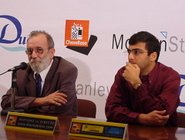
Ladies' final standings, Fifty+ and Sixty-Five+.  Shit, I'm getting old.  GM Nona Gaprindashvili in the 65+ category. What?  I'm still shaking my head in disbelief. 

Official website (in English).

Classic Final Standings:

14th European Senior 65+ Ladies Chess Championship 2014

Rk.SNoNameFEDRtgPts.TB1 TB2 TB3
12WGMKozlovskaya ValentinaRUS21697.50.0727.00
26GMGaprindashvili NonaGEO23047.01.0625.75
33WIMTsifanskaya Ludmila AISR21027.00.0625.50
48Kabanova IrinaRUS19416.00.0522.25
59WGMKhmiadashvili TamarGEO20835.00.0417.00
610WFMDotan ValeriaISR19594.00.0311.50
75Zaitseva TamaraRUS20993.50.029.25
84Hoose HanneloreGER17502.50.028.50
91Āboliņa Ārija SolveigaLAT18741.50.012.75
107Savostina LarisaRUS15951.00.012.50

14th European Senior 50+ Ladies Chess Championship 2014

Rk.SNo NameFEDRtgPts. TB1 TB2 TB3
11 WIMFomina TatyanaEST21886.50.5527.50
24 WIMKasoshvili TsialaGEO21126.50.5426.00
37 WGMStrutinskaya Galina NRUS22906.00.0524.50
46 WFMBogumil TatianaRUS21185.50.0521.25
55 WFMKierzek MiraMKD20024.51.0417.25
63 WIMJicman Ligia-LetiţiaROU21544.50.0317.25
710 WIMMednikova SvetlanaRUS21803.50.5213.25
88 IMGurieli NinoGEO23293.50.5211.75
92 Chireykina NataliaRUS18912.50.029.25
109 Baliūnienė MargaritaDEN19442.00.0211.00
xxx

2014 Chinese Chess Championships

March 11 - 22, 2014.  Information courtesy of The Week in Chess.  Final standings (women first):

ch-CHN w 2014 Xinghua CHN Tue 11th Mar 2014 - Sat 22nd Mar 2014
Leading Final Round 11 Standings:
RkSNoNameFEDRtgPtsTB1TB2TB3
11Ju WenjunCHN25208.50.041.257
23Shen YangCHN24358.00.539.005
310Lei TingjieCHN23748.00.536.257
411Ding YixinCHN24297.50.038.004
58Tan ZhongyiCHN24996.50.029.754
612Guo QiCHN24626.00.027.754
72Zhang XiaowenCHN23975.50.024.254
87Wang JueCHN23844.50.019.502
99Wang DoudouCHN22173.50.015.252
105Xiao YiyiCHN21773.00.013.001
114Zhai MoCHN22662.50.513.500
126Gu TianluCHN21642.50.59.500
12 players

ch-CHN 2014 Xinghua CHN Tue 11th Mar 2014 - Sat 22nd Mar 2014
Leading Final Round 11 Standings:
RkSNoNameFEDRtgPtsTB1TB2TB3
13Yu YangyiCHN26647.00.537.003
210Ding LirenCHN27177.00.536.754
35Ma QunCHN26066.50.534.502
41Wei YiCHN26256.50.533.003
59Zhou JianchaoCHN25656.00.532.003
68Zhao JunCHN26086.00.531.503
77Hou YifanCHN26295.00.027.752
82Lin ChenCHN24754.52.022.252
912Xiu DeshunCHN25714.51.525.002
104Zeng ChongshengCHN25204.51.522.503
116Wen YangCHN25914.51.024.252
1211Liu QingnanCHN25014.00.023.002
12 players

GM Hou Yifan finished about the middle of the pack.  She was third-ranked going in, so I would consider this not a very good performance. 

Iron Age Woman Buried With Her Feet Cut Off and Buried With Her

This is just strange.  Was it done to keep the woman's spirit from "walking about" outside her grave?  And were the two sheep buried around her head provided as - compensation - for preventing her from walking around in the after-life?  I would think that back then, two sheep would have been a very valuable compensation.  But we really don't know.

From BBC News
March 2014 Last updated at 15:35 ET

Iron Age woman's footless body found near West Knoyle

Source.
 
A skeleton of an Iron Age woman with her feet chopped off has been discovered in a field in Wiltshire.
The remains were found along the A303, near West Knoyle, by archaeologists ahead of a new water main being laid. Wessex Water said the woman's feet were found "reburied alongside her" along with the carcasses of at least two sheep or goats "on her head".
Peter Cox, from AC Archaeology, said: "We're unsure why - but it must have some link to beliefs at the time."
The female skeleton was found alongside the remains of a child aged about 10 and two males with sword wounds to their hips.

'Bad spirits'
Wessex Water is currently building a 40-mile (64km) pipeline to carry water from a Dorset treatment plant into Wiltshire.  It was during a pre-work survey of the West Knoyle area that AC Archaeology unearthed the Iron Age burial site.
"Human remains from these periods are very rare and indicate the long period of settlement that has occurred in the area," said Mr Cox.  "But we're unsure why the female skeleton has been found without her feet or why she may have been buried with sheep, but perhaps it was to protect her soul from bad spirits."
The bones have been removed from the site and will undergo radiocarbon dating to determine their age.

Amazons: Truth or Fiction?

The Smithsonian put together a feature on the Amazons.

The Amazon Women: Is There Any Truth Behind the Myth?

Strong and brave, the Amazons were a force to be reckoned with in Greek mythology—but did the fierce female warriors really exist?


I loved watching the “Wonder Woman” TV series when I was a girl. I never wanted to dress like her—the idea of wearing a gold lamé bustier and star-spangled blue underwear all day seemed problematic—but the Amazonian princess was strong and resourceful, with a rope trick for every problem. She seemed to be speaking directly to me, urging, “Go find your own inner Amazonian.” When I read the news that Wonder Woman was going to be resurrected for a blockbuster movie in 2016, Batman vs. Superman, it made me excited—and anxious. Would the producers give her a role as fierce as her origins—and maybe some shoulder straps—or would she just be cartoon eye candy?

The fact that she isn’t even getting billing in the title makes me suspicious. It wouldn’t have pleased Wonder Woman’s creator either. “Wonder Woman is psychological propaganda for the new type of woman who should, I believe, rule the world,” declared the psychologist and comic book writer William Moulton Marston, offering a proto-feminist vision that undoubtedly sounded quite radical in 1943. “Not even girls want to be girls so long as our feminine archetype lacks force, strength and power. Not wanting to be girls, they don’t want to be tender, submissive, peace-loving as good women are.”

Over the years, the writers at DC Comics softened Wonder Woman’s powers in ways that would have infuriated Marston. During the 1960s, she was hardly wondrous at all, less a heroic warrior than the tomboyish girl next-door. It was no longer clear whether she was meant to empower the girls or captivate the boys. But the core brand was still strong enough for Gloria Steinem to put her on the cover of the first newsstand issue of Ms. magazine in 1972—with the slogan “Wonder Woman for President.”

The creators of Wonder Woman had no interest in proving an actual link to the past. In some parts of the academic world, however, the historical existence of the Amazons, or any matriarchal society, has long been a raging issue. The origins of the debate can be traced back to a Swiss law professor and classical scholar named Johann Jakob Bachofen. In 1861 Bachofen published his radical thesis that the Amazons were not a myth but a fact. In his view, humanity started out under the rule of womankind and only switched to patriarchy at the dawn of civilization. Despite his admiration for the earth-mother women/priestesses who once held sway, Bachofen believed that the domination of men was a necessary step toward progress. [Yeah, they've done a really great hand job with the world, haven't they.]  Women “only know of the physical life,” he wrote. “The triumph of patriarchy brings with it the liberation of the spirit from the manifestations of nature.”

It comes as no surprise that the composer Richard Wagner was enthralled by Bachofen’s writings. Brünnhilde and her fellow Valkyries could be easily mistaken for flying Amazons. But Bachofen’s influence went far beyond the Ring Cycle. Starting with Friedrich Engels, Bachofen inspired generations of Marxist and feminist theorists to write wistfully of a pre-patriarchal age when the evils of class, property and war were unknown. As Engels memorably put it: “The overthrow of mother-right was the world historical defeat of the female sex. The man took command in the home also; the woman was degraded and reduced to servitude; she became the slave of his lust and a mere instrument for the production of children.”

There was, however, one major problem with the Bachofen-inspired theory of matriarchy: There was not a shred of physical evidence to support it. In the 20th century, one school of thought claimed that the real Amazons were probably beardless “bow-toting Mongoloids” mistaken for women by the Greeks. Another insisted that they were simply a propaganda tool used by the Athenians during times of political stress. The only theorists who remained relatively unfazed by the debates swirling through academia were the Freudians, for whom the idea of the Amazons was far more interesting in the abstract than in a pottery fragment or arrowhead. The Amazonian myths appeared to hold the key to the innermost neuroses of the Athenian male. All those women sitting astride their horses, for example—surely the animal was nothing but a phallus substitute. As for their violent death in tale after tale, this was obviously an expression of unresolved sexual conflict.

Myth or fact, symbol or neurosis, none of the theories adequately explained the origins of the Amazons. If these warrior women were a figment of Greek imagination, there still remained the unanswered question of who or what had been the inspiration for such an elaborate fiction. Their very name was a puzzle that mystified the ancient Greeks. They searched for clues to its origins by analyzing the etymology of Amazones, the Greek for Amazon. The most popular explanation claimed that Amazones was a derivation of a, “without,” and mazos, “breasts”; another explanation suggested ama-zoosai, meaning “living together,” or possibly ama-zoonais, “with girdles.” The idea that Amazons cut or cauterized their right breasts in order to have better bow control offered a kind of savage plausibility that appealed to the Greeks.

The eighth-century B.C. poet Homer was the first to mention the existence of the Amazons. In the Iliad—which is set 500 years earlier, during the Bronze or Heroic Age—Homer referred to them somewhat cursorily as Amazons antianeirai, an ambiguous term that has resulted in many different translations, from “antagonistic to men” to “the equal of men.” In any case, these women were considered worthy enough opponents for Homer’s male characters to be able to boast of killing them—without looking like cowardly bullies.

Future generations of poets went further and gave the Amazons a fighting role in the fall of Troy—on the side of the Trojans. Arktinos of Miletus added a doomed romance, describing how the Greek Achilles killed the Amazonian queen Penthesilea in hand-to-hand combat, only to fall instantly in love with her as her helmet slipped to reveal the beautiful face beneath. From then on, the Amazons played an indispensable role in the foundation legends of Athens. Hercules, for example, last of the mortals to become a god, fulfills his ninth labor by taking the magic girdle from the Amazon queen Hippolyta.

By the mid-sixth century B.C., the foundation of Athens and the defeat of the Amazons had become inextricably linked, as had the notion of democracy and the subjugation of women. The Hercules versus the Amazons myth was adapted to include Theseus, whom the Athenians venerated as the unifier of ancient Greece. In the new version, the Amazons came storming after Theseus and attacked the city in a battle known as the Attic War. It was apparently a close-run thing. According to the first century A.D. Greek historian Plutarch, the Amazons “were no trivial nor womanish enterprise for Theseus. For they would not have pitched their camp within the city, nor fought hand-to-hand battles in the neighborhood of the Pynx and the Museum, had they not mastered the surrounding country and approached the city with impunity.” As ever, though, Athenian bravery saved the day.

The first pictorial representations of Greek heroes fighting scantily clad Amazons began to appear on ceramics around the sixth century B.C. The idea quickly caught on and soon “amazonomachy,” as the motif is called (meaning Amazon battle), could be found everywhere: on jewelry, friezes, household items and, of course, pottery. It became a ubiquitous trope in Greek culture, just like vampires are today, perfectly blending the allure of sex with the frisson of danger. The one substantial difference between the depictions of Amazons in art and in poetry was the breasts. Greek artists balked at presenting anything less than physical perfection.

The more important the Amazons became to Athenian national identity, the more the Greeks searched for evidence of their vanquished foe. The fifth century B.C. historian Herodotus did his best to fill in the missing gaps. The “father of history,” as he is known, located the Amazonian capital as Themiscyra, a fortified city on the banks of the Thermodon River near the coast of the Black Sea in what is now northern Turkey. The women divided their time between pillaging expeditions as far afield as Persia and, closer to home, founding such famous towns as Smyrna, Ephesus, Sinope and Paphos. Procreation was confined to an annual event with a neighboring tribe. Baby boys were sent back to their fathers, while the girls were trained to become warriors. An encounter with the Greeks at the Battle of Thermodon ended this idyllic existence. Three shiploads of captured Amazons ran aground near Scythia, on the southern coast of the Black Sea. At first, the Amazons and the Scythians were braced to fight each other. But love indeed conquered all and the two groups eventually intermarried. Their descendants became nomads, trekking northeast into the steppes where they founded a new race of Scythians called the Sauromatians. “The women of the Sauromatae have continued from that day to the present,” wrote Herodotus, “to observe their ancient customs, frequently hunting on horseback with their husbands...in war taking the field and wearing the very same dress as the men....Their marriage law lays it down, that no girl shall wed until she has killed a man in battle.”

The trail of the Amazons nearly went cold after Herodotus. Until, that is, the early 1990s when a joint U.S.-Russian team of archaeologists made an extraordinary discovery while excavating 2,000-year-old burial mounds—known as kurgans—outside Pokrovka, a remote Russian outpost in the southern Ural Steppes near the Kazakhstan border. There, they found over 150 graves belonging to the Sauromatians and their descendants, the Sarmatians. Among the burials of “ordinary women,” the researchers uncovered evidence of women who were anything but ordinary. There were graves of warrior women who had been buried with their weapons. One young female, bowlegged from constant riding, lay with an iron dagger on her left side and a quiver containing 40 bronze-tipped arrows on her right. The skeleton of another female still had a bent arrowhead embedded in the cavity. Nor was it merely the presence of wounds and daggers that amazed the archaeologists. On average, the weapon-bearing females measured 5 feet 6 inches, making them preternaturally tall for their time. [Selective breeding!  I believe that even today, the average height of a woman in the USA is 5 feet 3 inches!]

Finally, here was evidence of the women warriors that could have inspired the Amazon myths. In recent years, a combination of new archaeological finds and a reappraisal of older discoveries has confirmed that Pokrovka was no anomaly. Though clearly not a matriarchal society, the ancient nomadic peoples of the steppes lived within a social order that was far more flexible and fluid than the polis of their Athenian contemporaries.

To the Greeks, the Scythian women must have seemed like incredible aberrations, ghastly even. To us, their graves provide an insight into the lives of the world beyond the Adriatic. Strong, resourceful and brave, these warrior women offer another reason for girls “to want to be girls” without the need of a mythical Wonder Woman.

Sunday, March 23, 2014

More on That 9000 Year Old "Ritual Wand"

Prior post (March 15, 2014).

Archaeologists in Syria find ancient 'wand' engraved with human faces

The 9,000-year-old item, made of cow-bone, likely depicted 'powerful supernatural beings,' archaeologists say.

By | Mar. 17, 2014 | 3:46 PM
 
Archaeologists have discovered a 9,000-year-old 'wand' near an ancient burial site in southern Syria, with two human faces engraved on it.
                      
The item, made of cow bone, is thought to date from the late 9th millennium BC. Archaeologists excavated it from Tell Qarassa, an Early Neolithic site. This is among the few archaeological sites not damaged in the fighting in Syria, which on Saturday marked its third anniversary.
                      
The wand was found near a burial site, where 30 headless skeletons were discovered previously. Archaeologists say the findings shed light on the rituals of people who lived in the Neolithic period. Other findings at the site indicate that its inhabitants in the Neolithic period were some of the world's first farmers.
                      
"The find is very unusual. It's unique," study co-author Frank Braemer, an archaeologist at the Centre National de la Recherche Scientifique in France told Livescience.

"Earlier traditions of figurative art had avoided the detailed and naturalistic representation of the human face. Fundamental changes occurred during the Pre-Pottery Neolithic with the famous plastered skulls of Jericho and other sites," International Business Times cited the archaeologists as saying. "Statues, masks and smaller carvings also appeared," they said in the findings, which were published in March in the journal Antiquity.

The cow-bone wand, found by archaeologists during digs at Tell Qarassa in 2007 and 2009, was possibly used in a burial ritual, archaeologists believe. "This small bone object from a funerary layer can be related to monumental statuary of the same period in the southern Levant and south-east Anatolia that probably depicted powerful supernatural beings," the experts said.
                      
"It may also betoken a new way of perceiving human identity and of facing the inevitability of death. By representing the deceased in visual form, the living and the dead were brought closer together."
With the fighting in Syria ongoing since 2011, there have been illegal excavations at UNESCO World Heritage sites in the country, including the Ancient Villages of Northern Syria, Bosra, Crac des Chevaliers, Palmyra, Damascus and Aleppo.

*************************************

At the risk of repeating myself, I'm much more focused upon the use of a COW BONE to carve this so-called "magic wand" and -- is it just a coincidence that Hat-Hert ("Hathor", the cow goddess) -- was developing via her predecessor, the warrior Goddess Neith, her own cult around the same time in the delta region of Egypt?

I believe it safe to say that many sacred cults of cow and bull worship developed during this period throughout the Fertile Crescent, focusing upon Sun and Moon worship, co-existent with cults that manifested separately (and may predate the worship of cows/bulls) the worship of felines (lionesses and lions).  Hat-Hert, for instance, turned into a voracious devouring lioness to destory evil mankind. Ancient Chinese goddesses (whose dates are yet uncertain) manifested themselves as tigress/females who could turn upon mankind at any second.  We should not ever forget the "lion" throne that was found with the rotund female sitting upon it, at Catal-hoyuk (Turkey, part of the Fertile Crescent), as well as the numerous aurochs' heads, either (approximately 7500 BCE - 5700 BCE). 

Add 2000 years, and what do you get -- development of such cults of worship more or less all around the same time...

Franciscan Friars Use Crowdsourcing To Restore St. Francis of Assisi's Cell

I just read about this today in my Milwaukee Journal/Sentinel - print edition. Yeah, I'm one of those dinosaurs who still reads a print newspaper, LOL!  I do not think I would have come across this story otherwise.  Once I read it, I did an online seach and voila, here is an article.  I just think this is so cool:


From CathNews Online
Franciscans use crowdsourcing for restoration project In Italy
Published: 18 March 2014
 
With interest in things Franciscan at an all-time high, the friars who run the San Francesco a Ripa church in Rome's Trastevere neighbourhood are launching a Kickstarter online fundraising campaign this week to try to raise A$137,000 for the restoration of the tiny cell where St Francis stayed when he came to Rome to see the popes starting in 1209, the Associated Press has learned.

Rather than ask for funding from the Italian government, which owns the church and is responsible for its upkeep, the friars decided on this more democratic crowd-funding initiative, thinking it more in keeping with the Franciscan tradition of seeking alms for just what they need, spreading the faith as they beg and making sure the poor are the priority.

'It seemed important to us, very Franciscan even, to say that today, perhaps public money should be destined to more urgent things, more important things like social issues that are affecting Italy and Europe at large,' said Stefano Tamburo, the 43-year-old guardian of the sanctuary who is spearheading the campaign.

'So like the friars in the past would go asking for a piece of bread, today we are going to ask for a dollar, a euro, so we can make this place as it was in the time of St Francis.'

Kickstarter is one of dozens of crowd-funding websites that have sprung up in recent years to let people raise money for specific projects, with the catch being that the money is returned to donors if the target isn't met in a certain time frame. Kickstarter campaigns have included Spike Lee movies, funky restaurants, arts projects and business startups.

Since it was founded in 2009, more than $1 billion has been pledged for 136,000 projects, though only about 44 percent of them were successfully completed, according to Kickstarter's website.

FULL STORY Franciscans Launch Kickstarter Restoration Project In Italy To Honor Patron Saint Francis (Huffington Post)

Wednesday, March 19, 2014

1500 Year Old Shaman Sculpture Found Guarding Intact Tomb

From The Mail Online

Ancient shaman discovered in Mexican tomb: 1,500-year-old sculpture found guarding bodies in underground shaft

  • The tomb, complete with the figure, was uncovered by archaeologists in the city of Villa de Alverez in Colima, Mexico
  • Six pots of different sizes and human bones were found in the underground burial chamber along with the figure, which measures around 20 inches
  • Few of the statues have been found intact as many have fallen victim to grave robbers in the region
The sculpture has a long face and holds a weapon to guard the shaft tomb which was covered over by slabs of volcanic rock. Six pots of different sizes (pictured) were also recovered

By Sarah Griffiths
|


Monday, March 17, 2014

"Rank" -- A New Kick-Starter Project!

Hey darlings!

I am so excited to tell you about this great new project!  Here's the press release:

KICKSTARTER CAMPAIGN LAUNCHED FOR
RANK, A NEW SCRIPTED DRAMA THAT TAKES VIEWERS INTO THE UNEXPECTED WORLD OF STREET CHESS
Creator Tonya Michelle to Couple Ensemble Cast, Los Angeles Setting, Unconventional Backstories;
Bringing Gritty Drama to Life
LOS ANGELES – March 10, 2014 – Los Angeles-based director Tonya Michelle has launched a 30-day Kickstarter campaign beginning today for the scripted chess drama, RANK, a new series profiling characters who call Los Angeles home and battle it out on the chess board to establish rank. The goal for the Kickstarter project is set at $100,000 to cover costs associated with producing the pilot episode of the new show.
The first season of RANK takes inspiration from the sometimes edgy and intense action that Michelle has experienced in the Ladera Heights neighborhood of Los Angeles. Michelle’s interest in chess came about in college when she was intrigued with “the thinking man’s game.” Seeing a challenge in the male-dominated competition, Michelle tracked down the only African American Grandmaster, Maurice Ashley, in the United States while living in New York and pursued the game in earnest. Back on the West Coast, Michelle found her way to the Ladera Heights section of Los Angeles where Grandmasters, experts and novices come together every afternoon and face-off while playing one of the world's most popular games…and started to play herself.
As she continues to explore this class-breaking game subculture, Michelle believes that chess has the power to bring communities together regardless of profession or income level – a core tenet of the series. RANK explores a little-known world, where the games on the chessboard often mirror the life lessons that each of the characters experience – with the show moving from the adrenaline rush of winning to trying to survive the daily grind. The ensemble drama aims to illuminate the complexities of how people interact while living together in Los Angeles, where all ranks of people intersect in an interwoven world of chess, gambling, passion, friendship and loyalty.
RANK is inspired by community, and the highs and lows that people experience in everyday life—not everyone in Los Angeles is a Hollywood starlet or a gang-banger, as many TV shows would have you believe,” said Tonya Michelle. “I’m calling on the chess community and people who are intrigued about this world to support my idea so that I may have a chance to create a smart and resonant drama, much like HBO’s The Wire.”
Michelle is using Kickstarter funds for production costs including film equipment rentals, actors, locations, production crew and vehicles, editing, theatre rental, publicity, post production costs, insurance, rental truck and catering. Pledge levels range from $1.00 to $10,000 and offer rewards such as being a featured extra in the pilot or receiving an Associate Producer credit.
Kickstarter is a crowd-funding platform for creative projects where backers pledge money in exchange for rewards. As an all-or-nothing platform, if a project meets its funding goal, backers receive their rewards and the project creator receives the backers’ pledges. However, if a project does not meet its funding goal, no money or rewards change hands.
For more information about RANK and to support the project, please visit Tonya Michelle’s Kickstarter project!
 
About RANK Creator Tonya Michelle:
 
Chicago native Tonya Michelle is a writer/director living in Los Angeles. An avid chess player herself, Michelle was inspired to createRANK based on the super competitive chess community at a local Starbucks in the Ladera Heights section of Los Angeles. Michelle has directed five short films, including 1031, which starred Taraji P. Henson, Isaiah Washington, and Vanessa Bell Calloway. In addition, she has written two screenplays, and one stage play. In addition to production-side work, Michelle has worked in business-side capacities at Sony Pictures Entertainment, 20th Century Fox, Paramount, MTV, and Warner Bros. Studios.
Michelle is a graduate of Whitney M. Young Magnet High School in Chicago. She has a BFA in Theatre Directing from Howard University in Washington, DC, and an MFA in Film Directing from The American Film Institute (AFI) in Los Angeles.
# # #

I hope all of our readers here at Goddesschess will consider making a donation. You will be amazed at how much one dollar can do, when combined with hundreds, thousands, and hundreds of thousands of dollars just like yours, itching to do something good!  Kickstarter endows the power of each of us as individuals to contribute to a greater, more wonderful whole, and to make dreams come true! 

Saturday, March 15, 2014

46th Belgrade WGM Tournament 2014

Took place March 3 - 11, 2014.  Final standings:

Final Ranking after 9 Rounds

Rk.SNoNameFEDRtgIBdldPts. TB1  TB2  TB3 nwwew-weKrtg+/-
14IMVega Gutierrez SabrinaESP23797.54.00.030.2597.56.211.291012.9
25WGMSzczepkowska-Horowska KarinaPOL23966.03.00.024.50966.41-0.4110-4.1
37WGMChelushkina IrinaSRB22616.02.50.022.25964.711.291012.9
41WGMStojanovic AndjelijaSRB22955.51.50.017.7595.55.160.34155.1
59WIMVega Gutierrez BelindaESP22035.02.50.022.25953.941.061515.9
63WIMRakic MarijaSRB23044.51.50.015.7594.55.27-0.7715-11.6
76WIMEric JovanaSRB22093.51.50.014.0093.54.04-0.5415-8.1
810Velikic AdelaSRB20782.51.00.58.7592.52.390.11151.6
92WFMZarkovic MilaSRB21072.51.00.58.5092.52.75-0.2515-3.8
108IMPetrenko SvetlanaMDA22162.01.00.08.50924.12-2.1215-31.8
Annotation:
Tie Break1: Koya Tie-Break
Tie Break2: Direct Encounter (The results of the players in the same point group)
Tie Break3: Sonneborn-Berger-Tie-Break variable

9,000 Year Old "Ritual Wand" Carved With Human Faces Found In Syria

Hmmmm....could this practice possibly be related to the carving of stone masks discovered in Israel dating to around the same time???  Both articles make a point of referring to these cultures as being primarily agricultural.

From Live Science Online

Ancient 'Ritual Wand' Etched with Human Faces Discovered in Syria


Source:  A 9,000-year-old wand with a face
carved into it was discovered in Syria.
Credit: Ibanez et al, Antiquity, 2014
Archaeologists have unearthed an ancient staff carved with two realistic human faces in southern Syria.

The roughly 9,000-year-old artifact was discovered near a graveyard where about 30 people were buried without their heads — which were found in a nearby living space.

"The find is very unusual. It's unique," said study co-author Frank Braemer, an archaeologist at the Centre National de la Recherche Scientifique in France. [See Images of the Ancient Wand and Skeletons]

The wand, which was likely used in a long-lost funeral ritual, is one of the only naturalistic depictions of human faces from this time and place, Braemer said.

Ancient site
Researchers first uncovered the wand during excavations in 2007 and 2009 at a site in southern Syria called Tell Qarassa, where an artificial mound made from the debris of everyday human life gradually built up in layers over millennia. (Though many stunning archaeological sites have been looted or bombed since the onset of the Syrian Civil War, this site is in a fairly peaceful area and has so far escaped damage.)

Other archaeological evidence from the site suggests the ancient inhabitants were amongst the world's first farmers, consuming emmer (a type of wheat), barley, chickpeas and lentils, and herding or hunting goats, gazelles, pigs and deer, the authors write in the March issue of the journal Antiquity.

Mysterious wand
After the skeletons and wand were buried, someone seems to have dug up and removed the skulls, placing them in the inhabited portion of the settlement.

The bone wand was likely carved from the rib of an auroch, the wild ancestor of cows, and was about 4.7 inches (12 centimeters) long. Two natural-looking faces, with eyes closed, were carved into the bone, though the wand was intentionally broken at both ends, with more faces likely originally adorning the staff.

The relic's purpose and symbolism remain a mystery. [Considering that Hathor, a cow-headed goddess, was worshipped in ancient Egypt, if I were an archaeologist or anthropologist I'd be looking for links between the areas through ancient migration and/or trading networks.  See also previous post on ancient stone masks discovered in Israel dating to about 9000 BCE.  See, for instance, this post from 2010 and following comments.]

"It's clearly linked to funerary rituals, but what kind of rituals, it's impossible to tell," Braemer told Live Science.

The find marks a transition in culture toward more interest in the human form. Older artifacts typically showed stylized or schematic representations of humans, but realistic depictions of animals. Art unearthed in what is now Jordan and Anatolia from the same time period also employs delicate, natural representations of the human form, suggesting this trend emerged simultaneously in regions throughout the Middle East, Braemer said.

The artistic innovation may have been tied to the emerging desire to create material representations of identity and personhood, the authors write in the paper.

Exactly why someone dug up the skulls and placed them within the living areas of the settlement is also unclear. But archaeologists unearthed similar finds in Jericho, Israel, dating to around 9,000 years ago, where the skulls of ancestors were covered with plaster and painted with facial features, then displayed in living spaces.

One possibility is that the practice was a form of ancestor worship, in which the human faces represented the living presence of supernatural beings in a humanized form.

It's also possible the heads on display were trophies from vanquished enemies, Braemer told Live Science. [Yeah, maybe, but seems more likely to me they were used as oracles.  The same practice is seen thousands of years later in lands settled by the Celts in England, as Robert Graves wrote about in "The White Goddess," for instance.]

*******************************************
 
Just for fun, check out this Goddesschess blog post from June 2013 about the "Super Moon." 

Fighting Over Richard III

Holy Hathor!

Groups are fighting to claim the body of a reputed child murderer and throne usurper.  Egads, put him back under that damn parking lot - PULEEESE!  Just imagine the thousands of gallons of spit that will have to be removed each year from the final resting place of  this King, if whoever wins this battle wants to promote King Richard III as a tourist attraction (or even not!).  Euuuuuwwwww!

From The Daily Beast Online

The Royalist
03.12.14

Richard III Burial Battle Begins

High Court battle over where the remains of Richard III should be buried is to get under way on Thursday.
For a monarch who was so extraordinarily unpopular in life, it's ironic that now everyone wants a piece of Richard III.
 
A High Court battle over where the remains of Richard III should be buried is to get under way on Thursday, and will examine the British government's decision to authorise the exhumation and reinterment of the monarch’s remains in Leicester.
 
It has been brought by a group of Richard III’s distant relatives, the Plantagenet Alliance Limited, who are campaigning to see the former king reburied in his native city of York.
 
Matthew Howarth, partner and judicial review expert at Yorkshire law firm Gordons, representing the Plantagenet Alliance, told History Extra: “We are challenging the process by which the decision [to grant the University of Leicester the licence] was made.
 
“Richard III was a culturally significant person, and there should have been a broader consultation about the location of his reburial.
 
“We would like to see the licence quashed, and a panel of properly qualified experts set up to consider where he should be reburied. The Plantagenet Alliance will willingly stand by the decision reached by the panel.
 
“Our client, the Plantagenet Alliance, is a not-for-profit entity, and Gordons is working with them on a conditional fee [aka no win, no fee] basis. The University of Leicester and the Ministry of Justice are, of course, in a different position. So this is a real ‘David and Goliath’ battle.”
 
***************************************************
 

To be fair, here is an article presenting counter-argument against Richard III being the killer of his own nephews:

From The Daily Mail Online

Yes, he may have killed the princes in the Tower, but now we should give our last ENGLISH king a decent burial

By Simon Heffer
|

Ancient Stone Masks On Display At Israel Museum, Jerusalem

Very cool!

Source

Ancient masks go on display in Jerusalem

Associated Press

2014 Chinese Chess Championships

The Championships (general and Women's) take place concurrently March 11 - 22, 2014.  GM Hou Yifan is playing in the general championship.  Here are the standings after R5:

Rank after Round 5

Rk.SNoNameFEDRtgPts. TB1  TB2  TB3 
13GMYu YangyiCHN26643.51.08.002
21GMWei YiCHN26253.50.08.753
310GMDing LirenCHN27173.0-1.08.002
48GMZhao JunCHN26083.0-1.06.751
52Lin ChenCHN24753.0-1.05.502
67GMHou YifanCHN26292.51.06.252
75GMMa QunCHN26062.5-1.05.750
84GMZeng ChongshengCHN25202.5-1.03.502
6GMWen YangCHN25912.5-1.03.502
1012GMXiu DeshunCHN25712.00.05.751
119GMZhou JianchaoCHN25651.50.04.000
1211IMLiu QingnanCHN25010.50.01.250
Annotation:
Tie Break1: Direct Encounter (The results of the players in the same point group)
Tie Break2: Sonneborn-Berger-Tie-Break (with real points)
Tie Break3: The greater number of victories
 
Here is a cross-table from The Week in Chess showing standings after 5 rounds:
 
ch-CHN w 2014 Xinghua (CHN), 11-22 iii 2014cat. V (2360)
123456789012
1.Lei, TingjieCHN2374*...½..11.112651
2.Ju, WenjunwgCHN2520.*..½1.½.1.142587
3.Tan, ZhongyiwgCHN2499..*..½1½1.1.42520
4.Ding, YixinwgCHN2429...*½..1.½1½2436
5.Shen, YangmCHN2435½½.½*½...1..32508
6.Guo, QiwgCHN2462.0½.½*..11..32519
7.Wang, DoudouwmCHN2217..0...*½0.½122226
8.Xiao, YiyiwfCHN21770½½0..½*....2258
9.Wang, JuewgCHN23840.0..01.*.½.2194
10.Zhang, XiaowenwgCHN2397.0.½00...*.12273
11.Gu, TianluCHN21640.00..½.½.*.12140
12.Zhai, MowmCHN226600.½..0..0.*½2021

15th European Individual Championship 2014

Final standings are in (257 players).  Winner shown plus the ladies:

Final Ranking after 11 Rounds

Rk.SNo 
NamesexFEDRtgIPts. TB1  TB2  TB3  TB4 Rpnwwew-weKrtg+/-
133
GMMotylev AlexanderRUS26569.0263369.074.0728721196.122.881028.8
5418
GMPolgar JuditwHUN26936.5258661.566.042636116.57.27-0.7710-7.7
89104
GMDzagnidze NanawGEO25466.0256763.067.0525641165.620.38103.8
91129
GMStefanova AntoanetawBUL24766.0254363.064.0325371164.941.061010.6
99137
IMMelia SalomewGEO24536.0248160.064.0524861165.510.49104.9
106131
GMDanielian ElinawARM24676.0240359.063.5524081166.69-0.6910-6.9
121160
WGMArabidze MeriwGEO23885.5250459.562.542473115.54.301.201518.0
157167
WGMCharochkina DariawRUS23745.0248957.061.0524191154.430.57105.7
158147
WGMGoryachkina AleksandrawRUS24245.0248757.061.0424181155.09-0.0910-0.9
167166
IMBulmaga IrinawROU23755.0244552.556.5323801154.970.03100.3
173186
WGMKursova MariawARM23265.0242157.060.5423401154.680.32154.8
174132
IMMkrtchian LilitwARM24655.0241555.559.0323471156.61-1.6110-16.1
188188
IMGalojan LilitwARM23175.0231353.056.0522451155.86-0.8610-8.6
203232
Sargsyan ShushannawARM20934.5235049.052.532240114.52.761.741526.1
205231
WFMImnadze NatowGEO21004.5229645.547.542176114.53.640.861512.9
207212
WIMPavlidou EkateriniwGRE21884.5226345.548.532167114.55.06-0.5615-8.4
217216
WFMGevorgyan MariawARM21804.0235949.051.0322011143.910.09151.4
219211
WIMHairapetian AnnawARM21884.0234249.552.5322051143.970.03150.4
223194
WGMCherednichenko SvetlanawUKR22704.0229746.549.5321561145.71-1.7115-25.6
236226
Bykova AnastasiawRUS21323.5227842.044.532095113.54.19-0.6915-10.4
239241
Gaboyan SusannawARM20433.5223643.544.512056113.53.56-0.0615-0.9
246235
Babayan ArminewARM20853.0228047.050.0220651133.45-0.4515-6.8
248246
Karapetyan LusinewARM19853.0220844.545.5119841133.17-0.1715-2.5
256259
Bejashvili IrmawISR17492.0199937.538.511677811.66-0.6615-9.9

GM Judit Polgar's R8 game was reported on at Chessbase on March 12th
Related Posts Plugin for WordPress, Blogger...