Sunday, August 25, 2019

Ancient Women's Voices in Modern Times: "The Silence of the Girls"

From Study Breaks


Pat Barker's "The Silence of the Girls" Gives the Perspective of Ancient and Modern Women Alike

The book reimagines "the Iliad" from the perspective of the epic's oft-ignored female characters.

Charlotte Susser, University of Chicago
August 23, 2019

"The Silence of the Girls,” written by Pat Barker, is a retelling of Homer’s “Iliad” from the perspective of a minor character — Briseis, Achilles’ war prize. Briseis, the queen of a city near Troy, is captured and enslaved by the Greek army and must learn to survive as the “bed-girl” of the famous hero Achilles. Tensions between the hero and the Greek commander Agamemnon escalate, and Briseis unwillingly sets in motion a quarrel that changes the course of the war. Even though she is a major catalyst of the story, Briseis hardly appears and is kept silent in the "Iliad."


Barker's “The Silence of the Girls” changes that by giving Briseis and the rest of the Trojan women their own voice. And their stories sometimes eerily echo those of modern women, forcing the reader to look at the experiences of both ancient and modern women alike.

Throughout the book, Briseis lives through and hears about many situations that modern women still find themselves in today. When Briseis is first led through the Greek camp as a new slave, she is catcalled and jeered at in ways reminiscent of today’s world. She recounts a specific cat-call: “Hey, will you look at the knockers on that!"

Along these lines, Barker uses modern swears to create the same jarring effect throughout “The Silence of the Girls.” The Greek men sing an obscene song about raping Helen and then killing her, with gratuitous cursing. The vulgarity of the song is shocking, even after all the previous horrible events, like Agamemnon spitting into Briseis’ mouth after he takes her from Achilles.

The book is one awful, shocking moment after another, and yet the cursing still shakes the reader. The modern swears bring readers out of the horrific life at the Greek camp and into today’s world, where horrible things still happen.

There are a few times when she tells stories that are eerily reminiscent of stories you hear today. When Briseis recalls her past friendship with Helen, she shares that the woman confided in her about her childhood sexually assault. Briseis thinks to herself: “Oh yes, I got that story too. Poor Helen, raped on a river bank when she was only ten. Of course I believed her. It was quite a shock to me, later, to discover nobody else did."

The moment harshly reminds readers of the #MeToo movement, which emphasizes the importance of believing survivors. This connection shows, once again, that the ancient world oftentimes bears an awful similarity to the modern one.

"The Silence of the Girls” is not all about the awful moments, however. Barker draws out similarities between ancient and modern women in some uplifting ways as well. When Briseis is remembering Helen’s friendship, she recalls Helen’s beautiful tapestries that she herself weaved. Briseis calls them Helen’s way of making herself human in response to the rampant objectification and shame that she faced. Briseis thinks, “[Helen] was so isolated in that city, so powerless … and those tapestries were a way of saying: I’m here. Me. A person, not just an object to be looked at and fought over."

Even in Helen’s impossible situation, trapped between two peoples who both hated and fought over her, she manages to find a way to be herself and to be human. Even though these words are given to a woman who lived thousands of years ago, they ring true for people today. 

Brisies also has her own moment of defining herself as a person. At the beginning of the novel, Briseis’ struggle with personhood and identity is heartbreaking as she is faced with slavery in the Greek camp after her (relatively) free life in the Trojan city. When Briseis goes to work in the medical tent at the Greek camp, she finds something she likes and is interested in. She narrates, “I really started to think: I can do this. And that belief took me a step further away from being just Achilles’ bed-girl — or Agamemnon’s spittoon."  

After everything Briseis has been through, after rape and objectification, she finds a sense of purpose and sense of self. It’s inspiring, to say the least.

Perhaps most importantly, “The Silence of the Girls” is about finding—and creating—a space for a woman’s perspective in a world dominated by men. Briseis recalls a famous moment at the end of Homer’s “Iliad” when Priam, the king of Troy, comes to beg Achilles to return his son Hector’s body to him for burial. Priam says, “I do what no man before me has ever done, I kiss the hands of the man who killed my son."

This moment has proven fascinating for many Homeric scholars, and yet Barker doesn’t care to analyze it herself. Instead, Briseis has her own story to tell, and she thinks, “And I do what countless women before me have been forced to do. I spread my legs for the man who killed my husband and my brothers.” Her words remind readers that Priam’s story, while painful, has already been told and that this is Briseis’s story now.

"The Silence of the Girls” gives a voice to the women whose perspectives were not told in Homer’s epic. This book is about breaking a repeated phrase: “Silence becomes a woman.” In the book, Briseis and Tecmessa, another captive Trojan woman, think about this phrase and then laugh and whoop and screech as loud as they can, even with all the men around them watching incredulously.

This book breaks the silence for ancient women through moments like this and also just by telling their stories and giving them a voice. It also recalls the #MeToo movement again for the modern readers, as well as the Time person of the year in 2017, “The Silence Breakers.” Once again, “The Silence of the Girls” connects ancient and modern women and tells their stories together.

Sorceress Kit? Roman Female Craft Kit? Or - What? Inquiring Minds Want to Know!

Leave it to Mary Beard to get to the heart of the matter.  You ROCK, MB!

From The Times Literary Supplement 

A Sorceress at Pompeii?

Mary Beard
August 19, 2019

The recent discovery at Pompeii – of what was once a boxful of beads and amulets – is of course a great find. And it is starting to be written up as a “sorceress’s toolkit”. And so indeed it might be.

By courtesy of Cesare Abate from ANSA agency

But my heart sinks a little as I foresee that all doubt will soon be left aside, and it will become simply “the sorceress’s kit from Pompeii” (in the usual way that archaeological hypotheses get more confident the further along the food chain they go).

Let me confess that I have had no more contact with this find than most of the rest of us, and am relying on the photos that have been released (one is at the top of this post). What we seem to have is a motley collection of beads, scarabs, skulls, a few willies and more. The wooden box they were kept in has “deconstructed” but the metal hinges attest that it was once there.

My problem is that what you call it makes a huge difference to how you think about it. I would be quite happy calling it someone’s precious box of charms – but there is, in our imaginations, a million miles between that and the “sorceress’s kit”. If you really want it to be the latter, you have to overlook the fact that a lot of the objects are plain ordinary beads AND you have to put a lot of weight on the “magical” properties of willies and scarabs and skulls. They may indeed have been “magical” (whatever exactly “magical” means) but they may also have been cheap exotic jewellery. (As for the scarabs, you only have to look at the Egyptian material from Pompeii more widely to see that some of it was heavily and “religiously” Egyptian and some wasn’t.) At first look, the jury’s out for me: somewhere between street magic and a slightly gothic jewellery box.

But sorceress? Now part of my heart leaps up to find a newly found object attributed to the ownership of a woman. But part of my heart leaps down at the sense that once again the only places we think of women are absolutely stereotypical “female” areas. (I get so fed up going into museums which genuflect to women in the ancient world with a case on cosmetics … apparently entirely forgetting that most women in the ancient world, like the modern, spent a lot more time working than primping. And some ancient men were well known to use “products” too.)

Now, one of the puzzles of such archaeological finds is that you almost never know who owned them, whether man or woman. (Even when you find material with identified skeletons in graves, you are not entirely certain that the dead person had been buried with their own possessions.) The bottom line is that we don’t know whose box of tricks this was. But the female “sorceress” line is not as certain as it is being made to seem. Part of it rests, I suspect, on the old stereotype of the witch (when we know that magic/fortune telling/sorcery was practised by men and women in antiquity). But part of it rests on trying to press the significance of the presence of amber in the collection, which it is said was connected with good luck in fertility and childbirth (hence a woman’s kit).

True, there is some evidence of that kind of connection, even if weaker than it is presented. (Much depends on such things as discoveries in Etruria where “fertility-like things” – a difficult category to define – have been found made in amber; one is a little figurine of a woman giving birth to a baby … or possibly to a monkey; people disagree!) But if you turn to what the elder Pliny has to say about the uses of amber in his ancient encyclopedia, you will find that he documents its use in treating problems with the throat, mouth and bladder; in his view, at least, it’s not just a women’s product. Some of the widespread evidence about amber is collected here. And it’s not all “medical” anyway.

So, “sorceress’s kit” this new find may be. But can we agree to keep the question mark in? It’s a “possible sorceress’s kit".

Saturday, August 24, 2019

Mega Volcanic Eruptions in 536 and 540 CE and Aftermath Caused the Collapse of Multiple Societies and Massive Deaths

"...the volcanoes decreased average global temperatures by as much as 3.6 degrees Fahrenheit. Crops in northern Europe and elsewhere failed, likely triggering starvation and disease."

I zeroed in on that 36 degrees F decrease in temperature, because a few days ago, I read an article at The Washington Post about the recent average 2 degrees Centigrade increase in temperatures in the United States - which equates to 3.6 degrees F.  If a drop of less than 4 degrees F caused massive crop failures and famines around the globe, triggering societal collapses in one area after another and roving groups of bandits and invaders looking for food, water and animals - what do you think a 3.6 degrees F rise in temperature on average may do to crop production, local ecosystems and their plants and animal life?  

The "disease" the quote above refers to is the plague of Justinian, which killed "tens of millions of people" starting in 541, arguable the worst year of the combined sustained impact of the catastrophic volcanic eruptions in 536 and 540.

This scares the bejesu out of me!  The climate change in the 6th century CE was "mini" (it lasted about 10 years) compared to what we can expect to get worse and deepen from now into the foreseeable future - and beyond that. 

If you want to read the articles I did, here they are:

"2 Degrees Centigrade Beyond the Limit
Extreme Climate Change Has Arrived in America"
Steven Mufson, Chris Mooney, Juliet Eilperin and John Muyskens
Photography by Salwan Georges

August 13, 2019"
The Washington Post Online

"The Global Cooling Event of the Sixth Century.  Mystery No Longer?"
Dr. Tim Neufield, Princeton University

May 1, 2016
Historical Climatology Blog
(This is the first article I read about the period in the 6th century CE called the "Mini-Ice Age."  It can get a little bit technical in places, but not overly so).  

"Colossal volcano behind 'mystery' global cooling finally found"
Michael Greshko
August 23, 2019
National Geographic Online
(While this article does not pinpoint the location of the massive volcanic eruption that occurred in 536 CE, it does refer to it.  The article itself is about the eruption in 540 CE and how researchers eventually narrowed the eruption site down to a volcano in Central America).  

Thursday, August 22, 2019

Well, You Can't Say I Didn't Warn You...

Starting off such a lovely morning here in good ol' Milwaukee, I am greeted by these headlines:


From The New York Daily News.  Oh, and so as not to leave anything out for the fake "Christians" who are willing to be Judases to the faith as long as Trump keeps appointing "conservative" Judges who all hate females, he also parroted a nut case that had been on Fox and Friends earlier in the day and called himself "The Chosen One."

I've been telling my friends and family since he commenced his campaign in 2015 (and never stopped) that Trump is the Antichrist.  I believe it.  Just wait - it WILL get worse.  Every time you think he's gone off the cliff, he does something even worse.  Remember - this is the man that some of  YOU voted for, and he has control over the "nuclear football."

Wednesday, August 21, 2019

4,000 Year Old "Hounds and Jackals" Board Found Carved into Rock Shelter in Azerjaiban

Late reporting this - that's what I get for not going through my "emails to myself" which is what I do when I find something I want to post here.  Doesn't work if I don't do it!

From Live Science

4,000-Year-Old Game Board Carved into the Earth Shows How Nomads Had Fun

A pattern of small holes cut into the floor of an ancient rock shelter in Azerbaijan shows that one of the world's most ancient board games was played there by nomadic herders around 4,000 years ago, according to an archaeologist who has investigated the find.
A distinctive pattern of holes scored into the rock of an ancient shelter in Azerbaijan are the remains of a board for one of the world's oldest games.
(Image: © Walter Crist/Gobustan National Park)
Walter Crist, a research associate with the American Museum of Natural History in New York, visited the rock shelter in a national park in Azerbaijan last year, searching for traces of the ancient game now known as "58 Holes."
The game is also sometimes called "Hounds and Jackals." British archaeologist Howard Carter found a game set with playing pieces fashioned like those animals in the tomb of the ancient Egyptian Pharaoh Amenemhat IV, who lived in the 18th century B.C.
The distinctive pattern of round pits scored in the rock of the shelter in Azerbaijan came from that same game, Crist told Live Science. But the Azerbaijan version may be even older than the game set found in the pharaoh's tomb.
Evidence from rock drawings near this shelter suggested that it dated to the second millennium B.C., or about 4,000 years ago, when that part of Azerbaijan was populated by nomadic cattle herders, he said.
At that time, the game was widespread across the ancient Middle East, including EgyptMesopotamia and Anatolia, he said.
"It suddenly appears everywhere at the same time," Crist said. "Right now, the oldest one is from Egypt, but it's not by very much. So, it could just be because we haven't found it from somewhere else older. So, it seems to [have] spread really quickly."
Crist was looking for the remains of another copy of 58 Holes or Hounds and Jackals that he had seen in a photograph in a magazine from Azerbaijan.
But after arranging to fly there, he learned a new housing development had buried the archaeological site near the country's capital, Baku.
So, Crist investigated other archaeological sites in Azerbaijan, which led him to the Gobustan National Park, a UNESCO World Heritage site in the southwest of the country, which is famed for its ancient rock carvings and drawings.
Archaeologists at the park knew about the holes in the rock shelter, but not that they had been used as a board game.The holes are cut into the rock of the shelter in a distinctive pattern that shows how they were used, Crist said. "There is no doubt in my mind — the games played for about 1,500 years, and very regular in the way that it's laid out," Crist said.
Though the rules of 58 Holes are unknown, many think it was played a bit like modern backgammon, with counters, such as seeds or stones, moved around the board until they reached a goal.
"It is two rows in the middle and holes that arch around outside, and it's always the fifth, 10th, 15th and 20th holes that are marked in some way," Crist said of the pattern cut into the rock shelter. "And the hole on the top is a little bit larger than the other ones, and that's usually what people think of as the goal or the endpoint of the game."
Players may have used dice or casting sticks to regulate the movement of counters on the board, but so far, no dice have been found with any ancient game set of 58 Holes or Hounds and Jackals, he said.
While it has been reported that the game is an ancient ancestor of modern backgammon, Crist rejects that idea — they have some similarities, but backgammon was derived from the much later Roman game Tabula, he said.
The game of 58 Holes is old, but it's not the oldest yet found; the Royal Game of Ur, dating from the third millennium B.C., is older, for example. Crist has also studied the ancient Egyptian board games of Senet and Mehen, which appeared starting around 3000 B.C.

Ancient players

Crist said the use of such ancient games throughout a wide area showed that they were able to cross cultural boundaries. [Photos: Ancient Tomb and Board Game Found in China]
"People are using the games to interact with one another," he said. Games were "kind of a uniquely human thing, kind of an abstraction — moving stones in blank spaces on the ground has no real effect on your daily life, except for the fact that it helps you interact with another person.
"So, a game is a tool for interaction, kind of like language — a shared way of being able to interact with people," Crist said.
He presented his findings at the American Schools of Oriental Research annual meeting in Denver in November.

Friday, August 16, 2019

I Love Me A Good Squirrel Commercial

This is so cute!  It rather reminds me of my backyard when I put out the hazelnuts in the morning and evening for my tribe of squirrels.  I've yet, however, to have a man show up with a squirrel's mask on.  Probably a good thing - I'd likely attack him with my broom...


Monday, August 12, 2019

FIDE Women's Grand Prix Series 2019-2020

The places and dates are set, along with the List of Players.  FIDE announcement on the upcoming events.  Players must play in 3 of the 4 events. 

   SkolkovoMonacoLausanneSardinia
PLAYERRATING September
10th – 23rd 2019
December 
2nd – 15th 2019
March
1st – 14th 2020
May 
2nd – 15th 2020
Harika, Dronavalli2492 +++-
Goryachkina, Aleksandra2564 +++-
Kosteniuk, Alexandra2517 +++-
Cramling, Pia2479 +++-
Koneru, Humpy2558 ++-+
Gunina, Valentina2497 ++-+
Lagno, Kateryna2549 ++-+
Paehtz, Elisabeth2473 ++-+
Ju, Wenjun2595 +-++
Stefanova, Antoaneta2474 +-++
Kashlinskaya, Alina2492 +-++
Sebag, Marie2451 +-++
Muzychuk, Anna2547 -+++
Muzychuk, Mariya2551 -+++
Dzagnidze, Nana2511 -+++
Zhao, Xue2485 -+++
       
Average Rating  2512251825132515

2019 FIDE World Cup

The 2019 FIDE World Cup event is set to start and the pairings are up for Round 1.  I won't be following the men's event because, frankly - I find them boring, but there are six Americans playing:  GM Wesley So (seems like a nice young man, GM Sam Shankland (who once declared after a dismal performance at, I believe, a U.S. Chess Championship some years ago that he was quitting, quitting, quitting the game forever), GM Hikaru Nakamura (I get bad vibes from this dude), GM Leinier Dominguez Perez (don't know who this player is), GM Samuel Sevian (been reading about him off and on since he was a promising kid - what am I saying, he's only 18!), and GM Jeffery Xiong (don't know who this player is). 

Action is set to start with Round 1 September 10 - 12, 2019.  Good luck, dudes.

Some information on the 2019 FIDE World Cup at Revolvy website.
Official website.


Medieval Islamic Style Chess Piece Found in Wallingford, England (Story from 2016)

Another bit of news from an older story, reported in April 2016 at ArcheoFeed, that I didn't find I'd reported here at Goddesschess Blog.

Medieval chess piece discovered


In a recent dig at Wallinford Museum a small medieval Arabic chess piece was discovered. Closer examination revealed it was made from the tip of an antler. Once the artefact was cleaned up it was identified as a gaming piece, highly decorated with ring and dot designs.
Chess bishop piece found in Wallingford (by Oxford Times)
It is one of only about 50 medieval chess pieces found in England and, at only 21.7 mm high [Note: 0.8543307 of an inch for Americans], it is unique in being the smallest medieval Arabic chess piece known in the country. It is dated to 12th-13th century. It was identified as a bishop and it can be estimated that the other pieces in the set must have been really small as well – it may also have been part of a travelling set. Archaeologist suspect that further pieces can be found when a second dig will be carried out in July.
 (after Oxford Times)

Silver Coins Found Inside Ivory Chess Piece

I missed this article - all the way back from May, 2017, but better late than never.  I haven't been able to find out anything about what happened to the Bishop these 10 silver coins were supposedly found in - inside a false bottom.  How big was the piece to have contained 10 coins in a false bottom?

You will note - not a word was said about the chess piece itself.  Evidently thus far this is the only chess piece  in this area because I've read nothing on any other chess pieces being discovered.  But even a single ivory piece dating back to the time of Ivan the Terrible, first Czar of Russia from 1547 to 1584 would, I assume, be valuable.  I could not locate any photographs of the piece itself or any further mention of what happened to the chess piece.

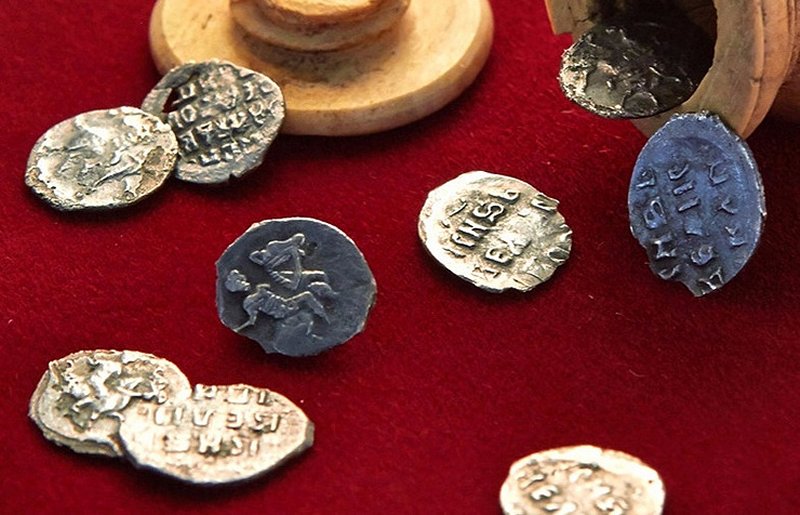
Silver Coins Hidden In Chess Figure Date Back To Ivan The Terrible’s Days – Discovery In Moscow


A collection of silver coins dating back to the days of Ivan the Terrible. was recently unearthed during construction work in downtown Moscow, Russia.
SIlver coins date back to Ivan the Terrible's times. Image credit: TASS
Silver coins date back to Ivan the Terrible's times. Image credit: TASS
Ten silver coins found in an ivory chess bishop, were probably hidden from thieves or robbers according to Alexey Yemelyanov,  head of Moscow’s Cultural Heritage Department.
"Chess was a game played for money at that time. Maybe the person who owned the chess set did not want to carry money in a purse out of fear of being robbed, but wanted to be able to pay in case he lost," Yemelyanov said.
"In another version, Prechistenka [district in downtown Moscow] of that time had a lot of inns where chess was played, and this was the way inn owners stored the money,"said Yemelyanov, adding that "ten hand-minted silver coins were stashed in a bishop made of ivory. The total sum is five kopecks."

This is rather a unique  discovery because  money is found only on rare occasions, and now Moscow museum workers will study the ancient chess pieces in their collections to look for more potential treasures stowed inside them, reports Russian News Agency TASS.
The deputy director general of a company providing archeological survey during construction work, Vladimir Berkovich, said the volunteer who had found the treasure trove was not rewarded for his discovery. "This is not customary among Moscow volunteers," he said. He also declined to reveal the treasure’s value, saying coin collectors must be consulted.
The coins date from the mid-16th century and among them, one was minted in Tver (a city about 174 kilometers northwest of Moscow) and the other nine - in Moscow.
"If each chess piece had the same stowage, the total sum of the stashed coins could amount to 160 kopecks," Yemelyanov noted, adding that no other chess pieces had been found yet.

Note:  There are only 9 coins in the photo, one of which appears to be halfway out of the empty bottom of something - the chess piece?  Who knows!

Sunday, August 11, 2019

Doing A Little Catch-Up:

Hola everyone!

It's a humid day threatening rain here in Milwaukee, but the stormy weather has given me a chance to do some catch-up at my poor, languishing Goddesschess blog.  As you know (or if not, I'm telling you now), I've been a member of the Chess Collectors International or CCI for many years.  I don't remember exactly when I joined, but I believe it may have been in the early to mid 2000's.  I receive the CCI magazines/news letters and the USA branch of the CCI also produces it own magazine that comes to me three times a year.

Recently I wrote about an exciting development - the CCI is going to be holding its biennial meeting in St. Louis, Missouri (USA) once again next year!  The first (to my knowledge) was in 2011, then in 2015, and now again next year in 2020.  Since I received the information, I've been thinking about possibly attending. I have a while before I need to make a decision.  I always like having those "whiles." 

The only CCI meeting I attended was in 2011, also in St. Louis.  It coincided at the time with the Kings v. Queens Tournament (also called "The Battle of the Sexes" Tournament) of American and international players being hosted at the St. Louis Chess Club, just a few blocks away from the hotel I booked a suite at for my friend of nearly 30 years, Georgia, and myself.  The chess club is right across the street from the World Chess Hall of Fame (and museum that features several new special exhibits, as well as shows and creative activities all year round.)  The Gift Shop at the World Chess Hall of Fame is something special - if you have a chance, visit it!

I went back earlier today to blog entries here from 2011 and refreshed my memories of the CCI meeting in 2011.  I did a summary in 2011 and in it I mentioned a few of the people I met as well as a special purchase or two I made at the CCI Auction that always closes out CCI get-togethers.

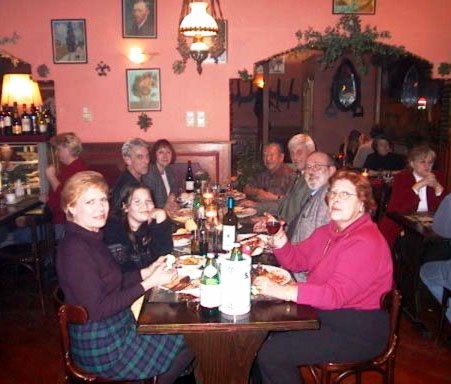
I met Duncan and Ann Pohl - Duncan is the current editor of the CCI-USA Magazine, and a most excellent job he does.  Mr. Pohl was one of the presenters in 2011; he started out a bit nervous, but soon got into the groove of his presentation on "vintage" American chess sets that don't cost an arm and a leg as many of the rare sets (or pieces) do that were crafted in the Old World, merely a couple of fingers or maybe a hand.  Yikes!  Both Duncan Pohl and his wife, Ann, were at a round table shared with  attendees (were there 10 or 12 of us - don't remember) including Georgia and I, at the CCI meeting at a lovely cocktail and dinner party.  I struck it off right away with Ann Pohl - such a lovely lady.  It was a lively group - the conversation hummed!

Mr. Pohl has produced a couple of books on American chess sets that would be of great help to a collector and of interest to any fan of the ancient game of the Goddess who wants to learn about American producers of chess sets, the materials used to make them, the rarity (or not) of such sets today, etc.  Both can be found at Amazon:

Chess Sets of the United States: Ready for Some Chess 'Tenite'? Paperback – May 14, 2014


Vintage Chess Sets of the United States Paperback – November 23, 2016


Later that evening after dinner, Ann Pohl introduced me to Rick Knowlton, who had also given a fascinating presentation at one of the CCI sessions.  We had a long chat about ancient chess and its origins, at least 30 minutes.  Among other things, Mr. Knowlton maintains a website on Ancient Chess (which I am particularly interested in).  He also did a "diary" online of his visit to St. Louis for the 2011 CCI meeting.  How wonderful then, to see that Mr. Knowlton and well-known chess historian Jean-Louis Cazaux produced a book (which you can find a Youtube video on), "A World of Chess:  Its Development and Variations through Centuries and Civilizations."  Also offered at Amazon

I also see that the BBC New program "The Forum" produced an episode by Mr. Knowlton and Mr. Cazaux that aired on April 19, 2019 and is available online in Podcast, "Chess: A Chequered History."

You just never know what these chess collectors and chess historians may get up to! 

2019 Perseid Meteor Showers

Hola darlings!

My birthday is a bit later this month and as I'm getting younger each year I won't bore you with the young age I'll be achieving soon :)

Tomorrow and Tuesday - August 12 and 13 - if you have clear skies check for the Perseid Meteor showers where you may see as many as 50 meteorites streaking across the sky each hour!  You should be able to see them all across the United States.  If you live in an urban area, don't expect to see much before 10 p.m. when the sky is dark enough for you to catch the brightest "falling stars."  Out in the countryside away from bright city lights, about an hour after sunset should give you a front-row seat.

You can read more about this year's Perseids in this article at The Washington Post
Related Posts Plugin for WordPress, Blogger...