Continuation of photographs from the Cathedral of Toledo:
A view of the ceiling in the Refrectory - the priests' private domain. Unfortunately, my photo did not come out very clear, it is blurry. Our guide told us this is the room where they changed into their robes to perform their priestly duties in the Cathedral. I do not recall the name of the artist who painted the ceiling, but I believe he was an Italian master. It is, to put it bluntly, Life in Heaven 101.
A not very clear shot of an El Greco masterpiece in the Refrectory. It depicts Jesus Christ just before his robe is stripped from him in preparation for his crucifixion.
This much clearer photo shows the very top part, the "crown," per se, of the El Greco painting, which is a wonderful work of art in its own right. Check out the vases on either side and following around the corners, too. Wow! This photo also gives you a clearer indication of the room-spanning painting I call "Life in Heaven 101" on the Refrectory's ceiling!
I do not know who this Madonna is, but she was inside the Refrectory, and she was encased in glass, so I figured she was important. She was not shown in our tour. In a Cathedral of this size, we saw several Madonnas. I was not able to get photographs of all of them, unfortunately, as we often passed by so quickly and I did not want to lose the group! If you look very closely in the lower left hand corner, you will see a reflection in the mirrored back of the case enclosing the Madonna. That is Mr. Don!
Here is another gloriously beautiful Madonna, from the 17th century. She is alabaster, marble, and bronze (that is not gold, but it looks like gold). My photo is not the clearest, unfortunately. Damn! The entire construct around her was so massive, there was no way for me to get her into a single photo. I wanted, however, to get that "sunburst" of bronze "rays" in the upper center part of the photo because that is actually a "window" that overlooks a chapel behind the wall. Natural light is provided into the chapel through this window by another "window" that was chiseled out of the Cathedral structure, way way up in the roof! I was not able to get a decent photo of it, but Mr. Don did:
I mean, really! Check this incredible photo out! Light from this 17th century "window" pours into the opening above the Madonna below (see photo, above) into the chapel that is on the other side of the wall. I asked our guide if it provides enough light to see by and she said oh yes, it does. And so look at what the artisans did to "camoflauge" the hole/window! Absolutely breathaking. They sculpted an entire gallery of saints and apostles to make them look like they'd always been there as well as the window! And in the "window well" above, spectacular three-dimensional paintings were added!
The chapel that got this light was not part of our tour but we did walk past a side of it (enclosed partially in glass and wrought-iron fencing) on our way to the main entrance/exit. It is a a nicely-sized area (it seemed to be built on the golden mean proportions) and was very well lit.
On the wall opposite where we walked by, some important religious who-do's coffin is showcased! He, our guide told us, was an advisor to kings and queens during his long life. One of his fans (a queen) put his coffin up on the equivalent of stilts on the side wall of this chapel after he died.
I don't even know in which direction I was facing when I took this photo, but it was the last interior shot I took. Look! An electric light bulb on the left! Wowsers! How did that get there?
Showing posts with label Cathedral of Toledo. Show all posts
Saturday, January 14, 2012
Friday, January 13, 2012
Scenes from Toledo, Spain Part IV
The Cathedral:
Working from memory here. Construction of the cathedral was begun approximately 1250 CE and completed about 240-250 years later, but thereafter, subsequent monarchs of Spain added internal improvements and new "chapels" so construction never really stopped.
I don't know if the pictures can give you the sense of space inside this structure. It's incredible. I could hardly tilt my head back far enough to see the vaulted roofs far overhead. I have no idea how tall they are, they look hundreds of feet up there!
A final word - unfortunately several of my photos turned out blurry even though my camera did not give me a blurred notice and option to delete the image and so I thought I was getting clear images. Damn. I think it must be the lack of light in some instances, we were not allowed to use flash (I totally understand).
The mighty spire on the left of the front facade.
The dome on the right of the front facade.
A close-up of the top area over the big central doorway.
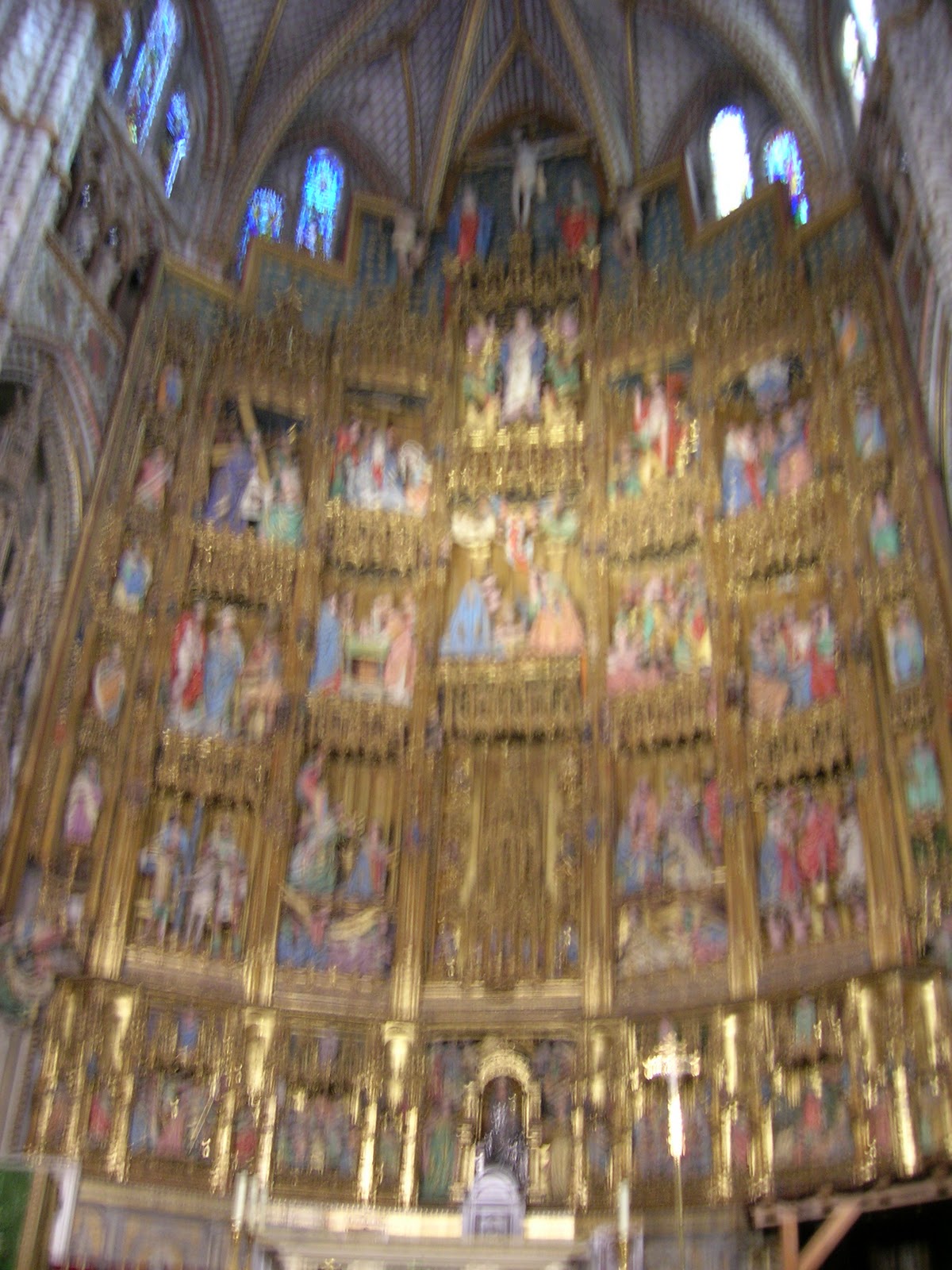
An unfortunately blurred shot of the main altar-piece.
Another blurred photo of the main altar-piece, this one giving a view of the vaulted arches and windows at the top.
A massive eagle backs a large book-rack for a Bible. In this side-chapel, tall-backed elaborately carved wooden chairs surround the pulpit. On the left, above, you can see part of one of the massive pipe organs in the Cathedral. On the opposite wall, another massive pipe organ of a different vintage. I got photos of both, below, but they are not very clear, unfortunately. We saw two more massive pipe organs on our tour but we were whisked by them so quickly, I did not have a chance to get any photos of them.
The White Virgin. She was sculpted in France of alabaster, and dates to the 12th century CE. Evidently this area is called the "Choir" -- see photos directly above -- the two organs, the pulpit, and this photo of the sculpture that appears to be floating in front of the massive and beautiful stained-glass window that you can see in the background of this photo. The name of the White Virgin will show up again in Toledo in a subsequent post. Of important historical note - this Virgin is considered a Black Madonna (Virgin Morena) because of the tone of her skin! She is called the White Virgin because of the color of her robes and for other historical reasons that relate "whiteness" to purity, a being unblemished. And so this Madonna and child was, and is, known by the local population by both names.
You know, I can't make out what this is at all. It looks almost Buddah like to me, at least, in this photo. This is the image that is seen in the background of the photo of the White Virgin, above.
More photos of the interior of the Cathedral in the next post.
Working from memory here. Construction of the cathedral was begun approximately 1250 CE and completed about 240-250 years later, but thereafter, subsequent monarchs of Spain added internal improvements and new "chapels" so construction never really stopped.
I don't know if the pictures can give you the sense of space inside this structure. It's incredible. I could hardly tilt my head back far enough to see the vaulted roofs far overhead. I have no idea how tall they are, they look hundreds of feet up there!
A final word - unfortunately several of my photos turned out blurry even though my camera did not give me a blurred notice and option to delete the image and so I thought I was getting clear images. Damn. I think it must be the lack of light in some instances, we were not allowed to use flash (I totally understand).
We approached the Cathedral from a rear side street, on foot. This is the domed end at the main entrance of the Cathedral; the other side of the main entrance is anchored by a mighty, peaked spire.
A close-up of the main facade.The mighty spire on the left of the front facade.
The dome on the right of the front facade.
A close-up of the top area over the big central doorway.
An unfortunately blurred shot of the main altar-piece.
Another blurred photo of the main altar-piece, this one giving a view of the vaulted arches and windows at the top.
A massive eagle backs a large book-rack for a Bible. In this side-chapel, tall-backed elaborately carved wooden chairs surround the pulpit. On the left, above, you can see part of one of the massive pipe organs in the Cathedral. On the opposite wall, another massive pipe organ of a different vintage. I got photos of both, below, but they are not very clear, unfortunately. We saw two more massive pipe organs on our tour but we were whisked by them so quickly, I did not have a chance to get any photos of them.
The White Virgin. She was sculpted in France of alabaster, and dates to the 12th century CE. Evidently this area is called the "Choir" -- see photos directly above -- the two organs, the pulpit, and this photo of the sculpture that appears to be floating in front of the massive and beautiful stained-glass window that you can see in the background of this photo. The name of the White Virgin will show up again in Toledo in a subsequent post. Of important historical note - this Virgin is considered a Black Madonna (Virgin Morena) because of the tone of her skin! She is called the White Virgin because of the color of her robes and for other historical reasons that relate "whiteness" to purity, a being unblemished. And so this Madonna and child was, and is, known by the local population by both names.
You know, I can't make out what this is at all. It looks almost Buddah like to me, at least, in this photo. This is the image that is seen in the background of the photo of the White Virgin, above.
More photos of the interior of the Cathedral in the next post.
Subscribe to:
Posts (Atom)