Showing posts with label Da Vinci. Show all posts

Friday, February 3, 2012

Da Vinci In The News - I

A second article on another famous Leonardo Da Vinci piece is posted separately.

Oldest Copy of 'Mona Lisa' Painted Alongside Original


This is the Prado's now proven to be copy of da Vinci's Mona Lisa.  I think I like this one a lot more! She looks prettier and younger than the painting we're all used to seeing!

A copy of Leonardo da Vinci's "Mona Lisa" was painted by a pupil or follower of the artist at about the same time as the original was created, and is now considered the oldest known copy of the enigmatic piece of work, scientists announced this week.

The painting was previously held in the Spanish royal collections, before it was sent to Madrid in 1819 when the Museo del Prado there was founded. Researchers studying the artwork think it is the painting referred to in 1666 in an inventory of the palace Alcázar in Seville as a female portrait associated with da Vinci. They suspect the copy may have reached Spain in the early part of the 17th century, according to Miguel Falomir Faus, the Prado's curator of Italian Painting up to 1700.

The painting originally received little notice because its sitter is posed in front of a plain black background, not a landscape as in da Vinci's "Mona Lisa." But as conservators were restoring the painting for its inclusion in a da Vinci exhibition at the Louvre in Paris scheduled to open March 29, they found that the black varnish obscured a copy of da Vinci's dreamy countryside. This Mona Lisa copy sheds light on details of the mysterious woman posing in the painting, including the cloth covering her breast, the semi-transparent veil around her shoulders and the shape of the chair. The copy also shows more clearly the landscape in the background.
Previous research has suggested da Vinci did indeed give Mona Lisa eyebrows, though they have since disappeared. That same study, in which an engineer scanned the original painting with various wavelengths of light, also suggested the great artist first painted fingers on the sitter's left hand in a slightly different position.

to be complete in about three weeks. The discovery was announced at the meeting of the Prado's Royal Board of Trustees.

Da Vinci In The News II

Did Leonardo da Vinci Copy his Famous 'Vitruvian Man'?


Leonardo da Vinci's drawing of a male figure perfectly inscribed in a circle and square, known as the "Vitruvian Man," illustrates what he believed to be a divine connection between the human form and the universe. Beloved for its beauty and symbolic power, it is one of the most famous images in the world. However, new research suggests that the work, which dates to 1490, may be a copy of an earlier drawing by Leonardo's friend.

Another illustration of a divinely proportioned man — the subject is Christ-like, but the setting is strikingly similar to Leonardo's — has been discovered in a forgotten manuscript in Ferrara, Italy. Both drawings are depictions of a passage written 1,500 years earlier by Vitruvius, an ancient Roman architect, in which he describes a man's body fitting perfectly inside a circle (the divine symbol) and inside a square (the earthly symbol). It was a geometric interpretation of the ancient belief that man is a "microcosm": a miniature embodiment of the whole universe. Leonardo and other scholars revived this vainglorious notion during the Italian Renaissance.

After decades of study, Claudio Sgarbi, an Italian architectural historian who discovered the lesser known illustration of the Vitruvian man in 1986, now believes it to be the work of Giacomo Andrea de Ferrara, a Renaissance architect, expert on Vitruvius, and close friend of Leonardo's. What's more, Sgarbi believes Giacomo Andrea probably drew his Vitruvian man first, though the two men are likely to have discussed their mutual efforts. Sgarbi will lay out his arguments in a volume of academic papers to be published this winter, Smithsonian Magazine reports.

The key arguments are as follows: In Leonardo's writings, he mentions "Giacomo Andrea's Vitruvius" — seemingly a direct reference to the illustrated Ferrara manuscript. Secondly, Leonardo had dinner with Giacomo Andrea in July 1490, the year in which both men are thought to have drawn their Vitruvian men. Experts believe Leonardo would have probed Giacomo Andrea's knowledge of Vitruvius when they met. And though both drawings interpret Vitruvius' words similarly, Leonardo's is perfectly executed, while Giacomo Andrea's is full of false starts and revisions, none of which would have been necessary if he had simply copied Leonardo's depiction.

Other scholars find the arguments convincing.

"I find Sgarbi's argument exciting and very seductive, to say the least," said Indra McEwen, an architectural historian at Concordia University who has written extensively about the works of Vitruvius. "But [I] would opt for the view that Giacomo Andrea and Leonardo worked in tandem, rather than Leonardo basing his drawing on Andrea's."

Rather than competitors, the two Renaissance men were colleagues working together to bring a beautiful, ancient idea back to life. "Whose was the 'original' drawing is a non-question as far as I'm concerned. Much as it is a preoccupation of our own time, I don't think it would have been an issue in Leonardo's day," McEwen told Life's Little Mysteries, a sister site to LiveScience.

Patrice Le Floch-Prigent, an anatomist at the University of Versailles in France who has analyzed the anatomical correctness of Leonardo's famous work, noted that, for both drawings, "the source is Vitruvius."

Furthermore, regardless of their chronology, Leonardo's work is an improvement on Giacomo Andrea's, McEwen said: "Leonardo is by far the superior draftsman, with a far superior understanding of anatomy."

Leonardo's is also more faithful to the text, she explained. "Nowhere does Vitruvius say that the man is positioned inside the circle and the square at the same time. A man lying flat on his back, can be circumscribed by a circle if his hands and feet are outstretched," writes Vitruvius. "Similarly, his height is equal to his arm span, 'just as in areas that have been squared with a set square.'" Giacomo Andrea's figure has only one set of arms and legs, which are simultaneously circumscribed by a circle and outlined by a square, while "Leonardo deals with [the two propositions] by having the position of his man's arms and legs change. That, I would have to admit, makes his drawing a closer approximation to the textual description than Giacomo Andrea's," McEwen wrote.

One thing is certain. The better Vitruvian man gained international fame, while the simpler, but possibly more original, one was left to languish in a library for five centuries. That may have to do with the very different fates met by Leonardo and Giacomo Andrea. When the French invaded Milan in 1499, the former fled to safety and went on to achieve eternal renown. The latter stayed in Milan and was hanged, drawn and quartered by the French, and largely forgotten by history — until now.

Sunday, October 16, 2011

Is It a da Vinci - Or Not?

Fascinating!  From Live Science:

'Lost' Da Vinci Portrait, and its Origins, Stir Controversy

Date: 14 October 2011 Time: 11:17 AM ET


Christie's auction house may have sold a priceless piece of art by Leonardo da Vinci for a little more than $21,000, according to researchers who claim to have identified the origins of the hotly debated painting.

The painting appears to have come from a 500-year-old book containing the family history of the Duke of Milan. Art historian Martin Kemp, of the University of Oxford, believes the mystery painting, which appeared in 1998, is a portrait of the duke's daughter, created by da Vinci for her wedding book.

"We knew it came from a book, you have the stitch holes and can see the knife cut. Finding it is a miracle in a way. I was amazed," Kemp told LiveScience. "When doing historical research on 500-year-old objects … you hardly get the circle completed in this way."

In 2010, Kemp first suggested that da Vinci painted the portrait, and since then, art historians have debated over both its origin and the painter. In fact, several art historians contacted by LiveScience said they wouldn't comment on the piece or didn't return emails. An earlier examination of the artwork by a gallery in Vienna led the director there to say it was not a da Vinci, and they are unswayed by the new evidence.

From storage to source

The portrait was sent to Christie's in 1998, with art historians there suggesting the piece came from 19th-century German artists called the Nazarenes, who mimicked the Renaissance style. (This was disproved after carbon dating estimated the portrait's creation between 1440 and 1650.) It was titled "Head of a Young Girl in Profile to the Left in Renaissance Dress."

Kemp wasn't convinced and started looking into the painting's history. He first saw the portrait as an attachment to an email in 2008, and immediately recognized da Vinci's left-handed style. He went to see it in Zurich and his co-author, Pascal Cotte, engineer and founder of art analysis start-up Lumiere Technology, examined it in Paris.

Kemp and Cotte then published "La Bella Principessa: The Story of the New Masterpiece by Leonardo da Vinci," (Hodder Hb, 2010) claiming the work might be a da Vinci, a claim that many respected historians have disagreed with, some vehemently.

The portrait is made on vellum, a specially prepared skin normally used for writing and printing. No work by da Vinci has been found on vellum before, though it was frequently used in books. Researchers believe the portrait came from a book, because three stitch holes are visible on the portrait's left margin. It is also made of chalks and ink, not paint.

A wedding gift

"The chance of identifying the vellum book it came from was pretty small, a needle in the haystack, one would say," Kemp told LiveScience. That was, until American art historian David Wright, of the University of California at Berkeley, suggested that Kemp look at a set of books titled the "Sforziad."

There were at most four copies made, Kemp said. Aside from the copy in the National Library in Warsaw, there is a copy in London and one in Paris. Each book was custom-made and had different art and cover pages; evidence that this portrait had been "ripped" out was only found in the Warsaw book. The image was probably removed during the 18th century when the book was rebound, Kemp said.

Da Vinci was an artist in the duke's residence for several years between 1481 and 1499. He was the only left-handed artist in the court at that time, the researchers said.

Matching page to book

Upon examination, Kemp saw that the stitch holes from the page match up with the stitching on the book, but they aren't the only evidence Kemp puts forward. Because vellum is made from processed skins, each sheet has different qualities. The thickness and composition of this sheet matches up perfectly with the vellum from the book, Kemp said. There are also cut marks on the edge of the book.

"It was apparent from the evidence we got about the vellum and the missing sheets, within reasonable margins of doubt, that's where it comes from," Kemp said. "At 500 years old, you never have as much confirmation as you like, but this is as good as it gets."

Kemp and Cotte have published a short version of their examination of the book and the portrait's cut marks and binding, along with their analysis of the vellum online. The painting has been renamed "La Bella Principessa," though its true origins are still debated.

Still up for debate?

The Albertina art gallery in Vienna decided not to exhibit the drawing, because when examined by their institution, "no one is convinced that it is a Leonardo," art gallery director Klaus Albrecht Schröder told ArtNEWS.

LiveScience asked spokesperson Verena Dahlitz what the gallery thought of the new data; she replied in an email, "We still believe that it is not an authentic drawing by Leonardo." When asked who could have painted it, if it had come from the Sforziad, she said: "We think that the drawing is from the 19th century."

Art blogger Hasan Niyazi, on his blog The Three Pipe Problem, updated his article on the La Bella Principessa controversy in reaction to Kemp's find, writing that, in his opinion, "Critics of the piece must now re-orient their approach — an argument that it is by a Leonardo contemporary may still arise from some. Although any allegation that it is a later piece is less likely to stand up against the body of evidence amassing for this work."

Many of the historians contacted by LiveScience refused to comment on the piece. William Wallace, an art historian at Washington University in St. Louis wouldn't comment on the piece, but said: "I think because few, like me, wish to pronounce on an unlikely attribution, especially without having seen the original," Wallace told LiveScience in an email. "Egos are easily bruised in a small field, and Kemp, after all, is a well-respected scholar."

Kemp will be publishing his findings in an updated edition of his book, "Leonardo" (Oxford University Press, 2011). A grant from National Geographic funded his search for the book, and the network will be producing a documentary on the search for the portrait's true origins to air in early 2012.

Wednesday, June 29, 2011

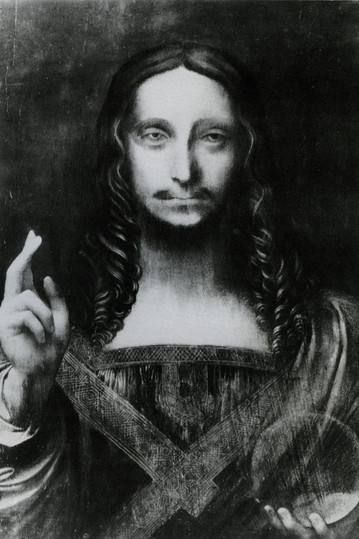
A Lost Leonardo DaVinci Found Again

Okay - is it just me, or does this look like the Mona Lisa with a mustache?  Why is this Christ figure wearing what appears to be a woman's dress???

From The Wall Street Journal Online
Wednesday, June 29, 2011 As of 6:23 AM
By DALYA ALBERGE
A lost masterpiece by Leonardo da Vinci has been discovered in a private American collection and will be unveiled publicly for the first time by the National Gallery in London later this year, according to people close to the institution.
"Salvator Mundi"—a depiction of Christ with his right hand raised in blessing —has been authenticated by experts as the Leonardo painting that disappeared after being owned by Charles I and Charles II of England, according to these people. The last time an important Leonardo was discovered was a century ago.

The National Gallery, which plans a major exhibition on the Renaissance master this fall, declined to comment.

Salvator Mundi—an oil on wood panel measuring 26 inches by 18.5 inches—is a devotional work comparable in size and subject to Leonardo's St. John the Baptist in the Louvre in Paris.

According to a person familiar with the painting's history, restorers began work on Salvator Mundi in the hope that it might be by someone closely associated with Leonardo because of stylistic evidence. Leonardo's hand was confirmed after the removal of layers of discolored varnish and overpaint applied by earlier restoration attempts.

This person said that the idea of finding a lost Leonardo was "not something a rational person would really believe." The composition was known from a 1650s engraving by Wenceslaus Hollar.

The owner's identity could not be learned.

ARTnews magazine, which reported the discovery earlier this week, suggested a figure of $200 million for the value of the painting.

ARTnews reported that the National Gallery's director, Nicholas Penny, invited four Leonardo scholars—including Carmen C. Bambach, curator at the Metropolitan Museum of Art in New York and Martin Kemp, professor emeritus of art history at Oxford University—to the institution's conservation studio. They came away convinced that they had seen an important Leonardo discovery, according to ARTNews.

According to ARTnews, after Charles II's ownership, the Salvator Mundi's whereabouts are unknown until it is recorded in the collection of Sir Francis Cook, a 19th-century British collector, though listed only as "Milanese School (c. 1500)". In 1958, Cook's trustees sold it as by Boltraffio, who worked in Leonardo's studio.

The National Gallery exhibition, which runs from Nov. 9 until Feb. 5, 2012, concentrates on paintings Leonardo produced for Duke Lodovico Sforza in Milan. Loans include "La Belle Ferronière" (Louvre, Paris) and the "Lady with an Ermine" (Czartoryski Museum, Krakow).

Monday, April 14, 2008

Update: De Ludo Scachorum

Prior post. An argument brews about whether da Vinci did the illustrations for this rare work on chess: From The New York Times Historical Stalemate: Chess Book May Have Leonardo Illustrations (or Not) By DYLAN LOEB McCLAIN Published: April 14, 2008 Reported discoveries of lost works by Leonardo da Vinci are almost as common as, well, images of the Mona Lisa. The latest attribution to be proposed involves the design for the illustrations in a chess book from around 1500. The book, “De Ludo Scachorum,” or “The Game of Chess,” is by Luca Pacioli, a Franciscan friar and Renaissance mathematician who was a friend and collaborator of Leonardo. One of the earliest chess books, it contains 114 diagrams of chess problems drawn in red and black. Long thought to be lost or destroyed, it was discovered in 2006 in a 22,000-volume library in northeastern Italy that belonged to Count Guglielmo Coronini, who died in 1990. The nonprofit Coronini Cronberg Foundation, which oversees the library, enlisted Franco Rocco, an Italian architect and sculptor whose work has puzzlelike qualities, to examine the book and its illustrations. After a year of study he determined that Leonardo created the design on which the illustrations are based, possibly by building a chess set. “I reached the conclusion that the diagrams are the invention of Leonardo da Vinci,” he said in a telephone interview. Mr. Rocco said that he based his report on the quality of the drawings and the friendship between Pacioli and Leonardo. The proportions of the illustrations are based on the golden ratio, he said, like many figures in Leonardo’s compositions; he also noted a similarity between the queen and designs for a fountain in Leonardo’s “Atlantic Codex.” His findings have been widely reported in the international press and have stirred some excitement in chess circles. In his chess column in The Times of London, Raymond Keene wrote that the sophistication of the chess puzzles themselves could have come only from “a powerful intelligence” and might also be the work of Leonardo. But Martin Kemp, a prominent Leonardo expert who is an emeritus art history professor at Oxford University, has emphatically dismissed the possibility that Leonardo had any hand in the drawings. “There is not an earthly chance of them being by Leonardo," he said in a telephone interview. He said that there was no resemblance between the drawings and Leonardo’s work. Nor did he find the designs particularly compelling, he said. The relationship between Pacioli and Leonardo is undisputed and has long fascinated art and mathematics scholars. The two met in Milan in 1496, and Leonardo illustrated Pacioli’s 1509 “Divina Proportione,” a treatise on mathematics and proportions that dealt at length with the golden ratio. (Two quantities or shapes are in the golden ratio if the ratio of their sum to the larger quantity is the same as the ratio of the larger quantity to the smaller one; expressed mathematically, the golden ratio is roughly 1.618.) In 1499 the French invaded Milan, and Leonardo and Pacioli fled to Mantua. While there Leonardo drew a portrait of the marchesa of Mantua, Isabella d’Este, who liked chess. “De Ludo Scachorum” was written during this time and dedicated to the marchesa and her husband, Francesco Gonzaga. Asked whether Leonardo might have designed the actual chess puzzles, Mr. Kemp said he doubted that. While Leonardo was interested in geometrical games, Mr. Kemp said, no information in surviving manuscripts suggests that he played chess. “It is not improbable of him being interested in it,” he said, “but whether he had the patience to sit for hours and play, there is some doubt.” As for Mr. Rocco’s investigation, Mr. Kemp called it “a nightmare of nonmethod.” He said the attribution was based on unsubstantiated ideas, which made the theory rickety from a historian’s perspective. “You start with one hypothesis, and you build another hypothesis on top of it and then you build another hypothesis on top of that, and you have this tower of unsupported hypotheses,” Mr. Kemp said. As he wrote in an e-mail message, “The silly season on Leo never closes.”

Friday, June 8, 2007

THE WEAVE A DIALOGUE ON CHESS AND CHESS HIS/HERSTORY, FROM THE ART BELL WEB-SITE. Mark Borcherding - 04:31am Apr 6, 1999 MST (#503 of 505) dare to dream upon your own star Leonardo & Chess, If you take Leonardo's diagram of a person the popular one with arms & legs in positions. The outer arms and legs touch a circle and the inner arms and legs touch a square. If you turn the square unto a chess board then the center four squares of the chessboard (a,b,c,d) (2nd pyramid giza) go from stomach area to right above the knee. The very center of the chessgrid would be directly on penis or vagina. The center of the circle would be around the belly-button "navel" about where E&F meet A&B. "ABCDEFGHIJLK" = 51 + 12 letters + 1 = 64 What happens when we mirror our numbers: 15 + 21 + 1 = 37 37 + 27 = 64 Jan Newton - 10:47am Apr 6, 1999 MST (#504 of 505) Mark, was there a particular reason why you put the letters into the chess grid in the way you did? Mark Borcherding - 01:13pm Apr 6, 1999 MST (#505 of 505) dare to dream upon your own star Ref 504 ... Jan, I placed the letters in that order because that is how they were in the digram in a "Flower of Life" book I just recently got. It did not mention a chess board but I counted the squares in their grid and it was 8x8. Did the order have any significance to you? Notice the pattern forms a Celtic cross or mandala and there are two sets of 8 squares one set top to bottome and the other set left to right and this means the 4 center squares are used twice. This would be where the 2nd pyramid is on the chessboard that Philip pointed out. Vickie Ramirez - 03:26pm Apr 6, 1999 MST (#506 of 517) O Music! In your depths we deposit our hearts and souls. Thou hast taught us to see with our ears, and hear with our hearts. Hi Jan, RE post 498: I am a Gemini. I am curious to see how we balance out, too. Neat info about the other chess history group you have contacted. Synchronistic! Just finished reading both of Katherine Nevils Books; The Eight and The Magic Circle. Just could not put them down. Ilumani Mark Borcherding - 06:08pm Apr 6, 1999 MST (#507 of 517) dare to dream upon your own star Ref 506 Ilumani & Jan "Katherine" = 46 "The Eight" = 46 [mirrored] = 64 = 8x8 "The Magic Circle" = 71 [mirrored] = 17 and 71+17=88 Guess I have a couple more books I need to read :) Jan Newton - 08:30pm Apr 6, 1999 MST (#508 of 517) Mark, until I read Neville, other than learning the fundamentals of the game, that was the only contact I'd had with The Game and its Herstory. I recently re-read "The Eight", and had even more appreciation for the depth of Neville's research than before, when I was a "Chess Ignoramus"! Vickie, thanks for the info. I left the little chart I was making up with our "match-ups" at the office; I will post on it tomorrow, I think. Mark, when I looked at the chess grid/letter post, I got a "funny" feeling about it, but I can't explain what it is or what it means; only that I tried to figure out a different way to put the letters into the grid that makes sense to me, but I haven't been able to do it yet. The letters aren't "comfortable" with where I'm putting them, or something like that. I was doing it at the office to boot, not conducive to "mental" endeavors (this is not a joke!). By the way, what is the story involving a horse and Set and Horus? I don't think I'm familiar with that one. One last thing, this may not mean anything, but then again, you never know. While I was researching the Mittani, the Hurrians, and Urartu, I came across an entry in a encyclopedia about the Hyksos. I vaguely remember learning about them eons ago in high school sophomore Ancient History. According to this entry, the Hyksos, whose origins are apparently yet unknown with any precision but suspected to be "from Palestine and Syria, ... were a Semitic people with a nomadic life style", had a temporary but lasting influence in Egypt in founding the 15th dynasty (1674-1567 BCE). They were later overthrown by a revolution of native Egyptians. The entry goes on to say that the Hyksos "came to have lasting influence on Egyptian military technique, as horse and chariot were introduced". Well, knock me over with a feather. This is a much later date than what was put forth in the 1990 Scientific American article I sited a few posts ago, which set forth the domestication of the horse and use of the horse in wheeled vehicles for agricultural purposes as early as around 4000 BCE!!! I can't imagine that it would have taken over 2000 years before the "jump" was made from using horses for agricultural purposes to using them for warfare purposes. So, somebody is wrong on their dates. However, that's not the primary reason why I mentioned the Hyksos. It's the similarity in the name "Hyksos" and "erkhos" that struck me right off the bat, especially because one of the few things I did remember about the Hyksos was their association with horses and chariots. I wonder if the Hyksos were actually peoples from the region (or descendants of people from the region) that encompasses modern-day Armenia, and not a Semitic people at all? Anyone an historian on ancient peoples out there? Jan Newton - 08:56pm Apr 6, 1999 MST (#509 of 517) Sorry folks, very tired tonight. I misspelled the proto Indo-European word for horse. It should be "ekhos", not "erkhos". Looked up "horse" in the venerable Webster's New Collegiate Dictionary circa 1977, and this is what it says: [ME] hors, fr. OE; akin to OHG hros horse]... and then it goes on to explain what a horse is and different usages of the word. ME means Middle English; OE means Old English, and OGH means Old High German. I found it interesting in light of the 1990 article I'd read. However, I also checked the definition of chess, which referred me to "check", and under check it says: [ME chek, fr. OF eschec, fr. Ar shah, fr. Per. lit., king; akin to Gk ktasthai to acquire]. I found that entry interesting too, because I thought the ancient Greek name for chess was zatrikion, played on a round board, but I could be wrong about that. Philip Mistlberger - 11:41pm Apr 6, 1999 MST (#510 of 517) Mark, re 503, the link between the 2nd pyramid and that part of the grid is interesting as this hits exactly on the location of the kundalini (serpent) base in the Indian yogic system. And, since the 2nd pyramid has been linked to both Isis and the planet Venus, its tie in with the Skakti/kundalini serpent force is natural, as Shakti is a form of Isis/Venus. Thus, the 64 grid plotted on Leonardo's "man" verifies one of the symbolic meanings of the 2nd pyramid. I don't know if this has been mentioned here, but both Georgia and I were born on the same day (both Pisces). A couple of fishes for the chess BBQ. Jan, tell me the truth. You must be hiring someone to do all this research. You seem to have enough material for a trilogy, never mind one book. Mark Borcherding - 06:03am Apr 7, 1999 MST (#511 of 517) dare to dream upon your own star Philip and Georgia that is neat, Pisces the fish. I was reading last night that the symbol for Christ was the Dolphin and was changed to the Fish by the Greek Orthodox Church. On the chess - giza grid: 1 Great Pyramid Earth orbit 3 Balance (Male+Female) 2 2nd Pyramid Venus orbit 2 Female 3 3rd Pyramid Mars orbit 4 Male "earth venus mars" = 58 58 + 1+2+3 = 64 = 8x8 Chess connection Interesting that Venus is called the "Morning Star" and people feel this relates to Christ as well. "Christ" = 32 so if we have a male and female then: "Christ Christ" = 64 "Chess", "Love", "Venus" all equal 18 5 + 18 + 18 + 18 + 5 = 64 Notice we have three 18's one for each pyramid and two 5's one 5 for male and one 5 for female. The 5 symbolizes the pyramid 4 base points + 1 capstone and it also symbolizes the 4 directions (east,north,west,south) and 1 center (balance). Note as well 18 = 9+9 so there is a male and female 9 and look what happens when we add the 5+9 = 14 which refers to 1 center/capstone & 4 directions/base points again. 9 = 4 + 1 + 4 (144) Jan Newton - 10:03am Apr 7, 1999 MST (#512 of 517) Pisces!?! I thought you were both Aquarians!!! Are you sure you're Pisces? I know, you're both cuspers! You realize, of course, that that screws up my entire estoric theory about our "signs". Oh well, back to the drawing board. Philip, I have been obsessed. I have been a researching maniac. I have been everywhere. Wait until I post about the Indus Valley connection I found, it will knock your socks off! Got to run but while I have it right in front of me I wanted to post the following information from Gerhard Josten: The next meeting of the IGK will be held in Hamburg, Germany during November 99. If you want more information and about membership e-mail me and I will give you the particulars. (I don't know if it would be against the rules to post that info here, and I don't want to get into trouble - that's a switch, hey?) Going off to the bookstore to see if I can hunt down a copy of "The White Goddess" by R. Graves, which R. Calvo was kind enough to turn me on to... "The Weave" has an enormous wealth of research from scholars from all over the world. The Weave is a journey guided by the words of many fasinating and intelligent people. This is also a fun journey. The humorous, and often cleaver, play between friends makes it a pleasure to read. Wonder through the labyrinth of The Weave and enjoy. Isis


Related Posts Plugin for WordPress, Blogger...