Prior articles on the subject:
Women in Archaeology: Kathleen Mary Kenyon-Follow up
Women in Archaeology: Eliat Mazar
Here's a special E-feature from Biblical Archaeological Review online, with an informative photo/slide show too:
Did I Find King David’s Palace?
by Eilat Mazar
This lengthy article is worth the read for anyone interest in "biblical" archaeology in that hot-bed of controversy, where so much as rolling over a stone causes an uproar - Jerusalem.
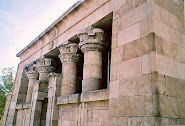
I found three things intriguing as I read - that Kenyon and Mazar excavated in Jerusalem some 40 years apart, that women are still a rarity in the world of archaeology (though no so rare as when Kenyon was doing her field work), and those "aeolic" style columns -- are those porpoise-heads depicted in the capitals? Or are my eyes deceiving me??? Whatever the design was meant to be - or suggest - I find it most evocative. A circular spiral is much in evidence, as is a linear triangular "delta" or "V" in the drawing of the capitals in the article -- was not able to copy it here. Both symbols have long been associated with the goddess - and that spiral - of course it brought to mind the Fibonnaci sequence of numbers that are encoded in all spirals found in nature.
Showing posts with label Eliat Mazar. Show all posts
Showing posts with label Eliat Mazar. Show all posts
Saturday, June 5, 2010


Sunday, October 5, 2008
Women in Archaeology: Eliat Mazar
 Sep 25, 2008 10:18 Updated Sep 25, 2008 10:19
Archeology: Dr. Eilat Mazar: The Bible as blueprint
By ETGAR LEFKOVITS
She has been at the forefront of a series of back-to-back Jerusalem archeological finds, including what she believes is the biblical palace of King David, a discovery which led her to international prominence.
She has also been at the epicenter of a public campaign against Islamic destruction of antiquities on the Temple Mount, and has repeatedly and unflinchingly criticized - and clashed with - the Israel Antiquities Authority for overlooking and turning a blind eye to the past desecration of Judaism's holiest site, which has earned her the reputation of something of a black sheep in the local archeological world.
Meet Dr. Eilat Mazar.
The no-nonsense 51-year-old mother of four, a strongly secular Zionist who comes from a venerated family of archeologists - the most prominent of whom was her grandfather, the pioneering Dr. Benjamin Mazar, who carried out the excavations around the Western Wall area after the 1967 war - has emerged as one of the country's leading archeologists.
Over the last several years, her ongoing dig in the City of David just outside the walls of the Old City has proven to be a treasure trove. In addition to the potential biblical palace - which has been dubbed as the find of the century by some and dismissed by others in the bitterly competitive local archeological community - Mazar has discovered two seal impressions belonging to ministers of King Zedekiah which date back 2,600 years, as well as the remnants of a wall from the time of Nehemiah.
Mazar, who is both revered and reviled by some of her colleagues for being a "biblical archeologist," says that the Bible is unquestionably the most important historical source for her work, since it contains a "genuine historical account of the past."
"I work with the Bible in one hand and the tools of excavation in the other," she says. "The Bible is the most important historical source."
Despite her early experience with archeology as a teenager under her family's tutelage, Mazar didn't decide to become an archeologist until after her army service, when she enrolled in courses at the Hebrew University, where she would eventually earn her Ph.D.
She calls her university years - during which she had her first child - an "immense delight," a time when she and her fellow students would run to any place in the country where an excavation, no matter how modest, was under way.
Balancing a career with family has not been easy. Mazar married right out of the army, had a child and then divorced. Later she found new love, archeologist Yair Shoham, and the couple had three children. Tragically, Shoham died suddenly of a heart attack in 1997 at 44.
Mazar says her family is a critical component of her work. "My family gives me the strength to do what I do," she says. "I see my work as a complete life."
Three decades after the thrill of her university years, the excitement is still palpable within - and radiates from - Mazar as she continually uncovers the past.
"It's nice to touch your history," she concludes.
Sep 25, 2008 10:18 Updated Sep 25, 2008 10:19
Archeology: Dr. Eilat Mazar: The Bible as blueprint
By ETGAR LEFKOVITS
She has been at the forefront of a series of back-to-back Jerusalem archeological finds, including what she believes is the biblical palace of King David, a discovery which led her to international prominence.
She has also been at the epicenter of a public campaign against Islamic destruction of antiquities on the Temple Mount, and has repeatedly and unflinchingly criticized - and clashed with - the Israel Antiquities Authority for overlooking and turning a blind eye to the past desecration of Judaism's holiest site, which has earned her the reputation of something of a black sheep in the local archeological world.
Meet Dr. Eilat Mazar.
The no-nonsense 51-year-old mother of four, a strongly secular Zionist who comes from a venerated family of archeologists - the most prominent of whom was her grandfather, the pioneering Dr. Benjamin Mazar, who carried out the excavations around the Western Wall area after the 1967 war - has emerged as one of the country's leading archeologists.
Over the last several years, her ongoing dig in the City of David just outside the walls of the Old City has proven to be a treasure trove. In addition to the potential biblical palace - which has been dubbed as the find of the century by some and dismissed by others in the bitterly competitive local archeological community - Mazar has discovered two seal impressions belonging to ministers of King Zedekiah which date back 2,600 years, as well as the remnants of a wall from the time of Nehemiah.
Mazar, who is both revered and reviled by some of her colleagues for being a "biblical archeologist," says that the Bible is unquestionably the most important historical source for her work, since it contains a "genuine historical account of the past."
"I work with the Bible in one hand and the tools of excavation in the other," she says. "The Bible is the most important historical source."
Despite her early experience with archeology as a teenager under her family's tutelage, Mazar didn't decide to become an archeologist until after her army service, when she enrolled in courses at the Hebrew University, where she would eventually earn her Ph.D.
She calls her university years - during which she had her first child - an "immense delight," a time when she and her fellow students would run to any place in the country where an excavation, no matter how modest, was under way.
Balancing a career with family has not been easy. Mazar married right out of the army, had a child and then divorced. Later she found new love, archeologist Yair Shoham, and the couple had three children. Tragically, Shoham died suddenly of a heart attack in 1997 at 44.
Mazar says her family is a critical component of her work. "My family gives me the strength to do what I do," she says. "I see my work as a complete life."
Three decades after the thrill of her university years, the excitement is still palpable within - and radiates from - Mazar as she continually uncovers the past.
"It's nice to touch your history," she concludes.
Wednesday, February 6, 2008
Ancient Seal Inscription Re-translated

From israelj.post.com
Feb 4, 2008 20:26 Updated Feb 5, 2008 17:14
Archeologist revises read of ancient seal inscription
By ETGAR LEFKOVITS
A prominent Israeli archeologist said Monday that she has revised her reading of an inscription on an ancient seal uncovered in an archeological excavation in Jerusalem's City of David after various scholars around the world critiqued her original interpretation of the name on the seal.
The 2,500 year-old black stone seal was found last month amid stratified layers of debris in the excavation under way just outside the Old City walls near the Dung Gate, said archeologist Dr. Eilat Mazar, who is leading the dig.
Mazar had originally read the name on the seal as "Temech," and suggested that it belonged to the family of that name mentioned in the Book of Nehemiah.
But after the find was first reported in The Jerusalem Post, various epigraphers around the world said Mazar had erred by reading the inscription on the seal straight on (from right to left) rather than backwards (from left to right), as a result of the fact that a seal creates a mirror image when used to inscribe a piece of clay.
The critics, including the European scholar Peter van der Veen, as well as the epigrapher Ryan Byrne, co-director of the Tel Dan excavations, suggested in Internet blogs that the correct reading of the seal is actually "Shlomit," also a biblical name.
Mazar said Monday that she accepted the reading of "Shlomit" on the ancient seal, and added that she appreciated the scholarly research on the issue.
"We are involved in research, not in proving our own opinions," Mazar said.
She noted that the name Shlomit was known in the period from which the seal dated, and that other contemporary seals had been found that bore names of women who held official status in the administration.
It was not clear whether the name on the seal had any connection to the daughter of Zerubbabel, mentioned in 1 Chronicles 3:19, since the name was apparently common in the period.
The grandson of Judean King Jehoachin, Zerubbabel, led the first band of Jews who returned from the Babylonian captivity, and laid the foundation of the Second Temple in Jerusalem.
"What we can say for sure is that this woman was an important woman in the society," Mazar said.
The seal, which portrays a common and popular cultic scene, was bought in Babylon and dates to 538-445 BCE, Mazar said.
In contrast, Byrne suggested that a date in the late seventh or early sixth century was more probable, noting that scene was typical of the Iron Age Levant and that there was no reason to surmise the seal had been made in Babylon.
The 2.1 X 1.8 cm elliptical seal is engraved with two bearded priests standing on either side of an incense alter with their hands raised in a position of worship.
A crescent moon, the symbol of the chief Babylonian god Sin, appears on the top of the altar, Mazar said.
The fact that this cultic scene relates to a Babylonian god seemed not to have disturbed the Jews that used the seal, she added.
Mazar gained international prominence for her recent excavation that may have uncovered the biblical palace of King David.
The three-year-old east Jerusalem dig is being sponsored by the Shalem Center, a Jerusalem research institute, where Mazar serves as a senior fellow, and the City of David Foundation, which promotes Jewish settlement throughout east Jerusalem.
Subscribe to:
Posts (Atom)