Showing posts with label Hatshepsut. Show all posts

Monday, December 3, 2018

Catching Up: Artifact Depicting Pharaoh Queen Hatshepsut Discovered in UK University in Storage!


By James Rogers, Fox News
March 26, 2018

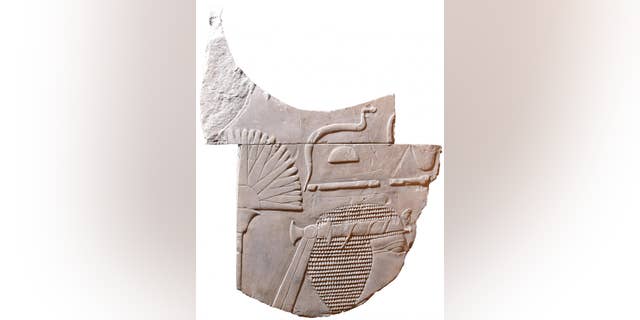
A rare ancient artifact depicting the famous female pharaoh Hatshepsut has surfaced in the U.K., stunning experts. 

The front of the artifact
The front of the artifact (The Egypt Centre, Swansea University)

Consisting of two limestone fragments that have been glued together, the artifact had been in storage for 20 years before it was chosen for an object handling session by students of Swansea University in Wales. While the artwork was being analyzed by the students, Swansea University Egyptology lecturer Dr. Ken Griffin noticed something unusual.

Griffin recognized the artwork’s iconography as being similar to carvings within the temple of Hatshepsut at Deir el-Bahri in Luxor, Egypt. The front of the artifact depicts the head of a figure whose face is missing, with the remains of a fan. A uraeus, or cobra, is depicted on the figure’s forehead and hieroglyphics can also be seen above her head.

The decoration of the fan, the figure’s hair, the uraeus and her headband are all similar to images found at Deir el-Bahri. The hieroglyphs, which use a female pronoun, are also found in text at the temple.

The unusual artifact, which is held in Swansea University’s Egypt Centre, thrilled Griffin and his students.

Hatshepsut, who reigned from about 1478 B.C. to 1458 B.C., is one of only a handful of female pharaohs. “Early in her reign she was represented as a female wearing a long dress, but she gradually took on more masculine traits, including being depicted with a beard,” explained Swansea University, in its statement.

The University obtained the artwork in 1971 with other artifacts that once belonged to the pharmaceutical mogul Sir Henry Wellcome.

The head of a man with a short beard is depicted on the rear of the mysterious fragment. “Initially there was no explanation for this, but it is now clear that the upper fragment had been removed and recarved in more recent times in order to complete the face of the lower fragment,” explained Swansea University, in its statement. “The replacement of the fragment below the figure would also explain the unusual cut of the upper fragment."

The recent work on the fragment’s rear may have been done by an antiques dealer, auctioneer, or previous owner to increase the piece’s value or attractiveness, the University added.

Experts think that the artifact came from Deir el-Bahri but more research is needed to confirm this.

Saturday, March 17, 2012

Bullshit Sensationalized

There is no evidence presented to suggest that this wooden statue is actually Hatshepshut.  Until I read about some good hard evidence, this is just sensationalized bullshit, starting from the title of the article.  Cross-dresser, my ass!

At newscientist.com

Cross-dressing pharaoh found in her feminine form


Saturday, August 20, 2011

Did Pharaoh Hatsepsut's Facial Lotion Contain Poison?

From dailyjournal.net

German researchers: toxic substance in flask belonging to ancient Egypt's Hatshepsut
THE ASSOCIATED PRESS
First Posted: August 19, 2011 - 7:26 am
Last Updated: August 19, 2011 - 8:30 am

BERLIN — A German university said Friday that researchers have discovered a carcinogenic substance in a flask of lotion believed to have belonged to Queen Hatshepsut, who ruled Egypt 3,500 years ago — raising a possibility she may have accidentally poisoned herself.

The University of Bonn said it spent two years researching the dried-out contents of the flask, which is part of its Egyptian Museum's collection and bears an inscription saying it belonged to Hatshepshut.

It said the flask contains what appears to have been a lotion or medicine used to tackle skin disorders such as eczema.

The contents included palm and nutmeg oil, along with fatty acids of the kind that can relieve such disorders. There are known to have been cases of skin diseases in Hatshepsut's family, the university said.

Researchers also found benzopyrene, an aromatic and highly carcinogenic hydrocarbon. "If one imagines that the queen had a chronic skin disease and the ointment gave her short-term relief, then she may have exposed herself to a major risk over the course of a few years," Helmut Wiedenfeld of the university's pharmaceutical institute said in a statement.

Egyptian officials have said that the mummy of Hatshepsut suggests the woman was obese, probably suffered from diabetes, had liver cancer and died in her 50s.

Hatshepsut is believed to have stolen the throne from her young stepson, Thutmose III, who scratched her name from stone records in revenge after her death. [Stolen the throne?  Oh please!That is such a sexist and 1890's take on what we now know is a very complicated subject.]

Her two-decade rule in the 15th century B.C. was the longest among ancient Egyptian queens, at a time of the New Kingdom's "golden age."
********************************************************

So, did Hatsepsut die from liver cancer?  Or did she die from something else? 

Sunday, September 26, 2010

Pharaoh Queen Hatshepsut

Hatshepsut gets nearly as much press as Cleopatra VII!  Glad to see it. This extraordinary female ruler of ancient Egypt, whom history bad-mouthed for so long, deserves her place in the eternal spotlight. 

From Al-Ahram Weekly Online
23 - 29 September 2010
Issue No. 1016

Queen Hatshepsut King of Upper and Lower Egypt
Framed by steep cliffs and poised in elegant relief is the mortuary temple of Deir Al-Bahri, known in ancient times as the "Most Holy of Holies". We now know more than ever before about the plans and ideas of the remarkable woman who built it, says Jill Kamil


Hatshepsut, with royal beard.
I believe this is from the Brooklyn Museum.
 Hatshepsut, as the offspring of the Great Royal Wife Ahmose, was the only lawful heir to the throne of Tuthmosis I [after her two brothers by this wife died]. Custom, however, prevented her as a member of the female sex from succeeding as Pharaoh. So she took the only step open to her: she married her half-brother Tuthmosis II.

"She came to the throne at a crucial time in Egyptian history," said Zbigniew Szafranski, director of the Polish Institute in Cairo at an illustrated talk at the institute last month. "The 18th-Dynasty (1567-1320 BC) emerged from a long-awaited liberation from Hyksos rule; Nubia had become the core of an independent African kingdom; and innovative ideas came from Persia, Palestine, northern Mesopotamia and the Minoan kingdom."

For several years Hatshepsut acted as a typical co- regent, allowing the young Tuthmosis to take precedence in all activities, already there were signs that Hatshepsut was not afraid of flouting tradition. She adopted a new title, "Mistress of the Two Lands", in clear reference to a king's time-honoured title "Lord of the Two Lands"; she commissioned a pair of obelisks to stand in front of the gateway to the Karnak temple complex; and, by the time her obelisks were cut and transported from the quarries at Aswan, she had become a king. She assumed the throne name Makere, "one of many", and she was depicted in relief and statues wearing a royal skirt and ceremonial beard.

The Polish - Egyptian mission has been excavating and restoring the temple of Deir Al-Bahri for 30 years and has recently come upon remarkable evidence on which to hypothesise more about Hatshepsut's life and times. Back in 1969, the team unearthed a small temple built by Tuthmosis III to the south-east of the upper terrace of Hatshepsut's stepped structure, and a year later they found another terrace. Scattered around were hundreds of blocks and fragments of statues from the temple of Hatshepsut, along with plaster casts of blocks from the temple that were taken to the Metropolitan Museum between the years 1911-1931. This enabled enthusiasts to set about reconstructing 26 colossal Osirid statues, many bearing traces of the bright colours with which they were originally painted.

Also discovered -- or should one say excavated from beneath the rubble -- was a temple that Hatshepsut herself appears to have built to the south of the upper terrace. It includes what Szafranski called "a family chapel" dedicated to her parents, their mothers and their grandmothers. "Reading between the lines, this complex subtly reveals a cult of parents," he added.

It was in the seventh year of her reign that Hatshepsut decided to present herself as "King of Upper and Lower Egypt". Indication of this appears in her image, carved in relief, honouring Amun at the entrance to the main sanctuary on the upper terrace, which was first painted pink (the usual skin tone of women), and then over-painted in red, denoting that the god was being honoured by his son. "Her images are beautifully sculpted, even those carved on such high registers on the wall that they could not possibly be seen from the ground. "Evidently she employed the most talented artists in her workshop," Szafranski said.

Indeed, it was her most talented architect, Senmut, who designed the terraced temple for Hatshepsut. "[It] was dramatically different from New Kingdom temples because it was meant to function as a memorial monument, sharing such components as gates, pillars, columns, Osirid statues and sphinxes," Szafranski said. In fact, when approaching the temple from the east one becomes aware that, far from belittling the temple, the stark purity of the cliffs to its rear -- water-worn for thousands of years by hot winds and flash floods forming deep cracks and crevices -- forms a dramatic backcloth.

The structure appears to have been inspired by the adjacent 11th-Dynasty temple built by Hatshepsut's distant predecessor Pharaoh Mentuhotep II (whose temple has also been restored), but it was carried out on a very much larger scale. Senmut adopted the idea of the terrace and added an extra tier, so that the whole temple comprised courts, one above the other, with connecting, inclined planes at the centre. The Polish mission has recently been hard at work on the upper terrace, a festival courtyard and two chambers which were added later -- one in honour of Hathor and devoted to the cult of the queen and her parents, and the other devoted to Anubis. These will soon be open to the public.

"Examining the innovative architecture, especially the large statue of Hatshepsut herself in the form of Osiris in what is known as the Coronation Portico, and also the reliefs on each side of a doorway showing her wearing the White Crown of Upper Egypt (to the left), and the Double Crown (to the right), one gets the impression that Hatshepsut herself influenced the project, and may indeed have personally designed her chapel towards the end of her reign," Szafranski said.

The sanctuary of Hatshepsut has a vaulted ceiling and some of the wall paintings bear a marked resemblance to those to be found in Old Kingdom tombs at Saqqara. Here are such scenes as Hatshepsut in front of an offering table, and registers of offering bearers. One cannot help but feel, along with Szafranski, that a little of Hatshepsut's whim and fancy went into the elaboration of this most magnificent of mortuary temples.

Hatshepsut had two tombs. The first she had dug in the Valley of the Kings, where all members of the royal family were laid to rest in the 18th Dynasty. The second was in Taket Zeid Valley, to the south of Deir Al-Bahri overlooking the royal valley. Hatshepsut's mummy was found in neither. It has been suggested that her body may be one of the couple of "unknown woman" found in the shaft at Deir Al-Bahri, but this is by no means certain.

Deir Al-Bahri is best viewed early in the morning when the sun is low in the sky and the air is cool. Later in the day it tends to be very hot and the reliefs are all but invisible. You'll want to see details of the famous colonnades of the voyage to Punt and the Birth Colonnade in their best light. The former commemorates an expedition ordered by Hatshepsut to the East African/Somali coast to bring back myrrh and frankincense trees to be planted on the terraces of her temple, where, at the centre of a long wall, is a scene of the queen (defaced) offering the fruits of her expedition to Amun: frankincense trees, wild game, cattle, electrum and bows. The Birth Colonnade includes a scene of the ram-headed Khnum shaping Hatshepsut and her ka on a potter's wheel. Among the particularly fine representations is one of the queen mother, Ahmose, full with child and radiating joy as she stands dignified in her pregnancy, being led to the birth room.

© Copyright Al-Ahram Weekly. All rights reserved
**************************************************************************
Check out archaeologist Judith Weingarten's fab blog Zenobia: Empress of the East. 

With her training and field work experience, Judith brings a learned but never stuffy/pedantic point of view to archaeology, with an emphasis on the females that history so often has left behind, buried under eons of dust and muck. She has posted about Hatshepsut, Pharaoh/Queen of Egypt, many times. Here is one of her posts regarding Hatshepsut.
Sunday, August 2, 2009

Is Berlin Museum's Hatshepsut a Forgery?

(Image from Wikipedia Commons, identified as: bust of the pharoah Hatshepsut, taken at the Altes Museum, Berlin (part of the Ägyptisches Museum Berlin collection), taken by Keith Schengili-Roberts in 2006. I think this is the bust referred to in the article, but I wouldn't swear to it on a stack of bibles). Egyptian bust in Berlin museum may be fake July 19 2009 at 04:35PM Berlin - An Egyptian bust acquired at vast expense by a Berlin museum more than two decades ago may be a forgery. The bust in brown granite of female Pharaoh Hatshepsut, who ruled Egypt for 22 years, is one of the draws at the German capital's Egyptian Museum and is only outshone by the limestone bust of exquisite Queen Nefertiti. Scientists at the Technical University of Berlin have discovered the Hatshepsut stone is rich in the minerals magnesite and siderite. No other bust from the Nile region is made of such rock, suggesting that the 16.5cm figure might be a modern fake. Asked for comment, Dieter Wildung, the recently retired director of the museum, said he had not been aware of the scientific study. The museum reportedly paid 1 million marks (R5.9 million) to buy the statue in 1986 from Robin Symes of Britain but Wildung declined to confirm its price."The purchase was long before my time," said Wildung, who became head of the museum in 1989 and retired two weeks ago. He criticised the media for "sneakily" going public with the report without clearance from the museum. Hatshepsut died in 1458 BC.
**************************************************************
Why did they have the piece tested? Did someone on staff suspect it was a forgery? Surprisingly, this time I actually found answers to my questions! Check this post out from Google Groups, by Tom Flynn on July 21, 2009: University denies test on Egyptian bust in Berlin Posted : Mon, 20 Jul 2009 16:23:40 GMT Author : DPA Earth Times: Berlin - A German university denied Monday that it had analysed the bust of Pharaoh Hatshepsut, an Egyptian sculpture at a Berlin museum, or suggested the statue was a forgery. The bust of the female ruler is one of the icons of the Egyptian Museum in the city. It was acquired for 1 million marks (510,000 euros or about 715,000 dollars) two decades ago. A news report Sunday said a test of the stone suggested it might be a fake. But the Technical University of Berlin said it had never studied the bust's authenticity. Scientists had in December 2007 merely studied some tiny flakes of stone found on the statue. "The analysis found these flakes were made of rock rich in the minerals magnesite and siderite. Where these flakes came from has not been established," a statement by the university said. The German news magazine Der Spiegel had asserted such rock was not sculpted in any other known Pharaonic statue and that this implied the figure was fake. Hatshepsut ruled Egypt for 22 years till her death in 1458 BC. Her 16.5-centimetre-high brown granite bust is a key draw at the museum, along with a limestone bust of exquisite Queen Nefertiti. The Berlin museum has been criticized by Cairo officials for refusing to give Nefertiti's bust, regarded as a national treasure, back to Egypt. Link: http://tinyurl.com/n6xxaz

Sunday, May 24, 2009

Hatshepsut: The Uppity Woman

Way to go Judith! No - not chess icon GM Judit Polgar but archaeologist Judith Weingarten, who hosts the fantastic blog Zenobia: Empress of the East. JW's website showed up in Explorator Edition 12.04 for this post on a giant but unfinished obelisk commissioned by the "uppity woman" Pharaoh Hatshepsut. Fantastic photos! Mr. Don and I took these photos of Hatshepsut artifacts while visiting the Met and the Brooklyn Museum: (1) Taken by dondelion at the Met, May 13, 2009 - a collection of Hatshepsut artifacts. (2) Taken by Jan at the Brooklyn Museum, May 17, 2009. Photo (3) below is the identifying tag to the exhibit. Originally the archaeologists hedged on the identity of this sculpture, but recent research has led experts to conclude that it is, indeed, an image of Hatshepsut and not her step-son Thutmose III.

Sunday, April 26, 2009

Queen Hatshepsut and Karnak

Story from UCLA Today. Photo: Digital Karnak architects Willeke Wendrich, from the left, Elaine Sullivan and Diane Favro. April 21, 2009 By Meg Sullivan Team's re-creation of ancient Karnak brings history of pharaohs to life After being crowned one of ancient Egypt’s rare female pharaohs, Queen Hatshepsut renovated a coronation hall lined with statuary depicting her father, her highly regarded predecessor, as a god. In the center of the hall, she installed two 10-story red granite obelisks and a beautiful red quartzite chapel inscribed with images of herself erecting the colossal obelisks. “To us, this may seem egomaniacal,” said UCLA Egyptologist Willeke Wendrich. “But part of the process of legitimating herself in a role rarely held by women was to imprint the space in a way that established her as the great heir to her great father.” Apparently, Hatshepsut was a little too successful: When her nephew, Thutmose III, who was for years co-ruler in her shadow, finally succeeded the 15th century B.C. queen, he removed the upgrades, partially bricked over the obelisks and tore down the chapel. What did Thutmose III have against his aunt, now considered to be one of the most successful pharaohs of all time? Was he merely sexist? Or was he threatened by the possibility that Hatshepsut’s own daughter might try to usurp his throne? [An interesting proposition - because of the importance of matrilineal descent in ancient Egypt, did Thutmose III marry Htsepsut's daughter to solidify his hold on the throne???] While scholars may never know the exact answers to these and other tantalizing mysteries, they are at least able to visualize one of the most important remaining records of this and other ancient Egyptian power struggles, thanks to the latest 3-D computer model from UCLA’s Experiential Technologies Center (ETC) in the Department of Architecture and Urban Design. The result of two years of painstaking research by a team of more than 24 scholars and technicians, Digital Karnak explores how scores of existing ruins may have originally looked and demonstrates how they came to be altered over time as generations of pharaohs put their stamp on the site that served as the religious center for Thebes, the Ancient Egyptian capital during the Golden Age of the Pharaohs. “Ancient Egyptian texts didn’t write about these kinds of rivalries,” said Diane Favro, ETC director and the project’s principal investigator. “So we rely on architectural transformations and depictions on contemporary reliefs to provide invaluable information about Egypt’s rich history.” Through interactive architectural plans and intricate perspective illustrations, Digital Karnak traces the site’s evolution over two millennia, encompassing 63 distinct features of this major religious center located on the Nile’s eastern bank at Thebes, a little more than a mile north of modern Luxor. Accompanied by ETC’s most ambitious web interface to date, Digital Karnak shows the site at any point in time between 1951 B.C. and 31 B.C., allowing users to fast-forward from a single temple occupying a two-acre site to a sprawling complex covering 69 acres with eight temples, 10 small chapels, 10 monumental gateways, 15 obelisks, 100 sphinxes and even a ceremonial lake. “Karnak is one of the most dazzling sites in Egypt nowadays, but if you try to figure out what any one feature originally looked like, you get in trouble because you have all these elements from different periods standing next to each other, many of which were moved or altered over time,” said Favro, a professor of architectural history. “We set out to give people a clear sense of the chronology of site’s development.” That's the goal that Favro and Wendrich, the project’s co-developer, are aiming for especially this month. On April 4, they demonstrated the model at the annual meeting of the Society of Architectural Historians, the field’s leading professional group, in Pasadena. On April 25, they will present it in Dallas, Texas, at the annual meeting of the American Research Center in Egypt, considered the premiere conference for U.S.-based Egyptologists. As one of ancient Egypt’s two chief religious centers, Karnak rose in prominence in the last half of the 3000-year-long empire. Still impressive after all these years, Karnak is one of the most visited sites in Egypt and is best known today for what remains of the Great Hypostyle Hall, a giant room with a painted ceiling supported by 12 massive seven-story and 122 four-story sandstone columns. “Even though I have been to Karnak many times, when walking through the temple, especially very early in the morning before the hordes of tourists come in or when I'm in a quiet corner of the enormous complex, I feel history becoming almost tangible,” said Wendrich, an associate professor of Near Eastern Languages and Cultures. This is the place where Akhenaten, believed to be King Tutankhamun’s father, built a temple to his own religion, thought to be the world’s first monotheistic faith. The Hypostyle Hall was decorated by Ramesses II, the pharaoh often associated with the Biblical Exodus. One of the Karnak gates is engraved with references to another pharaoh whose exploits may also be chronicled in the Bible: Shoshenq I, whose military conquests took him as far as today’s Israel. Hatshepsut’s legacy at Karnak is particularly exciting for art lovers. Holdings of most major museums include statuary and other pieces of art commissioned during her long and successful reign, which was characterized by a flowering of the arts. One of her 10-story obelisks still stands at Karnak. Other obelisks from the reigns of her successors were moved to grace public squares in Rome and Istanbul. Statuary unearthed at Karnak dots today’s Cairo. The ETC is renowned for making sense of such historic landscapes. Under Favro’s direction, the team has digitally reconstructed dozens of important landmarks that either have been lost or altered beyond recognition, including Pompeii’s Villa of the Mysteries and ancient sites in Rome including the Colosseum and Forum. Additional features of Digital Karnak include Quick-Time videos highlighting the processional routes of the major religious ceremonies for which Karnak was designed, such as the Opet Festival, an annual celebration of fertility. The model even helps users visualize how natural meandering caused the River Nile to recede almost a half mile from Karnak, driving the complex’s slow but steady westward expansion. “The model cannot show us Karnak as it really was because we will never know everything about a site that is so ancient,” said Elaine Sullivan, project coordinator and a postdoctoral fellow in Near Eastern Languages and Cultures. “However, it does represent the current state of knowledge of Karnak at this date.” Drafted with the same precision and attention to detail that would be required to generate architectural plans to actually reconstruct the site, Digital Karnak is based on generations of discoveries at the historical site, in particular by French archaeologists. “One of the real problems for American scholars studying the site is that all of the documentation, current research and reconstructions are published in French journals,” said Sullivan. “If an instructor or student can’t read high-level academic French, this information is inaccessible to them.” In contrast, Digital Karnak is written entirely in English, a feature that organizers hope will make it popular with travelers, architecture buffs and American college courses in art history, architectural history and world history. Funded by the National Endowment for the Humanities and the Steinmetz Family of Los Angeles, the model will also serve as an illustration for the UCLA-based Encyclopedia of Egyptology, an online encyclopedia of the field’s latest peer-reviewed research. Because the model is as dynamic as the encyclopedia’s other entries, creators plan to update the model as new discoveries become available. “We hope Egyptologists will use Digital Karnak to test out and advance research in the field,” said Wendrich. “We look forward to making as many changes to our Karnak as the pharaohs did to the actual site.” To see a video clip showing the western entrance to Karnak today, go here. This is how Karnak's western alley of sphinxes would have originally appeared, according to UCLA's Digital Karnak.

Sunday, April 5, 2009

The Scent of a Woman

Public release date: 15-Mar-2009 Contact: Michael Höveler-Müller aegyptisches-museum@uni-bonn.de 49-228-739-710 University of Bonn What scents did the ancient Egyptians use? Researchers in Bonn aim to recreate a 3,500-year-old scent This release is available in German. Pharaoh Hatshepsut was a power-conscious woman who assumed the reins of government in Egypt around the year 1479 B.C. In actual fact, she was only supposed to represent her step-son Thutmose III, who was three years old at the time, until he was old enough to take over. But the interregnum lasted 20 years. "She systematically kept Thutmose out of power", says Michael Höveler-Müller, the curator of Bonn University´s Egyptian Museum. Hatshepsut´s perfume is also presumably a demonstration of her power. "We think it probable that one constituent was incense – the scent of the gods", Michael Höveler-Müller declares. This idea is not so wide of the mark, as it is a known fact that in the course of her regency Haptshepsut undertook an expedition to Punt – the modern Eritrea, and the Egyptians had been importing precious goods such as ebony, ivory, gold, and just this incense, from there since the third millennium B.C. Apparently the expedition brought back whole incense plants, which Hatshepsut then had planted in the vicinity of her funerary temple. World Premier with an interesting Result The filigree flacon now under examination by the researchers in Bonn bears an inscription with the name of the Pharaoh. Hence it was probably once in her possession. The vessel is exceptionally well preserved. "So we considered it might be rewarding to have it screened in the University Clinic´s Radiology Department", Höveler-Müller explains. "As far as I know this has never been done before". This world premier will now in all probability be followed by another one: "The desiccated residues of a fluid can be clearly discerned in the x-ray photographs", the museum´s curator explains. "Our pharmacologists are now going to analyse this sediment". The results could be available in a good year´s time. If they are successful, the scientists in Bonn are even hoping to "reconstruct" the perfume so that, 3,500 years after the death of the woman amongst whose possessions it was found, the scent could then be revitalised. Hatshepsut died in 1457 B.C. Analysis of the mummy ascribed to her showed that the ruler was apparently between 45 and 60 years of age at the end of her life; that she was also overweight, and suffering from diabetes, cancer, osteoporosis and arthritis. Obviously for reasons of security, she was laid to rest in the tomb of her wet nurse. In 1903, over 3,300 years later, the famous Egyptologist Howard Carter stumbled upon the two mummies. However, more than 100 years were to pass before the Pharaoh´s corpse could be identified using DNA and dental analysis in the year 2007. Thutmose III, incidentally, appears not to have shed a single tear for his step-mother, as during his reign he had every image destroyed which showed her as ruler, and which could have belonged to her. ******************************************************************** Ancient Egypt seems to have had a god or goddess for just about everything, and sure enough, there was a god of scent - Nefertem (image, right, from Tour Egypt). To our modern sensibilities this seems a bit unusual, as we usually associate perfumes and colognes with the ladies. However, in many ancient and not so ancient cultures, both sexes wore scent to enhance their attractiveness, and perhaps to also mask much more unpleasant aromas (emanating both from the person and from the environment). In western societies today, men wear "after-shave" - which is just another word for cologne. Who among us has NOT heard of "Old Spice," etc. LOL! In ancient Egypt scent was used not only to enhance one's personal attractiveness, it was also used in a holistic manner to encourage health and emotional well-being. In that sense (pun!), the ancient Egyptians were way ahead of the aromatherapy of today! Nefertem was both an aspect of and, in some mythologies, a grandson of the Great Sun God, Re. He is very ancient, part of the Memphis triad, father: Ptah and mother: Sekhmet (opinions vary), although not well known, perhaps due to the prejudices of 19th century archaeologists who though that "scent" was an unimportant subject (and, as they were mostly men, were perhaps embarrassed that a male god was associated with so "feminine" a subject!) Nefertem is closely associated with the beautiful lotus. Interestingly, the lotus is also important in ancient Indian and Chinese symbolism. Whether this is a case of ancient cross-cultural contact or "simultaneous" (independent) development, I leave our readers to ponder. For further information on Nefertem, please see:
  • From the always excellent Tour Egypt, "Beauty Secrets of Ancient Egypt" by Judith Illes
  • From Encyclopedia Brittanica Online: In ancient Egyptian religion, youthful god associated with the lotus flower. Nefertem was an ancient god, mentioned in the Pyramid Texts (c. 2350 bce), but he became more prominent during the New Kingdom (1539–c. 1075 bce) and later. As a blue lotus he was believed to have emerged from the primeval waters. He also had a warlike aspect and could be depicted as a lion. He was most commonly represented holding a scimitar with a falcon’s head and wearing a headdress of a lotus with a menat (ritual necklace counterpoise) on each side and a pair of plumes above. As the son of Ptah and Sekhmet, he formed part of the Memphite triad.
  • Nefertem, God of Perfume, Water Lily of the Sun...by Caroline Seawright (Seawright does excellent research and has written many articles for Tour Egypt and other ancient-Egypt related websites)
  • From Ntlrworld, an intriguing word and image essay on the "evolution", if you will, of Nefertem. Who among us doesn't love a mystery? Certainly provides material for further research...

Sunday, March 29, 2009

More on the Tomb of Djehuty Discoveries

Judith Weingarten, archaeologist and author, blogs about Hatshepsut's valued Treasurer, Djehuty, and the recent discovery of a tomb beneath Djehuty's tomb. Great reading at a great blog (Zenobia, Empress of the East), check it out. Judith gives the background and historical context to Djehuty's life and times - and presents a mystery. I'm rather snooty (some would say anal) when it comes to blog links. Judith's blog is in my short list of links because her blog is uniformly excellent, interesting and informative. I did a couple of posts on the "tomb beneath the tomb": http://goddesschess.blogspot.com/2009/03/more-on-discovery-of-gold-jewelry-from.html http://goddesschess.blogspot.com/2009/03/gold-jewelry-discovered-in-3500-year.html

Thursday, March 12, 2009

Gold Jewelry Discovered in 3,500 Year Old Egyptian Tomb

Ohmygoddess - almost unbelievable, given the extent of ancient looting that we know took place as the fear of the priests' and priestesses' curses receded in the Egyptian population. Of course, there is Tut's spectacular tomb - discovered more than 80 years ago now. This discovery doesn't approach the splendor and awe of Tut's tomb, but it's awesome in its own right! Dating to the reign of Hatshepsut! Archaeologists Find Ancient Jewelry in Egyptian Tomb By VOA News 10 March 2009 Egypt says archaeologists have found ancient golden jewelry in the tomb of a senior official who died about about 3,500 years ago. Culture and antiquities officials say an excavation team found five golden earrings and two rings in the tomb of the state treasurer who served during the reign of Queen Hatshepsut. The walls of his burial chamber are decorated with texts from the Egyptian Book of the Dead. Archaeologists made the discovery while digging in Luxor, along the banks of the Nile River. Luxor is one of Egypt's most popular tourist sites. It is famous for the Valley of the Kings, which contains several pharaohs' tombs. Earlier this month, Egyptian officials announced that Egyptian and European archaeologists in Luxor had discovered two statues of an ancient pharaoh. Egypt's archaeology chief Zahi Hawass said those statues were of King Amenhotep III, who also ruled about 3,500 years ago. Some information for this report was provided by AFP, AP and Reuters. Why was the name of this treasurer not published???

Saturday, February 21, 2009

New Discoveries at Luxor

Egyptian archaeologists uncover ancient statues in Luxor www.chinaview.cn 2009-02-19 07:25:34 CAIRO, Feb. 18 (Xinhua) -- Egyptian archaeologists on Wednesday uncovered a statue of pharaoh and a bust of the famous woman pharaoh Hatshepsut in the southern city of Luxor, the state MENA news agency reported. The three-meter Amenhotep statue was "dug out with only one damage in the nose and one in the teeth," said Moustafa el-Waziri, director of the archaeological mission, adding that more antiques would be unearthed in the future. Amenhotep III, or Amenophis III, was the ninth pharaoh of the eighteenth dynasty of ancient Egypt. He ruled the country from 1411 B.C. to 1375 B.C. after his father Thutmose IV died. Hatshepsut, or Hatchepsut, generally regarded as one of the most successful pharaohs, was the fifth monarch of the eighteen dynasty which dates back to 15th century B.C. Being a woman, she wore a false beard to reinforce her authority while acting as the regent of her son, Thutmose III.

Sunday, October 26, 2008

Hatshepsut: Pharaoh of Egypt

AUB president sheds light on female pharaoh Daily Star staff Friday, October 24, 2008 BEIRUT: The American University of Beirut's (AUB) new president, Peter Dorman, who is also a professor of archeology and an expert on ancient Egypt, gave a presentation Wednesday about Hatshepsut, the only woman to reign as a male pharaoh over ancient Egypt. Organized by the Society of the Friends of the AUB Museum and held at the AUB Archeological Museum, the illustrated lecture was titled "Gender Trouble in Ancient Egypt: The Case of King/Queen Hatshepsut." It attracted a large audience, including Culture Minister Tammam Salam and his wife. In his talk, Dorman highlighted the uniqueness of the reign of Egyptian Queen Hatshepsut, who assumed the role of male king of ancient Egypt, through her garb and title, as depicted in the hieroglyphs contemporary to her time of rule. Hatshepsut is the fifth pharaoh of the 18th dynasty (1500 BC) of Ancient Egypt and wife of Thutmose II - also Hatshepsut's half-brother - who died a few years after becoming king without a direct heir to the throne. Thutmose III, Hatshepsut's stepson and nephew, was too young to assume kingship at the time. As a result, Hatshepsut claimed power as queen regent, and then usurped it, by claiming to be the legitimate heir, by virtue of being the daughter of a king. Seven years into her rule, she also assumed the role of male king. "Hatshepsut holds a unique place in ancient Egyptian history since she is the only woman to rule in the guise of a male ruler," said Dorman. While surveying the circumstances that led to her becoming queen then assuming legitimacy for rightful heir for kingship, Dorman supported his observations with archaeological evidence - mostly derived from her funerary temple in Dayr al-Bahri on the banks of the Nile - that showed the evolution of her role from queen to king. "Hatshepsut no longer claimed legality for being wife of a deceased king; rather, by being the eldest surviving heir to the throne, and tracing legitimacy to her father in life and death," said Dorman. In conclusion, Dorman noted that Hatshepsut's images were intentionally and meticulously desecrated and destroyed after her death by Thutmose III, and experimented with possible reasons for this fact. "Hatshepsut may have been forgotten, but with research we have been able to recover important aspects of her life," Dorman said. Dorman is an international leader in the study of the ancient Near East, and in particular the field of Egyptology, in which he is a noted historiographer, epigrapher and philologist. He is the author and editor of several major books and many articles on the study of ancient Egypt and is probably best known for his historical work on the reign of Hatshepsut and the Amarna period. His most recent monograph, "Faces in Clay: Technique, Imagery, and Allusion in a Corpus of Ceramic Sculpture from Ancient Egypt" (2002), examines artisanal craftsmanship in light of material culture, iconography, and religious texts. In 2007, he and Betsy M. Bryan of The Johns Hopkins University came out with an edited volume titled "Sacred Space and Sacred Function in Ancient Thebes." Since 2002 Dorman has chaired with great success the distinguished department of Near Eastern languages and civilizations at one of the world's top research universities, the University of Chicago. Prior to that, he spent nine years (1988-1997) heading the epigraphic efforts at Chicago House in Luxor, Egypt. From 1977 to 1988, he worked in curatorial positions in the department of Egyptian art at the Metropolitan Museum in New York. - The Daily Star

Friday, June 29, 2007

The Queen Who Became King

No, this isn't about Judit Polgar, although come to think of it, perhaps there is a slight resemblance... :) Queen/Pharaoh Hatshepsut has been in the news a lot recently, with Supreme Antiquities Director of Egypt Zahi Hawass saying that the Queen's mummy has been positively identified by virtue of a tooth, although DNA testing is also underway. The Smithsonian online magazine featured an extension article about Hatsepsut in September, 2006, and it's fascinating. A lot of things that we were taught about this female Pharaoh were colored through the eyes of 19th century white male historians who were HORRIFIED that this Queen allegedly usurped the throne of the young Thutmose III. And, it turns out, a lot of those things were WRONG! Hmmm, a familiar theme... Here's the link to the Hatsepsut article - it's too lengthy to reproduce here.
Related Posts Plugin for WordPress, Blogger...












