From
The Wall Street Journal
September 26, 2009
By DAVID SZALAY
What a piece of Cold War nostalgia! Fused together by their similar names, through four marathon matches over four years, they were like Siamese twins. Karpov and Kasparov. Kasparov and Karpov. So for a schoolboy of the 1980s, to see their names paired again in Spain—where they played their final world championship match in 1987—was a Proustian experience.

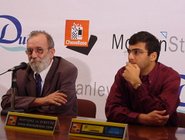
The match they played this past week to mark the 25th anniversary of their first world-title bout was the highlight of a chess conference in the city of Valencia. The two Russians played 12 games of speed chess over three days. And just as he did in the '80s, Garry Kasparov emerged victorious, winning 9-3.
Before the match he told the Spanish newspaper El País that the quality of the chess was unlikely to equal that of the five month, 48-game struggle of 25 years ago. "In this case," he said, "nostalgia will be a positive thing, and the duel will serve to put a spotlight on chess again." Some things never change, though—both players grumbled about the lighting in the hall.
Chess in the second half of the 20th century was overwhelmingly a Soviet phenomenon. But the Soviet Union is gone, Spain far more prosperous, and players' fees denominated in euros. As for the players, Anatoly Karpov is scarcely recognizable—the ax-faced and hungry master of 25 years ago is now a well-fed elder statesman. He's still an active pro, if in steep decline. (He worked hard for this one, though, spending weeks training with a team of grandmasters and a supercomputer.)
Mr. Kasparov hasn't played professionally for years, devoting himself instead to Russian politics. To prepare for this match he spent time with the Norwegian wunderkind Magnus Carlsen—the next great champion of the game, Mr. Kasparov says. (It will be at least two years before Mr. Carlsen gets his chance to prove that.) With the Soviet monopoly ended, chess has largely shed its political import.
Chess never mattered that much in the past. In 1809 Vienna Napoleon lost to the "Turk"—ostensibly an early chess-playing machine but in fact a man in a box, operating levers to move the painted effigy's wooden hands. The emperor swept the pieces from the board and shouted "Bagatelle!"—a trifle. Only in exile on St. Helena did he take chess seriously.
In 1920, a more accomplished amateur—Lenin—founded the Soviet Chess School, overruling those of his party who thought the game a luxurious and aristocratic pastime, and started the Soviet obsession with chess. Nikolai Krylenko, who headed the Soviet chess program, may have been odious—he's otherwise best known for his part in Stalin's show trials—but he was spectacularly successful in putting the Soviet Union at the forefront of world chess. For 4½ decades after World War II, with only one short interruption, the world champion was a citizen of the Soviet Union.
Mikhail Botvinnik was the first champion, in 1948, and to a large extent he established the nature of the modern game. Gone was the swashbuckling improvisation of the 19th century, when men like Adolf Anderssen and Paul Morphy took their opponents apart with dashing tactical flair applauded as the summit of the art. Then, the game was primarily seen as an art, the flower of effortless individual genius. Now we would say the style of Messrs. Anderssen and Morphy lacked strategic depth.
Mr. Botvinnik, the patron saint of this view, perfected chess as science, as tireless study and endless preparation, as an exercise in strategic patience. His openings were designed not to spring tactical surprises that could be used only once, but to lead to complex positions that he'd understand better and more deeply than his opponent. He was the first world-class player to be produced by Mr. Krylenko's school, and he nurtured the men who would maintain the Soviet stranglehold on the game for decades to come—including Mr. Kasparov, of whom Mr. Botvinnik said, "The future of chess lies in the hands of this young man." On the other hand, he said of Mr. Karpov, "This boy doesn't have a clue about chess." (Mr. Botvinnik himself admitted his judgment was sometimes flawed.)
In the postwar period, only one man managed briefly to wrest the title from Soviet hands. Bobby Fischer grew up in New York's borough of Brooklyn. Unlike the Soviet Union, the U.S. had no state-run chess program with priority almost equal to the space program. It didn't give chess-players the status of Olympic gold medalists. But with Mr. Fischer the U.S. managed to produce probably the single most talented player of the era, if not of all time.
The country might have hoped for someone less odd and objectionable. Mr. Fischer was an anti-Semite who years later was to describe 9/11 as "a good thing." Chess, it was said, was his first language. He was a grandmaster at age 15. When Mr. Fischer took on Boris Spassky in the 1972 World Championship match in Reykjavik, Iceland, he became the first non-Soviet challenger in a quarter of a century.
Messrs. Spassky and Fischer were reluctant, unlikely Cold Warriors. In later years they both rejected their unlooked-for roles as champions of their systems. After decades of exile, Mr. Fischer died back in Reykjavik in 2008, an Icelandic citizen and a fugitive from American justice. Mr. Spassky has lived quietly in France since the mid-'70s.
But for a few months in the summer of 1972, the two rivals and their game took on a strange geopolitical aura. Even Henry Kissinger pleaded with Mr. Fischer—who at the last minute seemed reluctant to fly to Iceland—to show the Commies what he was made of.
Things got off to a shaky start for Mr. Fischer. The sort of blunder a half-decent club player would never make cost him the first game. And he didn't even show up for the second. He was erratic, petulant, unpredictable, on a monumental scale. It drove poor Mr. Spassky up the wall.
But suddenly Mr. Fischer started playing things he had never played before, such as Alekhine's Defense, and playing them with devastating sharpness and insight. He improvised and made a mockery of Mr. Spassky's meticulous preparation. When Mr. Fischer won the sixth game—surprising his opponent by opening with d4, the queen pawn—Mr. Spassky stood and joined in the applause.
There was more Cold War skulduggery, too. The Russians accused the Americans of using electronic devices to meddle with their man's brain. The Americans counter-accused. The Icelandic police took the place apart and, in the lighting fixtures, found only two dead flies.
True to form, Mr. Fischer refused in 1975 to defend his title. Young Mr. Karpov took it by default and held it easily for another all-Soviet decade, until Mr. Kasparov challenged him. The Soviet Union was starting to feel the forces that would pull it apart—forces that young, abrasive Mr. Kasparov seemed to embody, as he faced the establishment's man. (Still, Mr. Kasparov was a member of the Communist Party.)

The match turned into a war of attrition, producing 40 drawn games before it was stopped like a boxing match for the well-being of the fighters. The score then was 5-3 to Mr. Karpov. For the next three years they slugged it out, Mr. Kasparov winning each time by small and diminishing margins. In 1987, their fourth and final match, they tied at 12-12. (They met several times again, for example at a speed-chess match in Germany in 1999, playing to a draw.)
Today, the top contenders are no longer predominantly Russian. While Norway's Mr. Carlsen waits for his shot at the championship, reigning champion Viswanathan Anand of India and the Bulgarian Veselin Topalov, currently No. 1 in the world rankings, will face off for the title next year.
Meanwhile, chess has largely faded from the world's front pages. One exception: the matches between Mr. Kasparov and a series of computers built by International Business Machines. In 1997 the computer Deep Blue for the first time won a match against the incumbent world champion.
It was purely a matter of processing speed. The computer only wants to win because we tell it to want to win. If we tell it to lose, it will—and just as happily. What's so fascinating about chess is the way that it combines two human characteristics that seem so far apart—our infinite capacity for abstraction and imagination on the one hand, and our equally infinite competitiveness on the other.
It's this competitiveness which gives meaning to chess; this is probably why it's so appealing as a proxy for political conflict. And this I think is why, as they waited for the first game to start in Spain last week, Garry Kasparov and Anatoly Karpov seemed—though little was now truly at stake—to slip back into their younger, fiercer, hungrier selves.
—David Szalay is the author of two novels: "London and the South-East" and, most recently, "The Innocent," which is set in the USSR in 1972 and includes an account of the great Fischer-Spassky match of that year from a Soviet perspective.
 The match they played this past week to mark the 25th anniversary of their first world-title bout was the highlight of a chess conference in the city of Valencia. The two Russians played 12 games of speed chess over three days. And just as he did in the '80s, Garry Kasparov emerged victorious, winning 9-3.
Before the match he told the Spanish newspaper El País that the quality of the chess was unlikely to equal that of the five month, 48-game struggle of 25 years ago. "In this case," he said, "nostalgia will be a positive thing, and the duel will serve to put a spotlight on chess again." Some things never change, though—both players grumbled about the lighting in the hall.
Chess in the second half of the 20th century was overwhelmingly a Soviet phenomenon. But the Soviet Union is gone, Spain far more prosperous, and players' fees denominated in euros. As for the players, Anatoly Karpov is scarcely recognizable—the ax-faced and hungry master of 25 years ago is now a well-fed elder statesman. He's still an active pro, if in steep decline. (He worked hard for this one, though, spending weeks training with a team of grandmasters and a supercomputer.)
Mr. Kasparov hasn't played professionally for years, devoting himself instead to Russian politics. To prepare for this match he spent time with the Norwegian wunderkind Magnus Carlsen—the next great champion of the game, Mr. Kasparov says. (It will be at least two years before Mr. Carlsen gets his chance to prove that.) With the Soviet monopoly ended, chess has largely shed its political import.
Chess never mattered that much in the past. In 1809 Vienna Napoleon lost to the "Turk"—ostensibly an early chess-playing machine but in fact a man in a box, operating levers to move the painted effigy's wooden hands. The emperor swept the pieces from the board and shouted "Bagatelle!"—a trifle. Only in exile on St. Helena did he take chess seriously.
In 1920, a more accomplished amateur—Lenin—founded the Soviet Chess School, overruling those of his party who thought the game a luxurious and aristocratic pastime, and started the Soviet obsession with chess. Nikolai Krylenko, who headed the Soviet chess program, may have been odious—he's otherwise best known for his part in Stalin's show trials—but he was spectacularly successful in putting the Soviet Union at the forefront of world chess. For 4½ decades after World War II, with only one short interruption, the world champion was a citizen of the Soviet Union.
Mikhail Botvinnik was the first champion, in 1948, and to a large extent he established the nature of the modern game. Gone was the swashbuckling improvisation of the 19th century, when men like Adolf Anderssen and Paul Morphy took their opponents apart with dashing tactical flair applauded as the summit of the art. Then, the game was primarily seen as an art, the flower of effortless individual genius. Now we would say the style of Messrs. Anderssen and Morphy lacked strategic depth.
Mr. Botvinnik, the patron saint of this view, perfected chess as science, as tireless study and endless preparation, as an exercise in strategic patience. His openings were designed not to spring tactical surprises that could be used only once, but to lead to complex positions that he'd understand better and more deeply than his opponent. He was the first world-class player to be produced by Mr. Krylenko's school, and he nurtured the men who would maintain the Soviet stranglehold on the game for decades to come—including Mr. Kasparov, of whom Mr. Botvinnik said, "The future of chess lies in the hands of this young man." On the other hand, he said of Mr. Karpov, "This boy doesn't have a clue about chess." (Mr. Botvinnik himself admitted his judgment was sometimes flawed.)
In the postwar period, only one man managed briefly to wrest the title from Soviet hands. Bobby Fischer grew up in New York's borough of Brooklyn. Unlike the Soviet Union, the U.S. had no state-run chess program with priority almost equal to the space program. It didn't give chess-players the status of Olympic gold medalists. But with Mr. Fischer the U.S. managed to produce probably the single most talented player of the era, if not of all time.
The country might have hoped for someone less odd and objectionable. Mr. Fischer was an anti-Semite who years later was to describe 9/11 as "a good thing." Chess, it was said, was his first language. He was a grandmaster at age 15. When Mr. Fischer took on Boris Spassky in the 1972 World Championship match in Reykjavik, Iceland, he became the first non-Soviet challenger in a quarter of a century.
Messrs. Spassky and Fischer were reluctant, unlikely Cold Warriors. In later years they both rejected their unlooked-for roles as champions of their systems. After decades of exile, Mr. Fischer died back in Reykjavik in 2008, an Icelandic citizen and a fugitive from American justice. Mr. Spassky has lived quietly in France since the mid-'70s.
But for a few months in the summer of 1972, the two rivals and their game took on a strange geopolitical aura. Even Henry Kissinger pleaded with Mr. Fischer—who at the last minute seemed reluctant to fly to Iceland—to show the Commies what he was made of.
Things got off to a shaky start for Mr. Fischer. The sort of blunder a half-decent club player would never make cost him the first game. And he didn't even show up for the second. He was erratic, petulant, unpredictable, on a monumental scale. It drove poor Mr. Spassky up the wall.
But suddenly Mr. Fischer started playing things he had never played before, such as Alekhine's Defense, and playing them with devastating sharpness and insight. He improvised and made a mockery of Mr. Spassky's meticulous preparation. When Mr. Fischer won the sixth game—surprising his opponent by opening with d4, the queen pawn—Mr. Spassky stood and joined in the applause.
There was more Cold War skulduggery, too. The Russians accused the Americans of using electronic devices to meddle with their man's brain. The Americans counter-accused. The Icelandic police took the place apart and, in the lighting fixtures, found only two dead flies.
True to form, Mr. Fischer refused in 1975 to defend his title. Young Mr. Karpov took it by default and held it easily for another all-Soviet decade, until Mr. Kasparov challenged him. The Soviet Union was starting to feel the forces that would pull it apart—forces that young, abrasive Mr. Kasparov seemed to embody, as he faced the establishment's man. (Still, Mr. Kasparov was a member of the Communist Party.)
 The match turned into a war of attrition, producing 40 drawn games before it was stopped like a boxing match for the well-being of the fighters. The score then was 5-3 to Mr. Karpov. For the next three years they slugged it out, Mr. Kasparov winning each time by small and diminishing margins. In 1987, their fourth and final match, they tied at 12-12. (They met several times again, for example at a speed-chess match in Germany in 1999, playing to a draw.)
Today, the top contenders are no longer predominantly Russian. While Norway's Mr. Carlsen waits for his shot at the championship, reigning champion Viswanathan Anand of India and the Bulgarian Veselin Topalov, currently No. 1 in the world rankings, will face off for the title next year.
Meanwhile, chess has largely faded from the world's front pages. One exception: the matches between Mr. Kasparov and a series of computers built by International Business Machines. In 1997 the computer Deep Blue for the first time won a match against the incumbent world champion.
It was purely a matter of processing speed. The computer only wants to win because we tell it to want to win. If we tell it to lose, it will—and just as happily. What's so fascinating about chess is the way that it combines two human characteristics that seem so far apart—our infinite capacity for abstraction and imagination on the one hand, and our equally infinite competitiveness on the other.
It's this competitiveness which gives meaning to chess; this is probably why it's so appealing as a proxy for political conflict. And this I think is why, as they waited for the first game to start in Spain last week, Garry Kasparov and Anatoly Karpov seemed—though little was now truly at stake—to slip back into their younger, fiercer, hungrier selves.
—David Szalay is the author of two novels: "London and the South-East" and, most recently, "The Innocent," which is set in the USSR in 1972 and includes an account of the great Fischer-Spassky match of that year from a Soviet perspective.