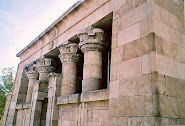
Unfortunately, the totally disfunctional Islamic government now in charge of the "new" Egypt doesn't know it's ass from a hole in the ground when it comes to diplomacy. Tsk tsk! Yeah, nothing like fundy politicians going on television saying they're go to war with Ethiopia if E goes ANY further with its construction of a massive damn across a portion of the Blue Nile. Surely Cheops is rolling in his grave (WHEREVER IT IS) right now...
Well, we ain't seen nothing yet. As the world continues to suffer through more drastic climate changes thanks to the shift in the Jet Stream and the melting of the Polar Ice Caps, to name just a few well-documented changes that didn't just "creep" up upon us over thousands or even hundreds of years but are happening right here and now, within the average person's lifetime, Ha! If I live to be 100, as I'd planned previously (I'll wait and see how things are going...) perhaps Mars won't look so forbidding to mankind after all... Meanwhile, I am sure to be entertained by the antics of the idiots in Cairo.
From Yahoo News
'No Nile, no Egypt', Cairo warns over Ethiopia dam

By Shadia Nasralla | Reuters – 1 hour 26 minutes ago
By Shadia Nasralla
CAIRO (Reuters) - Egypt's foreign minister, vowing not to give up "a single drop of water from the Nile", said on Sunday he would go to Addis Ababa to discuss a giant dam that Ethiopia has begun building in defiance of Cairo's objections. [Right, dude. Way to start negotiations from the get-go -- we won't give us a SINGLE DROP OF WATER.]Speaking to Egypt's state news agency MENA two days after the Ethiopian government flatly rejected a request [? request? More like a threat of war if construction was not halted] from Cairo to halt the project, Mohamed Kamel Amr said Egyptians view any obstacle to the river's flow as a threat to national survival.
"No Nile - no Egypt," he said, highlighting the pressure on the Egyptian government, whose popularity is wilting in the face of economic troubles, to prevent the hydro power plant cutting already stretched water supplies for its 84 million people. [How about reinstituting the birth control programs that were very popular under the former regime, you dildo heads?]
Last week, Ethiopia summoned the Egyptian ambassador after politicians in Cairo were shown on television suggesting military action or supporting Ethiopian rebels - a mark of the threat felt in Cairo from the plan to dam the Blue Nile, the tributary that supplies the bulk of water downstream in Egypt.
"Egypt won't give up on a single drop of water from the Nile or any part of what arrives into Egypt from this water in terms of quantity and quality," Amr told MENA, noting that Egypt has little rain and is effectively desert without its great river.
Speaking at a news conference, he declined to detail the action Egypt might take next but noted Ethiopian assurances that Africa's biggest hydro station would not cut water supplies.
"We have a plan for action, which will start soon," Amr said. "We'll talk to Ethiopia and we'll see what comes of it. Ethiopia has said it will not harm Egypt, not even by a liter of water. We are looking at ... this being implemented."
Countries that share the Nile have long argued over the use of its waters, repeatedly raising fears that the disputes could eventually boil over into war. Egypt, struggling with a shortage of cash and bitter internal political divisions following a 2011 revolution, called on Ethiopia to stop work after engineers began diverting the course of the Blue Nile late last month.
In Addis Ababa, a government spokesman called that request a "non-starter" and dismissed threats from Cairo of "sabotage" and "destabilization", saying attempts by Egypt under its previous military rulers to undermine Ethiopian leaders had failed.
The possible downstream effects of the $4.7-billion Grand Renaissance Dam, some 40 km (25 miles) from Ethiopia's border with Sudan, have been disputed and full details are unclear.
While letting water through such dams - of which Egypt, Sudan and Ethiopia already have several - may not reduce its flow greatly, the filling of the reservoir behind any new dam means cutting the river's flow for a time. Evaporation from reservoirs can also permanently reduce water flowing downstream.
Now 21 percent complete, the new dam on the Blue Nile will eventually have capacity of 6,000 megawatts and is central to Ethiopia's plans to become Africa's leading exporter of power.
Sudan, which borders Egypt and Ethiopia and also gets much of its water from the Nile, said it supported the project. [Okay, so where was the Egyptian government when this dam project was on the drawing board, and before construction even began? Were there no consultations, no negotiations going on before hand -- I don't believe that for a second!]
"The Grand Renaissance Dam brings many benefits and blessings for us," Information Minister Ahmed Belal Osman told reporters in Khartoum.
He gave no details, but Sudanese officials have said the dam will enable Ethiopia to export power to Sudan, a country with frequent outages and one of its closest allies in Africa.
(Editing by Alastair Macdonald, Tom Pfeiffer and Kevin Liffey)
*************************************************************
P.S. Did I forget to mention that the Islamist government in Cairo probably wouldn't hesitate to start a war it cannot possibly win, if only to rally the populace behind it -- you know, life and death of our country and all that jazz. An obvious ploy to try and distract the populace from the increasingly deteriorating conditions going on around them around them. Hmmm, no bread, no problem. Hmmm, no free-spending average-Joe AMERICAN and ENGLISH tourists, no problem. Waiting in lines to fill up with adulterated gasoline, no problem. No garbage pick-up, no problem. No clean wate rto drink, no problem. No water to grow our crops -- whoa, now that's a problem... Hey yeah, Abdul, our government frigging sucks and can't see the pyramids for the mounds of garbage being piled up all around them in the desert, but they want us to go to war over our water rights. Okay, let's go, dude. Geez, where is the Hind of Hinds when we need her...