From Reuters.com
DNA bolsters Bulgaria's John the Baptist bones claim
LONDON |
LONDON (Reuters) - Bulgaria's claim to have unearthed six bones belonging to John the Baptist has received a boost from scientists who have concluded after dating them and analyzing their genetic code that they could indeed be relics of the man who baptized Jesus.
The remains, which include a molar and a piece of cranium, were found in July 2010 in a marble sarcophagus in the ruins of a medieval church on the island of Sveti Ivan, or Saint John, off Bulgaria's Black Sea coast near the resort of Sozopol. They are on display in a church in Sozopol where thousands of worshippers have flocked to view them, untroubled by questions about their authenticity.
"When I first heard this story in 2010 I thought it was a bit of a joke, to be honest," said Tom Higham of the University of Oxford's Radiocarbon Accelerator Unit, one of the world's top laboratories for carbon dating of archaeological material.
Higham's team dated a knuckle-bone to the first century AD, when John the Baptist would have lived, while geneticist colleagues from the University of Copenhagen established the full DNA code of three of the bones.
The genetic analysis showed that the bones were from the same person, a man who most probably came from the Middle East. Higham, who is an atheist, said that it was obviously impossible to say with any certainty that the remains belonged to John the Baptist. But it could not be ruled out.
"I'm much less skeptical than I was at the beginning. I think there's possibly more to it. But I'd like to find out more," he told Reuters on Friday.
12 HANDS AND SIX HEADS
Relics of saints or fragments of the True Cross on which Jesus was crucified, according to Christian tradition, have been a powerful draw for pilgrims and tourists for centuries. Thousands of such relics can be found in churches across Europe.
But skeptics have always dismissed these items as a scam to lure the credulous, and some joke that if all the bones said to have belonged to John the Baptist were authentic the Biblical figure would have had 12 hands and six heads.
Higham plans to apply for funding to analyze purported John the Baptist relics from other places to see if any of them came from the same individual whose remains were found on Sveti Ivan.
"I look at this as a bit of fun. I'm not a hard core ecclesiastical researcher. I actually study Neanderthals and stuff like that, older stuff," said Higham. "But I'm really interested in applying radio carbon dating more widely to find out information about the past."
John the Baptist, who is revered in Christianity and Islam, announced the coming of Jesus and baptized him in the River Jordan. The Gospels say King Herod had him beheaded.
Oxford archaeologist Georges Kazan, who wrote his doctoral thesis on the movement of relics in the 5th and 6th centuries, said that there was historical evidence to support the claim that the Sveti Ivan remains could be authentic. The evidence includes a small box made from volcanic tuff, or consolidated ash, which was found next to the bones and is inscribed with John's name and his feast day in Ancient Greek.
The tuff came from Cappadocia, in modern Turkey, which was one of the routes used to take purported relics from the Holy Land to Constantinople, now Istanbul, where in the 5th and 6th centuries Eastern Roman Emperors were keen to acquire them.
The emperors, who were copied by pious aristocrats, wanted relics for devotional purposes or to be buried with them.
"They were often bestowed as a sign of favor. The monastery of Sveti Ivan may well have received a portion of relics as a gift from a patron, a member of Constantinople's elite," said Kazan, adding that the island was an easy distance from the Byzantine capital on a major Black Sea trading route.
(Additional reporting by Tsvetelia Tsolova in Sofia; Editing by Jon Hemming)
Showing posts with label St. John the Baptist relics. Show all posts
Sunday, June 17, 2012
Friday, June 24, 2011
St. John's (Yes - THE St. John the Baptist) Remains To Be Buried In Sozopol
Oooookaaaaayyyyyyy. How anyone knows these bones belong to St. John the Baptist is beyond me, but he's a big thing over in Bulgaria, evidently, and an equally big thing in Canada, where St. John Baptiste Day is soon to be celebrated - a national holiday in a secular country for a Roman Catholic saint. Oooooookaaaaayyyyyyy. Anyway, John Baptiste was a very popular French Canadian name - I have dozens of male ancestors and relatives named John Baptiste so-and-so (mostly Sequins, Villeneuves and Forciers). Hmmmm, do you think it is possible that I could be descended - nah...
Remains of John the Baptist to be put in Sozopol's church
Wed, Jun 22 2011 10:19 CET
by The Sofia Echo staff
The historian and director of the National History Museum Bozhidar Dimitrov said that the complete renovation of SS Cyril and Methodius church in Sozopol had been completed on schedule and the remains of the saint will be put on display there on June 24 2011 because it is St. John the Baptist Day.
The Island St. Ivan is one the largest of five Bulgarian islands in the Black Sea.
In August 2010 archaeologists found an exquisite reliquary – a relic urn – built in the altar of an ancient church bearing the name of St. John the Baptist.
The urn, which was opened on August 1 2010, contained small bones from the arm and leg of the saint, archaeologists told Bulgarian media.
I understand that John the baptist had over 7,000 bones in his body as against 206 for the usual person. He would also appear to have had 12 arms and about 38 fingers. Not surprised that he came to the attention of the Judean King. Now if the[y] had found one of his many heads....... Kudos to jonm267, who made this comment on Wed, Jun 22 2011 23:24 CET. LOL!
I've posted many items about this purported discovery of - at least some of - the remains of St. John the Baptist:
Thursday, August 5, 2010
John the Baptist Relics in Bulgaria, Blah Blah Blah
Monday, August 9, 2010
Bulgarian Diaspora Minister Contracts Foot in Mouth Disease
Monday, August 9, 2010
What Do the Norwegians Get Out of This???
Friday, August 13, 2010
Bulgaria and St. John the Baptist: The Latest --
Remains of John the Baptist to be put in Sozopol's church
Wed, Jun 22 2011 10:19 CET
by The Sofia Echo staff
The historian and director of the National History Museum Bozhidar Dimitrov said that the complete renovation of SS Cyril and Methodius church in Sozopol had been completed on schedule and the remains of the saint will be put on display there on June 24 2011 because it is St. John the Baptist Day.
The Island St. Ivan is one the largest of five Bulgarian islands in the Black Sea.
In August 2010 archaeologists found an exquisite reliquary – a relic urn – built in the altar of an ancient church bearing the name of St. John the Baptist.
The urn, which was opened on August 1 2010, contained small bones from the arm and leg of the saint, archaeologists told Bulgarian media.
****************************************************************
I would say this comment on the article left by someone (not me), just about sums it up:I understand that John the baptist had over 7,000 bones in his body as against 206 for the usual person. He would also appear to have had 12 arms and about 38 fingers. Not surprised that he came to the attention of the Judean King. Now if the[y] had found one of his many heads....... Kudos to jonm267, who made this comment on Wed, Jun 22 2011 23:24 CET. LOL!
I've posted many items about this purported discovery of - at least some of - the remains of St. John the Baptist:
Thursday, August 5, 2010
John the Baptist Relics in Bulgaria, Blah Blah Blah
Monday, August 9, 2010
Bulgarian Diaspora Minister Contracts Foot in Mouth Disease
Monday, August 9, 2010
What Do the Norwegians Get Out of This???
Friday, August 13, 2010
Bulgaria and St. John the Baptist: The Latest --
Friday, August 13, 2010
Bulgaria and St. John the Baptist: The Latest --
Die Presse: Bulgarian Minister Spoils Archaeology Discovery
Archaeology | August 12, 2010, Thursday
This is hilarious - a follow-up on the battle between the Bulgarian Diaspora Minister and certain archaeologists. The article of Die Presse argues that there is not sufficient evidence yet about the origin of the relics pointing out that Dimitrov’s claims are essentially based on an inscription that contains the name “John” and his “archaeology of the soul of the medieval person” which the historian believes is sufficient to declare that there were no fake relics placed in church buildings in the Middle Ages.
No fake relics were placed in church buildings in the Middle Ages - ha ha ha! Ohmygoddess!
From the ridiculous to the ridiculously sublime:
Bulgarian Diaspora Minister Said to Profit from Obscure Book Deals
Society
August 12, 2010, Thursday
The Bulgarian paper 168 Chasa Weekly reports in its Friday issue that in the last few years the controversial minister and famous historian got contracts with the municipalities in Southeast Bulgaria for books that he authored and that were published by a firm called Akshaena 2007, of which 1/3 is owned by his daughter Maria Dimitrova.
The weekly paper has entitled its article using a word play of Dimitrov’s name and his recent notorious statements after the discovery of the alleged relics of St. John the Baptist in Sozopol, in which he called the Bulgarians and the Bulgarian archaeologists “fucking people.” A rough translation into English of the title of the 168 Chasa article is “Fuckidar Fuckerov”.
Oh my Goddess!
But now, thanks to The Wall Street Journal, the true reason for all of the silly macho-man demonstrations (did you know that "macho" actually has it roots in the words for "stupid goat?" True!) Of course, darlings, it comes down to money money money - MONEY!
AUGUST 13, 2010
Bulgaria Looks to John the Baptist to Resurrect Flagging Economy
Archeological Find Promises Fame, Tourists; Questions Remain Over Relics' Authenticity
By JOE PARKINSON
SOZOPOL, Bulgaria—Archaeologists and clerics here say they have unearthed bones belonging to John the Baptist, an itinerant preacher revered by many Christians as the last of the Old Testament prophets.
Bulgaria's government is looking to the discovery for salvation—of a financial sort.
The remains, including a skull fragment and a tooth, were uncovered last month during the excavation of a fourth-century monastery on St. Ivan Island, off Bulgaria's Black Sea coast. They were in a sealed reliquary buried next to a tiny urn inscribed with St. John's name and his birth date.
Officials of this recession-scarred country think the purported relics will give a big boost to tourism, drawing believers from neighboring Orthodox Christian countries to this nearby resort town,
Tens of millions of dollars have already been earmarked to prepare for an anticipated surge in visitors. Construction crews are enlarging the port and building a big new parking lot. Tour guides are being rewritten and new signs are going up to direct people to the relics.
"I'm not religious but these relics are in the premier league," says Simeon Djankov, Bulgaria's finance minister and an avowed atheist. "The revenue potential for Bulgaria is clear."
Bulgaria's Orthodox church hierarchy has declared that the bones are authentic. "This is a holy find. It doesn't matter about the science," says Metropolitan Bishop Joanikii of Sliven, who oversees church affairs in Sozopol. "The holy relics of St. John radiate miraculous force. I cannot explain it by using words."
Kazimir Popkonstantinov, the archaeologist responsible for the finding in Sozopol and now hailed as a national hero, insists his discovery is in the same league as the Shroud of Turin. "This kind of discovery happens perhaps once every two hundred years," he says. "We have very strong proof that this is genuine. I know this is very important for the whole Christian world."
Some experts, however, are skeptical about the origin of the bones—as well as their earnings potential. Michael Hesemann, a religious historian who helps the Vatican date relics, says the bone fragments "appear to be authentic." But he thinks they lack the "box-office draw" of better-known religious attractions such as the Shroud, which believers say is Christ's burial cloth.
For its part, the Roman Catholic church says the matter requires more study. The Vatican's Pontifical Commission of Sacred Archaeology said tests to gauge the age of the bones and other factors would have to be weighed before it could judge their provenance.
News of the find, meanwhile, is already drawing visitors. At the local church of St. George, where the presumed relics are now on temporary display in a silver chest donated by Bulgaria's prime minister, hundreds of faithful line up for a chance to view the bones, mouthing prayers and making the sign of the cross.
The church says attendance at daily mass has jumped from about 100 to more than 3,000. Church officials say they are selling more votive candles in a day now than they used to sell in a year, and have just ordered another two tons of them to meet projected demand.
Bulgaria, the European Union's poorest nation, could use an economic miracle. The country's gross domestic product shrank 5% last year and contracted another 3.6% in the first three months of this year. Manufacturing has languished, and unemployment has climbed.
To help pull Bulgaria out of its worst recession since the collapse of communism here 20 years ago, the government is looking to promote tourism. Touting the relics is part of that plan. Mr. Djankov, the finance minister, says he wants to double government spending on the development of religious tourism so "we can make this history profitable."
Religious pilgrimages are big business globally, according to the World Tourism Organization, which estimates that up to 330 million faithful visit the world's key religious sites every year. Lourdes, the French town where worshippers believe the Virgin Mary appeared in 1858, draws about 5 million visitors annually.
The bones, though, make Bulgaria a member of a not-so-exclusive club of nations that say they are home to pieces of John the Baptist, who was beheaded on the orders of King Herod. Ancient tradition has held that his severed head was entombed in Herod's Jerusalem palace.
Over time, body parts believed to be St. John's have spread across Europe, the Middle East and South Asia. A church in Calcutta, India, claims to house part of a saintly hand.
The cathedral in Aachen, Germany, says it has the cloth used to wrap St. John's head after his decapitation. The Topkapi Palace in Istanbul, former seat of the Ottoman emperors, also claims to hold parts of one of St. John's arms and his head.
The presence of the relics of St. John hasn't translated into a tourist bonanza in any of these other resting places. Still, authorities in Bulgaria remain optimistic.
Orthodox Christians hold John the Baptist, who according to some accounts baptized Jesus, in especially high esteem. Services every Tuesday are dedicated to his memory in Orthodox churches.
There are some encouraging signs. Milenna Dimitrova, who has been selling fresh berries, figs and jams for 20 years from a stall here, says business has been so brisk that she doesn't have time to go to church. "The season was awful before—this is clearly a gift from God," she says.
Still, the hotel business in Sozopol continues to languish. Stanimir Stoyanov, a veteran hotelier who now runs the Hotel Duma, says occupancy is down by about a third since last year. "The government are telling us the town will become the next Jerusalem," he says. "We just hope that they're right."
Archaeology | August 12, 2010, Thursday
This is hilarious - a follow-up on the battle between the Bulgarian Diaspora Minister and certain archaeologists. The article of Die Presse argues that there is not sufficient evidence yet about the origin of the relics pointing out that Dimitrov’s claims are essentially based on an inscription that contains the name “John” and his “archaeology of the soul of the medieval person” which the historian believes is sufficient to declare that there were no fake relics placed in church buildings in the Middle Ages.
No fake relics were placed in church buildings in the Middle Ages - ha ha ha! Ohmygoddess!
From the ridiculous to the ridiculously sublime:
Bulgarian Diaspora Minister Said to Profit from Obscure Book Deals
Society
August 12, 2010, Thursday
The Bulgarian paper 168 Chasa Weekly reports in its Friday issue that in the last few years the controversial minister and famous historian got contracts with the municipalities in Southeast Bulgaria for books that he authored and that were published by a firm called Akshaena 2007, of which 1/3 is owned by his daughter Maria Dimitrova.
The weekly paper has entitled its article using a word play of Dimitrov’s name and his recent notorious statements after the discovery of the alleged relics of St. John the Baptist in Sozopol, in which he called the Bulgarians and the Bulgarian archaeologists “fucking people.” A rough translation into English of the title of the 168 Chasa article is “Fuckidar Fuckerov”.
Oh my Goddess!
But now, thanks to The Wall Street Journal, the true reason for all of the silly macho-man demonstrations (did you know that "macho" actually has it roots in the words for "stupid goat?" True!) Of course, darlings, it comes down to money money money - MONEY!
AUGUST 13, 2010
Bulgaria Looks to John the Baptist to Resurrect Flagging Economy
Archeological Find Promises Fame, Tourists; Questions Remain Over Relics' Authenticity
By JOE PARKINSON
SOZOPOL, Bulgaria—Archaeologists and clerics here say they have unearthed bones belonging to John the Baptist, an itinerant preacher revered by many Christians as the last of the Old Testament prophets.
Bulgaria's government is looking to the discovery for salvation—of a financial sort.
The remains, including a skull fragment and a tooth, were uncovered last month during the excavation of a fourth-century monastery on St. Ivan Island, off Bulgaria's Black Sea coast. They were in a sealed reliquary buried next to a tiny urn inscribed with St. John's name and his birth date.
Officials of this recession-scarred country think the purported relics will give a big boost to tourism, drawing believers from neighboring Orthodox Christian countries to this nearby resort town,
Tens of millions of dollars have already been earmarked to prepare for an anticipated surge in visitors. Construction crews are enlarging the port and building a big new parking lot. Tour guides are being rewritten and new signs are going up to direct people to the relics.
"I'm not religious but these relics are in the premier league," says Simeon Djankov, Bulgaria's finance minister and an avowed atheist. "The revenue potential for Bulgaria is clear."
Bulgaria's Orthodox church hierarchy has declared that the bones are authentic. "This is a holy find. It doesn't matter about the science," says Metropolitan Bishop Joanikii of Sliven, who oversees church affairs in Sozopol. "The holy relics of St. John radiate miraculous force. I cannot explain it by using words."
Kazimir Popkonstantinov, the archaeologist responsible for the finding in Sozopol and now hailed as a national hero, insists his discovery is in the same league as the Shroud of Turin. "This kind of discovery happens perhaps once every two hundred years," he says. "We have very strong proof that this is genuine. I know this is very important for the whole Christian world."
Some experts, however, are skeptical about the origin of the bones—as well as their earnings potential. Michael Hesemann, a religious historian who helps the Vatican date relics, says the bone fragments "appear to be authentic." But he thinks they lack the "box-office draw" of better-known religious attractions such as the Shroud, which believers say is Christ's burial cloth.
For its part, the Roman Catholic church says the matter requires more study. The Vatican's Pontifical Commission of Sacred Archaeology said tests to gauge the age of the bones and other factors would have to be weighed before it could judge their provenance.
News of the find, meanwhile, is already drawing visitors. At the local church of St. George, where the presumed relics are now on temporary display in a silver chest donated by Bulgaria's prime minister, hundreds of faithful line up for a chance to view the bones, mouthing prayers and making the sign of the cross.
The church says attendance at daily mass has jumped from about 100 to more than 3,000. Church officials say they are selling more votive candles in a day now than they used to sell in a year, and have just ordered another two tons of them to meet projected demand.
Bulgaria, the European Union's poorest nation, could use an economic miracle. The country's gross domestic product shrank 5% last year and contracted another 3.6% in the first three months of this year. Manufacturing has languished, and unemployment has climbed.
To help pull Bulgaria out of its worst recession since the collapse of communism here 20 years ago, the government is looking to promote tourism. Touting the relics is part of that plan. Mr. Djankov, the finance minister, says he wants to double government spending on the development of religious tourism so "we can make this history profitable."
Religious pilgrimages are big business globally, according to the World Tourism Organization, which estimates that up to 330 million faithful visit the world's key religious sites every year. Lourdes, the French town where worshippers believe the Virgin Mary appeared in 1858, draws about 5 million visitors annually.
The bones, though, make Bulgaria a member of a not-so-exclusive club of nations that say they are home to pieces of John the Baptist, who was beheaded on the orders of King Herod. Ancient tradition has held that his severed head was entombed in Herod's Jerusalem palace.
Over time, body parts believed to be St. John's have spread across Europe, the Middle East and South Asia. A church in Calcutta, India, claims to house part of a saintly hand.
The cathedral in Aachen, Germany, says it has the cloth used to wrap St. John's head after his decapitation. The Topkapi Palace in Istanbul, former seat of the Ottoman emperors, also claims to hold parts of one of St. John's arms and his head.
The presence of the relics of St. John hasn't translated into a tourist bonanza in any of these other resting places. Still, authorities in Bulgaria remain optimistic.
Orthodox Christians hold John the Baptist, who according to some accounts baptized Jesus, in especially high esteem. Services every Tuesday are dedicated to his memory in Orthodox churches.
There are some encouraging signs. Milenna Dimitrova, who has been selling fresh berries, figs and jams for 20 years from a stall here, says business has been so brisk that she doesn't have time to go to church. "The season was awful before—this is clearly a gift from God," she says.
Still, the hotel business in Sozopol continues to languish. Stanimir Stoyanov, a veteran hotelier who now runs the Hotel Duma, says occupancy is down by about a third since last year. "The government are telling us the town will become the next Jerusalem," he says. "We just hope that they're right."
Monday, August 9, 2010
What Do the Norwegians Get Out of This???
An interesting development in the story on the alleged "St. John the Baptist" relics and St. Ivan Island story out of Bulgaria (see post below for details):
Archaeology: Excavation and restoration of St Ivan island near Sozopol financed by Norway
Mon, Aug 09 2010 12:09 CET by The Sofia Echo staff
Excavation works and renovation of the monastery complex on St Ivan Island, off the coast of Sozopol in southern Bulgarian, have been financed by the Norwegian embassy in Sofia, an embassy media statement announced on August 9 2010.
The embassy has provided 580 000 leva, covering 90 per cent of the cost for the excavation and restoration of the monastery grounds, encompassing a total of 62 projects in all, the report said.
According to the Norwegian embassy announcement, there will be a second phase of financing, covering the period until 2014, worth about 126.6 million euro, which the Scandinavian country will provide to Bulgaria for a number of different projects such as preservation of cultural heritage, green energy, improvement or energy efficiency, scientific research, education and others.
At the end of July, excavations on Saint Ivan island, part of the Norwegian-sponsored project, unearthed an exquisite marble reliquary incorporated into the church’s altar, the historian Bozhidar Dimitrov, director of the National History Museum and minister without portfolio in charge of Bulgarians abroad, told Focus news agency on July 28 2010.
He suggested that the reliquary might hold the relics of John the Baptist.
St Ivan Island is the largest of five Bulgarian islands in the Black Sea, with an area of 0.66 square kilometres just off the Bulgarian Black Sea coast near Sozopol, a town rich in history and a popular tourist destination, and is separated by a strait several hundred metres long from the small neighbouring St. Peter Island. It is 920m from the Stolets peninsula, Sozopol's Old Town.
Once the island was converted to Christianity, a monastical complex was built between the 5th-6th century on top of the ruins of the old Roman temple, including the Basilica of the Mother of God. Around the 7th-9th century, the basilica was abandoned only to be reconstructed in the 10th century.
The Monastery of John the Forerunner and the Baptist grew into an important centre of Christianity in the region. Archaeological research was carried out after 1985 for two years, which revealed a royal residence, a library, part of the fortified wall with the gate and several monastic cells.
It became apparent in his statements in the articles cited in the post below that Diaspora Minister Dimitrov fervently desires to turn St. Ivan Island and Sozopol into "pilgrimage" stops for devout Christians (despite the naked women visiting the relics), featuring the allegedc relics of St. John the Baptist as well as the ruins of several early churches - a sort of Christian Mecca. That is a fine and worthy goal for a cultural minister, seeking tourist development for his country.
What I want to know is what the heck do the Norwegians get out of funding this multi-year and very expensive archaeological endeavor?
Call me paranoid. Call me suspicious. Call me suspiciously paranoid. I can't help but wonder if this has something to do with a possible future anticipated world champion chess match between World Chess #1 Norwegian Magnus Carlsen and World Chess #2 Bulgarian Veselin Topalov. Oh my oh my, what machinations are going on behind the scenes, heh? Is Silvio Danailov related to Minister Dimitrov by any chance? Hey, just wondering.
You may be right, I may be crazy, but then it just may be a lunatic you're looking for - so sayeth Billy Joel...
Archaeology: Excavation and restoration of St Ivan island near Sozopol financed by Norway
Mon, Aug 09 2010 12:09 CET by The Sofia Echo staff
Excavation works and renovation of the monastery complex on St Ivan Island, off the coast of Sozopol in southern Bulgarian, have been financed by the Norwegian embassy in Sofia, an embassy media statement announced on August 9 2010.
The embassy has provided 580 000 leva, covering 90 per cent of the cost for the excavation and restoration of the monastery grounds, encompassing a total of 62 projects in all, the report said.
According to the Norwegian embassy announcement, there will be a second phase of financing, covering the period until 2014, worth about 126.6 million euro, which the Scandinavian country will provide to Bulgaria for a number of different projects such as preservation of cultural heritage, green energy, improvement or energy efficiency, scientific research, education and others.
At the end of July, excavations on Saint Ivan island, part of the Norwegian-sponsored project, unearthed an exquisite marble reliquary incorporated into the church’s altar, the historian Bozhidar Dimitrov, director of the National History Museum and minister without portfolio in charge of Bulgarians abroad, told Focus news agency on July 28 2010.
He suggested that the reliquary might hold the relics of John the Baptist.
St Ivan Island is the largest of five Bulgarian islands in the Black Sea, with an area of 0.66 square kilometres just off the Bulgarian Black Sea coast near Sozopol, a town rich in history and a popular tourist destination, and is separated by a strait several hundred metres long from the small neighbouring St. Peter Island. It is 920m from the Stolets peninsula, Sozopol's Old Town.
Once the island was converted to Christianity, a monastical complex was built between the 5th-6th century on top of the ruins of the old Roman temple, including the Basilica of the Mother of God. Around the 7th-9th century, the basilica was abandoned only to be reconstructed in the 10th century.
The Monastery of John the Forerunner and the Baptist grew into an important centre of Christianity in the region. Archaeological research was carried out after 1985 for two years, which revealed a royal residence, a library, part of the fortified wall with the gate and several monastic cells.
***************************************************************
![]() |
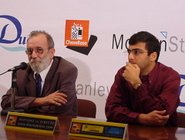
| Veselin Topalov used to have hair! |
What I want to know is what the heck do the Norwegians get out of funding this multi-year and very expensive archaeological endeavor?
![]() |
| Look! Magnus Carlsen is not in diapers anymore! |
You may be right, I may be crazy, but then it just may be a lunatic you're looking for - so sayeth Billy Joel...
Bulgarian Diaspora Minister Contracts Foot in Mouth Disease
Never say the Bulgarians don't know how to have some fun during summer holiday! This is absolutely hilarious - enjoy!
The first bru-ha-ha started with the announcement of the discovery of supposed relics of St. John the Baptist The alleged relics are very few: bone fragments of a human skull, hand and tooth.
Shortly after the announcement of the discovery appeared, some Bulgarian archaeologists (along with archaeologists from other countries) expressed reservations about what they considered (1) a premature and (2) sensationalized announcement of the alleged discovery. For instance, the bones have not been scientifically dated and there is no way to ascertain to whom they would have belonged in any event, even if it is ultimately determined that the bones are of the correct age and the reliquy is actually from the 5th century CE -- so what? John the Baptist was killed in the first third of the 1st century CE and his alleged relics are claimed to rest in many churches. Not mentioned at all is under what conditions the reliquy was opened, which may become critically important later on.
It was then that Bulgarian Disaspora Minister Bozhidar Dimitrov, an allegedly "renowned historian," cut loose, lambasting those who had criticized both the manner of the announcement and the announcement itself without further study:
Diaspora Minister and renowned historian Bozhidar Dimitrov...has expressed absolute certainty in the fact that the relics found on the St. Ivan Island belonged to St. John the Baptist. He has pointed to an inscription on the marble sarcophagus holding the relics as the greatest evidence for their origin.
“The other archaeologists are shaken by wild envy of their colleague, Professor Kazimir Popkonstantinov. He is a rarely lucky man. It is very seldom that one would find an inscription, and in archaeology the inscription is considered the most authentic proof,” stated Dimitrov, who is a former Director of the Bulgarian National History Museum and a native of Sozopol.
The inscription in question found on the reliquary states that “some time in the 5th century a man named Toma transferred the holy relics exactly on the birthday of St. John the Forerunner.”
More insults were hurled and comments exchanged on August 6, 2010:
Bulgarian Minister Exchanges Insults with Top Archaeologist over St. John the Baptist Relics
Archaeology | August 6, 2010, Friday
“Why, damn it, why, where is all this envy coming from?! This is what I cannot find an explanation with this fucking people, with these fucking colleagues,” the Diaspora Minister and a former Director of the Bulgarian National History Museum, said when expressing his indignation that some of the Bulgarian archaeologists had declared the triumph over the relics of St. John the Baptist premature.
“Please don’t interpret literally the words of a 65-year-old nationalist who has proven himself to the Bulgarian people. I did not say “fucking people, fucking colleagues”. The second part of this sentence makes it clear that I had in mind a group of people calling themselves archaeologists. You can see from the context of the conversation that this does not refer to the entire Bulgarian people and its qualities. I am condemning several archaeologists, who had made anonymous statements in the press, and who did not express doubt but, rather, envy and hate for their colleague. I was just defending out colleague Popkonstantinov,” Minister Dimitrov told Darik Radio Friday.
He further identified Prof. Nikolay Ovcharov as the main critic from among those “anonymous archaeologists”. This has resulted from a comment by Ovcharov published Friday in the 24 Chasa Daily.
“I am starting a discussion. Today Ovcharov came out with his name, and started quarreling with me. The “fuckers” are no longer anonymous. We are now going to be fighting personally, with our names,” Dimitrov said.
Then came:
Outraged Bulgarian Archaeologists Strike Back at Minister
Archaeology | August 9, 2010, Monday
The Bulgarian Archaeologists’ Association has expressed its deep distress and resentment over the recent “offensive” and “cynical” statements made by Diaspora Minister Bozhidar Dimitrov after the finding of alleged relics of St. John the Baptist.
This has been made clear in an open letter sent by the Archaeologists’ Association to Bulgarian Prime Minister Boyko Borisov in which they scold Minister Dimitrov for describing the Bulgarians and the archaeologists as “fucking people”.
Minister Dimitrov evidently believes in the honored age-old game known as tit-for-tat, except in the Bulgarian some players use the "f" word a lot on the record:
Bulgarian Archaeology Scandal Grows as Minister Declines to Apologize
Archaeology | August 9, 2010, Monday
“I have no intention of apologizing to anyone,” the Diaspora Minister told bTV on Monday explaining once again that the Bulgarian word for “fucking” or “damned” that he used did not actually have a pejorative connotation. [Really? LOL!]
“I cannot issue an apology to anonymous people. The apologies must be personal. Do you understand. I need to be able to apologize to that man, and that man, and that man. None of them has shown up with specific arguments, and they aren’t able to do that. They are just repeating that we must carry out tests of the relics of St. John the Baptist. What kinds of tests exactly – they never explain!,” he declared attributing once again the criticism by archaeologists through media publications of the discovery of the relics in the town of Sozopol to the envious nature of certain individuals.
“I will cite here a 10th century Arab chronicle which says about the Bulgarians that whenever somebody among them rose above the others, they would come to him, and would say, “You surpassed us, we are not good enough for you, you are good enough only for God.” And they would then hang him,” says Dimitrov who is known as a renown historian.
Dimitrov has pointed out that with the discovery of the holy relics the Bulgarian Black Sea coast should be able to develop as a destination for pilgrims throughout the entire year, not just with the finds in Sozopol but also with the nearby town of Nessebar, which has remains of 44 churches.
Not one to know when to stop inserting his big foot into his even bigger mouth, the Minister had some choice things to say about Bulgarian women who were coming to view the alleged relics:
Minister: Nude Bulgarian Women Come to Venerate St. John Relics
Society | August 9, 2010, Monday
“The Bulgarian women go to church in very revealing clothes, with only their nipples covered; compare them with the Russian women, of whom even the lowliest whore would put a headscarf on, and then enter a church,” Dimitrov commented at the end of last week. On Monday he elaborated his point:
“The clergymen who are listening to me now will confirm this: going to church requires some kind of a religious and human culture. There is no other place in the world where women are allowed in churches with clothes that leave their shoulders, legs, or bellies exposed. These days there are huge lines of people waiting to venerate the relics of St. John the Baptist laying in state in the St. George Church in Sozopol. You can identify the Russian women immediately – they all have headscarfs on and all wear dresses and clothes covering their entire bodies. I don’t say that all Bulgarian women enter a church the way I am about to describe but there have Bulgarian women in Sozopol who had come to see the relics straight from the beach – in revealing swimsuits, with only a towel tied around their waists. So this is how they come to see the holy relics. This is no good, damn it,” explained Dimitrov his indignation.
“Some people are now angry with me, and they want me to apologize to them. I am not going to apologize. When they put clothes on, then I will apologize. Nobody can say about me that I don’t love the Bulgarian women. I have shown that in past 60 years or so. I am always loved the Bulgarian women, and they have always loved me. But one must know when to take their clothes off and when to put clothes on,” the Diaspora Minister concluded.
The first bru-ha-ha started with the announcement of the discovery of supposed relics of St. John the Baptist The alleged relics are very few: bone fragments of a human skull, hand and tooth.
Shortly after the announcement of the discovery appeared, some Bulgarian archaeologists (along with archaeologists from other countries) expressed reservations about what they considered (1) a premature and (2) sensationalized announcement of the alleged discovery. For instance, the bones have not been scientifically dated and there is no way to ascertain to whom they would have belonged in any event, even if it is ultimately determined that the bones are of the correct age and the reliquy is actually from the 5th century CE -- so what? John the Baptist was killed in the first third of the 1st century CE and his alleged relics are claimed to rest in many churches. Not mentioned at all is under what conditions the reliquy was opened, which may become critically important later on.
It was then that Bulgarian Disaspora Minister Bozhidar Dimitrov, an allegedly "renowned historian," cut loose, lambasting those who had criticized both the manner of the announcement and the announcement itself without further study:
Diaspora Minister and renowned historian Bozhidar Dimitrov...has expressed absolute certainty in the fact that the relics found on the St. Ivan Island belonged to St. John the Baptist. He has pointed to an inscription on the marble sarcophagus holding the relics as the greatest evidence for their origin.
“The other archaeologists are shaken by wild envy of their colleague, Professor Kazimir Popkonstantinov. He is a rarely lucky man. It is very seldom that one would find an inscription, and in archaeology the inscription is considered the most authentic proof,” stated Dimitrov, who is a former Director of the Bulgarian National History Museum and a native of Sozopol.
The inscription in question found on the reliquary states that “some time in the 5th century a man named Toma transferred the holy relics exactly on the birthday of St. John the Forerunner.”
More insults were hurled and comments exchanged on August 6, 2010:
Bulgarian Minister Exchanges Insults with Top Archaeologist over St. John the Baptist Relics
Archaeology | August 6, 2010, Friday
“Why, damn it, why, where is all this envy coming from?! This is what I cannot find an explanation with this fucking people, with these fucking colleagues,” the Diaspora Minister and a former Director of the Bulgarian National History Museum, said when expressing his indignation that some of the Bulgarian archaeologists had declared the triumph over the relics of St. John the Baptist premature.
“Please don’t interpret literally the words of a 65-year-old nationalist who has proven himself to the Bulgarian people. I did not say “fucking people, fucking colleagues”. The second part of this sentence makes it clear that I had in mind a group of people calling themselves archaeologists. You can see from the context of the conversation that this does not refer to the entire Bulgarian people and its qualities. I am condemning several archaeologists, who had made anonymous statements in the press, and who did not express doubt but, rather, envy and hate for their colleague. I was just defending out colleague Popkonstantinov,” Minister Dimitrov told Darik Radio Friday.
He further identified Prof. Nikolay Ovcharov as the main critic from among those “anonymous archaeologists”. This has resulted from a comment by Ovcharov published Friday in the 24 Chasa Daily.
“I am starting a discussion. Today Ovcharov came out with his name, and started quarreling with me. The “fuckers” are no longer anonymous. We are now going to be fighting personally, with our names,” Dimitrov said.
Then came:
Outraged Bulgarian Archaeologists Strike Back at Minister
Archaeology | August 9, 2010, Monday
The Bulgarian Archaeologists’ Association has expressed its deep distress and resentment over the recent “offensive” and “cynical” statements made by Diaspora Minister Bozhidar Dimitrov after the finding of alleged relics of St. John the Baptist.
This has been made clear in an open letter sent by the Archaeologists’ Association to Bulgarian Prime Minister Boyko Borisov in which they scold Minister Dimitrov for describing the Bulgarians and the archaeologists as “fucking people”.
Minister Dimitrov evidently believes in the honored age-old game known as tit-for-tat, except in the Bulgarian some players use the "f" word a lot on the record:
Bulgarian Archaeology Scandal Grows as Minister Declines to Apologize
Archaeology | August 9, 2010, Monday
“I have no intention of apologizing to anyone,” the Diaspora Minister told bTV on Monday explaining once again that the Bulgarian word for “fucking” or “damned” that he used did not actually have a pejorative connotation. [Really? LOL!]
“I cannot issue an apology to anonymous people. The apologies must be personal. Do you understand. I need to be able to apologize to that man, and that man, and that man. None of them has shown up with specific arguments, and they aren’t able to do that. They are just repeating that we must carry out tests of the relics of St. John the Baptist. What kinds of tests exactly – they never explain!,” he declared attributing once again the criticism by archaeologists through media publications of the discovery of the relics in the town of Sozopol to the envious nature of certain individuals.
“I will cite here a 10th century Arab chronicle which says about the Bulgarians that whenever somebody among them rose above the others, they would come to him, and would say, “You surpassed us, we are not good enough for you, you are good enough only for God.” And they would then hang him,” says Dimitrov who is known as a renown historian.
Dimitrov has pointed out that with the discovery of the holy relics the Bulgarian Black Sea coast should be able to develop as a destination for pilgrims throughout the entire year, not just with the finds in Sozopol but also with the nearby town of Nessebar, which has remains of 44 churches.
Not one to know when to stop inserting his big foot into his even bigger mouth, the Minister had some choice things to say about Bulgarian women who were coming to view the alleged relics:
Minister: Nude Bulgarian Women Come to Venerate St. John Relics
Society | August 9, 2010, Monday
“The Bulgarian women go to church in very revealing clothes, with only their nipples covered; compare them with the Russian women, of whom even the lowliest whore would put a headscarf on, and then enter a church,” Dimitrov commented at the end of last week. On Monday he elaborated his point:
![]() |
| Bulgarian Diaspora Minister Dimitrov. Hubba hubba! I love everyone, especially naked Bulgarian women! |
“Some people are now angry with me, and they want me to apologize to them. I am not going to apologize. When they put clothes on, then I will apologize. Nobody can say about me that I don’t love the Bulgarian women. I have shown that in past 60 years or so. I am always loved the Bulgarian women, and they have always loved me. But one must know when to take their clothes off and when to put clothes on,” the Diaspora Minister concluded.
****************************************
No, I do not have any photos of the naked women at church but no doubt some enterprising Bulgarians have already come up with thousands of them!
Subscribe to:
Posts (Atom)