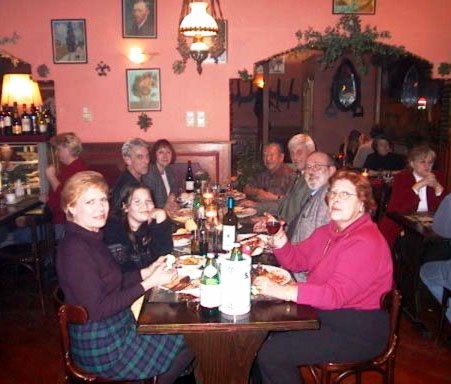
Hola everyone! I'm back from sunny and warm Las Vegas. It was a great trip.
My hotel was smack dab outside Rock in Rio that was held last Friday and Saturday - OMG! Navigating around the street concert area (for vehicles) was a nightmare! I tried to avoid the mad crush of people as much as possible. The hotel (I stayed at Circus Circus this visit) was pleasantly busy beforehand but not like the mob scenes that can occur when there's a chess tournament in town or one or more conventions, but last week Thursday the place was inundated with arrivals for the weekend concert and, perhaps, the music awards that were hosted in LV live last Sunday night. Of course when I'd planned my trip I had no idea these things were going to be going on during my LV stay. Oh well, LOL!
I ate too much, drank too much, talked too much. I did not go shopping except to one thrift store on a trip with Isis who combs through thrift stores like a pro to find vintage items for her online shop. It was a real education watching Isis do her thing at the thrift store, wow! I picked up a small decorative plate, one other item that for the life of me now I cannot remember, and my prize score was a black and white porcelain of a beautifully detailed horse.
Now, you may be wondering "how is it she doesn't remember what she bought? Can't she just go look and write it down?" Well, no, I can't do that because I don't have the things with me! We decided rather than cramming the items into my luggage, my purchases, together with several really cool items (including a new egg for my ever-growing egg collection) that Isis surprise gifted to me, would be shipped to my home. Since Isis has re-entered the world of vintage items and clothing via her e-bay shop (years ago she had a bricks-and-mortar location) she quickly became expert at packing items for safe arrival via US Mail, FedEx and UPS. I should have the box in a few days, woo woo!
So - back to my much more sedate and slow-paced life of retirement in good ol' Milwaukee :)
The Red Lady of El Miron (cave site in Spain) made the news again this past week. She lived and died approximately 18,000 years ago and was evidently reburied at some point, perhaps after her original grave site had been disturbed by predators. Before she was re-interred, her bones were painted in a glittery (crystallized minerals laden) form of red ocher. The "big" news about her discovery, though, wasn't the fact that she had been painted in red ocher, but that there was evidence a floral offering may have been included in her second grave, based on pollen found in the grave site.
Here is the latest article on the Red Lady of El Miron from Live Science:
Ancient Mourners May Have Left Flowers On Red Lady Grave, Tia Ghose, Staff Writer, Life Science, May 20, 2015
I knew about the somewhat controversial findings surrounding possible evidence of flowers left in or on a grave of a Neanderthal woman buried some 60,000 years ago in Shanidar Cave in the Kurdistan area of Iraq. See, for instance:
The Skeletons of Shanidar Cave, Owen Edwards, Smithsonian Magazine, March 2010.
For further information on Neanderthal burial practices, see Burial, Ritual, Religion, and Cannibalism at neandertals.org.
A more recent gravesite, a 14,000 year old burial in Raqefet Cave, Mount Carmel, Israel, written about in this article (a man and woman buried together in a pit grave):
Oldest Grave Flowers Unearthed in Israel, Tia Ghose, Staff Writer, Life Science, July 1, 2013. Note: This article dates the Neanderthal burial with evidence of flowers to some 35,000 years ago, in stark contrast to Owen Edwards' article which dates the burial to some 60,000 years ago. Perhaps two different burials are indicated.
Showing posts with label buried with flowers. Show all posts
Showing posts with label buried with flowers. Show all posts
Sunday, May 24, 2015


Tuesday, July 9, 2013
Buried With Flowers
Hola darlings! I took a brief respite and when I was ready to come back, I was confronted with internet connectivity problems, ACHHHH! Anyway, connectivity issues have FINALLY been resolved. So now I'm going to try and play catch-up with some of the fascinating stories that have come and gone.
A very interesting story about definitive evidence of flowers having been buried with two bodies some 12,000 years ago. Amazingly, the only grave with evidence of flowers being buried with the body is a 70,000 year old Neanderthal burial -- which is controversial.
Here's the story from National Geographic:
For example, in the case of the double burial, "are they relatives?" he said. "Are they parent and child? Are they brothers? Or friends? Did they die together? And how come they were buried together? We don't know."
Daniel Nadel's research was funded in part by the National Geographic Committee for Research and Exploration.
A very interesting story about definitive evidence of flowers having been buried with two bodies some 12,000 years ago. Amazingly, the only grave with evidence of flowers being buried with the body is a 70,000 year old Neanderthal burial -- which is controversial.
Here's the story from National Geographic:
Mysterious Pair Buried With Flowers—Oldest Example Yet
Aromatic sage and mint lined graves found on Israel's Mount Carmel.
Published July 1, 2013
Imprints of stems and blossoms stamped into the dirt of ancient graves are the oldest definitive proof of flowers decorating graves—a common practice around the world today—a new study says.
Scented flowering plants, such as mint and sage, were imprinted in soft mud after they decomposed some 12,000 years ago in the graves, which are located in a cave on northern Israel's Mount Carmel.
Ancient mourners lined four graves with the flowers, most notably one that holds the bodies of two people.
The pair—an adult male and an adolescent of undetermined sex—belonged to the primitive Natufian culture, which flourished between 15,000 and 11,600 years ago in an area that is now Israel, Jordan, Lebanon, and Syria.
The Natufian society was one of the first—possibly the first—to transition from a roaming hunter-gatherer lifestyle to permanent settlements, and was also the first to establish true graveyards, said study leader Daniel Nadel, an archaeologist at the University of Haifa in Israel.
"There are examples of groups living in a camp for a few years, but some of the [Natufian] sites we know about were used for thousands of years," Nadel said.
So what's new?
The new discovery indicates that the Natufians were also among the first to use flowers to honor their dead.
The only potentially older instance of funerary flowers is a dusting of pollen found at the site of an approximately 70,000-year-old grave of a Neanderthal dubbed Shanidar IV in Iraq. However, some scientists have argued that holes found at that site were made by burrowing rodents that stored seeds and flowers in the grave.
"From [the Neanderthal] example until the Natufians"—a period spanning some 50,000 years—"there is not one example [of flowers decorating graves]," said Nadel, whose study appears this week in the journal Proceedings of the National Academy of Sciences.
He noted, however, that this doesn't necessarily mean that people weren't using flowers at graves during that entire time. More likely, the flowers decayed over time.
"Finding such flowers is very difficult," Nadel said. "Asking for such preservation is asking for a lot."
Why is it important?
The evidence suggests the pair's grave was prepared with great care. First, a pit was dug, and then a thin veneer of mud was used to cover the sides. The bottom of the grave was lined with the plants—which bloom in pink and lavender—before the bodies were placed inside.
The scented flowers were likely chosen as much for their aromas as their appearance.
"There are hundreds of flowers on Mount Carmel during the spring, but only a small group provide very strong fragrances. It's impossible that the Natufians didn't recognize the smell" when they chose them for the graves, Nadel said.
What does this mean?
Based on items found in other graves at the cave cemetery—such as animal bones—Nadel thinks the pair was buried with great pomp and circumstance.
"They didn't just place the bodies inside the graves and leave," he said. "We have to envision a colorful ceremony that maybe included dancing, singing, and eating. They may have hunted a few animals and had a big meal around the graves and then threw bones or meat inside."
If Natufian burial practices were anything like those of modern cultures, the grave flowers were intended not only for the dead, but also for the living, Nadel said.
"We create ceremonies and make a big fuss to show our respect for the dead," Nadel said.
What's next?
Nadel and his team are currently working to identify the age, gender, and relationship of the individuals in the flower-lined graves.
Daniel Nadel's research was funded in part by the National Geographic Committee for Research and Exploration.
Subscribe to:
Posts (Atom)