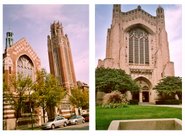
A photo of part of the SOS Children's Village in Chicago, taken from the parking lot outside the Community Center that hosted the project). Sunday was the day for Computer Labs for Kids Foundation's latest project!
It started earlier than usual for me. I arose at 5:00 a.m. I am having this room (my former bedroom turned into the den/library) painted and I was still in the middle of clearing out mountains of piled-up print-outs, spread-eagled books and dozens of journals and magazines, scattered all about the floor! I cleared out some more piles, and then headed downstairs to enact my all-important early-morning rituals (my one cup of coffee for the day, two slices of rye toast, put out plenty of in the shell nuts for the squirrels, fed the birds). I managed to read through the first section of the Journal/Sentinel before it was time to run upstairs and get myself ready. I left the house at 6:32 a.m. and did the 12 minute hike to the bus stop.
Standing at the bus stop in the chill morning air at 6:45 a.m. for my ride to the train station. It was a bit eerie to be out so early on a Sunday morning, when the sun was just pressing above the horizon to the southeast. There was next to no traffic – two cars on 76th Street when I pressed the "Walk" button to cross – unheard of!
While I waited at what is normally a zoom-zoom-zoom intersection during the work week, I saw squirrels dashing back and forth across the six lane divided highway, a hawk and a gull playing tag-team about 30 feet above my head, watched a flock of geese flying toward Jackson Park and was entertained by a chorus of crow calls in the last patch of woods behind me (it surrounds a very small condo complex where a lot more trees, survivors from the time before the area got "developed," were cut down for the condos to go up) It was in the 30’s with a persistent breeze from the northeast, brrr!
The bus arrived and got me downtown close to schedule, about 7:25 a.m. I walked the four blocks to the recently remodeled "Intermodel Station" which houses the Amtrak station and Greyhound and other buses stations. It is a very nice space now – but not gigantic like Union Station in Chicago and has no pretensions to being "grand" like that space is! Unfortunately, during the fervor of "urban renewal" in the early 60’s our lovely 19th century red sandstone train station near the lakefront was torn down and the tracks re-located. That wonderful place, preserved in photographs replete with ladies and gentlemen in late 19th century dress, can be found in our local museums. The building was lovely and would have been a great landmark for Milwaukee. Well, hindsight is always 100% accurate.
I arrived at the station, located the new counter where one purchases Amtrak tickets and got my roundtrip tickets. Right around the corner a line had already begun forming for the call to board the Hiawatha to Chicago. I got some V8 juice from a handy little store right across the hall and then staked out a place in the line. Perhaps 10 minutes later the conductor called out ALL ABOARD THE HIAWATHA SERVICE FROM MILWAUKEE TO CHICAGO as he released the chain that was the only thing separating us from the door to the elevated platform along the track where the massive train sat waiting for its passengers to board.
I had my choice of seats, as there were not many travelers to Chicago as during the work-week (or on Friday, when people go for a weekend and come back Sunday night). As per usual, I managed to pick a backwards seat thanks to my inerring sense of direction (cough cough), but travelling backwards doesn’t bother me as I usually spend my time napping anyway, which I did most agreeably during this trip! We left promptly at 8:00 a.m.

(A look back across the Chicago River toward the train station exit I took on Adams Street - this looks west).

(A look to the north across Adams. Beautiful!)We arrived in Chicago right on time at 9:30 a.m. As I did the three block walk to the McDonalds on Adams and Wells from the Union Station exit that is right on the Chicago River, I stopped to take these photos just the other side of the Chicago River, wisely anticipating that they might be the very last photos of the day I'd manage to grab!
There was the McDonalds, beckoning to me - FOOD, FOOD! I walked toward the corner of Adams and Wells and could see Shira inside. I waited for the light and crossed Adams. Then I had to wait for the light on Wells to change! There was Shira, standing outside the entrance (she'd seen me coming at about the same time I saw her inside), ready with a big hug. Our first face to face meeting after all these years! (This is the very same McDonalds that Mr. Don and I have fond memories of from our
2006 expedition to the University of Chicago's Oriential Institute one fine Sunday morning in early October. We had breakfast there shortly after arriving at 9:30 a.m. Later in the day as we headed back toward Union Station after a very interesting bus ride, we took a late lunch break. As we left, we walked into a fierce storm headed directly our way from the west, the direction we had to go! A tornado was reported to be headed straight toward us as Mr. Don dragged/pulled me through vicious winds those three blocks from the McDonalds at 186 West Adams toward that very same Chicago River exit/entrance into the relative safety of the underground labyrinth that is Union Station and the METRA combined!)
Shira is even lovlier in person than she is in her photographs! And she is model tall and thin. It was great to see her at last!
We went into the McDonalds. I was surprised by the number of people around! The last time I'd been there, I recall the place being relatively deserted, and there was nowhere near the street traffic of cars and people in 2006 that there was in 2009. But I digress -- I was famished and wanted to eat something - anything! While I stood in line, Shira told me that another friend of hers - Erin - had flown in just for a short weekend all the way from Los Angeles to help out too! She identified Erin -- I had actually seen Erin - sitting at a table outside a Starbucks right across the street from the McDonalds, enjoying a cigarette in the chilly air! I remembered thinking to myself as I waited for the walk light to change "That poor woman must be freezing out there!) I was no more than 15 feet away from Erin as I waited for the next walk light to turn so I could cross Wells Street where Shira was waiting, hopping with impatience!
Erin quickly joined us as I waited in line and Shira performed the introductions. I ordered an Egg McMuffin and OJ (please do not lecture me on fat and cholesterol). We happily chattered away as I ate my breakfast.
It wasn't long before Shira, Erin and I piled into Shira's car for the day (a Smart Car? I can't remember what it's called, but it's sort of a communal village approach to car ownership/sharing - I remember reading about the launch of this enterprise some years ago - in major cities - and wondered idly if it would ever work. Since I do not know how to drive and do not own a car, it was only of academic interest to me. The car was roomy - it looked sort of like a gigantic boxy modern interpretation of the old station wagon that was popular shortly after the babyboomers started being born. Shira programmed the GPS coordinates for the SOS Childrens Village into that app on her iPhone and we were off!
Shira has some fabulous friends, let me tell you! After a call for help, Erin flew in from Los Angeles specifically to help out Shira with this project, in Chicago for less than 48 hours! She’s flying back to LA today at 7:00 a.m. The plan was for Erin to catch the train (METRA?) to O’Hare at 5:00 a.m. (just a short walk from where she was staying with Shira) to catch her flight back to LA. (As it turned out, Erin missed her flight, but was able to book one leaving at 11:00 a.m. I hope she made it home okay).

Despite an unexpected detour and some fly-by-the-seat-of-our-pants instant navigation to reach the expressway on-ramp (we managed to successfully navigate by applying logic and intuition in female group-think), we arrived at the SOS Children's Village about 10:40 a.m. Even though the program wasn’t scheduled to begin until 2:00 p.m., there was a LOT to do and there was hardly any down time for the rest of the day.
First we unloaded the car - 28 boxed laptops accompanied by a very large, very heavy "tool" tub (fortunately it had rear wheels and a retractable handle, so it weighed about as much as my 19 inch carry-one does when I go to New York) that contained all of the supplies needed for the program and Shira's audio/visual equipment.

(Erin's table arrangement before the photographer changed everything around about five times!) Once we got everything up to the meeting room on the second floor of the Community Center for the Village, there were tables to arrange. The day before, Millie, who is the Director of the Village facilities, and her assistant(s) had wiped down everything with disinfectant – just a Swine Flu precaution, etc. However, there were the inevitable smears of poster paint and white glue that didn't come off in a routine swab-down.
After a brief discussion, Erin had come up with a good lay-out for the tables, giving all of the participants a good view of the area where the projected video would be. But because of the constraints we were under with respect to photographing the children, once the photographer got there (who volunteered his time, spent the entire day, and took us out to dinner afterwards - more about that later) - soon the tables were dancing around and around.
Ultimately an arrangement was decided upon that was good for photographing the proceedings, complying with the restrictions on photographing the children. Unfortunately, the lay-out was not the most advantageous for the volunteers who would be working with the children. The children were seated across from their volunteers, with their backs to the photographer's set up, instead of being seated side by side with their volunteer with the lap-top in between. It was awkward, but it worked out pretty much okay once everything got underway. Everyone was so engrossed in the program, it really didn’t matter who was sitting where. By the end of the program, some of the kids were laying halfway across the tables working on the notebooks, and other creative volunteer "buddy" and child arrangements were seen, too.
Once Shira, Erin and I got everything up to our second floor location (there was an elevator, thank Goddess!), all of the laptops had to be unboxed, unwrapped, and the power cords and AC adaptors had to be unwrapped, connected, the twisty ties removed from the cords (we did not want the children hassling with THEM!) and the convenient rubber stretchy "hold band" was closed to hold the cords in place to form a neat bundle. The notebooks were stacked with identifying labels on each one so that each volunteer could find his or her child’s computer and grab a cord/AC adaptor pack at the same time.
While Erin and I were busy getting the notebooks ready, with the assistance of Millie, the Director of the SOS facilities, and another young woman who also works at the SOS Village (I never did catch her name, unfortunately, and they did not wear name tags, but I will get her name and insert it where it needs to be), the speaker who would be delivering the first part of the program and a photographer arrived and began their own set-up!
I'd had no idea about these aspects of the program (check out
The Way to Happiness), and was really impressed with how quickly Shira had been able to pull things together and get it all organized! She had only just arrived in Chicago when we played our three-game Shira Chess Challenge Match over Labor Day weekend at the end of September, and now she was leading the way for her Foundation's most ambitious project yet!

Soon Shira and the motivational speaker (I will also supply his name, what a great guy!) set up Shira's A/V equipment. The tables were being shoved around to satisfy the photographer (see above). Millie and her assistant put up Computer Labs for Kids banners. I did a toilet paper and hand-towel check in the ladies' room (LOL!)
Erin was in charge of the volunteers. She was to get the volunteers checked in on our Master List, get media releases signed, make sure the volunteer’s training had already been completed (or would be completed at one of two computers we had standing at the ready), and make sure that each volunteer was filled in by Shira's IT volunteer assistant (Joe) regarding the particular programs that the children would be working with during the second half of the program.
I was in charge of registering the children. My job was to make sure each child had a name tag and a supply of stickers that would be used to mark off completed exercises on worksheets that they would go through with their volunteers, and was checked off the Master List, then matched up with his or her volunteer. Originally part of my duties was also to obtain signed releases (media and computer) from the foster-parents of the children. However, before things started to get really hectic, Millie and her assistant took charge of getting the necessary signed releases from the foster-parents as they brought their children to the first floor of the center. (This was a requirement of the program - the foster parent must bring his or her foster-child to the center by 2:00 p.m. and return to take his or her foster-child home at 5:00 p.m.) This change in the original plan worked like a charm, as Millie and her assistant obtained the foster-parents' signatures on the necessary releases as the children were brought to the center and I was afterwards free to greet each child one-on-one and get them signed in.
After the computer equipment was declared ready, Erin worked on the volunteer folders and name tags as we went over our respective duties again and again while I worked on assembling the name tags for the children. During this time, there were interim meetings with Shira, Millie, the motivational speaker and the photographer. The center was abuzz with activity - and it was yet a couple of hours before the foster-parents and the kids would arrive!
Until today, I had no idea just how much behind-the-scenes work goes into organizing a three hour event that was designed to host 28 children, 28 volunteers (one for each child), a photographer, a motivational speaker, additional volunteers (in case some volunteers did not make it), foster-parents, additional children (non-participants), and additional support volunteers working with the children and the IT people (for instance, accompanying a child to the restroom or to get a drink of water). Whew! I was already exhausted by noon, and our day had not even yet begun!
Shira called a lunch break about 12:30 p.m. The volunteers were scheduled to arrive at 1:45 p.m., 15 minutes before the start of the program. Shira had thoughtfully provided lunch for Erin and I - delicious chicken sandwiches and cheese plates from Starbucks. Absolutely delish! It was a nice break. While we munched we also talked about how things had gone thus far, and what was left to face – and do – as people started to pour into the center. Millie and her assistant went to McDonalds (I could have gone for a Big Mac, but good manners prevented me from slipping Millie money on the side for a sneak Big Mac).
After lunch we continued taking care of last-minute details, and going over the after-program items – DVDs and books to be handed out, connections to be made and contact info to be exchanged, etc. Always primary were the children. I like kids, and I usually get along with them just fine. But I was worried - would I be overwhelmed with these duties? How would the equivalent of a classroom full of young children behave at the peak of excitment?
I didn't have long to fret, though, because the volunteers who would be working with the children started arriving in twos and threes, fours and fives! They needed to be checked in, releases signed, last minute instructions issued, and then the volunteers met with an IT expert who did a quick review of the programs with them. We should have expected that it would not be the smooth and easy process that was outlined in our "Volunteer" materials! But those materials did prepare us for what we needed to do. . While early-arriving children were being marshalled downstairs by the able Millie and assistant, I helped Erin out as best I could with volunteer check-in. It was hectic but we made a good team. All went relatively smoothly, except that some volunteers didn't arrive early enough to have their full review with Shira’s IT people to go over the programs.
With some foresight, Shira had set up two separate computers in the registration area where volunteers could go through an online training program (about 15-20 minutes in length) if they had not previously completed their training. We had three (maybe four?) volunteers go through their training at those computers.

(The Community Center, a quick photo I took from the parking lot shortly after we arrived. The second floor area houses an open area where several computers are housed that the kids of the Village can use during designated hours (strict rules apply). Those computers are the property of the SOS Childrens Village and not part of Computer Labs for Kids' project, but we did use two of those computers to help give last-minute training to some volunteers who had not completed a short online "course" (an outline designed to familiarize the volunteers with what they would be doing while working with the children during the program).
Millie and her assistant were soon bringing the children upstairs to get signed in! There was one line of girls and one line of boys. Except for the usual exuberance one would expect from excited five to eight year olds, and one young man who will clearly make an excellent chess grandmaster some day, the children were very well behaved, on their best behavior, and they were all so sweet and shy! The girls went first (because there were fewer of them and courtesy dictates ladies first), and then the boys. All waited mostly patiently in line to give me their names and be checked in. I just wanted to hug them all, but hugs are not appropriate from a stranger, so I gave them what I hope was my best smile as I scrunched myself down to their height and learned the correct pronunciations of their names. Sometimes I had to ask them again because they were so shy and soft-spoken. I tried to commit their names to memory (which would become important later on), although I did make one mistake, which I gravely apologized for later on! Then I put their name tags (suspended by a stretchy sort of shoe-string thingy poked through two holes of a vinyl casing that held a name tag) over their heads and gave them their stickers, explaining that the stickers would be needed for the program.
More tomorrow -
 Prior post.
Yaaaahhhh! I have some photos from Shira! These tell the story. They are "still shots" that Shira extracted from the video that Lynn Ward took during the class. The kids, of course, are the stars :)
It seemed to take a long time, but actually it was a remarkably short time between Millie and Chrystine bringhing the children up to be registered by yours truly and the volunteers arriving in singles, twos, threes and more for Erin to register. Soon, everyone was in the room we had set up as the classroom, and I was sitting outside panting, trying to catch my breath! LOL!
But I didn't stay out there for long. Soon I was inside, circulating around, trying to stay out of the way as I watched the action.
The class started with everyone (and I do mean everyone, including volunteers and everyone else in the room) standing up and doing a loosey-goosey exercise. With everyone being silly together, kids and adults form an instant connection. Then it's back to our seats and down to business!
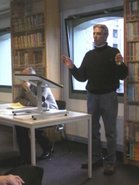
The first part of the class began with the "values" section, which was led by instructor Greg Molinaro of "The Way to Happiness." It is a common-sense approach to teaching values that does not a religious credo.
Prior post.
Yaaaahhhh! I have some photos from Shira! These tell the story. They are "still shots" that Shira extracted from the video that Lynn Ward took during the class. The kids, of course, are the stars :)
It seemed to take a long time, but actually it was a remarkably short time between Millie and Chrystine bringhing the children up to be registered by yours truly and the volunteers arriving in singles, twos, threes and more for Erin to register. Soon, everyone was in the room we had set up as the classroom, and I was sitting outside panting, trying to catch my breath! LOL!
But I didn't stay out there for long. Soon I was inside, circulating around, trying to stay out of the way as I watched the action.
The class started with everyone (and I do mean everyone, including volunteers and everyone else in the room) standing up and doing a loosey-goosey exercise. With everyone being silly together, kids and adults form an instant connection. Then it's back to our seats and down to business!
The first part of the class began with the "values" section, which was led by instructor Greg Molinaro of "The Way to Happiness." It is a common-sense approach to teaching values that does not a religious credo.
 "The Way to Happiness" video was presented in several sections so that the children could concentrate on one key concept at a time. Every child had an exercise book to work through with his or her buddy (technical instructor), who would ask questions at the conclusion of each video segment to elicit responses from the child that would reveal whether the child "got" the lesson of the video segment. As needed, the buddy would then ask the child questions designed to elicit further responses until the exercise was completed. As the child progressed through each exercise, the buddy would ask the child to place a sticker (the same stickers I had handed out to each child during registration) next to a particular section within the exercise, signifying that the child had successfully completed that part!
Above is a photo of the class while Greg went through an abridged video presentation of "The Way to Happiness." The video presented vignettes that dramatized certain every-day situations to help the children understand common-sense values, emphasizing the Golden Rule, that will help the kids keep their laptops safe and also learn how to share it with others. This photo shows a part where the buddies are going through one of the segment's workbook questions with their children. It's intense one-on-one, but also fun, as can be seen by the expressions and body language of the participants!
The entire class was designed to be completed in 3 hours, including time for one-on-one instruction after the award of each child's laptop computer for further work with their buddies to familiarize themselves with the programs downloaded to each laptop. The class was designed to keep in mind the ages of the children and time constraints (on a Sunday afternoon) of the volunteers. Shira tried to think of everything when designing this program, her most ambitious yet! Although Shira said that we started the Values Section late, we somehow managed to finish on time. The children were so eager - and so intent - being in that room was like being at a championship level chess tournament, except for the exchanges between the children and their buddies. It was awesome to behold!
"The Way to Happiness" video was presented in several sections so that the children could concentrate on one key concept at a time. Every child had an exercise book to work through with his or her buddy (technical instructor), who would ask questions at the conclusion of each video segment to elicit responses from the child that would reveal whether the child "got" the lesson of the video segment. As needed, the buddy would then ask the child questions designed to elicit further responses until the exercise was completed. As the child progressed through each exercise, the buddy would ask the child to place a sticker (the same stickers I had handed out to each child during registration) next to a particular section within the exercise, signifying that the child had successfully completed that part!
Above is a photo of the class while Greg went through an abridged video presentation of "The Way to Happiness." The video presented vignettes that dramatized certain every-day situations to help the children understand common-sense values, emphasizing the Golden Rule, that will help the kids keep their laptops safe and also learn how to share it with others. This photo shows a part where the buddies are going through one of the segment's workbook questions with their children. It's intense one-on-one, but also fun, as can be seen by the expressions and body language of the participants!
The entire class was designed to be completed in 3 hours, including time for one-on-one instruction after the award of each child's laptop computer for further work with their buddies to familiarize themselves with the programs downloaded to each laptop. The class was designed to keep in mind the ages of the children and time constraints (on a Sunday afternoon) of the volunteers. Shira tried to think of everything when designing this program, her most ambitious yet! Although Shira said that we started the Values Section late, we somehow managed to finish on time. The children were so eager - and so intent - being in that room was like being at a championship level chess tournament, except for the exchanges between the children and their buddies. It was awesome to behold!
 At the conclusion of the Values section, each child was called to the front of the room by name (in alphabetical order), to receive a Certificate of Completion for that part of the class, and received congratulations from Shira and Greg. It was my job to loudly call out the name of each child, which I did with gusto since I have a naturally big mouth :) and hand the certificates to Shira, who did the actual presentation to the child. I am happy to say I only made one goof, badly mispronouncing the name of one of the children, for which I abjectly apologized to her later. She was very magnanimous and forgave me for being such a screw-up. This photo: Greg on the left, Shira in the center presenting a Certificate to one of the children, and me on the right, looking MUCH stouter than I really am in person, darlings. But I think I must get a new bra, ahem.
At the conclusion of the first certificate ceremony, we took a 15 minute break, and then Part 2 of the class began! The computers!
At the conclusion of the Values section, each child was called to the front of the room by name (in alphabetical order), to receive a Certificate of Completion for that part of the class, and received congratulations from Shira and Greg. It was my job to loudly call out the name of each child, which I did with gusto since I have a naturally big mouth :) and hand the certificates to Shira, who did the actual presentation to the child. I am happy to say I only made one goof, badly mispronouncing the name of one of the children, for which I abjectly apologized to her later. She was very magnanimous and forgave me for being such a screw-up. This photo: Greg on the left, Shira in the center presenting a Certificate to one of the children, and me on the right, looking MUCH stouter than I really am in person, darlings. But I think I must get a new bra, ahem.
At the conclusion of the first certificate ceremony, we took a 15 minute break, and then Part 2 of the class began! The computers!