Wednesday, March 27, 2013

FIDE Women's Grand Prix Cycle 2013-2014

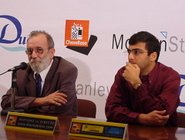
Finally - an announcement from FIDE.  So, there will be a FIDE Women's Grand Prix Cycle after all.  Geez!

Women's Grand-Prix announcement
Friday, 22 March 2013
FIDE announces the Women's Grand-Prix 2013-2014 which will give qualification to the Women's World Championship match 2015.
The schedule of the six events is the following:
* 2-16 May 2013 Geneva, Switzerland
* 15-29 June 2013 Dilijan, Armenia
* 17 September - 1 October 2013 Tashkent, Uzbekistan
* 2-16 May 2014 Khanty-Mansiysk, Russia
* 18 June - 2 July 2014 Tbilisi, Georgia
* 24 August - 7 September 2014 Erdenet, Mongolia

In total 18 players will participate, 10 qualifiers as per regulations (listed below) plus 6 nominees from the organisers of each tournament (to be announced) plus 2 nominees of the FIDE President (to be announced).

The 10 original qualifiers who have to confirm their participation by 26 March are:

01. Ushenina, Anna (World Champion 2012)
02. Stefanova, Antoaneta (finalist world championship 2012)
03. Ju, Wenjun (semi-finalist world championship 2012)
04. Harika, Dronavalli (semi-finalist world championship 2012)
05. Polgar, Judit (by rating 2703.78, average 9 lists Mar 2012 to Jan 2013) [she won't  play]
06. Hou, Yifan (by rating 2610.78, average 9 lists Mar 2012 to Jan 2013)
07. Koneru, Humpy (by rating 2598.44, average 9 lists Mar 2012 to Jan 2013)
08. Muzychuk, Anna (by rating 2593.33, average 9 lists Mar 2012 to Jan 2013)
09. Zhao, Xue (by rating 2555.00, average 9 lists Mar 2012 to Jan 2013)
10. Dzagnidze, Nana (by rating 2551.89, average 9 lists Mar 2012 to Jan 2013)

The first reserve for any replacement needed is Lagno [Lahno], Kateryna (by rating 2546.33, average 9 lists Mar 2012 to Jan 2013).

The full regulations of the Women's Grand-Prix 2013-2014 are published here:
http://www.fide.com/fide/handbook.html?id=137&view=article

Women Star Chess Rapid 2013

Report from The Week in Chess.

Women Star Chess Rapid 2013
The Women Star Chess Rapid took place in Huashan City 17th to 21st March 2013.

  • Women Star Chess Rap
  • Sun 17th Mar 2013 - Thu 21st Mar 2013
  • Huashan City, CHN
  • 8 Players, 7 Rounds.
  • SRR
  • Time Control: 25m+10spm
  • Women Star Chess Rap Huashan City CHN Sun 17th Mar 2013 - Thu 21st Mar 2013. Category: 10. Ave: (2495)
    RkNameTitleFEDElo12345678PtsTPR
    1Huang, QianWGMCHN2476#101===14.52600
    2Cmilyte, ViktorijaGMLTU25140#0=11114.52594
    3Kosintseva, TatianaGMRUS251711#=0===42542
    4Ushenina, AnnaGMUKR24770==#11==42548
    5Tan, ZhongyiWGMCHN2471=010#==13.52499
    6Ju, WenjunWGMCHN2505=0=0=#1=32444
    7Zhu, ChenGMQAT2491=0===0#=2.52394
    8Harika, DronavalliGMIND251000==0==#22335

    Awonder Liang Makes Master

    Woo woo!  Great news for the young chessplayer from Madison, Wisconsin.  Awonder often plays in the Southwest Chess Club (my adopted chess club) Hales Corners Challenge events.  I had the pleasure of meeting and having a nice conversation Awonder's dad a few years ago at one of the HCChallenges (it may have been Challenge XIII). 

    Published March 26, 2013, 12:49 PM

    9-year-old Wisconsin boy youngest American chess master

    Awonder Liang (front), at the Hales Corners Chess Challenge XIII, Milwaukee,
    Wisconsin, April 16, 2011, with Allen Becker, Tom Fogec and Robin Grohowski.
    Awonder made Expert Level as a result of his score in this event, 2 years ago!

    A 9-year-old Madison boy has become the youngest American to reach the rank of chess master.
    By: Associated Press staff, Wisconsin State Journal

    MADISON, Wis. — A 9-year-old Madison boy has become the youngest American to reach the rank of chess master.

    The United States Chess Federation has certified that Awonder Liang has earned more than 2,200 points, or master status, while playing at a weekend tournament in Dayton, Ohio.

    Federation rater Walter Brown says the fourth-grader is a week younger than the previous record holder, a California boy who set the mark in 2010.

    The Wisconsin State Journal says points toward master status are earned most quickly by beating better competition. Liang became a chess prodigy when he defeated a grandmaster, the highest rated player in the game, when he was 8.

    Brown says Liang currently is the 10th-best player overall in Wisconsin.

    Social Networks Revealed in Ancient Southwest United States

    From Science Daily

    Artifacts Shed Light On Social Networks of the Past

    Mar. 25, 2013 — Researchers studied thousands of ceramic and obsidian artifacts from A.D. 1200-1450 to learn about the growth, collapse and change of social networks in the late pre-Hispanic Southwest.

    The advent of social networking sites like Facebook and Twitter have made us all more connected, but long-distance social networks existed long before the Internet.

    An article published this week in the Proceedings of the National Academy of Sciences sheds light on the transformation of social networks in the late pre-Hispanic American Southwest and shows that people of that period were able to maintain surprisingly long-distance relationships with nothing more than their feet to connect them.

    Led by University of Arizona anthropologist Barbara Mills, the study is based on analysis of more than 800,000 painted ceramic and more than 4,800 obsidian artifacts dating from A.D. 1200-1450, uncovered from more than 700 sites in the western Southwest, in what is now Arizona and western New Mexico.

    With funding from the National Science Foundation, Mills, director of the UA School of Anthropology, worked with collaborators at Archeology Southwest in Tucson to compile a database of more than 4.3 million ceramic artifacts and more than 4,800 obsidian artifacts, from which they drew for the study.

    They then applied formal social network analysis to see what material culture could teach them about how social networks shifted and evolved during a period that saw large-scale demographic changes, including long-distance migration and coalescence of populations into large villages.

    Their findings illustrate dramatic changes in social networks in the Southwest over the 250-year period between A.D. 1200 and 1450. They found, for example, that while a large social network in the southern part of the Southwest grew very large and then collapsed, networks in the northern part of the Southwest became more fragmented but persisted over time.

    "Network scientists often talk about how increasingly connected networks become, or the 'small world' effect, but our study shows that this isn't always the case," said Mills, who led the study with co-principal investigator and UA alumnus Jeffery Clark, of Archaeology Southwest.

    "Our long-term study shows that there are cycles of growth and collapse in social networks when we look at them over centuries," Mills said. "Highly connected worlds can become highly fragmented."
    Another important finding was that early social networks do not appear to have been as restricted as expected by settlements' physical distance from one another. Researchers found that similar types of painted pottery were being created and used in villages as far as 250 kilometers apart, suggesting people were maintaining relationships across relatively large geographic expanses, despite the only mode of transportation being walking.

    "They were making, using and discarding very similar kinds of assemblages over these very large spaces, which means that a lot of their daily practices were the same," Mills said. "That doesn't come about by chance; it has to come about by interaction -- the kind of interaction where it's not just a simple exchange but where people are learning how to make and how to use and ultimately discard different kinds of pottery." [Just come out and say it -- diffusion -- oh, but  isn't that a dirty word these days in archaeology?]

    "That really shocked us, this idea that you can have such long distance connections. In the pre-Hispanic Southwest they had no real vehicles, they had no beasts of burden, so they had to share information by walking," she said.

    The application of formal social network analysis -- which focuses on the relationships among nodes, such as individuals, household or settlements -- is relatively new in the field of archaeology, which has traditionally focused more on specific attributes of those nodes, such as their size or function.
    The UA study shows how social network analysis can be applied to a database of material culture to illustrate changes in network structures over time.

    "We already knew about demographic changes -- where people were living and where migration was happening -- but what we didn't know was how that changed social networks," Mills said. "We're so used to looking traditionally at distributions of pottery and other objects based on their occurrence in space, but to see how social relationships are created out of these distributions is what network analysis can help with."

    One of Mills's collaborators on the project was Ronald Breiger, renowned network analysis expert and a UA professor of sociology, with affiliations in statistics and government and public policy, who says being able to apply network analysis to archaeology has important implications for his field.

    "Barbara (Mills) and her group are pioneers in bringing the social network perspective to archaeology and into ancient societies," said Breiger, who worked with Mills along with collaborators from the UA School of Anthropology; Archaeology Southwest; the University of Wisconsin, Milwaukee; Hendrix College; the University of Colorado, Boulder; the Santa Fe Institute; and Archaeological XRF Laboratory in Albuquerque, N.M.

    "What archaeology has to offer for a study of networks is a focus on very long-term dynamics and applications to societies that aren't necessarily Western, so that's broadening to the community of social network researchers," Breiger said. "The coming together of social network and spatial analysis and the use of material objects to talk about culture is very much at the forefront of where I see the field of social network analysis moving."

    Going forward, Mills hopes to use the same types of analyses to study even older social networks.
    "We have a basis for building on, and we're hoping to get even greater time depth. We'd like to extend it back in time 400 years earlier," she said. "The implications are we can see things at a spatial scale that we've never been able to look at before in a systematic way. It changes our picture of the Southwest."

    Distant Relatives Want King Richard III Interred in York

    The kicker is it's probably all about attracting future tourist dollars...

    From The Guardian Online

    Richard III's distant relatives threaten legal challenge over burial

    Relations say king should be buried in York and government's failure to consult them is in breach of human right to family life

    and

    guardian.co.uk,

    Fifteen living relatives of Richard III, whose body was exhumed from a Leicester car park last year, are threatening to launch a legal challenge seeking the monarch's reburial in York Minster.

    Although the last English king to die in battle perished almost 500 years before the European convention on human rights came into force, his distant relatives are claiming they were not consulted and that their rights have been breached.

    An application for judicial review is to be lodged by lawyers in Leeds on behalf of the Plantagenet Alliance. They are bringing the action against the Ministry of Justice, which granted the archaeological excavation licence to Leicester University.  The licence stipulated that the king's remains should be "deposited in [Leicester's] Jewry Wall museum or else be re-interred at [the city's] St Martin's Cathedral or a burial ground in which interments may legally take place".

    That latitude of interpretation has stirred up a popular debate over the location of Richard III's final resting place. Any site is likely to attract significant tourist business.

    The Richard III Society – which promotes research into the 15th-century ruler – says its proposed tomb will be inside Leicester Cathedral. The cathedral authorities have already held discussions with architects over plans for a suitable memorial.

    Leicester city council is planning a permanent exhibition centre in a Victorian school building overlooking the council car park which now covers the foundations of the medieval Greyfriars church, demolished in the dissolution of the monasteries.

    The Greyfriars priests bravely claimed Richard's body, and buried him uncoffined and in a hastily dug grave but in a position of honour in their church, after his body was brought back from the battlefield slung naked over the saddle of a horse.  But the Yorkists are determined to repatriate his remains and have launched their campaign under the banner of article 8 of the European convention, which guarantees the right to a private and family life.

    DNA tests on the bones found buried in Leicester's Greyfriars car park last year proved that they belonged to Richard III, who died at the battle of Bosworth outside the city in 1485.

    Richard died without any known surviving children. The closest traced relative, Michael Ibsen, a Canadian furniture maker now living in London and a direct descendant of Richard's sister whose DNA helped identify the bones, has supported the plans for burial in Leicester. 

    The Plantagenet Alliance is a separate Ricardian fan club from the Richard III Society, which largely funded the search for the lost remains of the last Plantagenet king.

    According to the Leeds law firm Gordons, the relatives will argue, "amongst other things, that the Ministry of Justice failed to consult with them over the terms of the licence and that such failure constitutes a breach of article 8 of the European convention on human rights (the right to respect for private and family life)".

    Matthew Howarth, the partner leading the Gordons team, said: "We have now written officially to the Ministry of Justice and University of Leicester, notifying them that we plan to issue these claims. This enables us to obtain some further information from them relating to the matters in question.
    "We will follow up by issuing the judicial review and other proceedings as soon as possible, but certainly within the next few weeks."

    The Plantagenet Alliance, which claims 15 descendants of relatives of the king as members, insists York is the most appropriate place, pointing out that although he was born at Fotheringhay in Northamptonshire – which has also been suggested as a possible burial place – he grew up in Middleham in Yorkshire, was known as Richard of York before he claimed the throne on the death of his brother, and visited York several times during his reign.

    Stephen Nicolay, a 16th great-nephew of the monarch and member of the Plantagenet Alliance, said: "We have every hope that [we] will succeed in … our quest to have Richard's remains buried at the most appropriate site, York Minster."

    A University of Leicester spokesman said: "As the licence holder, the university is responsible for the location of reinterment. Our decision was, and remains, that Richard III should be reinterred at Leicester Cathedral.

    "Reinterment on the nearest consecrated ground is in keeping with good archaeological practice. Richard has lain in the shadow of St Martin's Cathedral, Leicester, for over 500 years.

    "Richard III is believed to have no living descendants. Any distant relations are therefore descended from his siblings. Statistically speaking, many tens of thousands of individuals alive today are descended in this way. There is no obligation to consult living relatives where remains are older than 100 years."

    Tuesday, March 26, 2013

    How Ironic: Global Warming Aiding Archaeology

    Hola darlings!  Well, global warming, or to use the more politically correct phrase, global climate change (of which I see plenty evidence here in SE Wisconsin over the past 40 plus years, for sure), is destroying priceless archaeological sites as fast as it is revealing them!  Damn! 

    Pre-Viking tunic found by glacier as warming aids archaeology
    Thu, 21 Mar 2013 16:41 GMT
    Source: reuters // Reuters
     
    By Alister Doyle, Environment Correspondent
    OSLO, March 21 (Reuters) - A pre-Viking woollen tunic found beside a thawing glacier in south Norway shows how global warming is proving something of a boon for archaeology, scientists said on Thursday.

    The greenish-brown, loose-fitting outer clothing - suitable for a person up to about 176 cms (5 ft 9 inches) tall - was found 2,000 metres (6,560 ft) above sea level on what may have been a Roman-era trade route in south Norway.

    Carbon dating showed it was made around 300 AD.

    "It's worrying that glaciers are melting but it's exciting for us archaeologists," Lars Piloe, a Danish archaeologist who works on Norway's glaciers, said at the first public showing of the tunic, which has been studied since it was found in 2011.

    A Viking mitten dating from 800 AD and an ornate walking stick, a Bronze age leather shoe, ancient bows, and arrow heads used to hunt reindeer are also among 1,600 finds in Norway's southern mountains since thaws accelerated in 2006.

    "This is only the start," Piloe said, predicting many more finds.

    One ancient wooden arrow had a tiny shard from a seashell as a sharp tip in an intricate bit of craftsmanship.

    RECEDING GLACIERS
    The 1991 discovery of Otzi, a prehistoric man who roamed the Alps 5,300 years ago between Austria and Italy, is the best known glacier find. In recent years, other finds have been made from Alaska to the Andes, many because glaciers are receding.

    The shrinkage is blamed on climate change, stoked by man-made emissions of greenhouse gases from burning fossil fuels.

    The archaeologists said the tunic showed that Norway's Lendbreen glacier, where it was found, had not been so small since 300 AD. When exposed to air, untreated ancient fabrics can disintegrate in weeks because of insect and bacteria attacks.

    "The tunic was well used - it was repaired several times," said Marianne Vedeler, a conservation expert at Norway's Museum of Cultural History.

    The tunic is made of lamb's wool with a diamond pattern that had darkened with time. Only a handful of similar tunics have survived so long in Europe.

    The warming climate is have an impact elsewhere.

    Patrick Hunt, a Stanford University expert who is trying to find the forgotten route that Hannibal took over the Alps with elephants in a failed invasion of Italy in 218 BC, said the Alps were unusually clear of snow at 2,500 metres last summer.

    Receding snows are making searching easier.

    "I favour the Clapier-Savine Coche route (over the Alps) after having been on foot over at least 25 passes including all the other major candidates," he told Reuters by e-mail.

    The experts in Oslo said one puzzle was why anyone would take off a warm tunic by a glacier.
    One possibility was that the owner was suffering from cold in a snowstorm and grew confused with hypothermia, which sometimes makes suffers take off clothing because they wrongly feel hot. (Editing by Jeremy Gaunt.)

    Sunday, March 24, 2013

    Venus of Nimes Decapitated

    I can only read a few words of the French - a whole article, or even a sentence in local vernacular - nope!

    But someone or someones decided to cut the head off a beautiful ancient statue of Venus gracing the grounds of the archaelogical museum at Nimes.

    A Nîmes, la Vénus du musée archéologique mutilée
    ROLAND MASSABUAU
    20/03/2013, 06 h 00
     
    Des questions se posent après le vol de la tête de la célèbre statue au musée archéologique le vendredi 15 mars.


    Elle n’avait qu’un bras, et depuis les jours derniers, c’est la tête qui disparue. Volée à la suite d’un acte de vandalisme. L’acte a été découvert le vendredi 15 mars en fin d’après-midi, au moment de la fermeture du musée archéologique, boulevard Amiral-Courbet, site qui abritait cette Vénus de Nîmes, extraite en 1873 de fouilles opérées rue Pavée (actuellement rue Fernand-Pelloutier).
     
    Depuis, la pièce décapitée a été placée derrière une structure de grilles, et le musée est fermé au public. "Dès sa réouverture, il fera l’objet d’une surveillance accrue, et un gardien sera affecté en permanence dans la cour du cloître des Jésuites" a informé d’entrée Daniel-Jean Valade, adjoint à la culture, lors d’un point presse programmé hier. Dès le constat de cet acte, une plainte a été déposée par Dominique Darde, conservatrice du musée, tandis que l’information a été notifiée à l’Office central des biens culturels, lequel a transmis les éléments à Interpol.
     
    Cet acte de vandalisme pourrait être le fait d’au moins deux personnes
    Pour Dominique Darde, pas question d’extrapoler sur l’éventuelle valeur que la tête de la Vénus de Nîmes pourrait avoir sur le marché. Selon ses précisions, la statue, d’une taille initiale de 1,35 mètre, composée de marche ancien et moderne, et de plâtre, serait sans doute une œuvre d’importation, et avait été découverte brisée en plus d’une centaine de morceaux. Pièce ayant fait l’objet de nombreuses restaurations, elle "ne serait pas négociable". Et la tête disparue serait plutôt "mal recomposée". Rien à voir donc avec une autre Vénus, célébrissime entre toutes, et découverte sur l’île de Milo. Selon certaines déductions, cet acte de vandalisme pourrait être le fait d’au moins deux personnes. Les résultats du laboratoire expertisant les traces ADN seraient peut-être prochainement susceptibles de le confirmer.
     
    Tandis que la Vénus de Nîmes, toujours sur son socle, mais désormais décapitée, pose bien sûr la question de la surveillance des œuvres d’art dans les musées, les actes de vandalismes sont cependant, sur les divers sites nîmois, exceptionnels. Selon Daniel-Jean Valade, le dernier en date était l’œuvre de Pierre Pinoncelli. Véritable spécialiste des happenings culturels, ce peintre avait, au cours de l’été 1993, à Carré d’art, uriné sur “Fontaine “, pièce signée Marcel Duchamp, avant de lui asséner un violent coup de marteau.
     
    Dégradation gratuite ou action commandée ?
    À la suite du vol de la tête de la statue qui, même si elle ne figure pas parmi les antiquités majeures et précieuses du musée archéologique, fait évidemment partie du patrimoine cher aux Nîmois, l’interrogation sur l’identité et la démarche du (ou des) auteurs de cet acte demeure. Dégradation gratuite ou action commandée ? La tête disparue sera-t-elle retrouvée un jour ? Où et dans quel état ?
     
    Ou trône-t-elle déjà sur la cheminée d’un amateur passionné de la civilisation romaine ? Aucune piste pour l’heure. S’agit-il d’un pari stupide et inqualifiable (histoire de mesurer le degré d’efficacité de la surveillance des musées), ou ce vol est-il l’œuvre d’un visiteur fréquentant régulièrement le cloître des Jésuites ou celle d’un déséquilibré ? Toutes les hypothèses semblent envisageables, et le mystère restait encore, mardi soir, absolu.

    More on Ancient Chinese Coin Found in Kenya

    From The Smithsonian Online

    March 15, 2013 9:17 am

    Six Centuries Ago, Chinese Explorers Left This Coin Behind in Africa


    The 600-year-old coin is made of copper and silver and has a hole in the center. It’s called a Yongle Tongbao and was issued by Emperor Yongle, who reigned during the Ming Dynasty between the years 1403 to 1425 AD. It was found on Manda, an island in Kenya, announced researchers from The Field Museum and the University of Illinois, and it’s a tangible piece of evidence of Chinese exploration and trade in Africa, years before European explorers reached this part of the world.
    It’s easy to date the coin: it features the emperor’s name. Yongle was perhaps best know for starting the initial construction of Beijing’s Forbidden City, but he also sent huge fleets of ships, under the command of admiral Zheng He, out across the ocean to faraway lands.
    UCLA‘s International Institute explains:

    Upon the orders of the emperor Yongle and his successor, Xuande, Zheng He commanded seven expeditions, the first in the year 1405 and the last in 1430, which sailed from China to the west, reaching as far as the Cape of Good Hope. The object of the voyages was to display the glory and might of the Chinese Ming dynasty and to collect tribute from the “barbarians from beyond the seas.” Merchants also accompanied Zheng’s voyages, Wu explained, bringing with them silks and porcelain to trade for foreign luxuries such as spices and jewels and tropical woods.

    The researchers who found the coin describe Zheng He as “the Christopher Columbus of China.” But this admiral’s fleet was much larger than Columbus’. Zheng He commanded as many as 317 ships with 28,000 crew members; Columbus had just three ships and fewer than 100 crew to command.

    The Chinese expeditions started out closer to home, but a voyage that began in 1417 made it to Africa. The fleet’s treasure ships brought back strange animals—giraffes, zebras, and ostriches—to the court at home.

    After Yongle’s death, though, successors soon banned foreign expeditions and destroyed much of the documentation of the Zheng He’s voyages. The coin provides one of the few tangible links between Africa and China at that time. As for Manda, where the coin was discovered, that island was home to an advanced civilization for around 1,200 years, but it was abandoned in 1430 AD, never to be inhabited again.

    ********************************************
    Gavin McKenzie - vindicated,  heh heh heh!

    Saturday, March 23, 2013

    Chess Femme News!

    (1) From The Huffington Post:

    Phiona Mutesi, 17-Year-Old Ugandan Chess Player, Challenged By Bill Gates (VIDEO)
    The Huffington Post By Posted: | Updated: 03/20/2013 4:14 pm EDTMy Note: Comments to this article are interesting. A range of, er, diverse opinions, to say the least, har! Seriously, I find myself constantly flip-flopping on the issue of all-female events, which consistently have been relegated to "steerage class"(or worse) status in the chess world.  Sigh.   (2) From Chessbase.com:1st Chess and Science Festival for girls


    21.3.2013 - Many parents still believe that science, business and mathematics are for men and their daughters should not compete in these areas. It’s sad, but it is true – girls are encouraged to go into music, art, teaching… and stay away from the areas currently dominated by men. Three-time US Women's Champion WGM Anjelina Belakovskaia wants to do something about this – with a Kickstarter project. (Will be held in Tucson, Arizona -- coincindence that Tucson is the home of 9 Queens???) 

    My Note:  Monetary contributions are needed for this event planned for April 13, 2013.  While the initial goal of $1,000 has been reached, more contributions mean more funds for monetary prizes for players.  If you can help, no matter how small your contribution, please consider making a donation.  (3) Elizabeth Vicary Spiegel, the Quiet Chess HeroineOkay, that's my own made-up title for this article from English online newspaper, The Telegraph.  She is one of my chess heroines.  She is an ongoing miracle producer in a world that is far short of them, and she is doing it daily, teaching "her kids" how to play chess for all the right reasons.  Elizabeth Vicary (now Spiegel) won the very first Goddesschess prize offered at a U.S. Women's Chess Championship, in 2007.  I've followed her chess/teaching career ever since.  Here's the actual title and byline for the article:Mini masters: the hard-up Brooklyn school producing chess championsBy
    7:00AM GMT 22 Mar 2013


    Not sure if this means the women will be playing the country's version of "traditional chess" or - something else.  But interesting, nonetheless:

    (4) Myanmar to hold traditional chess event in Yangon 
    English.news.cn
    2013-03-21 14:34:28

    YANGON, March 21 (Xinhua) -- Myanmar will hold traditional chess women's singles tournament at Aung San Stadium this month, according to sports circle Thursday.

    Jointly organized by Sports and Physical Education Department under the Ministry of Sports and Myanmar Chess Federation, the chess event is scheduled to take place from March 24 to 29.  Myanmar traditional chess event will be included in the 27th SEA Games to be hosted in Myanmar in 2013.


    (5) Interesting turn of events on the March 18, 2013 broadcast of The Amazing Race.  In Vietnam, the detour challenge was -- play a game of Chinese chess on a giant board with live people representing the pieces, or go to a local open-air market and buy the exact ingredients for a traditional chicken dish.  Wonder how many will choose to play the chess game?  LOL! 

    This week's Detour then asked teams to "Make a Move" (playing Chinese chess on a giant board with human players) or "Make a Meal" (grab two empty baskets and another two filled with live chickens, then head to a market and get ingredients for the traditional Vietnamese dish pho, picking up exact weights for the ingredients on the shopping list).

    I did not watch this episode (I watch other programs on Sunday night) but judging by the comments following this article, there was a LOT of controversy about some events that occurred in the episode, including - according to the comments - some (or all?) of the Amazing Race contestants "praising"' the Communist Vietnamese government???  Well, that's sucky, for sure.  I wonder - how many of those irate posters will actually follow through and never watch CBS again?  Easier than peeing to say you're going to do this or that; it is another thing entirely to follow through and actually do the actions your big mouth said you were going to do...


    (6) Dylan McClain presents an interesting perspective on the recently concluded FIDE Women's World Team Chess Championship, and had high praise for the performance of IM Irina Krush, current U.S. Women's Chess Champion:

    Ukraine Wins Women’s Event Skipped by Many Big Names
    By DYLAN LOEB McCLAIN Published: March 16, 2013  

    The Rice Goddess

    Hola darlings!

    Okay, yes, I know, I've been neglecting you all, again.  I've been busy with - dare I say it? - decorating!  Yes, the Celadon Curse has once again descended in full force upon Maison Newton.  Not, mind you, that I actually have a damn thing in this house that is true celadon.  Nope - shades of teal, turquoise, robin's egg blue, marine blue, seafoam green, sky blue and aqua grace the back of the house now as accents (and a beautiful wool area rug that, alas, is not the right color, but it's not going back because I didn't open it up out of it's packaging until a few weeks ago, a year since I bought it at overstock.com), but not a speck of true celadon do I see.  Arggggh!

    Well, that's another story and not one for here.  Suffice to say, though, that in one of those synchronicitous events that have blessed (?) my life for years (particularly since the advent of Goddesschess), earlier today while hunting down celadon inspiration I came across a wonderful blog filled with interesting things.  While there, I continued to read a little and came across this most fascinating information about the rice goddess, and a rice god, too.  A rice god? 

    Rice Gods and Rice Goddesses

    Photo from India Pied-a-Terre, link above to post.

    Tuesday, March 19, 2013

    3300 Year Old Sundial Discovered in Egypt

    Press Trust of India | London March 15, 2013 Last Updated at 16:05 IST

    One of world's oldest sun dials discovered in Egypt

    Researchers have unearthed one of the world's oldest Egyptian sun dials - possibly dating back to 13th century BC - used by the people to tell time with the position of the Sun.

    The discovery was made during archaeological excavations in the Kings' Valley in Upper Egypt by a team of researchers from the University of Basel.

    The team led by Professor Susanne Bickel made the significant discovery while clearing the entrance to one of the tombs.

    During this year's excavations the researchers found a flattened piece of limestone (so-called Ostracon) on which a semicircle in black colour had been drawn. The semicircle is divided into twelve sections of about 15 degrees each.

    A dent in the middle of the approximately 16 centimetre long horizontal baseline served to insert a wooden or metal bolt that would cast a shadow to show the hours of the day. Small dots in the middle of each section were used for even more detailed time measuring.

    The sun dial was found in an area of stone huts that were used in the 13th century BC to house the men working at the construction of the graves. The sun dial was possibly used to measure their work hours.

    However, the division of the sun path into hours also played a crucial role in the so-called netherworld guides that were drawn onto the walls of the royal tombs.

    These guides are illustrated texts that chronologically describe the nightly progression of the sun-god through the underworld. Thus, the sun dial could also have served to further visualise this phenomenon, researchers said.

    During this year's excavation in cooperation with the Egyptian authorities and with the help of students of the University of Basel over 500 mostly fragmentary objects that had been recovered in former seasons were documented and prepared for further scientific examination.

    This also includes all the material of the lower strata of tomb KV 64 found in 2012. Inside the roughly 3500 year old tomb Basel researchers had discovered a sarcophagus that was holding the mummy of a woman named Nehemes-Bastet.

    Pre-Clovis Remains Date to Circa 22,000 Years Ago

    From Science News

    Disputed finds put humans in South America 22,000 years ago
    Brazilian site may have been home to people before the Clovis hunters
     
    By Bruce Bower
     
    Stone tools unearthed at a Brazilian rock-shelter may date to as early as 22,000 years ago. Their discovery has rekindled debate about whether ancient people reached the Americas long before the famed Clovis hunters spread through parts of North America around 13,000 years ago.

    These relics of ancient South Americans add to evidence from nearby sites challenging the longstanding view of Clovis people as the first Americans (SN: 8/11/12, p. 15), a team led by geochronologist Christelle Lahaye of the University of Bordeaux 3 and archaeologist Eric Boëda of the University of Paris X reports March 4 in the Journal of Archaeological Science.

    “We have new, strong evidence that the Clovis-first model is out of date,” Lahaye says.

    Among other South American locations proposed as human settlements well before North America’s Clovis culture, the most controversial is Brazil’s Pedra Furada rock-shelter. There, archaeologists unearthed burned wood and sharp-edged stones and dated them to more than 50,000 years ago. Pedra Furada’s excavators regard the finds as evidence of ancient human hearths and stone tools. Critics, and especially many Clovis investigators, say the Brazilian discoveries could have resulted from natural fires and rock slides.

    The new discovery came at Toca da Tira Peia rock-shelter, which is in the same national park as Pedra Furada. It also has drawn skeptics. The site’s location at the base of a steep cliff raises the possibility that crude, sharp-edged stones resulted from falling rocks, not human handiwork, says archaeologist Gary Haynes of the University of Nevada, Reno. Another possibility is that capuchins or other monkeys produced the tools, says archaeologist Stuart Fiedel of Louis Berger Group, an environmental consulting firm in Richmond, Va.
    The age of Toca da Tira Peia artifacts has also drawn debate. Dating the artifacts hinges on calculations of how long ago objects were buried by soil. Various environmental conditions, including fluctuations in soil moisture, could have distorted these age estimates, Haynes says.

    But archaeologist Tom Dillehay of Vanderbilt University in Nashville has seen some of the Toca da Tira Peia finds and regards them as human-made implements. Similar tools have been unearthed at sites in Chile and Peru, Dillehay says. His team previously estimated that people settled Chile’s Monte Verde site by 14,000 years ago, and possibly as long as 33,000 years ago.

    An absence of burned wood or other finds suitable for radiocarbon dating at Toca da Tira Peia is a problem, because that’s the standard method for estimating the age of sites up to around 40,000 years ago, Dillehay says. But if people reached South America by 20,000 years ago, “this is the type of archaeological record we might expect: ephemeral and lightly scattered material in local shelters.”

    Lahaye and Boëda’s team excavated Toca da Tira Peia from 2008 to 2011. Digging turned up 113 stone artifacts consisting of tools and tool debris in five soil layers. Using a technique that measures natural radiation damage in excavated quartz grains, the scientists estimated that the last exposure of soil to sunlight ranged from about 4,000 years ago in the top layer to 22,000 years ago in the third layer.

    Lahaye says that 15 human-altered stones from the bottom two soil layers must be older than 22,000 years. The researchers plan to calculate when those artifacts were buried.
     
    C. Lahaye et al. Human occupation in South America by 20,000 BC: The Toca da Tira Peia site, Piaui, Brazil. Journal of Archaeological Science. Doi: 10.1016/j.jas.2013.02.019. [Go to]

    Learn More About Dunhuang

    The China Institute is presenting a fabulous series of programs over the next - year!  Yes, you read it right :)  A series of programs on the fabulous city of Dunhuang, which was a gateway city at the eastern edge of the Taklamakan Desert into the Chinese Empire, one of the important points upon the ancient Silk Road (northern route).  Website


    EXHIBITIONS

    Dunhuang: Buddhist Art at the Gateway of the Silk Road

    April 19 – July 21, 2013
    This exhibition will feature work found in the caves of Dunhuang, including sutras (Buddhist scriptures on paper scrolls), high-relief clay figures, wooden sculpture, silk banners, and molded bricks from the golden eras of the Northern dynasties (420-589) and Tang dynasty (618-907). To re-create the magnificent cave settings, a replica cave from the 8th century that contains the beautiful Bodhisattva of the Mogao Caves and a central pillar from the 6th century will also be on view.
    You will have the opportunity to explore each of the Dunhuang exhibitions from your own computer or mobile device with our virtual tours. (The virtual tours will become available after the exhibitions open.)
    Highlighting paintings and sculptures by a dozen modern and contemporary artists, this exhibition will explore Dunhuang’s profound influence on generations of artists beginning with master painter Zhang Daqian. Other artists to be featured in the exhibition include contemporary art luminaries such as Zhang Hongtu, Liu Jude, Liu Dan and Yu Hong.
    You will have the opportunity to explore each of the Dunhuang exhibitions from your own computer or mobile device with our virtual tours. (The virtual tours will become available after the exhibitions open.)
    A fully illustrated catalogue will accompany each exhibition. They are available for sale here.

    GALLERY TOURS

    Discover China Through Art Group Tours
    Discover China Through Art (DCTA) offers art education through an innovative three-part program for all age and interest groups that complements the current exhibition. The program generally features a docent-led gallery tour, a video presentation, and a hands-on art workshop. Participants will be given an introduction to the culture of Dunhuang’s Buddhist Art by taking an in-depth look at the artworks, guided by a knowledgeable docent. The program concludes with an interactive painting workshop of a mural scene that has been chosen from the exhibition.

    There's much more!  Lectures!  Classes and courses!  Gallery tours!  And you can take full advantage for free of online resources :)  Please check things out. 

    Saturday, March 16, 2013

    India: Rape Capital of the World?

    Hola, darlings.  Well, you may have already read about another horrific gang rape that occurred in India, this time, of a married tourist.

    Swiss tourist gang-raped in central India


    NEW DELHI (AP) — Indian media are reporting that a Swiss tourist was gang-raped in the central state of Madhya Pradesh and that 13 men are being questioned.
     
    Local police superintendent C. S. Solanki told the Press Trust of India that the woman and her husband had camped out for the night in a forest after bicycling from the temple town of Orchha on Friday when they were attacked by a group of eight men.

    He said the couple were beaten and had their belongings stolen, and that the woman was gang-raped.
    Solanki said police were questioning 13 men in connection with the attack.

    India has seen outrage and protests against rape and attacks on women since the fatal gang-rape of a young woman in a moving bus in New Delhi in December.

    *********************************************************

    I was filled with horror reading this article this evening, and then I realized just what the photograph that accompanied the article was depicting!  At first glance I did not read the caption, I assumed it was one of the perpetrators of this horrible repugnant crime being led to a justice center for questioning.  But then, I read the caption and it made me sick to my stomach, literally.  I ran to the bathroom gagging and puked.  Yeah.  This sick sick sick SICK fucking society actually paraded the victim of a horrific crime in front of HORDES of males -- you can see them all around her.  And it sure looks to me like those Indian "police women" are pulling an unwilling victim to a "medical examination."  Just what will THAT entail, I wonder?  More males -- this time disguised as DOCTORS? 

    Associated Press - A Swiss woman, center, who, according to police, was gang-raped by a group of eight men
     while touring by bicycle with her husband, is escorted by policewomen for a medical examination at a hospital in
    Gwalior, in the central Indian state of Madhya Pradesh, Saturday, March 16, 2013. Thirteen men were detained
    and questioned in connection with the attack, which occurred Friday night as the couple camped out in a forest
     after bicycling from the temple town of Orchha, local police officer R.K. Gurjar said. The men beat the couple
     and gang-raped the woman, he said. They also stole the couple's mobile phone, a laptop computer and
    10,000 rupees ($185), Gurjar said. (AP Photo)

    WTF is going on in this country?  How could they possibly be so clueless as to parade the victim, tugging her all the way, through a crowd of paparazzi and men?  Are the fucking CRAZY?  Don't they have vehicles in India that could whisk a victim to a hospital for the "examination?"  Why parade her through the fucking streets like this?  SICK SICK SICK SICK, PERVERTED SOCIETY.  I thought the USA (where I live) was bad, evil!  But let me tell you, darlings, I was wrong.

    Friday, March 15, 2013

    Was Jesus a Shape Shifter?

    I wouldn't be surprised that Jesus was a shape-shifter, but I don't think Rome would be very happy to acknowledge such tales, as it would place Jesus Christ in a long line of predecessor and contemporaneous priestesses, priests and shamans (female and male) who could, reputedly, do the same.  What would make Jesus special then, hmmm, if pagan practitioners could do the same thing...  And yet canonical biblical accounts recount that, especially after his resurrection from the dead, that many of Jesus' closest followers, including Mary Magdalene, did not recognize him as Jesus until he spoke!  What's up with that?

    From science.nbcnews.com

    1,200-year-old Egyptian text describes a shape-shifting Jesus
    March 12, 2013

    By Owen JarusLiveScience
    A newly deciphered Egyptian text, dating back almost 1,200 years, tells part of the crucifixion story of Jesus with apocryphal plot twists, some of which have never been seen before.

    Written in the Coptic language, the ancient text tells of Pontius Pilate, the judge who authorized Jesus' crucifixion, having dinner with Jesus before his crucifixion and offering to sacrifice his own son in the place of Jesus. It also explains why Judas used a kiss, specifically, to betray Jesus — because Jesus had the ability to change shape, according to the text — and it puts the day of the arrest of Jesus on Tuesday evening rather than Thursday evening, something that contravenes the Easter timeline.

    The discovery of the text doesn't mean these events happened, but rather that some people living at the time appear to have believed in them, said Roelof van den Broek of Utrecht University in the Netherlands, who published the translation in the book "Pseudo-Cyril of Jerusalem on the Life and the Passion of Christ" (Brill, 2013).

    Copies of the text are found in two manuscripts, one in the Morgan Library and Museum in New York City and the other at the Museum of the University of Pennsylvania. Most of the translation comes from the New York text, because the relevant text in the Pennsylvania manuscript is mostly illegible.

    PontiusPilate has dinner with JesusWhile apocryphal stories about Pilate are known from ancient times, van den Broek wrote in an email to LiveScience that he has never seen this one before, with Pilate offering to sacrifice his own son in the place of Jesus.

    "Without further ado, Pilate prepared a table and he ate with Jesus on the fifth day of the week. And Jesus blessed Pilate and his whole house," reads part of the text in translation. Pilate later tells Jesus, "well then, behold, the night has come, rise and withdraw, and when the morning comes and they accuse me because of you, I shall give them the only son I have so that they can kill him in your place."

    In the text, Jesus comforts him, saying, "Oh Pilate, you have been deemed worthy of a great grace because you have shown a good disposition to me." Jesus also showed Pilate that he can escape if he chose to. "Pilate, then, looked at Jesus and, behold, he became incorporeal: He did not see him for a long time ..." the text read.

    Pilate and his wife both have visions that night that show an eagle (representing Jesus) being killed.
    In the Coptic and Ethiopian churches, Pilate is regarded as a saint, which explains the sympathetic portrayal in the text, van den Broek writes.

    The reason for Judas using a kissIn the canonical Bible ]not put together by "God" but by men], the apostle Judas betrays Jesus in exchange for money by using a kiss to identify him leading to Jesus' arrest. This apocryphal tale explains that the reason Judas used a kiss, specifically, is because Jesus had the ability to change shape.

    "Then the Jews said to Judas: How shall we arrest him (Jesus), for he does not have a single shape but his appearance changes. Sometimes he is ruddy, sometimes he is white, sometimes he is red, sometimes he is wheat coloured, sometimes he is pallid like ascetics, sometimes he is a youth, sometimes an old man ..." This leads Judas to suggest using a kiss as a means to identify him. If Judas had given the arresters a description of Jesus he could have changed shape. By kissing Jesus, Judas tells the people exactly who he is.

    This understanding of Judas' kiss goes way back. "This explanation of Judas' kiss is first found in Origen (a theologian who lived A.D. 185-254)," van den Broek writes. In his work "Contra Celsum," the ancient writer Origen stated that "to those who saw him (Jesus) he did not appear alike to all." [This mirrors one of the apostle's accounts of Jesus rising from the tomb, when Mary Magdalene, having gone to the tomb to annoint Jesus's body with herbs, found the tomb empty and, hysterical, ran from the tomb in tears, saw a "stranger" whom she did not recognize, and then he said Mary, do you not recognize me?  And it was only then that she did recognize him - as Jesus Christ.]

    St. Cyril impersonationThe text is written in the name of St. Cyril of Jerusalem who lived during the fourth century. In the story Cyril tells the Easter story as part of a homily (a type of sermon). A number of texts in ancient times claim to be homilies by St. Cyril, and they were probably not given by the saint in real life, van den Broek explained in his book.

    Near the beginning of the text, Cyril, or the person writing in his name, claims that a book has been found in Jerusalem showing the writings of the apostles on the life and crucifixion of Jesus. "Listen to me, oh my honored children, and let me tell you something of what we found written in the house of Mary ..." reads part of the text.

    Again, it's unlikely that such a book was found in real life. Van den Broek said that a claim like this would have been used by the writer "to enhance the credibility of the peculiar views and uncanonical facts he is about to present by ascribing them to an apostolic source," adding that examples of this plot device can be found "frequently" in Coptic literature. [Well, I'm not so ready to dismiss that this book did not once exist, but was destroyed, and all memory but for a few whisps disappeared.]

    Arrest on Tuesday
    Van den Broek says that he is surprised that the writer of the text moved the date of Jesus' Last Supper, with the apostles, and arrest to Tuesday. In fact, in this text, Jesus' actual Last Supper appears to be with Pontius Pilate. In between his arrest and supper with Pilate, he is brought before Caiaphas and Herod. [So what? Pilate was not one of the TWELVE apostles, so what he did with Pilate doesn't count in the eyes of Roman Catholic tradition Christians.  Ask yourself why Coptic and Eastern tradition Christians believe differently. And whose tradition is closest to the truth, if indeed, there is any truth to be found in the canonical biblical narrative?]

    In the canonical texts, the last supper and arrest of Jesus happens on Thursday evening, and present-day Christians mark this event with Maundy Thursday services. It "remains remarkable that Pseudo-Cyril relates the story of Jesus' arrest on Tuesday evening as if the canonical story about his arrest on Thursday evening (which was commemorated each year in the services of Holy Week) did not exist!" van den Broek wrote in the email.

    A gift to a monastery ... and then to New YorkAbout 1,200 years ago the New York text was in the library of the Monastery of St. Michael in the Egyptian desert near present-day al-Hamuli in the western part of the Faiyum. The text says, in translation, that it was a gift from "archpriest Father Paul," who, "has provided for this book by his own labors."
    The monastery appears to have ceased operations around the early 10th century, and the text was rediscovered in the spring of 1910. In December 1911, it was purchased, along with other texts, by American financier J.P. Morgan. His collections would later be given to the public and are part of the present-day Morgan Library and Museum in New York City. The manuscript is currently displayed as part of the museum's exhibition "Treasures from the Vault" running through May 5.

    Who believed it? Van den Broek writes in the email that "in Egypt, the Bible had already become canonized in the fourth/fifthcentury, but apocryphal stories and books remained popular among the Egyptian Christians, especially among monks."

    Whereas the people of the monastery would have believed the newly translated text, "in particular the more simple monks," he's not convinced that the writer of the text believed everything he was writing down, van den Broek said.

    "I find it difficult to believe that he really did, but some details, for instance the meal with Jesus, he may have believed to have really happened," van den Broek writes. "The people of that time, even if they were well-educated, did not have a critical historical attitude. Miracles were quite possible, and why should an old story not be true?"

    FIDE World Women's Team Chess Championship 2013

    Hola darlings!  Here are the final standings. 

    RankTeam12345678910MPPts.Res.SB.
    1UKRAINE*3233241624½0136,25
    2CHINA1*233341525½0118,00
    3RUSSIA22*23413240104,75
    4GEORGIA112*2331221½087,50
    5INDIA12*232918062,25
    6USA½½2*222815½063,00
    7KAZAKHSTAN1112*23615½036,00
    8ROMANIA21½1222*22614½047,25
    9FRANCE0½½½22*412024,00
    10TURKEY00112½*1907,25

    Team USA, well, what can I say? Are there any bright new rising US chess femmes on the horizon who can compete with the Chinese, Russians and Ukranians?  Not any that want to play chess as adults, unfortunately.  They're going off to be doctors, researchers, lawyers, future CEOs, etc, etc.  That's where the SURE money is, and putting up with misogyny and MCPs (an old term from the 1970's, darlings, for those of you who weren't around back then, it's short for Male Chauvenist Pigs) and crushing the occasional male neck along the way is par for the course for the course in reaching BIG MONEY.  It's not available for women who play chess for a living and, we (females), being rational creatures generally, go into professions where we know we'll be able to support ourselves.  Playing chess ain't it, except for a very few chess femmes.

    I am very happy, though, that someone other than China finished in first place, YAY! 

    Sorry to be late with them.

    Ancient Chinese Coin Found on Manda Island, Kenya

    To quote Mr. Spock: Fascinating.  Now, I'm not sure exactly what this may mean; it could be evidence of ancient trade, but it doesn't necessarily mean that Admiral Zheng He or any of his vast armada actually landed on and/or traded with the natives of Manda when he was on his journey in the 1400s that eventually led to his circumnavigating the world  (well before any European did it); it could mean that someone with a penchant for old coins visited Manda at some time a hundred or more years after Zheng He came and went, and that someone might not necessarily have been Chinese.  Or perhaps the coin was a family piece, handed down on a sea-faring family from generation to generation, and some WWI or post-WWII visitor lost it (quel horreur!)  But when viewed as a whole along with other evidence of trade and contact between Africa and China, the discovery of this 600-some year old coin sure is interesting.

    Public release date: 13-Mar-2013
    Contact: Nancy O'Shea
    media@fieldmuseum.org
    312-665-7100
    Field Museum

    Ancient Chinese coin found on Kenyan island by Field Museum expedition

    A joint expedition of scientists led by Chapurukha M. Kusimba of The Field Museum and Sloan R. Williams of the University of Illinois at Chicago has unearthed a 600-year-old Chinese coin on the Kenyan island of Manda that shows trade existed between China and east Africa decades before European explorers set sail and changed the map of the world.

    The coin, a small disk of copper and silver with a square hole in the center so it could be worn on a belt, is called "Yongle Tongbao" and was issued by Emperor Yongle who reigned from 1403-1425AD during the Ming Dynasty. The emperor's name is written on the coin, making it easy to date. Emperor Yongle, who started construction of China's Forbidden City, was interested in political and trade missions to the lands that ring the Indian Ocean and sent Admiral Zheng He, also known as Cheng Ho, to explore those shores.

    "Zheng He was, in many ways, the Christopher Columbus of China," said Dr. Kusimba, curator of African Anthropology at The Field Museum. "It's wonderful to have a coin that may ultimately prove he came to Kenya," he added.

    Dr. Kusimba continued, "This finding is significant. We know Africa has always been connected to the rest of the world, but this coin opens a discussion about the relationship between China and Indian Ocean nations."

    That relationship stopped soon after Emperor Yongle's death when later Chinese rulers banned foreign expeditions, allowing European explorers to dominate the Age of Discovery and expand their countries' empires.

    The island of Manda, off the northern coast of Kenya, was home to an advanced civilization from about 200AD to 1430AD, when it was abandoned and never inhabited again. Trade played an important role in the development of Manda, and this coin may show trade's importance on the island dating back to much earlier than previously thought.

     "We hope this and future expeditions to Manda will play a crucial role in showing how market-based exchange and urban-centered political economies arise and how they can be studied through biological, linguistic, and historical methodologies," Dr. Kusimba said.

    ###
     
    Other researchers who participated in the expedition to Manda include Dr. Janet Monge from the University of Pennsylvania, Mohammed Mchulla, staff scientist at Fort Jesus National Museums of Kenya and Dr. Amelia Hubbard from Wright State University. Also involved was Professor Tiequan Zhu of Sun Yat-Sen University, who identified the coin. The researchers also found human remains and other artifacts that predate the coin.

    Photos available upon request.

    ***********************************************


    I noted the description of the coin (photo from article at smithsonian.com) -- it had the square opening in the center, which I believe in ancient Chinese iconography represented the four "corners" of the square plane of the earth in its earliest representations, and also the four directions and the four winds, all contained within the circle of the coin, which represented the great expanse of the heavens encircling the Earth (whether the Earth was perceived as a flat plane or a sphere, or something in-between). 

    So, did Zheng He imagine that he was traveling in a large circle around the outer-most edges of the plane of the Earth when he embarked on his travels, and if he veered too far off course his ship and those of his fleet would fall off the Earth?  That seems to fly in the face of China's very early discovery of the properties of magnetism and its early use by their navigators to point ships in a certain direction.  Indeed, herstory shows us that the Chinese, like the ancient Egyptians (pre-Muslim invasion), were not ones to throw out old knowledge and "dictum" when new knowledge and "dictum" came along.  They just kept using the same symbols and incorporated the old into new concepts with a gloss of new intepretation, blending all that came before and all that was known now into a (more or less) harmonious whole.  These were people who did not suffer from cognitive dissonance :) 

    One final note, sometimes, it is very difficult to tell ancient Chinese gaming pieces from ancient Chinese coins, and I believe there have been instances where the two have been mistaken for each other. 

    Some more coverage (lots of repeat articles out there!) on the discovery of this coin:

    Science Daily, March 13, 2013
    Smithsonian, March 15, 2013
    The Chicago Tribune, March 14, 2013

    Way to go, Gavin Menzies :)  It's only a matter of time, methinks, before his theory is accepted seriously by a majority of historians and archaeologists. 
    Related Posts Plugin for WordPress, Blogger...