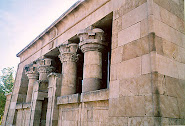
I think these two goddesses must be related - I found them in Barbara Walker's "The Woman's Encyclopedia of Myths and Secrets" --
Chicomecoatl
Mexican Goddess similar to Demeter, called Heart of the Earth, and ancestress of all peoples. No god could equal her in power. She was usually accompanied by a young savior son, a fertility-sacrifice. Her angelic messengers were seven serpents.(1)
Notes:
Neumann, G.M., 182.
Chimalman
Virgin mother of the Aztec savior Quetzalcoatl; one of "three divine sisters." She was the same Triple Goddess worshipped around the world in Virgin, Mother, and Crone aspects. See Trinity.
So it doesn't seem to make any difference - Old World or New World - the goddess archetypes are the same.
Showing posts with label Chicomecoatl. Show all posts
Showing posts with label Chicomecoatl. Show all posts
Sunday, June 6, 2010


Sunday, August 9, 2009
Goddess: Maize Goddess Chicomecoatl - Follow-up
 Prior post. Following-up on my comment to Carlos in response to his comment under the original post, I am not able to post images in a comment, so I thought I would post some images here, to show the remarkable coincidence of imagery between the old world and the new.
When I first saw Chicomecoatl, I was very much struck by the "tower"-like crown she wears. It reminded me of other Goddesses I've seen wearing similar headdresses/crowns.
Here is an image of the Goddess Cybele (which may be from Pergamum) - I was wrong in the information in my post - this is NOT the image of Cybele sent to Rome in c. 204 BCE. That Cybele was a sacred Black Stone that fell from the sky (a meterorite), similar to many other sacred Black Stones from Heaven worshipped as the Goddess -- Diana of Ephesus, for instance, and the sacred Black Stone in the Kabala at Mecca, which pre-dates the foundation of Islam. I do not have a date on this Cybele. By the way, Diana of Ephesus was also often depicted with a tower-like crown, many-breasted, and with cornucopias of fruit and grains.
 There are many sculptures and icons, going back as far as Catyl Hoyuk, showing a Goddess seated on a throne flanked by two lions, often wearing a towering crown or an actual tower as a crown. Here is an image of the Syrian goddess Atargatis, also known as Dea Syria by the Romans: Goddess wearing an impressive mural crown and flanked by doves, probably Artargatis identified with Aphrodite/Venus. Relief from the temple of Adonis at Duro-Europos. Dated to around the 1st century BCE. (Bilde attributes it to Khirbet Et-Tannur.)Drawing © S. Beaulieu, after Bilde 1990: 175, fig. 7.
More tomorrow - got to show down now - another severe thunderstorm with a lot of lightning is rolling through now. I can see this is going to be a sleepless night. Time to pull out a good book.
Thursday, August 6, 2009
Maize Goddess Monolith Restored

ArtDaily.org carried the story. Here is the press release from the Institudo Nacional de Antropologia e Historia (English pages) (photo from press release).
Late Post Classic Maize Goddess Sculpture Restored
August 4, 2009
Chicomecoatl monolith found recently in Zempoala municipality, Hidalgo, 500 years old, which represents the goddess of maize, was restored by National Institute of Anthropology and History specialists and now historical research has begun.
The archaeological finding associated to Mexica culture dated between 1430 and 1520 was found in July 2009 by employees of a private company, notifying immediately the Hidalgo INAH Center, which proceeded to remove and guard it.
The 60 centimeters tall sculpture represents the Mexica maize goddess, Chicomecoatl, linked to fertility. She carries 2 corncobs on each hand, and has an orifice in the chest, where a greenstone or “chalchiutlicue”, which represents the flower of life, was inlaid.
Archaeologist Osvaldo Sterpone, in charge of moving the piece to Pachuca and who will coordinate historical research, mentioned that the orifice was covered with red colored lime that matched the stone that has to be identified yet. He remarked the stone sculpture was found near Santa Ana Archaeological Site.
Sterpone commented that the sculpture may be dated in Late Post Classic period, when Mexica Empire controlled this region to obtain obsidian and other material that they traded.
Restoration of Chicomecoatl, which presents an excellent conservation state, was in charge of Virginia Carrasquel, from Hidalgo INAH Center, who leaded cleaning, stabilization and preservation tasks before being exposed at Zempolala Community Museum for 2 days.
After it returned to Hidalgo INAH Center, the piece was guarded at the cultural goods warehouse, where Chicomecoatl will be studied to determine the influence it had in the region.
Regarding the context of the finding, archaeologist Sterpone mentioned that no other element associated to the sculpture was found in the sand mine located at San Pedro Tlaquilpan.
“There are not regional archaeological studies about Chicomecoatl, so we will base on historical sources. In this sense, a similar sculpture was found during the 1970´s decade in Autonomous University of the State of Hidalgo” concluded the archaeologist.
Subscribe to:
Posts (Atom)