From Hurriyet News Online
Sculpture found in ancient city
July/12/2012
ÇANAKKALE - Anatolia News Agency
A sculpture depicting the goddess Artemis and estimated to be about 1800 years old has been discovered at an excavation site at the ancient city of Parion, near the village of Kemer in the Biga district of the northwestern province of Çannakale.
The excavation is being conducted by Professor Cevat Başaran, an instructor in the archaeology department at Erzurum’s Atatürk University, and is being carried out in six zones of the ancient city.
The marble sculpture was dug out in pieces at Odeion, one of the six excavation sites. Başaran, the head of the excavation, has announced that the sculpture depicts a clothed woman, is 1.70 cm tall and approximately 1,800 years old, and is a high quality sculpture of its kind. The excavators also found marble sculptures depicting animals including sheep and dogs.
“The bow and arrow in her hand indicates that the sculpture belongs to Artemis [Diana], the goddess of hunting, the wilderness and wild animals,” Başaran said.
Showing posts with label Goddess Diana. Show all posts
Showing posts with label Goddess Diana. Show all posts
Sunday, July 15, 2012


Tuesday, November 16, 2010
Temple of Diana Discovered
From adnkronos.com
Italy: Temple of goddess of virgins, wild animals, unearthed
Rome, 16 Nov. (AKI) - An almost 2,000 year-old Roman temple dedicated to Diana, the goddess of virgins and wild animals, has been unearthed in a protected park in the Italian region of Tuscany.
The ancient religious sanctuary, found in the Maremma national park is 350 square metres large, and was discovered in perfect condition by a team of Italian and other European archaeologists following a two-year dig.
Traditionally, Diana is known as the 'virgin' goddess charged with protecting women. According to mythology, Diana, along with goddesses Minerva and Vesta, swore to never marry, but the goddess is also associated with wild animals and nature, and so bears a second title of 'Diana, goddess of the hunt.'
The temple, which has some seven internal rooms, also contained several items that were unearthed during the dig including 35 oil lamps, 10 coins, a bronze dog-shaped votive, two glass vials and mosaic decorations. Three statues of Diana and her twin brother, Apollo, were also uncovered.
The temple dates between the end of the 2nd and beginning of the 3rd century AD.
Italy: Temple of goddess of virgins, wild animals, unearthed
Rome, 16 Nov. (AKI) - An almost 2,000 year-old Roman temple dedicated to Diana, the goddess of virgins and wild animals, has been unearthed in a protected park in the Italian region of Tuscany.
The ancient religious sanctuary, found in the Maremma national park is 350 square metres large, and was discovered in perfect condition by a team of Italian and other European archaeologists following a two-year dig.
Traditionally, Diana is known as the 'virgin' goddess charged with protecting women. According to mythology, Diana, along with goddesses Minerva and Vesta, swore to never marry, but the goddess is also associated with wild animals and nature, and so bears a second title of 'Diana, goddess of the hunt.'
The temple, which has some seven internal rooms, also contained several items that were unearthed during the dig including 35 oil lamps, 10 coins, a bronze dog-shaped votive, two glass vials and mosaic decorations. Three statues of Diana and her twin brother, Apollo, were also uncovered.
The temple dates between the end of the 2nd and beginning of the 3rd century AD.
Wednesday, July 21, 2010
Sculpture of Diana Discovered
om english.blic.rs
Archeologists found sculpture of Diana, Goddess of hunt
S. Božinović | 21. 07. 2010. - 00:02h | Foto: S. Božinović
 At the site of the ‘Felix Romuliana’, an imperial palace near the Town of Zajecar, German experts of the Archeology Institute in Frankfurt, together with the colleagues of the Archeology Institute in Belgrade have discovered a sensational sculpture, unique in this area of the Balkans. This marble statue originates from the first half of the third century.
As ‘Blic’ learns unofficially, it is most likely a sculpture of Diana, the Goddess of the hunt. At the National Museum in Zajecar we were told that this discovery has been the most significant one since finding of archvault in 1984 with the inscription ‘Felix Romuliana’ and a head of Galerius in 1993.
It is supposed that the sculpture symbolizes victory by Rome over barberians. Unfortunately a fragment of the sculpture (a horse and a rider) is missing. The rider is believed to be Diana.
Experts claim that this discovery is absolutely precious for studying of the ‘Romuliana’, but for the world culture as well.
Huge interest of experts from all over the world is expected.
The German archeologists using geomagnetic and geophysics method of search outside the imperial palace have discovered about fifty objects. Recently a new three-year agreement on cooperation has been signed with the Institute in Frankfurt.
The ‘Felix Romuliana’ contains numerous floor mosaics and remains of monumental temples and buildings. The Portrait of Emperor Galerius, heads of Hercules and Jupiter, mosaic presentations of Dionis, Labyrinth and Venator are the very best of the Roman art of that time.
Added July 22, 2010:
 Here is a photo of the sculpture from a different perspective - it is a boar that the dog is bringing down, as was pointed out by Anthony in his comment, thank you. A boar makes much more sense than a small horse, LOL, but I just did not see "boar" in the first photograph - it looked like a small horse with a mane, I did not see the tusks at all! (Photo credit: Tanjug)
This article has some more information about the sculpture:
Rare Roman sculpture found near eastern town
21 July 2010 | 10:31 -> 13:54 | Source: Blic
Zaječar -- A 3rd century AD sculpture was discovered in Serbia's Felix Romuliana archaeological site in the east of the country.
The sculpture is believed to be representing Diana, the Roman goddess of the hunt.
Serbian archaeologists and their German colleagues worked on the dig near the town of Zaječar, daily Blic reports, and adds the discovery is nothing short of "sensational", and unique in the Balkans.
The marble statue was found north of the Emperor's Palace location - a settlement that was built before Romuliana itself.
The Zaječar National Museum said that the find ranks among the most important since the 1984 discovery of a tabled with the words Felix Romuliana inscribed on it.
The Roman palace on that location was built from 297 until 311 AD.
The sculpture, believed to have been made to celebrate Roman victories over barbarians, shows a wild boar pierced with a spear, a hunting dog at one of its legs, and two horse hoofs. However, the horse itself and the rider - that archaeologists believe would have been Diana - are missing.
Archeologists found sculpture of Diana, Goddess of hunt
S. Božinović | 21. 07. 2010. - 00:02h | Foto: S. Božinović

As ‘Blic’ learns unofficially, it is most likely a sculpture of Diana, the Goddess of the hunt. At the National Museum in Zajecar we were told that this discovery has been the most significant one since finding of archvault in 1984 with the inscription ‘Felix Romuliana’ and a head of Galerius in 1993.
It is supposed that the sculpture symbolizes victory by Rome over barberians. Unfortunately a fragment of the sculpture (a horse and a rider) is missing. The rider is believed to be Diana.
Experts claim that this discovery is absolutely precious for studying of the ‘Romuliana’, but for the world culture as well.
Huge interest of experts from all over the world is expected.
The German archeologists using geomagnetic and geophysics method of search outside the imperial palace have discovered about fifty objects. Recently a new three-year agreement on cooperation has been signed with the Institute in Frankfurt.
The ‘Felix Romuliana’ contains numerous floor mosaics and remains of monumental temples and buildings. The Portrait of Emperor Galerius, heads of Hercules and Jupiter, mosaic presentations of Dionis, Labyrinth and Venator are the very best of the Roman art of that time.
*****************************************************************
They can tell that the rider from the missing horse/rider duo was the Goddess Diana? How do they know the horse had any rider at all? And how do they actually know it was a horse, since it looks like the entire thing is missing! Based on what's shown - which looks like some kind of very large dog bringing down a miniature horse - this is hardly what I would call a sculpture of Diana the Huntress! Guess I expect too much from my antiquities, heh?Added July 22, 2010:
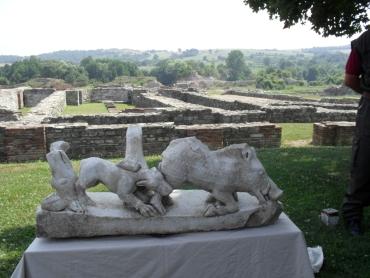

This article has some more information about the sculpture:
Rare Roman sculpture found near eastern town
21 July 2010 | 10:31 -> 13:54 | Source: Blic
Zaječar -- A 3rd century AD sculpture was discovered in Serbia's Felix Romuliana archaeological site in the east of the country.
The sculpture is believed to be representing Diana, the Roman goddess of the hunt.
Serbian archaeologists and their German colleagues worked on the dig near the town of Zaječar, daily Blic reports, and adds the discovery is nothing short of "sensational", and unique in the Balkans.
The marble statue was found north of the Emperor's Palace location - a settlement that was built before Romuliana itself.
The Zaječar National Museum said that the find ranks among the most important since the 1984 discovery of a tabled with the words Felix Romuliana inscribed on it.
The Roman palace on that location was built from 297 until 311 AD.
The sculpture, believed to have been made to celebrate Roman victories over barbarians, shows a wild boar pierced with a spear, a hunting dog at one of its legs, and two horse hoofs. However, the horse itself and the rider - that archaeologists believe would have been Diana - are missing.
Sunday, August 9, 2009
Goddess: Maize Goddess Chicomecoatl - Follow-up
 Prior post. Following-up on my comment to Carlos in response to his comment under the original post, I am not able to post images in a comment, so I thought I would post some images here, to show the remarkable coincidence of imagery between the old world and the new.
When I first saw Chicomecoatl, I was very much struck by the "tower"-like crown she wears. It reminded me of other Goddesses I've seen wearing similar headdresses/crowns.
Here is an image of the Goddess Cybele (which may be from Pergamum) - I was wrong in the information in my post - this is NOT the image of Cybele sent to Rome in c. 204 BCE. That Cybele was a sacred Black Stone that fell from the sky (a meterorite), similar to many other sacred Black Stones from Heaven worshipped as the Goddess -- Diana of Ephesus, for instance, and the sacred Black Stone in the Kabala at Mecca, which pre-dates the foundation of Islam. I do not have a date on this Cybele. By the way, Diana of Ephesus was also often depicted with a tower-like crown, many-breasted, and with cornucopias of fruit and grains.
Prior post. Following-up on my comment to Carlos in response to his comment under the original post, I am not able to post images in a comment, so I thought I would post some images here, to show the remarkable coincidence of imagery between the old world and the new.
When I first saw Chicomecoatl, I was very much struck by the "tower"-like crown she wears. It reminded me of other Goddesses I've seen wearing similar headdresses/crowns.
Here is an image of the Goddess Cybele (which may be from Pergamum) - I was wrong in the information in my post - this is NOT the image of Cybele sent to Rome in c. 204 BCE. That Cybele was a sacred Black Stone that fell from the sky (a meterorite), similar to many other sacred Black Stones from Heaven worshipped as the Goddess -- Diana of Ephesus, for instance, and the sacred Black Stone in the Kabala at Mecca, which pre-dates the foundation of Islam. I do not have a date on this Cybele. By the way, Diana of Ephesus was also often depicted with a tower-like crown, many-breasted, and with cornucopias of fruit and grains.
 There are many sculptures and icons, going back as far as Catyl Hoyuk, showing a Goddess seated on a throne flanked by two lions, often wearing a towering crown or an actual tower as a crown. Here is an image of the Syrian goddess Atargatis, also known as Dea Syria by the Romans: Goddess wearing an impressive mural crown and flanked by doves, probably Artargatis identified with Aphrodite/Venus. Relief from the temple of Adonis at Duro-Europos. Dated to around the 1st century BCE. (Bilde attributes it to Khirbet Et-Tannur.)Drawing © S. Beaulieu, after Bilde 1990: 175, fig. 7.
More tomorrow - got to show down now - another severe thunderstorm with a lot of lightning is rolling through now. I can see this is going to be a sleepless night. Time to pull out a good book.
There are many sculptures and icons, going back as far as Catyl Hoyuk, showing a Goddess seated on a throne flanked by two lions, often wearing a towering crown or an actual tower as a crown. Here is an image of the Syrian goddess Atargatis, also known as Dea Syria by the Romans: Goddess wearing an impressive mural crown and flanked by doves, probably Artargatis identified with Aphrodite/Venus. Relief from the temple of Adonis at Duro-Europos. Dated to around the 1st century BCE. (Bilde attributes it to Khirbet Et-Tannur.)Drawing © S. Beaulieu, after Bilde 1990: 175, fig. 7.
More tomorrow - got to show down now - another severe thunderstorm with a lot of lightning is rolling through now. I can see this is going to be a sleepless night. Time to pull out a good book.
Sunday, March 15, 2009
The Great Temple of Artemis - Cattle Feeding Grounds
Story from the Hurriyet Daily News.com
Monday, March 16, 2009 00:19
Temple of Artemis site suffers neglect
ISTANBUL - The site of the historic Temple of Artemis at Ephesus, considered one of the Seven Wonders of the Ancient World, looks more like a zoo these days as ducks, geese, chickens and sheep wander around its unfenced grounds.
Visited by approximately 1.5 million people a year, the temple lies within the boundaries of the Selçuk district in Aydın. Built by Croesus, the king of Lydia from around 560 to 550 B.C., it was burned down in 356 B.C. by a man called Herostratus who wanted to immortalize his name. Afterward, the temple was rebuilt on the same scale as the original, but three meters higher.
The temple, the biggest of the Hellenistic age, was also famous for its great marble statues, measuring 55 to 115 meters tall. The reconstructed building was razed by the Goths in 262 A.D. and was not rebuilt again.
The first excavations
J.T. Wood initiated the first archaeological excavations at Ephesus in 1869 on behalf of the British Museum. After 1904, Wood’s quest to discover the ancient Temple of Artemis was carried on by D.G. Hogarth. The excavations continue today under the supervision of the Archaeological Institution of Austria. Many artifacts found at the temple were brought to the British Museum, while others are housed at the Vienna Museum.
Antipater of Sidon, who listed the Seven Wonders of the Ancient World, described the temple in this way: "I have gazed on the walls of impregnable Babylon along which chariots may race, and on the Zeus by the banks of the Alpheus. I have seen the hanging gardens and the Colossus of Helios, the great man-made mountains of the lofty pyramids and the gigantic tomb of Mausolus, but when I saw the sacred house of Artemis that towers to the clouds, the others were placed in the shade, for the sun itself has never looked upon its equal, outside Olympus."
Protecting the site
Though by its nature an important tourism spot, the Temple of Artemis retains little of its former glory. Only one column is still erect while remnants of others lie on the ground. Representatives of the tourism industry want to see this pitiful state improved. They are asking to have informational signs put up at the site to guide tourists and a mockup of the temple to be built there based on the building's known architectural structure. They also want to have a fence put around the area to keep animals and cattle from roaming around the ruins.
Monday, November 24, 2008
Kim Cattrall as Titian's Diana
 (Photo of Kim Cattrall, 2007, from the Do Something blog)
What a great story! I've never seen Sex in the City - not even in re-runs! I did add the recent movie to my Netflix list and it will be delivered in due course. I remember Cattrall for remarkable green eyes and being incredibly gorgeous and a good sport in "Big Trouble in Little China."
Cattrall recreates art masterpiece
4 hours ago
Sex And The City star Kim Cattrall has posed semi-naked in a recreation of Titian's masterpiece Diana and Actaeon.
BBC Two's The Culture Show challenged Tom Hunter to create a 21st century version of the painting after he backed the campaign to raise £50 million to keep the artwork on public display.
The painting shows Actaeon, while out hunting, accidentally happening upon the secret bathing place of Diana, chaste goddess of the hunt, incurring her fury.
The National Galleries of Scotland and the National Gallery, London, have until the end of the year to raise the total sum to buy it, after which time it may be sold on the open market.
Cattrall, who is from British descent, is a regular visitor to the National Gallery and a huge admirer of Titian's work. She said that viewing this painting is "like being in the presence of genius... it would be a tragedy if it were not on public view".
Hunter is known for his recreation of old masters and is the only photographer to have had an exhibition at the National Gallery.
He rose to the challenge of recreating Diana and Actaeon, enlisting Cattrall, who plays man-eater Samantha in Sex And The City, to take the starring role.
Hunter said: "Kim is the perfect Diana. Just like the Greek goddess, she combines beauty with a sense of threat. She was a great sport and at 52 made an amazing Diana. She more than held her own among a room full of twentysomethings.
"The picture can't of course hold a candle to the original which deserves to remain on public view. This painting is sublime and to lose it to a private collection would be a tragedy."
Also featured in Hunter's version of Titian's painting are arts students from the Courtauld Institute and performers from West End burlesque show La Clique. The photograph was taken at the Arts Club in London's Mayfair.
Copyright © 2008 The Press Association. All rights reserved.
(Photo of Kim Cattrall, 2007, from the Do Something blog)
What a great story! I've never seen Sex in the City - not even in re-runs! I did add the recent movie to my Netflix list and it will be delivered in due course. I remember Cattrall for remarkable green eyes and being incredibly gorgeous and a good sport in "Big Trouble in Little China."
Cattrall recreates art masterpiece
4 hours ago
Sex And The City star Kim Cattrall has posed semi-naked in a recreation of Titian's masterpiece Diana and Actaeon.
BBC Two's The Culture Show challenged Tom Hunter to create a 21st century version of the painting after he backed the campaign to raise £50 million to keep the artwork on public display.
The painting shows Actaeon, while out hunting, accidentally happening upon the secret bathing place of Diana, chaste goddess of the hunt, incurring her fury.
The National Galleries of Scotland and the National Gallery, London, have until the end of the year to raise the total sum to buy it, after which time it may be sold on the open market.
Cattrall, who is from British descent, is a regular visitor to the National Gallery and a huge admirer of Titian's work. She said that viewing this painting is "like being in the presence of genius... it would be a tragedy if it were not on public view".
Hunter is known for his recreation of old masters and is the only photographer to have had an exhibition at the National Gallery.
He rose to the challenge of recreating Diana and Actaeon, enlisting Cattrall, who plays man-eater Samantha in Sex And The City, to take the starring role.
Hunter said: "Kim is the perfect Diana. Just like the Greek goddess, she combines beauty with a sense of threat. She was a great sport and at 52 made an amazing Diana. She more than held her own among a room full of twentysomethings.
"The picture can't of course hold a candle to the original which deserves to remain on public view. This painting is sublime and to lose it to a private collection would be a tragedy."
Also featured in Hunter's version of Titian's painting are arts students from the Courtauld Institute and performers from West End burlesque show La Clique. The photograph was taken at the Arts Club in London's Mayfair.
Copyright © 2008 The Press Association. All rights reserved.
Subscribe to:
Posts (Atom)























