Tuesday, July 27, 2010

Major Mummy Exhibition Coming to Milwaukee Public Museum!!!

Milwaukee Public Museum to host world's largest traveling mummy exhibit
By Jackie Loohauis-Bennett of the Journal Sentinel

Posted: July 27, 2010 10:34 a.m.

The Milwaukee Public Museum said Tuesday it will display the largest temporary exhibit of mummies and related artifacts ever assembled in the world when the museum opens a new exhibit starting Dec. 17.

The exhibit, "Mummies of the World," will include more than 150 real human and animal mummies from around the globe.

The [Milwaukee Public] museum is only the second venue to host the traveling exhibit.
**********************************************************************
The first U.S. stop for the exhibit is the California Science Center, which will host it through the end of summer.  (Photo from Guardian.co.uk article).

It then travels to Milwaukee -- I imagine it will take over the space temporarily in the Tells, Temples and Tombs permanent exhibit space. 

This is a real coup for Milwaukee.  How well I remember the fantastically wonderful "The Quest for Immortality" exhibit back in 2004 - the Museum scored record crowds and had a packed lecture hall most evenings as Milwaukeeans and people from Chicago, Minneapolis, Indianapolis and elsewhere either drove to or flew into Milwaukee to see the rare exhibit.  To score another great event like this is so exciting for the city.  I know Milwaukeeans will turn out for the exhibit. 

Of course, it is not just Egyptian mummies featured in this one-of-a-kind exhibit.  There are, literally, mummies from all over the world, all different places, all different times and conditions.  Which makes it even more remarkable and a once in a lifetime opportunity to see it in my own home town!  Check out the photo exhibition in the article at the Guardian to get an idea of the scope of what will be presented.  Amazing, absolutely amazing.

Monday, July 26, 2010

2010 Nana Aleksandria Cup

Held in Poti, Georgia, July 9 - 19, 2010.  The Cup is named after the much loved Nana Aleksandria, a Georgian chessplayer who vied several times for the Women's World Chess Champion title and won many individual Olympiad medals, accolodades and honors during her active playing career.  English website.  The Nana Aleksandria Cup is part of a very large international chess festival that includes Boys and Girls U8, U10, U12, and U14 events. 

The final standings from the Open:

Rk. Name FED Rtg Pts. TB1
1 GM Shanava Konstantine GEO 2556 7,5 39,5
2 GM Pantsulaia Levan GEO 2586 7,0 36,5
3 IM Azaladze Shota GEO 2443 6,5 36,5
4 Mammadov Zaur Fazahir Oglu AZE 2302 6,5 36,0
5 IM Benidze Davit GEO 2508 6,5 32,0
6 WIM Mikadze Miranda GEO 2360 6,5 31,5
7 IM Nigalidze Gaioz GEO 2478 6,0 34,0
8 Javakhadze Zurab GEO 2354 6,0 31,0
9 IM Shalamberidze Akaki GEO 2348 6,0 28,5
10 Shengelia Nikoloz GEO 1929 6,0 27,0
11 Zarkua Davit GEO 2350 5,5 30,5
12 FM Al-Ali Hussein Ali Hussein IRQ 2373 5,5 30,0
13 Gelazonia Parmen GEO 2313 5,5 29,5
14 IM Lomineishvili Maia GEO 2370 5,5 28,5
Lortkipanidze Nodar GEO 2211 5,5 28,5
16 WIM Arabidze Meri GEO 2286 5,5 26,5
17 Nikolashvili Giorgi GEO 2302 5,0 27,0
WGM Guramishvili Sopiko GEO 2298 5,0 27,0
FM Gamzardia Giorgi GEO 2188 5,0 27,0
20 Makharadze Jambul GEO 2392 5,0 26,0
21 WFM Bokuchava Madona GEO 2120 5,0 24,0
22 Tsomaia Sergo GEO 1989 5,0 21,0
23 Tsereteli Kakhaber GEO 1977 5,0 20,5
Modebadze Tariel GEO 1915 5,0 20,5
Tsomaia Merab GEO 1897 5,0 20,5
26 Lomsadze Davit GEO 2364 4,5 29,0
27 WGM Khmiadashvili Tamar GEO 2171 4,5 24,0
Khelaia Giorgi GEO 2115 4,5 24,0
29 Pipia Beka GEO 1962 4,5 23,5
30 Shurghulaia Giorgi GEO 2097 4,5 22,5
31 Kilasonia Levan GEO 2073 4,5 20,5
Kobeshavidze Lika GEO 1929 4,5 20,5
33 Anakidze Nino GEO 1965 4,5 20,0
34 IM Maghalashvili Davit GEO 2465 4,0 26,0
35 Kumsiashvili Nikoloz GEO 1969 4,0 23,0
36 Ammar Abdul Jabbar Aliwy IRQ 2181 4,0 22,0
37 Hamandi Mohammed Nawfel Karim IRQ 2258 4,0 21,0
38 Rizhamadze Patman GEO 2037 4,0 19,0
39 Mangiashvili Otar GEO 1806 4,0 15,0
40 FM Ali Ghassan M IRQ 2138 3,5 23,0
41 FM Ali Layth Ahmed IRQ 2296 3,5 22,0
42 Bibilashvili Lali GEO 2001 3,5 17,5
43 WFM Kharatyan Anahit ARM 2080 3,5 17,0
44 Gorduladze Giorgi GEO 1812 3,5 15,5
Tedoshvili Dimitri GEO 1808 3,5 15,5
46 Kosashvili Otar GEO 1812 3,5 15,0
47 Madoyan Iolanta GEO 1748 3,5 14,5
48 Chachibaia Parviz GEO 0 3,5 13,0
49 Malania Vakhtang GEO 0 3,5 9,0
50 GM Kotanjian Tigran ARM 2551 3,0 22,0
51 Svanidze Tamaz GEO 0 3,0 13,0
52 Tsirekidze Giorgi GEO 1836 3,0 10,5
53 Vasiltseva Mariam GEO 0 2,5 15,5
54 Kashia Vakhtang GEO 1720 2,5 14,0
55 Petriashvili Elene GEO 0 2,0 9,0
56 Khutsishvili Levan GEO 0 1,5 7,5
57 Benidze Koba GEO 0 1,0 7,0

Turkish Women's Chess Championship

July 8 - 15, 2010 Konya, Turkey
Organized by the Turkish Chess Federation
A very large event for a national championship - 55 players!  Several of the players came to the Championship with no ELO!  The championship was won by WIM Betul Cemre Yildiz with 8.5/9.  Here are the final standings from the official website:

Sira SNo. isim NRtg IRtg FED Puanlar BH. BH. SB.


1 2 WIM Yildiz Betul Cemre 2264 2235 TUR 8½ 46 41½ 47,25  (photo of the winner)
2 4 Kaya Emel 2009 2015 TUR 7 50 45 40,00
3 9 Patel Yesim 1847 1806 TUR 7 43½ 39 36,00
4 1 WIM Ozturk Kubra 2130 2286 TUR 6½ 49½ 44½ 37,75
5 5 Sop Selen 2014 1988 TUR 6½ 49 44½ 35,00
6 6 Sasmazel Burcu 2006 1876 TUR 6 51 45½ 34,25
7 10 Cemhan Kardelen 1909 1777 TUR 6 46 41½ 30,00
8 14 Ozturk Hilal 1710 1671 TUR 6 41 37 27,75
9 15 Şahin Handenur 1610 1669 TUR 6 40 36 27,25
10 11 Abdimanoglu Beste Basak 1780 1765 TUR 5½ 49½ 44½ 26,75
11 7 Menzi Nezihe Ezgi 1978 1851 TUR 5½ 47 42½ 27,25
12 8 Durmaz Ayca Fatma 1953 1807 TUR 5½ 46 41 27,00
13 3 WFM Yanik Süral Emine 1826 2037 TUR 5½ 43½ 38½ 26,50
14 13 Borekcioglu Zeynep Dilara 1804 1673 TUR 5½ 42 38 24,00
15 23 Isparta Sevim 1751 1605 TUR 5½ 41½ 38 24,00
16 21 Nurlu Selin 1700 1616 TUR 5½ 37 34 19,00
17 20 Firat Deniz 1657 1621 TUR 5 43 39 20,50
18 18 Yolal Sena Gokcen 1703 1662 TUR 5 42½ 38½ 22,25
19 16 Oney Gülümser 1789 1665 TUR 5 40½ 36½ 20,50
20 28 Gundogan Sinem Cagla 1644 0 TUR 5 39 36 19,00
21 30 Alic Gunseli 1585 0 TUR 5 39 35½ 18,50
22 22 Ulusoy Nisan 1622 1613 TUR 5 39 34½ 21,75
23 31 Karsiyaka Simge 1580 0 TUR 5 38½ 35 17,50
24 19 Akgul Beyza 1657 1641 TUR 5 37½ 34 16,50
25 33 Aksoy Ayça 1558 0 TUR 5 36½ 33½ 16,50
26 24 Aslan Cagla Yaren 1652 1572 TUR 5 35½ 32½ 18,50
27 17 Keskin Suara 1712 1662 TUR 4½ 44 40½ 18,50
28 26 Tandogan Buket 1717 1545 TUR 4½ 43 39 20,50
29 12 Sanal Suna 1780 1713 TUR 4½ 38 34 19,50
30 29 Sahin Hatice 1599 0 TUR 4½ 37 34 15,75
31 25 Alev Gonulden Seda 1682 1565 TUR 4½ 36½ 33 18,75
32 42 Kadiroğlu Ekinsu 1294 0 TUR 4 37 34 14,50
33 43 Hereklioğlu Sude 1226 0 TUR 4 36 33 15,00
34 27 Yilmaz Fatma Zumrut 1580 1532 TUR 4 35½ 32 14,50
35 36 Onur Çiğdem 1440 0 TUR 4 35 32 13,00
37 Yassibağ İpek 1341 0 TUR 4 35 32 13,00
37 40 Okuyaz Duru 1318 0 TUR 4 34½ 31½ 13,50
38 55 Özer Remziye 0 0 TUR 4 34½ 31½ 13,50
39 38 Çelik Eda 1324 0 TUR 4 33 30 12,50
40 46 İlter Nilay 1110 0 TUR 4 31 28 11,50
41 34 Ozel Zeynep 1508 0 TUR 3½ 38 35 12,25
42 32 Ozel Meryem 1565 0 TUR 3 39½ 36 11,50
43 52 Söyümez İlayda 0 0 TUR 3 33 30 8,50
44 39 Gökçen Feyza Gül 1320 0 TUR 3 32½ 29½ 9,00
45 41 Çevik Pınarsu Emre 1313 0 TUR 3 32 29 8,00
46 45 Başpınar Lara 1148 0 TUR 3 31 28 8,00
47 47 Keskin Isra Damla 1068 0 TUR 3 30 27 7,00
48 53 Turan Mürşide 0 0 TUR 3 29 27 7,50
49 51 Söyümez Fatma 0 0 TUR 3 26½ 25½ 4,00
50 54 Turan Nefise 0 0 TUR 3 26½ 24½ 5,00
51 44 Veske Ceylan 1205 0 TUR 2 29 28 2,00
52 49 Atalay Merve 0 0 TUR 2 25½ 24½ 2,00
53 50 Atalay Şeyma 0 0 TUR 1½ 24½ 23½ 5,00
54 48 Ar Leylahan 0 0 TUR 1½ 24 23 5,00
55 35 Arkan Yaren 1476 0 TUR 0 36 31½ 0,00

3rd Maria Abulet Memorial

Information from The Week in Chess
The 3rd edition of the "Maria Albulet" Memorial Romanian International Tournament for women took place in the Theater of Braila (port on the Danube) July 15 - 21, 2010. Elena-Luminita Cosma won with 6.5/9 a point clear of the field.

Maria Albulet Mem Braila ROU (ROU), 15-21 vii 2010
1 2 3 4 5 6 7 8 9 0
1. Cosma, Elena-Luminita wg ROU 2337 * ½ 1 ½ ½ ½ ½ 1 1 1 6½ 2363
2. Genova, Lyubka wm BUL 2209 ½ * ½ ½ 1 ½ ½ 1 ½ ½ 5½ 2292
3. Traistaru, Teodora ROU 2194 0 ½ * ½ ½ 1 ½ 1 ½ 1 5½ 2293
4. Makropoulou, Marina wg GRE 2245 ½ ½ ½ * ½ 1 ½ ½ 0 1 5 2251
5. Toma, Katarzyna wm POL 2261 ½ 0 ½ ½ * 0 1 1 ½ 1 5 2249
6. Worek, Joanna wm POL 2232 ½ ½ 0 0 1 * ½ 0 1 1 4½ 2209
7. Partac, Elena wg MDA 2149 ½ ½ ½ ½ 0 ½ * 0 1 0 3½ 2138
8. Uta, Adeline-Ramona ROU 2076 0 0 0 ½ 0 1 1 * 1 0 3½ 2146
9. Sgircea, Silvia-Raluca wf ROU 2199 0 ½ ½ 1 ½ 0 0 0 * ½ 3 2088
10. Dragomirescu, Angela wm ROU 2215 0 ½ 0 0 0 0 1 1 ½ * 3 2086

Sunday, July 25, 2010

Ohhh, I Want To Go to London...

Hmmm, is there a song with that title? 

LOL!  Just a few more photos from that brief visit to London in October, 2002 ...

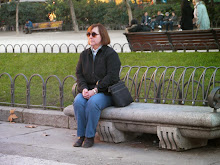
Not the most flattering photo of me, but what the heck - it's London Town! London, oh London...  Does anyone recall the great stage show number that Petula Clark did in the great MGM remake of "Good Bye, Mr. Chips"?  I think Clark went through at least four costume changes in that on-screen musical extravaganza, which catapulted the story of the shy school master and his once-in-a-lifetime-love-affair into 1920's London, transformed into a grand high budget musical with, of all people, Peter O'Toole as Mr. Chips!  I mean, darlings, the IRONY! 

But it was a grand movie, updated into an early 20th century love story between the Mr. Chips character as portrayed by Peter O'Toole (and he was a hunk back then, I have to say, and I believe he received an Oscar nomination for that performance), and Petula Clark, who was a pixy middle-class girl with a Giant's Voice!  The song she did at the - actually filmed onsite - Temple of Apollo - I have not forgotten yet.  It was "Apollo"  and morphed into "And the Sky Smiled Too."

There I am with my folding umbrella and my indestructible Laura Ashley bag (I've still got that bag, LOL!) -- Mr. Don insisted that I do this sort of "TA DA!" out of the phone booth, and I more or less obliged him. Long before Harry Potter, mind you!  It's not really visible in this photo but in the background was the Trocadero Club - I mean, the HISTORIC Tracadero Club, the one that set the mode for all the other Tracadero Clubs all around the world.

During the approximately 8-hour flight over to London from Montreal I'd taken off my shoe-boots as we settled in for dinner, a movie, and then fitful sleep.  My feet had swollen up so much during the "over night" flight that the next morning as we were approaching Heathrow to land, I could not get the damn shoe boots back on my feet!  Finally, shoving and mightily heaving and with some assistance from Mr. Don, I was able to get them back on, but not laced up.  The laces came out, and stayed out until 24 hours after we landed in Madrid.  During the long flight back to Montreal which was, I believe, a direct flight, no transfer in London (I was sick on the way back and do not remember much as I was mostly flopped over Mr. Don who carried me around until we got back to Montreal, by which time I was miraculously restored to health -- but that's another story...) 

[Photo: buses lined up near the Tracadero Club.]  Of course, we wouldn't be Goddesschess folk if we didn't find evidence of the Goddess throughout our trek, which we did, in plenty.  During our brief sojourn in London Town, we came across Charing Cross Station.  I believe there is some legend that has something to do with a King leaving a sign at a crossroads for his beloved "Cher Regina" which eventually became "Charing."  But I don't believe that for a second - it's just a paternalistic 19th century gloss passing as romanticism.  The original spot was undoubtedly a site of ancient Goddess worship, complete with a temple, sacred mound in the near distance and a sacred spring.  It was a cross-roads from early on because it attracted pilgrims to the holy site from all around England, long before the Romans came and long before the English (actually Norman, and later German) kings and queens were instituted.  The photo (right) is of a lampstand at the parking area right outside Charing Cross Station (which is actually located underneath a hotel, at least it was back in October, 2002).  Notice the "globus cruciger" shape - an ancient Goddess symbol that was later co-opted by the local "God-of-the-Day."  The ancient Goddess symbolism refused to die, however.  For instance, there are many depictions of the Virgin Mary, the Mother of God, standing upon such a symbol.  There are also many depictions of Jesus Christ, the Son of God, holding such an artifact in the palm of his - I believe left hand - whilst sitting on the 'The Mother of God's' lap. 

Last, but not least, is this great pic of a horse sculpture captured outside an art gallery near Trafalgar Square.  It was a larger than life bronze, and I was absolutely captivated by it.  Mr. Don took the photo.  It was modelled after one of the famous horses taken from the Elgin Marbles - a large frieze removed in pieces from the Parthenon, perhaps the most famout of Athena's Temples, at Athens, Greece, in the 19th century CE.  A bit of chess history - the "classic" Staunton knight piece, with the horse's lips turned back revealing teeth ready to bite during the heat of battle, with which we are so familiar, was modelled by Staunton's artist after the horses depicted on the Elgin Marbles. 

I Want to Go to London...

Back in October 2002 enroute to Madrid, Mr. Don and I had about an 8-hour layover in London.  We arrived there about 7 a.m. in the morning - on a weekday.  Eventually, after some arguments and a comedy of errors involving Customs, we figured out where to catch the "Tube" that would take us to Picadilly - PICADILLY! 

A few stops after Heathrow, which back then was in the midst of major renovations (I don't think it's ever NOT been in the midst of major renovations, come to think of it...) people going to work starting piling on.  But Mr. Don and I were firmly ensconced on a sort of mod-print purple seats and the Tube obligingly announced it stops and also showed them in digital displays hanging in the center of the cars above everyone's heads.  It was a smooth, inexpensive ride (I'd been willing to fork over 70 pounds for a train ride into and back but Mr. Don insisted there must be a cheaper way to get to "downtown" London, and he was right).  I found the trip absolutely fascinating.  It was so surreal sitting there, watching these people dressed in work clothes pile on to the Tube while Mr. Don and I were tourists.  Near the end of the trip it got a bit crowded but everyone was extremely polite (is that the English way coming to the fore?) and the Tube car itself was spotless and had no unpleasant smells emanating from any obscure corners or from any person en route.  Thank Goddess! 

About 9 a.m. we exited Picadilly and wound our way up some stairs that took us to stret level.  It was drizzling outside, but not overly cold.  OHMYGODDESS, we were there!  I, prepared as always (ahem), pulled out my trusty fold-up umbrella.  Mr. Don, unfortunately, had no hat, no hoody and no umbrella, so he got wet. We'd had an inadequate breakfast at some fast food restaurant or other at the airport while we were arguing about the best way to proceed.  [Photo: A shot of Picadilly Tube station as we were looking around after emerging.]  Above and beyond the absolutely amazing sight of Picadilly Circle itself, the first thing we spotted, in unison, as we turned around to take it all in, smiling hugely at each other, was a STARBUCKS!  LOL!

I don't remember any discussion about it, I believe we headed as one toward that Starbucks, both because we were running on empty and needed some coffee as much as needing a place to sit down and study the maps we'd picked up in the Underground and also to receive some local advice about how to navigate about for our hours in town before we would head back to the airport for our 4:00 p.m. flight. 

We took in as much as we could.  [Photo: St. Martin's Church, outside the Art Museum fronting on Trafalgar Square.]  We'd predetermined that we would need to head back to the airport about 1:00 p.m. for the hour long ride, that would give us 2 hours to clear customs and security.  As it turned out, I do not believe we had to do anything with customs, and security back then was still patchy at best.  We didn't have our shoes off back then and if I did walk through a metal detector I sure don't remember it.  We didn't have any luggage with us - everything had been checked through to our Madrid flight.  As it turned out, we didn't need to get back so early.  And, unfortunaely, our flight was delayed MORE THAN FOUR FRICKING HOURS.  We didn't leave London until about 8:00 p.m. for the 2 hour or so flight to Madrid.  That's another story entirely --

Oh, I so want to go back.  Just the wee small part we saw of London was so wonderful.  We spent a good hour at least in the National Gallery, for instance, and could well have spent a couple of days there.  Mr. Don was able to take several photos but that was in the pre-digital camera days and since we weren't able to use our flashes none of those photos turned out - it was just too dark.  That's too bad because there were some extraordinary paintings in that museum.

We strolled across Trafalgar Square and I took a photo of Mr. Don by one of the large lions of the Trafalgar Monument.  We strolled down historic streets, including past Scotland Yard, which I got a real kick out of doing.  We headed toward Parliament and Big Ben which we had square set in our sights in the distance, but had to turn around to go back to the Picadilly Tube station at 12:50 p.m. (There's Scotland Yard!)

Female Imams in China Forge a New Way

But will they survive?

July 21, 2010
National Public Radio
Female Imams Blaze Trail Amid China's Muslims
by Louisa Lim

It is 5:50 in the morning, and dark shadows scurry through narrow alleys to the mosque, as the call to prayer echoes from a minaret in Kaifeng. This city in central China's Henan province has an Islamic enclave, where Muslims have lived for more than 1,000 years.  [Photo: Ariana Lindquist for NPR

Yao Baoxia is a female ahong, or imam, at Wangjia Hutong Women's Mosque in Kaifeng, in central China. She sits alongside believers during prayers, not in front of them like male imams. She believes male and female imams are equal in their role as teachers and leaders of prayers.]

In an alleyway called Wangjia hutong, women go to their own mosque, where Yao Baoxia leads prayers. For 14 years, Yao has been a female imam, or ahong as they are called here, a word derived from Persian.

As she leads the service, Yao stands alongside the other women, not in front of them as a male imam would. But she says her role is the same as a male imam.

"The status is the same," Yao says confidently. "Men and women are equal here, maybe because we are a socialist country."

China has an estimated 21 million Muslims, who have developed their own set of Islamic practices with Chinese characteristics. The biggest difference is the development of independent women's mosques with female imams, something scholars who have researched the issue say is unique to China.

Yao studied to become an imam for four years, after being laid off from her job as a factory worker. First she studied under a female imam, then with a male imam alongside male students.

Her main role is as a teacher, she says.

"When people come to pray, they don't know how to chant the Quran, so my job is teaching people about Islam, helping them to study one line at a time and leading the prayers," she says.

Mosques Began As Quranic Schools

The modest courtyard of Wangjia Hutong Women's Mosque contains within it the entire history of China's mosques for females. It's the oldest surviving women's mosque in China, with one gray plaque high up on a wall dating back to 1820.

Like other women's mosques, it began as a Quranic school for girls. These sprang up in the late 17th century in central China, including Shanxi and Shandong provinces. They morphed into women's mosques about 100 years ago, starting in Henan province.

Remembering her own childhood, 83-year-old Tang Guiying says even then the women's mosque was the only place a girl could receive education.

"I didn't go to school when I was small," she chuckles. "We were all too poor; none of us girls studied. But I came here to play and study. The old imam was very, very old — she was 80-something, and she had bound feet."

Tang is sitting in the mosque's washroom as she talks. This is where women conduct ritual ablutions before prayer. This space — and the mosque itself — doubles as a social center for these women, the heart of a community.

In Kaifeng, there are 16 women's mosques, one-third the number of mosques for males.

A Unique Chinese Tradition

Shui Jingjun, of the Henan Academy of Social Sciences and co-author of a book on the phenomenon, says that so far there are no women's mosques in other countries. In most of the Muslim world, women pray behind a partition or in a separate room, but in the same mosque as men.

Shui points out that the women's mosques in China are administered independently, by women for women, in addition to being legally separate entities in some cases.

"After reform and opening up [in 1979], some female mosques registered independently, which shows the equality of male and female mosques," she explains.

Controversy still rages in the Muslim world about whether women can be imams. In 2006, Morocco became the first country in the Arab world to officially sanction the training of female religious leaders.

China is the only country to have such a long history of female imams. However, there are things that, according to the customary practices of Chinese Muslims, female imams can't do.

They can't, for instance, lead funeral rituals or wash male corpses.

Forty miles away in the provincial capital of Zhengzhou, white-sashed mourners wail as they process through the streets carrying the coffin from a mosque. No female imams are participating.

Opposition Still Exists To Women's Roles

In central China, most Muslims support the female mosques, but there is some resistance closer to China's border with Pakistan and Afghanistan, closer to the harder-line Wahhabi and Salafi influences.

"Historically in northwestern China, there were no female mosques," says Shui, the researcher. "There was resistance because people thought that building female mosques was against the rules of religion. But in central China and most provinces, people think it's a good innovation for Islam."

In the past decade, some women's mosques have been established in northwest China. The phenomenon appears to be spreading, helped politically by the Islamic Association of China, a state-controlled body that regulates Islam and issues licenses to practice to male and female imams alike.

This is part of the anomaly that is religion in China — the atheist Chinese authorities are endorsing a practice some Muslims find unacceptable.

While there is broad support among Kaifeng's Muslims for female mosques and imams, there is also some opposition.

"The education of Islamic women is a very important job," says Guo Baoguang, of the Islamic Association of Kaifeng. But he admits that he has been criticized for organizing religious education forums for Muslim men and women to take part in together.

"There were some criticisms that women ought to be in the home, and ought not take part in social activities. I think these criticisms are too conservative, and don't account of the importance of women's education in Islam," he says.

Guo believes that when it comes to female imams, China is leading the way.

"Given the fast development of China's economy, and as its political status rises, I think Chinese Islam will become more important in the Islamic world," Guo says. "The developments Chinese Islam has made, like the role played by Chinese women, will be more accepted by Muslims elsewhere in the world."

Greatest Challenge Is Economic

In the women's mosques, most of the faithful are elderly. Young women with families often don't have the time to worship, especially given the lengthy purification rituals several times a day.

Third-generation imam Sun Chengying, who has been practicing for 21 years, worries about the future.

"I haven't had any students since 1996," she says, shaking her head. "Women don't want be imams anymore, because the salaries in the mosques are too low. No one is willing to do it."

Female imams sometimes earn as little as $40 a month, one-third of what can be earned in other jobs. Younger women need to earn more to support their families.

And so it appears the future of female imams in China is threatened — not by the state, not by resistance from inside Islam, but by the forces of market economics.

Cucumbers Originated Not In Africa But In the Eastern Himalayas!

I am a long-time cucumber lover.  I can make an entire meal out of a couple of large cukes.  My favorite recipe is dill cucumbers, thinly sliced, soaked in a mixture of sour cream and mayonaise with fresh chopped dill.  Yum!  Nothing takes the heat of the day away like cold fresh cucumber, simply sliced and lightly dressed with salt and some black pepper!  I also make an excellent cucumber sandwich -- I won an award with it for best hors d'ouerves during our annual Christmas Cooking Contest!  I'm not much of a veggy eater, but any platter that holds cucumbers at a party is promptly raided by yours truly :)

I can say confidently that I've never turned my mind to the origins of the cucumber.  If asked, I might have guessed South America.  But the eastern Himalayas!  Wow!  This just fascinates me.  Who knew?  I'd love to see a Burt Wolf show on this!

From physorg.com
Where the wild veggies are: Cultivated cucumber and melon originated in Asia and Australia
July 20, 2010

Sites of origin and regions of domestication of many of our most important cultivated plants are still unknown. The botanical genus Cucumis, to which both the cucumber (Cucumis sativus) and the honeydew melon (C. melo) belong, was long thought to have originated and diversified in Africa, because many wild species of Cucumis are found there.

"A molecular genetic analysis has now shown that the wild populations that gave rise to melons and cucumbers originated in Asia", says LMU botanist Professor Susanne Renner. "In addition, we have found that 25 related species which have never been formally described are found in Asia, Australia and regions around the Indian Ocean." Future genetic studies on C. sativus and its wild relatives should therefore focus on Asia and Australia. The new results are important because the garden cucumber is one of the most widely cultivated vegetable crops, and the species is among the few flowering plants whose genomes have been fully sequenced.

According to Renner, "Our study would not have been possible without the resources of the Munich herbarium and Botanical Garden. A large fraction of the plants we have been able to sequence was collected in India, Vietnam and Australia during the 19th century, and most were then forgotten in herbaria, that is, collections of dried plant specimens. Many of these come from locations that no longer have natural vegetation, for example, because they were collected at sites that now lie in built-up areas of cities like Hanoi." (PNAS online, July 2010)

The family Cucurbitaceae includes crop plants, such cucumbers, melons, loofah, and pumpkins. In terms of its economic importance, the cucumber is among the top ten crop plants cultivated worldwide, and the related honeydew melon is also of considerable agronomic significance. Species that belong to the genus Cucumis are also popular with botanical researchers. Indeed, the domestic cucumber was the seventh species of flowering plant to have its genome sequenced completely, being preceded by such agricultural heavyweights as rice and grapevine. Over the past 10 years, thousands of scientific papers on the biology of cucumbers and melons have appeared.

Many of these studies have used these species as model systems to investigate the mechanism of sex determination during floral development. The question of the genetic origins of the genus Cucumis, on the other hand, has received comparatively little attention (the business about the Romans cultivating cucumber is wrong; I can send you a paper on this topic if you are interested). The general consensus among botanists has been that the melon originated in Africa, because putative wild ancestors of the cultivated variety had been identified there. It now turns out that none of these forms is ancestral to the melons we find in our markets and shops.

"We analyzed specific segments of the genetic material from herbarium specimens of more than 100 Cucumis species. The samples we used had been collected at various locations in Africa, Australia and Asia", reports Patrizia Sebastian, who is the first author on the new study. "It turned out that the closest living wild relative of the cultivated melon is a native of Australia. The two lines diverged about 3 million years ago, and they last shared a common ancestor with their more distant relatives in Asia and Australia about 10 million years ago." The total number of Cucumis species found in Asia and Australia is now around 25, and they branched off from their African relatives some 12 million years ago.

Nine of the 25 species were identified for the first time in the new study. Renner and her colleagues are preparing formal systematic descriptions of the new species for a specialized journal. Taken together, the results argue that the common ancestor of cucumber and melon originated on the continent of Asia. Possible ancestral populations from which the domesticated forms derive have been localized in the Himalayas. The genetic diversity of the varieties of C. melo that occur in India and China is particularly striking. "Our data also prove that the closest living relative of our garden cucumber is the species C. hystrix, which is found in the Eastern Himalayas", says Renner. "Future investigations of the phylogeny of Cucumis should therefore focus on Asia and Australia."

The new findings once again emphasize the great significance for modern botanical research of the herbarium materials that have been assembled over centuries and are now held in institutions like herbarium of the Bavarian Natural History Collections and the LMU's own herbarium. "Many of the plants we examined in this study were collected in the course of the 19th century, and most were then ignored and forgotten", says Renner, who is Director of these herbaria and the Munich Botanic Garden. "In many ways, this material represents an irreplaceable treasure, because the habitats in which much of it was collected no longer exist. Cucumis debilis, for instance, no longer grows at the location from which it was last collected in 1931. The site is now a suburb of Hanoi."

More information: Cucumber (Cucumis sativus) and melon (C. melo) have numerous wild relatives in Asia and Australia, and the sister species of melon is from Australia, Patrizia Sebastian, Hanno Schaefer, Ian R. H. Telford, and Susanne S. Renner, PNAS online, week of July 19 2010.

Provided by Ludwig-Maximilians-Universität München

Chinese Civilization Older Than Previously Supposed

It seems I have reported on this story already - but, just in case --

From People's Daily Online
Evidence suggests Chinese civilization even more ancient
15:53, July 23, 2010

Objects from the Taosi ruins in Shanxi Province that suggest Chinese civilization began around 4200 B.C., 500 years earlier than scholars had previously believed, will be displayed in the Capital Museum from July 29 to Oct. 10.

The Capital Museum and the Archaeology Institute of the Chinese Academy of Social Sciences will hold an archaeological exhibition containing the major achievements of the Archaeology Institute in the past 60 years and 70 percent of the content will be exhibited to the public for the first time.

It is generally believed that Chinese civilization began with the Xia Dynasty. However, recent archaeological discoveries at the Taosi ruins in Xiangfen County, Shanxi Province suggest the elements that form a civilization, including written characters, bronze ware and cities, all emerged as early as the Yao Dynasty.

Wangwei, director of the Archaeology Institute of the Chinese Academy of Social Sciences, said the recent archaeological achievements at the Taosi ruins will be displayed in the exhibition, and as one of the projects that retraces the origins of Chinese civilization, those discoveries will "change history."

Source: Beijing Times, Translator: Ye Xi

World's Oldest Domesticated Dog Remains Debated

World's Oldest Dog Debated
A dog jaw bone fossil found in a Swiss cave may be the oldest evidence of human-canine companionship. .Fri Jul 23, 2010 11:49 AM ET
Content provided by Bruce Bower, Science News

Every dog has its day, but that day took more than 14,000 years to dawn for one canine. A jaw fragment found in a Swiss cave comes from the earliest known dog, according to scientists who analyzed and radiocarbon-dated the fossil. (Image a "yaller dog" - wild dog - from Carolina - this one was bred 'domesticated.'  "Yaller dogs" may have come to the Americas with the first settlers some 16,000 years ago.')

Dog origins remain poorly understood, however, and some researchers say that dog fossils much older than the Swiss find have already been excavated.

An upper-right jaw unearthed in 1873 in Kesslerloch Cave, located near Switzerland's northern border with Germany, shows that domestic dogs lived there between 14,100 and 14,600 years ago, say archaeology graduate student Hannes Napierala and archaeozoologist Hans-Peter Uerpmann, study co-authors at the University of Tübingen in Germany.

"The Kesslerloch find clearly supports the idea that the dog was an established domestic animal at that time in central Europe," Napierala says.

Researchers have also found roughly 14,000-year-old dog fossils among the remains of prehistoric people buried at Germany's Bonn-Oberkassel site.

Older fossil skulls recently identified by other teams as dogs were probably Ice Age wolves, Napierala and Uerpmann argue in a paper published online July 19 in the International Journal of Osteoarchaeology. That includes a 31,700-year-old specimen discovered more than a century ago in Belgium's Goyet Cave and reported in 2009 to be the oldest known dog.

Paleontologist Mietje Germonpré of the Royal Belgian Institute of Natural Sciences in Brussels, who directed the analysis of the Goyet fossil, stands by his conclusions. "The Kesslerloch dog is not the oldest evidence of dog domestication," he says.

Numerous wolf fossils lie near alleged dog remains at Kesslerloch Cave and Goyet Cave, raising doubts about whether either site hosted completely domesticated animals, remarks archaeologist Susan Crockford of the University of Victoria in British Columbia. She regards the Swiss jaw as an "incipient dog" in the early stages of domestication from wolves.

Scientists disagree about how and when dogs originated, other than that wolves provided the wild stock from which dogs were bred. One investigation of genetic diversity in modern dogs and wolves concluded that domestication occurred in southeastern Asia, whereas another placed canine origins in Eastern Europe or the Middle East (SN: 4/10/10, p. 12).

Napierala and Uerpmann suspect that, however the DNA studies pan out, they will show where wolves originated, not dogs. In their view, dogs were domesticated from local wolf populations in various parts of Europe, Asia and perhaps northern Africa sometime before 15,000 years ago.

The Kesslerloch dog jaw and its remaining teeth are considerably smaller than those of wolves recovered from the same site, the scientists say. A space between two of the fossil dog's teeth indicates that domestication must have reached an advanced phase at that time, they argue. During initial stages of domestication, jaws shrink in size faster than teeth, producing dental crowding. Later in the domestication process, teeth get small enough to leave spaces.

Canine fossils from Goyet and several other sites older than Kesslerloch Cave fall within the size ranges of modern and ancient wolves, Napierala adds. Relatively short, robust snouts on the older fossils, initially cited as evidence of domestication, may denote an adaptation of wolves to hunting large Ice Age game, he holds.

Ancient dogs had shorter, broader snouts, wider mouths and wider brain cases than wolves, responds Germonpré. Brain studies indicate that dogs' retinas became reorganized to focus on the central visual field, perhaps to assist in tracking human faces, at the same time that selective breeding produced shorter noses, he says.

Dogs older than the one at Kesslerloch Cave were relatively large, although not as large as wolves, Germonpré argues. Those dogs have been unearthed at sites that have yielded huge numbers of mammoth bones. People living in those areas may have used dogs to haul mammoth meat from kill areas and as sentinels, he proposes.

Napierala and Germonpré agree that a resolution of this debate demands the dogged pursuit of additional canine fossils.

See Did Carolina Dogs Arrive With Ancient Americans?
By Brian Handwerk
for National Geographic News
March 11, 2003

Saturday, July 24, 2010

Hales Corners Challenge XII!

Hola darlings!

Hales Corners Challenge XII is coming in October!!! 

Hales Corners Challenge XII
USCF Grand Prix Points: 10. October 16, 2010.
4SS, G/60. 2 Sections: Open & Reserve (under 1600).

Crowne Plaza Milwaukee Airport Hotel—6401 S. 13th Street (near airport).

EF: $35-Open, $25-Reserve, both $5 more after 10/13. Comp EF for USCF 2200+, contact TD for details. $$ Open=1st-$325 (guaranteed), 2nd-$175 (guaranteed), A-$100, B & Below-$75; $$ Reserve =1st-$100, 2nd-$75, D-$50, E & Below-$40.

Reg: 8:30-9:30, Rds: 10-1-3:30-6. Ent: Payable to SWCC, c/o Allen Becker, 6105 Thorncrest Drive, Greendale, WI 53129 (allenbecker@wi.rr.com).
QUESTIONS TO: TD Tom Fogec, 414-405-4207 (cell)

Goddesschess has sponsored prizes for chess femmes since Hales Corners Challenge VIII, in October, 2008. My, how time flies!  Every Challenge I've threatened to show up and play.  Every year I've chickened out. 

We've established a new prize structure for chess femmes who play in the HCC XII.  Any win and draw by a chess femme will win $, regardless of final ranking.  Prize money will increase for wins and draws against higher-rated players in a tiered system.  Prizes for chess femmes who play in the Open Section will be double those in the Reserve.

Stay tuned for details.  As we've done for the past few HCCs, the top female finisher in each Section has her EF paid by Goddesschess for the next HCC, should she choose to play.

Friday, July 23, 2010

Wood Henges Found on Opposite Sides of the Atlantic

First, article from the Guardian.co.uk:

Stonehenge twin discovered stone's throw away
New wooden henge, a circular ditch that aligns with world-famous monument, deemed site's most exciting find in a lifetime
By Maev Kennedy
Thursday 22 July 2010 10.52 BST

Without a sod of earth being dug up, a new henge, a circular ditch which probably enclosed a ring of timber posts and may have been used for feasting, has been discovered within sight of Stonehenge. (Image: An artist's impression of a structure discovered by archaeologists studying the land surrounding Stonehenge, Wiltshire)

Professor Vince Gaffney, of Birmingham university, described the discovery of the new monument, only 900 metres away and apparently contemporary to the 5,000-year-old stone circle, as the most exciting find at Stonehenge in a lifetime.

"This finding is remarkable. It will completely change the way we think about the landscape around Stonehenge.

"People have tended to think that as Stonehenge reached its peak, it was the paramount monument, existing in splendid isolation. This discovery is completely new and extremely important in how we understand Stonehenge and its landscape.

"Stonehenge is one of the most studied monuments on Earth but this demonstrates that there is still much more to be found."

Midsummer revellers coming to Stonehenge for the solstice have probably trampled unwittingly across the grass hiding the henge.

The henge was revealed within a fortnight of an international team beginning fieldwork on the three-year Stonehenge Hidden Landscape project, which aims to survey and map 14 sq km of the sacred landscape around the world's most famous prehistoric monument, which is studded with thousands more monuments from single standing stones to ploughed out burial mounds.

Amanda Chadburn, the archaeologist responsible for Stonehenge at English Heritage, said: "This new monument is part of a growing body of evidence which shows how important the summer and winter solstices were to the ancient peoples who built Stonehenge. The discovery is all the more remarkable given how much research there has been in the vicinity of Stonehenge, and emphasises the importance of continuing research within and around the world heritage site."

The survey suggests that the henge was on the same alignment as Stonehenge, and comprised a segmented ditch with north-east and south-west entrances, enclosing internal pits up to a metre in diameter believed to have held massive timbers.

For the last fortnight curious tourists have watched scientists trundling what look like large lawnmowers around the nearby field. The geophysical equipment can peer under the surface of the earth using techniques like ground-penetrating radar, revealing structures now invisible to the human eye.

The new discovery was hidden in the landscape: nothing remains above ground.

The international team includes scientists and archaeologists from Birmingham University, Bradford, St Andrews, and the Ludwig Boltzmann Institute for Virtual Archaeology in Austria, as well as teams from Germany, Norway and Sweden.

Professor Wolfgang Neubauer, director of the Ludwig Boltzmann Institute, said: "This is just the beginning. We will now map this monument using an array of technologies that will allow us to view this new discovery, and the landscape around it, in three dimensions. This marks a new departure for archaeologists and how they investigate the past."

The work of other teams suggests that timber and stone monuments were separate parts of the same Stonehenge story. Professor Mike Parker Pearson, an archaeologist who has been excavating for many seasons at Durrington Walls, another nearby timber henge site, has already suggested that timber henges and structures were associated with feasting for the living, and stone circles with the realms of the dead.

Work continues and the team expects to uncover many more secrets in the landscape.


And this article, from National Geographic News (sorry, I looked for but could not find an artist's rendition of Moorehead Circle - Woodhenge):

Wooden "Stonehenge" Emerges From Prehistoric Ohio
Timber circles, like U.K. monument, aligned to summer solstice, study reveals
Published July 20, 2010

Just northeast of Cincinnati, Ohio, a sort of wooden Stonehenge is slowly emerging as archaeologists unearth increasing evidence of a 2,000-year-old ceremonial site.

Among their latest finds: Like Stonehenge, the Ohio timber circles were likely used to mark astronomical events such as the summer solstice.

Formally called Moorehead Circle but nicknamed "Woodhenge" by non-archaeologists, the site was once a leafless forest of wooden posts. Laid out in a peculiar pattern of concentric, but incomplete, rings, the site is about 200 feet (57 meters) wide. (See a picture of reconstructed timber circles near Stonehenge.)

Today only rock-filled postholes remain, surrounded by the enigmatic earthworks of Fort Ancient State Memorial (map). Some are thousands of feet long and all were built by Indians of the pre-agricultural Hopewell culture, the dominant culture in midwestern and eastern North America from about A.D. 1 to 900.

This year archaeologists began using computer models to analyze Moorehead Circle's layout and found that Ohio's Woodhenge may have even more in common with the United Kingdom's Stonehenge than thought—specifically, an apparently intentional astronomical alignment.

The software "allows us to stitch together various kinds of geographical data, including aerial photographs and excavation plans and even digital photographs," explained excavation leader Robert Riordan, an archaeologist at Wright State University in Dayton, Ohio.

The researchers had known, for example, that an opening in the rings; a nearby, human-made enclosure; stone mounds; and a gateway in a nearby earthen wall are all aligned.

But the model revealed that the alignment is such that, during the Northern Hemisphere's summer solstice—the longest day of the year—the sun appears to rise in the gateway, as seen from the center of the circle, Riordan said.

In much the same way, and on the same day, the sun appears to rise alongside Stonehenge's outlying Heel Stone, casting a beam on the monument's central altar.

Trench Mystery at Woodhenge

Park officials using ground-penetrating technologies discovered the first holes at Moorehead Circle in 2005. Since then, Riordan's team's excavations have revealed hundreds more.

About 10 inches (30 centimeters) across and up to three feet (one meter) deep, the holes are thought to have held posts made from stripped oaks, hickories, and other local trees, Riordan said.

Each post probably stood about 10 to 13 feet (3 to 4 meters) above ground, and some were spaced only a few inches apart.

At the center of the innermost circle is a patch of cleared earth filled with reddish, burned soil and hundreds of broken pottery fragments.

In 2007 Riordan and his team discovered a series of trenches filled with ash and clay and capped with gravel and soil.

The trenches' layout mimics the pattern of the long-gone posts. And as with the posts, Riordan said, "We have no idea what [the trenches] were built for."

(Also see "Stonehenge Was Cemetery First and Foremost, Study Says.")

An Elaborate Construction

For the ancient Ohioans, constructing Moorehead Circle would have been a significant undertaking.

"They would have had to dig these holes, go get the trees, cut them, strip them, and carry them in," Riordan said.

Workers would have had to carry limestone rocks from about a mile (1.6 kilometers) away and up a 250-foot (76-meter) hill. The rocks would have then been broken up and placed in the pits to help keep the posts upright.

Not even digging the postholes would have been easy. Lacking shovels or picks, the Hopewell people dug with bones and sharpened pieces of wood.

And for all their work, the circle's creators must have known their monument wasn't built to last. After about ten years the wooden posts would have been largely rotted and ripe for replacement, Riordan said.

"This was an elaborate construction," he added. "All the effort that went into constructing it suggests it was the ceremonial focus of Fort Ancient for a time."

Further information on Moorehead Circle

Ancient Woman Suggests Diverse Migration

Article at yahoo news:

Mark Stevenson, Associated Press Writer – Fri Jul 23, 5:25 pm ET
MEXICO CITY – A scientific reconstruction of one of the oldest sets of human remains found in the Americas appears to support theories that the first people who came to the hemisphere migrated from a broader area than once thought, researchers say.

Mexico's National Institute of Anthropology and History on Thursday released photos of the reconstructed image of a woman who probably lived on Mexico's Caribbean coast 10,000 to 12,000 years ago. She peeks out of the picture as a short, spry-looking woman with slightly graying hair.

Anthropologists had long believed humans migrated to the Americas in a relatively short period from a limited area in northeast Asia across a temporary land corridor that opened across the Bering Strait during an ice age.

But government archaeologist Alejandro Terrazas says the picture has now become more complicated, because the reconstruction more resembles people from southeastern Asian areas like Indonesia.

"History isn't that simple," Terrazas said. "This indicates that the Americas were populated by several migratory movements, not just one or two waves from northern Asia across the Bering Strait."

Some outside experts caution that the evidence is not conclusive.

Ripan Malhi, assistant professor of anthropology at the University of Illinois, said that "using facial reconstructions to assign ancestry to an individual is not as strong as using ancient DNA to assess the ancestry of the individual, because the environment can influence the traits of the face."

"All of the current genetic evidence points to Northeast Asia as the main source for Native Americans," Malhi said.

However, there have been few opportunities to use DNA or other methods to identify the origins of the first inhabitants because only a handful of skeletons from 10,000 years ago have survived.

The female is known as "La Mujer de las Palmas," or "The Woman of the Palms," after the sinkhole cave near the Caribbean resort of Tulum where her remains were found by divers and recovered in 2002.

Because rising water levels flooded the cave where she died or was laid to rest, her skeleton was about 90 percent intact. Archaeologists and physical anthropologists calculated she was between 44 and 50 years old when she died, was about 5 feet (1.52 meters) tall and weighed about 128 pounds (58 kilograms).

Experts also measured skull features and calculated the muscle and other tissue layers that once covered her face, which served as a guide for experts in paleo-anthropological modeling at the Atelier Daynes in France to complete a model of the woman.

The model shows a stocky woman and clad in a simple knee-length woven tunic. She had a broad face, prominent cheeks, thin lips, and little trace of the epicanthic eye-folds that characterize many modern Asian populations.

"Her body structure, skin and eyes are similar to the population of Southeast Asia," the institute said in a statement.

Susan Gillespie, an associate professor of anthropology at the University of Florida, noted that while the Bering land bridge theory still has a lot of support, "the situation is messier than the straightforward scenario ... of big-game hunters chasing woolly mammoths over the exposed `Bering bridge' to Alaska."

"Recently there has been more serious inquiry into the various origins of migrants, modes of transportation, and dates of when they got here," Gillespie said in an e-mail message. "Dates for peopling of the Americas have been pushed way back, and with the finding of very early skeletal remains, the genetic/skeletal linkages to peoples of northeast Asia has become more cloudy."

But Gillespie cautioned against comparing a reconstructed face from 10,000 years ago to modern populations in places like Indonesia, which have also probably changed over 10 millennia.

"You have to find skeletons of the same time period in Asia, or use genetic reconstructions, to make a strong connection, and cannot rely on modern populations," she wrote. "Do we have any empirical data on what Southeast Asian women looked like ... 10,000 years ago?"

Record-Breaking Rain and More on the Way...

I've got two swimming pool areas in my backyard that aren't supposed to be there, because I don't have any inground pools!  That means we got at least 6 to 7 inches of rain yesterday.  It started raining by about 7:30 a.m. and except for brief respites between storm fronts, it hasn't stopped.  The heaviest rain started falling during rush hour, stranding people for hours as freeway underpasses flooded out; more roads got taken out as rivers and streams burst their banks.  Some parts of the city (downtown and to the north of where I am) got 7 inches of rain IN AN HOUR.  Here's a sinkhole that opened up during the storm at the intersection of North Oakland Avenue and East North Avenue on Milwaukee's site.  That's a Cadillac Escalade that became it's unfortunate victim and yeah, that's a gushing water main adding insult to injury.  Photo from JS Online, by Mark Pawlik. 

Last night it was dashes into and out of the basement as the tornado sirens went off twice.  Lightning started fires all over the city; two people were struck by lightning while out walking.  Lightning terrifies me, and I was huddled wrapped in a blanket in a corner of the house as far away from windows as I could get, listening to the storm coverage on the television.  Fortunately I did not lose my electric power, so the sump pump did its job.  I don't have a FLOODED basement, but I do have standing water from seepage through the walls and around the floor.  What a mess.  I cleared out as much of the stuff stored in the basement as I could last night, in between tornado warnings, but no way could I get it all out by myself. 

(Photo from JS Online, Adam Schroepfer, Otto's parking lot flooded, east side of Milwaukee).  Waves of heavy, pounding rain and non-stop strobe-like lightning continued on and off all night and early morning.  It's still raining out there, but not heavy right now, and the lightning flashes have subsided for the moment.  I'm debating whether to try and make it to the office.  The bus I take downtown (which itself sits in a river basin) has to travel through low areas and there is no way of knowing right now if the route has been flooded closed (no way around the low areas of the city).  I can't call anyone at the bus company to find out because the last round of county budget cuts fired all live operators who used to take calls from the public.  Now one is supposed to "check online" - but the website sucks and is rarely updated.  Gee thanks, County Executive Scott Walker.  Wish you'd get stuck in a sinkhole!

Great, just great - I just heard on the radio that most of the power outages in the area (last night it was some 25,000 people, this morning it's about 8,000) was caused by lightning strikes, not downed power lines due to wind.  In fact, except for the odd tornado here and there, there has been no wind. 

Today the dew points will be in the 70's and the temperature a high of 88 F.  Plus the contant rain.  That desert down in Las Vegas is looking more and more tempting all the time...

Thursday, July 22, 2010

2010 Winner of the Fighting Chess Award!

Tatev Abrahamyan!

GM Alexandra Kosteniuk selected Tatev as winner of the $1,000 Fighting Chess Award, co-sponsored this year by Goddesschess and 9 Queens, from a large field of contenders.  The award was announced Tuesday evening at the Closing Ceremony of the U.S. Women's and U.S. Junior's Chess Championships in St. Louis, Missouri.  Tatev was also the winner of a $400 scholarship sponsored separately by 9 Queens. (Photo by Suzy Gorman)

Tatev was the winner of the Goddesschess Fighting Chess Award in 2008, chosen by GM Susan Polgar.

Tatev was born in Armenia in 1988.  She moved to the United States when she was 14.  Currently she is ranked 177 in the world of active female players, and 7th in the United States.

Tatev has quite a history of appearing in U.S. Championships since she moved to the USA.  Her first appearance was in 2003 when she played in the U.S. Juniors Championship and finished with 4.5/9.  Here are the final standings from that event, where she was the only female playing:

Name Fed Title Rc Rp W N K*change
Akobian, Varuzhan USA m 2317 8.0 9 9.8
Schneider, Dmitry USA m 2329 6.0 9 3.3
Milman, Lev USA f 2336 5.5 9 9.6
Hoekstra, Matthew USA f 2343 5.0 9 15.6
Abrahamyan, Tatev USA wf 2354 4.5 9 27
Friedel, Joshua E USA 2341 3.5 9 -9.6
Lopez, Bruci USA f 2329 3.5 9 -22.6
Fernandez, Daniel USA f 2344 3.5 9 -4.2
Wang, Philip Xiao USA f 2343 3.0 9 -13.05
Rouleau, John S USA 2350 2.5 9 -8.4
Rc - average rating of rated opponents, Rp - rating performance

Her next appearance in a national championship was in the 2004 U.S. Women's Chess Championship.  Here are the final standings from that event:

 Name Fed Title Rc Rp W N K*change
Shahade, Jennifer USA wm 2340 4.5 6 22.5
Krush, Irina USA m 2319 4.0 6 -2
Zatonskih, Anna USA wg 2322 4.0 6 -0.2
Abrahamyan, Tatev USA wf 2357 2.0 6 -0.6
Battsetseg, Tsagaan USA wm 2367 2.0 5 4.5
Goletiani, Rusudan USA wg 2346 1.5 5 -15.75
Belakovskaia, Anjelina USA wg 2371 1.0 4 -9
Rc - average rating of rated opponents, Rp - rating performance

Tatev tied for first place for the Women's Champion title in the 2005 U.S. Chess Championships [a large Swiss combining both male and female players, with the top-scoring female players vying for the Women's title and separate prize money], but lost in the play-off against Rusudan Goletiani. 
 
2006 was a nutso year as far as the U.S. Chess Championships.  The men and women were once again combined into - this time - two large groups - the A Group and the B Group.  I can tell you that Tatev finished second female in the B Group to Anna Zatonskih.  The Women's Championship eventually was between defender Rusudan Goletiani and challenger Anna Zatonskih, and Zatonskih won.
 
Name Fed Title Rc Rp W N K*change
Shulman, Yury USA 2520 6.5 9 12.8
Christiansen, Larry M USA 2513 6.5 9 15.5
Kamsky, Gata USA 2522 6.5 9 0.2
Fishbein, Alexander USA 2460 6 9 7.8
 Novikov, Igor USA 2549 5.5 9 6.4
Kreiman, Boris USA 2468 5 9 4.1
Wojtkiewicz, Aleks USA 2495 5 9 -2.2
Ivanov, Alexander USA 2508 5 9 -6.7
Yermolinsky, Alex USA 2463 5 9 -5.8
Kaidanov, Gregory USA 2456 5 9 -13
Perelshteyn, Eugene USA 2502 5 9 2.3
Browne, Walter S USA 2330 5 9 -7.6
Zatonskih, Anna USA 2477 5 9 10.4
Shabalov, Alexander USA 2541 5 9 -2.2
Gulko, Boris USA 2460 4.5 9 -15.3
Lugo, Blas USA 2385 4.5 9 -3.6
Ippolito, Dean J USA 2404 4.5 9 -0.9
Milman, Lev USA 2432 4.5 9 -5.4
Becerra, Julio USA 2421 4.5 9 -16.2
Fedorowicz, John P USA 2368 4.5 9 -15.3
Muhammad, Stephen A USA 2360 4.5 9 -2.7
Kriventsov, Stanislav G USA 2484 4.5 9 4.5
Ginsburg, Mark USA 2384 4 9 -3.2
Abrahamyan, Tatev USA 2332 4 9 7.35
Vigorito, David E USA 2322 4 9 -14.25
Sarkar, Justin USA 2406 4 9 4.9
West, Vanessa A USA 2258 3.5 9 16.05
Tuvshintugs, Batchimeg USA 2510 3.5 9 32.25
Liu, Elliott USA 2302 3.5 9 14.7
Airapetian, Chouchanik USA 2309 3.5 9 16.05
Itkis, Hana USA 2246 1.5 9 -19.35
Christiansen, Natasha C USA 2233 0.5 9 -34.75
Rc - average rating of rated opponents, Rp - rating performance

The 2007 Frank K. Berry U.S. Women's Chess Championship.  Tatev didn't have an impressive performance in this round robin event, finishing with 3.5/9, in 8th place:

1 Irina Krush 7
2-3 Anna Zatonskih 6½
2-3 Katerina Rohonyan 6½
4 Batchimeg Tuvshintugs 5½
5 Tsagaan Battsetseg 5
6-7 Alisa Melekhina 4
6-7 Camilla Baginskaite 4
7-8 Tatev Abrahamyan
9 Elizabeth Vicary 2½ (Liz won the Goddesschess Brilliancy Prize)
10 Chouchanik Airapetian ½

In the 2008 Frank K. Berry U.S. Women's Chess Championship, Tatev finished in third place with 6.0.  It was her record of six wins, three losses and no draws that GM Susan Polgar pointed to in declaring Tatev the winner of the 2008 Fighting Chess Award:

1 Krush, Irina IM 2515 USA 7.0
2 Zatonskih, Anna IM 2490 USA 6.5
3 Abrahamyan, Tatev WFM 2280 USA 6.0
4 Rohonyan, Katerine WGM 2318 USA 5.5
5-6 Battsetseg, Tsagaan WIM 2251 USA 4.5
5-6 Tuvshintugs, Batchimeg WIM 2289 USA 4.5
7 Zenyuk, Iryna WFM 2205 USA 3.5
8 Epstein, Esther WM 2194 USA 1.5
9 Airapetian, Chouchanik WFM 2143 USA 1.0
10 Jamison, Courtney 2064 USA 0.0

Tatev finished in 5th place at the 2009 Championship:

1 Anna Zatonskih 2492 2462 ½ 1 1 1 1 1 1 1 1 8½
2 Camilla Baginskaite 2356 2317 ½ ½ 0 1 1 ½ 1 1 1 6½
3 Alisa Melekhina 2253 2220 0 ½ ½ 1 1 ½ 0 1 1 5½
4 Irina Krush 2490 2458 0 1 ½ 0 1 1 ½ 1 ½ 5½
5 Tatev Abrahamyan 2342 2275 0 0 0 1 ½ ½ 1 1 0 4
6 Sabina Foisor 2379 2320 0 0 0 0 ½ 1 1 0 1 3½
7 Rusudan Goletiani 2437 2391 0 ½ ½ 0 ½ 0 1 1 0 3½
8 Iryna Zenyuk 2271 2285 0 0 1 ½ 0 0 0 ½ 1 3
9 Battsetseg Tsagaan 2265 2258 0 0 0 0 0 1 0 ½ 1 2½
10 Yun Fan 2134 1935 0 0 0 ½ 1 0 1 0 0 2½

Tatev's chessplaying has made a quantum leap this year.  Her performances have garnered her both norms and ratings points, but the only title she's interested in at the moment is IM.

Tatev will be playing on the U.S. Women's Chess Olympiad Team in September along with Irina Krush, Anna Zatonskih, Camilla Baginskaite and Sabina Foisor.

Heartfelt congratulations to Tatev Abrahamyan, and good luck at the Olympiad.

Computer Labs for Kids: South Central Los Angeles - Classes 3 and 4!

Wow - my buddy Shira has been more than her usual busy the past few weeks.  She has revamped the entire website for Computer Labs for Kids - check it out! 

Classes 3 and 4 in South Central LA have been completed - only 2 more to go (I think).  How quickly the time is going, how much the kids and the volunteers are learning.  (Photo from Class 3, a beautiful smile from a beautiful young lady). 

This project is the first using the new, expanded program of intensive training over several classes with a small group of students and volunteers.  Some of the kids are older than in the past projects - also a new approach.  Too often, it seems, the older kids in foster care and orphanages are just sort of forgotten about.  But Shira loves everyone, and wants to help everyone she can. 

Kudos to the volunteers for this project, who agreed to a six-week commitment, donating precious free time each weekend, to help these kids.  And kudos to the kids - they've shown up, they're learning, they're engaged.

2010 Canadian Open

Held July 10 - 18, 2010, Toronto, Ontario

A small number of chess femmes played in the large Open (265 registered players).  The event was won by GM Luke McShane with 8.0/9 (no losses):

67 WCM Alexandra Botez 1963 D84 L85 L120 D163 W225 W194 W176 D51 W111 5.5
77 WIM Dina Kagramanov 2226 L12 L33 W171 W135 D137 D108 W159 W124 L39 5.0
95 Dalia Kagramanov 1998 L100 W183 L25 W224 W205 D49 D48 W156 L36 5.0
103 Natasa Serbanescu 1880 L102 W166 W176 D246 H--- H--- H--- L36 W165 5.0
204 Marguerite Yang 1540 W214 L189 D133 D156 L93 W182 L155 L161 D194 3.5
208 Zhanna Sametova 1428 H--- D244 D109 L133 D90 W221 L72 L164 D195 3.5
212 Louisa Qianqian Hou 1256 W240 L198 W164 D102 L66 L107 W187 L106 L154 3.5
216 Jessica Danti unr. L150 L230 L147 W259 L197 W241 L170 D209 W243 3.5

Special prizes were set aside for the chess femmes: $500 for 1st; $250 for 2nd; $125 for 3rd.  Congratulations to the ladies!  I hope I did not overlook any of them, but sometimes it is very difficult to determine gender by name alone - and I don't have time to do a FIDE search and check on gender for each player.

2010 Susan Polgar Girls' Invitational

July 25 - 30, 2010, Texas Tech University, Lubbock, Texas

There is a new format this year:

• Instead of a six day tournament, there will be a five day intense world class training program with Susan Polgar, followed by a 6 round G/30 championship tournament.
• The traditional Blitz, Puzzle Solving, Bughouse events will stay the same as previous years.
• There will be many prizes awarded, including scholarship(s) to Texas Tech University.

This year also, former participants in the SPNI for Girls are invited to the SP Girls' Invitational with the object of learning training methods so they can go back to their home states and help other young chessplayers develop their skills, too.  Great idea!  Room and board is being made available at Texas Tech campus for reasonable rates.

I don't know who all will be attending, but potentially 50 of the most promising young female chessplayers, one from each state who chooses a representative, will converge in Lubbock for five days of training, OTB competition, fun and comradery with her fellow chessplayers.

Wednesday, July 21, 2010

Sculpture of Diana Discovered

om english.blic.rs
Archeologists found sculpture of Diana, Goddess of hunt
S. Božinović | 21. 07. 2010. - 00:02h | Foto: S. Božinović

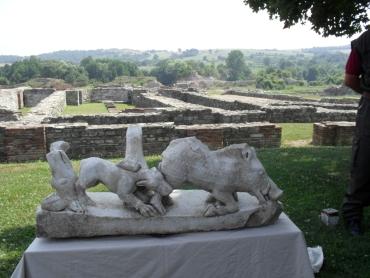
At the site of the ‘Felix Romuliana’, an imperial palace near the Town of Zajecar, German experts of the Archeology Institute in Frankfurt, together with the colleagues of the Archeology Institute in Belgrade have discovered a sensational sculpture, unique in this area of the Balkans. This marble statue originates from the first half of the third century.

As ‘Blic’ learns unofficially, it is most likely a sculpture of Diana, the Goddess of the hunt. At the National Museum in Zajecar we were told that this discovery has been the most significant one since finding of archvault in 1984 with the inscription ‘Felix Romuliana’ and a head of Galerius in 1993.

It is supposed that the sculpture symbolizes victory by Rome over barberians. Unfortunately a fragment of the sculpture (a horse and a rider) is missing. The rider is believed to be Diana.

Experts claim that this discovery is absolutely precious for studying of the ‘Romuliana’, but for the world culture as well.

Huge interest of experts from all over the world is expected.

The German archeologists using geomagnetic and geophysics method of search outside the imperial palace have discovered about fifty objects. Recently a new three-year agreement on cooperation has been signed with the Institute in Frankfurt.

The ‘Felix Romuliana’ contains numerous floor mosaics and remains of monumental temples and buildings. The Portrait of Emperor Galerius, heads of Hercules and Jupiter, mosaic presentations of Dionis, Labyrinth and Venator are the very best of the Roman art of that time.
*****************************************************************
They can tell that the rider from the missing horse/rider duo was the Goddess Diana?  How do they know the horse had any rider at all?  And how do they actually know it was a horse, since it looks like the entire thing is missing!  Based on what's shown - which looks like some kind of very large dog bringing down a miniature horse - this is hardly what I would call a sculpture of Diana the Huntress!  Guess I expect too much from my antiquities, heh?

Added July 22, 2010:

Here is a photo of the sculpture from a different perspective - it is a boar that the dog is bringing down, as was pointed out by Anthony in his comment, thank you.  A boar makes much more sense than a small horse, LOL, but I just did not see "boar" in the first photograph - it looked like a small horse with a mane, I did not see the tusks at all!  (Photo credit: Tanjug)


This article has some more information about the sculpture:

Rare Roman sculpture found near eastern town
21 July 2010 | 10:31 -> 13:54 | Source: Blic
Zaječar -- A 3rd century AD sculpture was discovered in Serbia's Felix Romuliana archaeological site in the east of the country.

The sculpture is believed to be representing Diana, the Roman goddess of the hunt.

Serbian archaeologists and their German colleagues worked on the dig near the town of Zaječar, daily Blic reports, and adds the discovery is nothing short of "sensational", and unique in the Balkans.

The marble statue was found north of the Emperor's Palace location - a settlement that was built before Romuliana itself.

The Zaječar National Museum said that the find ranks among the most important since the 1984 discovery of a tabled with the words Felix Romuliana inscribed on it.

The Roman palace on that location was built from 297 until 311 AD.

The sculpture, believed to have been made to celebrate Roman victories over barbarians, shows a wild boar pierced with a spear, a hunting dog at one of its legs, and two horse hoofs. However, the horse itself and the rider - that archaeologists believe would have been Diana - are missing.

Climate Changes - Civil Disorder, Chaos and Regime Change in China

From Discovery News
China's Wars Driven by Climate
Could 2,000 years of foreign invasions, rebellions and civil war really be boiled down to weather patterns? [As a certain tea-party person is fond of saying, "You betcha."]
July 14, 2010
Marlowe Hood, AFP

Two millennia of foreign invasions and internal wars in China were driven more by cooling climate than by feudalism, class struggle or bad government, a bold study released Wednesday argued.

Food shortages severe enough to spark civil turmoil or force hordes of starving nomads to swoop down from the Mongolian steppes were consistently linked to long periods of colder weather, the study found.

In contrast, the Central Kingdom's periods of stability and prosperity occurred during sustained warm spells, the researchers said.

Theories that weather-related calamities such as drought, floods and locust plagues steered the unraveling or creation of Chinese dynasties are not new.

But until now, no one had systematically scanned the long sweep of China's tumultuous history to see exactly how climate and Chinese society might be intertwined.

Chinese and European scientists led by Zhibin Zhang of the Chinese Academy of Sciences in Beijing decided to compare two sets of data over 1,900 years.

Digging into historical archives, they looked at the frequency of war, price hikes of rice, locust plagues, droughts and floods. For conflict, they distinguished between internal strife and external wars.

At the same time, they reconstructed climate patterns over the period under review.

"The collapses of the agricultural dynasties of the Han (25-220), Tang (618-907), Northern Song (960-1125), Southern Song (1127-1279) and Ming (1368-1644) are closely associated with low temperature or the rapid decline in temperature," they conclude.

A shortage of food would have weakened these dynasties, and pushed nomads in the north -- even more vulnerable to dips in temperature -- to invade their southern, Chinese-speaking neighbors, the authors argued.

A drop of 2.0 degrees Celsius (3.6 degrees Fahrenheit) in average annual air temperature can shorten the growing season for steppe grasses, which are critical for livestock, by up to 40 days.

"When the climate worsens beyond what the available technology and economic system can compensate for, people are forced to move or starve," they said.

The study found more droughts and floods during cold periods, but the factors that contributed most directly to wars and dynastic breakup were soaring rice prices and locust infestations.

The Roman and Mayan empires, they noted, also fell during cold periods.

Zhang and colleagues speculated that periodic temperature shifts roughly every 160 or 320 years were related to natural climate changes, namely fluctuations in solar activity and in Earth's orbit and axial spin.

The team said the findings demonstrate that climate change can lead to unrest and warfare.

"Historians commonly attribute dynastic transitions or cycles to the quality of government and class struggles," according to the paper, published in the British journal Proceedings of the Royal Society B. "However, climatic fluctuation may be a significant factor interacting with social structures in affecting the rise and fall of cultures and dynasties."

But the historical evidence they found points to global cooling, not to global warming, as the culprit.

The scientists were cautious about making projections for the future. In 2007, the UN's Intergovernmental Panel on Climate Change (IPCC) said that man-made warming this century will lead to worse droughts, floods, harsh storms and sea level rise, with the potential to inflict hunger and misery on millions.
****************************************************
Irony of ironies, China is currently undergoing a horrible monsoon season, worse than for many years it seems; so much water has accumulated in feeding rivers and tributaries that the Central Government is worried about whether the Three Gorges Dam can hold. Can you imagine? And yet drought continues to plague its cities and plains in the north.

Hmmm, well, it will be interesting to see what happens as climate changes around the globe.  With over 6 billion people, where are they going to go as desertification grows in already marginal areas as preciptation patterns shift, some areas grow much warmer, and other areas grow much colder, shortening growing seasons?  Will they be able to go anywhere?  Will people by the millions simply stay put and wait to die?  Well, in China that's already happening, but it's not due to climate change - the unrelenting pollution/poisoning of land, air, water and food supplies by unsustainable and totally unregulated growth will likely kill millions before climate change does, and I expect that to happen within what is left of my lifetime.  What will China be like in 2040, when I'm 89?  And what would we do -- what could we do -- if half a billion Chinese, or Indians, or Africans, or South Americans -- decided they're moving to what will be left of the land of the free and the home of the brave?  By 2040 we may have lost what - some 20% of our coastal lands to rising oceans due to the melting of the icecaps?  Oy!  I don't want to think about it.

Neither does Congress.
Related Posts Plugin for WordPress, Blogger...