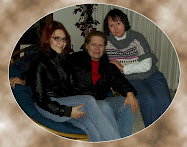
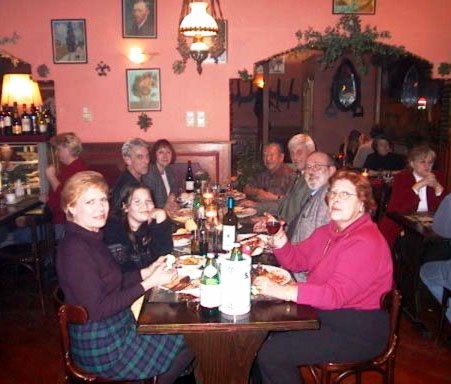
Ohmygoddess! I posted this photograph here on 6/24/09 because of my comment, which you'll be able to read below, about "babushkas." This is a photo from around 1960, and I remember that coat (it had brown velvet-covered buttons and brown velvet corded trim), so it was winter and very cold! That is my three younger sisters and me (I'm on the right, second row, my taller cousin Cookie is to my left, slightly behind), and two of my cousins - Cookie and Tootsie, daughters of one of my mother's sisters, Aunt Diane a/k/a Aunt Christine. Five of us are wearing babushkas. Notice the old television set to the far left and the very contemporary 1950's style drapes, LOL!
Juliette Frette is back at Examiner.com with an article about the Goddess Baba Yaga, "Wild Woman:"
Baba Yaga (pronounced bah-bye yegg-ah) is known as the Slavic "wild woman," a sacred old hag who is otherwise considered a goddess of birth and death. Although many goddesses cross-culturally seem to have some sort of reign over the beginnings and endings of life, this one has a unique image all her own. . . .
Barbara Walker's "The Woman's Encyclopedia of Myths and Secrets" does not have an entry under "Baba Yaga," "babau" or "Wild Woman." However, she does have an entry under HAG:
Originally "Holy Woman," the Hag was a cognate of Egyptian heq, a predynastic matriachal ruler who knew the words of power, or hekau.(1) In Greek she became Hecate, the Crone or Hag as queen of the dead, incarnate on earth in a series of wise-women or high priestesses.
Hebrew "wisdom" in Proverbs 8 is Hokhmah, from Egyptian heq-maa or Heka-Maat, the underworld Mother of widsom, law, and words of power.(2) Greek and Roman cognate hagia meant holy, especially as applied to the principle of female widsom, Hagia Sophia (see Sophia, Saint). Similarly in Israel, a haggiah was a holy day. Certain Jewish religious literature dating back to Israel's matriarchal period was probably written by wise-women, since it was called the Haggadah. Later patriarchal rabbis declared this material "not legal."(3)
In northern Europe, the Hag was the death-goddess corresponding to Hecate, like the Hag of the Iron Wood whose daughter or virgin form was Hel.(4) Old Norse hagi meant a sacred grove, the Iron Wood, a place of sacrifice. Haggen meant to chop in pieces, which is what happened to sacrificial victims dismembered for a feast. [EEK! This gives entirely new meaning to Robert Graves' discussions about "king sacrifice" and the maenads I was reading about yesterday who participated in the Dionysian "orgies" where men were literally torn apart. Compare also the horse-Valkyries or horse-masked priestesses of Freya, known as volvas, who tore part the acient kings of Sweden in ritual sacrifice.] "Hags" may have been priestesses of sacrifice, like the Scythian matriarchs who butchered for their sacred cauldrons and read omens in entrails.(5) Northmen colonized Scotland, where a haggis or "hag's dish" was made of internal organs. Until the 19th century, people kept the New Year festival of Hagmena, Hag's Moon, going in disguise from house to house, begging cakes. A chronicler said: "On the last night of the old year (pecularliarly called Hagmenai), the visitors and company made a point of not separating till after the clock struck twelve, when they rose, and mutually kissing, wished each other a happy New Year." This is still the custom. But a contemproary clergyman said the Hagmena meant the Devil was in the house.(6)
Devilish qualities were attributed to stone idols of the Hag, such as the famous Stone of Scone, still used at each British monarch's coronation. This stone once represented the Hag and her spinning wheel - i.e., Arianrhod, Goddess of the Wheel of Fate. A danish ballad said the Hag of Scone led the "swarthy Elves;" but she was turned to stone by an incantation of the missionary St. Olave: "Thou Hag of Scone, stand there and turn to granite stone."(7) Helvetian converts to Christianity were compelled to batter to pieces sacred stones in which their Goddess dwelt, reciting her formula, "Once I was the Goddess and now I am nothing at all."(8)
In the 16th century, "hag" was synonymous with "fairy."(9) Old High German called a wise-woman Hagazussa, that is, a moon-priestess.(10) Though "hagiology" still means the study of holy matters and saints, the root word hag declined in its meanings. Shakespeare's verb hagged meant to be bewitched. His noun haggard meant a hawk, a harpy, or an intractable woman.(11)
The Hag as death-goddess, her face veiled to imply that no man can know the manner of his death, was sometimes re-interpreted as a nun. Christianized legends were invented for these veiled figures.(12)
Notes:
(1) Book of the Dead, 351.
(2) Budge, G.E. 1, 296.
(3) Encyc. Brit. "Haggdah."
(4) Sturlson, 39.
(5) Wendt, 137.
(6) Hazlitt, 296.
(7) Wimberly, 36.
(8) Thorsten, 336.
(9) Scot, 550.
(10) J.B. Russell, 16.
(11) Potter & Sargent, 70.
(12) Graves, W.G., 409.
Ohmygoddess! I posted this photograph here on 6/24/09 because of my comment, which you'll be able to read below, about "babushkas." This is a photo from around 1960, and I remember that coat (it had brown velvet-covered buttons and brown velvet corded trim), so it was winter and very cold! That is my three younger sisters and me (I'm on the right, second row, my taller cousin Cookie is to my left, slightly behind), and two of my cousins - Cookie and Tootsie, daughters of one of my mother's sisters, Aunt Diane a/k/a Aunt Christine. Five of us are wearing babushkas. Notice the old television set to the far left and the very contemporary 1950's style drapes, LOL!
Juliette Frette is back at Examiner.com with an article about the Goddess Baba Yaga, "Wild Woman:"
Baba Yaga (pronounced bah-bye yegg-ah) is known as the Slavic "wild woman," a sacred old hag who is otherwise considered a goddess of birth and death. Although many goddesses cross-culturally seem to have some sort of reign over the beginnings and endings of life, this one has a unique image all her own. . . .
Barbara Walker's "The Woman's Encyclopedia of Myths and Secrets" does not have an entry under "Baba Yaga," "babau" or "Wild Woman." However, she does have an entry under HAG:
Originally "Holy Woman," the Hag was a cognate of Egyptian heq, a predynastic matriachal ruler who knew the words of power, or hekau.(1) In Greek she became Hecate, the Crone or Hag as queen of the dead, incarnate on earth in a series of wise-women or high priestesses.
Hebrew "wisdom" in Proverbs 8 is Hokhmah, from Egyptian heq-maa or Heka-Maat, the underworld Mother of widsom, law, and words of power.(2) Greek and Roman cognate hagia meant holy, especially as applied to the principle of female widsom, Hagia Sophia (see Sophia, Saint). Similarly in Israel, a haggiah was a holy day. Certain Jewish religious literature dating back to Israel's matriarchal period was probably written by wise-women, since it was called the Haggadah. Later patriarchal rabbis declared this material "not legal."(3)
In northern Europe, the Hag was the death-goddess corresponding to Hecate, like the Hag of the Iron Wood whose daughter or virgin form was Hel.(4) Old Norse hagi meant a sacred grove, the Iron Wood, a place of sacrifice. Haggen meant to chop in pieces, which is what happened to sacrificial victims dismembered for a feast. [EEK! This gives entirely new meaning to Robert Graves' discussions about "king sacrifice" and the maenads I was reading about yesterday who participated in the Dionysian "orgies" where men were literally torn apart. Compare also the horse-Valkyries or horse-masked priestesses of Freya, known as volvas, who tore part the acient kings of Sweden in ritual sacrifice.] "Hags" may have been priestesses of sacrifice, like the Scythian matriarchs who butchered for their sacred cauldrons and read omens in entrails.(5) Northmen colonized Scotland, where a haggis or "hag's dish" was made of internal organs. Until the 19th century, people kept the New Year festival of Hagmena, Hag's Moon, going in disguise from house to house, begging cakes. A chronicler said: "On the last night of the old year (pecularliarly called Hagmenai), the visitors and company made a point of not separating till after the clock struck twelve, when they rose, and mutually kissing, wished each other a happy New Year." This is still the custom. But a contemproary clergyman said the Hagmena meant the Devil was in the house.(6)
Devilish qualities were attributed to stone idols of the Hag, such as the famous Stone of Scone, still used at each British monarch's coronation. This stone once represented the Hag and her spinning wheel - i.e., Arianrhod, Goddess of the Wheel of Fate. A danish ballad said the Hag of Scone led the "swarthy Elves;" but she was turned to stone by an incantation of the missionary St. Olave: "Thou Hag of Scone, stand there and turn to granite stone."(7) Helvetian converts to Christianity were compelled to batter to pieces sacred stones in which their Goddess dwelt, reciting her formula, "Once I was the Goddess and now I am nothing at all."(8)
In the 16th century, "hag" was synonymous with "fairy."(9) Old High German called a wise-woman Hagazussa, that is, a moon-priestess.(10) Though "hagiology" still means the study of holy matters and saints, the root word hag declined in its meanings. Shakespeare's verb hagged meant to be bewitched. His noun haggard meant a hawk, a harpy, or an intractable woman.(11)
The Hag as death-goddess, her face veiled to imply that no man can know the manner of his death, was sometimes re-interpreted as a nun. Christianized legends were invented for these veiled figures.(12)
Notes:
(1) Book of the Dead, 351.
(2) Budge, G.E. 1, 296.
(3) Encyc. Brit. "Haggdah."
(4) Sturlson, 39.
(5) Wendt, 137.
(6) Hazlitt, 296.
(7) Wimberly, 36.
(8) Thorsten, 336.
(9) Scot, 550.
(10) J.B. Russell, 16.
(11) Potter & Sargent, 70.
(12) Graves, W.G., 409.
Showing posts with label Daughters of Hecate. Show all posts
Showing posts with label Daughters of Hecate. Show all posts
Monday, June 15, 2009
Goddess: Baba Yaga
Ohmygoddess! I posted this photograph here on 6/24/09 because of my comment, which you'll be able to read below, about "babushkas." This is a photo from around 1960, and I remember that coat (it had brown velvet-covered buttons and brown velvet corded trim), so it was winter and very cold! That is my three younger sisters and me (I'm on the right, second row, my taller cousin Cookie is to my left, slightly behind), and two of my cousins - Cookie and Tootsie, daughters of one of my mother's sisters, Aunt Diane a/k/a Aunt Christine. Five of us are wearing babushkas. Notice the old television set to the far left and the very contemporary 1950's style drapes, LOL!
Juliette Frette is back at Examiner.com with an article about the Goddess Baba Yaga, "Wild Woman:"
Baba Yaga (pronounced bah-bye yegg-ah) is known as the Slavic "wild woman," a sacred old hag who is otherwise considered a goddess of birth and death. Although many goddesses cross-culturally seem to have some sort of reign over the beginnings and endings of life, this one has a unique image all her own. . . .
Barbara Walker's "The Woman's Encyclopedia of Myths and Secrets" does not have an entry under "Baba Yaga," "babau" or "Wild Woman." However, she does have an entry under HAG:
Originally "Holy Woman," the Hag was a cognate of Egyptian heq, a predynastic matriachal ruler who knew the words of power, or hekau.(1) In Greek she became Hecate, the Crone or Hag as queen of the dead, incarnate on earth in a series of wise-women or high priestesses.
Hebrew "wisdom" in Proverbs 8 is Hokhmah, from Egyptian heq-maa or Heka-Maat, the underworld Mother of widsom, law, and words of power.(2) Greek and Roman cognate hagia meant holy, especially as applied to the principle of female widsom, Hagia Sophia (see Sophia, Saint). Similarly in Israel, a haggiah was a holy day. Certain Jewish religious literature dating back to Israel's matriarchal period was probably written by wise-women, since it was called the Haggadah. Later patriarchal rabbis declared this material "not legal."(3)
In northern Europe, the Hag was the death-goddess corresponding to Hecate, like the Hag of the Iron Wood whose daughter or virgin form was Hel.(4) Old Norse hagi meant a sacred grove, the Iron Wood, a place of sacrifice. Haggen meant to chop in pieces, which is what happened to sacrificial victims dismembered for a feast. [EEK! This gives entirely new meaning to Robert Graves' discussions about "king sacrifice" and the maenads I was reading about yesterday who participated in the Dionysian "orgies" where men were literally torn apart. Compare also the horse-Valkyries or horse-masked priestesses of Freya, known as volvas, who tore part the acient kings of Sweden in ritual sacrifice.] "Hags" may have been priestesses of sacrifice, like the Scythian matriarchs who butchered for their sacred cauldrons and read omens in entrails.(5) Northmen colonized Scotland, where a haggis or "hag's dish" was made of internal organs. Until the 19th century, people kept the New Year festival of Hagmena, Hag's Moon, going in disguise from house to house, begging cakes. A chronicler said: "On the last night of the old year (pecularliarly called Hagmenai), the visitors and company made a point of not separating till after the clock struck twelve, when they rose, and mutually kissing, wished each other a happy New Year." This is still the custom. But a contemproary clergyman said the Hagmena meant the Devil was in the house.(6)
Devilish qualities were attributed to stone idols of the Hag, such as the famous Stone of Scone, still used at each British monarch's coronation. This stone once represented the Hag and her spinning wheel - i.e., Arianrhod, Goddess of the Wheel of Fate. A danish ballad said the Hag of Scone led the "swarthy Elves;" but she was turned to stone by an incantation of the missionary St. Olave: "Thou Hag of Scone, stand there and turn to granite stone."(7) Helvetian converts to Christianity were compelled to batter to pieces sacred stones in which their Goddess dwelt, reciting her formula, "Once I was the Goddess and now I am nothing at all."(8)
In the 16th century, "hag" was synonymous with "fairy."(9) Old High German called a wise-woman Hagazussa, that is, a moon-priestess.(10) Though "hagiology" still means the study of holy matters and saints, the root word hag declined in its meanings. Shakespeare's verb hagged meant to be bewitched. His noun haggard meant a hawk, a harpy, or an intractable woman.(11)
The Hag as death-goddess, her face veiled to imply that no man can know the manner of his death, was sometimes re-interpreted as a nun. Christianized legends were invented for these veiled figures.(12)
Notes:
(1) Book of the Dead, 351.
(2) Budge, G.E. 1, 296.
(3) Encyc. Brit. "Haggdah."
(4) Sturlson, 39.
(5) Wendt, 137.
(6) Hazlitt, 296.
(7) Wimberly, 36.
(8) Thorsten, 336.
(9) Scot, 550.
(10) J.B. Russell, 16.
(11) Potter & Sargent, 70.
(12) Graves, W.G., 409.


Tuesday, February 17, 2009
Helen of Troy
Interesting information from Barbara Walker's "The Woman's Encyclopedia of Myths and Secrets" about Helen of Troy:
Incarnation of the Virgin Moon-goddess, daughter of Queen Hecuba, or Hecate, who embodied the Crone. Helen was also called Helle or Selene. She was worshipped as an orgiastic deity at the Spartan festival Helenphoria, featuring sexual symbols carried in a special fetish-basket, the helene.(1).
Trojan Helen married Menelaus, "Moon-king," who was promised immortality because he made a sacred marriage.(2) However, Helen left him and went home with her new Trojan lover Paris, so Menelaus lost both his immortality and the Trojan fiefs that Helen's "matrimony" brought. He sailed with his armies to get her back, and this was the start of the legendary Trojan War which pitted patriarchal Greeks against matriarchal Trojans.(3) [It was all about the money, darlings! Menelaus didn't give a rat's butt about Helen.]
As Elen, Elaine, or Hel-Aine, the same Moon-virgin became the queen of pagan Britain, a "Lily Maid" who made the first alliances with emperors of Rome. (See Elaine.) The oldest British histories said the first British king was a Trojan named Brutus, Helen's relative.(4)
After Troy fell, he sailed west to the island of Albion [probably meaning "white island", named for the white chalk cliffs of Dover] and founded a city, New Troy, later renamed Lugdunum (London) after his descendant, the god Lug.(5)
Notes:
(1) Graves, G.M. 1, 208-9.
(2) Knight, S.L., 125.
(3) Graves, G.M. 2, 276.
(4) Briffault 3, 431.
(5) Guerber, L.M.A., 309.
Related is Helice:
"Willow," a title of Hecate in her virgin form as the new moon and the Helicon or "willow-stream" surrounding the Mountain of the Muses. Like Artemis, Helice the Willow-maid was associated with both the moon and Ursa Major, eternally circling the pole, known as Helice's Axle.(1) Witches thought a willow wand a microcosmic axis mundi. See Willow.
Notes:
(1) Lindsay, O.A., 251.
Following the lead:
Willow
Water and willows represented the Goddess Helice, "Willow," virgin form of Hecate with her willow-witye grain-basket.(1) Willow wants invoked the Muses, whose mountain was encircled by the Helicon, "Willow-stream." The Dionysian thyrsus, like the later withche's wand, was willow. As Dionysus was once a major god of Jerusalem, the willow figured prominently in municipal ceremonies there. A "Great Day" of the Feast of Tabernacles was known as the Day of Willows, with rites honoring fire and water.(2) Willow wands gave protectin in the underworld, where Orpheus carried one to show the way.(3) Willow wands were sacred to the Moon-goddess as late as the 17th century A.D., when an English herbal said the moon owns the willow.
Witches used willow bark to treat rheumatism and fevers; i9t was the source of salicylic acid (aspirin), one of Hecate's cures. Some said wicca or "witchcraft" evolved from a word meaning willow, cognate with "wicher" (willow-withe weaving). Magic cats were supposed to grow from pussy-willows or "catkins," to become witches' malkins (familiars): hence the saying that all cats were gray in the beginning. The catkins were harbingers of spring, appearing on the willow as graymalkins. (See Cat.)
Winding up for tonight, Elaine:
(Var. Elen, Hel-Aine, Eileen) Britain's "Lily Maid," the virgin Moon-goddess bearing the same name as Helen of Troy; British tradition claimed the ilsand were colonized by Trojans. According to the bards, the Roman emperor acquired Britain only by marrying its queen, Elen. The people agreed to help build Roman roads because she ordered them, and the roads were called Roads of Elen of the Hosts: "The men of the Island of Britain would not have made those great hostings for any save for her."(1)
Elen or Elaine became the mother-bride of Lancelot-Galahad in Arthurian romance. Lancelot the father begot on her his own reincarnation, Galahad the son [I believe this is just a retelling of the ancient legend of Seraimis, the Queen of the original city of Babylon, married to Nimrod, the first king and builder of cities according to the Bible]; but Lancelot in his youth had been named Galahad, and his mother was Queen Elaine. The Lily Maid gave Lancelot her sexual-symbolic charm to make him invicible: her pearl-bedewed sleeve of red silk. The womb-symbol of the Holy Grail was displayed in her castle, tendered by her dove-soul, Colombe. Galahad saw this vision again in his last moments, as he expired at the altar in ancient sacred-king style.(2)
Notes:
(1) Mabinogion, 85.
(2) Malory 1, 377; 2, 268.
**************************************************
The Lily and the Dove can be traced back to the ancient Middle East, and probably more specifically, to ancient Egypt. Both symbols figure prominently in the pages of the Bible, which borrowed much imagery (and prayers/paeons) from the Egyptians. The lily is most likely the Egyptian lotus (also prominent in Indian iconography), embodied in later versions of iconic art such as the fleur-de-lis and trefoil, which came to represent the Christian concept of the Holy Trinity of Father-Son-Holy Spirit or Sophia (representing the hidden female aspect of creation - the fathers of the church did not want to give it a name or a sex, but everyone knew it was Sophia and, in later years, the Virgin Mary, the "Holy Mother of God.")
Wednesday, October 29, 2008
Lilith
From Barbara Walker's "The Woman's Encyclopedia of Myths and Secrets."
Lilith a/k/a Lilit
Adam's first wife was a relic of an early rabbinical attempt to assimilate the Sumero-Babylonian Goddess Belit-ili, or Belili, to Jewish mythology. To the Canaanites, Lilit was Baalat, the "Divine Lady." On a tablet from Ur, c. 2000 BC, she was addressed as Lillake.(1)
Hebraic tradition said Adam married Lilith because he grew tired of coupling with beasts, a common custom of Middle-Eastern herdsmen, though the Old Testament declard it a sin (Deut. 27:21). [Not the most auspicious of beginnings for a marriage...] Adam tried to force Lilith to lie beneath him in the "missionary position" favored by male-dominant societies. Moslems were so insistent on the male-superior sexual position that they said, "Accursed be the man who maketh woman heaven and himself earth."(2) Catholic authorities said any sexual position other than the male-superior one is sinful.(3) But Lilith was neither a Moslem nor a Catholic. She sneered at Adams's sexual crudity, cursed him, and flew away to make her home by the Red Sea. [Note the wings - an allusion to the ancient bird goddesses].
God sent angels to fetch Lilith back, but she cursed them too, ignored God's command, and spent her time coupling with "demons" (whose lovemaking evidently pleased her better) and giving birth to a hundred children every day. So God had to produce Eve as Lilith's more docile replacement. [Note: according to one of the biblical accounts of the creation of Eve, she was made out one of Adam's ribs; so, every time he made love to Eve, was he really making love to a clone of himself? Yechy!]
Lilith's fecundity and sexual preferences show that she was a Great Mother of settled agricultural tribes, who resisted the invasions of nomadic herdsmen, represented by Adam [a/k/a man from the red earth - from the Bible, from dust you came and to the dust you shall return...]. Early Hebrews disliked the Great Mother who drank the blood of Abel the herdsman, after his slaying by the elder god of agriculture and smithcraft, Cain (Gen. 4:11) [Gen. 4:11: And now art thou {Cain} cursed from the earth, which hath opened her mouth to receive thy brother's blood from thy hand; - King James Version]. Lilith's Red Sea was another version of Kali Ma's Ocean of Blood, which gave brith to all things but needed periodic sacrificial replenishment.
There may have been a connection between Lilith and the Etruscan divinity Leinth, who had no face and who waited at the gate of the underworld along with Eita and Persipnei (Hades and Persephone) to receive the souls of the dead.(4) The underworld gate was a yoni, and also a lily, which had "no face." Admission into the underworld was often mythologized as a sexual union. The lily or lilu (lotus) was the Great Mother's flower-yoni, whose title formed Lilith's name.
The story of Lilith disappeared from the canonical Bible, but her daughters the lilim haunted men for over a thousand years. Well into the Middle Ages, the Jews were still manufacturing amulets to keep away the lilim, who were lustful she-demons given to copulating with men in their dreams, causing nocturnal emissions.(5) Naturally, the lilim squatted on top of their victims in the position favored by ancient matriarchs. [No doubt thereby triggering lots of control issues and deep psychological wounds in their male "victims."]
Greeks adopted the lilim and called them Lamiae, Empusae (Forcers-In), or Daughters of Hecate. [The ancient Greek men would have hated and dreaded these Forcers-In because of their cultural preference at the time for homosexuality, copulating with females usually only to produce children.] Christians also adopted them and called them harlots of hell, or succubae, the female counterparts of incubi. Celebate monks tried to fend them off by sleeping with their hands crossed over their genitals, clutching a crucifix. It was said that every time a pious Christian had a wet dream, Lilith laughed. Even if a male child laughed in his sleep, people said Lilith was fondling him. To protect baby boys against her, chalk circles were drawn around cradles with the written names of the three angeles God sent to fetch Lilith back to Adam - even though these angels had proved incapable of dealing with her. Some said men and babies should not be left alone in a house or Lilith might seize them.(6)
Another common name for the Daughters of Lilith was Night-Hag. This term didn't imply that they were ugly; on the contrary, they were supposed to be very beautiful.(7) As with their brothers the incubi, they were presumed so expert at lovemaking that after an experience with a Night-Hag, a man couldn't be satisfied with the love of a mortal woman.
Notes:
(1) Graves & Patai, 68.
(2) Edwardes, 157.
(3) Graves & Patai, 67.
(4) Hays, 183.
(5) Graves, G.M. 1, 190.
(6) Cavendish, P.E., 99.
(7) Scot, 512.
Subscribe to:
Posts (Atom)