Saturday, November 3, 2007
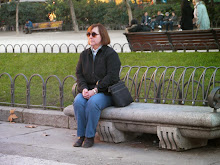
The Kitchen Goddess
Oi yah. Well, I suppose she's a follower of Martha (the human female incarnation of Mothra from those really bad 1960's Japanese Godzilla movies)...
Visit With the ‘Kitchen Goddess’
Submitted by Editor on Fri, 11/02/2007 - 11:07am.
LOU ANN GOOD
Food and FamilyFeatures Editor
LANGHORNE, Pa. — Her friends and family call her the “Kitchen Goddess” in reverence to her heavenly ability to prepare culinary feasts.
Readers of Lancaster Farming might recognize her as the contributor who sends in many recipes with French and Italian origins and answers requests for such delights as Tres Leches Strawberry Cake.
Marilyn Robinson is the antithesis of most of this newspaper’s rural readership. She lives in an upscale Philadelphia suburb with her husband Stephen Robinson, their two sons and two pampered dogs.
But she does lay claim to growing up on a farm, where she learned to cook when her mother gave her an EZ Bake oven and the reins to experiment. Her mother is deceased, but her dad continues to farm 115 acres in Hummelstown.
“On my 50th birthday, my dad gave me a subscription to Lancaster Farming,” she said. “He thought I’d enjoy reading about the auctions. I do. But I discovered the recipes and just love it,” she said.
She’s been an avid reader and contributor ever since. From those little notes she inserts with the recipes and from sharing her cookbook, “Art of the Domestic Feast,” which she compiled for Christmas gifts for friends, her enthusiasm for all things pertaining to culinary experimentation is evident.
She prepares meals like an artist paints on a canvas. Color and texture are as important as taste.
“See this color combo,” she often demands of her family before they are allowed to taste the food artfully arranged on their plates.
She likes to add simple touches to enhance the food presentation such as a smattering of fall leaves scattered among the serving dishes or a leaf topped on a pumpkin fudge cake. Bite-sized cookies surrounded a miniature bundt pumpkin cakes and muffins. Greek spinach Salad severed in a wooden bowl and fresh fruit served in a glass dish to showcase their brilliant hues add to a bouquet of deep red mums inserted in a wine box container.
She and her neighbors take turns hosting monthly theme parties. One of those Marilyn hosted was a movie night featuring Clueless. Food included an array of hors d’oeuvres named after characters and slang phrases in the movie, “Clueless,” such as Cher pizzettes, Baldwin turnovers, and Clueless Camembert accompanied by suitably “popular” veggies zucchini, yellow squash and cherry tomatoes marinated in olive oil and herbs and baked on skewers. Bite-sized strawberry tarts and Beverly Hill High nuts dipped in chocolate.
If that menu sounds daunting, Marilyn points out, “One frantic burst of activity, and then it’s someone else’s turn.”
Periodically she prepares a feast for her dad, and he reciprocates by making homemade sauerkraut. Although she has assisted him in preserving sauerkraut she hasn’t had success with it on her own. Recently she dumped crockfuls of spoiled kraut down her garbage disposal, which clogged and resulted in a repair bill that cost far more than the value of the expected sauerkraut.
Generally, she has more success than failure in the kitchen and cheerfully credits a glass of wine for making everything taste better.
Her creativity is not limited to the kitchen. On the day of the interview, Marilyn wore a shimmering, swinging vest that she sewed.
Her home abounds with skills from her hand. Faux, stencil and paint techniques intertwine for unique one-of-a-kind wall finishes. She decorates her home with auction finds.
“I just love the thrill of the auction. It’s sort of like going to Wal-Mart: you never know what it was you wanted or needed until you go up and down all the aisles,” she said.
“I’ve gotten boxes of cookbooks, videos, cast iron skillets, an antique cherry pitter, super big bowls . . .” and she has a wonderful cupboard with no assigned style ever determined.
She taught herself to knit, crochet and even quilt by following instructions she found on the Internet. Recently she crocheted a rather large rug for her laundry room.
“I established myself,” she said of developing creativity while growing up with two “brothers with brains.”
“I love to dabble in lots of things,” she said. As with any creative venture, things don’t always go as expected, and if it doesn’t work out — she improvises.
The family travels extensively, where Marilyn has discovered that real lasagna in Italy is quite different from that served in the U.S., and the glory of French sauces.
*******************************************************************************
Three of the Kitchen Goddess' recipes followed in the article, but I did not include them. Here's one of my own instead, darlings! I made it tonight, delish!
Really Easy Beef Burgundy
1 pound beef stew meat, cut into one inch pieces
1 can golden mushroom soup (don't use cream of mushroom, yechy)
1 package dried onion soup mix
1 soup can full of cheap red wine - I use anything that has 'Bordeaux' anywhere on the bottle
8 ounces fresh button mushrooms, cut into thirds
Mix all ingredients in oven-proof casserole dish. Bake uncovered for 2-1/2 hours at 325 degrees F.


Cell Phone Jammer, Yeah!
I know they're illegal, but if they were cheaper I'd buy one in a flash and just LOVE listening to the cussing and frustration of the a-holes on the bus who inflict their inane and assinine personal conversations on me courtesy of their cell phones! Wouldn't I just love to shove one of those phones - well, you get the picture, I'm sure. Wait a minute - where can I buy one of those $50 models -
Devices Enforce Cellular Silence, Sweet but Illegal
By MATT RICHTEL
Published: November 4, 2007
SAN FRANCISCO, Nov. 2 — One afternoon in early September, an architect boarded his commuter train and became a cellphone vigilante. He sat down next to a 20-something woman who he said was “blabbing away” into her phone.
“She was using the word ‘like’ all the time. She sounded like a Valley Girl,” said the architect, Andrew, who declined to give his last name because what he did next was illegal.
Andrew reached into his shirt pocket and pushed a button on a black device the size of a cigarette pack. It sent out a powerful radio signal that cut off the chatterer’s cellphone transmission — and any others in a 30-foot radius.
“She kept talking into her phone for about 30 seconds before she realized there was no one listening on the other end,” he said. His reaction when he first discovered he could wield such power? “Oh, holy moly! Deliverance.”
As cellphone use has skyrocketed, making it hard to avoid hearing half a conversation in many public places, a small but growing band of rebels is turning to a blunt countermeasure: the cellphone jammer, a gadget that renders nearby mobile devices impotent.
The technology is not new, but overseas exporters of jammers say demand is rising and they are sending hundreds of them a month into the United States — prompting scrutiny from federal regulators and new concern last week from the cellphone industry. The buyers include owners of cafes and hair salons, hoteliers, public speakers, theater operators, bus drivers and, increasingly, commuters on public transportation.
The development is creating a battle for control of the airspace within earshot. And the damage is collateral. Insensitive talkers impose their racket on the defenseless, while jammers punish not just the offender, but also more discreet chatterers.
“If anything characterizes the 21st century, it’s our inability to restrain ourselves for the benefit of other people,” said James Katz, director of the Center for Mobile Communication Studies at Rutgers University. “The cellphone talker thinks his rights go above that of people around him, and the jammer thinks his are the more important rights.”
The jamming technology works by sending out a radio signal so powerful that phones are overwhelmed and cannot communicate with cell towers. The range varies from several feet to several yards, and the devices cost from $50 to several hundred dollars. Larger models can be left on to create a no-call zone.
Using the jammers is illegal in the United States. The radio frequencies used by cellphone carriers are protected, just like those used by television and radio broadcasters.
The Federal Communication Commission says people who use cellphone jammers could be fined up to $11,000 for a first offense. Its enforcement bureau has prosecuted a handful of American companies for distributing the gadgets — and it also pursues their users.
Investigators from the F.C.C. and Verizon Wireless visited an upscale restaurant in Maryland over the last year, the restaurant owner said. The owner, who declined to be named, said he bought a powerful jammer for $1,000 because he was tired of his employees focusing on their phones rather than customers.
“I told them: put away your phones, put away your phones, put away your phones,” he said. They ignored him.
The owner said the F.C.C. investigator hung around for a week, using special equipment designed to detect jammers. But the owner had turned his off.
The Verizon investigator was similarly unsuccessful. “He went to everyone in town and gave them his number and said if they were having trouble, they should call him right away,” the owner said. He said he has since stopped using the jammer.
Of course, it would be harder to detect the use of smaller battery-operated jammers like those used by disgruntled commuters.
An F.C.C. spokesman, Clyde Ensslin, declined to comment on the issue or the case in Maryland.
Cellphone carriers pay tens of billions of dollars to lease frequencies from the government with an understanding that others will not interfere with their signals. And there are other costs on top of that. Verizon Wireless, for example, spends $6.5 billion a year to build and maintain its network.
“It’s counterintuitive that when the demand is clear and strong from wireless consumers for improved cell coverage, that these kinds of devices are finding a market,” said Jeffrey Nelson, a Verizon spokesman. The carriers also raise a public safety issue: jammers could be used by criminals to stop people from communicating in an emergency.
Rest of story.
**********************************************************************************
“It’s counterintuitive that when the demand is clear and strong from wireless consumers for improved cell coverage, that these kinds of devices are finding a market”
Say what? Obviously this man has never taken a bus and been subjected to listening to someone else's conversation at close range. YECH! In my shoes, the real mystery is why the jammers aren't being used by EVERYONE! I HATE CELLPHONES! I don't own one, and probably never will. I also don't have an answering machine, I don't have call forwarding or star-69 on my phone, and I don't have voice mail on my home phone. Guess what - I'm not missing a damn thing and I'm saving lots of money not missing it! LOL!
Brain Strain?
Hey - Shelby Lyman is still alive!
ON CHESS
Even world's best aren't immune to mental miscues
Saturday, November 3, 2007 3:48 AM
By SHELBY LYMAN
Chess players of all levels should be mindful that grandmasters aren't so unlike the rest of us.
Garry Kasparov testifies that he, too, has difficulty remembering phone numbers. And he and his chess colleagues make mistakes even in critical situations.
Looking at games from the recent Bilbao blindfold tournament in Spain, I found egregious blunders in three of the first eight. In one of them, Veselin Topalov -- a former world champion -- placed a bishop where it could be captured easily by his opponent. In another, Indian grandmaster Pentala Harikrishna left his queen in position to be snatched away.
Why so many errors by skilled players?
My experience has shown that it's possible to play chess blindfolded without a high frequency of blunders, but only under less-hectic time restraints. To attract spectators, blindfold tournaments are often played at rapid speeds -- in Bilbao, 25 minutes per player plus an additional 10 seconds per move.
Because the clock introduces the looming specter of sudden death almost from the outset, players must constantly perform with an eye on their remaining time.
Under such stressful conditions, their cognitive processes -- already slowed by the lack of a board and chess pieces -- often simply abort.
During his career, Kasparov has shunned blindfold events apparently because happenstance plays a large role. He, more than most, abhors losing -- even in what can be considered a marginal form of chess.
******************************************************************************
This kind of play appeals to some fans but is it really chess? Regardless, I'm sure the participants in this event, which included Judit Polgar, made some $$$ via appearance fees. What the heck - they've paid their dues, so to speak!
India Takes Blitz Silver in Asian Indoor Games
Humpy lost two games???
Saturday November 3, 01:54 PM
India relegated to team silver in Blitz Chess
By Indo Asian News Service
Macau, Nov 3 (IANS) India were edged out by China in the race for the last gold medal in the chess competition at the Asian Indoor Games Saturday.
India, who were the favourites for the gold medal after the twin successes of Krishnan Sasikiran and Koneru Humpy in the Individual Blitz competition, were however stunned by the loss to Kazakhstan in the round robin.
India for the first time in the Games also played Tania Sachdev in women and Arun Prasad for one game in men. Prasad won the only game he played.
With seven rounds being played in the round robin, India won six including over China. But then India lost to Kazakhstan 1.5-2.5 and that proved to be costly.
Also, Sasi and Surya Sekhar Ganguly had three draws and Humpy lost two games and Tania Sachdev lost one, drew one and won two. Dronavalli Harika was also somewhat off colour as she played three games -- winning two and losing one.
With both India and China having won six matches each, the gold medal was decided by game points and India secured 19.5 compared to China's 20.5, which gave them the gold medal. Kazakhstan took the bronze medal.
India's total tally from chess was five gold medals, two silvers and one bronze. In Asian Indoor Games, India's total tally was nine gold, eight silver and nine bronze.
Friday, November 2, 2007
Friday Night Miscellany
There was an interesting article at Chess Life online – yes, darlings, I do read it, at least, I try. I don’t always get there once a week, sometimes it’s a brief fly-by once a month. Anyway, as a result of this article "The Old, the Young & the Classical" by Christopher Kerrigan Damrosch, I found out about the Cross-Generation Chess Program.
I really like the idea of a program that not only encourages people of all ages to play chess (the game has benefits for both the young and the older), but encourages the young and the older to play chess with each other.
It seems that in today’s "nuclear" families, with parents and their kids sometimes living thousands of miles from their parents/grandparents, children often lack meaningful contact with older people and I think this is a real loss. I look back with much fondness and nostalgia to my childhood where I had close contact with my Grandpa and Grandma Newton.
Just about every Sunday at 10 a.m. dad would load us into "Otto" the car (something from about 1934, I believe, lol!) and we would drive to Sturtevant (about a 30 minutes drive before the days of expressways) and the remnant of the truck farm where the Newton family had survived the Great Depression. We would stay until it was dark, summer, winter, spring, fall. There was a big lawn out front, with equally big trees; I spent much time up those trees, much time exploring the remaining acres of the defunct truck farm (some of the acreage was leased to a neighboring corn farmer), and when it was too cold or rainy outside, or tornadoes threatened, or the snow was too deep, I spent glorious hours on the "sun porch" where it got pretty chilly in the winter but that’s where the books were - books, and lots of intriguing souvenirs built up over a lifetime of two world wars, a depression, and raising six children on that rag-tag farm (the family sold vegetables to survive). The sun porch was a short trip through a single "french door" into the living room, where the fireplace was ablaze three seasons out of four, and either a baseball game or football game always seemed to be playing on the black and white television in the corner. My siblings, cousins and I grew up humming the theme song to Hamm’s Beer, and eagerly looked forward to the new adventures of the Hamm’s Bear each season.
Hmmmm, seems to me I’ve written about this before, LOL. I could go on and on about those childhood memories. The point is, they’re rich memories of a loving, warm relationship with my grandparents. You know what, when I look back, I’ve really had a wonderful life! Oh my, now I’m getting teary-eyed! Too many kids are missing out on this kind of interaction and the opportunity to build their own wonderful memories.
Well, enough of that. I haven’t received my hard copy yet but I see at the Chesslife Online website that the November, 2007 issue of "Chess Life Magazine" is now out. GM Boris Gulko graces the front cover. GM Gulko will be participating in the upcoming 2007 SPICE Cup International Invitational Chess Tournament, In memory of Grandmaster Samuel Reshevsky, November 9 - 16, 2007, Texas Tech University, Lubbock, Texas.
SPICE, Texas Tech, Susan Polgar, Paul Truong and, no doubt, others, have gone out of their way to put together a grand event, despite the withdrawal of $10,000 sponsorship money by Dr. Erik Moskow. I expect it will be a great success and I salute all of the parties involved for their hard work and efforts to keep the event on track despite the loss of Dr. Moskow’s sponsorship.
This seems to be a night for chess news. In perusing Susan Polgar’s blog tonight, I see that she has evidently decided to go to the Executive Board meeting in Crossville, Tennessee after all, despite recently posting that she had cancelled her trip there because of a "security breach." (There are several photos posted at the blog of Ms. Polgar standing outside the USCF’s headquarters in Crossville, TN). I’m glad she decided to attend the meeting after all and fulfill her duties as an elected member of the Executive Board, despite her earlier concerns.
I wanted to re-read Ms. Polgar’s prior post about the reasons she’d decided not to attend the EB meeting, which she had posted sometime during the last week or so. Unfortunately, when I went backwards through Ms. Polgar’s blog to find the exact post where she’d expressed her worries about a security breach, I could not find it. I scrolled through all of the October, 2007 postings twice. I could not find it. What the heck? Was I going crazy? I distinctly remembered reading a post where Ms. Polgar said she would not be attending the meeting in Crossville! Shades of "Gaslight!"
Then I decided to get with it, and I did a Google search, LOL! Sure enough, good old Google returned a search result:
EB Meeting in Crossville
I have cancelled my trip for the upcoming USCF EB meeting in Crossville, Tennessee due to a serious security breach. I have asked the USCF to rectify the problems several times but my repeated requests were ignored.
3 days ago by SusanPolgar in Susan Polgar Chess Blog · Authority: 204
However, when I clicked on the link, I got one of those "error" page messages. So, my surmise is that the original blog post was deleted, and Google’s spider hasn’t caught up to that fact yet.
Under another google search ("polgar security breach") I found a post that Ms. Polgar did at a discussion board with which she is connected, chessdiscussion.com:
Upcoming EB meeting in Crossville
./viewtopic.php?p=2886&sid=3fa48155b2cc32b251ab8d19b0d856db - p2886./viewtopic.php?p=2886&sid=3fa48155b2cc32b251ab8d19b0d856db - p2886by SusanPolgar
on Mon Oct 29, 2007 11:25 pm
I have cancelled my trip for the upcoming USCF EB meeting in Crossville, Tennessee due to a serious security breach. I have asked the USCF to rectify the problem several times but my request was ignored. I will be joining the meeting via phone conference. Best wishes,
Susan Polgar
I want to make this clear: I supported Ms. Polgar and Mr. Truong for electon to the USCF Executive Board during the recently-concluded electon for EB seats. I think Ms. Polgar and Mr. Truong have done wonderful things for chess in the United States, and I expect they will continue to do so in the future. But - I don’t understand the need to go back and delete a prior post in a blog that, when it was written, expressed Ms. Polgar’s concerns at that time. It was a legitimate post. Why delete it? This kind of thing just gives fodder to the cows who make the manure that Mr. Sloan so delights in spreading about, peeee-yeeeeuuuuuhhhh!
Okay – on a lighter note, darlings, about a week ago or so (before Halloween, in any event), I looked out my patio door about 7:00 p.m. and saw a sight I hadn’t seen before - three critters grazing for the leavings of the critter food I put out first thing in the morning: a skunk to my left (tail up, indicating it was spooked), a youngish raccoon to my right and, down below the retaining wall, what looked like a very large Siamese cat, with red glowing eyes. Wow! I checked about 15 minutes later and they were all still out there, all still in their relative positions to each other (an eternal triangle? LOL!) The cat’s eyes were still glowing red; I could tell because it casually glanced up when I turned on the patio light, which lights up a good portion of the backyard, and then non-chalantly went back to eating.
Well, knock me off my barstool! According to something I read today over at the DailyGrail.com, it seems that animals’ eyes do NOT glow read in the dark in the normal course of events. And therefore, if you see a creature in the dark with red glowing eyes, you are seeing something OTHER than a natural living being. Like - something from the "dark land." Hmmmm….
Humpy Strikes Again
From The Hindu online
Saturday November 3, 2007
Sasikiran, Humpy claim blitz gold
MACAU: Grandmasters K. Sasikiran and K. Humpy gave India two more gold medals after winning the individual titles in the blitz chess competition of the Asian Indoor Games here on Friday.
This was Sasikiran’s third gold and Humpy’s second in the competition that offers nine sets of medals in chess. India has so far won five gold, a silver and a bronze in chess.
In the men’s blitz, Sasikiran defeated Kazakhstan’s Murtas Kazhgalyev 3-0 in the best-of-four final to claim the gold after the two players tied at 6.5 points following nine rounds of Swiss league.
Among the ladies, Humpy won the sudden-death tiebreak against former World champion Qatar’s Zhu Chen after they were tied at 2-2 in the final.
Thursday, November 1, 2007
2007 European Team Championships
Standings tables are available at the official website.
Here are the women's teams standings after Round 5:
Rank after Round 5
Rk. SNo Team Team + = -
1 6 POLAND POL 4 1 0
2 2 GEORGIA GEO 4 0 1
3 1 RUSSIA RUS 3 2 0
4 11 SLOVENIA SLO 3 2 0
5 5 HUNGARY HUN 3 1 1
6 3 UKRAINE UKR 3 1 1
7 15 SPAIN ESP 2 2 1
8 13 GREECE 1 GRE1 3 0 2
9 9 SERBIA SRB 2 2 1
10 12 ROMANIA ROU 2 2 1
11 14 BULGARIA BUL 3 0 2
12 10 ARMENIA ARM 2 2 1
13 8 NETHERLANDS NED 2 2 1
14 4 FRANCE FRA 3 0 2
15 22 CROATIA CRO 2 1 2
16 17 LITHUANIA LTU 1 3 1
17 7 GERMANY GER 2 1 2
18 18 AZERBAIJAN AZE 2 0 3
19 16 ISRAEL ISR 2 0 3
20 27 MONTENEGRO MNE 1 2 2
21 19 TURKEY TUR 2 0 3
22 20 ENGLAND ENG 2 0 3
23 24 AUSTRIA AUT 1 1 3
24 21 CZECH REPUBLIC CZE 1 1 3
25 29 FINLAND FIN 1 1 3
26 25 SWEDEN SWE 0 2 3
27 23 SWITZERLAND SUI 0 2 3
28 26 ESTONIA EST 0 2 3
29 30 GREECE 2 GRE2 0 1 4
30 28 BOSNIA & HERCEGOVINA BIH 0 0 0
Celebrating Navaratri In New Jersey
In our melting pot country, immigrants from India teach us the dances of the Goddess during Sharad poonay (fall in the evening) when Navaratri "Nine Evenings" is celebrated.
Navaratri: India goddess celebration
Monday, October 29, 2007
By SANDRA JOHNSON
MILLVILLE -- In India, folks dance for nine nights straight in multicolored robes and dresses during the full moon in the fall.
They dance for one of nine goddesses each night, and even the food and decorations are exotic and beautiful.
On Saturday, the Friends of India Society came together to share their dance and culture of Navaratri at Millville's Holly Heights School.
Before the dance, women readied a figurine of the goddess Amba, enclosed in a glass case, with candles, incense and red-painted decorations.
Most of the decorations were red dots, but on one of the trays was a symbol that looked like a swastika, but it was backward.
The women said that the symbol represented good luck and the four directions: North, south, east and west.
One woman stacked copper pots and also painted a dot on each one.
Latish Menghani, the Friends' vice president, explained that traditional India costume for men, a tunic and pants, is called kurta pajama, and women wore a dress and sash, called chania choli.
Sharad poonay, or fall in the full moon, is when they celebrate Navaratri, or nine evenings, he said.
One of the organizers, Yogesh Thakur, said that even the doodh poha, meaning milk and rice puffs, signifies the full moon during the event.
Like the milky white dessert, "the rays of the moon cool (things) down," Thakur said.
During the evening, women and men danced in a circle with steps backward then forward, with twists and turns and hand claps, to traditional western music.
The group offered the public lessons for two of the dances, Garba and Raas, and also danced the Bhangra and Aarti.
Garba was the dance for the goddess Amba.
The Friends' said that the main objectives of Navaratri here in Millville are to bring together natives of India in the community, to teach the children their culture, and to show the public their culture.
"I hope that people that don't celebrate this will learn something from it," said Deepam (Raju) Patel, another member of the Friends' organizing committee. "This brings community together."
Ashish and Shital Shah, who own a business in Millville and live in Vineland, fondly remember Navaratri in India.
"When I was a kid, I started dancing at seven at night and danced until four in the morning," he said. "I didn't work all the next week."
The Shahs said that doing the traditional nine nights would be impossible here in America, because people are busy working and raising their families.
But would they do it if they could?
"I wish I could do all nine nights," Ashish said.
"I would do it, no problem," Shital added.
"King" of Egyptian Antiquities' Website
Hola! Hawi Zahass - oops - I mean, Zahi Hawass, has revamped and bedazzled his website with Flash and all sort of things - and the content has been upgraded too (thank Goddess). We've always had a lot of fun with Dr.Hawass' name. You've got to give it to the man, though, he sticks to the storyline of the oldest Giza pyramid being built in c. 2650 BCE, and has done so since the start of his career. Conventional to the bone. Here is the link.
Wednesday, October 31, 2007
Reshevsky Memorial at Texas Tech
2007 SPICE Cup International Invitational Chess Tournament
In memory of Grandmaster Samuel Reshevsky
November 9 - 16, 2007
Texas Tech University
Lubbock, Texas
The #1 player is: GM Kamil Miton 2628 POL
More information here.
Sumerian Goddess of Beer
This Goddess would go over big here in Wisconsin, heh. "In Heaven, there is no beer, that's why we drink it here..."
From GuestonTap.com (love the name)
Sumerian Goddess of Beer
BY Angelo M. De Ieso II
Honorary Beer Scribe for Guest on Tap
Ninkasi Brewing of Eugene, Oregon has given Northwestern handcrafted beer enthusiasts something to feel even more enthusiastic about.
Started by former Steelhead brewer Jamie Floyd and his two partners Nikos Ridge and Tom Kamis, the neoteric company brings to the table a wealth of brewing savoir-faire with a business practice that is community-minded and enviromentally cognizant.
The name Ninkasi is that of the ancient Sumerian goddess of beer who is believeb by many to have created the original recipe for beer some 4,000 years ago. And while a few other beer-related organizations around the world have made reference of her, the concept of innovation is refreshing, even in a part of the world that demands inventive and originative brewing practices.
Rest of article here.
For more information about the history of Ninkasi:
http://www.matrifocus.com/SAM06/spotlight.htm (warning: some representations of ancient graphics are not suitable for children)
http://beeradvocate.com/articles/304
The Vampires of New England
Happy Halloween, waaaaaahhhhhoooooowwaaaahhhhhoooooo - alright, you get the idea.
Trail doesn't go dead for archaeologists traveling back in time
By Jamie DeLoma
Special Correspondent
Published October 31 2007
Beliefs about spirits coming in the night to eat the flesh of the living were pervasive among early New Englanders, and may have inspired the creator of "Dracula" -- and fear of blood-sucking vampires lurking in the night.
Although it is unlikely that the early settlers of Connecticut, Rhode Island, Vermont and New Hampshire used the term "vampire," historical evidence shows rampant belief in the undead.
Unlike modern interpretations involving imposing castles, pale faces and menacing bats, vampires that were perceived to lurk in the backwoods and farmlands of Connecticut looked more like malnourished farmers.
"We have found evidence of a vampire folk belief throughout New England," said Nicholas Bellantoni said, Connecticut's state archaeologist. "The accounts we have documented have primarily shown up in rural areas, with hot spots in eastern Connecticut and western Rhode Island."
The fears may have been stoked by an outbreak of tuberculosis, which caused extreme abdominal pain, particularly at night when lying down. Some victims bled from their mouths, said Michael Bell, a Rhode Island author and folklore expert.
Tuberculosis was the leading cause of death in 19th-century New England, accounting for 25 percent of all deaths at the time, Bell said.
Although there were reports of unearthing the dead because of fears of vampires in Chicago, northern Pennsylvania and upstate New York, the folklore is rooted in New England, Bell said.
People did not understand germs or the disease, or how it spread, Bellantoni said.
"The idea of the undead was used to explain the epidemic death," he said.
About two dozen cases of what could be considered vampirism were reported in five New England states from about 1784 to 1892, Bell said. "When these family members died and other people began to suffer similar symptoms, some people believed the people who died could spread the disease," Bellantoni said. "People were dying and had no way to explain why."
Bellantoni compared this spread of tuberculosis with diseases that are not understood today. "These people were frightened and trying to save loved ones. They were willing to do whatever was necessary to save their lives," he said. It is more than coincidence that the vampires the farmers feared share traits with Bram Stoker's "Dracula," he said. "Stoker had newspaper articles of New England and New York cases," Bellantoni said. "He was collecting evidence on the undead from around the world."
All the documented cases in New England occurred outside the Puritan heartland of Massachusetts and central and western Connecticut, Bell said. They took place in "fringe" areas where folk practices migrated from Eastern Europe, he said.
Dr. Michael Parry, director of infectious diseases and microbiology at Stamford Hospital, said tuberculosis, a highly contagious respiratory illness, is almost always spread through droplets in the air. It usually travels to the lungs and battles the immune system for about two weeks. It could become dormant for decades before flaring up again when the immune system weakens.
Victims primarily had severe cough, fever and weight loss. "As the illness progresses, the cough could become bloody and include chest pains," Parry said. "It goes on for months and months and becomes increasingly worse." A victim might develop nightmares or delusions from the fever, and leave blood on their bed linens from coughing -- things that some believed were caused by vampires.
Bell studied one victim in southeastern Connecticut known as JB who is believed to have died between 1820 and 1840 in Griswold near the Rhode Island border. "On the lid of the hexagonal, wooden coffin, an arrangement of brass tacks spelled out 'JB-55,' presumably the initials and age at death of this individual," Bell wrote in his book, Food for the Dead: On the Trail of New England's Vampires. "When the grave was opened, JB's skull and thigh bones were found in a skull and crossbones pattern on top of his ribs and vertebrae, which was also rearranged."
Bell and Bellantoni concluded the grave was opened five to 10 years after JB's death and his bones rearranged with the hope of preventing his spirit from terrorizing the village. "We do find certain references, about 22, that mention this going on," Bellantoni said. "One is from a doctor. He was outraged people were going into the graves. He . . . wrote an article in the local newspaper saying this should not be done."
Two brothers, Elisha and Lemuel Ray, also in Griswold, were exhumed and burned in the hope of saving the life of their brother, Henry Ray, in 1854, though he died months later. People sometimes dug up a person they suspected was a vampire, burned the heart and fed the ashes to a victim, Bell said. In other cases, they burned the entire body and had the victim inhale the ashes. Most people avoided speaking about the taboo practice. Similar cases were reported in West Stafford, Conn.; Exeter, West Greenwich, Foster and Cumberland, R.I.; Plymouth, Mass.; Barnstead and Loudon, N.H.; and Woodstock, Manchester and Dummerston, Vt. "We do know it was going on," Bellantoni said. "These are probably not families who want to do this but are doing it as a last resort to save a loved one."
After the publication of Dracula in 1897, vampire rituals seemed to stop, he said. "Two things, I think, are happening," he said. "In the late 1880s, you're getting a more medical answer where there's a scientific approach and information of how to deal with the disease, and once Dracula addresses it, it becomes a huge social stigma."
Copyright © 2007, Southern Connecticut Newspapers, Inc.
Tuesday, October 30, 2007
Reshevsky Memorial at Texas Tech
Hola! The tournament formerly known as the Reshevsky Memorial International Invitational has been renamed. It's new name is now: 2007 SPICE Cup International Invitational Chess Tournament
At her blog, Susan Polgar announced the line-up - minus the #1 position player:
2. GM Boris Gulko 2571 USA
3. GM Julio Beccerra 2568 USA
4. GM Imre Hera 2544 Hungary
5. GM Gilberto Hernandez 2536 Mexico
6. GM Eugene Perelshteyn 2536 USA
7. IM Dmitry Schneider 2502 USA
8. IM Manuel Hoyos Leon 2495 Mexico
9. IM Irina Krush 2475 USA
10. IM Blas Lugo 2411 USA
The event is a Category 12. More information about the event can be found here.
So - everyone is going to be guessing who the #1 player will be. Personally, I would love to see another female player in the mix - but if she's in the #1 spot that leaves only Judit Polgar or Humpy Koneru (female players rated above 2571), and I doubt either of them are going to be the #1. So, it's a guy. That's the extent of my "guessing."
Happy Halloween, Goddess Eiseria
Leave it to a newspaper in Lahore - of all places! - to write a good article about Halloween, including important background:
Wednesday, October 31, 2007
Lahoris ready to go trick-or-treating on Halloween
From The Pakistan Daily Times
History: The Festival of Halloween is a celebration of the end of the fertile period of the Celtic Goddess Eiseria. It is said that when Eiseria reaches the end of her fertile cycle the worlds of the dead and the living interlap. This happens on October 31.
Masks are worn to show respect for the Goddess Eiseria who, like most Celtic deities, does not wish to be seen with human eyes. The day also preceeds All Saints’ Day, which was at first the celebration of the start of a new cycle of fertility for the Celtic Goddess Eiseria. Couples incapable of producing children thus tried their luck on All Saints Day.
By Hina Farooq and Saif-ur-Rehman
LAHORE: Many schools, houses and farmhouses have been turned into houses of horror and have been decorated with pumpkins, candles, Jack-o-Lanterns and goblin and monster figures.
Lahoris are ready for Halloween, which is celebrated on the night of October 31. They have taken a liking to the festival and are enthusiastic to dress up in all kind of costumes – scary and funny.
The tradition of going trick-or-treating is not very strong in the city, as homeowners do not fancy strangers trespassing private property. Therefore, Halloween enthusiasts have taken the party indoors and have arranged all kinds of functions in their homes.
Faisal Zia, an event organiser, told Daily Times that he was hosting a Halloween party at his house and had invited several friends over. “I have turned the living room into a house of horror. I have put up bat figures on the walls and fake cobwebs around the room. I have also lined the room’s edges with candles and Jack-o-Lanterns. The dress code is strictly black, orange, purple, green and red and guests have to wear masks,” he added.Saim Kureshi, a Beaconhouse National University student, said he had arranged for several fun games at his house on the occasion. “Bobbing for apples will be the main feature. This game involved putting apples in a large tub of water and using the mouth to extract them. Several people play this game and are times. The person who extracts the most number of apples in the least number of minutes wins the game,” he added.
Umair Khan, a doctor, said he had arranged for a scary movie and games at his place. “All games are fun, but my friends and I like beer pong the most. There are two two-member teams that stand at the opposite ends of a large table. They place nine paper cups in front of them, half filled with beer. The teams take turns in throwing a ping-pong ball into each other’s cups. The team that gets the ball in its cup has to drink from it. The game is a lot of fun. The first prize is lingerie and the second a case of beer,” he added.
Arshad Farooq, a businessman, said his girlfriend and him had decided to spend the night in front of the television watching Carrie. He said the film was one of the scariest he had ever seen. “I love the work of Brian de Palma and Stephen King. They are geniuses. The film is about a quiet telekinetic girl who is pushed too far. I know for sure that my girlfriend will enjoy it. We have been invited to a party, but we’d rather spend time with each other,” he said.
Alisha Abid, an economics student, said she had planned to wear a scary costume and scare her fiancé. “I plan to sneak into his house at night and jump him. I bet he’ll jump out of his skin,” she said.
Mr and Mrs Kareem, the parents of four children, told Daily Times that this was the first time that their children were enthusiastic about celebrating Halloween. “When we were their age, we knew about Halloween, but never did anything about it. This is a good outlet for our children. At least our children won’t be in front of the TV and gaming console. We are glad this trend is picking up,” they added.
Schools have also picked up on the trend. They have arranged for festivals and bonfires on campus.The Pakistan School of Fashion Design (PSFD) has arranged for a Halloween night for their students. Zara Niazi, one of the students, said there would be a big competition amongst students over their costumes. “We are studying to be designers. Designing costumes is our forte. We will have a lot of fun,” she added.
The American School of International Academics (ASIA) has arranged for a get together for its students on Halloween. The Lahore University of Management Sciences (LUMS) has already held a Halloween concert for its students. So did the Lahore American School.
*********************************************************************************
Beer pong. Yeah!
The "Red Lady" is - NOT
Ancient skeleton was 'even older'
The Red Lady of Paviland has always been a little coy about her age - but it appears she may be 4,000 years older than previously thought.
BBC News
Tuesday, 30 October 2007, 13:12 GMT
Scientists say more accurate tests date the earliest human burial found in the UK to just over 29,000 years ago.
When discovered in a cave on Gower in the 1820s the bones were thought to be around 18,000 years old, but were later redated to between 25,000 and 26,000.
Researchers said it casts a new light on human presence in western Europe.
The team from Oxford University and the British Museum said new dating techniques provided more accurate results.
The skeleton of the Red Lady - actually a young male - was discovered at Goat's Hole Cave at Paviland on Gower in 1823 by William Buckland, then a geology professor at Oxford University.
It owes its name to the red ochre covering the bones.
Dr Thomas Higham of Oxford University said he and his colleague Dr Roger Jacobi of the British Museum had now done further tests and were "confident" of the new results.
The remains were found along with a number of artefacts including ivory wands, bracelets and periwinkle shells.
"The remains and artefacts were previously difficult to date accurately," said Dr Higham.
"Many of the bones were treated with preservations in the 19th Century and some of this contamination is often difficult to remove."
He said their analysis was the bones were "just over" 29,000 years old.
It would mean The Red Lady lived in an age when the climate was much warmer than it would have been 4,000 years later.
Dr Higham added: "The data that we have got now is making a lot more sense."
He said it was important for "our understanding of the presence and behaviour of humans in this part of the world at this time".
He also said it "might" suggest that the custom of burying people with artefacts originated in western Europe rather than eastern Europe as had previously been thought.
"This raises new questions about the way in which these people spread and lived on the continent," he added.
The remains of the Red Lady are to form part of a new exhibition opening at the National Museum Wales in Cardiff in December.
The full findings of the new research are due to be published in the Journal of Human Evolution early next year.
**********************************************************************************
Geez! Why don't they rename this discovery the "Red Guy" so he can rest in peace?
Monday, October 29, 2007
2007 European Team Championships
I totalled up the points after the women finished Round 2. Here are the results - not in order:
Russia: 6.0
Israel: 3.5
Lithuania: 4.5
Georgia: 4.0
Ukraine: 5.0
Azerbaidjan: 3.0
Czech Republic: 3.5
France: 5.0
Hungary: 7.0
Turkey: 3.5
England: 0.5
Poland: 7.5 (CURRENTLY FIRST PLACE)
Germany: 4.0
Croatia: 2.5
Switzerland: 3.5
Netherlands: 5.0
Serbia: 5.0
Austria: 2.5
Sweden: 3.0
Armenia: 4.5
Slovenia: 6.0
Estonia: 1.5
Montenegro: 2.5
Romania: 5.5
Finland: 0.0 (CURRENTLY IN LAST PLACE)
Bulgaria: 6.5
Spain: 5.5
Greece (2 teams): 1.5
The Snake Stone

In reading a book review tonight at The New York Times of "The Snake Stone," I was sufficiently intrigued by this comment:
The title of "The Snake Stone" refers to the bronze column created after the Battle of Plataea in 479 B.C. and installed at Delphi until it was transported to Constantinople, where its serpent-adorned head disappeared.
that I decided to do a little further research.
Well, darlings, I didn’t recall reading about a snake stone in all the years I’ve been researching, including plenty of research on serpent iconography! And I didn’t know anything about a Serpent Column. That just goes to show, Ya Nevah Know, to quote Rosanne Rosannadanna (at least, I think it was Rosanne Rosannadanna).
Delphi was the site of a spectacular Temple to Apollo, the god of prophecy, and his equally famous female Oracle, known as the Pythia. Pythia is, of course, "python," and is an oblique reference to the antiquity of the site, the serpent iconography of which predates Apollo, who slayed the serpent in some accounts, but which survived in the person of the Pythia; and possibly a link to the archaic form of the Goddess Athena, an archaic bird goddess that became associated with the serpent. In later times in Greek mythology Athena was depicted with an owl as one of her icons, representing "wisdom." I’ve written about Athena and her link to serpents and her association with ancient bird goddess iconography here.
I did a quick Google search under "snake stone" and quickly discovered that it might be associated with quartz and is credited with healing. In a related form, there is an entry at Wikipedia that briefly discusses a "snake" or "serpent" stone being made out of materials other than a stone or gemstone – usually made out of bone – and used much as a bezoar – reputedly with the ability to cure snake bite by removing the venom from a snake-bite victim. See also this entry.
That line of inquiry wasn’t taking me where I wanted to go – so I tried a new search and ended up with direct links to information about the Serpent Column at Delphi.
Unfortunately, it seems that no representations of this artifact – long ago disassembled – exists in contemporary accounts. There are written descriptions, but these are somewhat vague and have lead to different interpretations of what the column topped by its golden basin (resting on a tripod?) must have looked like. The golden basin, crafted out of booty taken by the Greeks after they defeated the Persians at the battle of Plataea in 479 BCE, was melted down in circa 345 BCE by Phocian forces (who then controlled the Temple area) to pay their mercenaries, and only the "serpent column" remained. The column was comprised of three intertwined serpents (not just one serpent) and ended in the serpents’ heads, upon which the golden basin rested. However, as the golden basin was said to rest upon a golden tripod, there is speculation that an underlying tripod (with an encircling gold band that rested either inside or outside the three serpents heads?) with three golden legs of equal length to the serpent column was also incorporated into the memorial.
Constantine the Great removed what was left of the memorial (the brass serpent column) from Apollo’s Temple at Delphi to take a place of honor in his newly constructed Hippodrome in Constantinople in the 4th century CE. (Gee, what a Christian guy!) There it remained until the city was conquered by Mehmet II in 1453 CE. It is said that Mehmet II partially damaged at least one of the serpent heads (jaw area) with a battle ax or mace, but all three of the serpents’ heads evidently remained intact until circa 1700 CE. The graphic at the beginning of this post is from Wikipedia, which described it as follows: Ottoman miniature from the Surname-ı Vehbi, showing the Column with the three serpent heads, in a celebration at the Hippodrome in 1582. See
http://penelope.uchicago.edu/~grout/encyclopaedia_romana/circusmaximus/delphi.html and http://en.wikipedia.org/wiki/Serpentine_Column.
The mystery of the goddess lives on. If Jason Goodwin is writing about one serpent head, what happened to the other two? Does someone have them, and are they still considered sacred talismans?
Murder in Calcutta
From The New York Times
A Tale of Tragic Love Cracks Calcutta’s Mirror
By SOMINI SENGUPTA
Published: October 28, 2007
A HINDU-MUSLIM love affair. A rich, well-connected patriarch. A high-handed police inquiry. And finally, a dead man on the railroad tracks.
For over a month, Calcutta has been gripped by the story of Rizwanur Rahman and Priyanka Todi: he a young, striving Muslim, she a fabulously wealthy Hindu, both daring to marry despite her family’s archresistance and, in the end, paying a terrible price. On a Friday in September, barely a month into their marriage, the body of Mr. Rahman, 29, turned up on the railroad tracks, his head mangled almost beyond recognition; whether it was murder or suicide remains in dispute. Ms. Todi, 23, shut herself off from the media glare and has said nothing publicly since.
At the center of their short-lived union stood the city police. Over the course of the eight days they lived together in Mr. Rahman’s family home, police interrogated the couple no fewer than three times, apparently at the request of Ms. Todi’s family. The police chief at the time, Prasun Mukherjee, justified his officers’ intervention by saying, at a news conference, that he found resistance to the marriage by the bride’s family “natural.” The family, he added, according to local press reports, “reacted because Rizwanur’s social and financial status did not match theirs.”
The police swiftly labeled Mr. Rahman’s death a suicide — a verdict his family just as swiftly rejected.
This tale of love, defiance and death has dominated the public imagination of this city, and not only for its rich drama and intrigue. It seems also to have touched a raw nerve, sparking public outrage that the police were making the bedroom their business, and seeming to do so at the behest of the rich and mighty. The case has been particularly jarring to the psyche of a city that has long regarded itself as a place where Hindus and Muslims can live relatively peaceably.
Rest of story.
Sunday, October 28, 2007
India wins three rapid chess golds at Asian Indoor Games

Posted : Sun, 28 Oct 2007 03:48:01 GMT
Author : IANS
Author : IANS
Published by the Earthtimes.org
Macau, Oct 28 - Krishnan Sasikiran and Dronavalli Harika added the individual gold medals in rapid chess to make it a clean sweep for the Indian chess team at the second Asian Indoor Games here.
The Indians won the team gold and then both the individual gold medals in rapid chess, giving India three gold medals and a third place in the medal standings.
Black was the winning colour for Sasikiran and Harika as they won their finals with a victory with black pieces. Sasi beat Qatar's Mohammed Ahmed Al Modiakhi and Harika defeated Nguyen Thi Thanh An as India dominated the rapid chess competition.
This makes up for the Asian Games disappointment,' said Sasi. 'But there is more to come, so I am looking forward to that.'
While India won all three gold medals available in rapid chess, Vietnam had one silver and two bronze, Iran had one silver and one bronze, Qatar had one silver, and China, one of the pre-Games favourites, managed just one bronze in individual through their top seed Bu Xianghi.
There are six more sets of medals to be fought for in chess, with three sets available in Classical and three more in blitz. Indians are expected to make their presence felt strongly in those too.
Sasikiran, who was very upset at not being able to win the individual gold medal in the Asian Games in Doha last December, made up with a fine performance here.
Winning five games in six rounds, Sasi made the semi-finals comfortably and then went the full distance before beating Vietnam's Ngyen Ngoc Truong Son in the semi-finals. Sasi won the first game with black, but then instead of going for a draw with white, he lost the game and went into the tie-breaker. He won that to make it to the final.
In the other semi-final, Qatar's Mohammed Ahmed Al Modiakhi stunned China's top seeded Bu Xianghi in the tie-breakerwAfter after they drew both their regulation games.
In the final, Sasi drew the first game with black and then defeated Al Modiakhi with white to complete a gold medal win.
In the women's section Harika beat Catherine Perena, who had stunned Koneru Humpy in the team competition, in the first game. Without trying any fancy stuff, Harika sealed her place in the final with a draw in second game.
From the other semi-final, Paridar Shadi of Iran beat Vietnam's Nguyen Thi Thanh An in the tie-breaker, they split the regulation games with one win each.
Humpy Performance in 2007 European Club Cup
Thanks to fruitella for posting the following information at another message board (which shall remain nameless, to protect my reputation):
Indian Grandmaster Koneru Humpy showed some great chess in recently conduced European Club Cup 2007. She played for the team Cercle d'Echecs de Monte-Carlo and scored an amazing 5.5/6 with a rating performance of 2800! ,which of course was good enough for her team to win the Womens Championships quite easily.
Chessgames.com has some of Humpy's games from that event.
Will I Have to Eat My Black Beret?
Hola darlings! Whew, what a day. Weather was great - moderate temps and not the monsoon winds that sapped my energy yesterday while I was out raking. I filled a large trash container with fallen twigs and branches and you wouldn't think I'd raked at all when I looked out there this morning. Sigh. But - every hopeful, I got out in the backyard this afternoon since the Packers weren't on (they play on Monday Night Football tomorror in Denver) and raked up a storm, finished cleaning the patio furniture and putting it away for the season and cut the grass.
We had an investment club meeting this morning. We settled on three new buys for the club, to be executed in stages starting tomorrow. We're doing quite well. I don't want to brag - well, actually I do want to brag - a lot - about our performance. Of course, we've only been officially investing for 2 years as a club, and as our portfolio of companies grows, it will become harder to make stellar returns, because the odds increase that we will buy a stinker, despite our most careful research to try and prevent that from happening. Still, I'm not sneezing at an 87.4% return since July, 2005.
Okay, end of bragging. Now, to an extremely serious matter - about possibly having to eat my favorite black wool beret. I discovered this morning when doing a review of the weekly news gathered by Explorator that the little bird goddess I'd written about here is NOT what it was represented to be! It turns out that the little bird goddess isn’t from that excavation at all! Therefore, she’s not 11,000 years old.
According to this article published by cyberpresse.ca on October 23, 2007, she was uncovered recently at Mari during ongoing excavations there, and was recovered with two (or possibly three) other figurines or parts of figurines. She is possibly dated to 2500 BCE, and is ancient certainly, but she is not, alas, neolithic.
Hmmmm, I wonder if the newspaper made an honest mistake or engaged in some archeological dishonesty in putting together its article. It would be too much to believe that the Mari figurine is identical to either of the statuettes mentioned in the Mideast Online October 23, 2007 article, although the identical photograph was used in both stories, complete with the red and white marked measuring stick on the right side of the photograph!
So, I'm thinking I'm not going to eat my black beret, since it was not I who made the mistake, but Mideast Online. But I'm shopping for a new hat, just in case.
Saturday, October 27, 2007
16th European Women’s Team Chess Championship 2007
This event will be held in Greece from October 27 through November 7, 2007. No women are playing on any of the "men’s" teams. No men are playing on any of the "women’s" teams.
Thirty (30) women's teams are participating. Here are the top ten (by averaged ratings):
1. RUSSIA
Bo. Name Rtg
1 GM Kosteniuk Alexandra 2515
2 IM Kosintseva Tatiana 2492
3 IM Kosintseva Nadezhda 2469
4 IM Kovalevskaya Ekaterina 2448
5 IM Korbut Ekaterina 2443
2. GEORGIA
Bo. Name Rtg
1 GM Chiburdanidze Maia 2500
2 IM Javakhishvili Lela 2474
3 IM Khurtsidze Nino 2450
4 IM Dzagnidze Nana 2416
5 IM Lomineishvili Maia 2409
3. UKRAINE
Bo. Name Rtg
1 GM Lahno Kateryna 2459
2 WGM Zhukova Natalia 2452
3 IM Ushenina Anna 2486
4 IM Gaponenko Inna 2440
5 IM Vasilevich Tatjana 2368
4. FRANCE
Bo. Name Rtg
1 IM Skripchenko Almira 2438
2 IM Collas Silvia 2408
3 WGM Milliet Sophie 2395
4 WGM Leconte Maria 2364
5 WIM Flear Christine 2149
5. HUNGARY
Bo. Name Rtg
1 GM Hoang Thanh Trang 2466
2 IM Vajda Szidonia 2407
3 IM Madl Ildiko 2381
4 WGM Gara Anita 2315
5 WGM Gara Ticia 2324
6. POLAND
Bo. Name Rtg
1 IM Socko Monika 2473
2 IM Rajlich Iweta 2411
3 WGM Zawadzka Jolanta 2371
4 IM Dworakowska Joanna 2316
5 WIM Przezdziecka Marta 2259
7. GERMANY
Bo. Name Rtg
1 IM Paehtz Elisabeth 2452
2 IM Kachiani-G Ketino 2404
3 WGM Michna Marta 2375
4 WFM Ohme Melanie 2274
5 WFM Mader Manuela 2203
8. NETHERLANDS
Bo. Name Rtg
1 GM Peng Zhaoqin 2419
2 IM Bosboom-Lanchava Tea 2379
3 WGM Muhren Bianca 2303
4 FM Schuurman Petra 2281
5 WIM Bensdorp Marlies 2263
9. SERBIA
Bo. Name Rtg
1 WGM Bojkovic Natasa 2428
2 WGM Chelushkina Irina 2351
3 WGM Benderac Ana 2328
4 WIM Stojanovic Andjelija 2274
5 Rakic Marija 2232
10. ARMENIA
Bo. Name Rtg
1 IM Danielian Elina 2458
2 IM Mkrtchian Lilit 2402
3 WGM Aginian Nelly 2261
4 WIM Andriasian Siranush 2234
5 Aghabekian Liana 2190
A Controversy of Biblical Proportions
I have been following this battle since I first read of it a couple of months ago. In academic circles, it has been a BIG story. At stake: a tenured position for a female of Palestinian ancestry who teaches at Barnard University. The field: biblical archaeology. I’ll bet you thought that biblical archaeology was a yawner subject! Ha!
From The Jewish Week News online (New York)
October 25, 2007
Flinging Dirt In Archaeology Dispute
Some charges against Barnard professor’s tenure inaccurate; scholars divided.
by Larry Cohler-Esses
Editor-At-Large
The key organizer of a campaign to deny tenure to a Barnard College professor seen by some as virulently anti-Israel acknowledged this week that her petition against the professor may not have quoted the book accurately.
Barnard alumna Paula Stern, who now lives in an Israeli settlement community on the West Bank, acknowledged Tuesday that her petition —signed now by more than 2,500 people — incorrectly quotes from Nadia Abu El-Haj’s book in charging she is grossly ignorant of Jerusalem geography.
Stern also conceded attributing to Abu El-Haj a viewpoint that Abu El-Haj does not voice as her own in her book. The petition does so by taking a quote fragment from a section in which Abu El-Haj describes others as having the opposite viewpoint.
In addition, despite Abu El-Haj’s frequent citation of Hebrew language sources and an acknowledgment on her book’s first page thanking her Hebrew tutor, Stern’s petition asserts, “Abu El Haj does not speak or read Hebrew ... We fail to understand how a scholar can pretend to study the attitudes of a people whose language she does not know.”
The charge may stem from criticism from some scholarly quarters that Abu El-Haj’s book contains mistakes in Hebrew, indicating her skills in the language are inadequate for such complex scholarship. Other experts have defended her Hebrew skills. “It was written very quickly,” Stern said of her petition, whose signatories include many Barnard and Columbia University alumni. “But there is a clear pattern in her book of attempting to undermine the historical connection of the Jewish people to the land.”
Abu El-Haj, a Palestinian American, has been condemned by many supporters of Israel who say her controversial book, Facts On The Ground, reflects a deep-seated hostility to the very notion of a Jewish state. But her politics, whatever they may be, are — in principle at least — irrelevant to the tenure process. More relevant to that process, many of these critics also charge that the book is intellectually dishonest — a fraudulent attempt to throw into question some of the basic historical assumptions about Jewish presence in the land of Israel through the centuries.
Some scholars have argued that she uses evidence selectively, misunderstands key aspects of how archaeology works and/or misrepresents the conduct and motives of archeologists. Others, no less expert, have praised and defended Abu El-Haj’s book — based on her dissertation —which has won several prestigious awards.
At times it sounds like the experts have read entirely different books. William Dever, a well-known retired professor of Near East archaeology at the University of Arizona, dismissed it as “a piece of shoddy work as historical research. She doesn’t quote a single Israeli archaeologist. She doesn’t show she’s read their work.”
Eric Meyers, a biblical archaeology professor at Duke University and member of her dissertation committee, pointed out that, in fact, Abu El-Haj went deep into the archaeological archives to quote directly from dusty reports and field notes of Israeli archaeologists from the 1950’s and early 1960’s.
Prof. Rafael Greenberg, senior lecturer in archaeology at Tel Aviv University, called the work an “eye-opener,” adding, “I recommend it.” His colleague, Aren Maeir, an archaeologist based at Bar Ilan, denounced it as “replete with inaccuracies [and] faulty research.”
But the scholars are, by and large, at least arguing over things that are actually in the book, presumably, in context. In her petition, Stern says that Abu El-Haj “asserts that the ancient Israelite kingdoms are a ‘pure political fabrication.’" Last August, bloggers Richard Silverstein and Jesse Walker publicly challenged the accuracy of this quote, among others, noting it was taken out of context.
After a close reading of the 319-page book, this reporter found that the only place in which that phrase appears is in a section devoted to comparing the understandings Israeli Jewish and Palestinian archaeologists have of their respective origins on the land. Abu El-Haj notes that some Palestinian archaeologists argue Palestinians are heirs to the Cannanites who preceded the Israelites on the land. Israeli archaeologists, she notes, dismiss this as complete nonsense while for them the “modern Jewish/Israeli belief in ancient Israelite origins is not understood as pure political fabrication.”
Stern denied she had taken out of context Abu El-Haj’s quote about political fabrication.
“She denies the ancient history of the Jewish kingdoms in many ways,” Stern said in an email about Abu El-Haj, “as when she says that Jerusalem in the times of Herod was not Jewish.”
The statement in question, in Abu El-Haj’s own voice, reads, “For most of its history, including the Herodian period, Jerusalem was not a Jewish city, but rather one integrated into larger empires and inhabited, primarily, by ‘other’ communities.” On the other hand, contrary to many claims by both scholars and lay critics, Abu El-Haj elsewhere repeatedly writes about the First and Second Temple periods and Jewish presence during these periods as a matter of fact. Like many archaeologists, she raises many more questions about the historicity of Israelite presence during the late Bronze and early Iron ages, when biblical tradition holds that identifiably Israelite tribes came into the land.
Stern's petition also lambastes Abu El-Haj for "demonstrations of her ignorance of history and archaeology." It cites her quoting of an unnamed Israeli archaeologist criticizing a dig "in the Jewish Quarter of the Old City" as "one of the worst" in terms of method and preservation. "Somewhere in there are the complexes of the Palaces of Solomon," the archaeologist frets.
Stern notes that Solomon's palaces, if they exist, would be nowhere near the Jewish Quarter. But the archaeologist quoted was not referring to a dig there but to one on the south and southwestern slopes of the Temple Mount - near the City of David. It is a site that, in fact, later turned up artifacts from what appear to be part of the palace grounds, said Greenberg, the Tel Aviv University archaeologist.
“I’ve spoken to many newspapers, no one has done what you’ve done,” said Stern, presumably displeased with questions asking her to square her charges against the book with its text.
She says the overall “trend” of the book is to deny a Jewish connection to the land and that “no matter whether it’s accurate or not, my petition is not on trial here. If you don’t like my petition, go to my Web site and read the experts’ opinions.”
The current status of Abu El-Haj’s tenure process is a well-kept secret. She is widely believed to have gotten tenure approval from Barnard but not yet from Columbia, the parent institution of the women’s college.
The campaign to deny her tenure has received public support from figures such as Martin Peretz, editor-in-chief of The New Republic, who stated, incorrectly, last month that Abu El-Haj “believes that archeology proves there were never any Hebrews in the Holy Land.”
Last November, The New York Sun, one of the first newspapers to report on the controversy, stated wrongly that Abu El-Haj “suggests Jerusalem was destroyed not by the Romans, but by the Jews themselves due to rising class tensions among them.” Sun managing editor Ira Stoll did not respond to a request for comment on the report by press time.Campus Watch, a web site devoted to exposing what it views as leftist bias in the academy, and FrontPage, a site with similar aims, have posted numerous articles critical of Abu El-Haj. The Democracy Project, another conservative website, has denounced her as “an academic impostor who passes off a political agenda demonizing the State of Israel and its legitimate historic roots.”
In her book, Abu El-Haj repeatedly uses terms such as “colonial nation-state,” “(colonial) national political project,” and “settler state,” when describing Israel. The book implicitly rejects widespread Jewish self-perception of the Zionist enterprise as one in which Jews have returned to a land to which they have always been inherently connected.
That connection, Abu El-Haj argues, had to be created in multiple ways—from establishing settlements and making that the sine qua non of early Zionism, through renaming and Hebraizing thousands of Arab villages, towns and place names and—not least of all—through developing a national “myth” of indigenous origin—a narrative—in which the findings of archaeology, with its scientific authority to “fix facts,” played a key role.
The book discusses these issues using the loaded jargon of academic post-structuralism, referring frequently to “national origin myth,” “making place,” “self-fashioning” and “privileging” certain concepts, methodologies or paradigms. It strongly rejects a positivist world view in which knowledge is something objectively out there that is simply discovered, through empirical investigation, rather than interpreted.
“The part that’s most revealing is her critical view of the automatic assumptions made by Israelis when they present Jerusalem,” said Greenberg, the Tel Aviv University senior archaeologist. “Anyone looking at it from a non-Jewish, non-Israeli point of view sees things we don’t see; for example, our use of terms like ‘First Temple period,’ ‘Second Temple Period. Once you think about it, you see it’s a very loaded term. There were many people living in the land at the time—many different religions, ethnicities, identities who did not relate to the Temple at all.
“The thing I don’t agree with, emphatically, is that there’s something unusual in the Israeli position,” Greenberg said. “Every archaeologist in the world has an agenda.”
The Khitan - Nomad Rulers of China

Here is an introduction to a people who ruled China from 907 to 1125 CE - a people who were nominal Buddhists but followed the old ways of shamanism, which was an equal opportunity belief system, for there were both female and male shamans, although in the east, more female than male shamans. (Image, right: In 2003, archaeologists found a woman buried in a Liao-era tomb with a headdress similar to those worn by modern shamans. (Inner Mongolia Archaeological Research Institute)).
Some Mongol people still follow the same ways today, and the shamans are mostly female. Dr. Jeannine David-Kimball wrote about them in her acclaimed book "Warrior Women." I noted with particular interest the mention of annual sacrifice of a white sheep, a white horse, and a white goose.
From the online version of Archaeology Magazine
Dynasty of Nomads
Volume 60 Number 6, November/December 2007
by Jake Hooker
Rediscovering the forgotten Liao Empire
Volume 60 Number 6, November/December 2007
by Jake Hooker
Rediscovering the forgotten Liao Empire
The Liao Empire was once considered a minor state on the fringes of Chinese civilization. Chinese-language sources depicted the Khitan as barbarians; Western scholars, who hadn't seen much material evidence other than Liao pagodas, regarded the dynasty as esoteric. But discoveries in Inner Mongolia over the past three decades have prompted scholars to reconsider these views, and Liao society is now recognized as a sophisticated blend of Khitan and Chinese traditions.
Before recent archaeological work, Liao history could only be reconstructed from Chinese-language sources. The Liao dynastic history describes the outlines of Liao culture in terms that Chinese historians could fathom--the economy, the government bureaucracy, the size and force of the cavalry, the number of vassal states. Other Chinese chronicles gave sketches of life and customs in Liao society, but they did not anticipate the profound impact that Liao innovations would have on China.
Scholars agree Liao rulers adapted Chinese customs and traditions over time. They governed the sedentary Chinese population with a civil bureaucracy modeled on the earlier Tang dynasty (A.D. 618-907): they wore Chinese dress on ceremonial occasions, built Chinese-style temples and pagodas that surpassed those built by Chinese empires, and adopted the dragon as a sacred emblem. Yet the Liao also followed the traditions of their nomadic culture. They continued to practice shamanism, and on the day of the winter solstice, they slaughtered a white sheep, a white horse, and a white goose. The Liao worshiped the mountains, the sun, and the moon, as well as the Buddha.
Chinese literati, living in some of the world's most cosmopolitan cities, did not understand these native customs, and sometimes their observations were insulting. One Chinese writer witnessed the preparation of the second Liao emperor Deguang's corpse after he died in battle, in A.D. 946. The intestines were removed and the body was filled with salt and fragrant herbs, then the arms and feet were wrapped in copper wire. The Chinese writer called the preserved remains "imperial dried meat."
The Chinese Moon Goddess and Chess
China Sends Lunar Goddess to the Moon
Wed Oct 24, 2007 4:45pm IST
Reuters - China launched its first moon orbiter on Wednesday amidst a blaze of patriotic propaganda celebrating the country's space ambitions and technological prowess.
Here are some facts about the Chang'e One orbiter and China's lunar probe programme:
-- The Chang'e One orbiter, named after a lunar goddess, blasted off from the Xichang Satellite Launch Centre in the southwestern province of Sichuan at 1005 GMT. It is expected to arrive in moon orbit on Nov. 5. ...
********************************************************************************
Many moons ago, when I was just getting started in researching the origins of chess, I tried to decipher the meaning (in English words) of Xiang Qi – the name the Chinese call their chess. I wasn’t convinced by the explanations given by chess historians that the words meant "elephant game" or "figural game." My approach was to break down the Chinese words into syllables and see what I could come up with. Here are some of my posts on the subject from the old Art Bell message board:
Jan - 02:38am Feb 3, 1999 MST (#163 of 672)
Located a Chinese/English dictionary that I figured out how to use (sort of). Under the english word "goddess" I found a pinyin chinese character definition of "chang" as "a moon goddess". This is interesting because another spelling or pronunciation for Xi'an (the Chinese province where the largest pyramids are located) is "Chang'an". Recall that the translation of chess from chinese to english characters is "xiangqi", and Ron and I speculated on a possible connection between the location of the chinese pyramids and the game of chess. So, Xi'an = Chang'an = possibly, goddess, a possible connection of the game, the goddess and pyramids... Also found at another dictionary site that "xian" is the name of a person, from "xu xian", meaning "madam white snake". I wonder if that was the formal name for the moon goddess??? Finally, chess, or any game similar to chess or any piece used in the game of chess is "k'i" "kei" or "qi", depending upon which set of chinese characters are used. "Chang" + "qi" = "Xiangqi", again connection between the goddess and chess.
Here is a follow-up post:
Jan - 05:08am Feb 3, 1999 MST (#164 of 672)
I found a few further items. Under a search of "white", I found the following: "k'i", "kei" and "qi" meaning "a white gem; piece of jade; a jade like precious stone". Recall that these characters are also used to define the game of chess or chess pieces. Under a search of "xi", it came up with "clear; evident; clearly; distinct; fair; white (said of one's skin)". Finally, under a search of "moon", "xian" came up, meaning "first and last quarters of the moon". I think we have a decisive link between chess and the chinese moon goddess: how about "precious game of the moon goddess", or "precious game of the fair skinned goddess".
Or, how about "precious game of the White Goddess" – the "White Goddess" being the book that Ricardo Calvo introduced me to a few months later when he joined this discussion we call The Weave. The Chief (Ricardo) participated in The Weave until his untimely death in September, 2002. That connection occurred to me just now – literally – as I was putting this post together. Duh, Jan! It’s been there since 2002 when Ricardo gave me the book. I just never went back and looked into The Weave.
We have all of the posts from The Weave archived at Goddesschess.
Here is an account of how Chang’o became Goddess of the Moon. Interestingly, it reports that prior to her marriage, Chang’o was an attendant of the Queen Mother of the West (Xi Wang Mu), who was the sponsoring Goddess of the ancient Chinese game Liubo. Liubo reached its height of popularity during the Han Dynasty (c. 220 BCE – 220 CE). Some scholars have suggested that Liubo is a predecessor of Xiang qi.
The Moon Festival is a harvest festival, celebrated mid-way through autumn, using the Lunar Calendar. I couldn’t help but notice the very large and beautiful full moon last night. Perhaps it is Chang’o, who is happy because her husband is visiting :)
Friday, October 26, 2007
Friday Night Miscellany - Spooky Stuff!
Cue spooky music from ONE STEP BEYOND….. or, if you prefer, THE X-FILES.
In honor of Halloween here’s some weird stuff, mostly reported at Daily Grail.
First stop – did you know that there are inhuman creatures living in vast complexes underground, controlled by the military of various nations? Did you know that more than 8 million people have been given as FOOD to these inhuman creatures? No? Well, check this out darlings. Of course, there are no photographs or even a description of these inhuman creatures that eat people – and no explanation is given for the fact that no one seems to have noticed that 8 million people have gone missing. Hmmmm…. But it’s all part of a dastardly plot to reduce the world population by 80%. Hmmmm…. But if that many humans get killed, what will the underground dwelling inhuman creatures do for food???
Darlings, searching for information on "elite plot to reduce world population by 80%" opened up an entirely and heretofore completely unexpected world on the internet! OHMYGODDESS! I can only say that people must have a lot of spare time on their hands. Hey, all you guys out there worrying about "world elites" and all of their nefarious plots, we could use some help over at Goddesschess doing basic research.
Years ago I read a book called "The Portent" and it scared the crap out of me! It was a story about nature gone amok, evidently in revenge for humans bringing ruin to the earth. In one particularly horrible sequence, a young couple out in the wilderness separate for awhile, she to go after some wild flowers, he to go explore a ghost town; later, Jess, the husband, goes looking for the wife, Claire. He searches and searches, and finds himself near a stand of trees; the sun was going down, the light was feeble, and his flashlight wasn’t much help:
"Claire!" he shouted. "For God’s sake, where are you? Claire?" He hears a whisper of a voice "…ess" – "… ess, go ‘ack…" Jess trips over a tree root and falls, breaking a leg. … From this prostrate and weakened position he was on the verge of pulling himself forward when the faint eye of light (from the flashlight) seemed to turn and focus on the trunk of a large tree. Through eyes dimmed with pain, he saw a variation, a piece of worn blue denim blending with the brown mottled bark, saw a shoulder, the angle of a cheekbone, lips… … Slowly he lifted his head and tried to blink his eyes into focus. And saw it again. And knew enough to hold still. And knew enough not to cry out. Her features were still visible, though quickly disappearing, the imprisonment complete, her head held high, a brown scale moving liquidly over her mouth. "…ess…"
Claire was "absorbed" somehow, by the tree. Jess never leaves the mountain; 30 years later, he still mourns the loss of Claire by the tree that took her and in a scene that part of the climax, one of the characters comes across the outline of Claire as preserved by the bark from 30 years ago.
Well, darlings! According to this news report out of India on October 18th – there is a tree that tried to eat a COW! Holy Cow (pun pun). Here’s the link to the news report at Cryptomundo. Seems the villagers beat the tree sufficiently that it released the cow (evidently unharmed, although according to the news account the cow was "snatched up into the branches") – well, don’t take my word for it, read the report yourselves!
I had no idea that it was really aliens in a spaceship that damaged Apollo 13. Geez – how dumb am I? I actually believe the accounts provided by the NASA and one of my favorite movies is "Apollo 13". But – a "Russian scientist" has written a book all about what REALLY happened. And there’s more – evidently Apollos 12 and 11 had contact with UFOs too – but everyone crossed their hearts and hoped to die and to this day have not revealed what REALLY happened "out there, in outer space"….
Thursday, October 25, 2007
Scientists Admit They Were Wrong - AGAIN!
Hmmmm, an object lesson about the problems that jumping to conclusions can pose:
From Physorg.com
Do birds, bees dance to same tune? How science goofed
Published: 13:30 EST, October 24, 2007
A clutch of scientific studies showing that the foraging patterns of albatrosses, bumblebees and deer conform to a single mathematical axiom all got it wrong, researchers said Wednesday.
The new work overturns a cornerstone study from 1996 claiming that the airborne seabirds trace an elegant pattern known as Levy flights, named after the French mathematician who first described them.
It also upends or casts a long shadow over a slew of follow-on studies by biologists seeking to extend the albatross findings to other animals, including bees, reindeer, grey seals, spider monkeys and microscopic zooplankton.
...
If all this published research turns out to be baseless -- as now seems likely -- it raises the intriguing and troubling question of how so many scientists working independently could have gone so badly astray.
Lead author Andrew Edward, a research scientist at the Canadian government's fisheries and oceans department, uncovered two problems with the study on albatrosses, only one of which affected subsequent research.
The first was simply an error in the raw data collected from tracking devices attached to the birds, which were mistakenly thought to be in the air when they were, for much of the time, soaking up the sun while sitting on rocks.
The more important error, however, was in methodology, which is what started the chain-reaction of mistakes.
Rest of story.
Levitation?

Well, for the "wierd" (or is that "weird?") news buffs out there, here's a good one:
From news.com.au
By staff writers
October 23, 2007 12:39pm
October 23, 2007 12:39pm
DUTCH magician Ramana has been doing his best to freak out American people by levitating in Times Square and in front of the White House.
The illusionist, real name Wouter Bijdendijk, hovered several feet above the pavement with apparent ease. His only "prop" was a stick that he held with his left hand.
A household name in his native Netherlands, Ramana has performed for Queen Beatrix and has been honoured in India with the Golden Cloth award, the highest cultural honour ever given to a westerner, metro.co.uk reported.
"This is an art," he said.
"And in India, they see it also as a science. I hope I make people wonder," Ramana said.
Ramana's repertoire also includes "flying" up to 10 metres above ground, mind reading and other forms of Indian street trickery.
Wednesday, October 24, 2007
Dewi Tolol: The Bimbo Goddess
In the ancient tradition of the bimbo-goddess
Julia Suryakusuma, Jakarta
From The JakartaPost.com - Opinion
October 25, 2007
At a recent dance performance I met some old friends who introduced me to a tall, slim, beautiful woman who turned out to be Nadine Chandrawinata, Miss Indonesia 2005 -- no wonder she looked familiar!
Later, I remembered a newspaper interview in which she had said "Indonesia is a beautiful city" -- probably just a slip of the tongue -- this led to her the being the butt of many jokes. How unfair, I thought, the poor girl was probably just nervous. The press wouldn't let it rest, saying she didn't speak English well enough to represent Indonesia (as if using Indonesian, one could not be intelligent).
An editorial said sarcastically she spoke English like a "typical Indonesian girl": "fractured but confident". Another said she didn't look Indonesian enough, and with a German mother she does indeed look very Western.
I felt even more sorry for Nadine: her face was too foreign, but her language wasn't foreign enough. She was good looking, but the media just thought she was another beautiful air-head bimbo.
It didn't matter what she was really like, the media seemed determined to force Nadine into our long-standing national obsession with dewi tolol: the moron goddess. It was Sukarno, our first president and founding father, who coined the term dewi tolol, and, notorious pants man that he was, knew what he was talking about.
In today's parlance, his term might be translated as a "bimbo", a woman who is dumb, crass, naive, lacking in character and who places an inordinate emphasis on physical appearance. (I know men like this too so I was pleased to find there is a label for them too: "himbos" or "mimbos"!)
Sukarno came out with the term dewi tolol in his manifesto on women. Sarinah, published in 1947, is a volume of lectures he gave to women revolutionaries in Yogya, urging their emancipation as part of our national struggle against colonial values.
Sukarno observed many husbands valued their wives like pearls, but were in fact preventing their happiness. He cited Havelock Ellis -- who devoted his life to the scientific study of sex -- saying that the majority of men look upon their wives as alternating between goddess and moron and treat them like fragile, childlike creatures incapable of maturity or independence.
Sukarno countered this idea with his preferred symbol for Indonesian womanhood: Sarinah, his able, competent and "liberated" nanny.
In a the same way Sukarno used Marhaen, a peasant-worker he once met, to represent the proletariat and symbolize Indonesian socialism, so he used Sarinah to symbolize his Indonesian-style feminism.
Of course, Sukarno was never much of a feminist in practice. Women for him were predominantly sex objects (as his many lovers would attest) and this was seen when he commodified Sarinah (who he later admitted publicly was his first lover) by using her name for our first department store. Ah well.
Putting Sukarno's juicy sex life aside for a moment, Sarinah was published 60 years ago but many of the views on women it contains still seem very progressive -- and in many respects are way ahead of all the governments since. And Sukarno was very clear in his condemnation of our national dewi tolol fixation (even if he did indulge himself in it).
This is a fascinating story which I became aware of when Sukmawati, Sukarno's youngest daughter, asked me and team of friends to translate Sarinah into English. She said she felt it countered reactionary constructions of womanhood that conservative religious groups still try to impose on today's Indonesia. I read Sarinah and realized she was dead right.
Decades ago I became involved in what academics call "the social construction of womanhood" because under the New Order, gender stereotypes were used to control not just women, but the entire population.
In "State Ibusim", my MA thesis in 1988, I showed how this was done -- and got into trouble for it, including even a tangle with state intelligence (now there's a misnomer) which of course only proved my point!
Things have changed a little since then. At least, we no longer have a single state-sanctioned model. The traditional military-endorsed "follow-the-husband" model is dying out and the religious model (that wives must unquestioningly obey their husbands to be pious Muslims) is also hotly contested.
But the model that is getting a following among young girls these days is the bimbo ala Paris Hilton, who seems proud of being the ultimate dewi tolol. But what do types like Paris Hilton or Anna Nicole Smith, famous for their consumerism and bad behavior, have that is worthy of emulation? When Anna Nicole Smith -- who made no positive contributions to humanity -- died, her story consumed 50 percent of cable news airtime, more than the war in Iraq.
The likes of Britney Spears, Jessica Simpson and Lindsay Lohan also get enormous coverage for their errant ways and the media hype about Princess Diana a decade after her death remains astounding. Queen of Hearts? Queen of Tabloids, more like.
And yes, the global obsession with vacuous celebrity also exists in Indonesia, with every television channel having its obligatory "infotainment" show featuring mind-numbing gossip on the lives of our local celebrities. One major theme of this obsession is to glorify bimbos and reduce all other women to their level.
Of course, this isn't new. Long before Paris and Anna Nicole there was Marilyn Monroe, a (peroxide) blonde but certainly not a dumb one. In fact her frustration was that Hollywood was trying to cast her as the dumb-blonde stereotype which she was not. The difference is, however, today the glorification of the bimbo has become so extreme there seems almost no alternative for any woman who becomes famous -- including poor Miss Indonesia.
So, pop culture rules, and with it inane, mindless consumerism that sees women as nothing much more than sex objects and rewards them richly for being beautiful morons. Yep, it's gotten so bad that if Sukarno were to publish Sarinah today, he would probably have to put Paris Hilton on the cover to sell it!
The writer is the author of "Sex, Power and Nation". She can be contacted at jsuryakusuma@gmail.com
Subscribe to:
Posts (Atom)