Saturday, March 19, 2011

U.S. Chess Federation Hijinks - as per usual

After a long hard day working on various chess and other projects, housework, hiking to the supermarket and back lugging an extra heavy load because the Boy Scouts will be here on the 28th to collect food donations for local food shelters, and starting the clean-up of the front yard -- in short, a typical Saturday -- I'm in no condition for straining my brain tonight.  No heavy-duty lifting posts tonight for moi. 

I did get a laugh out of this at the U.S. Chess Federation website, that I read tonight:

There are fewer than two weeks to register as a USCF voting member in time to cast a ballot for the 2011 Executive Board Election. As of today only just under 7% of eligible USCF members have registered. Don't cut it close-make sure your voice is heard! Also feel free to pass the voting registration link, https://secure2.uschess.org/voter-registration.php to other USCF members.

Yeah, right. Like the U.S. Chess Federation REALLY wants it members to vote in the upcoming Executive Board election. Frigging NOT.

I posted about this "registration" requirement some months ago and bitched about it then, and I'm bitching about it again now. What a crock of crap! This is a chess organization vote - not a national referendum. It seems, however, that at some point in the not too distant past, perhaps as a result of the fall-out from the law suit debacle instituted by Sam Sloan shortly after the 2007 Executive Board election (rumor has it Mr. Sloan is threatening another suit in connection with the upcoming Executive Board election), the powers that be decided that it was just too easy for the usual 20% or so of USCF members who used to vote in EB elections to continue to do so; and so the Executive Board got a rule-change pushed through that imposes a REGISTRATION requirement before a member can exercise his or her right to vote.

(1) Voting rights used to be exercised by filling out a ballot that came wrapped around the Chess Life magazine.  You took the ballot off the magazine, filled it out, signed it, taped it shut, and mailed it to the independent auditors.  The auditors counted the votes and voila, we eventually heard about who was elected by how many votes. 
(2) Voting rights are now only exercisable if one REGISTERS online, evidently; since I do not get the magazine I don't know if there are other avenues published in the magazine that describe a process for REGISTERING to exercise my right to vote other than doing so online (what if one does not have a computer, what does one do then?).  Did the Executive Board eliminate the paper ballots altogether?

This takes Voter ID requirements that some far-right wingnuts in certain political parties in the states are trying to push through in an attempt to prevent "certain people" from voting for "liberals" (Heaven Forbid!) one step further because if you don't get the magazine, and you don't read the USCF website, you won't know about this REGISTRATION requirement and if you don't REGISTER by the arbitrarily imposed deadline, you won't be able to vote. Pretty smart of certain Chess Nazis, I must say.

Of course, since practically no one gets the Chess Life Magazine anymore (because the annual membership fee is reduced if you give up the magazine, so that's what most members do in order to save some $$), and most USCF voting-eligible members do not use the USCF website as their main source of chess news, that they can get faster at other well known chess websites visits the USCF website, HARDLY ANY ELIGIBLE VOTERS SEEM TO KNOW ABOUT THIS REGISTRATION REQUIREMENT.

Just exactly what some chess politicians who control the USCF wanted. 
I usually stay away from chess politics because of the GAG ME factor being extremely high around chess politicians. I can't get within 100 yards of one without that gag reflex kicking in. Well, maybe that's a bit of an exaggeration. Say, 50 yards. But I just had to write about this.  It's just too fricking ironic, the USCF website bemoaning the fact that only 7% of its eligible voting members have REGISTERED for the upcoming election, when the Executive Board went out of its way to make it more difficult for those same eligible members to exercise their right to vote!  A pox on all EB members. 

Now, darlings, I know I registered.  But I don't remember if I wrote down somewhere my log in and all that crap. Since I rarely visit the USCF website (I certainly do not visit to get up to date news of chess events, Heaven Forbid), I'll probably miss the voting date despite having registered.  Notice - the article says NOTHING about when (a date) a  REGISTERED member can actually vote!

I hear evil laughter in the background......

Friday, March 18, 2011

The Symbolism of the Pointing Lady

The mystery of the pointing woman!  How and why is she related to chess? 

Most often she is a Queen - either an actual historical queen posed with coyly pointing fingers and captured by many artists over the centuries, or she is a representation of a Queen who is not meant to represent an actual historical figure. 

However, the pointing figures are not restricted to females.  Chess historian Ricardo Calvo was fascinated by the artwork in the "Book of Chess" (part of a larger work put together on chess as well as many different types of board games and gambling games) authorized by King Alfonso of Castile, finalized about 1283 C.E. or thereabouts.  In many of the lavishly colored illustrations within the chess folios of that work, chessplayers and observers (Templars, Muslims, females) were often depicted with fingers pointed in certain ways.  I have many of those images saved but not stored on this computer.  I'll dig them out :) The positions of the pointed fingers seem, somehow, to be commenting on the game in question -- a position, perhaps?

And was something else being hinted at in these medieval images from Alfonso to de Cessolis?  Something that perhaps even they did not fully understand?

If a study of these pointing figures has been done, I'm not aware of it. I would like to know what other people think.

Personally, Goddesschess has long connected the Goddess (the great Mother Goddess, an archetype) with the earliest forms of games from the earliest times when "boards" were first scratched out in dirt and divination took place in one form or other.  We believe the association goes back to the very beginning of "games" - from the time when they weren't actually games but the last word (from the gods, as transmitted by a shaman or priest, male or female) sometimes a predictor of who lived and who died.

"Checkerboard" drawings go WAY back in time.  Just by way of example, a 3x3 colored "checkerboard" (red/buff/black) was found in the Lascaux cave complex in France and is about 17,000 years old.  It may (or may not) be closely associated with a bovine figure (probably an auroch) sort of hovering above it, with distinctly curved horns.  Those ancient auroch horns remind me of the horns/crescent moon headdress worn by the very old Egyptian Mother Goddess Hathor, who heralds from pre-dynastic times. 

Sometime closer to written history, people made an intellectual leap and internalized the connection between the divination (the Divine) that shamans and priests undertook on behalf of the community and a more personal revelatory experience in becoming a "player" on the board.  Sort of the ultimate "Game of Life!"  It was from this point, whenever it occured, that the development of ancient games - and more permanent forms of boards (carved from wood, etched into stone, painted in Egyptian tombs, etc.) - took off like a rocket and either spread through trade and cultural contacts or simultaneously developed in independent ancient enclaves of people who had no contact with the "outside world." 

Take a look at this image, scanned from Marilyn Yalom's excellent book "Birth of the Chess Queen" - this particular engraving is from de Cessolis' "Book of Chess," Italian edition, 1493:

Here we see a beautiful woman with abundant, curling hair, a substantial crown, garbed in an elegant and luxurious gown, sitting on what appears to be a substantial throne. 

The crown is perhaps the easiest of the symbols to decipher - it harks back to the "horn" of prehistoric days that was worn by figures of authority in the earliest societies.  Was it a representation of the power of the beast itself from which the horn had been taken, taking us back, way way back?  It must have been a fearsome prospect to kill a horned (or tusked) animal with clubs and stone-tipped spears (maybe not even those tools, in the case of our more distant ancestors).  A throwback to the "horn" symbolism that was especially prevalent in surviving artwork and seals recovered from digs around the ancient Middle East is yet worn today by Roman Catholic bishops in their distinctive headdress.  A similar headdress was worn by Pharaoh as part of the united crown of Upper and Lower Egypt.  Perhaps the oldest Egyptian depiction of this conical headdress from pre-dynastic Egypt is in the Narmer Palette. 

It also appears that she is wearing a sort of partial body armor covering her breasts, which is suspended over her chest on some kind of cord hung around her neck.  The design on the covering over the right breast appears to be a rosette (ancient Goddess symbol in Mesopotamia) and the covering over the left breast appears to have a serpent design (another ancient goddess symbol in many cultures).  She is pointing with what appears to be her index finger on her left hand.  Pointing at what, and for what reason?  What does she represent?  Her right hand seems to be deliberately placed square on her right thigh, and she doesn't have her legs squeezed closed in a virginal aspect judging from the position of her knees, as one might expect from the time period. 

Notice the puffed sleeves of the lady's gown and what appears to be ribbons or perhaps lace hanging down from the seams around the "puffs" on the upper shoulders of the lady's gown.  Does that remind you of anything, hmmm???  It should.  Take a look at the gold costume worn by the lady observer in the painting in the post from last night. 

To me, the tip off that this is an important goddess, perhaps an aspect of Fortuna herself?, is in the eight-point stylized "rosettes" that decorate either arm of the throne and march across the bas relief that shows on either side of the throne.  The number eight appears again in the pattern of "diamonds" (alternating larger and smaller) that decorate the uprights of the arms of the throne on either side of the lady. 

This "lady of Fortune" has an interesting look on her face.  She is sort of smiling, but is she, really?  Compare her face to the face of the figure in gold in the painting in the post from last night.  I see distinct similarities. 

Got to go now - other projects are demanding attention.  More on this subject will follow.

Thursday, March 17, 2011

A Fascinating Chess Painting

Thanks to GM Alexandra Kosteniuk's chess blog for posting about this extremely interesting painting of a chess game in progress.  I was so impassioned by it (ahem) that I posted a comment about it at her blog, one that probably very few will ever read and those who do probably disagree with my sentiments expressed therein :)

LOL! 

I'm not interested in how the painting came to be used in an argument about "what is art."  The painting itself is what galvanized me.  Take a look:

GM Kosteniuk's blog describes the painting as follows:  It was painted around 1730 by James Northcote, a member of the British Royal Academy of Arts.

Northcote was amazingly prolific. Over 2,000 works are attributed to him. He painted historic and current news events, scenes from the Bible and classic literature, together with hundreds of portraits.

It was his animal paintings that attracted the most attention, though. Northcote made a fortune with his dramatic depictions of jungle cats, elephants, dogs and birds. This Northcote in the collection of the Worcester Art Museum is not, for the most part, about animals.

The Chess Players shows a pair of gentlemen pondering over an endgame. There's a boy standing behind one of the players, and a little dog sitting in the corner.

If you study the painting for a while, you'll notice a couple of interesting details. For one thing, the chess players clearly are not the center of attention. They're dressed in dark, sober colors, receding into the space of the painting.

By contrast, the boy appears in blazing gold. It almost looks as if he's under a spotlight. Yet he shows no interest in the chess game. His attention is directed away from the world of the painting. In fact, he appears to be staring directly at you, the viewer.

In his left hand is a sheet of paper, covered with undecipherable characters. His right finger appears to be pointing at something. But what? The sheet of paper? The man beside him?

And what is that dog doing there?

We'll probably never know. Everyone connected with the creation of this painting has been dead for generations.


After studying this painting for all of say, 60 seconds, I concluded that the "boy" is not a boy at all but a beautiful young woman from the early Regency Period in England with fashionably cropped hair (like Lady Lamb did, you remember - Caro Lamb?  She who created a fabulous Regency scandal by recklessly pursuing the famous poet George Gordon, Lord Byron [whom, some say, married his 14 year old niece - or was it his half-sister...]

I think the figure in gold is a young woman.  This is why:

CLOTHING:
Take a look at the person dressed in gold.  She is not wearing a cravat (neck-cloth/tie).  The two chessplayers are.

She has an abundance of lace about her throat, on her cuffs and also inset into her very puffy sleeves - neither of the men are wearing any such affectations.  Also, notice that her gown is buttoned up to the top of the throat, common for day-gown wear, whereas the men are both wearing Regency style open-throated overcoats so that their fine lawn shirts showed to advantage along with their under-vestments and intricately-tied cravats.  Contrast her outfit with the tight-fitted suit coats/over-coats worn by the two men playing chess, in darker, somber colors, and both of the chessplayers are wearing cravats/neckties.

FACIAL STRUCTURE AND MAKE-UP:
Notice the lady's face.  She has a blush on her cheeks (not blusher as in make-up as used today) - in contrast to the males.  This was an accepted way of depicting a woman's complexion in contrast to a male complexion.  She also has redder -- and fuller -- lips - in contrast to the males. During the period natural juice stains (strawberries, cherries) were often used by females to make their lips appear redder; and there was always the old stand-by -- biting one's lips to nearly the point of injury to get the blood flowing, just before going into company).  Note the chin, too.  She has a typical female chin that melts away into her throat (desirable in the period), whereas the male figures both have much more pronounced chins and jaw lines.  She also has much more delicately defined cheekbones than either of the chess players - and it's not just because she's supposed to be a boy.  However, I think the artist did intend her to be, ever so slightly, just a bit androgynous.  Just to tease the viewers of the day in the early 19th century (was she in drag???) and to even more so tease much less-educated in the nuances of the day viewers in our time! 

HAIRSTYLES:
She is wearing a top-knot.  Anyone who has ever seen "Pride and Prejudice" (the 1998 A&E version or the 1996 cinema version) knows whereof I speak.  This was not a male fashion of the period - certainly not for boys.  The men, in contrast, are wearing typical Regency period cropped and pommaded hair brushed forward toward the face in waves and curls, sometimes in conjunction with lush sideburns - having given up the Georgian-period white-powdered wigs! 

THE HAND STUFF:
What's that in the gold-clothed figure's left hand?  It's a fan - a lady's fan!  It looks rather awkward though - since the lady's left hand is also resting ever so softly on the shoulder of the younger chessplayer while holding the fan.  It apears that the fan is pressed between her bossom and  the young man's upper back.  It appears that she is leaning forward into him, almost as if she is pressing into him, and so the fan is trapped.

And that right hand with the pointing index finger?

More about my analysis of this painting and its symbolism tomorrow.  I't way past my bedtime now, I've got to scrub up and get some sleep. 

The 'Other' Side of Chess Events - When Things Go Really Really Wrong

If I haven't already added "Chess in Translation" as a link to this blog - remind me to do so pronto.  I thought I had, but - well, you know.  I will do it (if I haven't already) tomorrow - Friday nights are always a great release night for me and I have a modicum more energy to do things like that when I've a weekend (and no alarm clock!) at which to look forward! 

I happened upon this article earlier this evening while catching up with the news for the past few weeks at Susan Polgar's excellent chess blog.  I was at first horrified and shocked when I read through it.  But then, in reality, this kind of stuff happens all the time to chessplayers, not just restricted to female players.  This type of treatment, including not being paid promised appearance fees and/or receiving travel reimbursement, etc., happens to male players who are GMs, too. But the ladies often do not fight back to defend their rights and demand their due as ardently as the male players confronted with such nonsense do.  Alas, it is socialization that teaches females that we are not to act aggressively and blah blah blah, and we sure do not want to be tagged as bitches, etc. etc. Me, I'm a hopeless case.  I'm routinely called a first class beyatch by males (expected) and females (up your noses with a rubber hose) alike. Even after all these years, I'm woman enough to admit that it still hurts. 

So, please check out what happened to the female players of the 2011 Cotroceni Women's Invitational Tourmament as written about at the Chess in Translation blog. 

8th Annual Susan Polgar Girls' Invitational

This is a wonderful event that, since reformatted a few years ago, provides the winners from their qualifying state events the chance to receive three days of intensive training with GM Susan Polgar's team, culminating in a 6-round championship event, as well as side events (blitz, bug-house, puzzle-solving).  Plus, $120,000 worth of prizes (not cash), including three scholarships to Texas Tech University, are on the line. 

Each state is allowed one representative. Official representative alternates may be substituted no later than June 15. (Susan Polgar and/or the new Polgar Committee may allow the host state to enter an additional qualified player.) Susan Polgar and/or the new Polgar Committee (PolgarCommittee@gmail.com) may allow exceptions to the June 1 entry/alternate deadline. Should the state affiliate fail to respond to the notice for this tournament, Susan Polgar and/or the Polgar Committee may determine the candidate from that state.

Players must have been enrolled in a school (up to 12th grade) located in the state they represent, also of the year in which the tournament is held. Home-schooled students who are under the age of 19 on July 29th of the year in which the event is held or students who have never attended college on a full time basis prior to June 1 of the year in which the tournament is held, are eligible to represent the state in which they reside.

Exception: If a player graduates from high school early and is already attending college, she may still represent her state if nominated. This is the decision of each state affiliate.

VERY IMPORTANT NOTE: The participants of the Susan Polgar Girl’s Invitational DO NOT have to be high school students. Any qualifier under the age of 19 (by July 29th of the year in which the tournament is held) is eligible!

More information.

2011 Reykjavik Chess Festival

I've been following this event for many years and it always attracts a strong contingent of female players.  This year, the Nordic Chess Championships (Open and Women) were held in conjunction with the big Reykjavic Open that attracts top talent from around the world.

The chess dudes took all the top spots in this year's Open.


Here are the results for the chess femmes (Open and Women's Nordic Championship):


You can find the complete lists of all special prizes and section winners here.

Overall, the best female finisher in the Open (166 players)  was IM Dronavalli Harika of India (2524)(, who finished in 24th place overall with 6.0, but her peformance rating was sub-par and she actually will lose 6.4 ELO points. WGM Anna Sharevich of Bulgaria (2323) finished a distant second in the women's ratings in 48th place with 5.0 but gained 24.8 ELO points, so an excellent result for Sharevich!  India IM Karavade Eesha (2330) finished in 54th place overall with 5.0. IM Sophie Milliet of France (2369) finished in 52nd place overall with 5.0.

The best finish by an American player was GM Josh Friedel who finished in 23rd place overall with 6.0; GM Robert Hess finished in 29th place overall with 5.5. 
Full final standings of the Open available at Chess-Results.com. 

Wednesday, March 16, 2011

International Women's Chess Tournament Cotroceni 2011

Report from Chessdom.
March 2 - 11, 2011 in Bucharest, Romania. The 10-player round robin event is sporting a high average elo of 2456

Information from the official website.
GM Monika Socko had a marvelous start, gaining 4.5 points from five rounds, but then she suddenly blocked and got only half a point from the remaining four games. The top seed and reigning World Junior Champion, IM Anna Muzychuk, used the opportunity to overtake Socko and claim a clear first place with a total 6.5 points.

Final standings:
1. IM Muzychuk Anna SLO 2528 - 6.5
2. WGM Gunina Valentina RUS 2472 - 6.0
3. IM Zatonskih Anna USA 2499 - 5.5
4-6. GM Socko Monika POL 2495, IM Turova Irina RUS 2428 and IM Ushenina Anna UKR 2454 - 5.0
7-8. IM Muzychuk Mariya UKR 2476 and IM Peptan Corina-Isabela ROU 2415 - 4.5
9-10. IM Repkova Eva SVK 2446 and WGM Cosma Elena-Luminita ROU 2343 - 1.5
USA's Anna Zatonskih had a good result in this international mix of strong players, as she charged up for next month's U.S. Women's Chess Championship. 

Anna Muzychuk continues her march toward - what, exactly?  She needs to stop playing in women-only events and get out of the female ratings ghetto.  She easily a 2600 + player, but she won't ever get there playing in women-only events.  Sad, but true.

Sound Chess Advice from Ruan Lufei

The North American Chess Association sponsored an appearance by Ruan Lufei, who narrowly lost the Women's World Chess Champion title to GM Hou Yifan in December.  What a treat!

From triblocal.com/skokie

World Champion Dazzles Them at Skokie’s North Shore Chess Center
By Brad Rosen Monday at 10:36 p.m.
March 14, 2011

[Excerpted]
Ruan Lufei, a member of China’s 2007 world championship women's chess team, brought the chessboard to life Saturday afternoon at Skokie’s North Shore Chess Center. The 23-year old Ruan was the runner up at the recent 2010 Women’s World Chess Championship, where 64 of the world’s top women chess players competed in Hatay, Turkey in December. Ruan defeated Grandmaster Alexandra Kosteniuk, the defending champion, before coming up short in her championship match with fellow countrywoman Grand Master Yifan Hou.

Here are a few of Ruan’s suggestions for those trying to improve their game:

•Don’t show weakness or play for a draw no matter the strength of your opponent. Chess is about the struggle and the fight. Playing this way will lead to the greatest learning and improvement.
•The best defense is often offense: attack your opponent.
•Play openings that suit your personality, but always have a few different ideas in mind.
Ruan, who is currently pursuing a PH.D. in accounting from Carnegie-Mellon University in Pittsburgh, said the biggest influence on her development as a chess player has been GM Anatoly Karpov, the world champion from 1975-85.

According to its owner Sevan A. Muradian, the North Shore Chess Center plans on continuing its lecture series featuring top chess players, as well promoting chess throughout the community. “Chess is the great unifier,” said Muradian. “It brings people together regardless of age, race, gender or ethnicity. People don’t even need to speak the same language to play a game of chess with each other. Bringing people together is one of the things that drives my passion to promote chess and bring it to the forefront of our culture and society.”

Tuesday, March 15, 2011

An Egyptian Script Not Yet Deciphered!

Wow - I had no idea there was an undeciphered ANYTHING in ancient Egypt - perhaps the most studied culture ever!  From Past Horizons --

Deciphering Pseudo-Script in Ancient Egypt
Tuesday, March 15, 2011 | Featured, News
Dr. Ben Haring


Ostracon of limestone with
workers marks - often taken from
hieroglyphics - in columns (late New Empire)
In addition to using Hieratic script, the ancient Egyptian workers also developed their own identity marking system. The Egyptian New Kingdom (ca. 1150-1070 B.C.E.) in particular provides many examples of these marks, but although Hieratic has now been deciphered, the system of marks is still a mystery.

In an effort to understand more about these marks, Egyptologist Dr Ben Haring from the University of Leiden, has been awarded a grant to carry out a more detailed research.

Tomb workers
In his research project, Symbolizing Identity; Identity marks and their relation to writing in New Kingdom Egypt, Dr Haring focuses on the marks of the workers who were occupied in constructing the royal tombs during the New Kingdom. By analysing what is a particularly well-documented system, the ‘marks‘ can be studied in a context of rich archaeological and textual data.

Rest of article.

Hales Corners Chess Challenge XIII!

It's coming!  April 16, 2011 will be here in 30 days (hurray!) hopefully along with some balmy spring weather :)


The Challenge is grueling -- at least, I found it so - 4 games in one day!  Challenge XII was my introduction (crash-course) into the world of tournament chess, something I'd not done before and may never do again :)

Seriously, I had a great time and it was extremely educational to see what it's actually like to participate in a tournament and see how everything works.

We want to see Challenge XIII the biggest and best yet!  The Challenge is part of the Wisconsin Tour and also worth 10 USCF Grand Prix points. Flyer and information. 

Guaranteed prizes (higher amounts possible based on actual attendance):

In addition, Goddesschess is sponsoring prizes of $40 for each and every win and $20 for each and every draw by all chess femmes playing in the Open.  As in prior years, we will also pay the entry fee for the top female finishers in the Open and Reserve sections should they choose to play in the next Challenge. 

Monday, March 14, 2011

More Photos from the October, 2002 Trip to Spain

After an absolute nightmare of cancelled flight from London to Madrid, not arriving until many hours after we were supposed to (having been on the road for well over 24 hours at that point), the cab driver not being able to find the hostal I had booked us into, and then being jacked at the hostal when they claimed they did not have a record of my reservations despite the copy of the email I had brought along - once we finally relocated to other accomodations (another nightmare in and of itself), Mr. Don and I spent the rest of our time in Madrid walking over much of the city and having a wonderful time, despite not being able to speak the language and not being able to find a decent, modestly priced restaurant. 

We tried a high priced place one afternoon where we were the only customers (should have known) and they were eager to serve us but equally eager to shove us out the door by 3:00 p.m. (we had arrived at 2:00 p.m. starving after more than 24 hours without food); we found a place we liked and had good food but it wasn't exactly the corner cafe and about 9:30 at night it turned into a local hot spot (which we were not in the mood for, filled with people young enough to be our children); we tried another local spot that sported what promised to be a delicious menu and turned out extremely disappointing (how, pray, can a Spanish cook RUIN a potato fritatta, I ask you? - he was probably an illegal alien from Mexico), tried a pizza place one night where the Arab counter-person patently ignored us for 10 minutes as we stood at the counter, less than 3 feet away, as he nattered away on the telephone - again, the only people in the place that was not larger than 8 square feet squeezed into a triangular shaped space.  I should  have gone back the next day with a smoke bomb and dunked the place, I was that pissed off.

Finally, we gave up trying to find a reasonably priced and good food place to eat in the area where we were housed, and ate a lot of meals at McDonalds.  Fortunately, the NEW hotel we had settled into for our remaining stay served a fantastic breakfast buffet as part of our room rates and we stuffed ourselves every morning while drinking pot after pot (our coffee cups were the size of small pots) of coffee and hot milk poured together most expertly by a jolly waitress who seemed to have taken a fancy to Mr. Don.  It is the best damn coffee I ever had - ever!  But one cannot live on breakfast alone, not even a hearty breakfast like we enjoyed at that hotel - I cannot remember the name but I'm sure the rooms there are no longer 60 euros a night, especially after working up an appetite tromping around Madrid (and Toledo) on foot all day. 

Madrid was worth it - and worth going back to again, this time armed with fore-knowledge of what to expect and how to deal with it! 

I love this photo.  It was taken on our second evening in Madrid, after we have found the new hotel, had fed ourselves and had ventured out as dusk settled over the city.  We ended up in Rentiro Park and Mr. Don snapped this photo of one of the fountains as we watched ladies come with bags of dried cat food to feed the feral cats that suddenly appeared out of nowhere - like magic!  Dozens and dozens of them, being fed by these sturdy, modestly dressed older ladies, most wearing head scarves. I felt like I'd travelled back to old Mitchell Street in my hometown 50 years before, surrounded by the Babushkas! 

Rare Ancient Silk Material Discovered in Sri Lanka

From colombopage.com
Piece of silk cloth belonged to 2nd century AD discovered from Sri Lanka
Mon, Mar 14, 2011, 09:13 pm SL Time, Colombo
Page News Desk, Sri Lanka.

Mar 14, Colombo: The Archeological Department of Sri Lanka announced the discovery of a piece of silk cloth belonged to the second century AD.

The piece of silk cloth was excavated from an ancient Buddhist pagoda, Kotavehera Stupa at Daliwala in Rambukkana of Kegalle district.

Tests conducted by an Australian archeological expert has proven that the piece of cloth belonged to the second century, said the Archeological Commissioner General Dr. Senarath Dissanayake.

He pointed out that such ancient evidence had not been discovered even from India.

The discovery proves the use of silk in ancient Sri Lanka even though there were no reports of silk being manufactured in the country indicating that Sri Lanka was part of the ancient "Silk Road".

Several other artifacts were also discovered from the excavation site, where excavation commenced in 2001.

****************************************************
There is definitely a political propaganda tone to this news article, but it is, nonetheless, a very important discovery.

Sunday, March 13, 2011

GM Koneru Humpy Looking for Additional Coaching Staff

Story from The Times of India
Hari Hara Nandanan, TNN | Mar 11, 2011, 01.40am IST

MUMBAI: A top Grandmaster competing at the World championship in chess usually takes professional help to prepare against the potential rivals. Koneru Humpy has realised that she needs good preparation and so the help of professional trainers for her World championship match against defending champion Hou Yifan of China later this year.

So far, the 24-year-old Humpy has been training with her father, Koneru Ashok, a former National B player and Dronacharya, but the time has come for her to broaden her game. The upcoming match against Yifan will be totally different from the four attempts she had made in World championship in the last seven years.

"This is the first time I will be playing a match and I fancy my chances if I prepare well," she told TOI from Vijayawada. "I need professional help for my preparation because at the top level, most of the players even in the women's competition practise with trainers, all the time or at least for specific tournaments."

In 2004 and 2006 when she played the knockout championship, Humpy had disappointing results losing to Ekaterina Kovalevskaya of Russia (semifinal tiebreak) and Marie Sebag of France (second round) respectively. And in 2008 and 2010, when she entered the field as the top seed, she ran into Yifan, both in the semifinals.

So this is by far the best result for Humpy in the World championship. Her qualification from the Grand Prix — a series of events held by FIDE, the world body — was hanging in the balance until the last round as she needed to win that game and also hope that Nana Dzagnidze of Georgia would not figure in the top two.

Humpy had played in four events and two wins (a win at Istanbul and a shared first in Doha helped her pip Dzagnidze by eight points (398 to 390) and earn the right to play the title match.

At the same time, Humpy is guarded about her plans to choose a second because it is a sensitive issue. "I have to be careful in my choice because I have seen other women GMs in the World championships coming with trainers who had been working with their rivals before," she sounded cautious.

Will she prefer an Indian to work with her? "My problem is that there is hardly any player of substance after (Dronavalli) Harika and Tania (Sachdev) in India," lamented Humpy. "Previously, I used to go for the World championship without having a definite idea about my opponents (because they were knockout tournaments)."
******************************************************************************
Hmmmm.  It is a connundrum.  Who do you ask to assist as a second?  I say - why not ask an American-based player?  Anna Zatonskih?  Irina Krush?  How about Alexandra Kosteniuk, who plays under the Russian flag but lives in the U.S.?  What about Susan Polgar?  Polgar competed in two cycles under the "old" format to get to a match for the Women's World title and defeated formidible player Xie Jun to win the title in 1996.  GM Polgar no longer competes in tournaments, so she might be an ideal candidate --

Madrid Photos from 2002

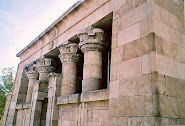
Who's that lady?  Outside the Temple Debod's
beautiful grounds in Madrid.

This is a shot of the one of the pools alongside the Temple Debod
built upon an escarpment overlooking part of Madrid.  It is hard to
describe how incredibly beautiful the surroundings of the Temple are.

More on the Temple Debod:

Sacred Destinations
Wikipedia


Funny Doggy Joke - No Kidding!

A temporary break as I'm downloading transferred pictures from my ancient desktop -- I found this in a late 2002 email (still saved, yes, me bad) from Mr. Don:


This is my sweetheart of a doggy,
Miss Tasha.  She was a brown labrador/doberman
mix I adopted in 1991 from the Wisconsin
Humane Society when she was 11 months old.
She passed away in Spring, 2004.
 This guy sees a sign in front of a house: "Talking Dog for Sale." He rings the bell and the owner tells him the dog is in the back yard.

The guy goes into the back yard and sees a mutt sitting there. "You talk?" he asks.

"Yep," the mutt replies.

"So, what's your story?"

The mutt looks up and says "Well, I discovered my gift pretty young and I wanted to help the government, so I told the CIA about my gift, and in no time they had me jetting from country to country, sitting in rooms with spies and world lders, because no one figured a dog would be eavesdropping. I was one their most valuable spies eight years running. I couldn't tell you how many wars I helped prevent.

But, the jetting around really tired me out, and I knew I wasn't getting aany ounger and I wanted to settle down. So I signed up for a job at the airport to do some undercover security work, mostly wandering near
suspicious characters and listening in. I uncovered some incredible dealings there and was awarded a batch of medals. Had a wife, a mess of puppies, and now I'm just retired."

The guy is amazed. He goes back in and asks the owner what he wants for the dog. The owner says "Ten dollars."

The guy says he'll buy him but asks the owner, "This dog is amazing. Why on earth are you selling him and why so cheap?"

The owner replies, "He's such a liar. He didn't do any of that stuff."

Sunday, Sunday...

Hola!  I spent most of the day hunting down information on bus and metro travel from the airport to the city center in Madrid, and then confirming and booking flights to and from Madrid for the first week in January, 2012.  Yes - we're booking that far out.  With the way airfare is rising because of increases in jet fuel, I want to be safe rather than sorry -- and we have to plan around Michelle's college schedule.  We did not want to go during the heat of summer (at least, I didn't - I can't take hot and humid anymore; I can take hot and dry as in Las Vegas, but not hot and humid). 

Found what looks like a nice little family-owned hostal - Hostal Gonzalo - just a few blocks away from the Prado Museum on a quiet street (what passes for quiet, anyway, in central Madrid, LOL!) with many restaurants nearby - I made our reservations there last night. 

We hope this trip to see many sites that we did not get to see during our trip in October, 2002 in addition to spending more time at the Prado - where we only were able to spend 4 hours before it closed down -- that was also the day I got sick (yech) but I didn't really feel bad untiil after we got back to our hotel.  We also hope to see our dear friend Carmen.

I'd like to share some photographs from that 2002 trip - all taken by Mr. Don. Except - oh oh - the old email that has all of the attachments has a geocities url that no longer works.  Drat - I will have to hunt down the current location of the photos!


Don in the Gift Shop at the National Palace,
we were waiting for our tour number to be called.
He did his "Obi Wan Don" imitation.


Saturday, March 12, 2011

Things That Look Like Board Games: What Is It?

One of my favorite features from BAR magazine (Biblical Archaelogy Review) is the "What Is It?" feature every issue?  I usually guess right, LOL!  Makes me feel smart (I'm a smart-ass anyway, but that's beside the point).

Mr. Don recently sent me an email with this image attached, and we've had some discussions about it since. 


I don't know where it is from or how old it is - despite nagging for the past 12 years; Mr. Don just doesn't find those sorts of things (like PROVENANCE) important :)

But I did find this very interesting discussion about the ancient "medium" here:  Info Tech of Ancient Democracy.  Enjoy! 

Save the Best for Last, by Vanessa Williams

It is absolutely cold and shitty-ass outside tonight.  The winds have not stopped all day and now, well after sun-down, they still haven't let up, persisting at about 20-35 mph.  The windchill remains well below freezing.  The sun snuck out for awhile today behinds tons of scudding black and grey clouds, and the filth-covered snow is ever-so-slowly melting away.  A typical March day in Wisconsin and I'm SO fricking sick of it.  LOL!

To cheer myself up, I thought I'd do a little research into a song I've been hearing recently on the online "smooth jazz" station I listen to, since the one and only smooth jazz station in Milwaukee was eliminated from the radio list nearly two years ago. Sigh.  The best stuff is always taken away from the public market and I'm left with really bad country western stations, really bad rap music (I detest it, it is nothing but anti-woman filth), a few lousy-formatted "oldies" stations, and contemporary shit music that I cannot stand the sound of.  No one sings anymore - they just scream and hope for the best.  If you don't believe me, watch one episode of American Idol.  The saddest thing is that people with real pipes, like Christine Aguilera, have sold themselves sort and sing shit for money instead of really singing and touching people with their music. 

Well, that's the state of music in the USA today -- but -- getting back to that "research" of mine - it was the 1991 recording of Vanessa Williams' "Save the Best for Last."  It's so hard to believe the song is now 20 frigging years old.  U-N-B-E-L-I-E-V-A-B-L-E.  Each time I hear her sing it on my computer "smooth jazz" station, I hear more and more, if you know what I mean.

The video is nothing to speak of, but she was gorgeous then, and she's gorgeous now, 20 years later.  It is comforting to know that a beautiful woman can remain beautiful despite trials, tribulations, and the temptations of wealth and fame, not to mention the march of Mother Time. Vanessa Williams remains a beautiful woman, inside where it counts, and outside, where it doesn't. 

Save The Best For Last - Vanessa Williams

Sometimes the snow comes down in June
Sometimes the sun goes 'round the moon
I see the passion in your eyes
Sometimes it's all a big surprise
'Cause there was a time when all I did was wish
You'd tell me this was love
It's not the way I hoped or how I planned
But somehow it's enough

And now we're standing face to face
Isn't this world a crazy place
Just when I thought our chance had passed
You go and save the best for last

All of the nights you came to me
When some silly girl had set you free
You wondered how you'd make it through
I wondered what was wrong with you

'Cause how could you give your love to someone else
And share your dreams with me
Sometimes the very thing you're looking for
Is the one thing you can't see

And now we're standing face to face
Isn't this world a crazy place
Just when I thought our chance had passed
You go and save the best for last

Sometimes the very thing you're looking for
Is the one thing you can't see

Sometimes the snow comes down in June
Sometimes the sun goes 'round the moon
Just when I thought our chance had passed
You go and save the best for last

You went and saved the best for last

2011 U.S. Women's Chess Championship!

It will be here soon!
The Chess Club and Scholastic Center of St. Louis is once again hosting both the 2011 U.S. Chess Championship and the 2011 U.S. Women's Chess Championship. 

The format for the Championship is, frankly, something I consider ridiculous, and the Women's Championship has also adopted the same silly format instead of the traditional round-robin which I believe best tests relative playing strength.  There is nothing to beat all-play-all.  Alas, I am not the organizer and I call no shots.  The women's field has also been cut down from last year's ten players to eight players this year:

1.IM Anna Zatonskih
2.IM Irina Krush
3.IM Rusadan Goletiani
4.WGM Camilla Baginskaite
5.WIM Tatev Abrahamyan
6.WIM Sabina Foisor
7.FM Alisa Melekhina
8.WIM Iryna Zenyuk

The prizes are rich! (Last year's prizes totalled $65,000 for the women, exclusive of special prizes for best game, scholarship, Goddesschess Award):

Prize Fund
Place Prize
1st $18,000
2nd $12,000
3rd $9,500
4th $7,000
5th $4,000
6th $3,000
7th $2,500
8th $2,000

There will be $2,000 in bonus prizes:

•After the preliminary round bonus prizes will be awarded:
◦$1,000 to the first-place finisher of the round robin
◦$600 for second place in the round robin
◦$400 for third place in the round robin
Additionally, $5,000 will be set aside to award Best Game Prizes throughout both the U.S. Championship and the U.S. Women's Championship.

All this stuff about a preliminary round, etc., what it boils down to is equal to the last minute in an NBA basketball game (usually boring, because the prior 58 minutes of team effort mean absolutely nothing), and this makes me very sad.  It isn't necessarily the best player who will win, just the luckiest.  This is a slap in the face to all the players invited to the Championship.

Jen Shahade will once again be providing commentary (I always enjoy her biting wit and insight) along with GM Maurice Ashley.  I did enjoy GM Ashley's commentary last year so I will listen again this year (as I can; unfortunately the rounds take place while I'm working and it is difficult to be simultaneously plugged in -- work or chess -- work or chess -- work or chess... and ultimately neither is very satisfying).  But I will miss GM Ben Finegold.  I really get him - he makes the games very "accessible" -- he has a knack, along with Jen, of making what is happening on the board almost understandable for a patzer like moi.

Goddesschess will once again be sponsoring a Fighting Chess Award - details to follow :)

Elephant Attacked by Crocodile!

Incredible photo sequence (with explanatory narrative) that I happened across at the National Geographic online while checking out what appears to be the latest on the Chinese Ming Mummy story (see post below).  The entire sequence of events took approximately 15 seconds!


The Mommy elephant was able to save both herself and her Baby, and I sure hope that nasty croc who tried to bite off way more than he could chew (reminds me of Wisconsin Governor Scott Walker) learned his fricking lesson. 

Confusing and Contradictory Press Coverage of Ming Dynasty "Wet Mummy"

National Geographic is saying that the "wet mummy" uncovered by Chinese workers digging out for a new road was first opened on March 1, 2011!  But coverage I saw last week at the Peoples Daily Online said the casket and others had been uncovered during digs in the area between 1979 and 2008 (see update added to original post on March 7, 2011).  So, does this mean that this particular casket was held for three years before being opened on March 1st? 

I'm confused - and it's not incipient old age seeping in, either!  So, what is the actual story?  Was The Mail Online correct, after all, in presenting this as a current story on March 5, 2011? In any event, the National Geographic has more great photos of the great "unwrapping" (so to speak) of this particular unintended mummy.


I wonder how long it will take before that ring disappears into some Commie honcho's private cache, to be replaced by fake gold and glass?   

What the hell is going on with the World, heh?

What a crazy fracking week this has been.  I don't know where to start, but one must start somewhere.  Like in this photograph of "debris" left behind by the tsunami that hit Japan in the aftermath of the quake Thursday.
Vehicles are piled up in Kesennuma, Miyagi prefecture,
Saturday, March 12, 2011, a day after a strong
 earthquake-triggered devastating tsunami hit Japan's
east coast. (AP Photo/Kyodo News)
How do you even begin to clean up such a disaster?  And yet, it will be done, one piece at a time.  I'd go wading in with a shovel, at the very least, but to remove the cars will take a lot of people to carry them out one by one, to be hauled away to be crushed in some junkyard contraption, or a jaws contraption that will grab each vehicle, shake it like a dinosaur of old would have shaken it's prey, and then deposit it (er, the car, not the prey) on a flat bed where the cars can be hauled to said junkyard.  The scope of the recovery effort is mind-bloggling and overwhelming, but the Japanese are a resilient and enterprising people, and with help they will recover from this horrible disaster.

I did not get much work done yesterday.  I first went to BBC News on the computer and saw this absolutely horrifying video of something that looked like it had been created by Hollywood imagining a disaster -- those images of the unrelenting crush of black, muck and debris-filled waters surging surging surging without stop across the flat landscape.  In the distance cars could be seen moving on a highway.  Could the drivers see the water coming?  Where could they (you) possibly flee to?  A human would not be able to outrun this wave of destruction on foot. I was just awe-struck and spent the entire time watching the events unfolding on the video with my hands up against my mouth.  As if - what?  What is this gesture of hand or hands to mouth that people (mostly women, I think) do when they are horrified by something?  Are we trying to hold something in (a cry, a scream?)  Are we trying to keep something out (evil spirits, bad miasma?) 


The worst is the absolutely helpless feeling that one experiences.  I cannot reach out and pluck those people out of harm's way. No amount of agonizing can save them, or change what happened.  I can only watch, in horror, as the events unfolded, captured forever in time on that video. Yesterday was not a good day...

Wednesday, March 9, 2011

Holy Blood

From Barbara G. Walker's The Woman's Eyclopedia of Myths and Secrets (just because I'm in that kind of mood tonight). 

Sa
Egyptian word of the holy blood of Isis, which made pharaohs and other selected heroes immortal; counterpart of the Hindu soma, the divine fluid of sovereignty and eternal life manifested in many ways, but basically derived from the Goddess's menstrual blood.  As the Egyptian Great Mother's "wise blood," sa was said to contain the spirit of all intelligence.(1)

Notes: 

(1)  Budge G.E. 2, 298.

Droit du Seigneur: The Connection Between Women and Land

From Barbara G. Walker's The Woman's encyclopedia of Myths and Secrets:

Droit du Seigneur
"The Lord's Right," also called jus primae noctis, "the law of the first night."  An outgrowth of the feudal system that equated ownership of land with ownership of women.  The droit du seigneur meant that every serf's bride must be deflowered on her wedding night not by her bridgroom but by the lord of the land.

As laid down by Ewen III of Scotland in the 9th century, the law said wives of common folk could be raped by any nobleman at any time; and "the lord of the ground shall have the maidenhead of all virgins dwelling on the same." (1)

The church upheld the droit du seigneur as a God-given right of the nobility.  For a vassal bridegroom to consummate his marriage within three nights after the wedding was declared blasphemous "to the holy benedictin" and tantamount to "carnal lust."(2)  The overlord's lust, however, was right and proper.  The eastern church provided legal penalties for a man who tried to consummate his marriage before his master could rape his bride.(3)

Droit du seigneur was a general rule throughout the feudal period and continued in Russia up to the 19th century.(4)

The system also continued in America's slaveholding south before the civil war, unofficially but generally acknowledged.  Every black woman was the sexal property of her master, whether she was married to another slave or not.(5)  Slave marriages could be legally ignored if plantation owners cared to do so.  In 1757, Peter Fontaine said plantation owners begot so many children on their female slaves that "the country swarms with mulatto vastards."  Thomas Anburey praised the system, calling it "a pleasant method to procure slaves at a cheap rate."(6)

Notes:

(1)  Bullough, 168. 
(2)  Brasch, 74.
(3)  Briffault 3, 242.
(4)  Felding, 155.
(5)  Brasch, 72.
(6)  Bullough, 300;  Rogoff, 325-26.
****************************************************************
I'm surprised that Walker did not pick up on the "old switcheroo" as 'Sis calls it.  In the way old days, twice a year a willing male was sacrificed after a night or orgiastic sex with the Priestess-representative of the Mother Goddess in order to ensure the fecundity of the land for the coming growing season and as a sacrifice to the Mother Goddess after a growing season, to ensure that it would come again. Sometimes the male victim was simply laid out on an altar stone within a sacred grove and, while he was under the influence of a drugged drink, his throat was slit; but sometimes he was physically torn apart in a frenzy by dozens of female acolytes.  The sacrifice was usually accepted by the Goddess, either way.

Under the patriarchal system that became firmly entrenched in just about every spot on the globe over the ensuing thousands of years after the advent of the warrior god (fraud) Marduk (but particularly accelerated with the advent of the patriarchal god representative in the West, Jesus Christ, and in the Middle East, Muhammed), the blessing of fecundity was perverted to sexual excess on the part of the "lord of the land" in his eagerness to deflower all virginal brides.  The link between women and fecundity in the land was maintained, but its true meaning was lost and the rite was perverted to the benefit of one male, rather than extending the benefit of the concept of "sacred union" to an entire locality/people/nation. 

Perhaps the sacred link between women and land remains, but the Mother Goddess has turned Her back on us.  There is a reason there are droughts in some lands, and excessive rains and flooding in others. Either condition is a killer of people, because crops cannot grow. No food - no life.  It doesn't take long for famine to set in, even in 2011. Crops die. Animals die.  Children die.  Women die. Finally, the men die, too.  The men usually survive the longest only because they steal what food and potable water there is from those weaker than they are - the animals, the children and the women.  Disrespect the women - kill the land.  It's simple.  But few "get it." 

Tuesday, March 8, 2011

Southwest Chess Club Action!

This Thursday (10 March 2011) the Southwest Chess Club presents “Wind Blowing, Storms-a-roaring, Marching into Spring Swiss” (see below for details).  We plan to start promptly at 7:00 p.m.  Registration is 6:20-6:50 p.m.  I plan to close registration at 6:50.  If you arrive after first-round pairings are prepared, you will have to take a 1/2-point bye in the first round. 

However, if you want to play but anticipate being a few minutes late, please e-mail me or Tom Fogec or call me 414-861-2745 or Tom 414-425-6742 prior to 4:00 p.m. on March 10, so I can include you in the pairings.  If you need a first round bye please let me know as soon as possible and you can have one.  Thanks.  Hope to see everybody on Thursday.   Robin

Wind Blowing, Storms-a-roaring, Marching into Spring Swiss: March 10, 17, 24 & 31
4-Round Swiss in Two Sections (Open and U1600).  Game/100 minutes.  USCF Rated.  EF:  $5.00.  (One ½ Point Bye Available for any round (except round four) if requested at least 2-days prior to round).  TD is Grochowski; ATD is Fogec. 

EXTRA: "David's Best Game Prize"  There will be a $5.00 "Best Game" prize for this tournament, which will be awarded by David Dathe.  The prize will be awarded for the most interesting game played in the tournament.  Mr. Dathe is the judge of any games submitted.  All tournament players are encouraged to submit a game.  Please submit the game to the TD.  The game needs to be legible (readable) so it can be properly analyzed.

Southwest Chess Club's location:  Police Station, located at 5635 South New Berlin Road, Hales Corners, Wisconsin, in the downstairs Community Room.� Club open at 6 PM, Tournament Games at 7 PM.

Monday, March 7, 2011

Female "Gendercide" in India and China Taking Enormous Toll - With Consequences

March 8, 2011 is the International Day of Women.  I've posted about this subject before.  This article brings it home in a very understandable way.  The generations of these men to come will say "Make war, not love."  This isn't funny
From The Daily Beast, posted at Yahoo News

Ominous rise of a bachelor generation
Niall Ferguson Niall Ferguson – Sun Mar 6, 10:43 pm ET
NEW YORK – According to the United Nations, there are far more men on the planet than women. The gender gap is especially pronounced in Asia. In this week’s Newsweek Niall Ferguson looks at the ominous rise of a bachelor generation.

In 1927, Ernest Hemingway published a collection of short stories titled Men Without Women. Today, less than a century later, it sums up the predicament of a rising proportion of mankind.

According to the United Nations, there are far more men than women on the planet. The gender gap is especially pronounced in Asia, where there are 100 million more guys than girls. This may come as a surprise to people in the Western world, where women outnumber men because—other things being equal—the mortality rate for women is lower than for men in all age groups. Nobel Prize-winning economist Amartya Sen calls it the mystery of Asia’s “missing women.” [Mystery is a bad word choice - it's no mystery why there is such a severe shortage of women in India and particularly in China - they are killing the female babies.]

The mystery is partly explicable in terms of economics. In many Asian societies, girls are less well looked after than boys because they are economically undervalued. The kind of domestic work they typically do is seen as less important than paid work done by men. And, of course, early marriage and minimal birth control together expose them to the risks of multiple pregnancies.

When Sen first added up the missing women—women who would exist today if it were not for selective abortion, infanticide, and economic discrimination—he put the number at 100 million. It is surely higher now. For, even as living standards in Asian countries have soared, the gender gap has widened. That’s because a cultural preference for sons over daughters leads to selective abortion of female fetuses, a practice made possible by ultrasound scanning, and engaged in despite legal prohibitions. The American feminist Mary Anne Warren called it “gendercide.” Notoriously common in northwestern India, it’s also rampant in the world’s most populous country: China.

In China today, according to American Enterprise Institute demographer Nicholas Eberstadt, there are about 123 male children for every 100 females up to the age of 4, a far higher imbalance than 50 years ago, when the figure was 106. In Jiangxi, Guangdong, Hainan, and Anhui provinces, baby boys outnumber baby girls by 30 percent or more. This means that by the time today’s Chinese newborns reach adulthood, there will be a chronic shortage of potential spouses. According to the Chinese Academy of Social Sciences, one in five young men will be brideless. Within the age group 20 to 39, there will be 22 million more men than women. Imagine 10 cities the size of Houston populated exclusively by young males.

The question left open by economists is what the consequences will be of such a large surplus of young men. History offers a disquieting answer.

The question left open by economists is what the consequences will be of such a large surplus of young men. History offers a disquieting answer. According to the German scholar Gunnar Heinsohn, European imperial expansion after 1500 was the result of a male “youth bulge.” Japan’s imperial expansion after 1914 was the result of a similar youth bulge, Heinsohn argues. During the Cold War, it was youth-bulge countries—Algeria, El Salvador, and Lebanon—that saw the worst civil wars and revolutions. Heinsohn has also linked the recent rise of Islamist extremism in countries like Afghanistan, Iraq, and Pakistan to an Islamic youth bulge. Political scientists Valerie Hudson and Andrea den Boer warn that China and India could be the next countries to overdose on testosterone.

That has scary implications. Remember, most of Hemingway’s stories in Men Without Women are about violence. They feature gangsters, bullfighters, and wounded soldiers. The most famous story is called simply “The Killers.”

It may be that the coming generation of Asian men without women will find harmless outlets for their inevitable frustrations, like team sports or videogames. But I doubt it. Either this bachelor generation will be a source of domestic instability, whether Brazilian-style crime or Arab-style revolution—or, as happened in Europe, they and their testosterone will be exported. There’s already enough shrill nationalism in Asia as it is. Don’t be surprised if, in the next generation, it takes the form of macho militarism and even imperialism. Lock up your daughters.

Niall Ferguson is a professor of history at Harvard University and a professor of business administration at Harvard Business School. He is also a senior research fellow at Jesus College, Oxford University, and a senior fellow at the Hoover Institution, Stanford University. His latest book, The Ascent of Money: A Financial History of the World, was published in November. 

Will "Broken Mayan Code" Reveal Tons of Golden Treasure?

I can't resist posting this story, LOL!  Well - you never know.  One of these days one of these old treasure legends just might be proven true...

Archaeology
Cracked Mayan Code May Point to 8 Tons of Lost Treasure

Published March 01, 2011
| Fox News Latino

It's a treasure hunt even Indiana Jones would be proud of.

Buried beneath a lake in Guatamala sits a fortune in lost treasure -- Mayan gold to be precise -- and a group of German archaeologists has just set off to find it. Their only guidance, a freshly decoded ancient book containing a map to the treasure.

It sounds like a movie, but it's very much real, reported FoxNews Latino. Joachim Rittsteig, an expert in Mayan writing who is heading up the mission to Guatemala's Lake Izabal, the site reported. Rittsteig claims to have cracked the famous Dresden Codex, a pre-Columbian Maya book possibly from the 11th century, and discovered in its pages specific information that leads to a treasure in the lake.

"The Dresden Codex leads to a giant treasure of eight tons of pure gold," said Rittsteig, who has spent more than 40 years studying the document. According to the German newspaper Bild, which is sponsoring the expedition, two reporters from the publication, a photographer, a television camera, and a professional diver will visit Izabal in an attempt to find the gold.

A professor emeritus at Dresden University and author of various publications about the Maya culture, Rittsteig stressed that the information is in the Codex.

"Page 52 talks about the Maya capital of Atlan, which was ruined by an earthquake on October 30th in the year 666 BC," he said. "In this city, they kept 2,156 gold tablets on which the Maya recorded their laws."

Lifestyle
Cracked Mayan Code May Pave Way to Lost Gold

Published March 01, 2011
| Fox News Latino

Led by Joachim Rittsteig, an expert in Mayan writing, a group of scientists and journalists left Germany Tuesday, on a mission to Guatemala in search of a lost Maya treasure allegedly submerged under Lake Izabal.

According to the German newspaper Bild, which sponsored the expedition, the expedition includes two reporters from the publication, a photographer, a television camera, and a professional diver who will submerge into Lake Izabal in an attempt to find eight tons of gold said to have been lost there.

The expedition is led by Joachim Rittsteig, an expert in Mayan writing, who claims to have cracked the famous Dresden Codex and discovered specific information in one of its chapters that leads to a treasure in Lake Izabal.

"The Dresden Codex leads to a giant treasure of eight tons of pure gold," said Rittsteig, who has spent more than 40 years studying the document, to Bild.

A professor emeritus at Dresden University and author of various publications about the Maya culture, Rittsteig stressed that "page 52 talks about the Maya capital of Atlan, which was ruined by an earthquake on October 30th in the year 666 BC. In this city, they kept 2,156 gold tablets on which the Maya recorded their laws."

The treasure sank, along with the city, into the waters of Lake Izabal, located in eastern Guatemala. But the German academic claims to have found the remains thanks to radar images taken in the area.

Rittsteig calculates that "just the gold in the tablets is estimated to be currently worth up to 211 million euros (290 million dollars)."

The Dresden Codex, drafted in the year 1250 AD by Mayan priests, is one of the four major documents that remain from that culture. It has been housed by the Saxon State Library in East Germany for the last 272 years.

The code was discovered in 1739 in the possession of a wealthy man in Vienna, though no one knows how he got a hold of it. He then donated it to the Dresden Library, where it is kept under bullet-proof glass in a room with other treasured documents.

Joachim Rittsteig has dedicated most of his entire life to decoding the codex, which is composed of 74 pages, 3.56 meters long with 74 distinct hieroglyphics.

The Dresden Codex contains much of what is known of Mayan Culture, including their understanding of astrology, medicine and even the end of the world. In the last chapter, the codex describes the coming apocalypse, which it says will take place on December 12th, 2012.

Translation by Fox News Latino from EFE.

Warrior Women - A Review

A new book on warrior women.  There have been others written - I have two excellent tomes wholly devoted to the subject:

Women Warriors: A History, by Davie E. Jones
Warior Women: An Archaeologist's SSearch for History's Hidden Heroines, by Jeannine Davis-Kimball, Ph.D. with Mona Behan

There are also chapters in other books in my library devoted to warrior women.

So - what does this new book, by Robin Cross and Rosalind Miles, have to offfer that prior books on the subject have not?  A lot of new female characters!

By Pam Norfolk
Published on Wednesday 2 March 2011 01:00

Whoever claimed that war was men’s work had never come across the likes of vengeful Caterina Sforza, the terrifying Jinga Mbandi or ace spy Pearl Witherington.

These are just a few of the feisty, fearsome and formidable fighting women whose acts of courage, daring and self-sacrifice have set alight theatres of war across the world for thousands of years.

While 21st century society wrings its hands over the rights and wrongs of women fighting on the front line, history tells us that they have always been there in some form or other, whether taking part in military campaigns or leading their countries into war.

As the world prepares to celebrate International Women’s Day on March 8, Warrior Women, a magnificent new book by author Rosalind Miles and historian Robin Cross, restores their wartime heroics to a rightful place of honour and prominence by painting vivid portraits of over 100 outstanding women across 3,000 years of history.

From the ‘silver-sworded, man-loving, male child-killing Amazons’ to Colonel Martha McSally, the first female pilot in the US Air Force to fly in combat, women have often proved themselves cool and courageous under fire.

Some, like Cleopatra, Joan of Arc and Elizabeth I, are familiar names but others like Susan Travers, the only woman to have joined the French Foreign Legion, are lesser known but just as thrilling.

As far back as 1049 BC, the legendary Delilah acted as the first ‘honey-trap’ operative when she ensnared Samson for the Philistines and in 61 AD Boudicca, dubbed the ‘Killer Queen’ of Britain by the Romans, cried ‘death before slavery’ as she took on the invaders.

In the second century, the Vietnamese Tru’ung Sisters led a famous rebellion against the Chinese Han Dynasty while swashbuckling swordswoman Tomoe Gozen, ‘a warrior worth a thousand, ready to confront a demon or a god’, was a senior samurai officer in the Japanese Genpei War of 1180-85.

Austrasian warrior queen Brunhilde paid the ultimate price for 40 years of bravery and skill during the Frankish wars of the 6th century - her enemies literally pulled her to pieces by stringing her between four horses.

The religious struggles following the 7th century birth of Islam produced Salaym Bint Malhan who, although pregnant, fought in the ranks of Muhammad with swords and daggers strapped round her swollen belly.

A woman not to be crossed was Caterina Sforza, daughter of the 15th century Duke of Milan, who took revenge on the ringleader of her husband’s killers by having him dragged round a square by a horse and then disembowelled and dismembered while still alive.

One of the most extraordinary women warriors was Jinga Mbandi, the 17th century queen of what is now Luanda, the capital of Angola, which was then being exploited by Portuguese slavers. Jinga is reported to have sat on the back of a crouching slave to assert her rights as queen during talks with the Portuguese governor and then executed the slave, explaining that she never used the same chair twice.

In more recent times, Second World War spy Pearl Witherington, a brilliant agent with the British Special Operations Executive, took command of over 3,000 men of the French Resistance in the field and was so feared by the Germans that they put a bounty of one million francs on her head.

Brimming with fascinating histories and an amazing collection of colour pictures and illustrations, Warrior Women is a big, beautifully produced book which tells the awe-inspiring and revealing story of some unforgettable female fighters.

(Quercus, hardback, £20

"Metal Books" - Real or Fraud?

A fascinating story.  The "books" have been called frauds by the scientific establishment - but are they?

From the Jewish Chronicle Online

Heavy metal secrets from a Mid-East cave
Israel’s archaeological establishment believes they are a fake. But could a collection of metal books be an early example of Kabbalah?
By Simon Rocker, March 3, 2011

Robert Feather is out to prove the sceptics wrong. A metallurgist with a passion for archaeology, he has been asked to help authenticate what he believes could be one of the most exciting religious discoveries since the Dead Sea Scrolls.

The West London Synagogue member has previously published a book on the Copper Scroll, the Dead Sea Scroll thought to hold clues about the location of buried Temple treasure.Now he is trying to establish the origins of a mysterious cache of metal books which could be linked to the Kabbalah.

The objects belong to Hassan Saeda, a Bedouin farmer in Galilee who says they have been in his family's possession since his great-grandfather found them in a cave in Jordan, a century ago.

His collection consists of more than 20 codices (early books), cast mostly in lead and containing cryptic messages in Hebrew and Greek along with symbols such as the menorah. In various places, the Hebrew letters appear to stand for Bar Kochba, leader of the second-century Judean revolt against the Romans; and the talmudic mystic Shimon bar Yochai, who hid from the Romans in a cave for 13 years.

"The first time I heard about the discovery, I was extremely cautious," Mr Feather said. "However, when I was given an opportunity to see and examine some examples…and visit the cave where they were said to have come from, my scepticism was allayed."

The books appear to be "Kabbalah-related and the nature of the content indicates a magical incantation style of writing," Mr Feather said. Before 400 CE, almost all ancient codices were made of parchment. The lead codices "predate any form of codex by several hundred years and this particular material was probably chosen to ensure permanency."

The Israel Antiquities Authority (IAA), however, has dismissed the idea that the books are of any value. Experts who examined some of them, it said, "absolutely doubted their authenticity". According to the IAA, the books are a "mixture of incompatible periods and styles…without any connection or logic. Such forged motifs can be found in their thousands in the antiquities markets of Jordan and elsewhere in the Middle East."

Professor Andre Lemaire, an expert in ancient inscriptions from the Sorbonne, was also dubious, saying the writing on some of the codices he had seen made no sense and it was "a question apparently of sophisticated fakes".

Undeterred, Mr Feather instead cites the findings of Peter Northover, a metals analyst at Oxford University. Conducting tests on two samples of metal from one book, Dr Northover concluded that their composition was "consistent with a range of ancient lead," and that it was clear from the surface corrosion that the book was "not a recent production".

The IAA remains unconvinced, arguing that the metal could have been taken from an ancient coffin while the messages could have been fabricated later.

But Sasson Bar-Oz, a lawyer representing Mr Saeda, the artefacts' owner, believes that the IAA did not carry out extensive enough checks. "My opinion, after a lot of time on this project," he said, " is that they are genuine."

Now there is fresh hope for Mr Feather, who was approached to help Mr Saeda because of his expertise in metal. A piece of leather, bearing the image of a crocodile, which also turned up with the metal books, was sent for carbon dating. The results, just back, indicate it is nearly 2,000 years old. But Mr Feather said that the dating needed to be corroborated by other tests, currently being conducted, before he could be confident of its accuracy.

The dry soil of the Middle East is rich in the relics of ancient civilisation. But experts do not want to be caught by elaborate forgeries. Last October a marathon five-year trial ended in Israel of two dealers accused of faking an inscription on an ossuary (stone coffin) to suggest that it might have once held the remains of James, the brother of Jesus Christ. The judge has still to announce a verdict and the 12,000 pages of conflicting evidence demonstrate how difficult it can be to determine what is genuine or not.

Institutions involved with antiquities tended to be "ultra-cautious", Mr Feather said, "because they have burned their fingers on previous occasions. A classic example is that of the Shapira strips."

Moses Shapira was a 19th-century antique dealer in Jerusalem who acquired some leather strips which he thought were early biblical writings. "Initially they were hailed as one of the greatest historical finds of all time," he said. "Subsequently the British Museum dismissed them as forgeries, largely because the text differed from the biblical version of the time. Shapira was so distraught that he blew his brains out in a hotel in Amsterdam," he said.

"When the first of the Dead Sea Scrolls was discovered in 1947, similarities to the Shapira texts made scholars reassess their conclusions. It is now generally accepted that the Shapira strips were probably the oldest known version of Deuteronomy."
Related Posts Plugin for WordPress, Blogger...