Sunday, March 28, 2010

A Miracle?

This event was verified as a genuine miracle by the Roman Catholic Church.

Amsterdam's own miracle of 1345
Published on : 24 March 2010 - 1:57pm

On 13 March 1345 an honest-to-God miracle occurred in Amsterdam. On that day, a dying man sent for a priest to administer the last sacraments. However, the man was so sick that he regurgitated the Host (the wafer that represents the body of Christ) and then died.

The Host returns
His vomit, including the Host, was thrown into the fire. The next day, the maid was surprised to find that the Host had remained untouched by the fire, and took it to the priest of Amsterdam's Old Church. Much to everyone's surprise, the Host reappeared at the dead man's house the next day. The maid again took it to the priest, but the host returned to the man's house twice. This wondrous sequence of events became known as the Miracle of Amsterdam.

The miracle was officially recognised by the Roman Catholic Church and considered proof of the actual presence of Jesus Christ in the Host. An annual procession was held to commemorate the Miracle of Amsterdam until all public expressions of the Catholic faith were banned in the 16th century.

The annual pilgrim's walk through Amsterdam, the Silent Procession (Stille Omgang), was held this year for the 129th time since its reintroduction in 1881.
******************************************************************************
What I want to know is where is this Host today? Is it preserved somewhere similar to those mysterious "archives" where was saw the Ark of the Covenant stashed inside an anonymous wooden crate at the end of "Raiders of the Lost Ark?" Did someone take it in Holy Communion hundreds of years later? Was it destroyed during the Protestant revolts in the 1600s? Is it still on display inside a glass case, miraculously preserved and pristine white (except for some dried puke?)  Or did the Host finally get tired of magically rescuring itself from the fire and decide to walk away and hide in the forest - where it remains hidden to this day...

Do We Only Live Once?

A fascinating subject, not necessarily a religious topic, although we have been taught this is so. The Bible says that 'eternity is writ in men's hearts' (paraphrased) and probably similar sentiments are found in many religious traditions.  In the oldest traditions (not necessarily religious) when society was more matriarchal and paid homage to many goddesses, the view was "birth/life/death/infinity" - to borrow a phrase from the old t.v. series.  (Image: Old Europe Cucuteni 4900 - 4750 bce fired clay 21 figurines and 13 chairs.  My guess is that the 13 chairs reflect the 13 lunar cycles per year).  The entire process of human existence, from birth to death, was seen as a never-ending circle that was reflected in the entire world around us - the never-ending cycle of the seasons, the rotations of the stars about our heads, the rebirth of the earth and its bounty every year during spring. 

To this very day we usually don't say that somebody has died, we say that person has "passed away."  Of course the implication is that the person has left behind physical life and moved on to something else - vaguely visualized as "something better."  The body may moulder inside an expensive casket (what a waste of money!) but the "soul" if you will - that essential spark and unique identity that is each of us - survives. 

What happens to that unique identity once the physical body dies is the subject of endless debate.  But the fact that the debate itself exists, is very telling, isn't it :)

For the record, I do believe that our unique selves survive and incarnate into human beings again.

I saw a link to this article through a friend's comment at Facebook. Here are the introductory paragraphs from the Huffington Post.

Robert Lanza, M.D.Scientist; author, "Biocentrism"
Posted: March 24, 2010 09:11 AM
Do You Only Live Once? Experiments Suggest Life Not One-Time Deal

We think we die and rot into the ground, and thus must squeeze everything in before it's too late. If life -- yours, mine -- is a just a one-time deal, then we're as likely to be screwed as pampered. But experiments suggest this view of the world may be wrong.

The results of quantum physics confirm that observations can't be predicted absolutely. Instead, there's a range of possible observations each with a different probability. One mainstream explanation, the "many-worlds" interpretation, states that there are an infinite number of universes (the "multiverse"). Everything that can possibly happen occurs in some universe. The old mechanical -- "we're just a bunch of atoms" −- view of life loses its grip in these scenarios.

Biocentrism extends this idea, suggesting that life is a flowering and adventure that transcends our ordinary linear way of thinking. Although our individual bodies are destined to self-destruct, the "me'' feeling is just energy operating in the brain. But this energy doesn't go away at death. One of the surest principles of science is that energy never dies; it can neither be created nor destroyed. When we die, we do so not in the random billiard ball matrix but in the inescapable life matrix. Life has a non-linear dimensionality −- it's like a perennial flower that returns to bloom in the multiverse.

A series of landmark experiments show that measurements an observer makes can influence events that have already happened in the past. One experiment (Science 315, 966, 2007) confirmed that flipping a switch could retroactively change a result that had happened before the switch was flipped. Regardless of the choice you, the observer, make, it'll be you who will experience the outcomes −- the universes −- that will result.

Biography of Pearl S. Buck

Methinks it is time for a new generation of Americans to read Buck's novels about life in China.  For the people living in China's hinterlands (the "peasants" as they are still called today), life hasn't changed much in thousands of years, except the water is more polluted where water is still available (millions have been driven off their hereditary lands through massive damming projects, and millions more are withering away through a 10-year long drought that shows no signs of ending anytime soon, thanks to shifts in weather patterns due to global warming), and the earth is more poisoned than ever with industrial pollution. 

As a country and as a western culture, we cannot begin to successfully understand and deal with the juggernaut that is today's China unless we know it - and through Buck's novels we can come to know it.

So, I am glad to see a biography of Buck being published.  Perhaps it will spur interest in her novels in this country and her readers can learn a few things about what life in China is really like - things haven't changed for the "peasants" since Buck wrote about them in her novels, and the cultural mores and outlooks they embody are deeply embedded in the people who control China today, despite a cosmopolitan gloss that fools some of the people (i.e., our leaders) most of the time. 

From literyreview.co.uk
Elaine Showalter
CHINA GIRL
Burying Bones: Pearl Buck's Life in China
By Hilary Spurling (Profile Books 288pp £15)

How does a woman overcome the suffocating messages of her culture to become an artist? In Burying the Bones, Hilary Spurling unearths the creative roots of the Nobel Prize-winning novelist Pearl Buck (1892-1973). Spurling points out that, although Buck's most famous novel, The Good Earth, is still in print, the author is 'virtually forgotten. She has no place in feminist mythology, and her novels have been effectively eliminated from the American literary map.' Boldly conceived and magnificently written, Burying the Bones should repair Buck's literary fortunes and restore her to the pantheon of feminist heroines.

In her foreword, Spurling dates her fascination with Buck to her childhood reading. The first book she remembers was Pearl Buck's The Chinese Children Next Door, about a family of six little girls totally overshadowed and enslaved by the seventh child, a baby brother. When she reread it as an adult, Spurling recognised 'echoes of stories my mother told me about her own childhood when she, too, had been the last of six unwanted girls'. For Spurling, these were stories of a remote time and place, but for Buck, who played as a little girl 'in a Chinese town where wild dogs foraged for babies routinely exposed to die on waste land', it was a domestication of the terrors of finding the 'half-eaten' remains of bodies, 'nearly always girls suffocated or strangled at birth'. Spurling makes this story a symbol of the archaeological process of 'recovering the remnants' of Buck's early life, but it is also a fable about male supremacy and the silencing of women's voices. How Buck survived and transcended this destiny is the empowering theme of the book.

Pearl Sydenstricker grew up in China at the turn of the century as the daughter of Southern Presbyterian missionaries, cared for by a beloved amah. 'I spoke Chinese first and more easily,' she recalled. 'I did not consider myself a white person in those days.' Pearl's father, Absalom, was an ascetic, fierce Christian in search of martyrdom, who demanded an area 'as large as the state of Texas' north of Shanghai as his first post, in a futile effort to convert a people for whom he had little personal compassion or cultural sympathy. In three years 'he made not a single convert', and came home from his solo trips around the country covered with bruises and spittle. Absalom's blind devotion to his church robbed his wife Carrie of all material comfort and emotional support, and fuelled Pearl's sympathy for all women bound in their minds as well as their bodies. In The Exile (1936) Buck told her mother's story of sacrifice, poverty and suffering in a marriage of sexual and spiritual duty. Nevertheless, as Buck would acknowledge in a biography of her father called The Fighting Angel (1936), there was something heroic in Absalom's single-minded calling and something admirable in his lifelong effort to translate the New Testament into the Chinese vernacular.

In 1901, having survived the sieges of the Boxer Rebellion, the Sydenstrickers returned temporarily to their native West Virginia, and nine-year-old Pearl had her first American experiences. Later she was sent to be educated at the genteel Randolph-Macon Woman's College in Lynchburg, Virginia, where she continued to read Dickens obsessively and briefly reinvented herself as a Southern belle. But Pearl was eager to return to China and went back in 1914 to keep house for her father, care for her ailing mother, and teach English to the new generation of Chinese students and intellectuals influenced by the Nationalist revolution of Sun Yat-sen.

During this exciting time she acknowledged her vocation as a writer, and was determined to follow the example of Chinese popular fiction, championed by the young iconoclasts of Chinese literary reform. Unlike the arcane classical Chinese literature of the past, this new writing, according to Buck, 'was an enormous release to educated men and women. To be able to say what one felt ... was to free an energy suppressed for centuries.' While for all Chinese writers, the change meant a shift from the classical to the 'despised' vernacular language, for women it meant the freedom to describe female experience, to tell the truth about their lives.

Pearl had just started to write stories and journalism about China when she married John Lossing Buck, an agricultural economist stationed in Anhwei Province. Although it began as a love match, the marriage turned out to duplicate some of the worst elements of her parents' unhappy life together. Lossing (as he was called) was obsessed by his work, and their sexual incompatibility showed up in her writing 'about thwarted sexuality, marital rape, and the physical repulsion' women could feel for their husbands. Indeed, Spurling writes, 'Sex was Pearl Buck's territory as a novelist.' Tragically, their daughter Carol was born in 1920 with a genetic birth defect called phenylketonuria, which led to mental impairment. The Bucks adopted another daughter, Janice, hoping to stimulate Carol with sibling companionship, but the emotional and practical weight of caring for the children fell on Pearl, and Lossing refused to leave the political chaos of China for America, even in 1927 when the violent clash between Nationalists and Communists in Nanjing put their lives at risk.

I see now that I was in a queer submerged state. It was like living in a solitary cell, nothing and no one came in, and I seemed unable to communicate with anyone ... remembering it, I have the feelings of someone having spent part of his life in jail.
She would explore this sense of imaginative and emotional imprisonment in her fiction.

In 1929, she made the agonising decision to put Carol in a private institution in New Jersey and, upon her return to China, began to write The Good Earth. Published by the small New York firm John Day in 1931, the novel was an international sensation, 'the first attempt to penetrate the deep underlife of ordinary Chinese people that no one else had ever written about before'. Its depiction of a strange and harsh society and its portrait of the stoic mother, O-lan, connected with the fears of ordinary Americans in the Depression. The book's success dramatically changed Buck's life. She divorced Lossing Buck, married her publisher Richard Walsh, and moved back to the US. Together they adopted five more children and founded Welcome House, the first international, interracial adoption agency. In the last forty years of her life, Buck became a popular novelist who never lost her faith in the importance of fiction to reach a mass audience, and a staunch advocate for birth control, the care of mentally disabled children, and racial and sexual equality.

9 Queens Action! Third Annual Chess Fest

April 11, 2010 in Tucson, Arizona!

3rd Annual Chess Fest
Time: 2:00pm - 5:00pm
Location: Historic Hotel Congress
Street: 311 E. Congress St.

9 Queens and the Hotel Congress are proud to present the 3rd Annual Chess Fest. This nontraditional chess festival offers something for everyone including:
* A speed chess tournament
* Free chess lessons
* Blindfold chess exhibition
* Human chess match played on a life size board
* Live music
* Face painting

Saturday, March 27, 2010

Computer Labs for Kids: Dallas, Texas

An email from Shira Evans of Computer Labs for Kids.  Once again, a successful project - this one in Dallas, Texas earlier this month.  Shira is working on a small scale in concentrated bursts to introduce big changes into the lives of foster kids and orphans all around the world, and she has done it successfully now for over a year.  But, as you know, the need is great.

Foster kids receive Laptops!
On March 20th twenty children received their very own educational laptop at Buckner Children and Family Services.

Twenty-five Computer Labs for Kids volunteers teamed up to deliver training to these children who came from foster homes and the poorest areas of Dallas, TX.

I would like to extend a very warm thank you to all of our volunteers and contributors. You made this event possible!!!

Success!
So far this year, we have awarded 40 laptops to children at foster care facilities. Last year, we awarded 31 laptops and 13 leapsters.

Future Projects

Mary Kimball has requested we hold a course at an Indian Reservation in Phoenix, AZ.

Rev. Alfred Solomon has requested we hold a course for the poor children in Scotland Neck, NC.

The requests go on... including India, Thailand, Brazil, Africa and Israel.

Visit our website to see photos and videos!

FREE MOVIE PASS!
The first 30 people to donate $10 or more will receive a Pacific Theatres pass good for 1 admission ticket. Limited to 1 per donor.

Donate Now!

We Need Help!
We are entirely dependent on your generosity. The only way we will be able to get started on our next project is with the help of your donations.

It costs us $600 per child and right now we have no way to continue. Our costs include the price of the laptop, software, and all course materials.

Thank you for being a part of our organization! Shira

Computer Labs for Kids, Inc.
278 E Colorado Blvd.
#1617
Pasadena, CA 91101

2010 World Ladies' Free Skate

Well, we can rest assured that bullshit continues to reign in the world of figure skating.  What I'm seeing here (see below) says that Kim Yu Na WON the free skate.  NOT.  I watched her performance, and I watched Asada's performance.  I watched every performance for the last 3 groups (18 skaters).  I'm no expert but I've watched figure skating for over 45 years and I've learned a few things about it in that time.

So reputation trumps actual performance for Kim.  She didn't look too happy on the medals stand, I'm thinking she knows she got an absolute gift in that silver medal.  If she's not thinking it, she SHOULD be.  I've got nothing against Kim Yu Na, I think she is a magical skater.  But not in this competition.

Kim sure as hell did not out-performace Mao Asada in the Free Skate nor do I think that she out-performed Mirai Nagasu.  Asada has her shortcomings but she did a really fine performance in the Free Skate, I thought it was better than her performance at the Olympics.  The American skaters were absolutely screwed.  No way did Nagasu deserve 11th place ranking for her Free Skate - not after what I saw the other skaters did.  It's all there, you will be able to watch it on video and judge for yourselves. I'm thinking the judges thought the Americans won an ice-dance medal and that's enough for this year, and since Nagasu is the "future of American figure skating" (and they are all hoping that Rachel Flatt leaves the sport and becomes a Nobel Prize Winner in science) they could screw them over with their scores.  Which they did.  Way to go, judges. 

FPl. Name Nation Points SP FS
1 Mao ASADA JPN 197.58 2 2
2 Yu-Na KIM KOR 190.79 7 1   WAY OVERSCORED
3 Laura LEPISTO FIN 178.62 3 6  WAY OVERSCORED
4 Miki ANDO JPN 177.82 11 3  WAY UNDERSCORED
5 Cynthia PHANEUF CAN 177.54 8 4
6 Carolina KOSTNER ITA 177.31 4 5 OVERSCORED
7 Mirai NAGASU USA 175.48 1 11 WAY UNDERSCORED
8 Ksenia MAKAROVA RUS 169.64 5 8  OVERSCORED
9 Rachael FLATT USA 167.44 6 9  UNDERSCORED
10 Viktoria HELGESSON SWE 161.79 9 10

Here is the table for the Free Skate (top skaters):
Pl. Name Nation TSS = TES + PCS + SS TR PE CH IN Ded. - StN.
1 Yu-Na KIM KOR 130.49 66.45 65.04 8.35 7.75 7.95 8.15 8.45 1.00 #15
2 Mao ASADA JPN 129.50 67.02 62.48 8.25 7.40 7.95 7.55 7.90 0.00 #20
3 Miki ANDO JPN 122.04 63.64 58.40 7.35 6.85 7.60 7.30 7.40 0.00 #14
4 Cynthia PHANEUF CAN 118.04 61.48 56.56 7.20 6.65 7.35 7.15 7.00 0.00 #17
5 Carolina KOSTNER ITA 115.11 54.87 60.24 7.70 7.20 7.55 7.55 7.65 0.00 #19
6 Laura LEPISTO FIN 114.32 54.24 60.08 7.60 7.40 7.45 7.50 7.60 0.00 #22
7 Akiko SUZUKI JPN 111.68 58.96 52.72 6.80 6.10 6.85 6.55 6.65 0.00 #6
8 Ksenia MAKAROVA RUS 107.58 55.14 53.44 6.80 6.20 7.00 6.70 6.70 1.00 #24
9 Rachael FLATT USA 106.56 53.20 53.36 6.75 6.45 6.75 6.75 6.65 0.00 #21
10 Viktoria HELGESSON SWE 105.47 54.91 50.56 6.40 6.05 6.55 6.40 6.20 0.00 #16
11 Mirai NAGASU USA 105.08 49.04 57.04 7.40 6.75 7.20 7.25 7.05 1.00 #23
12 Jenna MCCORKELL GBR 98.78 51.82 46.96 6.10 5.40 6.20 5.80 5.85 0.00 #10
13 Sarah HECKEN GER 98.74 54.14 45.60 5.90 5.35 5.85 5.70 5.70 1.00 #7
14 Alena LEONOVA RUS 98.50 51.50 48.00 6.25 5.75 6.00 6.00 6.00 1.00 #8
15 Julia SEBESTYEN HUN 91.56 42.28 49.28 6.55 5.90 6.30 6.05 6.00 0.00 #18
16 Yan LIU CHN 91.33 47.65 43.68 5.70 5.45 5.30 5.60 5.25 0.00 #12

Liu Yan - that's the Chinese skater I mentioned in my earlier post today.  I'm thinking keep your eye on her.  She's got something special, despite the lousy costume.  I think she's got that "IT" factor.  Looking forward to seeing the competition heat up between her and Nagasu in the next few years.  For the Russians, Leonova has more "it" than Makarova, but Makarova has a "prettier" presence on the ice.  Leonova, ditch the "edgy" haircut, it doesn't do anything for you, trust me girlfriend. 

Rachel Flatt should change her last name and lose 10 pounds.  I know that sounds cruel - but I will bet you money that is what every single international judge who is looking at her thinks. 

I love Miki Ando, but she peaked in 2007 and hasn't been back since.  Today I saw more spark in her than in the last year - she was particularly flat at the Olympics.  I think she should retire, I think she will be a fabulous coach because she knows what it feels like to "lose that loving feeling" for the sport.  I think she should coach Nagasu after Frank Carol retires.

That's it until Nationals for me, in January 2011.  Geez, I'm getting old, and I'm not liking it one bit.

2010 Worlds Ladies' Free Skate

I've been watching the live action on Universal Sports online since 8 a.m. and have seen all of the key performances thus far.  Very interesting!

Kim Yu Na goofed up in the last part of her program, again on easy elements that she should be able to do while sleepwalking! and it's doubtful that she will make the podium unless the top 3 skaters really screw up.  The last group is getting ready to skate right now (10:09 a.m.) - the 2 Americans are in it, the Italian belle Carolina Kostner and the Japanese powerhouse Mao Asada - stay tuned!

10:14 a.m. - Kostner has a great presence on the ice and is a lovely young lady.  She has had some problems with her triple jumps but has not fallen (a big plus) and her home country crowd is behind her all the way.  Awaiting scores - there is a break right now where an advertisement would normally be but there are none so I just have to wait for the blank screen to reappear! 10:17 a.m. - score for Kostner:  115.11, puts her into 4th place.  Crowd not happy about that but she will finish in the top 10.

Mao Asada now up - with 2 triple axles planned.  World champion in 2008 - let's see -- she landed both triple axles (the second in combination with a double toe loop?) cleanly - still not liking that costume though.  10:23 a.m. - looks like a perfect performance to me.  Commentators are already crowning her at the new world champion, stating that she landed 6 triples and Kim Yu Na landing 5.  Waiting for the scores --129.50 (a few points below her season's best).  She is now in 1st place, 7 points higher than Kim Yu Na.  Announced at 10:28 a.m. by the commentators - Mao's 2nd triple axle was downgraded.

Now Rachel Flatt skates. Rachel had a triple/triple planned but she doubled the second jump after a problem landing on the triple flip; now she has just popped another triple.  Looks discombobulated.  Score: 106.06, puts her in 6th place with 3 skaters remaining, so she will be in the top 10, but is not happy with her performance.

Laura Lepisto is skating now (10:33 a.m.) -- lovely presence on the ice and nice speed.  Love the costume.  She doubled a triple loop (Tara Lapinski commentating said she slipped off an edge).  Very nice musicality, but she popped a couple of jumps.  10:38 a.m. - waiting for scores after a short break (arrgggh).  10:40 a.m. - waiting for scores -- 114.32, puts her into 3rd place, with 2 skaters left to go.

Nagasu up NOW.  Oh my - she had problems on her 2 triple lutzes and fell on her double axle, but oh my, what a performer and the got the audience behind her.  So now, 10:46 a.m. waiting for scores.  Commentary by Frank Carroll in the kiss and cry - you're not dead!  Score - 105.08 and they knocked her to 7th place.  That's bullshit. Compared to the other skaters she did not deserve to be so severely downgraded.  Looks like the judges are already setting up the Russian skater.

10:52 a.m. who just fell on a triple Salchow, otherwise clean program but not overly inspiring.  Waiting for scores -- 107.58, in 8th place.  That's okay. I do not think she outskated Nagasu, who should be placed higher than 7th.  That's just bullshit.

11:08 a.m. - I made the mistake of trying to get to the ISU page to see the table of scores.  Ach.  It's been 10 minutes now and the page is still downloading.

Asada wins gold - well deserved and absolutely earned at this championship.  I think Nagasu has better artistry and presence on the ice, though, as do several other skaters I saw today, including a Chinese skater who had a horrid costume but skated a lovely performance -- I'll have to hunt down her name.

Kim Yu Na won silver? - Not deserved, absolutely not deserved.  Shades of the old scoring system, she was propped up.

Is that Lapisto on the stand for the bronze?  Yep.  Oh, Johnny Weir says she was grossly overscored technically.  I think he's right.  He said Miki Ando should have won the bronze, so does Tara Lapinski.

I will post the top 10 scores table when I can get it to open!  I don't know where Nagasu ended up.

Friday, March 26, 2010

Earth Hour, March 27, 2010 at 8:30 p.m. your local time

Turn our your lights for 60 minutes, starting at 8:30 p.m. your local time on March 27, 2010.  I just saw an ad on t.v.  Wow!

What the hell, I usually sit in the dark anyway, except for my computer monitor and t.v., so it won't be no sweat off my back!

As soon as Kitchen Nightmares signs off at 9:00 p.m. my time, I'm going to watch the short programs of various female skaters now available on You Tube and Universal Sports T.V. online, so there may not be any more blog posts tonight.  Tomorrow, darlings!

Ice Dance - 2010 World Figure Skating Championshps

I just checked to see what was happening at the ISU website and found this (top 10 only) - results after the Free Dance:

Ice Dance - Free Dance
Result Details

Pl. Name Nation TSS  = TES  + PCS  + SS MO PF CH IT Ded.  - StN.
1 Meryl DAVIS / Charlie WHITE USA 110.49 53.70 56.79 9.50 9.35 9.40 9.55 9.60 0.00 #17
2 Tessa VIRTUE / Scott MOIR CAN 110.03 53.10 57.93 9.60 9.50 9.75 9.75 9.80 1.00 #18
3 Nathalie PECHALAT / Fabian BOURZAT FRA 98.09 48.70 49.39 8.20 8.05 8.25 8.35 8.45 0.00 #16
4 Federica FAIELLA / Massimo SCALI ITA 97.84 47.10 50.74 8.35 8.20 8.60 8.65 8.70 0.00 #19
5 Sinead KERR / John KERR GBR 93.32 45.70 47.62 7.90 7.85 8.00 7.95 8.05 0.00 #20
6 Alexandra ZARETSKY / Roman ZARETSKY ISR 91.34 46.30 45.04 7.40 7.25 7.70 7.65 7.75 0.00 #15
7 Vanessa CRONE / Paul POIRIER CAN 91.22 47.90 43.32 7.30 7.05 7.25 7.30 7.30 0.00 #14
8 Ekaterina BOBROVA / Dmitri SOLOVIEV RUS 89.76 47.60 42.16 7.05 6.80 7.15 7.10 7.20 0.00 #11
9 Nora HOFFMANN / Maxim ZAVOZIN HUN 83.52 42.60 40.92 6.90 6.65 6.90 6.85 6.90 0.00 #8
10 Emily SAMUELSON / Evan BATES USA 83.37 42.40 40.97 6.90 6.65 6.90 6.85 6.95 0.00 #6

Since Davis and White were in second place before the Free Dance, does this mean they won the gold medal since they won the Free Dance???

I'm going to check the news - (7:27 p.m.) -

7:29 p.m. - No, they didn't.  Virtue and Moir won the gold by 1.4 points -- total scores of 224.43 to 223.03.  Well you know what, that really sucks!  But congratulations to both the American and Canadian teams. What an amazing rivalry - and friendship.  Both teams train together and share coaches, and there's a little romance too, between White and Virtue.  Maybe they'll create their own commune and raise ice-dancing babies together and 18 years from now... okay okay, maybe not.

 Canadians placed 2 teams in top 10 and so did the Americans, both countries combined teams positions totalling 13 or less. That is the magic number that means both countries will send three ice-dance teams to 2011 worlds.  This is a really big deal!

Wow - ice-dance in North America has come of age!!!  The Russians had only one team in the top 10.  Unbelievable.  Putin is going to be spitting fire, ha ha ha!

News coverage about 2010 Worlds Women's Short Program

One thing we know - Mirai Nagasu (photo from the Short Program 2010 Worlds - AP) skated an outstanding short program judging by her scores - and the audience reaction must have been phenomenal.  Keep in mind that Kim Nu Yu skated after Nagasu. Did she hear the audience reaction as Nagasu skated and hear the score afterward as she waited to take the ice?

Kim was obviously distracted. She had problems with a triple flip jump, missed a pirouette before messing up her spiral sequence.

"My first triple-triple was really good and I was ready to do my flip. I don't know what happened, my left foot was just shaking a lot and I just want to find out what it is," the South Korean told Italy's Rai TV.

She received no credit at all for a spin, under-rotated a triple flip and bungled a spiral. Not even her strong opening triple-triple combo could make up for that. Her score of 60.30 points was more than 18 points behind her record-setting performance at the Vancouver Games.


"I felt very good at the warmup. My first jump, the triple-triple, was really great. And then after that I felt I was ready to do a triple flip. It was really weird. I don't know what happened," Kim said. "It's the first time I missed the elements like that."

 Phillip Hersh at the Chicago Tribune said Kim had problems on a triple flip jump, totally botched part of her spiral sequence.

This story just showed up in a Google News Search from The Chosun Ilbo (English Edition) dated March 27, 2010 - foreshadowing problems? - you decide:

Kim reportedly had a brief period of drifting after winning the gold medal at the Vancouver Olympics last month. Having "achieved everything," as she put it, she was in state of indifference and absent-mindedness, missing some practice sessions. "There was no physical problem, but I lost motivation since the Olympics," Kim said after completing her official practice in Turin on Thursday. "But I'm okay now that I'm here skating with the other athletes."

I am guessing the editor for The Chosun Ilbo English Edition had not yet heard the news about Kim's crash and burn during the World Short Program.

Added at 1:43 p.m.:

Oh my - this sounds awful - from Canada's The Globe and Mail:

Olympic champion Kim Yu-Na fell from grace in less than three minutes on Friday, looking almost disoriented in the women’s short program at the world figure skating championships.


Kim finished only seventh after under rotating a triple flip, falling out of a layback spin, slipping out of a spiral, fumbling her way through footwork and then looking rather confused in front of the judges, almost as if she forgot what she was doing.


The skater who is known to chalk up points as easily as breathing, found out how quickly you can lose points too. She got zero points for her layback spin and only a rudimentary level of difficulty on her spiral.


So what is with the judges' BIAS against Rachel Flatt?  She skated cleanly and they STILL gave her a crap score in comparison to Kim who, from reading the various descriptions in the stories cited above, totally messed up her Short Program. 

Mirai Nagasu in FIRST PLACE after Worlds Short Program

It's official - Nagasu in 1st, Rachel Flatt is in 6th.  Olympic gold medalist Kim Nu Ya is in 7th place.

I had a chance to find out a little bit more about the scoring - not that I understand all of it, but you can see that Nagasu outscored Kim on the technical side a whopping 10.1 points!  Side by side, their scores for program components were very close, with Kim edging out Nagasu 30.28 to 30.20 - only .08 a point separating them.

Here are the items that go into the Program Components (formerly "presentation") scores:

SS = Skating Skills
TR = Transitions/linking footwork and movement
PE = Performance/Execution
CH = Choreography/composition
IN = Interpretation

So - does this mean that Nagasu outskated everyone on the technical side - crisp edging, centered spins, elegant lines and amazing stretch and flexibility in her spirals, perfect take-offs and landings on jumps?  Of the top 10 skaters, Nagasu has the highest TES (Technical Score), outscoring even the mighty Asada with her triple axel!

I'll be interested to read what the skating people have to say about this.  I admit I'm shocked - not that Nagasu did so well (considering her break-out performance at the Olympics) but that Kim "fell" so far -- and that is absolutely ridiculous sounding, isn't it, since she currently sits in 7th place and that is VERY respectable.  But those 10.1 points in total score that separate Kim from Nagasu - can she make them up in the Free Skate?  Will Nagasu be able to hold it together and deliver a fabulous and technically sound Free Skate to fend off the skaters who will be aiming square at her to knock her off the podium? 

The pressure both skaters will be feeling - unbelievable.  Oy!  When is the Free Skate? -- Just checked -- it's tomorrow 3/27.

USA's Mirai Nagasu currently in first - Worlds short program!

Holy Goddess!  I'm trying to work and following the rankings as they happen live at the ISU website (can't watch the programs on Universal sports because we cannot download the needed program to our computers) - Nagasu just finished her short program and scored a season best score of 70.40 -- dig this -- she knocked Mao Asada into second place, who has 68.08!  Next up is Kim Yu Na.

Unbelievable!  Stay tuned...

11:17 a.m. - OHMYGODDESS!  Kim is in 6th place - she scored 60.30.  Unbelievable!  What the hell happened?  No time to check element scores and stuff like that - I'm supposed to be working...

Rachel Flatt has yet to skate - can she bump Asada out of second place so the unheralded American teens land in 1st and 2nd after the short program?  I can feel my hair turning grey...

11:19 a.m. - Akiko Suzuki finished skating and is in 17th place.  Rachel Flatt is up next...

THE TENSION IS KILLING ME...

11:28 a.m. - WOW!  Rachel knocked Kim Yu Na out of 6th place.  She scored 60.88 to Kim's 60.30.  Are people jumping out of buildings in South Korea at this moment?

Here's the stats for the top 7 thus far:

Pl. Qual. Name Nation TSS = TES + PCS + SS TR PE CH IN Ded. - StN.
1 Q Mirai NAGASU USA 70.40 40.20 30.20 7.60 7.15 7.70 7.70 7.60 0.00 #50
2 Q Mao ASADA JPN 68.08 37.12 30.96 7.95 7.25 7.95 7.65 7.90 0.00 #45
3 Q Laura LEPISTO FIN 64.30 34.98 29.32 7.45 7.10 7.20 7.40 7.50 0.00 #48
4 Q Carolina KOSTNER ITA 62.20 33.20 29.00 7.25 6.90 7.25 7.35 7.50 0.00 #44
5 Q Ksenia MAKAROVA RUS 62.06 36.90 25.16 6.50 5.90 6.50 6.25 6.30 0.00 #42
6 Q Rachael FLATT USA 60.88 33.80 27.08 6.60 6.15 7.25 6.85 7.00 0.00 #53
7 Q Yu-Na KIM KOR 60.30 30.02 30.28 7.95 7.45 7.30 7.70 7.45 0.00 #51

I don't know how many more skaters there are to go - there can't be that many -- they were already skating when I checked the news this morning at 6:30 a.m.

11:36 a.m. - THIS IS HUGE, HUGE!  I don't see any deductions for Kim so was it her performance?  Arggghhh, I won't be able to even check Universal Sports for replays until I get home tonight, unless something goes up at You Tube over my lunch hour...

Thursday, March 25, 2010

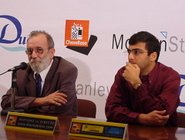
Sad News: IM/WGM Elena Tairova Passed Away at Age 18

This is a very sad story.


Reported at Chessbase.com.  In 2007 this lovely young lady sported hair down to her hips, but the latest photo in the Chessbase report from December, 2009 showed Elena with short hair growing out after what must have been a long bout of intensive chemo-therapy and/or radiation therapy.  I'm guessing, of course - I do not possess any insider information.  But, we've all seen pictures in the media of the changes wrought in a person's hair after chemo and radiation, or have experienced it up close and personal with a loved one who goes through such cancer treatment.  Elena played under the Russian flag, and had an ELO of 2455. 

IM/WGM Elena Tairova passes away at eighteen

24.03.2010 – Very sad news from Russia: the talented young player Elena Tairova, born on August 28 1991, has died at the age of just 18. Elena became a WGM at just 14 years of age, and a full IM the following year. She won a succession of European and World girls’ junior titles, and in 2006 was the Russian women’s under-20 champion. We offer our deepest condolences to her family and friends.

Squirrel: An Awwwwwhhhhh Story About a Rescued Baby Squirrel

It's spring and soon I am going to be an honorary squirrel grandmother (or perhaps great-grandmother, not sure which generation of female I'm dealing with).  The squirrels were already busy frigging in the tree rigging at the end of January and shortly thereafter a female started rebuilding a nest in an abandoned spot in the gigantic double-trunked Chinese Elm close to my deck.  There weren't any leaves on the trees, needless to say, so she chewed up a ton of little twigs and branches to make her home, leaving an absolute mess behind of dropped branches and twigs on my frozen tundra, that was soon covered by a snow storm for several weeks.  But the second half of February and most of March proved above-normal temperatures and all the snow has melted away, the ground has thawed, making me itchy-fingered to get out there and start gardening.  That would be a big mistake.  Today, Winter in Wisconsin reminds us that we aren't safe from Arctic blasts until June, with a Nor'easter whipping gigantic waves off Lake Michigan and dropping us back into the teens windchill.  Brrrrrr.  But no snow - yet...

Here is a video of a rescued baby squirrel that touched my heart.  It's nearly a couple of years old now (from 2008).  Soon, I will be seeing three or four squirrel pups racing up and down that old Chinese Elm, brightening my days with a constant reminder that concrete and exhaust fumes and Ozone Alert Days are not all there is to life. 

Ahhh, I cannot wait until April 21st when tax season has ended and I'm relaxing with a Mai Tai at Isis' pool in sunny, warm and dry Las Vegas. 

Oxford, Alabama is Back in the News Again - Divine Retribution???

Ohmygoddess, this story has more twists and turns than anything Alfred Hitchcock ever wrote!  Wow!  What I thought was the end - isn't!  You're going to love this. I have to get a tiny giggle in here - tee hee hee :)
Prior coverage:

Oxford, Alabama, a Sad Conclusion (March 15, 2010)
Follow-Up: The Oxford Mound (January 31, 2010)
Greed and Lies in Oxford, Alabama (January 22, 2010)
Indian Mound Being Destroyed by Corrupt Politicians (August 4, 2009)

Story from The Anniston Star
Oxford project shut down: Oversight in reporting human remains costs city thousands, delays work
by Patrick McCreless
Staff Writer
Mar 25, 2010

Construction on a multi-million-dollar Oxford sports complex halted a month ago because the discovery of ancient human remains at the site was not reported to the proper authorities — an oversight that so far has forced the city to pay approximately $200,000 to its idle project contractor.

The Oxford City Council briefly discussed the situation during the work session before its regular meeting Tuesday. The council agreed to sit down with all parties involved at 10 a.m. April 5 at City Hall to learn how the oversight occurred and to get the project started again. The parties involved include a representative from the U.S. Army Corps of Engineers, which shut down the project; Taylor Corp., the contractor; University of Alabama archaeologist Robert Clouse, who is overseeing the project; and engineering firm Goodwyn, Mills and Cawood.

"There's obviously been an oversight and someone's responsible for that oversight," Councilman Mitch Key said Tuesday.

Council President Chris Spurlin said the Corps of Engineers stopped the project around late February because it was not notified about the remains, which were discovered around Jan. 8 at the construction site on Davis Farm across from the Oxford Exchange. The wetlands permit the city obtained to develop the Davis Farm site stipulates the corps must be notified if any remains and/or artifacts are discovered.

Spurlin said the city has had to pay approximately $12,000 a day, except for days of rain, during the shutdown period to Taylor Corp.

Taylor's contract states the city must cover equipment and manpower costs for every day the project is shut down for reasons beyond the construction company's control, he said.

"Every two days, we're paying Taylor Corp. what it would cost for a new police car," Spurlin said.

To date, the city has spent more than $5.9 million on the project, most of it for the purchase of the property.

Mayor Leon Smith, who has told The Star on several occasions that he has been against the sports complex project since it began, has apparently washed his hands of this latest ordeal.

"I'm totally out, myself," Smith said after the Tuesday meeting.

Councilwoman June Reaves said she hoped the project would restart as soon as possible.

"We definitely need it," she said of the complex.

Spurlin said the corps has not budged on its decision to shut down the project because it is waiting on a detailed report from Clouse about when, where and how the remains were found.

"The U.S. Army Corps of Engineers requested a timeline of events leading up to, and the discovery of, the human remains that were found on the Davis Farm project," Clouse wrote in a Wednesday e-mail to The Star. "That timeline was submitted. Subsequent to the submittal of the timeline, the Corps of Engineers requested a report on all of the findings of the archaeological monitoring conducted to date on the Davis Farm project. That report is still in production and has not yet been submitted."

Clouse's involvement became significant in recent months because of two contradictory reports on a mound behind the Oxford Exchange that he filed last year with Oxford.

The first report, commissioned by the city, claimed the mound was manmade. The second report, published months later, offered a different opinion, saying the mound was the product of natural forces. Experts around the state, including those with the Alabama Historical Commission, disagreed with the second report and believe the mound is culturally significant.

One of those experts is Harry Holstein, professor of archaeology and anthropology at Jacksonville State University, who has studied American Indian sites in this area for decades. Incidentally, engineering firm Goodwyn, Mills and Cawood — which the city contracted to apply for its wetlands permit — hired Holstein to conduct the archaeological portion of the permit in 2007.

"As part of the wetlands permit process, archaeology is incorporated," Holstein said. "We told them there were 24 archaeological sites on that parcel of land, including a temple mound and village areas. The Historical Commission concurred, and the city signed off on it."

Holstein claimed earlier this year that someone had bulldozed the temple mound, which may have contained human remains. Clouse and the city claim the mound is still there.

Holstein believes the few remains the city found in January are only the beginning of what will be discovered at the construction site.

"They're going to find more bodies," he said. "(Indians) didn't just bury one person in a large town like that."

Attempts to reach representatives of the Corps of Engineers on Wednesday were unsuccessful.

Until DNA Says So, She is Not an Ancestor

Isis sent me this story when it first broke a couple of days ago, but I had hoped it would go away. But - it has not - so, Isis, here is the story, the latest version from the BBC. Lots of to-do about a "new ancestor of humans" - only, she probably is not.  Unless it can be shown that this female who is "dated" to between 48,000 to 32,000 years ago has her mitochondrial DNA present in today's humans, she cannot be an ancestor.  Amazingly, from a sliver of a finger bone artists have managed to come up with a very human-looking representation of what this ancient female looked like!  Modern reconstructive forensic science!  The miracles never cease!  This is better even than Eve being created out of one of Adam's ribs!

DNA identifies new ancient human dubbed 'X-woman'
By Paul Rincon
Science reporter, BBC News
Thursday, 25 March 2010

As I understand the current results, there is no evidence that the "X woman" contributed anything to the line of modern humans.  So - she is not an ancestor.  By scientific definition, she cannot be.  Notice, however, the use of the loaded term "woman" rather than using the more generic term "female."  "Woman" definitely connotes a human being - which the female could not be, since she shares no mitochondrial DNA with modern females according to current DNA test results.  So - let's see what the "further testing" that is planned reveals.  What will be reported in the popular press if further tests turn out to point to something other than a "modern human" connection?  Anyone want to place a bet? 

Wednesday, March 24, 2010

The More Things Seem to Change, the More They Stay the Same...

Redux.

I know there are millions of people, in the USA and in Europe (which presents itself as more sophisticated and urbane than us "cowboys" in the wild wild West), who think that women have achieved absolute equality with men.  Unfortunately, the title of the following article gives a bad name to the absolutely blameless Neanderthal humans.

Ukrainian women berate 'Neanderthal' PM for sexist remarks
Mykola Azarov enrages feminist groups by suggesting women are unsuitable for high political office
Luke Harding in Moscow
guardian.co.uk, Wednesday 24 March 2010 19.50 GMT

Ukraine's new pro-Russia prime minister, Mykola Azarov, has enraged feminist groups by suggesting that women are unsuitable for high political office and incapable of carrying out reforms.

Women's groups in Ukraine have angrily reported Azarov – who presides over an all-male cabinet – to the country's ombudsman following his remarks last week. They accuse him of gender discrimination and holding Neanderthal views.

Speaking on Friday, Azarov said Ukraine's economic problems were too difficult for any woman to handle.

"Some say our government is too large; others that there are no women," he said. "There's no one to look at during cabinet sessions: they're all boring faces. With all respect to women, conducting reforms is not women's business."

Ukraine's new woman-free government was capable of working 16 hours a day with "no breaks and weekends", Azarov boasted.

The prime minister's gaffe echoes comments made recently by the man who appointed him – Ukraine's new president, Viktor Yanukovych. During February's election campaign, Yanukovych declared that his female opponent, Yulia Tymoshenko, should "go to the kitchen".

Today, Azarov's political enemies denounced him as an unreconstructed dinosaur. They said his derisory remark, snubbing half of the country's 46 million population, underlined just how out of touch he is with ordinary Ukrainians.
**********************************************************************
Against this current backdrop, I put forth for your consideration:

March 22, 2010, 6:09 pm
Using Quotas to Raise the Glass Ceiling
By THE EDITORS (The New York Times)
In 2002, Norway enacted a law requiring that 40 percent of all board members at state-owned and publicly listed companies be women by 2008.

Since then, Spain and the Netherlands have passed similar laws. Now Belgium, Britain, Germany, France and Sweden are considering legislative measures involving female quotas. And although Germany is also debating such a law, Deutsche Telekom, which is based in Bonn, announced last week that it would voluntarily introduce a quota aiming to fill 30 percent of upper and middle management jobs with women by the end of 2015.

Do quotas work? Would they work in the U.S.? Does the U.S. need them?  Viewpoints by:

Marit Hoel, Center for Corporate Diversity, Oslo
Amy Dittmar, University of Michigan
Peter Baldwin, author, “The Narcissism of Minor Differences”
Sharon Meers, former managing director at Goldman Sachs
Linda Hirshman, author, “Get to Work”

Staffordshire Hoard Saved for Local Museums by Grant Funds

From the Guardian.co.uk
Anglo-Saxon Staffordshire hoard saved by £1.3m heritage grant
The Staffordshire hoard of Anglo-Saxon treasure found last year will receive a £1.3m Heritage Memorial Fund grant to allow it to remain in Midlands museums
Maev Kennedy guardian.co.uk, Tuesday 23 March 2010 15.45 GMT Article history

A grant of £1,285,000 from the National Heritage Memorial Fund (NHMF) will keep the glittering treasures of the Staffordshire hoard, the most spectacular heap of Anglo-Saxon gold ever found, in the region where an amateur metal detector found it last summer after it spent 1,300 years buried in a nondescript field.

The grant goes to Birmingham and Stoke-on-Trent museums, which will share the treasure, having raised the £3.3m necessary to pay Terry Herbert, who found the gold, and farmer Fred Johnson, the owner of the field where it was discovered.

Unusually for the fund, when the trustees met today there was no argument about the extraordinary quality of the hoard, or the merits of making the grant. Dame Jenny Abramsky, chair of the NHMF, said: "The Staffordshire hoard is an extraordinary heritage treasure. It is exactly the sort of thing the National Heritage Memorial Fund was set up to save, stepping in as the 'fund of last resort' when our national heritage is at risk, as a fitting memorial to those who have given their lives in the service of our nation. We're delighted, in our 30th anniversary year, to be able to make sure it stays just where it belongs, providing rare insights into one of the more mysterious periods of our history." Image: A glass chequerboard stud with a gold and garnet surround. Photograph: PR.
"Frankly they'd have been demented not to give the money," David Starkey, the historian who led the £3.3m appeal, said, welcoming the announcement. He has labelled the 1,500 pieces of jewel-studded gold, which appear to have been wrenched violently off their original metal, leather and wooden mounts, "gangland bling".

"This is by far the most important archaeological discovery in Britain since the second world war, and beyond that this is a find – of the most extraordinary beauty, brilliance and technical sophistication – which has really caught the imagination of the public."

The culture minister, Margaret Hodge, said: "Thanks to this grant, these superb items will be able to stay – and be enjoyed – where they belong: in the Midlands where they were discovered."

The British Museum, which would once inevitably have been seen as the natural home for a find of international importance, gave its blessing and practical support to the campaign. The total includes thousands of small donations from members of the public, some sent from as far as Australia, and a £300,000 grant from the Art Fund charity, which launched the appeal. The museums, backed by their local authorities, put in £100,000 each.

Stephen Deuchar, director of the Art Fund, said: "We have been absolutely bowled over by the enthusiasm and fascination the Staffordshire hoard has sparked amongst the British public, as well as visitors from abroad. It is wonderful news that the NHMF has enabled the target of £3.285m to be reached ahead of schedule, and I hope that this will give the West Midlands a head start with the next stage in fundraising for the conservation, research and display of the treasure."

When the find was announced in September the news went round the world. The gold was found by Terry Herbert, a passionate amateur metal detector whose best previous find was a broken piece of medieval horse harness, on farmer Fred Johnson's land near Lichfield in July. When Herbert had covered his dining room table with gold, and was becoming thoroughly alarmed at the scale of his find, he called in the experts. The archaeologists and forensic scientists who hit the field – under the cover story from the local police that they were investigating a murder – found most of the pieces just below the surface, and some tangled in clumps of grass which had grown up through the delicate filigree gold: eventually they retrieved 2.5kg of silver and 5kg of gold. One gold-and-garnet Anglo-Saxon sword pommel would be regarded as a find of international importance: there were scores in the hoard, along with unique and enigmatic objects still baffling the archaeologists such as the wriggling gold serpents, and a biblical inscription on a strap of gold folded in half like a shirt collar.

Starkey said: "These are pieces from the period which we were brought up to call the dark ages, and they prove that it was no such thing. When the Normans invaded in 1066, they may have been better organised chaps – but it wasn't that they were the civilised ones invading a primitive backwater, they came because they were desperate to get their hands on the wealth of Harold's England."

Local pride and interest in the treasure is intense. The exhibitions at the Birmingham city museum, immediately after the find was announced in September, and at the Potteries museum in Stoke-on-Trent last month when the hoard returned for the first time to Staffordshire, broke records at both museums with crowds queueing for hours to see the treasures.

More than 52,000 people visited the Stoke museum in three weeks, donating more than £152,000 to the appeal, including a single anonymous donation of £50,000 on the eve of the exhibition.
Many of the pieces are still caked in mud, and some still tangled with blades of grass. While careful conservation work continues, scholars will be poring over the treasures for decades to come.

"There could be blood on them as well. These pieces still have a lot to tell us," said Deb Klemperer, the archaeologist and curator at the Potteries, who was reduced to tears at their beauty when she first saw the gold last summer.

Starkey said the gold, and its new homes in Birmingham and the Potteries, will redraw the map of Anglo-Saxon England.

"These pieces change our understanding not just of history but of geography, swinging the axis away from Kent and Wessex and Northumbria, which we are fairly knowledgeable about, to the highly important but very little understood kingdom of Mercia, of which we know so little."

And he added the collection would have a positive impact on the Midlands of today. "They will put new heart and hope into a region which has suffered terribly through de-industrialisation, with the loss of thousands of metal working jobs, and literally the shattering of the Potteries."

In Stoke Hazel Lyth, city council cabinet member for economic development and culture, said they were thrilled at the grant, "a fantastic gesture that will cap a phenomenal fundraising campaign", but warned that the fundraising goes on.

"Acquiring these unparalleled treasures is essential, but it is just the beginning. We still very much need the public's support in helping us to unlock the secrets of this amazing collection. It will cost a further £1.7m to develop a Mercian trail which will take in Lichfield and Tamworth to link up the ancient Anglo-Saxon kingdom. We need to interpret and research the hoard, so that we can discover where it came from, why it was put in Staffordshire soil, and find the answers to many other questions."

Although the major exhibition has closed, some of the pieces remain on display at Stoke, Birmingham, and at the British Museum in London.

State University of NY at Buffalo Receives Gift of Fabulous Collection

Cravens gives world-class archaeological and ethnographic collection to UB
'Cravens World' public opening set for March 28
Release Date: March 23, 2010

BUFFALO, N.Y. -- Annette Cravens, MSW '68, has donated her multimillion dollar collection of archaeological and ethnographic objects -- dating as far back as 4,500 BC -- to the University at Buffalo College of Arts and Sciences.

The collection has been curated into a world-class permanent installation that will be a resource for the entire UB community. The Cravens collection creates a watershed moment for the university, boosting its profile as a center for world cultural heritage research and extends the vibrant role UB Anderson Gallery plays in the education of students, both at the university and elementary and high-school levels.

The public is invited to the premiere opening of the exhibit, "Cravens World: The Human Aesthetic" at the UB Anderson Gallery on March 28 from 1-5 p.m.

The 1,100-piece collection -- which has nearly doubled the university's collection -- was amassed by Cravens during her more than 40 years of engagement around the globe, often with her husband. She also provided funding so that the collection will be accessible to UB students, Buffalo Public Schools students, scholars and the community.

Phase one of the Cravens project is complete, which includes two rooms for the collection. The largest and by far most impressive room is "Cravens World," where objects from around the world are displayed in transparent, acrylic cubes shaped into a life-size globe that seemingly reaches to the sky. In this display, 126 objects can be experienced from 360-degree views, which are organized into six thematic groups.

"We came up with the idea of the globe to reflect Annette's world travels, and her unique way of viewing objects and of seamlessly moving from culture to culture without borders or bias," says Peter Biehl, associate professor of anthropology at UB and director of the project. Wall cabinets and drawers in the room house another 451 objects organized by geographic location. These objects will serve as teaching tools for students to learn about other cultures.

"Outreach to schoolchildren from kindergarten to high school will be an integral part of the project, and is a piece of which we are proud," Biehl adds. "Not only does this further the mission of UB in educating and reaching out to the Buffalo community, it speaks to Annette's tireless work to support Buffalo's intellectual life via arts, theater and the university."

An interactive touch screen will allow visitors to access information on the objects, and gain information about the cultures, countries, people and artists who created them.

Having a collection of this stature "makes UB a center of excellence in regards to material culture studies and research," Biehl says. "Students have the benefit of access to a collection that can be used to teach them to study, draw, research and curate objects. The experience they will have in regards to the Cravens' collection is invaluable."

The oldest objects in the exhibit are from Asia, Mesopotamia, South America and Europe. Cravens donated her collection so that students, residents and visitors will have a chance to experience diverse cultural traditions. She believes that firsthand contact with these artifacts provides a tangible connection to the aesthetic sensibilities of other people and creates a critical dynamic that can teach others to see and spark appreciation, inspiration and understanding.

"The collection complements and reinforces the mission of UB Anderson Gallery to serve as a unique academic center for interdisciplinary research focusing on learning from objects," says Sandra H. Olsen, PhD, director of the UB Art Galleries.

"It has also positively and dramatically altered the character of the university's collection. Formerly focused on European and American modern and contemporary art, the Cravens collection extends the reach of the visual arts at UB Anderson Gallery from modern to ancient times. The collection represents a significant expansion of the university's collection, nearly doubling its size and exponentially broadening its contents. The unique installation of the objects in the collection advances immeasurably the UB Anderson Gallery's mission of accessing its unique academic resources as broadly as possible."

In addition to the Cravens World open installation, modern works of art from the Cravens collection are installed in the Anderson Gallery. Prints, paintings and sculptures invite guests to consider aesthetics shared by modern works and cultural objects in the Cravens World exhibition.

In fall 2010, phase two of the Cravens' collection project will begin, with construction of a seminar room, research laboratory and a repository and study room for the collection's archives. Biehl will teach a seminar, and UB students will focus on objects from Europe and the Near East. Similar courses using objects from other continents will follow over the next three years. At the end of the fall 2010 semester, students will collectively curate a public exhibition of Cravens collection objects. The collection will also open opportunities for internships in museum studies, anthropology, classics, art history, oral history, education and library science.

The Cravens Collection Project is funded by the UB College of Arts and Sciences with generous support from Annette Cravens. It includes the assessment, research and management of the donated collection of archaeological and ethnographic objects; archives of written documents, oral histories, photos and artwork from around the world; reconstruction of two rooms in the UB Anderson Gallery and outreach activities. The project also includes the creation of a virtual museum interfaced with an online multimedia database, as well as the production of an educational video game.

As well as Biehl and Olsen, other UB faculty who collaborated on this project include Mehrdad Hadighi, professor and chair, School of Architecture and Planning, responsible for the Cravens World design; Stephen Dyson, Park Professor of Classics; Samuel Paley, professor of classics; Douglass Perrelli, adjunct professor and director, archaeological survey, Department of Anthropology; Phillips Stevens Jr., associate professor of anthropology; Roy Roussel, professor and acting chair, media study; Alexander Reid, associate professor of English; Michael Frisch, professor of American studies; Sarah Robert, assistant professor of education; and R. Nils Olsen, professor of law. Robert, Frisch and Sandra Olsen are contributing to the project "Open Knowledge and Digital Archives: Digitization, Curation and Dissemination of the Cravens Collection." Reid, Roussel, Robert and Martin Danahay and Kevin Kee from Brock University have contributed time, creativity and expertise to the project "Serious Play and the Cravens Collection: Designing an Educational Video Game for the Outreach Program of the Cravens Collection." Both projects have received funding from the Digital Humanities Initiative at Buffalo (DHIB).

Annette Cravens continues a family philanthropic tradition at UB that began more than 75 years ago. Her father, Dr. Edgar McGuire, succeeded Dr. Roswell Park as professor of surgery and medicine at the university until his death in 1931. A few years later, Annette's mother, Mildred, married Thomas B. Lockwood, who built the original Lockwood Library on the UB South Campus and later gave his collection of rare books to the university.

In 1984 she contributed the original renderings of Lockwood Library to the university. She and her children worked with university administrators to establish a lecture series in the poetry collection in memory of her mother. She also donated a medical instruments collection to UB -- dating from the early Roman period to the late 19th century -- in memory of her father. In 2007 the UB Alumni Association gave Cravens its highest award, the Capen Award, for her contributions to the university.

The University at Buffalo is a premier research-intensive public university, the largest and most comprehensive campus in the State University of New York. UB's more than 28,000 students pursue their academic interests through more than 300 undergraduate, graduate and professional degree programs. Founded in 1846, the University at Buffalo is a member of the Association of American Universities.

Han Dynasty City Discovered

From the Economic Times of India
Ruins of 2,000-year-old city found in China
24 Mar 2010, 1307 hrs IST, IANS

BEIJING: Archaeologists in China have found the ruins of a 2,000-year-old city dating back to the Eastern Han Dynasty, a report said Wednesday.

The site, located near Fujiacun village in Fengcheng city in Jiangxi province, covers about 18,000 square metres and is surrounded by a moat, Xinhua news agency reported.

About 30 metres of the wall surrounding the ancient city was still standing on its west and pieces of broken tiles were found scattered on the ground, it said.

Villagers said they had seen stone implements at the site in the past, but none was found during a field trip by archaeologists. The researchers said the implements might have been collected by some private collector.

The archaeologists believe the ruins would provide new clues for research on the city structure of the Eastern Han Dynasty, which ruled the eastern part of the country during 24-220 AD.
***************************************************************
"The researchers said the implements might have been collected by some private collector."

Yeah, right. Wholesale looting by the locals! LOL! Well, I can't say as I blame them, the way they get screwed by corrupt officials at all levels of government. What do they care about their own ancient heritage? If they are even aware that their country has one that is worth preserving,
Related Posts Plugin for WordPress, Blogger...