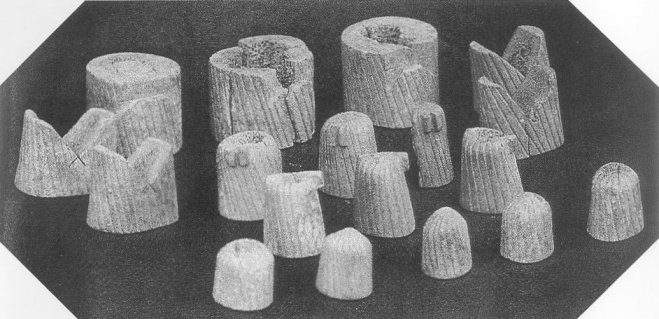
A spectacular discovery was made in 1932 - several Arabic style chess pieces in pristine condition, recovered from (I believe) an equally pristine Roman era grave. (Image: The Venafro chess pieces, from Louis Cazaux's
website on chess).
I expect the discovery caused a great sensation among chess historians because, up to that point, it had been assumed that H.J.R. Murray (
A History of Chess), the god of chess history, was right in his assertion that chess was invented in northern India sometime in the 6th century CE.
But here were those Venafro pieces, throwing Murray's assertions right out the window! Part of the mystery would not be solved until 1994 when a tiny piece of one of the bone chess pieces was analyzed using the latest carbon-dating techniques.
From the Encyclopedia Moderna (online):
The Venafro chessmen
The Venafro chessmen, discovered in 1932 in the southern Italian necropolis of Venafro, are among the most controversial chess-related archaeological finds of this century. For more than 60 years, archaeologists have formulated a variety of hypotheses to explain how bone chess pieces of Arabic shape were discovered in a tomb of Roman age. Some scholars claimed that the chessmen were indeed of Roman origin. The chess pieces are preserved in the Archaeological museum of Naples, where a bone fragment of 2 grams was collected for AMS analysis. AMS radiocarbon measurements yielded a calibrated age of 885-1017 AD (68 % confidence level) (Terrasi et al., 1994), supporting the view that this game was introduced to Central Italy during the Saracen invasions of the 10th century AD.
Great mystery, indeed! How did those Islamic style chess pieces get into a Roman era grave?
I haven't read anything about that online. Why not? Too esoteric? I would have though this is a story ripe for lots of articles. I suppose it has now been concluded that the pristine (i.e., undisturbed) Roman era grave was not so pristine after all, as there would be no other way to account for the presence of the chess pieces, which at the earliest were dated to 885 CE, long after the Roman era had passed into herstory. They must have been buried in the grave sometime after they were carved. Or maybe the chess pieces are embued with the ability to time travel? Or a time traveller from the "future" buried the pieces during the time the grave was new?
One can go on and on with suppositions about how the Venafro chess pieces got buried in that Roman era grave. But the question remains. Why would someone bury the chess pieces to begin with, whether they were buried in 885 CE or in 1017 CE or somewhere in-between?
I can think of two reasons one would bury something like those chess pieces (there is no dispute that they
are chess pieces). Several ancient (and not-so-ancient) cultures have buried sacrifices made to deities. Many obviously brand-new objects have been excavated over the years that were buried intact, but sometimes smashed into pieces and then buried. When it hasn't been obvious that the objects were "treasure trove," archaeologists and anthropologists have concluded that these items were sacrifices and/or devotional offers to various gods and goddesses.
The other reason to bury something is to hide it from others. I am assuming that a rational person would not go through the trouble of burying something that he or she did not consider valuable or, in some other way, worthy of being preserved as a memorial. For instance, the container holding the ashes of my dog Spencer, who died in 1999, are buried under a memorial birdbath in my backyard. Whenever I look at the birdbath, and I see it every single day, I think of Spencerdog.
Could the Venafro chessmen be something buried centuries afterward as a memorial to the person in that grave? This raises so many questions - among which is the most important - that whoever buried those chess pieces knew that they were burying them at so and so's grave. Speaking of which, I have no idea who was buried in that grave. I do not believe I have read that information in a single article about the Venafro chess pieces. Might that information provide a vital clue?

I have read in many descriptions of the Venafro chess pieces that they were carved out of bone (some descriptions say they were topped with ivory). I never though about just what this means. Then this morning, I learned in a totally unrelated email from dondelion that the Venafro chess pieces were carved from
deer horn. It just so happens that Carlos Lascoutx has been posting a lot of information about deer and horns the last few days - and I did a post in response this morning - which dondelion could not have known about.
That Old Goddess Magic at work?
Deer imagery goes back many thousands of years in pre-history. For instance, I blogged about an image showing a Shaman either transformed into a "
deer-man" or wearing deer antlers, and I posted this
article about an unnamed goddess excavated in Iran - she is a pair of red deer horns!
So - what about checking on old "deer horn" chess pieces? I found several references to this material being used at Dr. Louis Cazaux's website (I was amazed, actually). This is by no means meant to be an exhaustive study. I found these under the heading of "
The First European Chess Pieces" by scrolling down the page and looking at the captions under the thumbnail images:
(1) Chariot, deer bone or antler, 10th c., found at Loisy, Musée des Ursulines,Mâcon
(2) King (?), deer bone or antler, 10th c., found at Loisy,Musée des Ursulines,Mâcon
(3) Rook, deer bone, 978-1070,
Pineuilh, Gironde, France
(4) Scandinavian Knight, Bishop, Pawn, deer bone, Beginning 11th c., Nuremberg, Germanisches Nationalmuseum
(5) Scandinavian or German Chessmen, deer bone, found at Ilot des Deux-Bornes, around Noyon, OiseBeg 12th c., Musée du Noyonnais, Noyon, France
Several other pieces were identified as carved of "bone" but the type of bone was not specified. Perhaps this was not determined at the time the pieces were discovered and/or catalogued or tests to determine what type of bone have never been performed. I mean, what difference could it possibly make, right?
Except it might be very important what materials were used to make old chess pieces. Just based on the admittedly unscientific information presented here by me and Carlos Lascoutx about antlers/horns/deer the significance of the ancient iconography is worth looking into further. Was there some ritual significance attached to using deer horn to carve chess pieces? Perhaps that is being too literal - how about a very old tradition of using deer horn to carve certain significant objects being passed on from generation to generation, and the reason why this was done had long since been lost under the gloss of Christianity and/or Islam?
Sounds like a good PhD thesis!
http://goddesschess.blogspot.com/2009/07/from-discovery-news-altar-to-mysterious.html (antlers/deer/horns discussed in comments)
http://www.megalithic.co.uk/article.php?sid=2146412185
http://www.presstv.ir/detail.aspx?id=68642§ionid=351020105 (See image of deer horn goddess, above)
http://goddesschess.blogspot.com/2009/02/ceraunos-and-cernunnos.html
http://goddesschess.blogspot.com/2008/03/further-information-on-peruvian.html
See also
http://goddesschess.blogspot.com/2009/04/12000-15000-year-old-carving-found-in.html
 A spectacular discovery was made in 1932 - several Arabic style chess pieces in pristine condition, recovered from (I believe) an equally pristine Roman era grave. (Image: The Venafro chess pieces, from Louis Cazaux's website on chess).
I expect the discovery caused a great sensation among chess historians because, up to that point, it had been assumed that H.J.R. Murray (A History of Chess), the god of chess history, was right in his assertion that chess was invented in northern India sometime in the 6th century CE.
But here were those Venafro pieces, throwing Murray's assertions right out the window! Part of the mystery would not be solved until 1994 when a tiny piece of one of the bone chess pieces was analyzed using the latest carbon-dating techniques.
From the Encyclopedia Moderna (online):
The Venafro chessmen
The Venafro chessmen, discovered in 1932 in the southern Italian necropolis of Venafro, are among the most controversial chess-related archaeological finds of this century. For more than 60 years, archaeologists have formulated a variety of hypotheses to explain how bone chess pieces of Arabic shape were discovered in a tomb of Roman age. Some scholars claimed that the chessmen were indeed of Roman origin. The chess pieces are preserved in the Archaeological museum of Naples, where a bone fragment of 2 grams was collected for AMS analysis. AMS radiocarbon measurements yielded a calibrated age of 885-1017 AD (68 % confidence level) (Terrasi et al., 1994), supporting the view that this game was introduced to Central Italy during the Saracen invasions of the 10th century AD.
Great mystery, indeed! How did those Islamic style chess pieces get into a Roman era grave?
I haven't read anything about that online. Why not? Too esoteric? I would have though this is a story ripe for lots of articles. I suppose it has now been concluded that the pristine (i.e., undisturbed) Roman era grave was not so pristine after all, as there would be no other way to account for the presence of the chess pieces, which at the earliest were dated to 885 CE, long after the Roman era had passed into herstory. They must have been buried in the grave sometime after they were carved. Or maybe the chess pieces are embued with the ability to time travel? Or a time traveller from the "future" buried the pieces during the time the grave was new?
One can go on and on with suppositions about how the Venafro chess pieces got buried in that Roman era grave. But the question remains. Why would someone bury the chess pieces to begin with, whether they were buried in 885 CE or in 1017 CE or somewhere in-between?
I can think of two reasons one would bury something like those chess pieces (there is no dispute that they are chess pieces). Several ancient (and not-so-ancient) cultures have buried sacrifices made to deities. Many obviously brand-new objects have been excavated over the years that were buried intact, but sometimes smashed into pieces and then buried. When it hasn't been obvious that the objects were "treasure trove," archaeologists and anthropologists have concluded that these items were sacrifices and/or devotional offers to various gods and goddesses.
The other reason to bury something is to hide it from others. I am assuming that a rational person would not go through the trouble of burying something that he or she did not consider valuable or, in some other way, worthy of being preserved as a memorial. For instance, the container holding the ashes of my dog Spencer, who died in 1999, are buried under a memorial birdbath in my backyard. Whenever I look at the birdbath, and I see it every single day, I think of Spencerdog.
Could the Venafro chessmen be something buried centuries afterward as a memorial to the person in that grave? This raises so many questions - among which is the most important - that whoever buried those chess pieces knew that they were burying them at so and so's grave. Speaking of which, I have no idea who was buried in that grave. I do not believe I have read that information in a single article about the Venafro chess pieces. Might that information provide a vital clue?
A spectacular discovery was made in 1932 - several Arabic style chess pieces in pristine condition, recovered from (I believe) an equally pristine Roman era grave. (Image: The Venafro chess pieces, from Louis Cazaux's website on chess).
I expect the discovery caused a great sensation among chess historians because, up to that point, it had been assumed that H.J.R. Murray (A History of Chess), the god of chess history, was right in his assertion that chess was invented in northern India sometime in the 6th century CE.
But here were those Venafro pieces, throwing Murray's assertions right out the window! Part of the mystery would not be solved until 1994 when a tiny piece of one of the bone chess pieces was analyzed using the latest carbon-dating techniques.
From the Encyclopedia Moderna (online):
The Venafro chessmen
The Venafro chessmen, discovered in 1932 in the southern Italian necropolis of Venafro, are among the most controversial chess-related archaeological finds of this century. For more than 60 years, archaeologists have formulated a variety of hypotheses to explain how bone chess pieces of Arabic shape were discovered in a tomb of Roman age. Some scholars claimed that the chessmen were indeed of Roman origin. The chess pieces are preserved in the Archaeological museum of Naples, where a bone fragment of 2 grams was collected for AMS analysis. AMS radiocarbon measurements yielded a calibrated age of 885-1017 AD (68 % confidence level) (Terrasi et al., 1994), supporting the view that this game was introduced to Central Italy during the Saracen invasions of the 10th century AD.
Great mystery, indeed! How did those Islamic style chess pieces get into a Roman era grave?
I haven't read anything about that online. Why not? Too esoteric? I would have though this is a story ripe for lots of articles. I suppose it has now been concluded that the pristine (i.e., undisturbed) Roman era grave was not so pristine after all, as there would be no other way to account for the presence of the chess pieces, which at the earliest were dated to 885 CE, long after the Roman era had passed into herstory. They must have been buried in the grave sometime after they were carved. Or maybe the chess pieces are embued with the ability to time travel? Or a time traveller from the "future" buried the pieces during the time the grave was new?
One can go on and on with suppositions about how the Venafro chess pieces got buried in that Roman era grave. But the question remains. Why would someone bury the chess pieces to begin with, whether they were buried in 885 CE or in 1017 CE or somewhere in-between?
I can think of two reasons one would bury something like those chess pieces (there is no dispute that they are chess pieces). Several ancient (and not-so-ancient) cultures have buried sacrifices made to deities. Many obviously brand-new objects have been excavated over the years that were buried intact, but sometimes smashed into pieces and then buried. When it hasn't been obvious that the objects were "treasure trove," archaeologists and anthropologists have concluded that these items were sacrifices and/or devotional offers to various gods and goddesses.
The other reason to bury something is to hide it from others. I am assuming that a rational person would not go through the trouble of burying something that he or she did not consider valuable or, in some other way, worthy of being preserved as a memorial. For instance, the container holding the ashes of my dog Spencer, who died in 1999, are buried under a memorial birdbath in my backyard. Whenever I look at the birdbath, and I see it every single day, I think of Spencerdog.
Could the Venafro chessmen be something buried centuries afterward as a memorial to the person in that grave? This raises so many questions - among which is the most important - that whoever buried those chess pieces knew that they were burying them at so and so's grave. Speaking of which, I have no idea who was buried in that grave. I do not believe I have read that information in a single article about the Venafro chess pieces. Might that information provide a vital clue?
 I have read in many descriptions of the Venafro chess pieces that they were carved out of bone (some descriptions say they were topped with ivory). I never though about just what this means. Then this morning, I learned in a totally unrelated email from dondelion that the Venafro chess pieces were carved from deer horn. It just so happens that Carlos Lascoutx has been posting a lot of information about deer and horns the last few days - and I did a post in response this morning - which dondelion could not have known about.
That Old Goddess Magic at work?
Deer imagery goes back many thousands of years in pre-history. For instance, I blogged about an image showing a Shaman either transformed into a "deer-man" or wearing deer antlers, and I posted this article about an unnamed goddess excavated in Iran - she is a pair of red deer horns!
So - what about checking on old "deer horn" chess pieces? I found several references to this material being used at Dr. Louis Cazaux's website (I was amazed, actually). This is by no means meant to be an exhaustive study. I found these under the heading of "The First European Chess Pieces" by scrolling down the page and looking at the captions under the thumbnail images:
(1) Chariot, deer bone or antler, 10th c., found at Loisy, Musée des Ursulines,Mâcon
(2) King (?), deer bone or antler, 10th c., found at Loisy,Musée des Ursulines,Mâcon
(3) Rook, deer bone, 978-1070, Pineuilh, Gironde, France
(4) Scandinavian Knight, Bishop, Pawn, deer bone, Beginning 11th c., Nuremberg, Germanisches Nationalmuseum
(5) Scandinavian or German Chessmen, deer bone, found at Ilot des Deux-Bornes, around Noyon, OiseBeg 12th c., Musée du Noyonnais, Noyon, France
Several other pieces were identified as carved of "bone" but the type of bone was not specified. Perhaps this was not determined at the time the pieces were discovered and/or catalogued or tests to determine what type of bone have never been performed. I mean, what difference could it possibly make, right?
Except it might be very important what materials were used to make old chess pieces. Just based on the admittedly unscientific information presented here by me and Carlos Lascoutx about antlers/horns/deer the significance of the ancient iconography is worth looking into further. Was there some ritual significance attached to using deer horn to carve chess pieces? Perhaps that is being too literal - how about a very old tradition of using deer horn to carve certain significant objects being passed on from generation to generation, and the reason why this was done had long since been lost under the gloss of Christianity and/or Islam?
Sounds like a good PhD thesis!
http://goddesschess.blogspot.com/2009/07/from-discovery-news-altar-to-mysterious.html (antlers/deer/horns discussed in comments)
http://www.megalithic.co.uk/article.php?sid=2146412185
http://www.presstv.ir/detail.aspx?id=68642§ionid=351020105 (See image of deer horn goddess, above)
http://goddesschess.blogspot.com/2009/02/ceraunos-and-cernunnos.html
http://goddesschess.blogspot.com/2008/03/further-information-on-peruvian.html
See also http://goddesschess.blogspot.com/2009/04/12000-15000-year-old-carving-found-in.html
I have read in many descriptions of the Venafro chess pieces that they were carved out of bone (some descriptions say they were topped with ivory). I never though about just what this means. Then this morning, I learned in a totally unrelated email from dondelion that the Venafro chess pieces were carved from deer horn. It just so happens that Carlos Lascoutx has been posting a lot of information about deer and horns the last few days - and I did a post in response this morning - which dondelion could not have known about.
That Old Goddess Magic at work?
Deer imagery goes back many thousands of years in pre-history. For instance, I blogged about an image showing a Shaman either transformed into a "deer-man" or wearing deer antlers, and I posted this article about an unnamed goddess excavated in Iran - she is a pair of red deer horns!
So - what about checking on old "deer horn" chess pieces? I found several references to this material being used at Dr. Louis Cazaux's website (I was amazed, actually). This is by no means meant to be an exhaustive study. I found these under the heading of "The First European Chess Pieces" by scrolling down the page and looking at the captions under the thumbnail images:
(1) Chariot, deer bone or antler, 10th c., found at Loisy, Musée des Ursulines,Mâcon
(2) King (?), deer bone or antler, 10th c., found at Loisy,Musée des Ursulines,Mâcon
(3) Rook, deer bone, 978-1070, Pineuilh, Gironde, France
(4) Scandinavian Knight, Bishop, Pawn, deer bone, Beginning 11th c., Nuremberg, Germanisches Nationalmuseum
(5) Scandinavian or German Chessmen, deer bone, found at Ilot des Deux-Bornes, around Noyon, OiseBeg 12th c., Musée du Noyonnais, Noyon, France
Several other pieces were identified as carved of "bone" but the type of bone was not specified. Perhaps this was not determined at the time the pieces were discovered and/or catalogued or tests to determine what type of bone have never been performed. I mean, what difference could it possibly make, right?
Except it might be very important what materials were used to make old chess pieces. Just based on the admittedly unscientific information presented here by me and Carlos Lascoutx about antlers/horns/deer the significance of the ancient iconography is worth looking into further. Was there some ritual significance attached to using deer horn to carve chess pieces? Perhaps that is being too literal - how about a very old tradition of using deer horn to carve certain significant objects being passed on from generation to generation, and the reason why this was done had long since been lost under the gloss of Christianity and/or Islam?
Sounds like a good PhD thesis!
http://goddesschess.blogspot.com/2009/07/from-discovery-news-altar-to-mysterious.html (antlers/deer/horns discussed in comments)
http://www.megalithic.co.uk/article.php?sid=2146412185
http://www.presstv.ir/detail.aspx?id=68642§ionid=351020105 (See image of deer horn goddess, above)
http://goddesschess.blogspot.com/2009/02/ceraunos-and-cernunnos.html
http://goddesschess.blogspot.com/2008/03/further-information-on-peruvian.html
See also http://goddesschess.blogspot.com/2009/04/12000-15000-year-old-carving-found-in.html