The recent passing of Pal Benko and Shelby Lyman draws the curtain on an American period that produced some of the game’s most sparkling play.
By Peter Nicholas
September 5, 2019
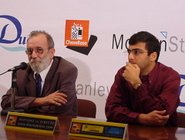
Outside the cloistered world that serious chess players inhabit, few would have taken any special note of the death last month of Pal Benko, at age 91.(1) Benko was a top grand master and one of the game’s great artists. After defecting from his native Hungary in 1957, he moved to the United States, competing in tournaments and composing ingenious puzzles that introduced generations of young players to the mysteries of the endgame.
But his singular contribution to American chess wasn’t at the board. Without Benko, there might not have been Bobby Fischer—at least not the Fischer who delivered the U.S. perhaps its greatest cultural victory of the Cold War. His competitive career fading, Benko stepped aside in 1970 and let the younger, more talented Fischer take his place in the competition to determine a challenger for the reigning world champion, Boris Spassky of the Soviet Union. Fischer, who had been playing sporadically throughout the 1960s and who seemed on the brink of quitting the game altogether, tore through the qualifying tournaments before dethroning Spassky in a 1972 match that riveted America.
 |
| Associated Press |
Benko and Fischer hadn’t always been on the best of terms. Playing in a tournament in 1962 in the Caribbean, they squabbled one night and got into a fistfight—“the first fistfight ever recorded by two grandmasters,” Frank Brady wrote in his Fischer biography, Endgame. But they reconciled and stayed friends to the end. “Pal felt that Bobby could change the chess world—which Bobby did—and if Bobby became world champion, that would benefit the whole game,” Susan Polgar, a friend of both men and a former women’s world chess champion, told me. “His own personal interest was secondary to the bigger picture."
Another chess master who was central to the Fischer story also died last month: Shelby Lyman.(2) Though not a world-class player, Lyman did more to popularize chess in America than anyone not named Bobby Fischer. He was teaching chess in New York when one of his students, a TV executive, tapped him to host a PBS show covering the Fischer-Spassky match. Lyman proved a natural showman, explaining densely complicated chess positions to TV viewers, many of whom thought of a fork only as an eating utensil. (In chess, it’s a move where a single piece makes at least two simultaneous attacks.) Like tons of other kids at the time, I’d turn to Channel 13 in New York that summer and follow Lyman’s commentary move by move, sparking a lifelong interest in the game. After becoming a journalist, I wrote about Lyman, and from time to time we’d talk about the match.
“I had no concept of TV,” he told me. “I never watched television. I had no idea how a talk show host should act.” But, he added, “chess is a dramatic event. You could hear the swords clang on the shields with every move. They went at each other. The average person is turned onto chess when it’s presented right. Trying to figure out the next move is a fascinating adventure—an adventure people can get into.”
 |
| Shelby Lyman, Image: Twitter.com/USChess. |
With his bushy brown hair and endearing miscues (in that low-tech era, he’d fumble for the pieces he used to shove onto demonstration boards), Lyman became a mini-celebrity, while interest in the ancient game boomed. In the year before the match, membership in the U.S. Chess Federation was about 27,000. A year after Fischer won the title, it had more than doubled, to about 59,000. “Shelby was the face of chess in America,” Bruce Pandolfini, the coach and author who was played by the actor Ben Kingsley in the movie Searching for Bobby Fischer, told me.
The loss of Benko and Lyman draws the curtain on an era in American chess that produced some of the game’s richest personalities and most sparkling play. The players and teachers who dominated the firmament in the mid-20th century were the game’s greatest generation. They bested a Soviet pipeline of grand masters who once had a stranglehold on the title.