Museum displays parity of women in ancient Egypt
Turin, Italy (CNN)Like many a bumbling tourist, this traveler was perplexed by the unexpected. People dressed differently, ate differently, wrote differently, did everything differently. The river flowed not from north to south but from south to north.
But what was most perplexing to the fifth century BC Greek historian Herodotus when he visited Egypt was the role of women. "Women attend market and are employed in trade, while men stay at home and do the weaving," he wrote.
The Egyptians, he concluded, "in their manners and customs seem to have reversed the ordinary practices of mankind."
The women of ancient Egypt—the mighty and the modest—were considered equal to men, said Egyptologist Valentina Santini. "They could divorce. They could own property. They had many rights that women in subsequent civilizations didn't have."
Santini was showing me around Turin's Museo Egizio -- Egyptian Museum -- the oldest museum dedicated to ancient Egypt, founded in 1824.
We were in a room dedicated to Merit, a woman who lived around 3,400 years ago during Egypt's New Kingdom period. She died at the age of 25 from causes unknown. The boxes that contained her toiletries and other possessions are painted with images of a confident woman side by side with her architect husband, Kha, giving offerings to the gods and greeting visitors.
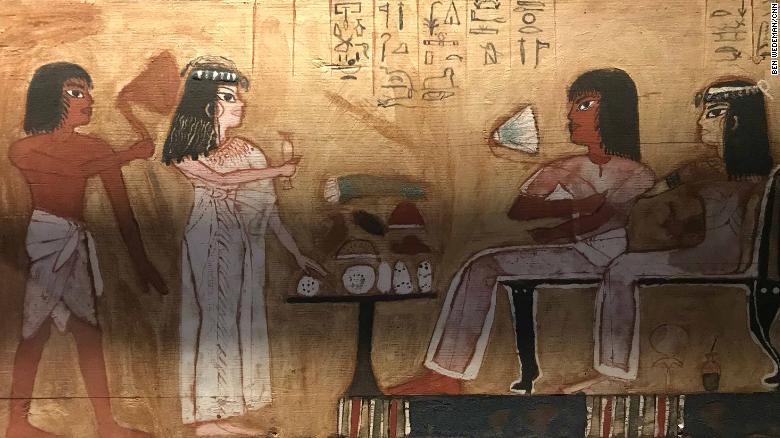 |
| Antiquities on display demonstrate that women in ancient Egypt were equal to men. Here, Merit and her architect husband, Kha are pictured greeting visitors.
[My note: Notice the evident affection between Merit and Kha. Merit is turned toward Kha, you can see the line of her back all the way down to her buttocks through the sheer material of her dress. Her left arm is tucked between Kha's left arm and his body, and it appears that Kha's right hand is holding both a lotus and is tucked underneath his arm, possibly holding Merit's hand. They sit before an offering table that is filled with delicious items - bread, looks like fruits and possibly some vegetables and perhaps some cheese.]
|
The variety of expensive goods she was buried with—a large wig made of human hair, loaves of bread, jewelry, toiletries, clothing—attests to her importance.























