Showing posts with label ancient game pieces. Show all posts

Wednesday, October 7, 2020

Ancient Boardgames: Experts find the missing piece (but can't figure out how the game was played)

Hola darlings!

The last of weather warm enough to be able to sit outside in my screened Shezebo and enjoy the breeze, the last of the flowers in my gardens and the sunshine is here this week.  It should last for the rest of the week, but with temperatures declining from the mid-70s F to the mid-60s F by the end of the week.  Being able to sit outside in the privacy of my yard and gardens is such a treat after numerous rainy streaks and cold streaks! 

Below is an interesting article I found this afternoon.  I immediately thought of Mr. Don, and what he might make of this.  How I miss him!  Don would have found this absolutely fascinating and would have chewed on it for weeks, coming up with all kinds of potential hypotheses.  Me, I'm just the same old, same old pragmatically minded legal eagle, LOL!  Don was the experimental balloon, flying high; I was the anchor.  What a team we made.  The 8th year since Don's death will be here in a few days, and yes, it's heavy on my mind.


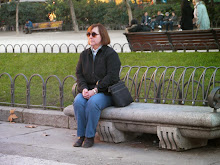
 The photo above is one of the last taken of Don and I together.  We revisited Spain in 2012, a little more than 10 years after our first trip there in 2002.  This was taken on a cliff-side road overlooking the ancient town of Toledo in mid-January, 2012.  

Article from Middleeasteye.net:

Ancient boardgames:  Experts find the missing piece (but can't figure out how to play the game)

'Dogs and Pigs', a set of 5,000-year-old figurines found in Turkey's southeast, is nominated as one of the world's oldest and most crowded games but its rules remain a mystery

By Nimet Kirac in Siirt and Batman, Turkey
9 September 2020 09:18 UTC/Last update:  3 weeks 5 days ago


It’s a curious sight inside the Batman museum, Turkey, where attention seems to be focused on a section to the right of the main exhibition room.

Within a glass display case in the corner, more than three dozen colourful animal figurines are presented on a chequered wooden board. Alongside the elaborately sculpted animals stand similarly tiny artefacts in various abstract and pyramid shapes.

The visitors, including a group of schoolchildren, hover in awe over the gaming pieces in the corner. They speculate over the origins, discussing excitedly the intricate connections they may have.

For 11-year-old Rasan Ekinci, a Batman local who’s been playing chess for three years, usually with her younger sister, the stones in the back rows resemble pawns from a chess board.

"But this seems more fun than chess,” Ekinci says. “I’d want to save up lots of money and buy this."

Her school friends, meanwhile, think some of the more abstract games pieces look like burgers, trees and meteorites.

According to the museum's director, Seyhmus Genc, out of all the collections, visitors are most surprised to see these pieces. “They often ask us how the game may have been played,” he said.

"[They] are signature pieces of our museum by now. I must say they transport me to other worlds also."

Game Set

According to the carbon dating, these handcrafted pieces are around 5,000 years old.

Discovered in an archaeological site in Turkey’s south-eastern Siirt province, they could possibly represent one of the world’s oldest-known board games, sitting alongside the Egyptian Senet, Chinese Go, and Mangala, which is still played in Turkey today.

With or without the title, these items tell an intellectual, sociological story from the Early Bronze Age in eastern Anatolia - a major crossroads and corridor for trade and culture circa 3,100-2,800 B.C.

Despite tensions caused by occasional periods of regional conflict, including the separatist Kurdistan Workers’ party’s (PKK) armed campaign against the Turkish state and the Syrian War across the border, the field phase of the project, which was carried out as part of the Ilisu Dam rescue excavations, launched in 2007 and ended in 2019, before the hydroelectric plant became active.

"[I’m] very happy we found all the pieces before excavations had to end,” Saglamtimur, who teaches at Ege University in Izmir, told Middle East Eye.

"The gaming set of 40 pieces discovered in the [Basur Mound] is nominated to be the world’s oldest and most crowded game set ever found."

"Although they steal the show from the other findings,” he said, adding that to him the Early Bronze Age site is most remarkable because of the large number of findings in 18 tombs.

These include 80kg of metal objects (mostly copper alloy, as well as gold and silver), thousands of beads and jewellery with mountain crystals, and human bones, which hint that children were sacrificed here.

As for the game, the first 39 pieces were discovered in 2012, found buried together by one of the tombs, and were then moved to the neighbouring Batman province for public display in the museum.

In February this year, Saglamtimur announced that the game's pieces were complete - the fourth elephant figurine had been discovered in the excavations in late autumn, completing all 40 pieces.

"All but the board,” the archaeologist noted. “It must have eroded over time. We found some wooden pieces that had eroded by [the tomb]. The [board] in the museum was made for display purposes."

Thursday, March 26, 2015

Bones, Stones and Other Items Used for Divination Found in Armenian Dig

Are these "dough stamps" -- designed to impress raw dough with images that were used in divination?  Or were they used in an entirely different way altogether, hmmm?  These look similar to ancient game pieces to me.  Might they have been used in an elaborate ritual to make impressions on a chessboard-like grid drawn into the dirt of the sacred sanctuary where the diviner practiced -- one not unlike the Dogon "fox print" ritual still practiced today?

Image courtesy of Professor Adam Smith, from news article at The Daily
Mail (UK -- see link at end of this post).  "Dough stamps" discovered
in three different ancient Armenian sanctuaries.  

Story and photos at Phys Org

Bronze Age bones offer evidence of political divination

Mar 13, 2015 by H. Roger Segelken

Trying to divine the future of a precarious administration, "House of Cards" President Frank Underwood enters the inner sanctum with a trusted adviser. "It's really a crapshoot," the adviser says, and the president nods. The bourbon is drained, cigars are snuffed, and the political leader emerges with a more confident sense of what's to come.

"It really was a crapshoot, with very high stakes for sovereign rulers in a turbulent time," says Cornell archaeologist Adam T. Smith, interpreting evidence from 3,300-year-old Bronze Age shrines, ensconced within a hilltop fortress on the Tsaghkahovit Plain of central Armenia. Smith, a professor of anthropology in the College of Arts and Sciences, studies the role that the material world – everyday objects, representational media, natural and built landscapes – plays in the political lives of ancient and modern-day people.

Dice-like knucklebones used for osteomancy and colored stones used for lithomancy (divination with bones and stones, respectively) were found deep within the ruins of the fallen citadel of Gegharot.

Aleuromancy (divination with freshly ground flour) is a likely explanation for implements found in one of three shrines, Smith and Cornell Ph.D. candidate Jeffrey F. Leon report in their October 2014 American Journal of Archaeology article, "Divination and Sovereignty: The Late Bronze Age Shrines at Gegharot, Armenia." > Excavations conducted at Gegharot since 2002 have turned up a variety of ceremonial, iconic and fortune-telling objects:

  • censers and basins for burning aromatic plant materials that could induce a trance state;
  • covered storage containers made of clay where pollen analysis found evidence of wheat;
  • drinking vessels, probably for long-gone wine;
  • sculpted clay idols "with vaguely anthropomorphic features and hornlike protrusions" and stele (standing blocks) the archaeologists say "likely served as focal point for ritual attention";
  • grain-grinding implements and stamp seals to make impressions in flour dough;
  • dozens of knucklebones (also called astragali) of cattle, sheep and goats with certain sides blackened like the markings on dice; and
  • polished stones in colors ranging from black and dark grey to red, green and white.
The Tsaghkahovit Plain was sparsely populated until around 1500 B.C. when a nameless people (they left no written record of what they called themselves) began to build strongholds and new institutions of rule there.

"It was a time of radical inequality and centralized practices of economic redistribution," Smith says, "and the political leaders were scrambling to hold on to their power. Knowing what the future held was critically important." [Sounds like the USA today.]

The diviner, Smith says, was a kind of primordial actuary, assessing risks and advising on pathways forward. "We call them 'shrines' because of two distinctive qualities of the spaces: They were quite intimate in scale, with not much room for public spectacle," Smith explains, "yet they appear to have been religiously charged places, designed and built to host esoteric rituals with consecrated objects – secretive rites focused on managing risks by diagnosing present conditions and prognosticating futures."
 The Bronze Age people who tried to predict futures there had a quarter-millennium run, until about 1150 B.C. Their divination paraphernalia, meticulously unearthed by the archaeologists, looks as if it had been abandoned in place, moments before the inhabitants fled some cataclysm.

 Without Bronze Age mystics to interpret the bones and stones, it's hard to know whether the citadel's demise was presciently foreseen. As the fictional President Underwood said: "It's not the beginning of the story I fear; it's not knowing how it will end."

 More information: "Divination and Sovereignty: The Late Bronze Age Shrines at Gegharot, Armenia American" Journal of Archaeology Vol. 118, No. 4 (October 2014), pp. 549–563 DOI: 10.3764/aja.118.4.0549

*****************************************************


See also interesting interpretative article on the findings reported at The Daily Mail (UK) - where else, LOL!  The article does provide additional information along with several maps, diagrams and photographs of the excavation site and some of the excavated artifacts -- which are very interesting.  Check them out and see what you think.

Sunday, November 23, 2014

Ancient Roman Board Game Pieces Discovered in Kibyra Excavation (Turkey)

Story from Hurriyet Daily News:

Ancient game found in Roman era city

BURDUR - Anadolu Agency

Two game pieces from the Roman era 1,800 years ago have been found in the ancient city of Kibyra, in the southern Turkish province of Burdur’s Gölhisar district. [No photos of the pieces was provided; there is a generic photo of the layout of the ancient game carved in stone.]

“We don’t have too much information about this game but we believe that it was played by two people on squares … with dice,” Professor Ünal Demirer said, adding that the Roman-era game dated back 1,800-2,000 years ago at least.

The game was known as “Ludus duodecim scriptorium” or “XII scripta” (game of 12 markings).

Excavations in the ancient city are being conducted by Mehmet Akif Ersoy University’s (MAKU) Archaeology Department. 

Demirer said the works had been continuing since 2007 on the avenue of the ancient city’s agora, adding that the game pieces were also used for other purposes. 

“The game was found in the pool structure. We think that it was also used for another purpose. Because of its Latin name, we attribute the game to the Romans. It is like today’s Jacks. People spent time in the agora playing such games,” he said.

"Ludus duodecim scriptorum" was a board game popular during the time of the Roman Empire. The game tabula in Byzantium is thought to be a descendant of this game, and both are similar to modern backgammon. 

Very little information about specific gameplay has survived, though we know that it was played using three cubic dice, and each player had 15 pieces.
November/21/2014
Related Posts Plugin for WordPress, Blogger...