I was so taken with that image that I emailed Mr. Don about it and spouted off about possible connections between Egypt and Old Europe via cow worship! I don't think he took me seriously, or my email may have put him to sleep. So, I was gearing up to do some research today when, lo and behold, after I posted here earlier today the entry from Barbara Walker's wonderful The Woman's Encyclopedia of Myths and Secrets about "Convent" - that one was sure an eye opener to yours truly, by the way, geez, I hapened to flip the page over and there is was, an entry on -- COW!
First, a brief return visit to the November 14, 2010 Random Round-up at Goddesschess - honestly, we did not plan this! Here is a photo of the reconstructed sanctuary at Parta at the Banat Museum. Unfortunately, I am not clear by the description whether the "ox" is the female, or the other figure is the female -- the description of the reconstruction is rather ambiguous:
The monumental statue has been reconstructed based on some fragments discovered, unfortunately very few fragments – thus, fragments of the shoulder of the statue have been very well preserved, the belly of the feminine statue (the Mother statue), the ear and the a part of the ox’s muzzle – based on these fragments the reconstruction of the ox was possible; the feminine statue, because no fragment of the head was kept it was built based on some analogies.
 |
| Reconstruction of the Parta sanctuary, at Banat Museum. |
Barbara Walker in her truly remarkable Encyclopedia did all of the research for me. This is what she wrote under "Cow:"
 |
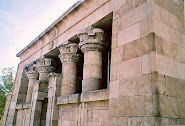
| Goddess Hathor giving sustenance to young Horus, Temple of Hathor, at Dendera, Egypt. |
The name of Italy meant "calf-land."(1) This country too was the gift of the Milk-giver, whom Etruscans called Lat, Arabs called Al-Lat, Greeks called Latona, Lada, Leto, or Leda. She ruled Latium, and gave her milk (latte) to the world.
All Europe was named after the Goddess as a white Moon-cow, whom the Greeks mated to the white bull incarnation of Zeus. Her alternative name was Io, "Moon." Under this name she was presented in classic mythology as a rival of Hera, but patriarchal writers were always setting different manifestations of the same Goddess at odds with one another, posibly on the principle of divide and conquer. Hera herself was named Io, ancestress of the Ionians. In her temple on the site of Byzantium she appeared as teh same lunar cow, the Horned One, wearing the same crescent headdress as the Egyptian Cow-goddess.(2)
Herodotus said the milk-giving Mother Hera-lo-Latona was the same as Egypt's Buto, "an archaic queen of the Lower Kingdom."(3) The holy city of Buto, Egypt's oldest oracular shrine, was known to the Greeks as Latopolis, "city of Lat."(4) Of course Buto, or Lat, was only another name for Hathor, or Isis, or Mut, or Neith: all represented "the great cow which gave birth to Ra, the great goddess, the mother of all the gods ... the Cow, the great lady of the south, the great one who gave birth to the sun, who made the germ of gods and men, the mother of Ra, who raised up Tem in primeval time, who existed when nothing else had being, and who created that which exists."(5)
The Cow as creatress was equally prominent in myths of northern Europe, where she was named Audumia; she was also Freya, or a Valkyrie taking the form of a "fierce cow.(6) A semi-patriarchal Norse myth tried to attribute the creation of the world to the giant Ymir, whose body and blood made the universe. But he was not the first of creatures. The Cow preceded him, for he lived on her milk.(7)
Earlier myths showed the universe being "curdled" into shape from the Cow's milk. In India, many still believe literally the creation myth known as Churning of the Sea of Milk.(8) The Japanese version said the primordial deep went "curdlecurdle" (kowororkoworo) when stirred by the first deeities, to make clumps of land.(9) The ancient near east thought human bodies too were curdled from the Goddess's milk. One of her liturgies was copied into the Bible: "Has thou not poured me out as milk, and curled me like cheese?" (Job 10:10).
The root of "cow" was Sanskrit Gau, Egyptian kau or kau-t. Goddess-names like Gauri and Kauri also designated the yonic cowrie shell.(10) Brahman rebirth ceremonies used either a huge golden yoni or an image of the Cow-mother. "When a man has for grave cause been expelled from his caste, he may be restored to it after passing several times under the belly of a cow."(11) The Egyptian Goddess as birth-giver typically wore a cow's head or horns, as she offered her breasts with both hands.(12) As the nursing mother who gave each Egyptian his secret soul-name (ren), she was entitled Renenet, the Lady of the Double Granary, a reference to her inexhaustible breasts.(13) The bovine enzyme rennet, used even in antiquity to curdle milk, was also sacred to her.
A favorite Roman emblem of the Goddess was the Cornucopia, Horn of Plenty: a cow's horn pouring forth all the fruits of the earth. The cow was honored as the wetnurse of humanity, and her image is still inadvertently invoked to this day as an expletive Holy Cow, or a perjorative Sacred Cow.
Notes:
1. Thomson, 50.
2. Elworthy, 183, 194.
3. Larousse, 29.
4. Herodotus, 106.
5. Budge, C.E. 1, 457-58, 463.
6. Turville-Pette, 256.
7. Larousse, 248.
8. O'Flaherty, 274.
9. Campbell, Or. M., 467.
10. Waddell, 404.
11. Frazer, F.O.T., 220-22.
12. Neumann, G.M., pl. 9.
13. Larousse, 38; H. Smith, 24.
 |
| The Narmer Palette, c. 3500 BCE, Egypt. Note the presence of Hathor at the top of both the front and reverse sides. |