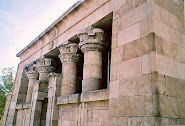
If whoever the hell is running Egypt don't get their act together real soon, they will have NO tourism left. Who wants to go into the desert to explore ruins only to see mountains of trash and dead half-burned up animals?
And then what will the stupid sucks running things do, heh? Continue their bashing of the United States out of the sides of their mouths while accepting with both hands greedily outstretched our foreign aid? News flash - that's not going to continue for very long. We (meaning the majority of American people) are losing patience and you do not want to piss off the President. He is the epitomy of a man who walks softly and carries a big stick.
From Egypt Independent
Garbage dumping and archaeological looting in Abu Sir alarm residents
By Steven Viney
Sun, 26/02/2012 - 11:52
Since last January’s uprising, the archaeologically rich area of Abu Sir in the Giza Governorate has come to resemble an ad hoc garbage disposal site due to a lack of law enforcement coupled with an ongoing conflict between the army, a nearby sand quarry and a garbage dump, residents say.
The governorate’s garbage dump site is situated several kilometers into the desert at the end of a road that also leads to a sand quarry, near the Beni Yusef army base.
However, due to a lack of law enforcement and police presence, the garbage trucks no longer deposit at the dump site regularly, dumping the garbage in the nearby canals, throughout the desert, and among the area’s archaeological sites instead.
The garbage now reaches as far back as the western end of the Moneib highway, starting in the desert and running all along the Mansoureya road canal.
The Abu Sir sand quarry has, according to residents, been digging outside its property for years, crossing the restrictive lines put in place by the Ministry of State for Antiquities Affairs.
The same location was reported to have fallen victim to archaeological theft and looting during the 2011 protests earlier last year.
Residents say that this looting and digging for antiquities has never stopped and now involves many of the quarrymen. “Before, there were occasional cases of people searching at night with a shovel and a flashlight, but now it’s being done on a bigger scale, using the trucks during the day,” says a local resident who asked to remain anonymous due to sensitivity around the issue and a fear for his own safety.
“They’re no longer just taking sand, you can find them looking through the sand inside the trucks, dumping it then taking more. They’re even digging into the mud all the way under the sand, too, which dates back to ancient times,” the resident said.
Recently, territorial issues with the nearby army base have led to conflicts that resulted in trucks from the sand quarry blocking important roads in Abu Sir with bulldozers and sand in retaliation, including the road leading to Giza Governorate’s garbage dump site.
The details of the disputes are uncertain, but road blockades mean that all of trucks transporting the governorate’s garbage are often not able to reach the dump site, so it gets dumped throughout Abu Sir. This practice, residents say, has continued even after the roads were cleared.
To make matters worse, the garbage is also sifted through for valuable items, and often burned.
Visiting the location reveals a shocking site of massive piles of burning trash, dead animals, birds and dogs among archaeological heritage sites and around the canal.
Meanwhile, the over-digging from the quarry has left holes of meteoric proportions scattered throughout the locality. The army appears to remain idle as garbage trucks and trucks filled with sand just whisk by consistently dumping their goods, or rummaging through it and burning it.
According to the residents, many official complaints have been filed, to no result.
The issue is also particularly sensitive among the residents, who asked for anonymity out of fear of the quarrymen, who are very well known and locally established in Abu Sir — and often armed.
“The garbage is of course a huge disaster that needs fixing, but what’s more crucial is preventing and monitoring the archaeological looting,” said another resident who wished to remain anonymous. “But they’re all related, and nobody, not the ministry or the army, wants to address the issue.”
The Ministry of State for Antiquities Affairs refused to provide a statement, stating that any looting of the area has stopped, and that the issue of garbage dumping is not its responsibility.
The Ministry of State for Environmental Affairs said that issues involving the sand quarry and the Abu Sir locality fall under the responsibility of the Ministry of State for Antiquities Affairs.
Showing posts with label destruction of ancient sites. Show all posts
Showing posts with label destruction of ancient sites. Show all posts
Sunday, March 4, 2012


Tuesday, February 7, 2012
Priceless Indian Find and Yet More Destruction of Ancient Sites
From dawn.com
February 7, 2012
Rare Indus seal discovered in Cholistan (excerpted)
LAHORE, Feb 6: The Punjab University archaeology department has discovered a rare Indus seal in steatite material with carved figure of Ibex with two pictographs from Wattoowala, Cholistan, during a survey of different sites near Derawar Fort along the ancient bed of River Hakra.

(Not a good image, unfortunately) The seal dates back to 2500-2000 BC.
The seal has been discovered by a six-member team of archaeologists headed by PU archaeology department chairman Dr Farzand Masih, who has just concluded a Unesco-funded US$26,000 project “Sui-Vihar Excavations and Archaeological Reconnaissance of southern Punjab”.
Dr Masih told Dawn that the discovery would open new dimensions for scholars. The seal has a perforated boss in the back with variant style from Harappan seals showing the regional influence and perhaps a separate identity in the Harappan domain. The seal is almost square in shape and slightly broken from the right side but figure of Ibex is almost intact. The muscles, genitalia, hooves and tail of the Ibex were engraved artistically with high proportion of skill and craftsmanship.
Dr Masih said the team had also combed the Cholistan desert in the vicinity of Derawar Fort. Prior to that, he said, Sir Aural Stein and Henry Field had conducted the survey in 1941 and 1955, respectively. After the Independence, he said, Dr Muhammad Rafique Mughal had conducted an extensive survey during 1974-77 and discovered altogether 424 settlements on a 24-32 km wide strip on both sides of the dry bed of Hakra River.
He said the Mughals’ work in Cholistan had established a new dimension in the understanding of Indus cultures in Cholistan but unfortunately any indigenous or foreign scholar could not precede his work further even after three decades. Consequently, he said, the PU took the gigantic task of exploring the sites in spite of the inhospitable climatic conditions and surveyed some 25 sites in Cholistan Desert, which eventually led to the discovery of the rare Indus seal.
During explorations in Cholistan, the archaeology department chairman told Dawn that the team had also recorded flagrant violation of the Antiquities Rules to the cultural mounds which had been subjected to the worst human vandalism. “The land grabbers and other mafias have brutally murdered the cultural heritage while sinking tubewells on the mounds and ploughing the mounds to convert them into farm lands,” he said.
Dr Masih said the private land owners had sold the land including the cultural mounds and now the attitude of the new buyers towards the heritage was very hostile and it was feared that if no concrete steps were taken to safeguard the relics of the past, it might meet the fate of ruins of Harappa that suffered colossal damage during the laying of Lahore-Multan railway track.
“The entire scenario shows the dexterity of the investors and the pathetic attitude of the agencies responsible for cultural heritage of Pakistan,” he observed.
February 7, 2012
Rare Indus seal discovered in Cholistan (excerpted)
LAHORE, Feb 6: The Punjab University archaeology department has discovered a rare Indus seal in steatite material with carved figure of Ibex with two pictographs from Wattoowala, Cholistan, during a survey of different sites near Derawar Fort along the ancient bed of River Hakra.

(Not a good image, unfortunately) The seal dates back to 2500-2000 BC.
The seal has been discovered by a six-member team of archaeologists headed by PU archaeology department chairman Dr Farzand Masih, who has just concluded a Unesco-funded US$26,000 project “Sui-Vihar Excavations and Archaeological Reconnaissance of southern Punjab”.
Dr Masih told Dawn that the discovery would open new dimensions for scholars. The seal has a perforated boss in the back with variant style from Harappan seals showing the regional influence and perhaps a separate identity in the Harappan domain. The seal is almost square in shape and slightly broken from the right side but figure of Ibex is almost intact. The muscles, genitalia, hooves and tail of the Ibex were engraved artistically with high proportion of skill and craftsmanship.
Dr Masih said the team had also combed the Cholistan desert in the vicinity of Derawar Fort. Prior to that, he said, Sir Aural Stein and Henry Field had conducted the survey in 1941 and 1955, respectively. After the Independence, he said, Dr Muhammad Rafique Mughal had conducted an extensive survey during 1974-77 and discovered altogether 424 settlements on a 24-32 km wide strip on both sides of the dry bed of Hakra River.
He said the Mughals’ work in Cholistan had established a new dimension in the understanding of Indus cultures in Cholistan but unfortunately any indigenous or foreign scholar could not precede his work further even after three decades. Consequently, he said, the PU took the gigantic task of exploring the sites in spite of the inhospitable climatic conditions and surveyed some 25 sites in Cholistan Desert, which eventually led to the discovery of the rare Indus seal.
During explorations in Cholistan, the archaeology department chairman told Dawn that the team had also recorded flagrant violation of the Antiquities Rules to the cultural mounds which had been subjected to the worst human vandalism. “The land grabbers and other mafias have brutally murdered the cultural heritage while sinking tubewells on the mounds and ploughing the mounds to convert them into farm lands,” he said.
Dr Masih said the private land owners had sold the land including the cultural mounds and now the attitude of the new buyers towards the heritage was very hostile and it was feared that if no concrete steps were taken to safeguard the relics of the past, it might meet the fate of ruins of Harappa that suffered colossal damage during the laying of Lahore-Multan railway track.
“The entire scenario shows the dexterity of the investors and the pathetic attitude of the agencies responsible for cultural heritage of Pakistan,” he observed.
Friday, December 3, 2010
Friday Night Miscellany
My old desktop upstairs has got an issue - I think it's called something like a repeating loop and I cannot get the home page to open up (yahoo.com). It started two nights ago but eventually I was able to get it to the New York Times and after that I was able to get back to yahoo and everything was fine. I did the same thing last night but tonight I could not get to any alternate url no matter what I tried. So I have to cut this short and do some googling to find out what the heck I can do to fix the problem.
Archaeologically, Peru is an amazing country. There is not a month that goes by without some new discovery coming out of Peru. It was the site of Caral, which was as old as some of the settlements in the Indus Valley, Mesopotamia and Egypt. I have done lots of blog posts about discoveries in Peru. So it doesn't surprise me that its residents approximately 8,000 years ago were getting high on coca leaves!
1 December 2010 Last updated at 21:20 ET
Coca leaves first chewed 8,000 years ago, says research
Another ancient site plundered in Iran and the government does the same old, same old "What site? There is no site. What pictures? What farmer? What complaint? And by the way, any archaeologist who talks to the press will lose his job and be barred from working again in Iran. And we'll get your little dog, too..."
From the CAIS (Circle of Iranian Studies) site
Smugglers discovered and plundered a Parthian Dynastic site in Masjed-Soleiman
Friday, 03 December 2010 13:07
LONDON, (CAIS) -- Smugglers in search of treasures in an area known as Shanzdah-Maylee (Šānzdah-Māylē / sixteen-mile) have discovered and plundered an ancient tappeh (archaeological mound) in a depth of four meters, according to a recent report by the Persian service of Mehr News Agency.
Archaeological vandals aren't limited to the Old World, they're here in force in the New World, too.
Entertainment
2,300-Year-old Maya ruins destroyed for pastureland
Published December 03, 2010
| EFE
Mexico City – An ancient Mayan residential complex some 2,300 years old was destroyed by heavy machinery in the southeastern Mexican state of Yucutan to clear the land for pasture on a private ranch, officials told Efe.
According to experts at the National Anthropology and History Institute, or INAH, the Maya site near the town of Chicxulub dates to the 300 B.C. Preclassical Period and is registered as No. 15 in the Yucutan archaeological catalog.
"The presence of remains were previously known in the area and for that reason INAH will act quickly," the communications chief of the public institute, Julio Castrejon, said.
Yeah, right - and what are you going to do now? The site is GONE, dude.
Okay, got to go. Need to get the desktop upstairs moving again so I can work on Chess Femme News - they'll be games to report from the Women's World Chess Championship tomorrow.
Archaeologically, Peru is an amazing country. There is not a month that goes by without some new discovery coming out of Peru. It was the site of Caral, which was as old as some of the settlements in the Indus Valley, Mesopotamia and Egypt. I have done lots of blog posts about discoveries in Peru. So it doesn't surprise me that its residents approximately 8,000 years ago were getting high on coca leaves!
1 December 2010 Last updated at 21:20 ET
Coca leaves first chewed 8,000 years ago, says research
Another ancient site plundered in Iran and the government does the same old, same old "What site? There is no site. What pictures? What farmer? What complaint? And by the way, any archaeologist who talks to the press will lose his job and be barred from working again in Iran. And we'll get your little dog, too..."
From the CAIS (Circle of Iranian Studies) site
Smugglers discovered and plundered a Parthian Dynastic site in Masjed-Soleiman
Friday, 03 December 2010 13:07
LONDON, (CAIS) -- Smugglers in search of treasures in an area known as Shanzdah-Maylee (Šānzdah-Māylē / sixteen-mile) have discovered and plundered an ancient tappeh (archaeological mound) in a depth of four meters, according to a recent report by the Persian service of Mehr News Agency.
Archaeological vandals aren't limited to the Old World, they're here in force in the New World, too.
Entertainment
2,300-Year-old Maya ruins destroyed for pastureland
Published December 03, 2010
| EFE
Mexico City – An ancient Mayan residential complex some 2,300 years old was destroyed by heavy machinery in the southeastern Mexican state of Yucutan to clear the land for pasture on a private ranch, officials told Efe.
According to experts at the National Anthropology and History Institute, or INAH, the Maya site near the town of Chicxulub dates to the 300 B.C. Preclassical Period and is registered as No. 15 in the Yucutan archaeological catalog.
"The presence of remains were previously known in the area and for that reason INAH will act quickly," the communications chief of the public institute, Julio Castrejon, said.
Yeah, right - and what are you going to do now? The site is GONE, dude.
Okay, got to go. Need to get the desktop upstairs moving again so I can work on Chess Femme News - they'll be games to report from the Women's World Chess Championship tomorrow.
Sunday, November 28, 2010
Temple of Ptah Sits in Sewage Caused by Bitching Villagers
This is absolutely disgusting. A site that should be preserved for all eternity is awash in sewage and no one is doing a thing about it. The ignorance and arrogance of some people who think they are entitled to something just because they were born. Villagers ripped up sewage pipes to build illegal huts and then dumped their waste around the temple. And now they are complaining that they don't get anything out of the few tourists who still visit the site. Hey, Hawass, where are you in this, heh?
Reported at newkerala.com
Ancient Egyptian temple sits submerged in sewage
Cairo, Nov 24 : An ancient Egyptian temple of Ptah, located in the village of Meet Rahina near Memphis, just south of Cairo, now sits in stinking effluent.
The temple, built during the reign of Ramesses II (1279 BC - 1213 BC) and once a major tourist attraction, now serves as a home for stray dogs, reports Almasry Alyoum.
There is now a small lake of wastewater and sewage surrounding the temple.
The local residents said that sanitation authorities never removed the piles of garbage dumped around the temple by villagers.
They also complained that many homes were also flooded with sewage and underground water, which were removed using buckets.
"Villagers destroyed sewage pipes and built homes in their place. They also disposed of their washing water around the temple, creating a small lake in the area," said a local resident Ashraf Beshir.
"The authorities have forbidden us from burying our dead in and around the village on the pretext that the village itself is an archaeological site," complained villager Abu Ahmed.
"Even when tourists came to visit the temple, though, we never benefited," he added.
--ANI
Reported at newkerala.com
Ancient Egyptian temple sits submerged in sewage
Cairo, Nov 24 : An ancient Egyptian temple of Ptah, located in the village of Meet Rahina near Memphis, just south of Cairo, now sits in stinking effluent.
The temple, built during the reign of Ramesses II (1279 BC - 1213 BC) and once a major tourist attraction, now serves as a home for stray dogs, reports Almasry Alyoum.
There is now a small lake of wastewater and sewage surrounding the temple.
The local residents said that sanitation authorities never removed the piles of garbage dumped around the temple by villagers.
They also complained that many homes were also flooded with sewage and underground water, which were removed using buckets.
"Villagers destroyed sewage pipes and built homes in their place. They also disposed of their washing water around the temple, creating a small lake in the area," said a local resident Ashraf Beshir.
"The authorities have forbidden us from burying our dead in and around the village on the pretext that the village itself is an archaeological site," complained villager Abu Ahmed.
"Even when tourists came to visit the temple, though, we never benefited," he added.
--ANI
Subscribe to:
Posts (Atom)