Showing posts with label moon. Show all posts

Sunday, June 23, 2013

Super Moon Over Rotterdam

Hola darlings!

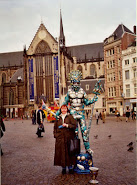
Yesterday was the "super Moon" event - as I understand it, the Moon happened to be a point in its rotation around the Earth closest to it and this coincided with the "full" Moon, making the Moon look super-large and particularly close in the skies in the northern hemisphere last night.  I happened to see this breathtaking photograph at Xinunet while I was checking out a story on the upcoming excavation of an ancient Shang Dynasty capital.


What struck me was the juxtoposition of the lunar crescent on the top of a mosque against the full Moon Goddess in all of her glory rising above Rotterdam in The Netherlands!  A truly international symbol as well as an international event published in international news coverage.  How connected we have become.  If only we would remember that underneath our different skin colors and cultures, we're all the same, too.

Does that crescent symbol look familiar to you?  It sure does to me...


Above is one of the sides of the incredibly beautiful and ancient Narmer Palette from pre-dynastic Egypt, although some historians call it Dynasty Zero.  Zero because it was right around the time Narmer was united Upper and Lower Egypt into one kingdom.  Check out Hat-hert a/k/a Hathor, the cow/lunar goddess, who was later turned into a daughter of the Sun god, Re, and became a solar goddess. But her first, and most ancient, association is with the Moon, and in some depictions of Hat-hert and later, Isis, she wears the "horns" of the Moon (a/k/a cow horns) enclosing the sacred solar disc.  Hat-hert also prominently appears on the reverse side of the Narmer Palette.  The Palette's antiquity is attested to by the fact that Hat-hert is depicted in her original cow form.  In later incarnations during her long herstory in ancient Egypt, Hat-hert was depicted as a woman with cow-ears, and still later, as a woman wearing a "crown" of cow horns. 

Here is a much later depiction of the lunar crescent worn as a crown by this beautifully formed alabaster goddess who "may" be Ishtar (Astarte), from a "necropolis of Hillah, near Babylon" with a 400 year swing date of 2nd Century BCE or CE, at the Lourve (photo from Wikipedia Commons):

 
At Carthage, the Moon goddess was worshipped as the fearsome Tanit, sometimes depicted with a lion's head (Hat-Hert was sometimes transformed into a lioness to wreak destruction upon sinning Egyptians, harking back to predynastic depictions of Hat-Hert as a warrior goddess:

  Tanit, to whom infants and young children were sacrificed by the CARthiginians (CAR is another archaic Moon goddess, whose worship is found in ancient place-names, I've written about her, too) is said to be an incarnation of Astarte:


The photo above is from Wikipedia Commons.  Do you see a resemblance between this form of the Goddess and the ancient Egyptian "ankh" symbol?  I also couldn't help but notice that in this depiction of a lunar goddess, the crescent Moon is "inverted" over the Goddess' head and I was much struck by its resemblance to some depictions I've seen of doves, so often associated with the Roman Catholic Mother of God, the Virgin Mary.  Periodically in modern-era Egypt (prior to the Islamists taking over the government after the overthrow of Mubarak), thousand of people attested to seeing the Virgin Mary appearing in the skies above Coptic Christian churches, often surrounded by "doves."  I've written about some of these apparitions of the Virgin Mary. 

If you're interested in learning more, please check out:

July 2, 2009:  The True Origins of the Koran (formatting is screwed up on this post, and many of my older posts, due to various changes that Google Blogger has gone through since the founding of this blog.  I hope you will take the time to slog through it despite no paragraph breaks!)

April 15, 2008:  Goddess Tanit

July 4, 2008:  The Goddess of the Moon

Did you know that the Moon Goddess has an intimate connection with Chinese Xiang'qi and the even older "pre-chess" game of Xiang'xi?  Oh yeah, if you read herstory between the lines, sometimes one can discern the truth.  Please check out my post from October 27, 2007:  The Chinese Moon Goddess and Chess

And if you would like to read more about some of the Virgin Mary apparitions:

August 24, 2007:  Goddess Sighting: Our Lady of Guadalupe (check out the nice crescent Moon the Our Lady is standing upon)

Our Lady of Zeitoun, from Wikipedia (I'm sure I posted about this and other Virgin Mary apparitions occurring in Egypt, but right now I cannot find them in my blog and I don't have time to hunt and peck at the moment)

At Tour Egypt:  Egypt: Egypt's 1960's Remarkable Virgin Mary Sightings, Egypt
Check out the "dove" above the "Virgin Mary" figure -- does it remind you of the crescent Moon depiction in the ancient stone carving above Tanit's head at Carthage (above):


She reappeared again in 2009, at a different location, but this time the birds around here were described as a swirl of pigeons and the Goddess had been reduced to appearing as an amorphous "flash of light."  Well, maybe.  Depends who you talked to when it happened...  Such things, after all, are in the eye of the beholder:

December 15, 2009:  EGYPT: Is it the Virgin Mary or just a curious flash of light?

For my part, I think the Mother has been, and is still trying, desperately, to reach out to us, but we're just not getting Her message.  Beware when she returns as Kali or Car.  And those in the know won't be able to say we weren't warned.

Saturday, October 23, 2010

The Cow Jumped Over the Moon

See the post immediately below on the latest issue (Volume 19) of the Asia Institute Bulletin.  In it is an article:

Almut Hintze, The Cow That Came from the Moon: The Avestan Expression māh- gaociθra-

SynopsisIt is argued that the syntactic combination of ciθra- with the ablative case in the Avesta warrants the meaning "origin, offspring" and that such meaning is also present in the phrase māh- gaociθra- "the moon that holds the seed of the animal." This and other evidence indicates that the Middle Persian myth about the lunar origin of the numerous animal species on earth goes back to the Avesta.

I don't think I would try to read the article based on the synopsis, which sounds extremely technical and way beyond the bounds of my knowledge, but the underlying premise about an ancient Persian/Avestan tale that relates the creation of animals with the Moon - that fascinates me.  The first thing that sprang into my mind when I read the title of the article was "the cow jumped over the Moon."

Yeah, I'm crazy.  Bear with me. Do you remember the old nursery rhyme  - Hey diddle diddle - this is how I remember it:

Hey diddle diddle,
The Cat and the Fiddle,
The Cow jumped over the Moon,
The Old Dog laughed to see such Craft,
And the Fork ran away with the Spoon.

(See Wikipedia for few other versions of the rhyme, along with discussion of the rhyme's possible meaning.)

Some free association in Goddesschess style - feel free to join in:

I see a pattern of pairs that may hold a deeper meaning, in other words, the sum of the whole is greater than its parts:

diddle - diddle
cat - fiddle
cow - Moon
dog - craft
fork - spoon (or dish - spoon)

Could this be a "spell," a formula hidden in "code" that is very very old?

There are some other associations that immediately come to mind:

Line drawing of the Narmer Palette, c. 3500-3400 BCE,
Naqada, ancient Egypt.  She's across the top on the front
and reverse sides, with cow ears and horns.  Her
iconography is extremely old.
cat - dog: opposites; light/dark, ying/yang
cat: associated with witchcraft; ancient Egyptian goddesses (Hathor, Bast)

cow: Hathor, India
cow: milk, food, mother

Craft: witchcraft; wizardry; old magic

dog - Moon: dog howling at the Moon, crying for his mate
dog: ancient game pieces were often called dogs
dog: companion of the Triple Goddess in her death aspect, harbinger of death, bringer of knowledge and insight, faithful companion

Moon: long associated with the Triple Goddess, and with female power, menstruation, creation - birth, death (blood), soma, the Elixir of Eternal Life
Moon: Wife/Mother of the Sun

fiddle: ancient stringed instrument of any sort for making music

fork - spoon/dish - spoon: eating, offering, ritual, feast/festivity

You get the idea...

Is "diddle" really a reference to illicit sexual activity? Could it have some other meaning, something older that has fallen out of usage and collective memory? Or was it simply added somewhere along the line in order to rhyme with "fiddle?"

Could "Craft" be an oblique reference to witchcraft?

"Catgut" was used to string ancient and not so ancient musical instruments. I'm not kidding - check out these definitions of "catgut:"

Catgut is a type of cord that is prepared from the natural fiber in the walls of animal intestines. Usually sheep or goat intestines are used, but it is occasionally made from the intestines of a hog, horse, mule, pig or donkey. ...
Wikipedia

A popular name for classical guitar strings.
www.guitarlessons.net/musicterms.shtml

I looked at the Wikipedia entry on "catgut" and found the following information:

The name neither implies nor derives from any association with cats.

The word catgut may have been an abbreviation of the word "cattlegut". Alternatively, it may have derived by folk etymology from kitgut or kitstring -- the word kit, meaning fiddle, having at some point been confused with the word kit for little cat. According to legend, string makers of the 17th century deliberately misled people to believe that the strings were made of cat intestines in order to protect their industry, as any association with cats was superstitiously believed to be extremely bad luck, and to be avoided at all cost.


For a long period, catgut was the most common material for the strings of harps, lutes, violins, and violas, as well as other stringed musical instruments, as well as older marching snare drums; however, most musical instruments produced today use strings with cores made of other materials, generally steel or synthetic. Gut strings are the natural choice for many classical and baroque string players, and catgut strings are still most commonly preferred in concert-tension pedal/grand and some lever harps because they give a richer, darker sound as well as withstanding high tension within low alto, tenor and high-bass ranges.

Sacred implements including bowls, platters, vials, pitchers and serving/mixing implements of all sorts, made out of all kinds of materials, have long been associated with the preparation of sacrifices to the goddesses and gods in ancient religious traditions. 

Fiddle brought to mind the ancient stringed musical instrument the lyre, which can be found (I believe) in Sumer, Egypt, Palestine, Israel, and ancient Greece.  Probably other places, too - ancient China?  So often one forgets about China and places to the far east of the Mediterranean in discussing herstory.  For instance, this blog that explores the meanings of words associated with the zodiac - in this case, the lyre - connects it to the concept of a tortoise shell.  That's fine - but it's all western analogies cited.  The tortoise shell in ancient China represented the mathematical basis of the first perfect 3 by 3 magical square, the Lo Shu, which may be incorporated into the ancient Chinese game liubo, which many Chinese scholars say is the predecessor of Xiang Qi -- Chinese Chess. All sides of the Lo Shu magic square sum to 15, and it is very very old, between 5000 and 6000 years old.  Perhaps as old as the Horns of Hathor.  And we should not forget what has been called the most ancient preserved zodiac in the world: that carved into the ceiling of the Temple of Hathor at Dendera.  Note: I cannot add graphics at the moment, something to do with Google Blogger maintenance, I believe.  If I remember tomorrow, I will add the necessary pics then.

Okay - so, putting it all together, could the old nursery rhyme actually be an incomplete and imperfectly remembered rendition of a very old spell -- tradition -- that had to do with making offerings of some kind to a deity?  Or a recording, in code, of the steps involved in making such an offering? 

Probably some brilliant graduate student has already written a paper on the subject :) 

Thursday, December 11, 2008

I'll Be Looking At The Moon...A BIG ONE TOMORROW

Biggest Full Moon of the Year tomorrow, December 12, 2008. The Moon Goddess will be putting on her Holiday Clothes and wowing all of us mere mortals with Her most spectacular display of the year. We're supposed to have clear skies here, so I'll be looking at the Moon... From PhysOrg.com Published: 13:50 EST, December 10, 2008 Biggest Full Moon of the Year It's no illusion. Some full Moons are genuinely larger than others and this Friday's is a whopper. Why? The Moon's orbit is an ellipse with one side 50,000 km closer to Earth than the other: see diagram (not copied here). In the language of astronomy, the two extremes are called "apogee" (far away) and "perigee" (nearby). On Dec. 12th, the Moon becomes full a scant 4 hours after reaching perigee, making it 14% bigger and 30% brighter than lesser full Moons we've seen earlier in 2008. A perigee Moon brings with it extra-high "perigean tides," but this is nothing to worry about, according to NOAA. In most places, lunar gravity at perigee pulls tide waters only a few centimeters (an inch or so) higher than usual. Local geography can amplify the effect to about 15 centimeters (six inches)--not exactly a great flood. Okay, the Moon is 14% bigger, but can you actually tell the difference? It's tricky. There are no rulers floating in the sky to measure lunar diameters. Hanging high overhead with no reference points to provide a sense of scale, one full Moon looks much like any other. The best time to look is when the Moon is near the horizon. That is when illusion mixes with reality to produce a truly stunning view. For reasons not fully understood by astronomers or psychologists, low-hanging Moons look unnaturally large when they beam through trees, buildings and other foreground objects. On Friday, why not let the "Moon illusion" amplify a full Moon that's extra-big to begin with? The swollen orb rising in the east at sunset may seem so nearby, you can almost reach out and touch it. But you still won't be able to see Armstrong's footprint. Not even Hubble can do that. The Moon is 384,400 km away (on average). At that distance, the smallest things Hubble can distinguish are about 60 meters wide. The biggest pieces of left-behind Apollo equipment are only about 9 meters across and smaller than a single pixel in a Hubble image. What you will see is the world around you. This is both the brightest and (in the northern hemisphere) the highest-riding full Moon of the year. If you go outside around midnight it will be close to overhead and act like a cosmic floodlamp making the landscape absolutely brilliant, especially if there's snow. Full moons are always high during winter and, indeed, the solstice is right around the corner on Dec. 21st. Source: Science@NASA, by Dr. Tony Phillips

Friday, July 4, 2008

The Goddess and the Moon...

Oh, the Moon, the great, big beautiful Moon.

The Moon has inspired mankind throughout the ages. Countless poems and songs - and romantic legends - have revolved around the Moon. Animals are inspired by the Moon, too. Why is this? Why, for instance, do coyotes and wolves and dogs howl at the full moon?

There is a close connection between the Moon Goddess and canines; in the way ancient times, before time was even counted as we count it today, canines were associated with death and the Passing Over of the dead to the Next World. Canines were carrion eaters, along with vultures and crows. The carrion eaters performed an important function - they picked the bones of the dead clean of putrefying flesh, thus rendering the bones fit for burial and memorial. This is the logical reason why canines, vultures and crows have, since the most ancient times, been associated with death and primeval goddesses of death, birth and resurrection.

As the Sun was associated with life, the Moon was associated with death and rebirth; but the Moon is also with life, since from the most ancient times onward it was associated with the rhythyms of menstruation, and menstruation, a uniquely feminine physiological event, was associated with the creation of Life. Blood was death, but it was also a symbol for life in menstruating women, the bearers of New Life. Thus, the dual notion of symbolism in blood - and the dual notion of symbolism in the Moon.

In most cultures, the Sun was considered masculine and the Moon was considered feminine, the Mate of the Sun. Actually, the Sun was the Mate of the Moon, for it was the Moon that controlled the tides and controlled the menstrual cycles of women in close societies. To this day, scientists continue to study why it is that women who work together in offices, for instance, seem to "shift" their menstrual cycles so that they all happen relatively close together. They think it might have something to do with phemerones - but who really knows for sure, heh?

Tonight, after a long hard day of whacking at weeds, cutting down unwanted seedling trees and pruning what seemed like endless branches from shrubs and trees, I'm pooped! And for some reason, I'm thinking about the Moon. There's no moon in the sky, leastwise, that I can see.

But I was thinking about this wonderful old song, "I'll Be Seeing You," and it's punchline lyrics about the Moon:

...I'll be seeing you
In every lovely, summer's day
And everything that's bright and gay
I'll always think of you that way
I'll find you in the morning sun
And when the night is new
I'll be looking at the moon
But Ill be seeing you.

So I see a connection between the Sun, a lovely summer's day and a warm, summer night with a full Moon shimmering in the sky after all...

A few interesting tidbits about the Moon Goddess:

From Barbara Walker's "A Woman's Encyclopedia of Myths and Secrets:"

Chaldean
"Moon worshippers," a common name for Mesopotamian astrologers who studied the movements of the moon in relation to the stars.(1) Because the magic powers of the Chaldeans commanded respect nearly everywhere in the ancient world, biblical writers made abraham a Chaldean (Genesis 121:28).. The same name wa still being applied to astrologers and wizards in the 15th century A.D. (2)

Notes:
(1) Briffault 2, 600.
(2) Lea unabridged, 772.

Ch'ang-O
(This is the Goddess that got me to thinking many Moons ago, har!, that chess had something to do with the Goddess...) Chinese Moon-goddess, sole keeper of the ambrosia of immortality (menstrual blood). Her husband, the Excellent Archer, became intensely jealous of her monopoly of life-magic and quarreled with her. So she left him, as Lilith left Adam, and went to live in the moon forever, dispensing her precious elixir to women only.(1)
Notes:
(1) Larousse, 383.

There is also a new article available online (by subscription only) at the American Journal of Achaeology:

Issue 112.3 (July, 2008)
Moon Over Pyrgi: Catha, an Etruscan Lunar Goddess?
Nancy T. de Grummond
(Image: American Journal of Archaeology: Terracotta head of a deity from Pyrgi (Leukothea? Catha?), fourth century B.C.E. Rome, Museo Nazionale di Villa Giulia (courtesy Università di Roma La Sapienza, Pyrgi Excavations).

Terracotta head of a deity from Pyrgi Relatively little has been written about Etruscan deities of the moon. This article explores the imagery of Etruscan lunar divinities and argues for recognition of a moon goddess at Pyrgi named Catha. A group of antefixes long recognized as astral or cosmic, from the 20-celled building in the Etruscan sanctuary at Pyrgi, includes a female figure with two horses, proposed here as an image of Catha. The paper considers implications for the cult of Catha at Pyrgi as consort of the sun god Śuri and as a goddess of the sea and the moon, perhaps associated with childbirth.

Friday, February 29, 2008

The Hind of Hinds - Continued

I want to relate a couple of very interesting "hallucinations" I had last night that are related to the material above and – well, you’ll see where this goes -- I’ve mentioned in earlier posts about how I tend to have hallucinatory "dreams" – not sure what to call the state, exactly, it tends to happens in that area where I’m half awake, or not quite asleep. Last night, or I should say, early this morning, it was between 2 and 3 a.m. when I am prone to wake up these days – anyway, I did my usual, wake up, roll over, look at the clock, roll back to settle into the pillows and I saw what, for the life of me, appeared to be the outline of a bear sitting in my wing chair by the south window. Now darlings, I knew it couldn’t possibly be a bear sitting in my chair, not at 2 in the morning, but it was quite distinctly the outline of a bear, even after I shook my head and blinked my eyes a couple of times and tried to "wake up." It was still there. I laid back down and watched it for awhile; it’s head was moving! It didn’t occur to me until I was having my morning coffee that it was moving in a barely perceptible nodding motion. I was totally stumped as to why this hallucination would not go away even though I thought I was almost fully awake; I fell back asleep – perhaps it was 10 minutes later while continuing to look at the "bear in the chair." It’s a bit hard to explain – this half-baked/half-awake thought process, but since the bear did NOT attack me, I KNEW it was an hallucination, not the real thing (forget about the logic of how a bear would happen to get into a locked house without any noise, happen to wander upstairs into my bedroom, and happen to sit in my chair quietly waiting for me to "wake" up), and so I wasn’t afraid to try and fall back asleep, only annoyed that whatever it was wouldn’t go away. As often happens in these post-menopausal times (women of a certain age in the audience will know exactly what I mean), I then proceeded to wake up about every 45 to 55 minutes for the next couple of hours – sometimes this happens until the alarm goes off at 6 a.m., but last night/early this morning it only happened two more times, and so I was able to get in a last couple of hours of "quality" sleep before the alarm went off. Anyway, when I next awoke, I turned my head and crinked my neck up just to get a look and sure enough, the bear was still sitting in the chair by the window on the south wall. Damn! And still ever so slightly nodding it’s head. I could see it distinctly because my south window overlooks a street light perhaps 50 feet away, and it casts enough light through the curtains to cast eerie shadows inside my bedroom (cue spooky music….) Hmmmmm. Then I rolled over toward the west wall and caught a glimpse of something that set my heart to pounding – a giant serpent! I nearly leaped out of bed -- Of course it wasn’t a giant serpent, it was my "pharmacy" style floor lamp that I have sitting next to the computer hutch, but to my half-awake eyes it took on the form of a gigantic hooded cobra. Hmmmm, a bear and a snake? Very weird. Someone must be trying to tell me something, I thought, as I settled back into my pillows and went back to sleep. OKAY! A bit of back story. The serpent I understand because for the past couple of weeks delion and I have been nattering back and forth about things Egyptian, etc. and I’ve been refreshing my memory by checking out information on Uadjet, the serpent tutorial Goddess of "Upper" (Southern) Egypt, very ancient, who also represents the Sun God (Ra/Re) and, in one of her aspects, is also His Sacred Eye. So the lamp-turning-into-cobra makes sense, in a "dream" way. But the bear? Now, mind you darlings, this all happened before I ever cracked open Walker’s Woman’s Encyclopedia today and copied out the information on "Arabia" published above. As it so happens, when I first opened the book, I came upon an entry of Atalanta: Amazonian huntress, the best athlete in Calydon. As an infant, Atalanta was suckled by Artemis herself, in totemic form as a She-Bear. When she grew up, she took part in the famous hunt of the Calydonian Boar and drew first blood, pausing only to kill two centaurs who tried to rape her on the hunting field. Ah ha! Bells went off in my head. Artemis was the bear! But not only a bear, Walker links her to the "Hind of Hinds" (Hind al-Hunud): "Many Koreshites remained faithful to the Goddess and to their queen, Hind al-Hunud: the Hind of Hinds, similar to the title of Artemis" – but I didn’t know that until I read and then posted the entry on Arabia from The Woman’s Encyclopedia today! So – my admittedly amateur interpretation of my "waking dreams" is that the Goddess (in bear and serpent forms) approve/approved my intent/plan to post more about the ancient battle queens here – even before I knew I was going to do it. Well, they are goddesses, they can "see" the future! A couple notes. Based on what I read in Walker, Fatima, the putative daughter of Mohammed, is a "sister" of the ancient Egyptian cow-goddess Hathor. One of Fatima’s titles is "Red Cow," and Fatima shares many other titles and attributes with Egyptian Hathor. Hathor was also considered a moon goddess, because her horns formed a "crescent" moon. Hmmm, where have we seen that symbol before? Oh yeah, on the flags of many countries where Islam is the majority religion. Hmmm….
Related Posts Plugin for WordPress, Blogger...