Showing posts with label serpent game board. Show all posts

Tuesday, December 4, 2012

Two Ptolemic Lions Uncovered in the Fayoum...and MeHeN

Lion-shaped statues unearthed in Fayoum

Italian archaeological mission discovers a pair of large limestone lion statues at the Ptolemaic temple of god Sknopaios in Fayoum

Nevine El-Aref , Monday 3 Dec 2012

Screen snip from article -- "in storage." 

The Italian archaeological mission of Salento-Litchi University stumbled upon a pair of gigantic seated lion statues on Monday.

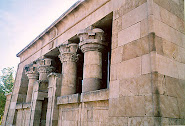
They were found erected at the entrance of Soknopaios Temple at the Ptolemaic town, Dimeh Al-Siba, in Fayoum.

Dimeh Al-Siba, which means ‘Island of the Crocodile god,’ is located eleven kilometres to the north of Qarun Lake. It was founded by Ptolemy II on top of a Neolithic residential area (Ptolemy II Philadelphus r. 283 - 246 BCE).

The Ptolemaic-era town contains a collection of residential houses, a large temple to worship Sknopaios, in ancient Egypt Sobek-en-Pai (crocodile), a bakery and a market.

During excavation work carried out by archaeologist and director of the Italian mission, Mario Capasso, a pair of lion statues appeared on the sand surface.

The lion statues are skillfully carved of limestone and were presumably used to decorate the entrance gate of the temple.

Mohamed Ibrahim, Antiquities Minister, describes the discovery as interesting, as it confirm that the temple was constructed according to an architectural plan used in main temples in large cities and capital.

“It is also the first time that the gigantic lion shaped statues can be unearthed in a small Greco-Roman settlement in Fayoum,” said Ibrahim

Both statues are in a very well-preserved condition and are now at the Fayoum storehouse for restoration.

*****************************************

By the time of the reign of Ptolemy II, how many lions do you think were still living around the area, heh?  Probably NONE.

There had probably been no lions living in the desert for at least a couple thousand years after the founding of Dynasty Zero.  They would have long since been hunted to extinction, and what humans didn't wipe out, the desertification of the vast area of northern Africa certainly did. 

But, there was a time when the Egyptians were quite familiar with lions.  In fact, one of the oldest board games of record had lions (and/or lionesses) playing pieces.  That game was called MeHeN -- the game of the serpent according to some.  But if it was a serpent's game, why were there lion playing pieces???

Just one of the unexplored mysteries of ancient Egypt, I guess.  The gameboard for MeHeN is, in fact, in the shape of a coiled serpent.  That could mean that it was first created in southern Egypt -- the land where serpents abounded in the more arid regions far away from the fertile delta of the Nile on the coast of the Mediterranean Sea. 

I think it is safe to say the MeHeN predates Dynasty Zero.  It was already an old game when the first carved stone gameboards were excavated in the earliest Dynastic tombs, and was, according to modern-day historians, soon on its way to extinction as the game of twenty-squares or "robbers" (but also called "dancers") became more and more popular.

Here is a lion game piece that is probably from a MeHeN game found in the First Dynasty tomb of Djer "Dojer"), and it's beautiful, even in its ruined state:

Gaming Piece. Tomb of Djer, First Dynasty.
From the British Museum website about the lion gaming piece, above (I think it is actually a lioness).

Hypotheses vary as to why MeHeN went extinct.  But you know how it goes -- the same thing happens today.  New games come along, new forms of entertainment, languages change -- and the old often falls by the wayside, trampled in the dust of time, forgotten.  Fortunately, for ancient Egypt, they did many things in STONE.

MeHeN crumpled into dust as the game of Senet took over in popularity and, eventually, religious symbolism in representing the passage of a human being from life to death to life again. But the lioness (and sometimes the lion), remained a powerful symbol of sovereignty, majestic power, and perhaps most importantly of all, mysterious power received from the Heavens.  Long after MeHeN was forgotten and its last vestiges as a sacred game buried under tons of sand, the lioness continued to be an extremely powerful symbol in Egypt and indeed, throughout the Middle East.  These Ptolemaic examples of that continuing fascination, well, just more evidence piled upon evidence piled upon evidence...

Ancient Egyptian Games: Mehen

Faulkner’s Concise Dictionary of Middle Egyptian gives the translation of the word ‘Mehen’ as literally meaning “coil” and is used in reference to the goddess Mehen, or ‘Coiled One’, and also the board game called Mehen.
MehenBig Ancient Egyptian Games: Mehen

I am this one who escaped from the coiled serpent (Mehen),
I have ascended in a blast of fire, having turned myself about.
The two skies go to me, the two earths come to me,
I have trodden on the green k3d-plant, which is under Geb,
I have travelled the roads of Nut.

- Pyramid Texts Utterance 332.


In later years, the hieroglyphic that looks like a series of "M's" or "V's" stuck together, which represents, surprisingly enough, water, which may have been pronounced something like "NUUUN" in ancient Egyptian, in close conjunction with the symbol of a horizontal gameboard with pieces upon it, came to represent the shorthand symbol for "board game" and the popular game Senet, which soon overtook Mehen as THE game to play, and in later Dynasties' tomb paintings was openly represented as having religious significance.  "NUN," the ancient Egyptian symbol for water or the waters of life, was also the name of the ancient Mother/Sky Goddess who was often depicted as "arced" or stretched over the Earth as a protector and life-giver.  In later years, "NUN" came to be shown as swallowing the Sacred Barque bearing the God Horus at night.  Horus represented the Sun God on his journey through the Underworld or Land of Death (in ancient Egyptian texts, this was the Land to the West)  to a new day and rebirth.  If successful in this harrowing journey, in the morning the Mother Goddess "NUN" would "give birth" to Horus once again, representing the dawning of a new day.

I have posted about MeHeN before:

Mehen
May 25, 2008

Mehen: An Ancient Egyptian Boardgame
February 21, 2009
Sorry about the formatting of this article!  It got totally f'd up when Google did one of it's abitrary "enhancements" and nearly all (but not all?) of the posts at this blog got messed with.  There were too many posts screwed up to go back and try to fix them all.  So as I re-post links to them I go in and try to fix them as best I can.  But, I'm too tired tonight to fix the February 21, 2009 post, I'll do it tomorrow (if I remember, LOL!)

An important point to remember is that, in the earliest translations from Egyptian hieroglyphics to English, MeHeN was a FEMALE GOD -- a Goddess - who was charged with keeping safe the Horus on the Sacred Barque.  In later symbolism, after the original meaning had been obscured, Horus was often replaced by Pharaoh, in a sort of Naos-like enclosure that was surrounded by a serpent-like creature that often reminds me of early 20th-century American representations of electricity! 

In the earliest representations that I have seen, MeHeN was, Herself, forming the Naos like an embryo in a uterus around the Horus, without any intervening wooden structure on the Sacred Barque.  That symbolism harkens back to earliest prehistoric times, back to the time when the process of birth was itself sacred, when the color red obtained its special status as the color of Sacred Blood and Life, and the womb was akin to a Sacred Cave. 

A lot to ponder...

One of the most frustrating things -- here is what is obviously a MeHeN gameboard shown in the same photograph with the lion game piece from Djoser's tomb, and yet it is NOT identified at all!  How ridiculous is this:

From British Museum website.  Game board is NOT identified; marbles are NOT
identified; "white lion" is NOT identified.  ARRRRGGGHHHH! 

Friday, November 9, 2012

Evidence That Foundations of Indus Civilization Older Than Thought

Indus Valley 2,000 years older than thought


New Delhi, Nov. 4 -- The beginning of India's history has been pushed back by more than 2,000 years, making it older than that of Egypt and Babylon. Latest research has put the date of the origin of the Indus Valley Civilisation at 6,000 years before Christ, which contests the current theory that the settlements around the Indus began around 3750 BC.
 
Ever since the excavations at Harappa and Mohenjo-daro in the early 1920s, the civilisation was considered almost as old as those of Egypt and Mesopotamia.

The finding was announced at the "International Conference on Harappan Archaeology", recently organised by the Archaeological Survey of India (ASI) in Chandigarh.

Based on their research, BR Mani, ASI joint director general, and KN Dikshit, former ASI joint director general, said in a presentation: "The preliminary results of the data from early sites of the Indo-Pak subcontinent suggest that the Indian civilisation emerged in the 8th millennium BC in the Ghaggar-Hakra and Baluchistan area."

"On the basis of radio-metric dates from Bhirrana (Haryana), the cultural remains of the pre-early Harappan horizon go back to 7380 BC to 6201 BC."

Excavations had been carried out at two sites in Pakistan and Bhirrana, Kunal, Rakhigarhi and Baror in India.

Published by HT Syndication with permission from Hindustan Times.

********************************************

Well, I expect this will start a good rip-roaring argument in certain circles!  For myself, I'm open to the idea.  Take a look at this map from Wikipedia:


It is well established that people were living in the Iranian Plateau and making beautiful pottery/clay vessels dating to as early as c. 8000 BCE.  I am no expert in this area, by any means, but I don't find it impossible to imagine migration from the Caspian Sea area to the coast on the Arabian Sea.  Notice the location of the Indus area in relation to the ancient areas of Baluchistan and Sind.  In fact, some late 19th century writers thought that chess originated in Sind (in today's world, southeast Pakistan)

See Art of Pottery in Iran at Iran Review. 


Whenever I see Baluchistan in print, I think of Shar-i Sokhtah (spelled in myriad different ways) and the wonderful miraculously preserved wooden game board of 20-squares that was about 4300 years old.  Notice on the map above the location of Shahr-e-Suchte (a/k/a the Burnt City) and Mohenjo Daro of the Indus civilization.  I blogged about this remarkable gameboard, formed by the bodies of interwoven serpents carved into the wood, back in 2010:


Sorry, not the best photo, but it's right out of a print report from back in the 1970s when the news was first published - unfortunately, the source below did not cite to the original report:

A well-preserved wooden 20-squares gameboard (the serpent gameboard) was excavated from Shar-i Sokhtah near the borderlands of Iran, Afghanistan and Pakistan in the late 1970's I believe, and dated to about 2400 BCE. Also known as the "Burnt City," Shar-i Sokhtah was a trading hub as well as a center of decorative arts and crafts. Image: "Evidence of Western Cultural Connections from a Phase 3 Group of Graves at Shar-i Sokhta", M. Piperno, S. Salvatori, Mesopotamien und Sein Nachbarn, Band 1, Dietrich Reimer Verlag, Berlin 1997, pgs. 79-84, Tafel XXII. The illustration (Fig. 4) is described as "The wooden gaming board found in grave IUP 731 at Shahr-i Sokhta. The board features an engraved serpent [on a rectangular board] coiling around itself for 20 times, thus producing 20 slots for the game."  From June 10, 2010 blog "Author Fudging on Game Board Fragment in Article on Harappan Site". 
The game of 20-squares was made famous when Woolley excavated the remains of a couple of different boards from the royal tombs of Ur, dated to roughly the same period as the gameboard from Shar-i Sokhtah. 

Thursday, August 21, 2008

Women Ruled in Iran - 5500 Years Ago...

Remember the babe with the Golden Eye Ball? I'm sure I wrote about her somewhere - maybe at Random Round-up. She was, according to the latest, a personage of some importance in the ancient scheme of things. Here's more about the ancient history of "The Burnt City" a/k/a Shar-i Sokhtah (various spellings), where was exacavated an amazing wooden game board of 20 squares, carved in the classical shape of those game boards recovered from the Royal Tombs of Ur by Woolley dated to about 2600 BCE, but with the "squares" (playing cases) composed entirely by the intertwined bodies of two serpents! Serpents, as we've seen here in numerous posts, are ancient symbols of The Goddess. 5000 years ago women in control of Burnt City Tuesday, August 12, 2008 - ?2005 IranMania.com [Does this mean this story dates back originally to 2005?] LONDON, August 12 (IranMania) - Recent studies of a team of archeologists have shown that 5000 years ago (3200 BC) women had the economic control of the Burnt City. Some paleo-anthropologists believe that mothers in the Burnt City had social and financial prominence, director of the team working at the Burnt City in Sistan-Baluchestan Province, southeastern Iran said recently. Addressing the archaeology students at Zabol University, Seyed Mansour Seyed Sajjadi said that 5000 year-old insignias, made of river pebbles and believed to belong only to distinguished inhabitants of the city, were found in the graves of some female citizens. "Some believe the female owners of the insignias used them to place their seal on valuable documents. Others believe the owners may have used the seal to indicate their lofty status in society", he added. In December 2006, archaeologists discovered the world's earliest artificial eyeball in the city's necropolis, thought to have been worn by a female resident of the Burnt City. The artificial eye is a hemisphere with a diameter of just over 2.5 cm (1 inch). It consists of very light material, probably bitumen paste. The surface of the artificial eye is covered with a thin layer of gilding and is engraved with a circle at its center to represent the iris. The eye includes gold lines patterned like the rays of the sun. A hole has been drilled through the eyeball, through which a golden thread is thought to have held the eyeball in place. Microscopic research has revealed that the eye socket of the female remains bear clear imprints of the golden thread, suggesting that the woman must have worn the eyeball during her lifetime. With her shining golden eye she must have been a striking figure, perhaps a soothsayer or an oracle. The woman with the artificial eye was 1.82 m tall (6 feet), much taller than the average women of her time. She was aged between 25 and 30 and had dark, exotic skin. Her Africanoid cranial structure suggests her origins were the Arabian Peninsula. [Interesting - a business woman who set up shop far from home? Or an imported bride?] Experts say that her skeleton dates to between 2900 and 2800 BC, when the Burnt City was a bustling, wealthy city and trading post at the crossroads of the East and the West. It is thought that the woman may have arrived at the city on a caravan from Arabia. Archeologists have not yet revealed the cause of the woman's death. Paleopathological studies on 40 teeth unearthed in the Burnt City's cemetery show that the inhabitants of the city used their teeth as a tool for weaving to make baskets and other handmade products. "More than 40 teeth lesions have been identified, the most prominent of which belongs to a young woman who used her teeth as a tool for weaving baskets and similar products," said Farzad Foruzanfar, director of the Anthropology Department of Iran's Archeology Research Center (ICAR) in an interview with CHN. The use of teeth as a tool in the Burnt City is seen in both males and females of different age groups. Evidence shows that weaving was more than a hobby in the prehistoric city. It was one of the most common professions in the city which required a special skill. Residents made a variety of weaved products such as carpets, baskets and other household items. The city, called Shahr-e-Sookhteh, sits on the banks of the Helmand River along the Zahedan-Zabol road in the southeast province of Sistan. The excavations at the Burnt City also suggest that the inhabitants were a race of civilized people who were both farmers and craftsmen. No weapon has ever been discovered at the site, suggesting the peaceful nature of the residents. The Burnt City has been continually excavated since the 1970s by Iranian and Italian archaeological teams, with new discoveries periodically reported. Covering an area of 151 hectares, the city was built around 3200 BC and abandoned over a millennium later in 2100 BC. The city experienced four stages of civilization and was burnt down three times. It took its eventual named because it was never rebuilt after the last fire. Learn more at Goddesschess.

Sunday, June 15, 2008

5,000 Site Discovered in Iran

5000-year-old site discovered in southeastern Iran
Tehran Times Culture Desk
June 8, 2008

TEHRAN -- A broad site dating back to the third millennium BC was discovered during the latest excavations in Bampur region in Sistan-Baluchestan Province, southeastern Iran.

“In the Bampur valley, there is an ancient site covered with sand mounds, which is as large as the Burnt City and may belong to a civilization as great as the civilization of that the city,” Mehdi Mortazavi, an archaeologist of the University of Sistan-Baluchestan, told the Persian service of CHN on Saturday. According to Mortazavi, the site measures 1x1.5 kilometer. “I feel sure that there are a large number of sites like this here. Such sites may even exist in nearby regions like Saravan,” he stated.

Mortazavi refused to give more details about the location of the site for security reasons. “It’s better for the site to remain covered for the time being, because it will be plundered by illegal excavations if the precise location of the site is revealed,” he argued. [Psssst...it probably already has been discovered by the looters...]

Twenty sites -- mostly prehistoric -- have been discovered by the archaeologists of the University of Sistan-Baluchestan over the past few years. Covering an area of 152 hectares, the Burnt City, located 57 kilometers from the city of Zabol in Sistan-Baluchestan Province, is the largest prehistoric site of the province. It was one of the world’s largest conurbations at the dawn of the urban era and was well developed during the third millennium BC. It thus constitutes one of the country’s most important prehistoric sites. The city, which was burnt down three times, shows evidence of four stages of civilization. Since it was not rebuilt after the last conflagration, it has been named the Burnt City.
**********************************************************************************
The Burnt City (Shar-i Sokhta, various spellings) was where the wooden serpent game board was excavated in 1983 (image above). The serpent game board dates to about 2400 BCE, making it about 200 years younger (more or less) than the famous 20-squares boards excavated by Woolley at Ur.
On the Iranian side of the border, the area is called Sistan va Baluchestan; on the Pakistani side of the border the area is called Baluchistan. In older times, the larger area (encompassing lands in the border regions of Iran, Pakistan and India, all the way south to the Indian Ocean) was called Baluchistan. Several chess historians have pointed to Baluchistan as being the birth place of chess.
Related Posts Plugin for WordPress, Blogger...