From The New York Times Opinion Page
Menstrual Pads Can't Fix Prejudice
Chris Bobel*
March 31, 2018
The period is finally having its moment.
In the last decade, the difficulties women and girls across the globe face during menstruation have inspired a raft of grass-roots campaigns. “Period poverty” activists seek to make menstrual products more affordable and available. International agencies like Plan International, Water Aid, U.N. Women and Unicef are supporting menstrual hygiene programs in dozens of countries. Access to safe, accessible bathrooms and materials to manage menstruation is now recognized as a human rights issue that involves many other areas of development, like clean water, education and gender equality.
These shifts are certainly heartening. For centuries, around the world, menstruation has been treated as a source of shame, rather than as a normal, healthy part of women’s lives. Initiatives to “make menstruation matter” are both welcome and overdue.
Why, then, after years studying these efforts, do I feel ambivalent? Because too many of them have opted to focus on providing women with new products, failing to substantively fight the core problem surrounding menstruation: cultural stigma.
Consider the humble piece of cloth. Many Westerners are horrified to learn that repurposed cloth is commonly used by women in poor countries to manage their periods. Yet cloth is absorbent, readily available, cheap and sustainable. Folded or cut to size, changed as necessary and properly washed and dried, it can be sanitary and effective.
Still, many programs are hustling to replace this traditional method with commercial products. In addition to the nongovernmental organizations that make products their priority, start-ups are seeding microbusinesses in which, say, Rwandan, Indian and Ugandan women make and sell pads. Such an approach falls under the category of a “technological fix”: a seemingly simple solution to what is, in reality, a complex problem.
Such interventions can be helpful, and in some circumstances even necessary, but they fail to address the root issues. No menstrual product is effective for a schoolgirl who lacks access to a clean, secure toilet, as is the case in many poor countries. Stigma about menstruation often undermines proper use, and a woman’s fear of inadvertently revealing she is menstruating remains a distraction and a burden.
These fears and stigmas are prevalent in the rich world, too. As the historian Joan Jacobs Brumberg has shown, in the United States at the turn of the century, menstruation became increasingly medicalized: Doctors, who were mostly men, and increasingly viewed as experts, coached mothers to socialize their daughters to keep tidy and discreet. Menarche, the first menstrual period, was effectively reduced from a sign of womanhood to a “hygienic crisis."
Even now, American girls are socialized to see menstruation, and more generally, their bodies, as problems to be solved through use of the “right” products. Today, we are exporting this view around the world.
Monday, December 3, 2018


Catching Up: Artifact Depicting Pharaoh Queen Hatshepsut Discovered in UK University in Storage!
By James Rogers, Fox News
March 26, 2018
A rare ancient artifact depicting the famous female pharaoh Hatshepsut has surfaced in the U.K., stunning experts.
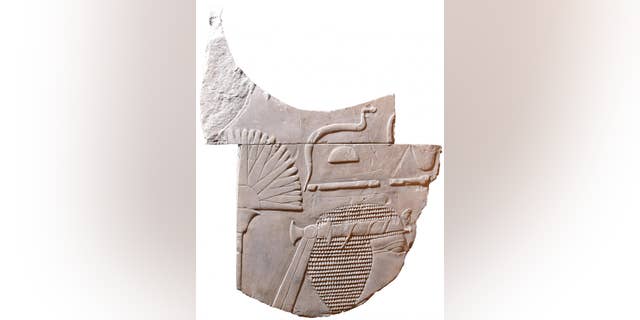 |
| The front of the artifact (The Egypt Centre, Swansea University) |
Consisting of two limestone fragments that have been glued together, the artifact had been in storage for 20 years before it was chosen for an object handling session by students of Swansea University in Wales. While the artwork was being analyzed by the students, Swansea University Egyptology lecturer Dr. Ken Griffin noticed something unusual.
Griffin recognized the artwork’s iconography as being similar to carvings within the temple of Hatshepsut at Deir el-Bahri in Luxor, Egypt. The front of the artifact depicts the head of a figure whose face is missing, with the remains of a fan. A uraeus, or cobra, is depicted on the figure’s forehead and hieroglyphics can also be seen above her head.
The decoration of the fan, the figure’s hair, the uraeus and her headband are all similar to images found at Deir el-Bahri. The hieroglyphs, which use a female pronoun, are also found in text at the temple.
The unusual artifact, which is held in Swansea University’s Egypt Centre, thrilled Griffin and his students.
Hatshepsut, who reigned from about 1478 B.C. to 1458 B.C., is one of only a handful of female pharaohs. “Early in her reign she was represented as a female wearing a long dress, but she gradually took on more masculine traits, including being depicted with a beard,” explained Swansea University, in its statement.
The University obtained the artwork in 1971 with other artifacts that once belonged to the pharmaceutical mogul Sir Henry Wellcome.
The head of a man with a short beard is depicted on the rear of the mysterious fragment. “Initially there was no explanation for this, but it is now clear that the upper fragment had been removed and recarved in more recent times in order to complete the face of the lower fragment,” explained Swansea University, in its statement. “The replacement of the fragment below the figure would also explain the unusual cut of the upper fragment."
The recent work on the fragment’s rear may have been done by an antiques dealer, auctioneer, or previous owner to increase the piece’s value or attractiveness, the University added.
Experts think that the artifact came from Deir el-Bahri but more research is needed to confirm this.
Catching Up: Museum Displays Parity of Women in Ancient Egypt
I have tons of older "saves" to post, let's see how far I get today! First up:
Museum displays parity of women in ancient Egypt

Wednesday, November 21, 2018
New York Times on the World Chess Championship - Live TV Coverage in Norway All the Rage!
"The Magnus Effect," The New York Times, November 21, 2018.
By Andrew Keh, photographs by Linda Bournane Engelberth
Please use the link above to read the entire article. For current coverage (event runs through November 28th unless decided sooner by a sufficient winning margin on the part of one of the players), I recommend The Week in Chess, my go-to source for chess news (which I haven't been reporting on much the past few years, particularly world championships involving only male players. Snore.) It is nice to have an American player competing for the title, it's been a lllooooonnnnggggg time.
OSLO — Late on Friday night, a couple hundred people were packed into a dimly lit, stylishly decorated bar in the heart of Oslo’s downtown night-life district.
The place already was generating considerable buzz. It had been open for only a week, but one recent night the line to enter had snaked down the block. Inside, it felt like so many of the other hip spots in downtown Oslo — candlelight illuminating framed artwork on the walls, conversation humming over the clink of beer glasses — except for one small detail: the chess games happening at every table and countertop.
"That’s the Magnus Effect,” said Martin Mortensen, a 32-year-old software developer at the bar, referring to the Norwegian world champion Magnus Carlsen. “Almost everyone in Norway has some relationship to chess nowadays. It’s on T.V. and in newspapers all the time."
He scanned the overflowing room. “It’s bizarre."
Now chess is once again being rejuvenated in America, this time by an unlikely source in the Sinquefield billionaire husband and wife team in St. Louis, Missouri. GM Susan Polgar, one of the three famous Polgar sisters originally from Hungary, has lived in the US for years, centered first in New York where she met Fabiano Caruana at her chess training center when he was just a youngster. She saw his promise as a player. Polgar eventually moved to Texas Tech to establish a chess training program that drafted players from around the world to come to the Texas Tech campus in Lubbock, Texas to play for the che, ss team while earning college degrees. Some years later, Polgar moved to Webster University in St. Louis, where she remains today, at the helm of the Susan Polgar Institute for Chess Excellence.
If you're interested, you can check out the somewhat "checkered" history of the title of World Chess Championship during the modern era, involving both FIDE and "not FIDE" titles. Information comes directly from Wikipedia:
3World champions
By Andrew Keh, photographs by Linda Bournane Engelberth
Please use the link above to read the entire article. For current coverage (event runs through November 28th unless decided sooner by a sufficient winning margin on the part of one of the players), I recommend The Week in Chess, my go-to source for chess news (which I haven't been reporting on much the past few years, particularly world championships involving only male players. Snore.) It is nice to have an American player competing for the title, it's been a lllooooonnnnggggg time.
* * * * *
OSLO — Late on Friday night, a couple hundred people were packed into a dimly lit, stylishly decorated bar in the heart of Oslo’s downtown night-life district.
The place already was generating considerable buzz. It had been open for only a week, but one recent night the line to enter had snaked down the block. Inside, it felt like so many of the other hip spots in downtown Oslo — candlelight illuminating framed artwork on the walls, conversation humming over the clink of beer glasses — except for one small detail: the chess games happening at every table and countertop.
"That’s the Magnus Effect,” said Martin Mortensen, a 32-year-old software developer at the bar, referring to the Norwegian world champion Magnus Carlsen. “Almost everyone in Norway has some relationship to chess nowadays. It’s on T.V. and in newspapers all the time."
He scanned the overflowing room. “It’s bizarre."
* * * * *
"Bizarre?" No more bizarre than the chess fever that swept through an entire generation of American chess players back in 1972 when American Bobby Fischer challenged the Russian chess champion juggernaut - AND WON! Chess infected millions of youngsters and others all across the country and churned out a great number of revered American chess Grandmasters who competed on the world stage for years, although none achieved the same level of fame as Fischer.Now chess is once again being rejuvenated in America, this time by an unlikely source in the Sinquefield billionaire husband and wife team in St. Louis, Missouri. GM Susan Polgar, one of the three famous Polgar sisters originally from Hungary, has lived in the US for years, centered first in New York where she met Fabiano Caruana at her chess training center when he was just a youngster. She saw his promise as a player. Polgar eventually moved to Texas Tech to establish a chess training program that drafted players from around the world to come to the Texas Tech campus in Lubbock, Texas to play for the che, ss team while earning college degrees. Some years later, Polgar moved to Webster University in St. Louis, where she remains today, at the helm of the Susan Polgar Institute for Chess Excellence.
If you're interested, you can check out the somewhat "checkered" history of the title of World Chess Championship during the modern era, involving both FIDE and "not FIDE" titles. Information comes directly from Wikipedia:
3World champions
- 3.1Leading players before the World Chess Championships
- 3.2Undisputed world champions (1886–1993)
- 3.3Classical (PCA/Braingames) world champions (1993–2006)
- 3.4FIDE world champions (1993–2006)
- 3.5Undisputed world champions (2006–present)
- 3.6Timeline
Sunday, October 14, 2018
Hales Corners Chess Challenge 28! RESULTS RESULTS RESULTS (Goddesschess Winners)
Hola darlings:
Fresh from Robin via email, here are the prize winners of Goddesschess prizes and the Don McLean Award, which is awarded annually in October to the top male finishers in each section in honor of our late webmaster for many years and Goddesschess partner:
Fresh from Robin via email, here are the prize winners of Goddesschess prizes and the Don McLean Award, which is awarded annually in October to the top male finishers in each section in honor of our late webmaster for many years and Goddesschess partner:
OPEN SECTION:
Susanna Ulrich won $125
Gauri Menon won $150
Madeline Weber won $100
Sandra Hoffman (played in the Open section this time and did not score any points)
RESERVE SECTION:
Simran Bhatia won $50
Aradh Kaur won $60
Radhika Gupta won $50
Ellen Wanek won $50
Jind Kaur won $40
Delenn Kier won $40
 |
| Nine of the ten chess femmes at Hales Corners Chess Challenge XXVIII (28)! Photo sent by Ellen Wanek, my chess buddy of some years - she's the beautiful blonde in the back row. |
OTHER PRIZES:
Free entry to both sections is $70.00 (Gauri Menon and Aradh Kaur)
Don McLean Performance Award is $100.00 in Open for IM Erik Santarius and $50 in Reserve for Jacob Schwartz.
Congratulations to all of our winners! I hope you will all come back and participate again in the spring 2019 Hales Corners Chess Challenge.
We had a female participation rate this event of 25%! Thank you, chess femmes, for coming out and participating in this great event.
Monday, October 8, 2018
Hales Corners Chess Challenge 28 (Forget the Roman Numerals Already, Pul-leeze!)
Hola Darlings!
Yes, I am still alive and kicking, just been uber-busy protesting the hell out of what's been going on politically in our country and working on registering voters (particularly FEMALE voters, YAY!), sending out more money than I can afford to back candidates (all won their primaries, now fingers crossed for mid-terms), writing my too large butt off on political commentary sites and throwing verbal bombs EVERYWHERE! I am a tornado in action. Or maybe I should call myself a HERricane...
Anyway, back to chess, at least for this splinter of time that it takes me to post about Goddesschess' relationship with the Hales Corners Chess Club since Challenge VIII. I'm getting too old to fuss about writing out 28 - which is the Challenge that is unfolding NEXT WEEK!!!
Goddesschess is sponsoring prizes again this Challenge, including the annual Don McClean Award of $100 to the top finishing male player in the Open and $50 to the top finishing male player in the Reserve sections. This is in honor of our dearly beloved and now departed long-time Goddesschess partner and former webmaster genius extraordinaire, Don McClean, who passed away far too young in 2012.
There are also Goddesschess prizes for the chess femmes, which are awarded in addition to whatever other prizes players (both female and male) may also qualify for. Whoop whoop! Chess femme prizes:
Open: $50 per win/$25 per draw
Reserve: $20 per win/$10 per draw
Perfect Score: Open $100; Reserve $50
Here's the scoop - it's this SATURDAY, darlings! Where has the time flown, Geez Louise. I think the warm sunny weather here today after Monsoon season (you'd think we lived in the tropics, except for the temperatures, for pete's sake!) tricked me into thinking it's still summer. Oh well. BETTER LATE THAN NEVER! Register today, pul-leeze!
Love you all, smooches from Jan.
Yes, I am still alive and kicking, just been uber-busy protesting the hell out of what's been going on politically in our country and working on registering voters (particularly FEMALE voters, YAY!), sending out more money than I can afford to back candidates (all won their primaries, now fingers crossed for mid-terms), writing my too large butt off on political commentary sites and throwing verbal bombs EVERYWHERE! I am a tornado in action. Or maybe I should call myself a HERricane...
Anyway, back to chess, at least for this splinter of time that it takes me to post about Goddesschess' relationship with the Hales Corners Chess Club since Challenge VIII. I'm getting too old to fuss about writing out 28 - which is the Challenge that is unfolding NEXT WEEK!!!
Goddesschess is sponsoring prizes again this Challenge, including the annual Don McClean Award of $100 to the top finishing male player in the Open and $50 to the top finishing male player in the Reserve sections. This is in honor of our dearly beloved and now departed long-time Goddesschess partner and former webmaster genius extraordinaire, Don McClean, who passed away far too young in 2012.
There are also Goddesschess prizes for the chess femmes, which are awarded in addition to whatever other prizes players (both female and male) may also qualify for. Whoop whoop! Chess femme prizes:
Open: $50 per win/$25 per draw
Reserve: $20 per win/$10 per draw
Perfect Score: Open $100; Reserve $50
Here's the scoop - it's this SATURDAY, darlings! Where has the time flown, Geez Louise. I think the warm sunny weather here today after Monsoon season (you'd think we lived in the tropics, except for the temperatures, for pete's sake!) tricked me into thinking it's still summer. Oh well. BETTER LATE THAN NEVER! Register today, pul-leeze!
Love you all, smooches from Jan.
| |||
Sunday, August 12, 2018
Nine Year Old Chess Prodigy and Family Receive Reprieve from Deportation
From The Washington Post:
After visa woes, a 9-year-old chess prodigy may have won his fight to stay in Britain
Siobhan O'Grady, August 11, 2018
Royal belongs to the Battersea Chess Club, which released a statement on Friday saying that “in ten years' time we hope he’ll be a household name as England’s first world champion.”
After visa woes, a 9-year-old chess prodigy may have won his fight to stay in Britain
Siobhan O'Grady, August 11, 2018
Last year, Shreyas Royal became the world’s youngest chess “candidate master.” Worldwide, he’s ranked fourth for his age group, and English Chess Federation officials have called him “the greatest British chess prospect in a generation.”
He only started playing chess a few years ago, but Royal is now considered a prodigy.
Oh, and he’s 9-years-old.
The chess champion has grabbed international attention in recent months as his family struggled to find a way to keep him in the United Kingdom to continue playing chess. He was born in India, and moved to London with his parents when he was 3. His father’s computer services job has sponsored their visas since then, but his work visa is set to expire in September.
Then, this week, following an intervention from a number of lawmakers, British Home Secretary Sajid Javid said he made a personal decision to help keep the family in the U.K. His reasoning: Royal’s chess skills.
Jitendra Singh, Royal’s father, told the BBC that the family “started jumping on the sofa” after he received the news from the Home Office via email on Friday that he could apply to renew his visa.
“The U.K. is a country that fosters world class talent and Shreyas is one of the most gifted chess players in his generation,” Javid said in a statement. “We have always been clear we want a world-class immigration system that welcomes highly-talented individuals from across the globe."
Before Javid stepped in, Singh’s five-year work visa could only be renewed if his salary was increased to more than 120,000 British pounds per year, prompting the family to prepare to return to India. The New York Times reported that just a day before Javid’s decision was announced, a spokesman for the Home Office said “there is no route within the immigration rules which would allow the family to remain in the U.K.”
In early August, the Home Office sent Royal’s family a letter saying that despite the 9-year-old’s “immense promise,” he couldn’t necessarily stay in the U.K., the Guardian reported.
But despite the challenges, there were many advocates pushing to keep the child in Britain.
Lawmakers Rachel Reeves and Matthew Pennycook took up Royal’s case, penning a letter to Javid earlier this month. “Nine years old, he spends his spare time traveling around the country and the world to play in chess tournaments and regularly beats competitors a decade older than he is,” the pair wrote. After explaining his father’s visa situation, they wrote that if Royal “is forced to leave the U.K. and return to India, the country will lose an exceptional talent.”Royal belongs to the Battersea Chess Club, which released a statement on Friday saying that “in ten years' time we hope he’ll be a household name as England’s first world champion.”
**************************
Surely the United Kingdom has an exception in its immigration regulations to allow for the immigration of people with special skills and talents. In Shreyas Royal's case, his talent is indisputable. But if for some reason things don't work out in England, maybe Rex Sinquefield can use his billionaire influence to convince the current administration to allow Royal and his family to come to the United States, despite the fact that they aren't from Norway. We need chess talent (Royal) and computer experts (his father) here, too.
Sunday, April 15, 2018
Buried in Income Tax Paperwork and Ice
Overnight, we got an extra goody treat - FREEZING RAIN, SLEET AND SNOW! It was sleeting out with ice pellets beating against the windows on the east side of the house when I got up at 6:30 a.m. Then it started snowing, and right now it's snowing rather hard. I tried an experiment "push" of the built-up accumulation on my patio steps earlier this morning (it's now about 9:29 a.m.) with my trusty broom, but it didn't really even make a dent. Oh oh. It is going to be monstrous trying to remove this stuff once it finally stops falling! And I don't have enough de-icer pellets left to put enough down on the entire area that needs to be shoveled for the public and the postal carrier to do a decent job melting it all away.
Fingers crossed that it does, indeed, warm into the 40s by Tuesday as is currently forecasted. So far, the forecast has been spot on. More than a foot of snow and blizzard conditions as of last night in northern Wisconsin, and its worse in areas in the western plains states. UGH!
I grabbed my ancient Nikon digital (all 5.1 Megapixels of it) and took some photos for your enjoyment in the sunny warm climes, about 9 a.m.:
 |
| Looking out my front door to the southwest (driveway base is buried under ice chunks! |
 |
| Looking out my front door to the northwest. |
 |
| Three of my squirrel tribe braving the sleet/snow combo falling to munch on some hazelnuts by my Shezebo in the backyard. |
Monday, March 26, 2018
Yes: Smart Women Are Scarier
Based on personal experiences throughout my life, with a 130 IQ, I know this to be true. I didn't pretend to be dumb and "nice;" the alternative to being accepted as a smart human being, though, appeared mostly to be labeled as a bitch and man-hater (as to the bitch part that depends on who you ask, as to the man-hater part, definitely not!!!) And I didn't go into a STEM area in undergrad and post-undergrad. Article from Salon online.
Are smart women scary? Study suggests women are punished for academic success with lower pay
Call it the Hermione effect: New study shows employers would rather hire women who got B’s than those who got A’s
By Amanda Marcotte
March 26, 2018
There are two schools of thought when it comes to what fuels the gender pay gap. Feminists tend to point to systematic discrimination, arguing that through various means over the course of women's lives, they are pushed out of higher-paid work into underpaid or unpaid labor. Anti-feminists argue that women themselves are the problem, suggesting that women tend to be too dull, lazy or frivolous to compete with men and choose instead to take on less challenging careers or a life of domesticity.
"Women, far more than men, appear to be drawn to jobs in the caring professions; and men are more likely to turn up in people-free zones," anti-feminist Christina Hoff Sommers has written, without interrogating why "caring" professions are routinely underpaid. (Probably because they're largely done by women.)
"Want to close wage gap? Step one: Change your major from feminist dance therapy to electrical engineering," she tweeted in 2015, in a snottier version of the argument that made clear her view that women simply are duller and lazier than men.
But what happens to women when they take Sommers' advice, and apply themselves energetically in college? A new study to be published in April's American Sociological Review shows that potential employers often hold that against them. For women who pick a traditionally "masculine" major, like math or the physical sciences, the discrimination they face for being a high achiever is even greater.
"There’s been a lot of research in sociology about how women now earn more college degrees than men, so it’s more likely for women to go to college than men and also to graduate," Natasha Quadlin, an assistant professor of sociology at Ohio State University, told Salon. "But there’s still lots of documented evidence of gender inequalities in the workplace and in society more broadly."
Monday, February 26, 2018
Wu Zetian - China's One and Only Female Emperor
This an excerpt from a forthcoming "graphic novel" Brazen: Rebel Ladies Who Rocked the World, by Penelope Bagieu, due to be out on March 6, 2018. The excerpt was published at The Lily, a product of The Washington Post.
I'm not going to attempt to cut and paste the graphics here, complete with text. Here's the link. Enjoy - it's a fast read, and fascinating. You can find a lot more about Wu Zetian online. The Empress created her own dynasty (which did not outlive her); aging and sick, she ceded the throne to back to her son Zhong Zhong in 705 CE, and died in 713 CE at the age of 81.
All of this intrigue and action took place under the Tang Dynasty (618-907 CE), during which the game called "Chinese chess" - Xiangqi - had fully evolved from the ancient Han Dynasty game of Liubo (played with "Generals" and "pawns" and moves determined by dice) into a game of multiple pieces and from a game of chance using dice to determine moves to one of strategy, where moves were constrained only by certain rules and the knowledge and abilities of the respective players.
I'll bet Empress Wu was a great fan of Xiangqi. A few years back, a tomb of one of the Empress' trusted female aides was discovered and excavated, and I wrote about it and some about Wu Zetian. Link.
I'm not going to attempt to cut and paste the graphics here, complete with text. Here's the link. Enjoy - it's a fast read, and fascinating. You can find a lot more about Wu Zetian online. The Empress created her own dynasty (which did not outlive her); aging and sick, she ceded the throne to back to her son Zhong Zhong in 705 CE, and died in 713 CE at the age of 81.
All of this intrigue and action took place under the Tang Dynasty (618-907 CE), during which the game called "Chinese chess" - Xiangqi - had fully evolved from the ancient Han Dynasty game of Liubo (played with "Generals" and "pawns" and moves determined by dice) into a game of multiple pieces and from a game of chance using dice to determine moves to one of strategy, where moves were constrained only by certain rules and the knowledge and abilities of the respective players.
I'll bet Empress Wu was a great fan of Xiangqi. A few years back, a tomb of one of the Empress' trusted female aides was discovered and excavated, and I wrote about it and some about Wu Zetian. Link.
Thursday, February 15, 2018
UBS Freezes FIDE Bank Accounts - Bank: Get Rid of Ilyumzhinov OR No Accounts
So: They finally decided to bust the crook after ALL these years. First Obama and now Trump backing Kasparov in this tit-for-tat proxy fight as tensions with Russia continue to heat up - despite whatever hold Putin has over Trump ...]
World chess body has Swiss bank accounts frozen after president accused of links to Isil oil deals

The world governing body of chess has had its financial dealings halted amid allegations its scandal-hit president facilitated the funding of Islamic State terrorists.
Fide, the Lausanne-based federation which runs the game, disclosed on Tuesday that Swiss bank UBS closed its accounts after finally losing patience with its failure to depose Russian millionaire Kirsan Ilyumzhinov.
Mr Ilyumzhinov, who was once part of Vladimir Putin's inner circle, was placed on a US wanted list in November 2015 for allegedly being involved in oil deals which left a financial trail to the terror group Isil via the Syrian government.
But despite repeatedly denying the allegations, and claiming he is the victim of a US-led plot to topple him, Mr Ilyumzhinov has been unable to clear his name.
In a letter published on the Fide website, treasurer Dr Adrian Siegel revealed UBS had shut its bank accounts and the federation faces a "serious problem" paying bills just weeks before the Candidates, its flagship world championship play-off tournament in Berlin which has a prize fund of $460,000.
Dr Siegal laid the blame squarely on Ilyumzhinov, saying the allegations "severely damaged Fide's business activities".
"It was only a matter of time before we faced this serious problem," he said. "In summary, Kirsan Ilyumzhinov's problems severely damaged Fide's business activities and we have to look for a new banking connection."
The decision by UBS, the world’s largest wealth manager, comes amid a wider attempt in Switzerland to clean up the reputation of its banking sector, which has long been accused of turning a blind eye to criminal activity.
It is doubtful whether any other bank will agree to take on Fide's accounts while Mr Ilyumzhinov remains president. Mr Ilyumzhinov, an eccentric former politician who claims he was abducted by aliens twice, has reigned as the king of chess for 23 years.
But after the US Department of Justice's decision to investigate him, rumours of back-stabbing and in-fighting began to swirl around Fide.
The embattled head was unable to attend the 2016 world chess championship held in New York for fear of arrest and became increasingly sidelined.
Last year, Fide officially announced Mr Ilyumzhinov had stepped down but then backtracked when the former head of the Russian semi-autonomous republic of Kalmykia insisted it was "fake news".
David Kramaley, founder of chess learning site Chessable.com, said: "This kind of turmoil at the top of chess has got to stop for the good of the game.
The game needs stable leadership." In 2014 Mr Ilyumzhinov overcame an attempt to unseat him led by his US-based rival Garry Kasparov amid widespread allegations of vote-rigging, allegations Mr Ilyumzhinov and Fide denied.
In a comment a spokesperson for UBS said: "We can't comment on whether individuals or organizations are clients of UBS. We follow all laws and regulations that are applicable to us."
Wednesday, February 7, 2018
DNA Analysis of 10,000 Year Old "Cheddar Man" Once Again Upends Things We Think About "Race"
Race is an artificial concept. But research in the 21st century is overthrowing old concepts held for generations. Perhaps in time the concept of "race" will finally die, because there is NO scientific basis for it.
Reported at Yahoo, from Associated Press

Reported at Yahoo, from Associated Press
DNA suggests 10,000-year-old Brit had dark skin, blue eyes
JILL LAWLESS,Associated Press 6 hours ago
LONDON (AP) — DNA from a 10,000-year-old skeleton found in an English cave suggests the oldest-known Briton had dark skin and blue eyes, researchers said Wednesday.
Scientists from Britain's Natural History Museum and University College London analyzed the genome of "Cheddar Man," who was found in Cheddar Gorge in southwest England in 1903.
Scientists led by museum DNA expert Ian Barnes drilled into the skull to extract DNA from bone powder. They say analysis indicates he had blue eyes, dark curly hair and "dark to black" skin pigmentation.

The researchers say the evidence suggests that Europeans' pale skin tones developed much later than originally thought.
"Cheddar Man subverts people's expectations of what kinds of genetic traits go together," said Tom Booth, a postdoctoral researcher at the museum who worked on the project.
"It seems that pale eyes entered Europe long before pale skin or blond hair, which didn't come along until after the arrival of farming."
"He reminds us that you can't make assumptions about what people looked like in the past based on what people look like in the present, and that the pairings of features we are used to seeing today aren't something that's fixed," Booth said on the museum website.
It's thought ancient humans living in northern regions developed pale skin because it absorbs more sunlight, which is needed to produce vitamin D.
Cheddar Man shares a genetic profile with several other Mesolithic-era individuals found in Spain, Hungary and Luxembourg whose DNA has already been analyzed. The group, known as Western Hunter-Gatherers, migrated to Europe from the Middle East after the last Ice Age, about 12,000 years ago.
Dan Bradley, a professor of population genetics at Trinity College Dublin, said the findings were credible.
"There are other data from hunter-gatherers who lived in western Europe, and they also show darker skin and light eyes, blue eyes," said Bradley, who was not involved with the study.
"Modern Europeans are a mixture of people like this, who are older hunter-gatherer inhabitants of western Europe, and people who came in with the advent of agriculture, and people who came from the east in the Bronze Age and who also brought new genetics into the region."
Cheddar Man is the oldest complete skeleton found in Britain. Humans had lived in Britain off and on for thousands of years before his time, but they had been wiped out during periodic ice ages.
Cheddar Man would have been one of a tiny population of hunter-gatherers in Britain at the time. Scientists, who have been studying his skeleton for decades, say he appears to have had a healthy diet but died in his 20s, possibly through violence.
Dutch "paleo artists" Alfons and Adrie Kennis created a likeness of Cheddar Man based on the British scientists' findings, showing a man with long curly hair, a short beard and striking blue eyes.
Saturday, February 3, 2018
4400 Year Old Tomb Found of Hetpet, High Ranking Priestess to Hathor
Newsweek Magazine Online
Link to Twitter Feed video in article.
Link to BBC video from a shorter article in The Week contains scenes of the tomb paintings; that article indicates that Hetpet was a high ranking official and closely connected to the Royal Palace and the tomb dates to about 2400 BCE.
TOMB REVEALS RARE PAINTINGS IN NEW EXCAVATION
An ancient Egyptian tomb, dating back more than 4,000 years, was discovered by archaeologists about 12 miles outside of Cairo, the country’s capital. The finding marks the first discovery to be announced in 2018, Ahram Online, an Egyptian news organization, reports.
The tomb is thought to have belonged to “Hetpet,” a high-ranking female official, Egypt’s Antiquities Ministry announced. The mud-brick tomb is in good condition and features various paintings of Hetpet, who was a priestess to Hathor, the goddess of fertility.
“The tomb has very distinguished wall paintings, in a very good conservation condition, depicting 'Hetpet' standing in different hunting and fishing scenes or sitting before a large offering table receiving offerings from her children,” according to the ministry.
Some of the scenes also show performances, as well as, one monkey collecting fruit while the other one dances. Paintings like this have been found before, but not often.
“Such scenes are rare... and have only been found previously in the (Old Kingdom) tomb of 'Ka-Iber' where a painting shows a monkey dancing in front of a guitarist not an orchestra,” Mostafa Al-Waziri, leader of the archaeological mission, told Agence France-Presse.
The tomb, which was found near the Giza Pyramids, also has a shrine; however, no mummy was found.
Archaeologists began excavating the site last October, but didn’t reveal their findings to the public until Saturday, The Associated Press (AP) reports. Al-Waziri believes there are other ancient artifacts waiting to be uncovered near the site.
“This is a very promising area. We expect to find more,” Al-Waziri said, according to the AP. “We have removed between 250-300 cubic meters of layers of earth to find the tomb.”
“What we see above the earth’s surface in Egypt doesn’t exceed 40 percent of what the core holds,” he added.Link to Twitter Feed video in article.
Link to BBC video from a shorter article in The Week contains scenes of the tomb paintings; that article indicates that Hetpet was a high ranking official and closely connected to the Royal Palace and the tomb dates to about 2400 BCE.
Subscribe to:
Posts (Atom)