Sunday, November 7, 2010

The Top Secret "Rosies" of World War II

I just watched the most fascinating PBS special about women mathematicians who worked on top secret projects for the U.S. Army in during WWII.  In addition to the mind-blowing intelligence and skills these women brought to pre-computer computing (indeed, people who did the sorts of calculations these women performed were called "computers"), beginning pay was around $1,260 a year, great wages at the time, and top pay was around $2,000 a year - unheard of wages for a lot of people back then, not to mention a female! 

While these women were working on ballistics calculations and code-breaking, a team of engineers at the University of Pennsylvania was developing the first electronic "computer" - the ENIAC - not sure I've got the initials correct but that is what it sounded like in the television show.  Guess who the first programmers of the ENIAC were - the women!  But publicity photos from after the war and stories written about the development of the ENIAC at the time (by male reporters) left them totally out of the picture - literally! 

These women were from all walks of life, all religions, and all races.  Many of them are dead now, veterans of the WWII war effort.  Every single day more and more of these veterans pass on, soon, there will be none left.  I am so happy that this project was realized and this great story is available on DVD so that in the future people will be able to see what these women did, despite not receiving the recognition they deserved for their accomplishments.  That was then - people did what they had to do in order to win the war, and no bones were made about who got credit for what.  But now we are able to know the full story. 

PBS offers a DVD of the excellent program on the female mathematicians who blazed the way into the computer age, and I understand starting in 2011 you will be able to "rent" it by download at Amazon.com. 

More at g fem. com.   

Ahhhh, I see Wikipedia has an entry for the ENIAC (I had it spelled with two Ns so I changed it above) that contains two photos showing women programmers at work. 

Cool photo published by the BBC from 15 November 2007, showing three women working on programming the ENIAC. 

What Do You Call A Cathedral That Used to Be a Mosque?

And what do you do with some Muslims who decide to pray to their Allah inside a Christian Cathedral that used to be mosque - 1,000 years ago?

From The New York TimesName Debate Echoes an Old Clash of Faiths
By RACHEL DONADIO
Published: November 4, 2010

Site of the first mass inside the Cordoba Cathedral, 1236 CE.
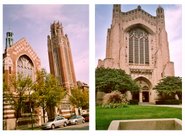
CÓRDOBA, Spain — The great mosque of Córdoba was begun by the Muslim caliphs in the eighth century, its forest of pillars and red-and-white striped arches meant to convey a powerful sense of the infinite. With the Christian reconquest of Spain in the 13th century, it was consecrated as a cathedral.

Today, signs throughout this whitewashed Andalusian city refer to the monument, a Unesco World Heritage site, as the “mosque-cathedral” of Córdoba. But that terminology is now in question. Last month, the bishop of Córdoba began a provocative appeal for the city to stop referring to the monument as a mosque so as not to “confuse” visitors.

For now, the matter is largely semantic because the mayor says the city will not change its signs. But the debate goes far beyond signs. It is the latest chapter in the rich history of the most emblematic monument in Christian-Muslim relations in Europe — and a tussle over the legacy of “Al Andalus,” when part of Spain, under the Muslim caliphs, was a place of complex coexistence among Muslims, Christians and Jews.

The debate takes on greater weight ahead of Pope Benedict XVI’s planned visit this weekend to Spain, which he has identified as an important battlefield in his struggle to shore up Christian belief in an increasingly secular — and implicitly Muslim — Europe.

The polemic in Córdoba began in mid-October, when Bishop Demetrio Fernández published an opinion article in ABC, a Spanish center-right daily newspaper.

“There’s no problem saying that the Muslim caliphs built this temple to God,” the bishop wrote. “But it is completely inappropriate to call it a mosque today because it has not been one for centuries, and to call it a mosque confuses visitors.”

“In the same way, it would be inappropriate to call the current mosque of Damascus the Basilica of St. John or to expect that it could be both a place of Muslim and Christian worship,” Bishop Fernández added, referring to the Syrian site where an Umayyad mosque was built in the eighth century above a fourth-century church said to contain the remains of John the Baptist.

The Córdoba monument — one of the true architectural wonders of the world, with its rows of pillars that both disorient and overpower — drew 1.1 million visitors in 2009, most of them tourists, not worshipers. But diocesan officials are upset that some Muslims have tried to pray there, even though it is a consecrated cathedral.

“Every time some Islamic fundamentalist, in a video on Al Jazeera or other channels, calls for the re-conquest of Al Andalus, the old Muslim dominion, people show up here calling for the use of the cathedral as a place of Islamic worship,” said the Rev. Manuel Montilla Caballero, who oversees the diocese’s nighttime tours of the monument, which use dramatic lighting to showcase the splendid architecture.

Today, the legacy of Al Andalus is highly contested. While Osama bin Laden and other radicals have called repeatedly for the return of Al Andalus to Muslim hands — that is, for the Islamic reconquest of Spain and implicitly Europe — others look to Al Andalus as an almost utopian era of peaceful coexistence among Christians, Muslims and Jews.

The city also has a rich Jewish history. Maimonides, the 12th-century Jewish polymath philosopher, was born in Córdoba, in a modest white house in the Judería, now a tourist area where the local Jewish population lived before Ferdinand and Isabella expelled the Jews from the Iberian Peninsula in 1492.

In the following century, when Spain’s Catholic rulers took to destroying Muslim and Jewish places of worship, the Hapsburg emperor Charles V is said to have been so captivated by the beauty of the Córdoba monument that he ordered its preservation.

“The Córdoba monument is a lesson in universalism, in how cultures and religions can meet and co-exist,” said Isabel Romero, the spokeswoman for Córdoba’s local Islamic association. Much to the diocese’s displeasure, the group wants the diocese to create a space in the cathedral for Muslim worship. “It would be an exemplary gesture,” Ms. Romero said.

In another complex twist, indicative of the historical ironies at work in today’s Spain, Ms. Romero is a Catholic convert to Islam — as are 300,000 out of Spain’s 2.2 million Muslims.

This week, a judge in Córdoba charged eight Austrian Muslims with disturbing the peace when they entered the monument in small groups on Good Friday this year, began to pray loudly and scuffled with security guards and local police officers who tried to stop them.

Meanwhile, a group called the Association of Muslims of Córdoba, which represents others among the 2,500 Muslims in this city of more than 300,000 people, says it has no intention of seeking the right for its members to pray in the mosque-cathedral.

“No, no, no,” said Kamel Mekhelef, the secretary of the association, whose members pray in a mosque in Córdoba built in the 1940s by North African soldiers who fought for Franco. “To ask for shared worship is to fan the flames, to force the question and raise tensions,” Mr. Mekhelef added.

But he said that he and his group were vehemently opposed to the bishop’s suggestion of removing the word “mosque” from local signs.

“It’s a tendency that I feel across Spain, a certain inclination to want to cancel anything related to Islamic Spanish history,” he said.

Local officials say they have no intention of changing the signs. “The bishop’s statement creates an unnecessary and useless polemic,” said the mayor of Córdoba, Andrés Ocaña, from the United Left party.

“It has no support among people, and obviously not among politicians, not even from the Popular Party,” he added, referring to the center-right opposition.

A spokesman for the diocese, Juan José Jiménez Güeto, said the bishop declined to elaborate beyond his published remarks.

On a recent afternoon, visitors to the monument, standing beneath the rows of orange trees and clever irrigation canals in its courtyard, appeared split. “It’s a cathedral and should be called a cathedral,” said Daniel Ramírez, who was visiting from Seville. “It’s not a question of terms; it’s a question of our culture.”

His friend Celestino González from Málaga disagreed. “It’s a mosque,” Mr. González said, pointing to the Islamic architecture. “I’m not practicing, and I don’t see any problem in combining the two names. For me it’s the same thing.”

As Conchi Bello stood in the doorway to her house nearby, she said the debate was purely academic. “For us, for everyone in Córdoba, it’s normal to give tourists directions to the mosque,” Ms. Bello said. “We’re not offended. On the contrary, it’s a nice example of the history of our land.”

The Sata Snake Spell

It wasn't just the ancient Egyptians that revered the snake/serpent as a symbol of regeneration and rebirth. This article leaves out quite a lot regarding why the snake is so important in iconograpy of eternal life but it is okay, as far as it goes.  (For a general overview of serpent symbolism in multiple cultures, see Wikipedia Serpent-Symbolism).

From the guardian.co.uk
The magic of the mummies
The Egyptian Book of the Dead contains a spell that turns the speaker into a snake
Jonathan Jones guardian.co.uk, Wednesday 3 November 2010 20.00 GMT

I am the Sata-snake, long of years, who sleeps and is reborn each day. I am the Sata-snake, dwelling in the limits of the earth. I sleep and am reborn, renewed and rejuvenated each day."

This is a translation of a spell (right) from the Egyptian Book of the Dead, on display at the British Museum, which enables the speaker to change into a snake. It may not read like a spell – eye of bat, skin of toad – but it was expected to have a magical effect and to be recited by a mummy – the dead person in the tomb.

Why a snake? Well, if you wanted to travel after death through the Western Lands, over hill and through river, a serpent's body was ideal. Also, the Sata-snake was thought to be reborn in an endless cycle mirroring the dream of eternal life.

The spell is shorter in English; hieroglyphs, says John H Taylor, curator of the exhibition, include phonetic signs and ideograms, and any word is likely to mix the two. But every symbol has magic in it. Images and words combine to give the mummy power, as The Book of the Dead puts it, to "go forth by day".
********************************************************
The sacred barque upon which the deceased braves the obstacles of the after-life to reach the
other side of the sky and achieve the realm of the Imperishable stars, in Hour 10 symbolically
takes the form of Mehen, the Enveloper, ancient protector of Pharaoh, as the deceased
(identified with Pharaoh) is assuming a new form as Horus hovers overhead.  Notice
that Mehen as the sacred barque wears the crowns of Upper and Lower Egypt.
The Tenth Hour

A change of direction. We turn south to the luminous, solar region of Helipotis. Af, purified by the fire and water, becomes the unborn Kepri. The snake, Mehen, entwines itself around this body, which is in the process of being reborn. A falcon hovers above the boat. The cynocephalus of Thot recognize the god and present the Oudjats to him. The limpid waters are split where those who have already bathed in the light of the east peacefully frolic.

DNA Contamination Leads to Wrong Conclusion

Fortunately, someone figured out what had happened --

Pompeii’s Mystery Horse Is a Donkey
November 3rd, 2010, 15:47 GMT| By Smaranda Biliuti

Indeed, the identity of the strange breed of 'horse' that has been discovered in 2004, at Pompeii, has been cleared out by a Cambridge University researcher, who realized it was actually a donkey.

Back in 2004, when academics unearthed skeletons found at a house in the ancient Roman town that was covered in ashes in 79 AD, they thought it belonged to an extinct breed of horse.

The mistake was made at the DNA analysis, and Susan Gurney – from the University's Institute of Continuing Education, working with Dr Peter Forster on horse genetics at the University of Cambridge, realized the mistake when she revisited the study.

What happened really was that there seems to have been a mix-up in the lab, which led to horse DNA being combined with donkey DNA, creating an artificial hybrid that actually never existed.

Six years ago, the skeletons of equids having belonged to a rich Roman household in Pompeii were analyzed.

There were found in the stables of a probably wealthy politician, and all five of them were very well preserved by the volcanic ash that covered Pompeii and Herculaneum, when Mount Vesuvius erupted.

The team then analyzed the mitochondrial DNA sequences (mtDNA) of each of the horses, and found that one of them had a mysterious type of DNA, that was no longer found today, probably an
unknown breed of horse, which had disappeared.

Luckily, Susan Gurney examined the research and found that there was an accidental combination of a donkey mDNA sequence with that of a horse.

She explained in her journal article that the first 177 nucleotides matched existing patterns of donkey, and the next 193 nucleotides matched those of an existing breed of horse.

“Looking at the research with hindsight, it's possible to recognize two separate strands of horse and donkey DNA,” she said.

"In addition, the horse DNA that appears to have been inadvertently mixed in with the donkey's genetic information is the same type as that found in another Herculaneum horse, which might be the source of the mistake.”

This research could still have its importance, because apparently the DNA of this newly identified donkey finds its closest match with the DNA of domestic donkeys related to the Somali wild ass that lives in Italy today.

This might be evidence that the 'Somali' ass lineage dates back to at least Roman times, whereas in other European countries, asses are often descended from the Nubian lineage.

Susan Gurney wrote in the new issue of the Journal of Cellular Biochemistry.
Copyright © 2001-2010 Softpedia

I found this article extremely troubling.  How often do these kinds of "accidents" of cross-contamination in a lab testing DNA happen - and how often are they discovered? And, if discovered, how often is the "accident" publicized and the findings based on the "accident" retracted?  How much information is out there now that is WRONG - based on analysis from contaminated DNA? 

Chess Femme News!

The number 3 rated female player in the world, GM Hou Yifan of China, will play a match against former world chess champion GM Anatoly Karpov in China beginning November 6-11, 2010.  News from Susan Polgar's chess blog.  This will be interesting, but I'd rather see Hou mixing it up with bigger fish in open tournaments.  She is not living up to her potential by playing in women-only events and glamour events like this one.  I don't know if that is by choice or if the Chinese government wishes to keep her out of competition with the male stars it has been grooming.  Whatever the case, it's too bad to see such talent wasted.  She's not a prodigy any longer, now she's just another 2500-something rated female who can't hold her own against 2700 rated male players because she's not getting proper training and experience.

Kudos for the Jamaican Women's Chess Olympiad Team in The Jamaica Observer
Category honours for Ja's female chess team
SPORTS
Thursday, November 04, 2010
JAMAICA etched another fantastic chapter in its illustrious sporting history when the curtains came down on the 39th World Chess Olympiad in Khanty-Mansiysk, Siberia, Russia, on October 3, 2010.

The Jamaican women crowned their country and region in glory by becoming the first team from the English-speaking Caribbean to win a category in the 80-plus year history of the World Chess Olympiad.

Although largely inexperienced, with only captain, WFM Deborah Richards, having played at a Chess Olympiad before, the Jamaicans fought with pride and determination and improved with each round.

In the process, they recorded a Jamaican record 19 points and won category "E" (with approximately 20 countries) with some sterling performances, including victories against countries such as Nigeria, Yemen and Qatar.

In addition to the landmark victory, Jamaica had the added bonuses of earning two new individual international chess titles when Ariel Barrett and Margoe Williams were each awarded the Woman Candidate Master title for their performances.

With the squad of players growing stronger with coaching and participation in local and international events, even greater things should be in store for the future, especially at the 40th World Chess Olympiad scheduled for Istanbul, Turkey in 2012.

WFM Deborah Richards made the news again after top female finish in an open tournament in Jamaica, saw this at Susan Polgar's chess blog:
Super Rowe reclaims Jamaica Chess Open title

Saturday, November 06, 2010
Playing "chess" with wild African elephants --
By Kyle VanHemert on November 6, 2010 at 6:20 AM
Photographer Bob Poole talks about filming wild elephants as part of the "Great Migrations" series for National Geographic. 

Elephant in carved black stone, about 7th c, Persia,
which might be a Chess piece. Metropolitan Museum of Art,
New York. Jean-Louis Cazeaux's chess history website
See also First Persian and Arab chessmen, same site.
Elephants were originally part of chess as far as we can determine from written history, which doesn't take us back farther than the mid-500s CE in ancient Persian (Iran).  The Persians said they got chess (chatrang) from the Indians of Hind (today, southwest Pakistan region) but they also wrote that they invented Nard (backgammon) in response to chess and that their Nard was a superior game (ahem).  This is clearly wrong since there are historical records that Nard was being played in the 200s CE in China, where it had been introduced by Persian merchants traveling along the Silk Road. 

Some scholars argue that the name for Chinese chess - Xiang qi - is "elephant game" -- not only because original game pieces may have been carved from ivory but also because the "xiang" -- elephant, is also a phonome for general, one of the pieces in the game  Whatever the case, elephants herds are led by the oldest female and are definitely a matriarchal society; so, in a way, elephants could be considered honorary chess femmes from olden times :) 

“The reason why we’re working on foot with those elephants is because they don’t tolerate vehicles. They’re very wild elephants; they’re not like the elephants you’d see on safari to Kenya or Tanzania or South Africa or wherever. These elephants really aren’t visited by tourists and they don’t tolerate cars whatsoever. That means that you have to film without the elephants ever knowing you’re there. But because we wanted to tell these intimate stories I had to get really close, and you need a lot of experience to be able to do that. You need to understand elephant behavior; you need to understand what their intentions are.”
“You anticipate where elephants are going, you wait for them to show up, then you position yourself long before they can have a chance of seeing you using the wind in your favour, and then as they come closer you sort of do play that chess game where you think, “alright, I still have time to move without them seeing me, but if I wait any longer it might be too late.”

So depending on what the shot is, you always have this decision to make which is kind of critical. But the scary thing is that often you’re in the middle of something really, really good and you don’t want to move; you don’t want to break the shot. And the elephants can move very fast, and suddenly you’re at this point of no return. You’re at this point now where if you move they’re gonna see you.

There’s a lot of times when you’re not really touching the camera anymore because you’re trembling, your heart is pounding so hard. They’re incredibly dangerous.”

If it's January a chess fans thinks of Wijk aan Zee. This year, January 14-30, 2011.  In the depths of winter, to me this chess tournament is a harbinger of spring, and looking forward to it every year gets me through the worst part of winter, when the days are shortest and the coldest weather is yet to come!   It used to be called Corus, now it's owned by Tata (of the great Tata family from India, they seem to own a piece of everything these days) and new money is funding this venerable tournament.  No chess femmes will be playing in the A or B Groups, but two will be playing in Group C:  GM Katerina Lahno (UKR 2539) and IM Tania Sachdev (IND 2382).  Further information available at The Week in Chess.

Saturday, November 6, 2010

Crossroads and The Key of Solomon

From Barbara G. Walker's The Women's Encyclopedia of Myths and Secrets:

Crossroads
In the Greco-Roman world, crossroads were sacred to the elder Diana under the name of Hecate Trevia (Hecate of the Three Ways), mother of the Lares compitales, "spirits of the crossroads."  Travelers made offerings to the Goddess' three-faced images, and regular festivals called Compitalia were celebrated at her roadside shrines.(1)

Four-way crossroads were sometimes dedicated to Hermes, whose ithyphallic herms stood beside them until replaced by Christians' roadside crosses.  However, the Christian sign of the cross was copied from Hermes' cult and traced his sacred numeral 4 on the worshipper's head and breast.  Hermetic crosses were left at the crossroads of 10th-century Ireland and simply re-interpreted as Christian symbols, though they plainly displayed the twin serpents of the pagan caduceus, another sign of the older deity.(2)

Cross, herm, and caduceus merged in northern symbolism with the gallows tree of Odin/Wotan, "God of the Hanged," which led to the Christian custom of erecting a gallows at crossroads as well as a crucifix. The god on the gallows once played the same role as Jesus on the cross: a dying-god image rendered the crossroads numimous.  Pre-Christian Europeans held waymeets, or moots, at crossroads to invoke their deities' attention to the proceedings; hence a moot point used to be one to be decided at a meet.  The Goddess as Mother Earth, dispenser of "natural law," and creatress of birth-and-death cycles, was always present where the dying god died - as the women long remembered.  the English monk Aelfric complained of female customs dedicating newborn infants to the ancient Mother.  Women would "go to the crossways and drag their children over the earth, and thereby give both themselves and the children to the Devil."(3)
The Key of Solomon
As the crossroads ceremonies and their deities became diabolized, the Goddess of the waymeet became the queen of witches, who still worked magic there.  The Key of Solomon* said crossroads were the best of all places for magical procedures "during the depth of silence of the night.(4)  Ghosts of the hanged, of the heathen, and of anicent oracles still haunted crossroads.  Bernard Ragner** said a spirit voice would foretell the future to anyone who went to a crossroad at the last hour of Christmas Eve.  As late as the 1920's, English farmers still believed witches' sabbats were held at crossroads.  Neocromantic superstitions were encouraged by the custom of burying criminals and suicides in unhallowed ground at crossroads; clergymen said anyone so buried would walk as a ghost.  Sometimes, such corpses were pinned down with a stake: "A stake was driven through them when deposited at the cross-roads in order to keep the ghost from wandering abroad,"(5)  Presumably, the ghost could be consulted in situ, just as spirits could be raised from their graves in the churchyard by any necromancer.

Thus Hermes and Hecate, who led the souls of the dead in antiquity, became dread spirits of "witchcraft" in the same places that they once benevolently ruled.

Notes:
(1)  Hyde, 137.
(2)  Campbell, M.I., 337.
(3)  Briffault 3, 58.
(4)  Wedeck 153.
(5)  Summers, V., 154-57.

* Key of Solomon
(Clavicule de Salomon)
A popular "Black Book" or magic book much used between the 11th and 13th centuries A.D.

** Bernard Ragner
Author of Legends and Customs of Christmas, 1925.

Invisible Critters in Action

Earlier today I tossed some bread outside for the birds and was surprised to see, about an hour later, that one piece in particular that had landed on the top of a railroad tie retaining wall had disappeared completely.  I had my suspicions - it wasn't the birds that made the bread disappear.

So, I decided to do a test.  Just before 12:30 p.m. I placed another slice of bread half-way on the top tie and half-way on the grass, fully exposed.  I watched it for a few moments but I saw no tell-tale movement of "tugs" of the bread from underneath.  I suspected that my close presence while placing the bread spooked the suspect bread thieves.  In this photo you can see the slice of bread resting half-way on the grass and half-way on the top of the railroad tie.  Should have got a close-up.

I went back to working indoors.  About 1:25 p.m. I checked again and saw the bread had been moved - quite a bit moved!  It was now fully off of the wall and on its way underneath the wall.  Even as I watched I could see tell-tale little "jerks" of the bread, signifying tiny critters underneath working on moving the bread.  Field mice!  There are several large 'holes" along the top edge of the retaining wall where I know they nest, and as long as they stay out of my house, it's live and let live.

I checked again at 1:35 p.m. and the bread had been pulled further into their lair beneath the top railroad tie.

At 1:43 p.m. the bread was now well on it's way to disappearing, and even as I watched further jerking movements of the bread attested to frantic action now that the mice sensed victory near at hand!

At 1:54 p.m. I noticed that the crust on the outer-most edge of the bread had been totally removed and even as I watched, there was a constant tugging of what remained of the visible crescent of bread , pulling it underneath the edge of the wood tie. 

The final check at 2:12 p.m., bread has disappeared.  Rustling of leaves and tiny movements signal mice still hard at work storing away what is left of the bread slice :)  Bon apetit! 

I was listening to the Wisconsin Badgers football game on the radio and the final minutes, where we capped a decisive victory over Purdue (yippee!) took my attention away from the mice.  Judging from their earlier progress, the mice probably already had the piece tucked away underneath the railroad tie by about 2:00 p.m. and were busy working on deconstruction and storage when I took this final photograph. 

The Expression of Gratitude

A very interesting column from the Sri Lanka Daily News Online - not about a chess champion, but about a chess champion's father.

Saturday, 6 November 2010
Susantha Karunaratne’s Animisa Lochana Poojawa
Malinda
The Morning Inspection

More than two millennia ago, an exceptional human being and according to some one endowed with the greatest mind ever, Siddhartha Gauthama, the Enlightened One, stood for a week in front of the tree Asathu. This was upon attaining Enlightenment. The Buddha, we are told, paid tribute, showed gratitude and taught lesson by this simple but significant act of gazing upon the tree that given him shade in the long moments of reflection that resulted in the fruition of Nirvanic comprehension. Hour after hour, day after day, for an entire week, the Buddha gazed upon the tree, without blinking once.

Tree. Inanimate. Symbolic. One might say it was unnecessary for someone who has vanquished his kleshas, but then again, it also indicates ‘teacher’ and exemplifies the virtue of humility.

Chess Champion
Gratitude is rare. We prefer to indulge ourselves by believing that achievements are self-wrought. I am thinking of gratitude and remembered the Buddha’s Sath Sathiya (the Seven Weeks post-Enlightenment) and especially the first week where the focus was on unwavering appreciation because of a man called Susantha Karunaratne.

I met Susantha because his seven years old daughter, Yathra, was representing Sri Lanka in the Girls Under Eight category at the World Youth Chess Championship. Yathra is the current Girls Under Eight Chess Champion of Sri Lanka. This doesn’t say much because at that age, it is more luck than anything else that sees someone win and another lose. It is more about the other person making a blunder than one’s chess skills. Still, ‘Champion’ does have market value and parents do market such things to get their children into better or at least more popular schools.

Yathra attends a primary school in Kurunegala. Susantha, like his wife, is an artist. He used to do some work in advertising, graphic design and printing, but had ‘retired’ recently because he, like his wife, wanted to pursue his passion, painting. They are not super wealthy and live frugal and simple lives, not necessarily out of poverty as out of choice.

Primary school
I assumed that the girl was attending a big-name school in Kurunegala. ‘Maliyadeva Balika?’ I asked the father. He said ‘no’ and explained.

‘It is possible to get her into Maliyadeva because of her achievements, but we thought this was wrong. She goes to a primary school in Kurunegala. It is a good school. The principal has done a lot of hard work to turn the school into what it is now. He has helped Yathra a lot.

He encouraged her and gave her a lot of recognition. The entire school knows her. It would be wrong to abandon this school for a big school now. It is a primary school. Once she finishes the fifth year we can try to put her into Maliyadeva. We are grateful for what this school has given to our daughter.’

The Karunaratnes live in Kalugamuwa, located between Narammala and Kurunegala. Yathra is a Grade three student at the SWRD Bandaranaike Model Primary School in Wehera, Kurunegala. According to Susantha, this was a school that had been on the verge of being shut down. It had been revived four years previously and much work had been put in to make it a school that parents consider sending their children to.

Greener pastures
Wijayananda Dharmasena, the principal of the school, I am sure, is old enough and wise enough to understand that people like to graze on greener pastures. I feel that at the back of his mind, he must have wondered how long young Yathra would remain in his school. He must be proud, though.

Susantha Karunaratne is a self-effacing man who is highly talented. He can paint. He writes poetry. He is soft-spoken.

He can crack a joke and he can laugh. He is simplicity personified. He is not at all interested in changing the world to fit his dimensions of perfection.

He is not a teacher. He is just himself.

Susantha and his wife, I feel, gaze upon this school in a manner that is not too dissimilar from the Buddha’s gaze on the tree Ajapal. There’s gratitude.

Humility. Example. A lesson. Some would say, bodhisatva gunaya or exemplifying the virtues of a to-be Buddha. Susantha would laugh and say ‘you are kind and good-hearted’ to such a person.

2010 Women's World Chess Championship

Here is the list of the 64 players - after reviewing the regulations, it appears these are based on events from 2008 and 2009, so I must keep that in mind when I do future bitching about the field of players:


Tnmt RankNameCountryTitleW_titleRating
1Kosteniuk, AlexandraRUSgwg2507
2Koneru, HumpyINDgwg2600
3Hou, YifanCHNgwg2591
4Kosintseva, TatianaRUSgwg2581
5Dzagnidze, NanaGEOgwg2551
6Stefanova, AntoanetaBULg2548
7Muzychuk, AnnaSLOmwg2530
8Cramling, PiaSWEg2526
9Harika, DronavalliINDmwg2525
10Ju, WenjunCHNwgwg2524
11Lahno, KaterynaUKRgwg2522
12Cmilyte, ViktorijaLTUgwg2514
13Chiburdanidze, MaiaGEOgwm2502
14Socko, MonikaPOLgwg2495
15Sebag, MarieFRAgwg2494
16Ruan, LufeiCHNwgwg2480
17Mkrtchian, LilitARMmwg2479
18Zatonskih, AnnaUSAmwg2478
19Zhu, ChenQATg2477
20Zhao, XueCHNgwg2474
21Paehtz, ElisabethGERmwg2474
22Hoang Thanh TrangHUNgwg2473
23Pogonina, NatalijaRUSwgwg2472
24Danielian, ElinaARMgwg2466
25Muzychuk, MariyaUKRmwg2462
26Shen, YangCHNwgwg2461
27Ushenina, AnnaUKRmwg2460
28Skripchenko, AlmiraFRAmwg2460
29Dembo, YelenaGREmwg2454
30Zhukova, NataliaUKRgwg2447
31Rajlich, IwetaPOLmwg2446
32Turova, IrinaRUSmwg2439
33Khukhashvili, SopikoGEOmwg2430
34Houska, JovankaENGmwg2421
35Romanko, MarinaRUSmwg2414
36Munguntuul, BatkhuyagMGLmwg2409
37Foisor, Cristina-AdelaROUmwg2403
38Huang, QianCHNwgwg2402
39Ovod, EvgenijaRUSmwg2387
40Cori T., DeysiPERwgwg2384
41Shadrina, TatianaRUSwgwg2384
42Kovanova, BairaRUSwgwg2380
43Ding, YixinCHNwgwg2370
44Zawadzka, JolantaPOLwgwg2368
45Fierro Baquero, Martha L.ECUmwg2363
46Muminova, NafisaUZBwmwm2360
47Lomineishvili, MaiaGEOmwg2347
48Zhang, XiaowenCHNwgwg2339
49Baginskaite, CamillaUSAwgwg2336
50Vasilevich, IrinaRUSmwg2333
51Soumya, SwaminathanINDwgwg2332
52Meenakshi SubbaramanINDwgwg2328
53Demina, JuliaRUSwgwg2323
54Ozturk, KubraTURwmwm2264
55Caoili, ArianneAUSwmwm2242
56Nadig, KruttikaINDwgwg2230
57Yildiz, Betul CemreTURwmwm2225
58Zuriel, MarisaARGwmwm2208
59Aliaga Fernandez, Ingrid YPERwfwf2154
60Kagramanov, DinaCANwmwm2101
61Mona, KhaledEGYwgwg2093
62Heredia Serrano, CarlaECUwmwm2087
63Greeff, MelissaRSAwgwg2082
64Mezioud, AminaALGwmwm2029


I will be rooting for USA's IM Anna Zatonskih who, I believe, qualified by virtue of being the 2009 U.S. Women's Chess Champion.  FIDE is always behind the curve, never ahead of it.  The players for the 2010 title are not the current best female players in the world.

Aside from the fact that the knock-out format has been totally discredited as a way to determine a chess champion and in the Men's Cycle - oh, excuse me, the Open Cycle - it has not been used for years - this will be a nice way for players such as Amina Mezioud of Algeria to take home a check for playing one game of chess - minus FIDE's 20% cut, of course.

Here is the prize structure:

3. 9. Prizes for the Women's World Championship
3. 9. 1. Prize list
1st round 32 losers x 3.750 = 120.000
2nd round 16 losers x 5.500 = 88.000
3rd round 8 losers x 8.000 = 64.000
4th round 4 losers x 12.000 = 48.000
5th round 2 losers x 20.000 = 40.000
6th round 1 loser x 30.000 = 30.000
Women's World Champion = 60.000

TOTAL: 450.000 USD
3. 9. 2. A payment of 20% from the above prize fund shall be made to FI?DE.

If you are interested, you can find all the FIDE rules and regulations governing the Women's World Chess Championship here - for as long as the link lasts (it's FIDE, it won't last very long).   Excerpted portions:

3. Women's World Chess Championship 2010
3. 1. Qualifiers. There are 64 qualifiers:
  1. The Women's World Champion, runner-up and semi-finalists of the previous Women's World Championship (4 players)
  2. The World Junior Girl Champions U-20 of 2008 & 2009. (2 players)
  3. The five best rated players from the average of the FIDE rating lists of July 2008 and January 2009 (5 players).
  4. Fifty-one qualifiers from the Women's Continental Championships and Zones (51 players).
  5. Two nominees of the FIDE President (2 players).
3. 1. 1. Replacements. Women's World Champion, semi-finalists of the previous women's world championship, World Junior Girl U-20 Champions and rated players can be replaced only from the rating list. Continental and Zonal qualifiers will be replaced from their respective events, except that in the Zonal Tournament the replacement must have scored at least 50% of the maximum possible score. Otherwise the place passes to the Continental Championship.

3. 1. 2. For the purpose of deciding the 5 rated players-qualifiers, as well as any replacements, the average from the following lists will be used: rating lists of July 2008 and January 2009 divided by 2. In case of equality two decimals will be taken into consideration. If the numbers are still equal then the number of games from the two periods shall be decisive. That means the player with the greater number of games shall qualify. If the numbers are still equal then the January 2008 list shall be decisive. If the Elo in this list is still the same, the player with the greater number of games in this list will qualify.

3. 1. 3. Players who appear in the inactive list in both July 2008 and January 2009 lists will not be able to qualify as a rated player. If the player is inactive in one list but appears in the other, then the rating that is published shall be taken as the average.

3. 1. 4. The list of qualified players and the reserves will be published on the FIDE web site.

3. 2. Tournament format

3. 2. 1 There shall be five (5) rounds of matches, comprising two (2) games per round, with the winners progressing to the next round. The 6th round (final round) shall be played over four (4) games and the winner will be declared Women's World Champion.

Round 1: there shall be 64 players
Round 2: there shall be 32 players
Round 3: there shall be 16 players
Round 4: there shall be 8 players
Round 5: there shall be 4 players
Round 6: there shall be 2 players
3. 2. 2. Schedule of the Women's World Championship

Opening Ceremony/Players` meeting 1 day
Round 1: 2 days play 2 days
+ tiebreaks 1 day
Round 2: 2 days play 2 days
+ tiebreaks 1 day
Round 3: 2 days play 2 days
+ tiebreaks 1 day
Round 4: 2 days play 2 days
+ tiebreaks 1 day
Round 5: 2 days play 2 days
+ tiebreaks 1 day
Free Day 1 day free 1 day
Round 6: 4 days play 4 days
+ tiebreaks 1 day
Closing Ceremony 1 day
TOTAL 23 days

Yeah, it's in a Muslim country and it's over Christmas.  Sucks big time.  FIDE has such sensibilities...
Related Posts Plugin for WordPress, Blogger...