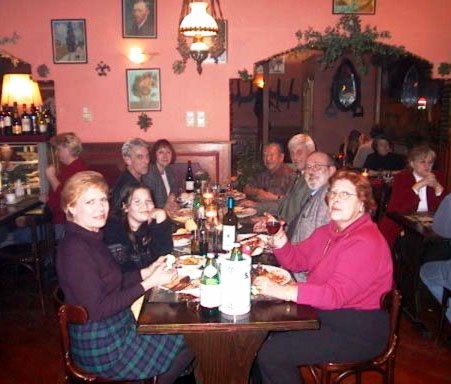
A record number of chess femmes participated in the Hales Corners Chess Challenge XVI today, hosted by my adopted chess Club, Southwest Chess Club, in Milwaukee, Wisconsin.
I am working off of information provided at the Southwest Chess Club's blog. I'm not sure of the names of all of the chess femmes, only that four played in the Open and nine played in the Reserve. The prior record was eleven chess femmes. I am very happy with this great turnout.
Here are the rankings of the Open and Reserve sections as reported by the USCF -- note: as Tom Fogec explained to me tonight (October 21st) the highest rated players who finish with the same score are listed from highest ELO to lower, without regard to tie breaks that determine actual finish position! So, in the case of tie scores, the person you see listed as number 1 isn't necessarily the winner. I didn't know this, oops!
OPEN:
No. Name St Rate Rd 1 Rd 2 Rd 3 Rd 4
Score
1. Friedel, Joshua Ed (1)........ NH 2566 W22 W30 W5
D2 3.5
2. Boor, Carl Brandon (2)........ IL 2361 W47 W11 W10
D1 3.5
3. Williams, William (4)......... WI 2223 W7 D12 W15
W14 3.5
4. Becker, Allen J (8)........... WI 2064 W32 D14 W33
W8 3.5
7. Ulrich, Rachel J (17)......... WI 1892 L3 W40 W35 W29 3.0 (clear top chess femme finisher)
16. Rajendra, Anupama (24)........ WI 1820 L12 W31 W42 D9 2.5
39. Huang, Alena (39)............. WI 1517 W26 L6 L23 L24 1.0
41. Pahl, Sandra R (43)........... WI 1450 L19 L26 L24 W46 1.0
Rachel Ulrich is the real deal! She won three of four and wins a Goddesschess cash prize of $120.00, in addition to a modest gift bag and free entry to Hales Corners Challenge XVII, should she choose to enter.
Anupama Rajendra won two games and drew one, for a total Goddesschess cash prize of $100.00.
Alena Huang and Sandra Pahl each won a game, good for $40.00 cash each from Goddesschess.
RESERVE:
No. Name St Rate 1 2 3 4
Score
1. Sydlewski, Dean (2)........... WI 1517 W9 W10 W17
D3 3.5
5. Saycocie, Vanisa (10)......... WI 1283 L2 W20 W19 W15 3.0 (Goddesschess prize $60)
6. Ulrich, Anne E (12)........... WI 1242 D3 W25 W24 D2 3.0 (Goddesschess prize $60)
9. Huang, Sabrina (11)........... WI 1249 L1 W21 W29 D11 2.5 (Goddesschess prize $50)
20. Pandey, Ritika (26)........... WI 877 W33 L5 W16 L7 2.0 (Goddesschess prize $40)
22. Wanek, Ellen Ann (28)......... WI 838 L13 L33 W35 W28
2.0 (Gpoddesschess prize $40)
25. Bepar, Naisha (16)............ WI 1082 -H- L6 L8 W34 1.5 (Goddesschess prize $20)
26. Vootkur, Manisha (19)......... WI 1028 L16 L7 W32 -U- 1.0 (Goddesschess prize $20)
30. Pandey, Divya (30)............ WI 746 L28 W35 L7 L18 1.0 (Goddesschess prize $20)
34. Foat, Patricia J (35)......... WI 306 L19 L31 -B- L25 1.0 (Goddesschess prize $20)
Updated October 21, 2012:
I added the names of Divya Pandey and Ritika Pandey to the Reserve chess femmes, I did not have them on the list last night.
Congratulations to all of the ladies. On tie-breaks, Anne Ulrich, whom I met a few Challenges ago, is the recipient of a Goddesschess gift bag and receives free entry to the next Hales Corners Challenge should she choose to enter, in addition to her cash prize.
As you can see, the ladies did very well! ALL of them won prizes, I couldn't be more pleased. For the first time ever, we'll have to put MORE into our prize pot!!! Woo woo!
I hope this is the an indication that the future of chess femmes participating in the Hales Corners Challenges will just keep growing and growing and growing.
I understand photographs from Challenge XVI are on the way. That means I've got to figure out how to publish them here. Evidently, all of a sudden I ran up against a LIMIT on images I had no idea existed before a few days ago. So now Google wants money from me for a supposedly FREE blog, and if I do not pay up, I cannot post any further images at this blog.
My choices are limited. I can either start a new blog or pay the extortion to add more images to this blog and continue it forward. Of course, the extortion could increase at any time, as extortionists tend to do.
So, I'm not sure what I'm going to do at the present time.


MEXICO CITY (AP) — Mexican archaeologists say they have determined that the ancient Mayas built watchtower-style structures atop the ceremonial ball court at the temples of Chichen Itza to observe the equinoxes and solstices, and they said Friday that the discovery adds to understanding of the many layers of ritual significance that the ball game had for the culture.
The structures sit atop the low walls of the court, where the Mayas played a game that consisted, as far as experts can tell, of knocking a heavy, latex ball with their elbows, knees or hips, through a stone ring set in the walls.
The bases of the structures — essentially, look-out boxes set atop the walls, each one with a small slit running through it —had been detected before, but archaeologist hadn't been sure what they were used for. Since the ball court was built around 864 A.D., the boxes and the stairs leading to them had crumbled.
The government's National Institute of Anthropology and History announced Thursday that the boxes had been 90-percent reconstructed, based on the stone footings that remained. Late last year and early this year, a team led by archaeologist Jose Huchim confirmed that the sun shone through the slit-like openings when the setting sun touches the horizon at the winter solstice.
The sun's rays also formed a diagonal pattern at the equinox in the slit-like openings, which are about tall enough to stand up in.
Huchim said he knew of no similar structures at other Mayan ball courts. "This is the place where we're finding this type of pasaje (structure)," Huchim said. He said a stone structure atop a ball court at the nearby ruin site of Uxmal appeared to have been used as a sort of spectators' stand for elite audiences.
Huchim said the slits may have been used to determine when ball matches were played, given that the ball itself, as it was knocked through the air by the players, may have been seen as imitating the sun's arc as it passed through the sky.
It may have also been used "like a calendar, to mark important periods for agriculture," like planting the core crop of corn.
Finally, Huchim noted that old descriptions of the ball courts sometimes depicted people atop the walls, and that they may have been acting as umpires in the game.
Huchim said Thursday that stairways to the structures are being restored so visitors can observe the phenomenon.
Boston University archaeologist Francisco Estrada-Belli, who was not involved in the project, said the solar sighting lines were part of "part of Maya architecture and cosmology."
"The fact that the sun rise can be observed behind a structure should be understood in that sense, as reverence to the sun or other star, not necessarily as an observatory in the technical sense," Estrada-Belli said. The orientation of the structures "emphasized the sacrality of the ritual space."
Copyright 2012 The Associated Press.