Showing posts with label Chinese chess. Show all posts

Friday, November 4, 2011

Asian Chinese Chess Championships

Vietnam man wins Asian Chinese chess champstuoi tre
Updated : Fri, November 4, 2011,6:31 PM (GMT+0700)

Two Vietnamese men Nguyen Hoang Lam and Bui Duong Tran won the gold and silver medals at the 15th Asian Xiangqi (Chinese chess) Individual Championship that wrapped up today in Macau.

In the women’s division, Ngo Lan Huong from Vietnam clinched a silver medal behind Chen LiChun of China.

Lam becomes the first Vietnamese player crowning the title at the Asian arena. In 1998, Nguyen Thanh Bao had won a gold medal for U-18 group of the Asian Xiangqi Championship. Ngo Lan Huong won a gold at the 2007 Asian Indoor Games in Macau.

The 15th edition that started from Nov.1 drew the participation of 30 players including ten women from 16 nations.

Winners List
Men's IndividualWomen's Individual
ChampionNguyen Hoang Lam (VIE)Ngo Lan Huong (VIE)
SecondBui Duong Tran (VIE)Chen LiChun (CHN)
ThirdMa Chung-Wei (TPE)Cheng Ming Chuo (M.E)
FourthChong Heung Ming (PHI)
FifthWang YueFei (CHN)
SixthLü Qin (CHN)

Saturday, April 30, 2011

Xiang Qi (Chinese chess) Star Looking for a few good apprentices!

Chinese chess king looks for an apprentice
Hu Ronghua, king of Chinese chess, takes his cue from Donald Trump, and launches a reality TV show
By Frances Wang 20 April, 2011

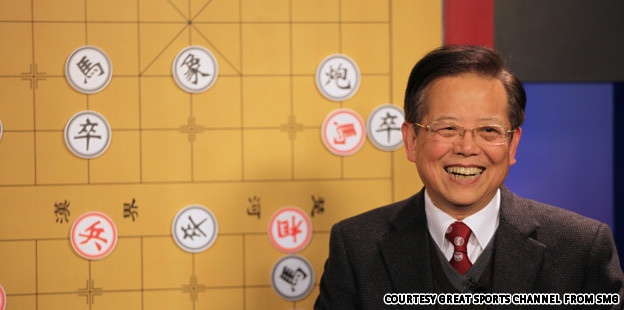
Xiang qi master Hu Ronghua
It seems like everywhere you look in Shanghai you see people playing “Angry Birds” on their smart phones or tablets. So it’s even more impressive that the visually simple Chinese chess is making a comeback with Chinese youth, thanks to a new reality TV show, and Chinese chess legend Hu Ronghua (胡荣华).
Hu, a master of Chinese chess, started his own show on Hi Sports Channel called “Let’s play Chess together” (“弈棋耍大牌”), calling on Chinese chess fans to audition as his apprentice.

At age 66, Hu, a Shanghai resident, is one of the most brilliant chess players in China and is using this show to appeal to Chinese youth who have slowly turned away from the sport.

Chinese Chess, just a memory?
In the 1980s and 1990s, Chinese chess games drew crowds of spectators in Shanghai's streets, parks and lanes. The interested crowds were a mix of young and old, all captivated by local matches of this traditional game.

A single well-played move could elicit cheers from a crowd. Yet such a long-lived game has lost popularity as Chinese youth turns to online games.

Today there are only a few seniors playing Chinese chess while chatting the day away in local parks and neighborhood gardens, and rarely do crowds gather like they used to.

“Fewer and fewer people are playing Chinese chess compared to a decade ago,” says Hu.

“However, for those who loved to play chess since childhood, this hobby is for ever. Chess is like this, once a love, always a love.”

Hu Ronghua takes an apprentice
To support this national pastime, Hi Sports channel decided to work with Hu on the Chinese chess program “Let’s Play Chess,” which started broadcasting its first season, which runs Monday to Friday 6 p.m. to 7 p.m. for eight weeks, in early March.

“Let’s Play Chess” has a simple premise: it invites people who want to play Chinese chess to face off during each show. Those who show the most promise can earn a coveted apprentice spot. The ultimate winner will go up against Hu himself.

“I don’t want too many people [as apprentices], just maybe five kids, ideally aged between 10 and 14 years old,” says Hu.

As the top name in Chinese chess circles, Hu is never short of potential apprentices, but he says doing a national TV show opens the pool of potential apprentices, instead of only looking at Shanghaining.

“China is too big, it’s too hard to find a non-local kid with potential without using television,” says Hu. “If I hire them through the show, people will gather from across the country. This way it’s more fair.”

In addition to getting Hu a few dedicated students, the TV show he says also serves another purpose: a recruiting call for the Shanghai Chinese chess team which is also looking to add more players to its ranks.

Charm of chess
For ordinary people, Chinese chess may appear to be simple game of black versus red, but Hu explains that there’s much more than that going on, allowing it to compete with even today’s modern games.

“Chinese chess can cultivate one’s mentality," says Hu. “The small chessboard is filled with life’s ups and downs. Seemingly winnable chess might end up in total loss, while losing games might have chances to win back.”

Playing, says Hu, helps people develop skill and patience.

Master Hu says some of the happiest moments in his life came when he thought of a move that nobody else had ever thought of, showing that his years of dedication and patience are paying off.

“That is a top-notch happiness,” he says.

When asked about what criteria he’ll be looking for in potential apprentices, Hu says he’s looking for the people the game has chosen, similar to himself.

“There’s no entry level for Chinese chess, it’s fate,” he says. “If destiny calls, you will love it.”

Chinese chess advancements
Although Hu’s TV search for new talent is promising, it brings up the question of the future of Chinese chess as local youth look elsewhere for entertainment.

Hu points out that while new technology has pushed the game into a corner, Chinese chess is making its way back, using technology to relaunch the game in China.

For instance, says Hu, if you type in “Chinese chess” in Apple’s app store, there are dozens of Chinese chess apps available, with Tencent QQ's version as one of the most popular, offering the game for both the iPhone and iPad.

Other tech firms like Winger Technology (affiliated with Shanda Interactive) are also coming out with their own mobile versions of the game.

“Mobile is helping develop future of Chinese chess,” says a spokesman from Winger Technology.

“We have launched special games on smart phones and tablets such as ‘Killers of the Three Kingdoms’ [a version of Chinese chess]. Other chess and card products designed for the mobile Internet are also in development.”

Even Hu’s TV show “Let’s Play Chess” has abandoned the traditional Chinese chessboard. Instead, it mainly uses digital boards.

With all of these advances, Hu seems assured that more young people will discover Chinese chess, in both its traditional or modern form, revitalizing the game in China.

This article was translated by Sarah Chen. Click to see the original article in Chinese.

Saturday, March 21, 2009

Giant Chinese Chess

I found this beautiful photograph in an article about Nantou, Taiwan (central part of the country).

Friday, June 22, 2007

Old Chinese Chess Commentary


Hola darlings! Whew - it's Friday night (finally), and I'm feeling all right! Hot as hell here, and the weekend is jam packed with yard work, an investment club meeting (remind me to tell you about the investment club some time), and a Sunday afternoon at a St. Martin's Fair - dodging thunderstorms, of course!

I came across this information in an article the other day and thought it was interesting - I've never heard of the "book" it mentions and probably most westerners have not. It's not quite clear from the article, but I assume it is about Chinese chess (xiang qi). As far as I can tell, all Chinese scholars think that the west got its chess from xiang qi via transmittal by Persian merchants, and most western scholars follow H.J.R. Murray's school of thought that chess was invented in India and travelled east to China along the Silk Road. Only a few brave voices from the west, such as Joseph Needham and Pavel Bidev, believed chess came out of China but, unfortunately, they're not around anymore to develop their theories further. I'm not aware of anyone else who has chosen to pick up the gauntlet, except perhaps Peter Banaczak, and I have not been able to get in touch with him for at least five years (he probably put me on a "do not receive list" - I can be a pest. Drat!) The last I know, Banaczak was working on his PhD, one of the few western chess historians who can actually read Chinese and has knowledge of ancient Chinese classics that mention a game that might very well be chess or a form of proto-chess.

It seems pretty obvious to me that the "standard history" of chess that we in the west accept as true is steeped in 19th century racism and few have bothered to "call" Murray's progeny on their implicit, unspoken assumptions of "western" cultural superiority. You know, the "Aryan invasion" and all that crap! There's a reason I call some of these people the chess Nazis. Ah, but that's an argument for another day, I don't feel like fighting tonight, I just want to soak my feet and have a glass of wine on the deck while the sun goes down.

The English translation of the article is somewhat quirky. This is the gist of it: a Qing Dynasty collection of chess games and - I think - chess problems - has been declared a "national folk treasure" by the Chinese government and now resides in - I think - a museum in Bejing. It's a bit unclear from the article, but it appears that only a portion of the actual games and/or problems has ever been published. It's also unclear whether what's being exhibited at the Bejing museum is just the published portion of the text, or the whole thing. So, without further adieux, here's the excerpted information from the article:

"The chess manual scripts collection, "the Deep Pool and Infinite Sea," has been cited as the "rarest and most valuable works" highly revered and esteemed among top Chinese chess game players for almost two centuries.

"These folk national gems have kept intact through centuries in spite of vicissitudes they have gone through from generation to generation. So people have taken interest in anecdotes about them and in particular titbits or sidelights of interest.

"The Qing Dynasty (Chinese) chess manual scripts represent a huge collection of the cream or quintessence of ancient chess games and well-known, knotty chess games collected and sorted out by author Chen Wenqian for 17 consecutive years, and he finally completed the copying in 1808. The entire works is divided into 16 volumes with a total of 371 famous chess games. But to date, there is one works only extant, as Chen was too poor and much in need to have it printed at that time.

"The collection of chess games emerged abruptly in 1933 after having had sunken into oblivion for over a century. Then, an ace (Chinese) chess game player in north China's Hebei province, Qian Mengwu, chanced on it but he failed to get it as its owner offered too higher a price that he could pay. Through the maneuvering of his friend, however, he succeeded to borrow it and got his chess pals to hurry through its copying overnight.

"About 30 years later, another chess star Liu Guobin on July 30, 1964 found the chess manual scripts collection with the introduction of an acquaintance at the China Bookstore. Then, he pawned a Swiss-made watch and bought the chess manual scripts with 150 yuan (some 20 dollars) he got from the mortgage. And, grand chess master Qian Mengwu confirmed it afterwards as the very works he had borrowed and had it copied with the help of his chess pals three decades earlier."
Related Posts Plugin for WordPress, Blogger...