Showing posts with label xiang qi. Show all posts

Saturday, September 12, 2015

Ancient Chinese Game of "Go" Alive and Well in Lincoln, Nebraska

Some game historians have speculated that chess may have originated from the game of Go (Chinese: Wei qi; Japanese: Igo), but I'm not convinced (Chinese chess is Xiang qi).  Still, Go is a venerable game played by millions all around the world today, which is more than can be said for many other ancient board games that we know of, such as another Chinese game, Liubo or "six sticks," and the ancient Egyptian games of  Mehen and Senet.

Article from The Daily Nebraskan

Local club meets weekly at Cultiva to play ancient board game

  • Nick Niendorf
  •  

Patrons at Cultiva are greeted by an intriguing sight every Saturday afternoon.  Entering the café yields a view of brooding, pensive combatants. Their moves are swift, but thoughtful and each of the games attract the undivided attention of those around the players.
This is board game that started in China well over 2,500 years ago has found a home in modern-day Lincoln.
“It is less like a war and more like a contest for territory,” said Grant Centauri, the Go club’s founder, when describing the game’s play style. “The end goal is to take over more space than your opponent.”

Saturday, December 17, 2011

Asian Women's Xiangi Champ Wins Silver in Mind Games

From Vietnam News (English)
Updated December, 17 2011 10:25:00

HA NOI — Asian xiangqi (Chinese chess) champion Ngo Lan Huong received a silver medal in the women's category at the SportAccord World Mind Games 2011 which ended in China yesterday.

Huong earned seven points after drawing with Australia's Liu Bi Jun and beating the US's Take Aki, three points fewer than the host nation's Jin Hai Ying. Liu Bi Jun, who stands behind Huong, earned four points. In this case, the first and second positions were finalised prior to the final round.

In the men's category, Vietnamese master Nguyen Hoang Lam lost his last two games to miss out on a medal. Chinese player Jiang Chuan secured his place as a champion.

International grandmaster Le Quang Liem did not make it to the medal round in blindfolded chess. During the tournament, he defeated Chinese Wang Yue and Cuban Dominguez Perez, drew with Russian Sergey Alexandrovich Karjakin and lost to Ukranian Rusland Olegovich Ponomariov. The Vietnamese master finished in 14th place out of 16 with 6.5 points in rapid chess and in 10th position out of 16 with six points in blitz chess.

With Huong's silver, the Vietnamese delegation stood at the 13th position. The host nation lead the medal tally with eight gold, two silver and one bronze. The US took the second place with four gold, one silver and four bronze while Russia palmed three gold, two silver and one bronze medals. — VNS

Friday, November 4, 2011

Asian Chinese Chess Championships

Vietnam man wins Asian Chinese chess champstuoi tre
Updated : Fri, November 4, 2011,6:31 PM (GMT+0700)

Two Vietnamese men Nguyen Hoang Lam and Bui Duong Tran won the gold and silver medals at the 15th Asian Xiangqi (Chinese chess) Individual Championship that wrapped up today in Macau.

In the women’s division, Ngo Lan Huong from Vietnam clinched a silver medal behind Chen LiChun of China.

Lam becomes the first Vietnamese player crowning the title at the Asian arena. In 1998, Nguyen Thanh Bao had won a gold medal for U-18 group of the Asian Xiangqi Championship. Ngo Lan Huong won a gold at the 2007 Asian Indoor Games in Macau.

The 15th edition that started from Nov.1 drew the participation of 30 players including ten women from 16 nations.

Winners List
Men's IndividualWomen's Individual
ChampionNguyen Hoang Lam (VIE)Ngo Lan Huong (VIE)
SecondBui Duong Tran (VIE)Chen LiChun (CHN)
ThirdMa Chung-Wei (TPE)Cheng Ming Chuo (M.E)
FourthChong Heung Ming (PHI)
FifthWang YueFei (CHN)
SixthLü Qin (CHN)

Sunday, October 16, 2011

The Tale of Truong Ba, Who Lived Twice

I was going through some old files on my ancient Systemax desktop last night and I found this article I had archived from 2002.  The website I orginally found the story at no longer exists, but the story is out on the internet

This may be the current home of the legend that I copied:  http://www.vietnamwebsite.net/myth/myth1.htm

It is a fascinating tale.  I cannot help but wonder what the basis of this kind of tale is - you know - people being brought back to life by shamans (for instance, Jesus, a Jewish shaman, was said to have performed at least two resurrections of the dead), "gods" or god-like figures.  That this particular tale is tied to chess [Chinese chess, xiang qi - which has sometimes been translated as star chess/game or celestial ches/game] is doubly fascinating to me, since the true lesson of chess is that of pawn promotion - achieving the transformation from mere mortal to an Imperishable Star by reaching the eighth rank!  Perhaps the moral of the story is only to be very careful what you wish for...

Chinese Chess
http://www.vn-style.com/mycollection/myths_legends/Hon_Truong_Ba.htm
Myths and Legends

Soul Move
Very long ago, there lived a young man named Truong Ba who was very good at Chinese chess. Truong Ba's fame as a chess player spread far and wide, throughout Vietnam and even China.

At that time, the Chinese chess champion was a man named Ky Nhu. When he heard of Truong Ba, Ky Nhu set off to Vietnam to challenge his rival to a game. They played two games, each of which ended in a draw. During the third game, Ky Nhu got into trouble. Seeing that his opponent was trapped, Truong Ba said haughtily: "Even the Chess Deity De Thich could not find a way out of my moves."

Upon hearing Truong Ea's words, the Chess Deity decided to teach the young man a lesson. As Truong Ba and Ky Nhu sat hunched over the chessboard, an old man came to sit nearby. This old fellow made a suggestion to Ky Nhu, who followed his advice and won a dazzling victory.

Truong Ba was furious but, seeing the old man's glowing white beard, it occurred to him that he might be a god. To play it safe, Truong Ba sank down on one knee before the old man and said: "You must be De Thich. I am terribly sorry."

"I heard you claim to be the best chess player," said De Thich. "So I came to see you."

Truong Ba invited De Thich to stay at his house and organized a large party in his honor. De Thich took a liking to Truong Ba and agreed to help him to improve his game. "Whenever you need my help, burn some incense and I'll come to you," promised the deity.

Some years later, Truong Ba caught the flu and died suddenly. His wife found some of De Thich's incense and lit it, causing the Chess Deity to appear. When he discovered that Truong Ba had been dead for over a month, De Thich was distraught. "Why didn't you call me as soon as he died?" he asked Truong Ba's wife. "Now that he's been dead for a month it's difficult to help."

Faced with the woman's sobs, De Thich came up with a plan. "Has anyone in the village passed away recently?" he asked. Truong Ba's wife replied that the butcher had died the night before.

"Then take me to the butcher's house," cried De Thich. "I will bring your husband back to life!"

Moments later, the mourners crowded around the butcher's open coffin were terrified to see the corpse sit up. Without uttering a word, the butcher jumped up, threw off his shroud and ran towards Truong Ba's house. When the butcher's wife and children found him, he was sitting with Truong Ba's wife. The butcher's family demanded that he come home, but the butcher refused, leading to an ugly scene. Finally, a village official was called in to arbitrate the dispute.

The village official found two women claiming the same man as their husband. Turning to the butcher's wife, the official asked about her husband's job. "He's a butcher," said the woman. "He's a famous chess champion," said Truong Ba's wife.

The official ordered his servant to fetch a pig, then told the butcher to kill it. The butcher had no idea how to slaughter or carve up a pig. The official then invited a good chess player to play against the butcher, who quickly won the game. Seeing this, the official issued a verdict in favour of Truong Ba's wife.

To this day, people have a saying inspired by this tale: "Truong Ba's soul in a butcher's body".

Copyright © 2002 Vietnam Datacommunication Company. All rights reserved.
vdcmedia@vnn.vn

********************************************************
GM Alexandra Kosteniuk's chess blog also has an interesting article with some historical background on the annual Vietnamese Chess Festival.

Saturday, April 30, 2011

Xiang Qi (Chinese chess) Star Looking for a few good apprentices!

Chinese chess king looks for an apprentice
Hu Ronghua, king of Chinese chess, takes his cue from Donald Trump, and launches a reality TV show
By Frances Wang 20 April, 2011

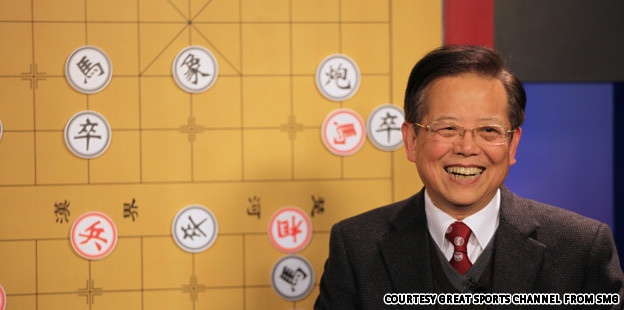
Xiang qi master Hu Ronghua
It seems like everywhere you look in Shanghai you see people playing “Angry Birds” on their smart phones or tablets. So it’s even more impressive that the visually simple Chinese chess is making a comeback with Chinese youth, thanks to a new reality TV show, and Chinese chess legend Hu Ronghua (胡荣华).
Hu, a master of Chinese chess, started his own show on Hi Sports Channel called “Let’s play Chess together” (“弈棋耍大牌”), calling on Chinese chess fans to audition as his apprentice.

At age 66, Hu, a Shanghai resident, is one of the most brilliant chess players in China and is using this show to appeal to Chinese youth who have slowly turned away from the sport.

Chinese Chess, just a memory?
In the 1980s and 1990s, Chinese chess games drew crowds of spectators in Shanghai's streets, parks and lanes. The interested crowds were a mix of young and old, all captivated by local matches of this traditional game.

A single well-played move could elicit cheers from a crowd. Yet such a long-lived game has lost popularity as Chinese youth turns to online games.

Today there are only a few seniors playing Chinese chess while chatting the day away in local parks and neighborhood gardens, and rarely do crowds gather like they used to.

“Fewer and fewer people are playing Chinese chess compared to a decade ago,” says Hu.

“However, for those who loved to play chess since childhood, this hobby is for ever. Chess is like this, once a love, always a love.”

Hu Ronghua takes an apprentice
To support this national pastime, Hi Sports channel decided to work with Hu on the Chinese chess program “Let’s Play Chess,” which started broadcasting its first season, which runs Monday to Friday 6 p.m. to 7 p.m. for eight weeks, in early March.

“Let’s Play Chess” has a simple premise: it invites people who want to play Chinese chess to face off during each show. Those who show the most promise can earn a coveted apprentice spot. The ultimate winner will go up against Hu himself.

“I don’t want too many people [as apprentices], just maybe five kids, ideally aged between 10 and 14 years old,” says Hu.

As the top name in Chinese chess circles, Hu is never short of potential apprentices, but he says doing a national TV show opens the pool of potential apprentices, instead of only looking at Shanghaining.

“China is too big, it’s too hard to find a non-local kid with potential without using television,” says Hu. “If I hire them through the show, people will gather from across the country. This way it’s more fair.”

In addition to getting Hu a few dedicated students, the TV show he says also serves another purpose: a recruiting call for the Shanghai Chinese chess team which is also looking to add more players to its ranks.

Charm of chess
For ordinary people, Chinese chess may appear to be simple game of black versus red, but Hu explains that there’s much more than that going on, allowing it to compete with even today’s modern games.

“Chinese chess can cultivate one’s mentality," says Hu. “The small chessboard is filled with life’s ups and downs. Seemingly winnable chess might end up in total loss, while losing games might have chances to win back.”

Playing, says Hu, helps people develop skill and patience.

Master Hu says some of the happiest moments in his life came when he thought of a move that nobody else had ever thought of, showing that his years of dedication and patience are paying off.

“That is a top-notch happiness,” he says.

When asked about what criteria he’ll be looking for in potential apprentices, Hu says he’s looking for the people the game has chosen, similar to himself.

“There’s no entry level for Chinese chess, it’s fate,” he says. “If destiny calls, you will love it.”

Chinese chess advancements
Although Hu’s TV search for new talent is promising, it brings up the question of the future of Chinese chess as local youth look elsewhere for entertainment.

Hu points out that while new technology has pushed the game into a corner, Chinese chess is making its way back, using technology to relaunch the game in China.

For instance, says Hu, if you type in “Chinese chess” in Apple’s app store, there are dozens of Chinese chess apps available, with Tencent QQ's version as one of the most popular, offering the game for both the iPhone and iPad.

Other tech firms like Winger Technology (affiliated with Shanda Interactive) are also coming out with their own mobile versions of the game.

“Mobile is helping develop future of Chinese chess,” says a spokesman from Winger Technology.

“We have launched special games on smart phones and tablets such as ‘Killers of the Three Kingdoms’ [a version of Chinese chess]. Other chess and card products designed for the mobile Internet are also in development.”

Even Hu’s TV show “Let’s Play Chess” has abandoned the traditional Chinese chessboard. Instead, it mainly uses digital boards.

With all of these advances, Hu seems assured that more young people will discover Chinese chess, in both its traditional or modern form, revitalizing the game in China.

This article was translated by Sarah Chen. Click to see the original article in Chinese.

Wednesday, January 5, 2011

Great Exhibit at the China Institute in New York

Gallery
Exhibition: Along the Yangzi River: Regional Culture of the Bronze Age from Hunan
January 27– June 12, 2011

Here's our little friend, the elephant, showing up as a Hunan cast bronze from the - you guessed it - Bronze Age! 
And in the Exhibit too.  So much for one theory that Xiang Qi (Chinese Chess) had to have been imported from India
(at a much later date) because China did not "know" about elephants.  After all, so the argument goes,
 the game was named after an elephant. Next theory, please...
The middle bank of the Yangzi River is one of the most significant cradles of Chinese civilization and a historical area for study of Chinese bronze culture. Several important excavations in the past few decades have enabled us to examine the little known aspects of this culture through exquisite bronze vessels. This exhibition will reveal the fascinating story of this regional culture in three ways: the development and characteristics of Hunan bronzes, their function and patronage, and their cultural connection to central China.

This is an original exhibition organized by China Institute Gallery in collaboration with the Hunan Provincial Museum. The exhibition is directed by Willow Hai Chang, Director of China Institute Gallery, and co-curated by Chen Jianming, Director of the Hunan Provincial Museum, Jay Xu, Director of the Asian Art Museum in San Francisco, and Fu Juliang, Curator of the Bronze Collection at the Hunan Provincial Museum. A scholarly bilingual catalogue will be published by China Institute Gallery.

VISITOR INFORMATION
Location:
125 East 65th St, between Lexington and Park Avenues

Gallery Hours:
Monday – Sunday               10am – 5pm
Tuesday and Thursday     10am – 8pm          
Free admission from 6pm-8pm

Closed in between exhibitions and on major holidays.

Admission:
Adults $7 Students and seniors (with valid ID) $4Free Children under 12    Free Members of China Institute, Asia Society, and Channel Thirteen

Wednesday, September 22, 2010

Vietnam Women Aiming for a Xiang Qi Medal at Upcoming Asian Games

From Vietnam News
Chess players hunt for medals
September 22, 2010


National senior Chinese chess master
Ngo Lan Huong takes part in the National
Championships. Huong will represent Viet Nam
at the Asian Games in Guangzhou, China,
on November 11-27.
— VNA/VNS Photo Thanh Vu
 HA NOI — Viet Nam is expecting to win a silver medal in the women's Chinese chess (xiangqi) at the 16th Asian Games (ASIAD) in Guangzhou, China, in November, said coach Hoang Dinh Hong.
Hong also hopes the men will take home at least a bronze medal.

Eleven chess masters have been undergoing intensive training in HCM City for the tournament, which includes Chinese chess for the first time – since early May. They have been competing with teams from Dong Thap and Khanh Hoa provinces.

Their final test will be at the National Sports Meet in Da Nang city next month.

National senior master Ngo Lan Huong, who is the Asian Indoor Games defending champion, is favourite to take the Asian Games' women's berth.

Masters Nguyen Thanh Bao, Lai Ly Huynh, Trenh A Sang and Nguyen Hoang Lam will be vying for the two slots in the men's team.

"This year ASIAD only features women's and men's individual events. Unfortunately, that puts Viet Nam at a disadvantage because we have the strongest team in the world," Hong said.

At this year's ASIAD, Viet Nam's main rival will be China.

"Our difficulty is not the quality of our players but their lack of competition experience. Chinese players regularly attend at least 10 events a year, while our players attend just a handful," the team coach said.

Lan Huong's chief rivals will be Wang Lin Na, the China national champion, and Yang Dan.

Hong said that despite their youth, the two Chinese masters are more talented than former world champion Yu Yungquin, also from China, whom Lan Huong has met several times.

Kao Yiping, from Chinese Taipei, is also a major threat. She took the silver medal at the Asian championship.

On the men's side, chief rivals will be China's national champion Hsu Yinchuan and Hsiang Chuan, who has the highest elo rating; Wu Kueilin of Chinese Taipei, who came fifth at the world championship; and Singapore's Wo Zonghan, the world No 6. — VNS

Sunday, August 8, 2010

New Course at The China Institute, New York

Chinese elephant figurine.  Could it be a game piece?
Chinese chess is called "Xiang Qi" which can be translated as "elephant game."
The chance to take a class like this is only one reason why I wish I lived in New York.  Oh well. Maybe in my next life, when I come back as a Rockefeller heiress. 

Chinese Art and Archaeology

Resident Scholar and Consulting Archaeologist to UNESCEO World Heritage Centre and Discovery Channel’s Ancient Manmade Marvels series, Dr. Hsin-Mei Agnes Hsu, will teach a five-week long course introducing Chinese art and archaeology from the Neolithic period to the Bronze Age. This the first in a series of short courses on Chinese art and archaeology to be offered in the next few years in conjunction with our exhibitions.

Dr. Hsu was on the faculty of Brown University (2004-2007) and a research scholar at Stanford University (2008). In 2002, she was the first American graduate student to receive a Mellon Foundation fellowship to conduct research at the Needham Institute at Cambridge University for her work on ancient cartographic science. Dr. Hsu’s publications include “Structured Perceptions of Real and Imagined Landscapes in Early China” in Geography, Ethnography, and Perceptions of the World from Antiquity to the Renaissance (2010), “An Emic Perspective on the Mapmaker’s Art in Western Han China” in Journal of the Royal Society of Asiatic Studies (2007), and The Exceptional Universal Value of the Road Systems in Ancient Empires: A Comparative Study of the Chinese Oasis Route of the Early Silk Road and the Qhapag Ñan, UNESCO (2006).

Tuesdays, January 11, 18, February 1, 8, and 15 ~ 6:30-8:30 PM
$200 member / $250 non-member (5 sessions)
$45 member / $55 non-member (per session)

To register, please click here.

Information on more upcoming courses provided in the August, 2010 China Institute newsletter.

Sunday, February 14, 2010

A Checkerboard-Patterned Stud and Gold Serpents

Part of the magnificent and unprecented find called the Staffordshire Hoard.

I have found references in several articles to five "mysterious" small gold serpents that archaeologists cannot figure out - what they mean, what they may have been a part of.  See, for instance, this comment from an Art Daily articleGems to be displayed for the first time include a delicate filigree gold horse’s head and gold snakes that have left experts baffled as to what they could have been used for . . .

I wasn't able to locate a photograph online of any of these serpents.  I want to see the five little gold serpents!  Are they game pieces?  Pieces off a horse tackle?  Jewelry?

While searching for images of the serpents, I found this lovely little item from the Hoard, described as a millefiori stud.

Millefiori (literally "thousand flowers"), dates back to Roman times.  I wonder if the archaeologists will be able to pinpoint the date this lovely piece was created?  There is ongoing discussion about when the Hoard was put into the ground; and, of course, even if a date can be agreed upon for that event, individual items that make up the Hoard may be much older than 650-750 CE.

What a beautiful piece! And fascinating. For instance, notice the markings around the large inner border marked out in gold - not all of the lines are straight, and there is a distinct pattern in these lines, set at 90 degrees to each other, dividing the circle into four equal parts. 

The inner-most pattern of the black/gold/white millefiori checkerboard pattern consists of a 3x3 square with curved edges to fit into the circular pattern; the outside frame increases the size of the "square" to 4x4.  I was reminded of the oldest magic square known in history - from ancient China, the Lo Shu magic square that sums to 15 in all directions. 

The center of the Lo Shu is the number 5, and we are reminded of that number (the number of the sacred spiral seen repeatedly in nature) by the five black rectangles that make up center of the millefiori design; the number 5, which in Chinese lore is considered "masculine," is complemented by four white rectangles, four being an even number and therefore considered "feminine" by the Chinese.  Ultimately, though, the black/white checkerboard pattern is balanced to at - 8 white and 8 black, a perfect reflection of the ancient Taoist principle of yin/yang. 

The overall design of the Staffordshire Hoard stud reminds me of an ancient Chinese boardgame - liubo.  I know it sounds crazy -but look at all of the elements of the millefiore stud and compare it to this standard liubo board configuration from Wikipedia commons.  The "V"s in the four corners, facing outward; the "L"s on the center of each of the four sides; and four "T"s centered around the perimeter of the innermost space.  This inner center space could well be the ancestor of the "palace" in the later game of xiang qi, and in some versions of the ancient liubo, was a pool where fish cavorted - a sacred pool, perhaps? It is not known what role the "fish" played in liubo, only that they were sometimes "caught."

A c. 400 BCE serpent-overlaid liubo board.  You'll notice that the "V"s and the "L"s are there in their traditional places - but it's very hard to see any "T"s  amid the inner markings, although suggested by the twisting bodies of the numerous serpents and three horizontally-laid out grid marks.  Interesting.  A variation on a theme...

Just what are those markings on the inner border around the black and white checkered millefiore stud?  Could those possibly be representations of "L"s from a liubo board?

Saturday, January 30, 2010

Ancient 'Defense Minister' Tomb Uncovered in China

Shades of xiang qi! 
Tomb of ancient China's "defense minister" unearthed in northwest China
English.news.cn 2010-01-29 18:08:32

XI'AN, Jan. 29 (Xinhua) -- The family tombs of an high-ranking general of the Han Dynasty (202 B.C.-220 A.D.) was unearthed in northwest China's Shaanxi Province, providing evidence to China's military history, archaeologists said Friday.

The tomb in Weiqu Town of suburban Xi'an, provincial capital of Shaanxi, belonged to Zhang Anshi (?-62 B.C.), a major general of Han Dynasty and he was conferred the titled of Liehou, top level of entitled officials of the dynasty, after helping Liu Xun (91 B.C.-49 B.C.) to become the emperor, said Zhang Zhongli, vice president of Shaanxi Provincial Institute of Archaeology.

The identification of the tomb owner was confirmed by the archaeologists based on the discovery of the official seals and the seal carved with the family name Zhang from the tomb, which is only six kilometers away from the emperor's tomb, Zhang Zhongli said.

The main chamber of ancient Zhang's tomb, surrounded by more than a dozen of tombs, is 35 meters long and 24.5 meters wide, and has been robbed before, Zhang Zhongli said.

The whole tomb faces the direction of the emperor's tomb, which shows the respect of the general toward his king, Zhang said.

More than 2,000 pieces of cultural relics, including exquisite bronze and ceramics decorations, bronze seals and appliances which represent the high rank of the general, had been unearthed over the past year.

However, the body of the owners had not been unearthed in terms of better protection, Zhang said, without revealing the schedule.

The structure and size of the tomb and the large amount of unearthed appliances are all significant to archeological researches, Zhang said.

The military appliances and the carriages might be the remarkable discovery of the Chinese military history, as the general was considered the "national defense minister" of the Han Dynasty, he said.

Although the tombs of Zhang Anshi's and his wife's had been robbed and burnt before being discovered by the archeologists, they had provided abundant evidence to the research of the Han Dynasty history, he said.

Editor: Lin Zhi

Tuesday, July 7, 2009

Ancient Royal Chinese Tomb Discovered

Hola darlings! I do hope I have not previously reported on this discovery. I found this story at English.Chosun.com which is, I believe, a South Korean website (but don't quote me on that :)) Ancient Royal Tomb Found in China Arirang News / Jul. 07, 2009 12:10 KST Workers in northern China building water infrastructure recently uncovered a 1,400-year-old royal tomb containing ancient wall paintings. The tomb belonged to Gao Xiaoxu, the male heir of an emperor during the Qi Dynasty. The detailed frescoes of honor guard officials found inside are thought to date from 550-577 AD. [This is around the time that the game of Xiang Qi - Chinese chess - may have evolved in China from an earlier practice that was part divination/part board game called Xiang Xi, according to Dr. Joseph Needham]. However, the more than 1,000 years that have passed have taken its toll on the condition of the paintings. Sun Jinghua of the Shaanxi Provincial Institute of Archaeology says that the discovery needs the full attention of restoration specialists. Fragments will be secured and the wall will be removed to a location off-site for further study. The site is located in an area that contains 134 tombs mostly from the royal family of the Northern Dynasties which ruled from 368-581 AD.

Saturday, March 21, 2009

Giant Chinese Chess

I found this beautiful photograph in an article about Nantou, Taiwan (central part of the country).

Friday, October 10, 2008

First World Mind Sports Games

Xiang qi - Chinese chess - variously translated as "elephant game," something akin to "ambassador game" and "star" or "celestial" game." It has a lot of similarities to western chess, but has enough differences to require learning a whole different set of pattern-recognition and, of course, basic piece moves and rules. The pieces are different from western ches pieces, too. The modern game of xiang qi is played with flat pieces (like checkers) that have their symbols painted or printed on them. The xiang qi board is not checkered like a western chess board; the pieces are placed on the intersections of the squares and not within the squares, and there is a "river" that divides the xiang qi board in half - so a xiang qi board has 72 squares, but the number of playing pieces is 16 to each side because of their placement. Pieces are distingished entirely by color and by subtle variations in the names of the pieces. I'm no expert, that's for sure! The extent of my knowledge is very limited, basically gleaned from a few articles read when I researched the meaning of the name of xiang qi in English ("qi" basically can mean "man" - as in a "playing piece" - but it can also, more intriguingly, refer to the "qi" that is, to put it into popular venacular, rather like "The Force," that invisible yet palpable "something" that forms the very essence of the universe, from "Star Wars." Thre are several different siang qi events taking place side by side with western chess events. Here is news about one of the women's events. Unfortunately, the photograph of the chessboard and pieces in the article is a western chess set with a checkered board! Lan Huong brings home xiangqi bronze 14:06' 10/10/2008 (GMT+7) VietNamNet Bridge – Ngo Lan Huong yesterday secured a bronze medal in the women's individual xiangqi (Chinese chess) event at the first-ever World Mind Sports Games, held in Beijing, China. Huong beat Tan Min Fang Fiona from Singapore in the last round to grab a spot in the top three. The 2007 Asian Indoor Games title-holder pocketed 10 points after seven matches, finishing behind China's Wang Linna and Zhao Guanfang. In a near tie-break for gold, Wang and her compatriot Zhao both accumulated 13 points. Wang was finally awarded the medal because of better rival points, suggesting she encountered stronger opponents during the tournament. "I am so excited with the results," said 28-year-old Wang. "After all, this is the World Mind Sports Games, and in some sense it is just like the Olympic Games for the mind. So being the champion means a lot to me." Ranked as one of the best female xiangqi players in China, Wang earned six victories during, the competition. A native of Heilongjiang Province in northeast China, Wang is a veteran in the sport, having started learning xiangqi at the age of eight. She bagged her first national title in 1997. But facing Zhao was a close call, Wang said. "I did not play well in that match. I left too many chances for my opponent. I think Zhao was too nervous to beat me at that time, or I could not have earned one point from that match." The champion said she hoped her gold medal will be a good start for Chinese female xiangqi players, adding: "Hopefully, my teammates will win another gold for China in the women's team event." The competition was also a hard-won battle for silver medallist Zhao: "Foreign female xiangqi players have made great progress in recent years. Competitors from Viet Nam, the Netherlands and Britain have posed a huge challenge for us during the matches." On the men's side, Vietnamese Nguyen Thanh Bao and Nguyen Hoang Lam are both in the top ten. The duo finished round five with six points. The competition for men has nine rounds and will conclude tomorrow. In the chess event's mixed pair blitz, Ecuador secured gold after tense games against India. In the play-off for third place the Ukraine proved too strong for Iran, winning 3-1 to take the bronze. Vietnamese duo Le Quang Liem and Hoang Thi Nhu Y did not play well, earning only 13 points after 11 rounds, which was not enough to qualify for the semi-final. In the mixed pair rapid event which kicked off yesterday, Dao Thien Hai and Le Kieu Thien Kim of Viet Nam took two points from two first matches and were in the middle of the ranking table. The first World Mind Sports Games attracted more than 3,000 players from 143 countries and regions. Masters compete for 35 medal sets divided into five events: bridge, chess, go, draughts and xiangqi. (Source: VNS/XINHUA)

Wednesday, May 7, 2008

Superstar Xie Jun Playing in Major Tournament!

From Vietnam News: Chinese chess and Go regional tournament to open in Ha Noi (07-05-2008) HA NOI — Chinese chess and Go players from Viet Nam will be up against some of the best in Asia this weekend when Ha Noi hosts a major regional tournament for the first time The Chinese chess (Xiangqi) and Go Ha Noi Open has been organised by the Ha Noi Sports Department, and is being jointly sponsored by China’s Guangxi Hualan and the C-Hope groups. Some 64 players from China, South Korea, Japan and Viet Nam will be competing in the event, which starts on Saturday at Quan Ngua Sports Palace. At a press conference in Ha Noi yesterday, organisers proudly boasted that Chinese chess stars such as Li Dong Jun and Xie Yun (from China) and Go champs Guangxi Yu Xue Jun (China), Miyata Takeshi (Japan) and Park Kyun-chul and Kwon Kwe-hyun from South Korea would be participating in the tournament. "We are honoured to be able to sponsor the tournament, which is being held for the first time in Viet Nam," said John Chin, assistant director of the Guangxi Hualan Group. Danny Kung, executive president of the C-Hope Group, said he hoped the tournament would boost economic co-operation and friendship between China and Viet Nam. In recent years, Viet Nam has become one of the leading Chinese chess nations in the region. "[Chinese] chess has been played in Viet Nam for a long time, but this is the first time Ha Noi has hosted such a big tournament, which has attracted top players from chess giants in Asia," said Nguyen Manh Hung, vice director of the Ha Noi Sports Department. "The event marks a new era [for the game in Viet Nam]." Among Viet Nam’s leading representatives at the competition will be Treng A Sang, Nguyen Thanh Bao, Tran Van Ninh and Nguyen Vu Quan. At the 10th World Chinese Chess Championship in Macau last year Viet Nam’s Nguyen Thanh Bao won a bronze medal. Also last year in Macau, Nguyen Vu Quan won a silver medal at the Asian Indoor Games. At the Asian Chinese Chess Team Championships in the southern province of Ba Ria-Vung Tau last year in which Viet Nam finished fourth, Quan caused an upset by beating world champion Lu Qin. The tournament ends on Monday. — VNS ********************************************************************************** GM Xie Jun was the Women's World Chess Champion from 1991-1996 and 1999-2001 -- that is, "international (or western)" chess, not "xiang qi" or Chinese chess. All I could find about Xie Jun and xiang qi was this information from Wikipedia: At the age of six Xie began to play Chinese chess, and by the age of 10 she had become the girls' Xiangqi champion of Beijing. I cannot be sure, of course, but it sounds as if Xie Jun has taken up xiang qi again, but there is no information available via a regular Google search. A search on Chinese Google wouldn't be helpful, though, since I don't read Chinese. It's great to see a great chess champion's name in print again!
Friday, June 22, 2007

Old Chinese Chess Commentary


Hola darlings! Whew - it's Friday night (finally), and I'm feeling all right! Hot as hell here, and the weekend is jam packed with yard work, an investment club meeting (remind me to tell you about the investment club some time), and a Sunday afternoon at a St. Martin's Fair - dodging thunderstorms, of course!

I came across this information in an article the other day and thought it was interesting - I've never heard of the "book" it mentions and probably most westerners have not. It's not quite clear from the article, but I assume it is about Chinese chess (xiang qi). As far as I can tell, all Chinese scholars think that the west got its chess from xiang qi via transmittal by Persian merchants, and most western scholars follow H.J.R. Murray's school of thought that chess was invented in India and travelled east to China along the Silk Road. Only a few brave voices from the west, such as Joseph Needham and Pavel Bidev, believed chess came out of China but, unfortunately, they're not around anymore to develop their theories further. I'm not aware of anyone else who has chosen to pick up the gauntlet, except perhaps Peter Banaczak, and I have not been able to get in touch with him for at least five years (he probably put me on a "do not receive list" - I can be a pest. Drat!) The last I know, Banaczak was working on his PhD, one of the few western chess historians who can actually read Chinese and has knowledge of ancient Chinese classics that mention a game that might very well be chess or a form of proto-chess.

It seems pretty obvious to me that the "standard history" of chess that we in the west accept as true is steeped in 19th century racism and few have bothered to "call" Murray's progeny on their implicit, unspoken assumptions of "western" cultural superiority. You know, the "Aryan invasion" and all that crap! There's a reason I call some of these people the chess Nazis. Ah, but that's an argument for another day, I don't feel like fighting tonight, I just want to soak my feet and have a glass of wine on the deck while the sun goes down.

The English translation of the article is somewhat quirky. This is the gist of it: a Qing Dynasty collection of chess games and - I think - chess problems - has been declared a "national folk treasure" by the Chinese government and now resides in - I think - a museum in Bejing. It's a bit unclear from the article, but it appears that only a portion of the actual games and/or problems has ever been published. It's also unclear whether what's being exhibited at the Bejing museum is just the published portion of the text, or the whole thing. So, without further adieux, here's the excerpted information from the article:

"The chess manual scripts collection, "the Deep Pool and Infinite Sea," has been cited as the "rarest and most valuable works" highly revered and esteemed among top Chinese chess game players for almost two centuries.

"These folk national gems have kept intact through centuries in spite of vicissitudes they have gone through from generation to generation. So people have taken interest in anecdotes about them and in particular titbits or sidelights of interest.

"The Qing Dynasty (Chinese) chess manual scripts represent a huge collection of the cream or quintessence of ancient chess games and well-known, knotty chess games collected and sorted out by author Chen Wenqian for 17 consecutive years, and he finally completed the copying in 1808. The entire works is divided into 16 volumes with a total of 371 famous chess games. But to date, there is one works only extant, as Chen was too poor and much in need to have it printed at that time.

"The collection of chess games emerged abruptly in 1933 after having had sunken into oblivion for over a century. Then, an ace (Chinese) chess game player in north China's Hebei province, Qian Mengwu, chanced on it but he failed to get it as its owner offered too higher a price that he could pay. Through the maneuvering of his friend, however, he succeeded to borrow it and got his chess pals to hurry through its copying overnight.
"About 30 years later, another chess star Liu Guobin on July 30, 1964 found the chess manual scripts collection with the introduction of an acquaintance at the China Bookstore. Then, he pawned a Swiss-made watch and bought the chess manual scripts with 150 yuan (some 20 dollars) he got from the mortgage. And, grand chess master Qian Mengwu confirmed it afterwards as the very works he had borrowed and had it copied with the help of his chess pals three decades earlier."

Sunday, April 29, 2007

Typical Research Project

Before I run to the supermarket and then cut the grass (it's overdue for a trim), I thought I'd share a bit about one of my current "research projects." I've just finished reading Cathy Forbes' 1992 book "The Polgar Sisters - Training or Genius?" (I highly recommend it - I believe she was unfairly vilified for writing this book, and I find that many of her insights into the Polgar sisters have proven to be true) and later this afternoon I'll settle down on the deck, a tall ice-filled glass of cheap vino at hand under the shade of a 7 foot umbrella (it's supposed to get up to 80 and I don't want to get sunburnt) and start reading Susan Polgar's latest book "Breaking Through," which will, presumably, cover much of the same territory that Forbes covered in her 1992 book. Of course, though, from an entirely different perspective. After that, "Chess Bitch" by IM Jennifer Shahade is on the list. The object of this burst of reading about female chessplayers is to fill in background information for two articles I'm working on for Goddesschess - one inspired by David Shenk's latest research project into whether geniuses are born or created - well, that's not an exact description of what he's working on, that's my paraphrase of how I understand his research at the present time. Shenk wrote a book last year that I'm also reading (in between all the other reading projects I'm juggling) - "The Immortal Game - A History of Chess" and I think he did an excellent job of capturing the mystique and allure of chess. Oh yes - he also provided a ton of fascinating information about the game I love - and hate. Chess is a black hole that sucks you in - whether as a player or as an historian, which, I guess, is my avocation - chess historian. But not your average historian, because for the most part I could care less about who played who with what opening when; nope, I and my cohorts in chess history apostacy are interested in the really ancient stuff, the stuff that lead to the invention of such games as senet, twenty squares (the Royal Game of Ur), mehen, backgammon, chess, liubo, xiang qi, etc. And I've gotten totally off subject, lol! Once my research is done, one article will be about sexual discrimination in chess; the second article will be an examination of Shenk's intriguing research, but only in connection with chessplayers (i.e., are they "born" or "made?") I hope to have them both written soon; I've got bits and pieces saved on the computer already, but it's always a struggle to pull everything together and try to make a cohesive, understandable whole. I enjoy writing; I consider myself rather good at it (ahem). Still, it's MUCH easier to just continue to do research - one then never has to commit anything into final form for death by a thousand pinpricks and slurs of the critics...
Related Posts Plugin for WordPress, Blogger...