Showing posts with label Joseph Needham. Show all posts
Showing posts with label Joseph Needham. Show all posts
Tuesday, July 7, 2009
Ancient Royal Chinese Tomb Discovered
Hola darlings!
I do hope I have not previously reported on this discovery. I found this story at English.Chosun.com which is, I believe, a South Korean website (but don't quote me on that :))
Ancient Royal Tomb Found in China
Arirang News / Jul. 07, 2009 12:10 KST
Workers in northern China building water infrastructure recently uncovered a 1,400-year-old royal tomb containing ancient wall paintings. The tomb belonged to Gao Xiaoxu, the male heir of an emperor during the Qi Dynasty.
The detailed frescoes of honor guard officials found inside are thought to date from 550-577 AD. [This is around the time that the game of Xiang Qi - Chinese chess - may have evolved in China from an earlier practice that was part divination/part board game called Xiang Xi, according to Dr. Joseph Needham].
However, the more than 1,000 years that have passed have taken its toll on the condition of the paintings. Sun Jinghua of the Shaanxi Provincial Institute of Archaeology says that the discovery needs the full attention of restoration specialists. Fragments will be secured and the wall will be removed to a location off-site for further study.
The site is located in an area that contains 134 tombs mostly from the royal family of the Northern Dynasties which ruled from 368-581 AD.


Tuesday, October 7, 2008
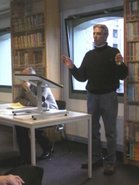
Joseph Needham Biography
Joseph Needham was a sometimes contributor to the Initiativ Gruppe Koenigstein (IGK), a group of chess historians and chess afficianados founded in Germany some ten years ago.
Needham's raison d'existence was not discovering who first invented chess or the even more obscure subject, the origins of the game. He was a historian, but his focus in writing about ancient China was about what the Chinese did, and did not do, in science and technology.
Some years ago at Goddesschess we hunted down what Needham wrote about the origins of chess at a university library in Montreal, Canada that housed a collection of his monumental work, Science and Civilisation in China. Check out Needham's articles.
Here is a review of the Needham biography, from The Timesonline. uk:
October 1, 2008
What the West makes of Chinese science
Early China's scientific achievements and Joseph Needham, their controversial advocate
John Keay
Until fifty years ago, it was widely assumed that China had no tradition of scientific thought and innovation. Meticulous observation and reasoned deduction were taken to be European traits, as was the application of scientific principles to industrial production. The Chinese were supposed to be good at imitating, not originating; and the notion that the West’s scientific and industrial revolutions owed anything to the East’s inventiveness seemed laughable.
We now know better. Ancient China’s precocity in almost every field of scientific achievement has since been acknowledged – in medicine, metallurgy, ceramics, mechanics, chemistry, physics, mathematics. Ridicule has turned to awe, tinged with trepidation.
This dramatic reversal is credited to one man, the redoubtable Dr Joseph Needham, plus a small team of devoted disciples and a monumental work of scholarship. All three provide rich matter for Simon Winchester’s Bomb, Book and Compass, while the stature of Needham’s great work may be judged by the appearance of a new volume on ferrous metallurgy, the twenty-fourth in his Science and Civilisation in China series. Fifty years since the first volume appeared, and thirteen since Needham died, the work of assessing pre-Qing China’s scientific achievement goes on. “Sci[ence] in general in China – why [did it] not develop?”, wondered Needham in an aide-memoire jotted down in 1942. Later touted as “the Needham question”, this conundrum about why so promising a tradition failed to generate its own industrial revolution has never been satisfactorily answered – by Needham or anyone else. But the idea behind it – that China did indeed once excel in science – has generated an industry of its own. Mining the world’s most richly documented culture for references to scientific and technological practice now provides employment for a host of scholars; many of them enjoy the resources on offer at Cambridge University’s specially built Needham Research Institute; and seldom has there not been a volume of Science and Civilisation in China making its stately progress across the print floor of the University Press.
For revealing how, in almost every conceivable field of scientific endeavour, the Chinese had preceded other nations, Needham was hailed as “the Erasmus of the twentieth century”, fawned on by the Left and feted by international academe. The Fellows of Caius College, Cambridge, made him their Master; Beijing, no less than Taipei, showered him with honours. Yet, boisterous and headstrong, Needham was not without his critics. Cambridge had cause to resent his long absences and reluctance to teach. Washington steadfastly refused him entry following his endorsement of Communist claims that US aircraft had dropped cholera-infected rats on North Korea. Forums designed to further the cause of international understanding were something of a deathtrap for Needham. He was hoodwinked by his Maoist friends – and by a Soviet-laid germ-trail in respect of the rats. It was not until the Cultural Revolution that his faith in Communist China began to waver. His flaws and foibles were legion, and it is these that seem to have recommended him to that connoisseur of bookish eccentricity, Simon Winchester.
Bomb, Book and Compass (these being some of the undisputed products of Chinese invention) is no more a standard biography than was The Surgeon of Crowthorne (Winchester’s book about William Minor and the OED). Instead, Winchester delivers a masterly narrative, rich in description and quirky asides, and as undemanding as it is compelling. Needham, we learn, though a distinguished embryologist, self-taught sinologist and general polymath, was susceptible to distractions. He was keen on steam engines, morris dancing, singing and swimming in the nude. A Communist in all but party membership, he yet remained a devout Anglo-Catholic; and a dedicated husband in so far as his compulsive womanizing permitted.
Nearly half of Winchester’s book is devoted to the years (1943–6) that Needham spent in China as the head of a wartime agency called the Sino-British Scientific Co-operation Office. Winchester insists it had nothing to do with intelligence gathering and was solely concerned with offering encouragement and materials to scientific institutions uprooted by the Japanese invasion. But it does seem to have involved more adventurous travel than the distribution of books and laboratory equipment strictly required. Though based in Chongqing, the capital of unoccupied China, Needham was seldom there. It was his first visit to China and would be his only extended residence in the country; he was determined to make the most of it. His three major journeys, one by truck to Gansu in the north-western desert, another by road to Yunnan in the south-west, and a third mainly by rail to Fuzhou in the south-east, were as notable for what he learned about Chinese science as for what he imparted to it. Indeed, the immense collection of books and artefacts that he brought back probably outweighed the largesse he distributed. Shipped to Cambridge, they would provide the raw material for Science and Civilisation in China and the core of the Needham Research Institute’s extensive library.
Winchester has retraced these expeditions exhaustively. He makes good use of the reports submitted at the time, and writes of China with real affection. The Man Who Loved China, which is the title of his book in the US, could as well apply to the author as the subject. But all this leaves little room for the rest of Needham’s career, which is sketched in the broadest of strokes, and none at all for the ongoing debate over the methodology of Science and Civilisation in China.
Needham’s purpose was to demonstrate not just the scale of early China’s scientific achievement, but its importance in the development of world science. Even his disciples have had difficulty with this. In his handsome contribution on ferrous technology – Part Eleven of the fifth volume, Chemistry and Chemical Technology, in Science and Civilisation in China – Donald B. Wagner dissociates himself from Needham’s faith in both “the essential virtue of Progress” and “modern natural science as a measure of historical value”. Like others, he is also unhappy with Needham’s extraction of Chinese science from its geographical, cultural and social context and his categorization of it into essentially Western disciplines – chemistry, physics, biology, etc – that were unfamiliar to the Chinese. And finally, though he wrestles with the Needham dictum that the West owed its eventual technological superiority to the East, Wagner concludes that in respect of iron, “the results are not by any means conclusive”.
Unfazed by such apostasy, Needham stuck to his task well into his nineties (he died in 1995). He devoured every available text and interrogated every known authority for the earliest Chinese references to any relevant technology. Finding that these generally predated anything in other cultural traditions, he then awarded to China a precedence based on priority and offered conjectures as to how this technology might subsequently have spread to other receptive societies. He was, in short, a committed diffusionist; he made no allowance for the possibility of independent invention and parallel development elsewhere. He also made no allowance for the profusion and antiquity of Chinese textual sources compared with those of other cultures. The doubtful nature of references to ferrous technology in, for instance, India’s historiography does not prove that this material was unknown there; witness the famous iron pillar at the Qutb in Delhi. It merely affirms the comparative paucity of the textual resources available for pre-Islamic India.
Notching up these Chinese “inventions and discoveries” and awarding to each a date based on the earliest known reference became something of an obsession for Needham. Several such listings appear in his published works and have since been adapted by admirers; Winchester reproduces a representative example. But while one can hardly quarrel with “Blast furnace – 3rd century b.c.”, “Book, printed, first to be dated – a.d. 868”, or “Crank handle – 1st century b.c.”, the whole exercise invites ridicule with the inclusion of items such as “Wheelbarrow, sail-assisted – 6th century a.d.”, “Great Wall of China – 3rd century b.c.”, or “Bookworm repellent – no date”. For reducing the painstakingly researched and elegantly written tomes of Science and Civilisation in China to the level of general knowledge trivia, Needham himself must bear much blame. But what Donald Wagner’s new volume well demonstrates is the extent to which recent archaeology, while modifying some of Needham’s conclusions, generally supports the veracity of the textual testimony and so the value of his life’s great work.
Simon Winchester
BOMB, BOOK AND COMPASS
Joseph Needham and the great secrets of China
336pp. Viking. £20. 978 0 670 91378 7
Donald B. Wagner
SCIENCE AND CIVILISATION IN CHINA
Volume Five: Chemistry and Chemical Technology Part Eleven: Ferrous Metallurgy
478pp. Cambridge University Press. £120 (US $220). 978 0 521 87566 0
Friday, June 8, 2007
What's the Oldest Evidence of Chess? - Part 2

The archaeologists' conclusion that the Butrint artifact was a chess piece drew gasps of horror from most traditionalist chess historians. The Butrint artifact cannot be chess, they say, because chess may not have even been invented at the time; furthermore, they say, since there is only one such piece, it could be anything - it is probably a "finial."
It's doubtful that anyone will ever be able to pinpoint an exact date when chess was invented. However, that hasn't stopped people from trying! In the late 19th and early part of the 20th centuries, it was practically stated as fact that chess was invented in what is now part of Pakistan (pre-partition historians refer to this area as "northern India"), sometime during the 6th century CE. This date is used in H.J.R. Murray's work "A History of Chess," which is basically a chess historian's bible, and has been repeated ad nauseum on the internet. Since Murray's time, though, the possible date of the invention of chess has been pushed back a bit and most chess historians now accept a date somewhere in the middle to late 5th century CE. Well, guess where that puts the invention of chess - between 450 to 500 CE. According to news reports at the time of the discovery, the Butrint king is securely dated to 465 CE because of a distinctive type of Roman pottery found in the same level of ruins and some recovered coins.
What does current published archaeological and literary evidence reveal as to how old chess is?
The earliest "unambiguous" written reference to chess is, according to the traditionalists, in the Pahlavi (middle Persian) work Wizârišn î chatrang ud nihišm î nêw-ardaxšîr (The explanation of Chess and the invention of Nard), also called "Mâdayân î chatrang" or simply named "Chatrang nâmag" (The Book of Chess, per Murray), dating to about 600-620 CE.
Other than the Butrint piece, currently the earliest known chesspieces (chatrang pieces) were found at Afrasiab, near Samarkand in Uzbekistan. Those pieces are a king, chariot, vizier, horse (knight-image above), elephant, and two soldiers, all made of ivory. The Afrasiab discovery is significant because the number of pieces found and their configuration allowed chess historians to unequivocally declare that they were, indeed, chess pieces, albeit of the "figural" kind. That the pieces were figural and not abstract could reasonably suggest that the pieces are pre-Islamic, because of Islam's emphasis on not making "images" of living things.
The Afrasiab pieces are dated to about 760 AD because a coin, dated to 761 CE, was found with the chesspieces. The chess pieces could not, therefore, be any younger than the coin, but they could be older than the coin. This assumes that the excavated layer had not previously been disturbed, so that there is no possibility that the coin could have been introduced into a much earlier (or later, for that matter), layer of archaeological deposit.
H.J.R. Murray said that northwest India (ancient "Hind") was where chess originated, and for the better part of the 20th century, most agreed with him. However, there are other possibilities. A strong case can be made that proto-chess first arose in ancient China. There are literary references to such a game that predate the "Chatrang namag" by a couple hundred years. The great scholar Joseph Needham was of the opinion that chess was a Chinese invention. See his comments at Goddesschess (a large PDF file, will be slow-loading for dial-up users).
And our Chief, the late Ricardo Calvo, suggested that Persia itself might be the home of chess. See his comments at Goddesschess. I have been researching rather obscure and esoteric matters Persian that might support this hypothesis for the past several years. A woman's work is never done...
Subscribe to:
Posts (Atom)