Tuesday, April 17, 2012

2nd Women Masters Tournament

Standings after R7:

Rk.NameFEDRtgPts. TB1 TB2 TB3
1gmZhao, XueCHN25435.50.017.754
2imKhotenashvili, BelaGEO24905.00.016.004
3wgmDing, YixinCHN23504.50.012.503
4wgmTan, ZhongyiCHN24384.01.012.503
5wgmJu, WenjunCHN25574.00.011.252
6wgmZhang, XiaowenCHN23543.50.010.502
7imMuzychuk, MariyaUKR24903.00.08.251
8wgmHuang, QianCHN23992.50.06.251
9wgmGu, XiaobingCHN22571.50.05.500
10wgmShen, YangCHN24401.50.05.000

Saturday, April 14, 2012

Ancient Practices Trump Islamic Dogma

In the Roman Catholic religion (I'm most familiar with this branch of Catholicism), ancient pre-Christian practices were incorporated wholesale into "the Church" in order to attract and appease new worshippers.  Despite subsequent purges and councils and what not (I believe the most recent one was Vatican II, which did nothing to make "the Church" more popular), many customs, beliefs, practices and rituals that are not part of the Official Catechism persist in everyday Roman Catholicism around the world.

Whether by design or due to the intransigence of the human spirit, so too it is with Islam -- we just don't read it about it too often in the western popular press.  I have a feeling that such articles/reports rarely, if ever, make it into the popular press, or even into the academic press, in very many countries where Islam is the predominant religion.  Although the religion of Mohammed is a mere 600 years younger than "Christianity" (give or take some years), Islam has a lot of growing up to do relative to it.  But you know, once the genie is let out of the bottle, you cannot put him back in...

Art Daily has put together a very good summary of recent articles on this study:

Archaeologist says modern sacrifice rituals in the Levant reveal diversity of beliefs
April 14, 2012

MIAMI, FL.- Harvard University educated anthropologist and president of the Paleontological Research Corporation, Dr. Joel Klenck, conducted a study of Bedouin sacrificial rituals that reveal a diversity of beliefs in Arab populations in the Levant. Sponsored by a grant from the Joe Alon Museum, Klenck conducted a study of Bedouin sacrificial rituals completed in 2012 and featured in a forthcoming publication.

Rarely revealed by Western researchers, Arab pastoral nomads practice several types of sacrificial rituals other than the main feast of sacrifice or “Id al ‘Adha” that occurs the tenth day of the Hadj or “Dhul Hijjah” and is practiced by all observing Muslims. Three other rituals include sacrifices to spirits or “ginn”, ritual slaughters to ward off curses and bless newly married couples, and commemorations to deceased family members. Another type of sacrifice practiced by Bedouin in the Levant comprises sacrifices to a “weli” or revered person. Klenck states, “Bedouin sacrifice sheep, goats, cattle and occasionally a camel to a weli to redeem vows, incur healing, give thanks or insure fertility. Individuals performing the sacrifices believe the weli will act as a mediator between them and Allah to facilitate their requests.”

Around 1771, Muhammad Ibn ‘Abd al-Wahhab, a cleric who traveled throughout Saudi Arabia and Iraq, began to influence the ruler of Dara’iya, Muhammad Ibn Sa’ud, whose tribe created the Kingdom of Saudi Arabia in 1932. The religious leader al-Wahhab formed a movement that denounced Bedouin believing in the special powers of a weli, punished individuals performing sacrificial rituals to these revered persons and largely eradicated these practices.

Although sacrifices to Bedouin saints are mostly forbidden in Saudi Arabia, these rituals continue to be practiced by Muslim pastoral nomads in the Levant and North Africa. Klenck states, “I was able to observe Bedouin venerating the tombs of Sheikh Abu-Hurreira, Ibrahim, Hussein, Falougie, Nebi Musa, and the adjacent sepulchers of Al-Azzam and Al-Nabari. The sheikhs’ tombs vary in their size, care and decoration. The tombs often feature sticks of wood mostly of palm with white or green cloth tied to each structure. According to the Bedouin, the white cloth represents peace and goodwill and is a beneficial omen for those petitioning Allah through a weli. The Bedouin consider the color green to be very holy as its significance stems from their traditions and because they allege the tomb of the Prophet Muhammad and the Kabbah in Saudi Arabia are covered with green tapestries. At the tombs the Bedouin often light candles and sometimes leave salt, sugar, matches, and coins in the sacred area.”

While Bedouin women perform prayers and light candles at the tombs, the men perform animal sacrifices near the sepulchers. At the tombs of Al-Azzam and Al-Nabari, the trees surrounding the sacred areas exhibit slash marks where Bedouin hang animal carcasses during butchery activities. After the sacrifice, the meat is boiled and everyone participates in the subsequent feast, especially the poor. Several Bedouin stated that in past centuries, individuals left valuable possessions at the sheikh’s tombs knowing that no Bedouin would dare steal from the tomb for fear of being cursed. Klenck concludes, “Studies of Bedouin animal sacrifices reveal a diversity of beliefs and are important in understanding cultures and ritual activities in the Levant.”

2nd Women Masters Tournament

Standings after R5:

Rk.NameFEDRtgPts. TB1 TB2 TB3
1gmZhao, XueCHN25433.51.59.252
2wgmJu, WenjunCHN25573.50.56.502
3imKhotenashvili, BelaGEO24903.50.07.253
4wgmDing, YixinCHN23503.01.05.752
5wgmTan, ZhongyiCHN24383.00.05.752
6imMuzychuk, MariyaUKR24902.50.05.251
7wgmZhang, XiaowenCHN23542.00.04.251
8wgmHuang, QianCHN23991.50.53.750
9wgmShen, YangCHN24401.50.53.500
10wgmGu, XiaobingCHN22571.00.03.250

Friday, April 13, 2012

Fifty-Three Han, Tang and Song Dynasty Tombs Uncovered

The report is rather understated, I think!  This is in incredibly important discovery. I sincerely hope the government will do everything (and I do mean everything) to protect those tombs and, as is quite apparent from the photographs that accompany the article, the artifacts that have already been removed from the tombs, including one or more absolutely priceless Han Dynasty bronze "mirrors."  Sad to say, the originals of these artifacts have probably already disappeared into the "private collections" of high mucky-muck Communist Party Politburo princes. 

From China Daily
Han Dynasty Tombs Found by Accident
Updated: 2012-04-13

More than 50 ancient and rare relics were uncovered in a tomb excavation in Guxian County, Anhui province. The 53-tomb complex is believed to have been under construction over many dynastic periods dating back to the Eastern Han Dynasty nearly 2,000 years ago.

The tomb complex was discovered accidentally on a construction site. It contains over 50 brick tombs from the Eastern Han, Tang and Song dynasties.
Experts identified the type of people who were buried there.
Zhao Lanhui, deputy researcher of the Bengbu Cultural Relics Institute, said, "lying south to north would perhaps be people of four generations. Due to its size, we know the tombs come from the Song Dynasty. It's small with a simple style.
The tombs hold a unique character that were built in an animal shape."
Though some tombs have been plundered over the years, precious relics have emerged, such as bronze mirrors, gold and silver garments, along with pottery boxes.

This is a photo from the article.  Not captioned, so it could be "any" Bronze Mirror rather than one
 recovered from one of the Han Dynasty tombs.  Bronze Mirrors went out of fashion at the
end of the Han Dynast; they were tied to Taoist philosophy and the Queen Mother of the West, and were
 used for divination. I am not able to tell from this photo if this is a TLV mirror or a "cloud" pattern mirror.
Many people buried here were considered common people, until the discovery of a special, delicate and well-preserved mirror.
Zhou Chongwen, archaeologist, said, "It's a relatively large bronze mirror, which means the owner held social status."
An archeological study is continuing on into its history and the people who lived here.
It's generating much interest in local heritage and cultural identity.

6th Grand Pacific Open

I received a report from  Brian Raymer, one of the organizers of the Grand Pacific Open: 

Another great GPO. Nino was 2nd place this year. 5/6 Her only loss to Nakamura who came 1st with 6/6. 120 players 10 women this year. A few others who could not make it last minute. Here is a video of Nino playing blitz with a couple of our young women. http://youtu.be/pptZ3hX08qs Nino had 1 minute her opponents 5 minutes. Nino is a great ambassador for chess. I hope she is able to make it again to the next GPO. Maybe the Canadian Open as well.

2nd Women Masters Tournament

Standings after R4:
Rk.NameFEDRtgPts.TB1 TB2 TB3
1wgmJu, WenjunCHN25573.00.04.752
2wgmDing, YixinCHN23503.00.04.002
3gmZhao, XueCHN25432.51.06.001
4imKhotenashvili, BelaGEO24902.50.03.252
5imMuzychuk, MariyaUKR24902.01.04.251
6wgmZhang, XiaowenCHN23542.00.03.251
7wgmTan, ZhongyiCHN24382.00.02.501
8wgmHuang, QianCHN23991.50.02.750
9wgmShen, YangCHN24401.00.02.250
10wgmGu, XiaobingCHN22570.50.01.000

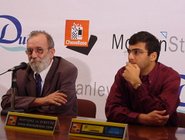
WGM Ju Wenjun, highest rated player at the 2nd Womens Masters.
Chessbase has a pictorial report through Round 3.

Wednesday, April 11, 2012

Viking Treasure Trove

Viking-era 'piggy bank' yields silver treasure

Published: 11 Apr 12 16:22 CET

A bronze, Viking-era "piggy-bank" containing thousands silver coins dating from the 11th century has been unearthed on the Baltic island of Gotland in what Swedish archaeologists have described as a "fantastic" treasure find.

 
The silver treasure was found last Thursday during an archaeological examination of a field in Rone, on southern Gotland.

"We had an expert out there with a metal detector who got a signal that he's found something pretty big," Per Widerström, an archaeologist with the Gotland Museum, told The Local.

The same field has yielded previous treasure finds, including a well-known discovery from the 1880s, when a collection of nearly 6,000 coins dating from the 11th century were uncovered.

The field's reputation made it a target for amateur treasure hunters and plunderers, prompting the Gotland county administrative board to commission a survey of the area as a preventative measure against any further plundering of valuable archaeological finds.

After being alerted to the new find, Widerström and colleague Majvor Östergren went back out to the field to figure out exactly what lay beneath the surface.

"What we found was a bronze, Viking-era bucket filled with silver coins," he said.

A preliminary analysis of one of the coins revealed that it was likely minted in Germany some time between 1000 and 1040.

"It's fantastic," museum head Lars Sjövärd told the local helagotland.se news website.

X-rays also indicate that the bucket, which measures 23 centimetres in diameter and has a depth of about 17 centimetres, likely contains "thousands" of coins.

"We can't say for sure because the x-rays couldn't penetrate all the silver. There might be other silver artefacts in there, but as it looks now, the bucket appears filled to the brim with coins," said Widerström.

He explained that the find is unusual in that it was a complete treasure was found intact, something which is likely due to the fact that it was nestled just over 30 centimetres deep in the earth.

"Ploughs only go down about 29 centimetres, which means this treasure has managed to escape damage from all agricultural activity over the centuries," Widerström explained.

He compared the bronze bucket to a Viking-era "piggy bank" or "cash box", adding that the size of the find may be one of the first indications of a consolidation in the market of Viking merchants.

"Treasures found before this time are usually much smaller, while those found after, while fewer in number, tended to be much larger," Widerström said.

"We hope to be able to determine if the bucket was filled all at once, or one several occasions over time."

He refused to place a monetary value on the find, although museum head Sjövärd explained that even one of the silver coins could be worth "thousands" of Swedish kronor.

Widerström hopes to commence with more detailed examination of the treasure next week assuming additional resources are made available from the Swedish National Heritage Board (Riksantikvarieämbetet).

He added that the field where the coins were found has likely yielded its last Viking-era treasure.

"We're certain there isn't anything left there," Widerström told The Local.

David Landes

2012 Grand Pacific Open

The surprise of the Canadian tournament season was the appearance of 6th in the world GM Hikaru Nakamura at the GPO!  Well of course they broke an attendance record, darlings :)  People were eager for a chance to see Nakamura in action, even if they didn't get near him on the table!

With the advent of Nakamura it didn't seem likely that last year's champion, WGM Nino Maisuradze, would repeat as champion.  She did, however, have a very creditable tournament, going 5.0/6 and finished in clear second place.  Nakamura was 6.0/6.  I would have fallen over in a faint if he hadn't finished with that score.


Congratulations to the winners of the Goddesschess prizes for chess femmes!

Report from the organizers:

Open Section:

1st: GM Hikaru Nakamura $1150 + Trophy 6 points

2nd: WGM Nino Maisuradze $700 5 points

3rd: Nicolas Haynes, Lucas Davies, Alisher Sanetullaev, Jack Yoos, Jamin Gluckie, Howard Wu: $75 each, 4.5 points

Top BC Player (qualifies for BC Closed): Lucas Davies.

U2100: Benedict Daswani (Trophy), Jason Cao, Janak Awatranami, James Chan, $200 each. 4 points.

Top Women (Courtesy of Goddess Chess): Nino Maisuradze $80 5 points, Becca Lampman $70 3 points, Lan Ma $70 3 points, Alice Xiao $60 2.5 points, Polly Wright $50 2.5 points, Jill Ding $40 2 points.

Top Junior (Courtesy Yaron Gvili): Tanraj Sohal, Lionel Han $50 each 4 points.

Furthest travelled: Adrian Check (Australia)!

Full Final Standings Open and U1800. 

2nd Women Masters Tournament

Thanks to Chessdom.com for the following report: 

China is hosting the second Women Masters Tournament April 10 - 19, 2012.  in Wuxi, Jiangsu, China.

Ten players will compete in the round robin tournament for the prize fund of 215,000 Yuan.

Participants:
Ju Wenjun CHN 2557
Zhao Xue CHN 2543
Mariya Muzychuk UKR 2490
Bela Khotenashvili GEO 2490
Shen Yang CHN 2440
Tan Zhongyi CHN 2438
Huang Qian CHN 2399
Zhang Xiaowen CHN 2354
Ding Yixin CHN 2350
Gu Xiaobing CHN 2257
Average elo: 2432

There are two token European players, so the lower rated Chinese women that the sports ministry is trying out to see who rises up the ranks will get to beat-up on them; the Chinese women are notoriously under-rated -- that's what happens in the female chess ghetto, particularly in China where those lower in the ranks rarely play against anyone other than each other.

Standings after R2:

Rk.NameFEDRtgPts. TB1 TB2 TB3
1wgmJu, WenjunCHN25572.00.01.002
2wgmKhotenashvili, BelaGEO24901.50.01.251
3wgmDing, YixinCHN23501.50.00.751
4gmZhao, XueCHN24951.00.50.750
wgmTan, ZhongyiCHN24281.00.50.750
6wgmMuzychuk, MariyaUKR24901.00.00.501
7wgmHuang, QianCHN23990.50.00.750
wgmShen, YangCHN24430.50.00.750
9wgmGu, XiaobingCHN22570.50.00.500
wgmZhang, XiaowenCHN24380.50.00.500
Annotation:
Tie Break1: The results of the players in the same point group#results against
Tie Break2: Sonneborn-Berger-Tie-Break variable
Tie Break3: The greater number of victories


Monday, April 9, 2012

Treasure Trove!

From The Star:

Treasure hunter finds ancient gold jewellery in bog in Northern Ireland
Published On Fri Mar 30 2012

Lesley Ciarula Taylor
Staff Reporter


Photo by Sean Barden.

A treasure hunter with a metal detector has unearthed a 3,000-year-old piece of ornate gold jewellery from a bog in Northern Ireland.

Ronald Johnston first thought the Bronze Age torc was an old car spring, he told the BBC.

The coiled metal, typically worn around the neck or waist, would actually have belonged to a Celt who had “access to extreme wealth,” said Armagh County Museum’s Andrea Kennedy.

Johnston had cleaned the mysterious metal and stuffed it in a drawer in his home in Enniskillen until he saw a photograph of another Celtic torc in a magazine. His brother Charlie Johnson took it to the museum.

“I really can’t believe it’s a valuable and ancient object. We didn’t know what it was,” Charlie Johnston told the BBC.

The torc would date from 1300 to 1100 B.C., Kennedy said.

A symbol of the Celts’ “delight in gaudy ostentation,” according to the ancient Greek philosopher Poseidonius, torcs carried distinctive designs created by local blacksmiths. The word torc comes from the Latin for “to twist” or torque.

Ribbon torcs such as the one found by Johnston were typical of north Ulster and north Connaught.
It is only the second one discovered on the Irish isle that is coiled like a spring as well as carrying the distinctive ribbon twist design, said Kennedy. Stretched out, it’s unusually large — 47 inches or 119 centimetres — so it would likely have been worn around the waist rather than the neck.

“Perhaps it was buried when the owner died and the coiling was a type of decommissioning so that it could no longer be worn,” she said.  “Alternatively it could have been an offering to the gods.”

The Treasure Valuation Committee at the British Museum in London will determine how much the ancient artifact is worth.

Zahi Hawass Being Jacked by Egyptian Government

I'm no fan of Zahi Hawass.  This is so bogus though, I don't even know where to begin.  Right now at the Milwaukee Public Museum through April 22, 2012, an exhibit relating to Queen Cleopatra - from Egypt.  Guess these corrupt new rulers are pissed off because they didn't get a cut of the money the second Tut exhibit has raised and is continuing to raise during it's journey around the USA.

Zahi Hawass, the former minister of state for antiquities faces charges of breaking Egypt's antiquities law when he agreed to display rare Egyptian objects in Australia and the US
 
Ahram Online, Monday 2 Apr 2012
 
General Prosecutor Abdel Meguid Mahmoud on Monday referred charges of wasting public money and stealing Egyptian antiquities against Zahi Hawass, former minister of state for antiquities to the Public Fund Prosecution office.
Nour El-Din Abdul-Samad, Director of Archeological Sites, had filed the accusations against Hawass, and requested that the objects in question be returned to the Egyptian Museum.

The Public Funds Prosecution office also received other charges accusing Hawass of wasting public money and exposing Egyptian antiquities to stealing in collaboration with former regime members.
Hawass is accused of sealing a deal with the American Geographical Society to display rare Egyptian antiquities in exhibitions across the United States and Australia, violating the law of protecting antiquities.

Hawass admitted in a television talk show that he had a 17 million dollar deal with the American Geographical Society with regard to a Tutankhamun exhibition to raise donations for Suzanne Mubarak's association, wife of former president Hosni Mubarak. Suzanne Mubarak's association was a private association not a state body, and as such Hawass was not legally allowed to use his position as a state minister to raise funds for it.

The charges relate to Hawass agreeing to transfer and display 143 objects from the Egyptian Museum to Washington DC in 2003. The antiquities have yet to be returned to the museum. [Tut, tut.  They are still on exhibit and touring the USA -- they will be in Seattle starting in May, 2012 through January, 2013.  Now if I can find this information out simply by doing a quick google search, don't ya think the geniuses running Egypt could do the same thing and read all about it, heh?]

These exhibitions violate the antiquities law that prohibits renting Egypt's heritage. [BULLSHIT.  That is, pure and simply, BULLSHIT.  Like I said, it's all about the money, and the fact that the boys now running Egypt ain't getting any from the millions generated by the tour of the Tut-related artifacts and exhibition.  Too bad, so sad.  All of this was put in place LONG before the 'revolution.']

Sunday, April 8, 2012

Ancient Egyptian Queens In the News!

Wow, I thought Zahi Hawass was thrown into prison or something.  But now he's a "Chief Archaeologist."  Well, good for him, and good for Egypt.  Whatever else he may or may not be, he was damn good at his job.

From The Daily Star:

Rare pink granite sarcophagus uncovered in Egypt
March 16, 2010 12:00 AM
By Agence France Presse (AFP), Reuters
CAIRO: Archaeologists have unearthed the intact sarcophagus of Egypt’s Queen Behenu, a 4,000-year-old artifact made from rare pink granite. The sarcophagus was found inside her burial chamber near her pyramid in Saqqara, chief archaeologist Zahi Hawass has announced.

The Old Kingdom queen’s chamber was badly damaged except for two inner walls covered with spells meant to help her travel to the afterlife, he said in a statement.

Ancient Egyptians believed that the souls of royalty could fly to heaven, or alternatively use stairs, ramps and ladders with the help of religious spells. Such engraved spells, known as Pyramids Texts, were common in royal tombs during the 5th and 6th Dynasties, Hawass said.

“Pyramid Texts were first discovered inside the burial chamber of King Unas’s pyramid at Saqqara, the last king of the 5th Dynasty,” he added.

The well-known necropolis of Saqqara, 30 km south of Cairo, served the nearby city of Memphis and was scoured in ancient times by thieves.

The 5th Dynasty is generally understood to have lasted from 2465 to 2323 BC, while the 6th Dynasty ran from 2323 to 2150 BC. The Old Kingdom collapsed soon after, amid social upheaval.

Philippe Collombert, who headed the French mission that excavated Behenu’s remains, said the team found her sarcophagus within the sprawling necropolis of Pepi I at Saqqara.

“It is a well-preserved granite sarcophagus engraved with the queen’s different titles, but says nothing about the identity of her husband,” Collombert said.

Archaeologists are unsure whether Behenu was the wife of Pepi I or Pepi II, both 6th Dynasty rulers.
One side of the sarcophagus bore the hieroglyphic inscription “the king’s wife and beloved.”

Behenu’s 25-meter-long pyramid was discovered in 2007 along with seven queen pyramids belonging to Inenek, Nubunet, Meretites II, Ankhespepy III, Miha, and an unidentified queen.

Saturday, April 7, 2012

2012 Chinese Chess Championships

Final Standings.  GM Hou Yifan had a respectable showing, but not as good as 2011 when she finished in clear 5th place with 6.0.11: 

Rk.NameFEDRtgPts.TB1 TB2 TB3
1GMDing LirenCHN26608.00.041.005
2GMYu YangyiCHN26157.00.036.254
3GMNi HuaCHN26376.50.033.752
4GMWang YueCHN27026.00.030.003
5GMZhao JunCHN25835.50.530.003
6GMBu XiangzhiCHN26685.50.528.752
7GMLi ShilongCHN25495.02.024.252
8GMHou YifanCHN26395.01.529.501
9GMZhou JianchaoCHN26255.01.525.502
10GMLu ShangleiCHN25145.01.025.003
11IMLiu QingnanCHN24614.50.026.001
12IMWang ChenCHN24903.00.015.003

Women Only Championship:
Rk.NameFEDRtgPts.TB1 TB2 TB3
1WGMHuang QianCHN23998.00.540.005
2WGMZhang XiaowenCHN23548.00.539.005
3WGMJu WenjunCHN25577.00.034.004
4WGMGuo QiCHN23516.50.531.504
5IMWang Yu ACHN23726.50.531.503
6WGMTan ZhongyiCHN24386.00.532.001
7Wang JueCHN23666.00.526.005
8WGMDing YixinCHN23505.50.027.252
9Nie XinCHN20534.00.518.002
10WGMGu XiaobingCHN22574.00.516.752
11WIMWang XiaohuiCHN22093.00.015.750
12Wang DoudouCHN21861.50.07.250

Friday, April 6, 2012

2012 Chinese Chess Championships

Rank after Round 10

Rk.NameFEDRtgPts.TB1 TB2 TB3
1GMDing LirenCHN26607.50.034.005
2GMYu YangyiCHN26157.00.033.004
3GMNi HuaCHN26376.00.026.752
4GMLu ShangleiCHN25145.02.022.253
5GMWang YueCHN27025.01.024.252
6GMBu XiangzhiCHN26685.00.024.252
7GMHou YifanCHN26394.51.024.251
8GMZhao JunCHN25834.50.522.002
9GMLi ShilongCHN25494.50.519.752
10IMLiu QingnanCHN24614.00.521.501
11GMZhou JianchaoCHN26254.00.517.001
12IMWang ChenCHN24903.00.013.003

Rank after Round 10

Rk.NameFEDRtgPts. TB1 TB2 TB3
1WGMHuang QianCHN23997.50.035.005
2WGMZhang XiaowenCHN23547.00.031.754
3WGMJu WenjunCHN25576.50.029.004
4Wang JueCHN23666.01.024.005
5IMWang Yu ACHN23726.00.025.753
6WGMGuo QiCHN23515.50.527.253
7WGMTan ZhongyiCHN24385.50.526.001
8WGMDing YixinCHN23504.50.019.501
9Nie XinCHN20534.00.016.002
10WGMGu XiaobingCHN22573.50.011.752
11WIMWang XiaohuiCHN22092.50.010.750
12Wang DoudouCHN21861.50.06.250

Woooo Woooo!

Just a quick note!  Goddesschess blog has gone over 500,000 page views sometime between yesterday and today and we're very happy about that.  Yeah, that number is nothing compared to what the largest and most popular chess websites receive on a daily basis, but considering we're just a little poopnoodle blog about Chess, Goddess, and Everything, we're very happy and grateful to our fans for supporting us all these years.  Thank you, darlings!

2007 Goddesschess anniversary celebration.  Mr. Don photographed our reflections in the "bubble" at
Millennium Park in downtown Chicago, Illinois, USA.  It was damn hot and steamy that day!
The Goddesschess crew will be celebrating the 13th anniversary of the Goddesschess website online on May 6, 2012.  Since April, 2007 when this blog was started up, Goddesschess also features a weekly "Random Round-up" to provide our viewers with new and intriguing content.  We have continued to work hard to bring you new and original content on ancient board games, the development and theory of board games, cards, dice, etc., and of course, chess, by historians, writers, researchers, archaeologists, anthropologists and interested "amateurs" (such as ourselves, ahem).  Check out the latest additions to Ch'Essays, Chesstories, and Chess Quest.  Our very newest addition (not yet added to a category), is Stewart Culin's "Chess and Playing Cards" abstracted from his 1908 "report" to the United States Museum of National History, a/k/a The Smithsonian. 

Thursday, April 5, 2012

Lady Ka-Nefer-Nefer Can Stay in the USA

From The Washington Post
Federal judge rules 3,200-year-old Egyptian mummy mask can remain at St. Louis Art Museum

By Associated Press, Updated: Thursday, April 5, 5:40 PM
Lady Ka-Nefer-Nefer - looking pretty
good for being 3200 years old.  Got to
get me some of that khol.
ST. LOUIS — A St. Louis museum can keep hold of a 3,200-year-old mummy’s mask, a federal judge has ruled, saying the U.S. government failed to prove that the Egyptian relic was ever stolen.
Prosecutors said the funeral mask of Lady Ka-Nefer-Nefer went missing from the Egyptian Museum in Cairo about 40 years ago and that it should be returned to its country of origin. The St. Louis Art Museum said it researched the provenance of the mask and legitimately purchased it in 1998 from a New York art dealer.
U.S. District Judge Henry Autry in St. Louis sided with the museum.

The U.S. government “does not provide a factual statement of theft, smuggling or clandestine importation,” Autry wrote in the March 31 ruling.

“The Government cannot simply rest on its laurels and believe that it can initiate a civil forfeiture proceeding on the basis of one bold assertion that because something went missing from one party in 1973 and turned up with another party in 1998, it was therefore stolen and/or imported or exported illegally,” the judge wrote.

A message left with Egypt’s Supreme Council of Antiquities was not returned.

The 20-inch-long funeral mask of painted and gilded plaster-coated linen over wood with inlaid glass eyes was excavated from one of the Saqqara pyramids, about 16 miles south of Cairo, in 1952. Ka-Nefer-Nefer was a noblewoman who lived from 1295 BC to 1186 BC.

U.S. government investigators suspect the mask was stolen sometime between 1966, when it was shipped to Cairo for an exhibit, and 1973, when the Egyptian Museum discovered it was missing.
The art museum bought the mask in 1998 for $499,000 from a New York art dealer, and it has been on display at the museum in Forest Park ever since.

U.S. Attorney Richard Callahan said a decision on whether to appeal has not been made.

“We’re just looking to make sure we haven’t missed the tiniest bit of circumstantial evidence,” Callahan said. “We’re back to the drawing board and studying it.”

Museum officials have said they researched the mask’s ownership history before buying it and had no indication there were questions about how it arrived in the U.S. The museum’s research showed the mask was part of the Kaloterna private collection during the 1960s, before a Croatian collector, Zuzi Jelinek, bought it in Switzerland and later sold it to Phoenix Ancient Art of New York in 1995. The art museum purchased the mask from Phoenix Ancient Art.

St. Louis Art Museum attorney David Linenbroker said the museum is confident the ruling will mean that the mask can remain permanently in St. Louis.

“We don’t have any interest in possessing a stolen object,” Linenbroker said. “We’ve been facing all this innuendo for years.”

He said the legal process provided an opportunity for someone to prove the mask had been stolen, but no one did.

“We’re confident we’re the rightful owner,” Linenbroker said.

Copyright 2012 The Associated Press. All rights reserved.

The Reconstructed Lion Figure of Stadelhole

I think I've posted about this previously, but this is a fairly current article from Archaeology Magazine online and it gives a lot of good background/details about the painstaking reconstruction process of this fragile mammoth ivory figurine originally excavated in 1939.

Volume 65 Number 2, March/April 2012
by Jarrett A. Lobell

Using recently uncovered fragments, archaeologists may be able to finally piece together one of the world’s oldest works of art 
On August 25, 1939, archaeologists working at a Paleolithic site called Stadelhole (“stable cave”) at Hohlenstein (“hollow rock”) in southern Germany, uncovered hundreds of mammoth ivory fragments. Just one week later, before they could complete their fieldwork and analyze the finds, World War II began. The team was forced to quickly fill the excavation trenches using the same soil in which they found the ivory pieces. For the next three decades, the fragments sat in storage at the nearby City Museum of Ulm, until archaeologist Joachim Hahn began an inventory. As Hahn pieced together more than 200 fragments, an extraordinary artifact dating to the Aurignacian period (more than 30,000 years ago) began to emerge. It was clearly a figure with both human and animal characteristics. However, only a small part of the head and the left ear had been found, so the type of creature it represented remained a mystery.

Between 1972 and 1975, additional fragments from excavation seasons in the 1960s, which had been stored elsewhere, and still others picked up from the cave’s floor, were taken to the museum. Yet it took until 1982 for paleontologist Elizabeth Schmidt to put the new pieces together with Hahn’s earlier reconstruction. Schmidt not only corrected several old errors, but also added parts of the nose and mouth that made it clear that the figurine had a cat’s head. Although the artifact is often called Lowenmensch (the “lion man”), the word mensch is not specifically male in German, and neither the gender of the animal nor of its human parts is discernible. Five years later, to conserve the figurine, the glue that held it together was dissolved. It was then carefully put back together, revealing that only about two thirds of the original had actually been recovered.


This changed in 2008, when archaeologist Claus-Joachim Kind returned to the site at Hohlenstein. Kind removed the old backfill from the hastily concluded excavation of 1939. Over the next three years, Kind’s team found several hundred more small mammoth ivory fragments. “In 2009, when we found the first ones, it was a huge surprise,” says Kind. “But this is exactly the spot where the fragments of the figurine were originally found, so I knew right away that some belonged to the lion man. It had clearly been damaged during the earlier excavations. Only the larger pieces were collected and the smaller ones left behind,” he adds. Kind was able to fit several of the new pieces to form part of the back and neck, and a computer simulation of the lion man was created, showing the placement of several more previously unattached fragments. “At the end of the 2011 season, all the backfill will have been removed. There will be no more pieces left,” says Kind. “We hope that the lion man will finally be complete.”

Jarrett A. Lobell is executive editor at ARCHAEOLOGY.

2012 Chinese Chess Championships

Two more rounds to go!

Rank after Round 9

Rk.NameFEDRtgPts.TB1 TB2 TB3
1GMDing LirenCHN26607.00.028.755
2GMYu YangyiCHN26156.50.027.504
3GMNi HuaCHN26375.00.021.501
4GMLu ShangleiCHN25144.52.018.253
5GMWang YueCHN27024.51.019.502
6GMBu XiangzhiCHN26684.50.018.502
7GMZhou JianchaoCHN26254.01.015.501
8GMHou YifanCHN26394.00.519.251
9GMLi ShilongCHN25494.00.515.502
10GMZhao JunCHN25833.51.016.001
11IMLiu QingnanCHN24613.50.016.251
12IMWang ChenCHN24903.00.011.003

Rank after Round 9

Rk.NameFEDRtgPts. TB1 TB2 TB3
1WGMHuang QianCHN23997.00.028.505
2WGMZhang XiaowenCHN23546.50.026.004
3WGMGuo QiCHN23515.51.024.253
4WGMJu WenjunCHN25575.51.021.003
5Wang JueCHN23665.50.017.505
6IMWang Yu ACHN23725.00.021.752
7WGMTan ZhongyiCHN24385.00.020.251
8WGMDing YixinCHN23504.00.015.751
9Nie XinCHN20533.50.013.752
10WGMGu XiaobingCHN22573.00.08.502
11WIMWang XiaohuiCHN22092.00.07.750
12Wang DoudouCHN21861.50.05.500

Wednesday, April 4, 2012

Animal Effigy Mounds in Peru?

So, does this shed any light on whether mound building spread from the north to the south, or from the south to the north? Or was it concurrent in both Peru and North America? And if so, does that say anything about possible immigration patterns from the Old World to the New World?

Mysterious Animal-Shaped Structures Are Oldest Known

Date: 29 March 2012 Time: 12:11 PM ET


Manmade mounds shaped like orcas, condors and even a duck may be the oldest evidence of animal mounds outside of North America, according to former University of Missouri anthropologist.

Writing in the magazine Antiquity, Robert Benfer, a professor emeritus, describes a series of mounds, some more than 1,300 feet (400 meters) across, in coastal valleys in Peru. Archaeological evidence at the sites pegs some at more than 4,000 years old.

"It's going to shake everybody's views," Benfer told LiveScience. "The previous oldest animal figures were at Nazca and they're 2,000 years old."

The Nazca Lines are simple stone outlines of animals decorating the Nazca Desert in Peru. Like the newly discovered mounds, they may have had ritual significance. In addition, the shapes likely coincided with the constellations these ancient people saw in the Milky Way.

"Ancient" Statue a Fraud

Fascinating!  So, the original charges of  "looting antiquities" are going to have to be amended to "attempted sale of FAKE antiquities."  LOL! 

From BBC News


Fake antiquity!
An "ancient" Greek statue found in a sheep pen north-west of Athens last week has now been deemed a fake.

At first, archaeologists at Greece's Culture ministry thought the figure of a woman dated from the 6th century BC.  Now, a closer examination has found moulding marks and traces of bubbles which prove it is a copy, sources at the ministry told news agencies.

Two men were arrested last week for allegedly trying to sell the statue for half a million euros (£417,000).   They are currently awaiting trial on charges of looting antiquities.

The figure is 1.2m (4ft) tall and depicts an archaic maiden, but experts are now certain it is a cast rather than an original sculpture.

They say it is an identical copy of a statue found in the Acropolis in Athens, and not an item of "priceless historical value" as originally thought.
Related Posts Plugin for WordPress, Blogger...