Sunday, August 25, 2019

Sorceress Kit? Roman Female Craft Kit? Or - What? Inquiring Minds Want to Know!

Leave it to Mary Beard to get to the heart of the matter.  You ROCK, MB!

From The Times Literary Supplement 

A Sorceress at Pompeii?

Mary Beard
August 19, 2019

The recent discovery at Pompeii – of what was once a boxful of beads and amulets – is of course a great find. And it is starting to be written up as a “sorceress’s toolkit”. And so indeed it might be.

By courtesy of Cesare Abate from ANSA agency

But my heart sinks a little as I foresee that all doubt will soon be left aside, and it will become simply “the sorceress’s kit from Pompeii” (in the usual way that archaeological hypotheses get more confident the further along the food chain they go).

Let me confess that I have had no more contact with this find than most of the rest of us, and am relying on the photos that have been released (one is at the top of this post). What we seem to have is a motley collection of beads, scarabs, skulls, a few willies and more. The wooden box they were kept in has “deconstructed” but the metal hinges attest that it was once there.

My problem is that what you call it makes a huge difference to how you think about it. I would be quite happy calling it someone’s precious box of charms – but there is, in our imaginations, a million miles between that and the “sorceress’s kit”. If you really want it to be the latter, you have to overlook the fact that a lot of the objects are plain ordinary beads AND you have to put a lot of weight on the “magical” properties of willies and scarabs and skulls. They may indeed have been “magical” (whatever exactly “magical” means) but they may also have been cheap exotic jewellery. (As for the scarabs, you only have to look at the Egyptian material from Pompeii more widely to see that some of it was heavily and “religiously” Egyptian and some wasn’t.) At first look, the jury’s out for me: somewhere between street magic and a slightly gothic jewellery box.

But sorceress? Now part of my heart leaps up to find a newly found object attributed to the ownership of a woman. But part of my heart leaps down at the sense that once again the only places we think of women are absolutely stereotypical “female” areas. (I get so fed up going into museums which genuflect to women in the ancient world with a case on cosmetics … apparently entirely forgetting that most women in the ancient world, like the modern, spent a lot more time working than primping. And some ancient men were well known to use “products” too.)

Now, one of the puzzles of such archaeological finds is that you almost never know who owned them, whether man or woman. (Even when you find material with identified skeletons in graves, you are not entirely certain that the dead person had been buried with their own possessions.) The bottom line is that we don’t know whose box of tricks this was. But the female “sorceress” line is not as certain as it is being made to seem. Part of it rests, I suspect, on the old stereotype of the witch (when we know that magic/fortune telling/sorcery was practised by men and women in antiquity). But part of it rests on trying to press the significance of the presence of amber in the collection, which it is said was connected with good luck in fertility and childbirth (hence a woman’s kit).

True, there is some evidence of that kind of connection, even if weaker than it is presented. (Much depends on such things as discoveries in Etruria where “fertility-like things” – a difficult category to define – have been found made in amber; one is a little figurine of a woman giving birth to a baby … or possibly to a monkey; people disagree!) But if you turn to what the elder Pliny has to say about the uses of amber in his ancient encyclopedia, you will find that he documents its use in treating problems with the throat, mouth and bladder; in his view, at least, it’s not just a women’s product. Some of the widespread evidence about amber is collected here. And it’s not all “medical” anyway.

So, “sorceress’s kit” this new find may be. But can we agree to keep the question mark in? It’s a “possible sorceress’s kit".

Saturday, August 24, 2019

Mega Volcanic Eruptions in 536 and 540 CE and Aftermath Caused the Collapse of Multiple Societies and Massive Deaths

"...the volcanoes decreased average global temperatures by as much as 3.6 degrees Fahrenheit. Crops in northern Europe and elsewhere failed, likely triggering starvation and disease."

I zeroed in on that 36 degrees F decrease in temperature, because a few days ago, I read an article at The Washington Post about the recent average 2 degrees Centigrade increase in temperatures in the United States - which equates to 3.6 degrees F.  If a drop of less than 4 degrees F caused massive crop failures and famines around the globe, triggering societal collapses in one area after another and roving groups of bandits and invaders looking for food, water and animals - what do you think a 3.6 degrees F rise in temperature on average may do to crop production, local ecosystems and their plants and animal life?  

The "disease" the quote above refers to is the plague of Justinian, which killed "tens of millions of people" starting in 541, arguable the worst year of the combined sustained impact of the catastrophic volcanic eruptions in 536 and 540.

This scares the bejesu out of me!  The climate change in the 6th century CE was "mini" (it lasted about 10 years) compared to what we can expect to get worse and deepen from now into the foreseeable future - and beyond that. 

If you want to read the articles I did, here they are:

"2 Degrees Centigrade Beyond the Limit
Extreme Climate Change Has Arrived in America"
Steven Mufson, Chris Mooney, Juliet Eilperin and John Muyskens
Photography by Salwan Georges

August 13, 2019"
The Washington Post Online

"The Global Cooling Event of the Sixth Century.  Mystery No Longer?"
Dr. Tim Neufield, Princeton University
May 1, 2016
Historical Climatology Blog
(This is the first article I read about the period in the 6th century CE called the "Mini-Ice Age."  It can get a little bit technical in places, but not overly so).  

"Colossal volcano behind 'mystery' global cooling finally found"
Michael Greshko
August 23, 2019
National Geographic Online
(While this article does not pinpoint the location of the massive volcanic eruption that occurred in 536 CE, it does refer to it.  The article itself is about the eruption in 540 CE and how researchers eventually narrowed the eruption site down to a volcano in Central America).  

Thursday, August 22, 2019

Well, You Can't Say I Didn't Warn You...

Starting off such a lovely morning here in good ol' Milwaukee, I am greeted by these headlines:


From The New York Daily News.  Oh, and so as not to leave anything out for the fake "Christians" who are willing to be Judases to the faith as long as Trump keeps appointing "conservative" Judges who all hate females, he also parroted a nut case that had been on Fox and Friends earlier in the day and called himself "The Chosen One."

I've been telling my friends and family since he commenced his campaign in 2015 (and never stopped) that Trump is the Antichrist.  I believe it.  Just wait - it WILL get worse.  Every time you think he's gone off the cliff, he does something even worse.  Remember - this is the man that some of  YOU voted for, and he has control over the "nuclear football."

Wednesday, August 21, 2019

4,000 Year Old "Hounds and Jackals" Board Found Carved into Rock Shelter in Azerjaiban

Late reporting this - that's what I get for not going through my "emails to myself" which is what I do when I find something I want to post here.  Doesn't work if I don't do it!

From Live Science

4,000-Year-Old Game Board Carved into the Earth Shows How Nomads Had Fun

A pattern of small holes cut into the floor of an ancient rock shelter in Azerbaijan shows that one of the world's most ancient board games was played there by nomadic herders around 4,000 years ago, according to an archaeologist who has investigated the find.
A distinctive pattern of holes scored into the rock of an ancient shelter in Azerbaijan are the remains of a board for one of the world's oldest games.
(Image: © Walter Crist/Gobustan National Park)
Walter Crist, a research associate with the American Museum of Natural History in New York, visited the rock shelter in a national park in Azerbaijan last year, searching for traces of the ancient game now known as "58 Holes."
The game is also sometimes called "Hounds and Jackals." British archaeologist Howard Carter found a game set with playing pieces fashioned like those animals in the tomb of the ancient Egyptian Pharaoh Amenemhat IV, who lived in the 18th century B.C.
The distinctive pattern of round pits scored in the rock of the shelter in Azerbaijan came from that same game, Crist told Live Science. But the Azerbaijan version may be even older than the game set found in the pharaoh's tomb.
Evidence from rock drawings near this shelter suggested that it dated to the second millennium B.C., or about 4,000 years ago, when that part of Azerbaijan was populated by nomadic cattle herders, he said.
At that time, the game was widespread across the ancient Middle East, including Egypt, Mesopotamia and Anatolia, he said.
"It suddenly appears everywhere at the same time," Crist said. "Right now, the oldest one is from Egypt, but it's not by very much. So, it could just be because we haven't found it from somewhere else older. So, it seems to [have] spread really quickly."
Crist was looking for the remains of another copy of 58 Holes or Hounds and Jackals that he had seen in a photograph in a magazine from Azerbaijan.
But after arranging to fly there, he learned a new housing development had buried the archaeological site near the country's capital, Baku.
So, Crist investigated other archaeological sites in Azerbaijan, which led him to the Gobustan National Park, a UNESCO World Heritage site in the southwest of the country, which is famed for its ancient rock carvings and drawings.
Archaeologists at the park knew about the holes in the rock shelter, but not that they had been used as a board game.The holes are cut into the rock of the shelter in a distinctive pattern that shows how they were used, Crist said. "There is no doubt in my mind — the games played for about 1,500 years, and very regular in the way that it's laid out," Crist said.
Though the rules of 58 Holes are unknown, many think it was played a bit like modern backgammon, with counters, such as seeds or stones, moved around the board until they reached a goal.
"It is two rows in the middle and holes that arch around outside, and it's always the fifth, 10th, 15th and 20th holes that are marked in some way," Crist said of the pattern cut into the rock shelter. "And the hole on the top is a little bit larger than the other ones, and that's usually what people think of as the goal or the endpoint of the game."
Players may have used dice or casting sticks to regulate the movement of counters on the board, but so far, no dice have been found with any ancient game set of 58 Holes or Hounds and Jackals, he said.
While it has been reported that the game is an ancient ancestor of modern backgammon, Crist rejects that idea — they have some similarities, but backgammon was derived from the much later Roman game Tabula, he said.
The game of 58 Holes is old, but it's not the oldest yet found; the Royal Game of Ur, dating from the third millennium B.C., is older, for example. Crist has also studied the ancient Egyptian board games of Senet and Mehen, which appeared starting around 3000 B.C.

Ancient players

Crist said the use of such ancient games throughout a wide area showed that they were able to cross cultural boundaries. [Photos: Ancient Tomb and Board Game Found in China]
"People are using the games to interact with one another," he said. Games were "kind of a uniquely human thing, kind of an abstraction — moving stones in blank spaces on the ground has no real effect on your daily life, except for the fact that it helps you interact with another person.
"So, a game is a tool for interaction, kind of like language — a shared way of being able to interact with people," Crist said.
He presented his findings at the American Schools of Oriental Research annual meeting in Denver in November.

Friday, August 16, 2019

I Love Me A Good Squirrel Commercial

This is so cute!  It rather reminds me of my backyard when I put out the hazelnuts in the morning and evening for my tribe of squirrels.  I've yet, however, to have a man show up with a squirrel's mask on.  Probably a good thing - I'd likely attack him with my broom...


Monday, August 12, 2019

FIDE Women's Grand Prix Series 2019-2020

The places and dates are set, along with the List of Players.  FIDE announcement on the upcoming events.  Players must play in 3 of the 4 events. 

   SkolkovoMonacoLausanneSardinia
PLAYERRATING September
10th – 23rd 2019
December 
2nd – 15th 2019
March
1st – 14th 2020
May 
2nd – 15th 2020
Harika, Dronavalli2492 +++-
Goryachkina, Aleksandra2564 +++-
Kosteniuk, Alexandra2517 +++-
Cramling, Pia2479 +++-
Koneru, Humpy2558 ++-+
Gunina, Valentina2497 ++-+
Lagno, Kateryna2549 ++-+
Paehtz, Elisabeth2473 ++-+
Ju, Wenjun2595 +-++
Stefanova, Antoaneta2474 +-++
Kashlinskaya, Alina2492 +-++
Sebag, Marie2451 +-++
Muzychuk, Anna2547 -+++
Muzychuk, Mariya2551 -+++
Dzagnidze, Nana2511 -+++
Zhao, Xue2485 -+++
       
Average Rating  2512251825132515

2019 FIDE World Cup

The 2019 FIDE World Cup event is set to start and the pairings are up for Round 1.  I won't be following the men's event because, frankly - I find them boring, but there are six Americans playing:  GM Wesley So (seems like a nice young man, GM Sam Shankland (who once declared after a dismal performance at, I believe, a U.S. Chess Championship some years ago that he was quitting, quitting, quitting the game forever), GM Hikaru Nakamura (I get bad vibes from this dude), GM Leinier Dominguez Perez (don't know who this player is), GM Samuel Sevian (been reading about him off and on since he was a promising kid - what am I saying, he's only 18!), and GM Jeffery Xiong (don't know who this player is). 

Action is set to start with Round 1 September 10 - 12, 2019.  Good luck, dudes.

Some information on the 2019 FIDE World Cup at Revolvy website.
Official website.


Medieval Islamic Style Chess Piece Found in Wallingford, England (Story from 2016)

Another bit of news from an older story, reported in April 2016 at ArcheoFeed, that I didn't find I'd reported here at Goddesschess Blog.

Medieval chess piece discovered


In a recent dig at Wallinford Museum a small medieval Arabic chess piece was discovered. Closer examination revealed it was made from the tip of an antler. Once the artefact was cleaned up it was identified as a gaming piece, highly decorated with ring and dot designs.
Chess bishop piece found in Wallingford (by Oxford Times)
It is one of only about 50 medieval chess pieces found in England and, at only 21.7 mm high [Note: 0.8543307 of an inch for Americans], it is unique in being the smallest medieval Arabic chess piece known in the country. It is dated to 12th-13th century. It was identified as a bishop and it can be estimated that the other pieces in the set must have been really small as well – it may also have been part of a travelling set. Archaeologist suspect that further pieces can be found when a second dig will be carried out in July.
 (after Oxford Times)

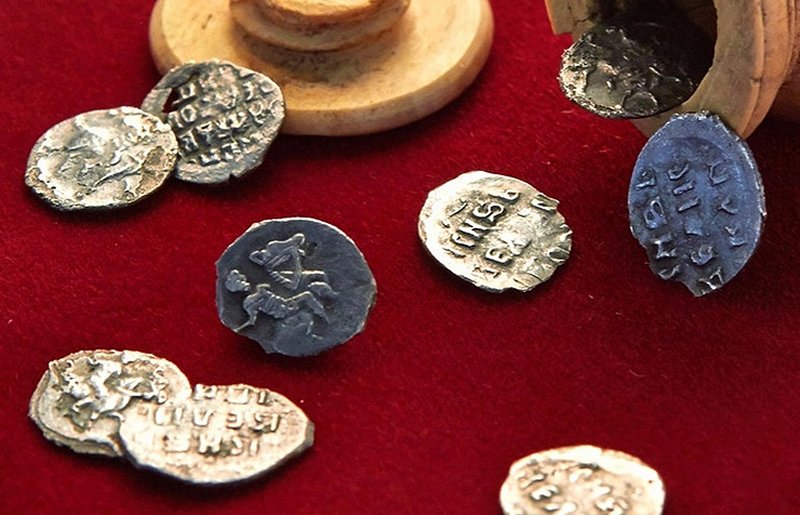
Silver Coins Found Inside Ivory Chess Piece

I missed this article - all the way back from May, 2017, but better late than never.  I haven't been able to find out anything about what happened to the Bishop these 10 silver coins were supposedly found in - inside a false bottom.  How big was the piece to have contained 10 coins in a false bottom?

You will note - not a word was said about the chess piece itself.  Evidently thus far this is the only chess piece  in this area because I've read nothing on any other chess pieces being discovered.  But even a single ivory piece dating back to the time of Ivan the Terrible, first Czar of Russia from 1547 to 1584 would, I assume, be valuable.  I could not locate any photographs of the piece itself or any further mention of what happened to the chess piece.

Silver Coins Hidden In Chess Figure Date Back To Ivan The Terrible’s Days – Discovery In Moscow


A collection of silver coins dating back to the days of Ivan the Terrible. was recently unearthed during construction work in downtown Moscow, Russia.
SIlver coins date back to Ivan the Terrible's times. Image credit: TASS
Silver coins date back to Ivan the Terrible's times. Image credit: TASS
Ten silver coins found in an ivory chess bishop, were probably hidden from thieves or robbers according to Alexey Yemelyanov,  head of Moscow’s Cultural Heritage Department.
"Chess was a game played for money at that time. Maybe the person who owned the chess set did not want to carry money in a purse out of fear of being robbed, but wanted to be able to pay in case he lost," Yemelyanov said.
"In another version, Prechistenka [district in downtown Moscow] of that time had a lot of inns where chess was played, and this was the way inn owners stored the money,"said Yemelyanov, adding that "ten hand-minted silver coins were stashed in a bishop made of ivory. The total sum is five kopecks."

This is rather a unique  discovery because  money is found only on rare occasions, and now Moscow museum workers will study the ancient chess pieces in their collections to look for more potential treasures stowed inside them, reports Russian News Agency TASS.
The deputy director general of a company providing archeological survey during construction work, Vladimir Berkovich, said the volunteer who had found the treasure trove was not rewarded for his discovery. "This is not customary among Moscow volunteers," he said. He also declined to reveal the treasure’s value, saying coin collectors must be consulted.
The coins date from the mid-16th century and among them, one was minted in Tver (a city about 174 kilometers northwest of Moscow) and the other nine - in Moscow.
"If each chess piece had the same stowage, the total sum of the stashed coins could amount to 160 kopecks," Yemelyanov noted, adding that no other chess pieces had been found yet.

Note:  There are only 9 coins in the photo, one of which appears to be halfway out of the empty bottom of something - the chess piece?  Who knows!

Sunday, August 11, 2019

Doing A Little Catch-Up:

Hola everyone!

It's a humid day threatening rain here in Milwaukee, but the stormy weather has given me a chance to do some catch-up at my poor, languishing Goddesschess blog.  As you know (or if not, I'm telling you now), I've been a member of the Chess Collectors International or CCI for many years.  I don't remember exactly when I joined, but I believe it may have been in the early to mid 2000's.  I receive the CCI magazines/news letters and the USA branch of the CCI also produces it own magazine that comes to me three times a year.

Recently I wrote about an exciting development - the CCI is going to be holding its biennial meeting in St. Louis, Missouri (USA) once again next year!  The first (to my knowledge) was in 2011, then in 2015, and now again next year in 2020.  Since I received the information, I've been thinking about possibly attending. I have a while before I need to make a decision.  I always like having those "whiles." 

The only CCI meeting I attended was in 2011, also in St. Louis.  It coincided at the time with the Kings v. Queens Tournament (also called "The Battle of the Sexes" Tournament) of American and international players being hosted at the St. Louis Chess Club, just a few blocks away from the hotel I booked a suite at for my friend of nearly 30 years, Georgia, and myself.  The chess club is right across the street from the World Chess Hall of Fame (and museum that features several new special exhibits, as well as shows and creative activities all year round.)  The Gift Shop at the World Chess Hall of Fame is something special - if you have a chance, visit it!

I went back earlier today to blog entries here from 2011 and refreshed my memories of the CCI meeting in 2011.  I did a summary in 2011 and in it I mentioned a few of the people I met as well as a special purchase or two I made at the CCI Auction that always closes out CCI get-togethers.

I met Duncan and Ann Pohl - Duncan is the current editor of the CCI-USA Magazine, and a most excellent job he does.  Mr. Pohl was one of the presenters in 2011; he started out a bit nervous, but soon got into the groove of his presentation on "vintage" American chess sets that don't cost an arm and a leg as many of the rare sets (or pieces) do that were crafted in the Old World, merely a couple of fingers or maybe a hand.  Yikes!  Both Duncan Pohl and his wife, Ann, were at a round table shared with  attendees (were there 10 or 12 of us - don't remember) including Georgia and I, at the CCI meeting at a lovely cocktail and dinner party.  I struck it off right away with Ann Pohl - such a lovely lady.  It was a lively group - the conversation hummed!

Mr. Pohl has produced a couple of books on American chess sets that would be of great help to a collector and of interest to any fan of the ancient game of the Goddess who wants to learn about American producers of chess sets, the materials used to make them, the rarity (or not) of such sets today, etc.  Both can be found at Amazon:

Chess Sets of the United States: Ready for Some Chess 'Tenite'? Paperback – May 14, 2014


Vintage Chess Sets of the United States Paperback – November 23, 2016


Later that evening after dinner, Ann Pohl introduced me to Rick Knowlton, who had also given a fascinating presentation at one of the CCI sessions.  We had a long chat about ancient chess and its origins, at least 30 minutes.  Among other things, Mr. Knowlton maintains a website on Ancient Chess (which I am particularly interested in).  He also did a "diary" online of his visit to St. Louis for the 2011 CCI meeting.  How wonderful then, to see that Mr. Knowlton and well-known chess historian Jean-Louis Cazaux produced a book (which you can find a Youtube video on), "A World of Chess:  Its Development and Variations through Centuries and Civilizations."  Also offered at Amazon. 

I also see that the BBC New program "The Forum" produced an episode by Mr. Knowlton and Mr. Cazaux that aired on April 19, 2019 and is available online in Podcast, "Chess: A Chequered History."

You just never know what these chess collectors and chess historians may get up to! 

2019 Perseid Meteor Showers

Hola darlings!

My birthday is a bit later this month and as I'm getting younger each year I won't bore you with the young age I'll be achieving soon :)

Tomorrow and Tuesday - August 12 and 13 - if you have clear skies check for the Perseid Meteor showers where you may see as many as 50 meteorites streaking across the sky each hour!  You should be able to see them all across the United States.  If you live in an urban area, don't expect to see much before 10 p.m. when the sky is dark enough for you to catch the brightest "falling stars."  Out in the countryside away from bright city lights, about an hour after sunset should give you a front-row seat.

You can read more about this year's Perseids in this article at The Washington Post. 

Monday, August 5, 2019

Interesting Observations on Kingship

I've had reason recently to dip back into Barbara G. Walker's incredibly informative "The Woman's Encyclopedia of Myths and Secrets" and I came across this entry on KINGSHIP.  Here is a part of it, verbatim, that I typed word for word from my 1986 edition.

If you want to read the entirety of the lengthy and very informative/interesting entry online, you can find a scanned edition of "The Woman's Encyclopedia of Myths and Secrets" online at archive.org (also in various formats, including PDF and in various zip formats, that you can read online or download).  It is the complete 2007 edition with footnotes and Bibliography.  I have found this book to be an invaluable resource in doing my research over the years and it is a treasure trove of information.

Kingship

In early Asiatic civilizations, kingship depended on the choices of women.  There was no law of primogeniture.  Kings were rarely succeeded by their sons.  Kings of Sumeria and Assyria were of unknown fatherhood.  King Esakhuruna was called "the son of Nobody." (1)  Women were the kingmakers in the land he ruled. (2)

Marriage with the earthly representative of the Goddess, in the form of the queen, was essential to the position of kingship; this was the original meaning of "holy matrimony" (hieros gamos).  Akkadian kings apparently went on military expeditions chiefly to prove themselves worthy of the sacred marriage. (3)

Ashurbanipal said he ruled by the grace of the Goddess Ishtar, he was he king "whom her hands created."  Shamash-shum-ukin of Babylon said he was chosen for kingship by the same Goddess under her title of Eura, Queen of the Gods.  King Esarhaddon of Assyria said he was "beloved of Queen Ishtar, the goddess of everything, the unsparing weapon, who brings destruction to the land of the enemy." (4)  Ishme-Dagan, king of Isin in 1860 B.C., said he was "he whom Inanna, queen of heaven and earth, has chosen for her beloved husband.(5)  The Bronze Age King Iion of Thessalian Lapithis married the Mother of the Gods after killing her former mate, described as his father-in-law, because each king's successor was supposed to call his defeated rival "father."(6)  The queens were the same as Goddess, or Mother of God.  The pharaoh Amenhotep III built a temple for his wife Ti, who was worshipped as the Goddess. (7)

The goddess-queen's choice largely depended on the candidate's sex appeal.  If she tired of the king's lovemaking, he could be deposed or killed, for the queen's sexual acceptance of him determined the fertility of the land.  In many early societies the old king was killed by the new king, usually called a "son," though he was no blood relative.  Hence the unbroken chain of Oedipal murders that puzzled modern scholars before it was known that the words "father" and "son" were used in a different sense.  A Babylonian tablet says:

Haharni laid claim for himself to lordship over Dunnu.  Earth raised her face to her son Anakandu, "Come let me make love to you,"she said to him; in Dunnu, which he loved, they laid him to rest.  And Anakandu took over his father's lordship and Nether Sea, his sister, he took (as wife).  Lahar, son of Anakandu, came and Anakandu he killed and in Dunnu in the (tomb) of his father he caused him to rest.  Nether Sea, his mother, he took (as wife). (8)

After this Lahar's son killed Lahar and took his sister River as wife; he in turn was killed by his son, who married his sister Ningesh-tinna, "Lady of the Vine of Heaven," a shortened name of the Goddess Nin-gest-inanna.  Sovereignty passed from mother to the daughter, beginning with Earth, the Goddess Dunnu herself, foundress of the line - the same as Crete's Danuna, Anatolia's Danu, Greece's Danae, the Gaulish Diana.  Kings were expected to kill their predecessors or pseudo-fathers, "Son" meant "successwor," and "wsister" was synonymous with "wife." (9)

The length of a king's reign was often predetermined, because people thought the Goddess needed the refreshment of a new lover at stated intervals.  Up to 1810 A.D., kings of Zimbabwe were ceremonially strangled to death by their wives at the moon temple every four years. (1)  Kings of ancient Thebes reigned for seven years; so did kings of Canaan.  Myths suggest a similar seven-year period for each king of Crete.  Cretan kings were never allowed to grow old, they always died in the full bloom of youth. (11)  More recently, Nigerian kings were strangled after the queen's pregnancy was established, which meant each king fulfilled his role in life by begetting one royal offspring. (12)

White explorers in Africa spoke of tribal "kings," but rarely mentioned that the real rulers of the tribes were queens.  "In the oldest times there were no reigning princes in Africa, but the negroes had large kingdoms [sic] which were ruled by goddesses. (13)  Ghana was governed by kings of matrilineal succession whose divine right passed through sisters' sons.  The Lovedu were ruled by a female "king" who took a series of lovers but always left the government to one of the royal princesses. (14)  Angola was ruled by women until the Portuguese invasions.  Ashanti was ruled by queens until the British Protectorate in 1895.  Its kings were subject to the queen mothers; its princesses took no husbands but kept a series of lovers.  Similar customs obtained in Loango, Daura, the country of the Abrons, and other African nations.  The queen of Ubemba was called Manfumer, "Mother of Kings," and did all the governing. (15)

The Gospels' "Candace queen of the Ethiopeans" (Acts 8:27) was not a single individual but the hereditary title of queen mothers who governed the Nubian states. (16) Ethiopian kings were ritually slain from the earliest times.  Regicide was still the custom of Nubian Kassites of the Upper Nile in the 1st century B.C.  Diodorus said only one Ethiopian monarch escaped the kingly fate because he was educated in Greece and dared to disobey tribal law.  He led a party of soldiers into the sanctuary and killed all the priests before they could kill him. (17)

The Javanese Singasari dynasty had matriarchal queens similar to Candace, typified by Queen Dedes whose statues show her as a beautiful Shakti of wisdom.   She married a number of new kings after they killed her previous consorts, each apparently holding office for a seven-year period. (18)

Legends consistently associate kingship with ceremonial death.  A seal from Lagash shows the Goddess taking her new kin by the hand, while he raises a weapon to slay the old king, prostrate under the queen's feet. (19)  King Sennacherib of Assyria was "beaten to death with stauettes of the gods," in the temple at Nineveh.  Perpetrators of the deed were his "sons," one of whom succeeded him as King Esarhaddon.  Upon his succession, Esarhaddon proclaimed"  "I am powerful.  I am omnipotent.  I am a hero, I was gigantic, I am colossal!" (20)

Sometimes, kings had to proclaim they were embodiments of the Goddess herself so as to rule with the same authority as queens.  Antiochus of Commagene announced that he could rule because he was the Goddess. (21)  A king's investiture used to mean putting on female robes, so the king could be displayed as a transvestite Goddess (see Transvestism).

In the ancient Middle East generally, kings were not so much governing figures as ceremonial ones, primarily concerned with dedication of temples and other religious responsibilities. (22)  Sometimes they were also war leaders, able to preserve their lives in time of danger by convincing the people that no one else could defeat the enemy.  In such a case, a surrogate victim might be found - a real or adopted son, a prophet, a condemned criminal, or a divine animal.

A war leader of Carthage "clothed his best and most beloved son in royal robes and crucified him as a sacrifice" to secure the blessing of Baal on his military campaigns. (23)  Similarly, the god-king Isra-El clothed his only-begotten son Ieud in royal robes and sacrificed him "according to the custom of the Jews," as Philo said. (24)   The king became Jesus, "king" of the Jews (John 18:33).  Since a king was God, any king's real or adopted son was naturally the Son of God, and Yahweh himself was embodied in the Jewish king.  "In the early period of the Hebrew monarchy the central element of the annual New Year festival was the ritual enthronement of Jahveh as King. (25)

Son-killing was a habit, not only of the Jewish god-king but of many other god-kings who modified the old custom by shedding the blood of someone else in the proper season.  A Swedish king named Aun extended his reign for nine years by sacrificing one of his nine sons each year to ransom his own life. (26)

Footnotes and Bibliography for the material above:

1.  Assyr. & Bab. Lit., 198.
2.  Bachofen, 215.
3.  Hooke, S. P., 49.
4.  Assyr. & Bab. Lit., 91, 114, 130.
5.  Gray, 59.
6.  Campbell, C. M., 422.
7.  Budge, D. N., 83.
8   Albright, 94.
9.  Albright, 94, 128.
10.  Lederer, 132.
11.  Campbell, Oc. M., 59.
12.  Stone, 132.
13.  Briffault 3, 26-32.
14.  Hays, 296, 312.
15.  Hartley, 161.
16.  Briffault 3, 41.
17.  Campbell, P. M., 200.
18.  Campbell, M. I., 216-17.
19.  Campbell, Oc. M., 42.
20.  de Camp, A. E, 64.
21.  Cumont, M. M., 95.
22.  Hooke, S. P., 49.
23.  de Lys, 450.
24.  Frazer, G. B., 341.
25.  Hooke, S. P., 110.
26.  Frazer, G. B., 337.

1.  Assyrian and Babylonian Literature, Selected Translations, New York: D. Appleton & Co., 1901.
2.  Bachofen, J. J., Myth, Religion and Mother Rite, Princeton, N. J.: Princeton University Press, 1967.
3.  Hooke, S. H., The Siege Perilous, Freeport, N. Y.:  Books for Libraries Press, 1970.
4.  Assyrian and  Babylonian Literature, Selected Translations, Ibid.
5.  Gray, John, Near Eastern Mythology, London: Hamlyn Publishing Group Ltd., 1963.
6.  Campbell, Joseph, The Masks of God: Creative Mythology, New York; Viking Press, 1970.
7.  Budge, Sir E. A. Wallis, Dwellers on the Nile, New York: Dover Publications, 1977.
8.  Albright, William Powell, Yahweh and the Gods of Canaan, New York: Doubleday & Co., 1968.
9.  Albright, William Powell, Yahweh and the Gods of Canaan, Ibid.
10.  Lederer, Wolfgang, The Fear of Women, New York: Harcourt Brace Jovanovich Inc., 1968.
11.  Campbell, Joseph, The Masks of God: Occidental Mythology, New York:  Viking Press, 1964.
12.  Stone, Merlin, When God was a Woman, New York: Dial Press, 1976.
13.  Briffault, Robert, The Mothers (3 vols.), New York: Macmillan, 1927.
14.  Hays, H. R., In the Beginnings, New York: G. P. Putnam's Sons, 1963.
15.  Hartley, C. Gasquoine, The Truth About Woman, New York: Dodd, Mead & Co., 1913.
16.  Briffault, Robert, The Mothers (3 vols.,) Ibid.
17.  Campbell, Joseph, The Masks of God: Primitive Mythology, New York: Viking Press, 1959.
18.  Campbell, Joseph, The Mythic Image, Princeton, N. J.: Princeton University Press, 1974.
19.  Campbell, Joseph, The Masks of God: Occidental Mythology, Ibid.
20.  de Camp, L. Sprague, The Ancient Engineers, New York: Ballantine Books, 1960.
21.  Cumont, Franz, The Mysteries of Mithra, New York: Dover Publications, 1956.
22.  Hooke, S. H., The Siege Perilous, Ibid.
23.  De Lys, Claudia, The Giant Book of Superstitions, Secaucus, N. J.: Citadel Press, 1979.
24.  Frazer, Sir James G., The Golden Bough, New York: Macmillan, 1922.
25.  Hooke, S. H., The Siege Perilous, Ibid.
26.  Frazer, Sir. James G., The Golden Bough, Ibid.

My Notes:

1.  Frazer's The Golden Bough (my edition is a 1963 paperback issued by Collier Books of Macmillan Publishing Company, New York) has an entire chapter devoted to "The Killing of the Divine King" (Ch. XXIV) and consisting of:  I.  The Mortality of the Gods; II.  Kings Killed When Their Strength Fails; and III.  Kings Killed at the End of a Fixed Term.

There are also separate chapters devoted to:  Ch. XXV -- Temporary Kings; and Ch. XXVI -- Sacrifice of the King's Son (also cited in Walker's "The Woman's Encyclopedia...").  This would be considered a form of "substitute" King sacrifice.

2.  Wikipedia has an interesting entry on the ancient Egyptian Sed festival or "Jubilee," that tested the stamina and physical/mental fitness of the Pharaohs.  You may want to follow-up on Footnote 4 in the Wikipedia entry:

3.  For some "light" reading (har!), check out Human Sacrifice in Jewish and Christian Tradition by Karin Finsterbusch Amin Lange at Google Books online starting on page 21 under "5.3.  Ritual of the Substitute King."
Related Posts Plugin for WordPress, Blogger...