Showing posts with label goddess symbolism. Show all posts

Friday, February 26, 2016

Is This the Oldest Depiction of the Virgin Mary?

The Virgin Mary/Maria is a Christian incarnation of the ancient Mother Goddess, She who has gone by various names throughout written and unwritten history: Mariah/Maya/Mari/Mare/Amaya/Astarte/Ishtar/Inanna/Isis/Hathor/Mut, etc.

The myth of a virgin giving birth to a "god" or demi-god through an "incarnation" is nothing new -- having shown up throughout the ages in various forms and cultures around the world (not just the Middle East). What I find most fascinating about this article is the association of the ancient Mother Goddess with water symbolism which means, essentially, She is the giver and sustainer of life itself.  No water - no life. Thus, she is feared above all others because she controls life itself, and her representatives on Earth -- females -- are feared above all else by the males of all species, and by male homo sapiens sapiens most of all.

Article at The New York Times:

Is This the Oldest Image of the Virgin Mary?

By MICHAEL PEPPARD
JAN. 30, 2016

THE Virgin Mary, the mother of Jesus, is the most revered woman in the Christian tradition. In the history of art, she appears almost as frequently as Jesus himself. But for the past 80 years, one of the oldest paintings of her may have been hiding in plain sight.

At the Yale University Art Gallery hang wall paintings from one of the world’s oldest churches. Buried by the middle of the third century, this house-church from eastern Syria had images of Jesus, Peter and David. The gallery showcases a well-preserved procession of veiled women that once surrounded its baptistery, a room for Christian initiation.

Off to the side, seldom noticed among the likes of Jesus and Peter, stands a different wall fragment, faded but still discernible: a woman bent over a well. Holding the rope of her vessel, she looks out at the viewer or perhaps over her shoulder, seemingly startled in the act of drawing water.

A detail of the baptistery painting from Deir ez-Zor, Syria, that may portray the Virgin Mary.CreditTony De Camillo/Yale University Art Gallery
Who is she? The museum’s identification is certainly plausible: “The painting most likely depicts a scene from the encounter between Christ (not shown) and a woman from Samaria,” as recorded in the Gospel of John.

But historians also know that the Samaritan Woman, a repentant sinner who conversed at length with Jesus, was usually depicted in dialogue with him. This woman appears to be alone. Is it possible that a painting from a building excavated in 1932 and publicized around the world has not been correctly identified?

These murals come from the eastern frontier of the Roman Empire, a military outpost variously called “Dura” or “Europos” in antiquity. Perched high above the Euphrates in the region that is now called Deir ez-Zor, the ruins of Dura-Europos have yielded more distinct artifacts than almost any other ancient archaeological site: an intact Roman shield, a lavishly painted synagogue, a temple to the gods of nearby Palmyra. It is the “Pompeii of the Syrian desert,” declared Michael Rostovtzeff, director of Yale’s excavations at the site.

 But no Vesuvius buried this Pompeii. Portions of Dura-Europos were buried intentionally, to bolster a rampart against a Sasanian army invading from the east in the 250s. The misfortune of the Roman garrison, which lost the battle, would become good fortune for historians. The earthen rampart sealed cross-sections of many buildings, including the house-church, so that both contents and date were secure.

The church’s painted baptistery remains a unique discovery. Outside of funerary contexts, such as the catacombs in Rome, there are precious few Christian paintings from before Emperor Constantine’s conversion to Christianity in the fourth century. These also offer a glimpse into the beliefs and rituals of Syrian Christians, a community currently in peril.

While the Samaritan Woman at the Well was a respected biblical figure for early Christians, there was actually a more prominent “woman at the well” in Syria: the Virgin Mary during the Annunciation, when an angelic visitor informed her of her miraculous pregnancy. Where does this episode take place? The setting of the canonical account, in the Gospel of Luke, is not specified. But the second-century biography of Mary’s early life, usually called the Protevangelium of James, describes how one day, during a break from her work, “she took the pitcher and went forth to draw water, and behold, a voice said: ‘Hail, you are highly favored, the Lord is with you, blessed are you among women.’ And she looked around on the right and on the left to see from where this voice could have come.”

During this first encounter, at a well or spring, the angel was heard but not seen. Mary appeared to be alone. Most people, when they imagine the Annunciation, have in mind some western Renaissance masterpiece: a studious, cloistered Mary welcoming the angel from the comfort of home. But Byzantine images of the scene, though coming centuries later than the figure from Dura-Europos, bear an arresting formal resemblance to it.

An annunciation scene from a Byzantine 12th-century illuminated manuscript.CreditBibliothèque Nationale de France
The brilliant illumination in James of Kokkinobaphos’s “Homilies on the Virgin” and the grand mosaic from the Byzantine monastery at Chora in Istanbul both demonstrate the importance in eastern Christianity of placing Mary at the well.

Some manuscripts even depict this type among illuminations of the Gospel of Luke itself, showing that artists preferred the evocative iconographic traditions of the noncanonical text over the unspecified setting of the canonical one. At Chora, Mary’s figure can also be contrasted with the portrayal of the Samaritan Woman in the same church, who looks across a well at a pictured Jesus.

The woman at Dura-Europos has yet more secrets to reveal. Archival photographs and drawings made by the archaeologists on site show that the supposed absence behind the female figure is not totally silent — it speaks a couple of lines. That is to say, a field sketch of the wall done “to show additional details” depicts two painted lines touching the woman’s back, along with a kind of starburst on the front of her torso, features described as “unexplained” in the archaeological report. But with the new interpretation of the figure, in connection with the Eastern iconography that came later, the lines invite a rather evident meaning. They appear to represent a motion toward the woman’s body and a spark of activity within it, as if something invisible were approaching and entering her — an incarnation. If correct, this woman at a well is the oldest securely datable image of the Virgin Mary. [Ed. Note: Absolutely major!  There will be vehement scholarly protests, let's see if they trickle down into The NYT in future editions!]

Devotees of the Roman catacombs may demur, since a few female figures there are often presented as Mary. But these are challenging to date with certainty, and many scholars argue that the proposed examples have insufficiently specific iconographic signifiers.

Identifying the oldest image of Mary isn’t an end in itself. Re-identifying this woman helps us to ponder anew the distinctive emphases of early Christians in Syria, who in this baptistery celebrated salvation through images of marriage, pregnancy and birth — as much or more than through participation in a ritualized death [the symbolic eating of the corpse and drinking of its blood]. This is not to undermine the power of Jesus’ passion and resurrection accounts, but rather to rebalance the perspective of modern Western viewers, looking back after centuries of art focused on the cross. In the extant art from Dura-Europos, we see the hope of new spiritual birth, but the death of Christ is not pictured once.

Today the paintings from this church are safe. But further opportunities to understand early Syrian Christianity are slipping away, as the archaeological sites of Deir ez-Zor are being systematically plundered under the auspices of the Islamic State. According to satellite images and reports from the ground, the looting pits at Dura-Europos are innumerable. Even while the human tragedy of the refugee crisis justifiably occupies our attention, the destruction of cultural heritage tells a parallel narrative. Images from this ancient Syrian church are thus much more than museum pieces. They illuminate a people and heritage that need salvation — and not the kind of salvation found in a baptistery. [Ed. Note: And thus damn good reason to NEVER REPATRIOT ANY ARTIFACT THE WEST HAS REMOVED from the Middle East or elsewhere.  There are ISIR/Daesh lurking around every corner, every era.]

Michael Peppard is an associate professor of theology at Fordham University and the author, most recently, of “The World’s Oldest Church: Bible, Art, and Ritual at Dura-Europos, Syria.”

Tuesday, January 1, 2013

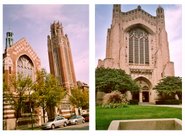
The Notre Dame Cathedral (Paris) Celebrates 850th Birthday!

She wears her age well, this Grande Dame :)  I'll bet it was built upon an ancient sanctuary of goddess worship.  It has all of the hallmarks:  It was built on a island (check); it either had it's own source of water or was near a conjunction of rivers (check); it's named after the Roman Catholic Mother of God (check).  It incorporates well-known (if not to laymen of today) Goddess symbols ("Rose Window," bells, etc.)


This is the "Rose" Window of Notre Dame Cathedral in Paris.  If you count the small circles around the center-most circle in the "rosette," there are eight.  Eight, the number of the Goddess from ancient times, as in the eight-pointed rosette symbol of Inanna, back in the days of ancient Sumer.  Many "rose windows" also have center-most circles of five, another sacred number codified in the Fibonnaci Spiral and seen in nature repeatedly.  See "Rose Window" at Wikipedia for some great photographs of many different "Rose" windows. 


Paris Notre Dame cathedral turns 850 years old
December 24, 2012


Friday, February 13, 2009

The Eternal Female: Worship of the Mother Goddess

Hola darlings! This is my final post for the time being, and perhaps for the night. I'm hungry and I have fixings downstairs for my infamous stick-to-your spoon, ribs, kidneys, liver and intestines cheeseburger casserole calling out to me. Tomorrow I am going shopping for a new bathroom light fixture for the upstairs bath and some area rugs for the upstairs bedrooms and hallway. If I am successful in finding a reasonably-priced light fixture, I will hunt for a reasonably-priced electrician (har!) to install it! Then it's on to painting. dondelion won't recognize the place when he arrives in May... (Image: Minoan snake goddess, circa 1600-1500 BCE) Talk about synchronicity. I recently posted about the importance of the vulture goddess and the snake goddess in ancient Egypt, and about the serpent goddes symbolism incorporated into one of the most ancient twenty squares game boards ever to be uncovered in the form of intertwined serpents forming the playing surface: the wooden game board from the Burnt City in the borders area of Iran/Afghanistan/Pakistan, dating to about 2400 BCE. Tonight I came across this post - it was a headline at The Independent, but I received an error message when searching for the article there. From sci.tech-archive.net. (Seems a rather strange place to have an article about the Mother Goddess, but as I've said before, what do I know?) The eternal female: Worship of the mother goddess From: Jack Linthicum Date: Thu, 12 Feb 2009 05:28:34 -0800 (PST) Stonehenge, Crete, Thera, pretty much a tourist's tour of the Bronze Age, and earlier, cultures that honored or featured women. But the author has missed the revelations about the Phaistos Disk. The eternal female: Worship of the mother goddess Thursday, 12 February 2009 Some experts believe megalithic societies were matrilineal, with womenplaced at the apex of the civilisation – not as rulers, but as birth-givers. Perhaps a line can be traced from the Natufian women of Lebanon, or even as far back as the 24,000-year-old Venus ofWillendorf . After all, women were the original seed-gatherers while men went out to hunt. It was they who probably developed the most intimate expertise in agriculture, using instinct and common sense to select the best seeds for the next year's crops, unwittingly instituting what we now call artificial selection. The mother goddess took a variety of different forms. Sometimes she was a snake, or a vulture, or the Moon. Each symbol represented a cycle of death, birth and regeneration: the snake hibernates, then wakes up and sheds her skin; the vulture recycles dead flesh by eating it; and the Moon dies and is reborn every 28 days, mirroring the feminine menstrual cycle. Moon worship was very highly advanced in megalithic times. It has recently been recognised that temples such as Stonehenge were originally built to glorify the Moon as well as the Sun. Every month, shafts of moonlight line up perfectly with gaps in the massive stones, the architects having positioned them precisely to accommodate the subtly shifting patterns of the Moon's rising and setting cycles, that repeat themselves exactly every 18.6 years. The full moon has had historic and religious significance going back thousands of years,since it was by the light of the full moon that many hunter-gathering tribes hunted, providing the best opportunities for a good catch. Matriarch island: The enigmatic civilisation of Minoan Crete Europe's mother goddess culture grew to its climax on the Mediterranean island of Crete in the second millennium BC. Here it also survived longest. Crete thrived on trade routes that linked the Mediterranean with the rest of megalithic Europe and North Africa. The flowering of the island's Minoan civilisation coincided with the growth of the Indus Valley civilisation, from c3300 to 1700 BCE. Homer, a Greek poet who wrote in the eighth century BCE, claimed there were as many as 90 cities on Crete, and archaeologists have found a number of "palaces", including the largest of all at the island's capital, Knossos. The discovery of this ancient island civilisation was chiefly the work of Sir Arthur Evans, an eccentric but meticulous Victorian archaeologist. As soon as he set foot on Crete in 1894, Evans rigorously pursued the mystery of the mythical King Minos, who, legend has it, ruled from a fabulous palace at Knossos which housed an appalling monster, the minotaur. Half-man, half-bull, this beast lived in an impenetrable maze and feasted off the flesh of still-living virgins. Minoan Crete was like a heart pumping at the centre of the Bronze Age trading system. Its trade links stretched as far as Mesopotamia in the east, to Spain in the west. Tin and copper were imported and exported for smelting into bronze, while luxury crops such as bright yellow saffron were grown in the island's fields and exported as flavouring for food. Evans discovered that the people of ancient Crete followed the megalithic tradition. Women and men had equal rights. Wall paintings from the palaces of Knossos and Phaistos show that women were able to express themselves freely. They are depicted as bare-breasted, wearing short-sleeved shirts open to the navel and long, flowing, layere dskirts. Statues, vases and wall paintings show images of sporting contests where women competed equally alongside men. The island's favourite sport was the impossible-sounding bull-vaulting. An acrobat (sometimes female) would grab the horns of a bull and somersault on to its back. Then, in a second somersault, she would leap off its back and land upright, with her feet back on the ground. No wonder Minoan women were the first people known to have worn fitted garments and bodices – essential prerequisites, you would think, for a sport like this. Women did not dominate society, but they did oversee it. Frescoes at the palace of Thera, on the island of Santorini,100km north of Crete, show women standing on balconies overseeing processions of young men who are carrying an animal for sacrifice. Most priests on Minoan Crete were female. In Minoan law, women retained full control of their property. They even had the right to divorce at pleasure. It was a tradition, too, that a mother's brother was responsible for bringing up her children. Customs such as these, which seem strange to us today [what is so strange about a woman having control of her own property and the right to divorce at will? In western civilization, these rights are taken for granted, they are the norm], lingered long in the Mediterranean mind. Minoan palaces were not mighty and dominant like those in Egypt or Sumeria. Rather, they functioned as the region's communal administrative and religious centres, providing a place of work for craftsmen, storage spaces for food and temples for goddess-worship. One look at a model reconstruction of the palace at Knossos and you can understand why Greek invaders might later imagine that the corridors and irrigation channels resembled an impenetrable maze. Like the traders of the Indus Valley and other European megalithic people, the Minoans had their own form of symbolism which shows that their civilisation was culturally and technologically advanced. In 1903, archaeologists excavating the palace of Phaistos, on the southern side of the island, made a discovery which has had historians baffled ever since. The Phaistos Disc, currently on display at the archaeological museumin Herakleion, Crete, is thought to date from some time between 1850 and 1600 BCE. It contains 45 unique symbols arranged in a spiral shape, resembling the swirls found on vases at Knossos, or even in European megalithic tombs such as that at Newgrange in Ireland. No one really knows who made the disc, or what the symbols mean, but it does show that the people of Minoan Crete were artistic, prosperous and highly ingenious. Following excavations at a site called Akrotiri in 1967, the Minoans are now known to have spread to the island of Santorini. There, archaeologists have discovered the remains of a vast, ancient island city which had been buried for thousands of years under thick layers of volcanic ash. Although only the southern tip of the town has so far been examined, houses three storeys high have been unearthed with fine wall paintings, stone staircases, columns and large ceramic storage jars, mills and pottery. Minoan Akrotiri even boasted a highly developed drainage system, featuring the world's first known claypipes with separate channels for hot and cold water supplies. A distinct pattern is discernible from the evidence that has been left by these early civilisations. Stretching from the ancient Indus Valley, right across the mountains of Anatolia, to the islands of the Mediterranean and as far as the topmost island of Orkney in Scotland,what emerges is a series of like-minded civilisations whose temples and graves bear witness to a lifestyle of peace and a veneration for mother nature. Their common belief in the continuous cycle of birth, death and regeneration is personified by their worship of a mother goddess in all her forms: snake, vulture, pregnant woman or moon. Excellence in craftwork, technical skill and exquisite art are some of their legacies, along with a spirit of natural equality. This was not to continue. During the second millennium BC, the last of these early civilisations fell. New power in the form of military might was sweeping across Europe, the Middle East and Asia. [made possible, in no small part, by the invention of the eight-spoked wheel that enabled the invention of a light-weight and swift war chariot, I posted about a day or two ago.] Warriors had worked out how to prey off the profits of others, ushering in an age when human elitism, ruthlessness and terror had their true beginnings.

Tuesday, December 2, 2008

Love and Sex in the Renaissance

Probably no chess tonight - I'm chessed out - and shoveled out. More than a foot landed in my driveway due to drifting and blowing, despite the fact that "officially" we only got 3 inches. Ha! More snow due tomorrow night, up to 5 inches. So far, this December is turning out to be a near-carbon copy (as far as I remember) of a year ago, when we had near record-breaking snow fall, over 100 inches. I saw this exhibit advertised at the Met in New York - looks fascinating. I picked out threeinteresting objects from it. My take on the exhibit is decidedly different from the reviewer's article: Art Review 'Art and Love in Renaissance Italy' Eternal Objects of Desire November 20, 2008 The objects I zeroed on present goddesses and/or women (representing goddesses) in close association with dogs, in an erotic context. "Sex" is used to gloss over the underlying concepts of women's unique power to bear life and the monthly menstruation of blood during the fertile years - blood representing the life of the earth, the very rhythym of the interaction of the earth and the moon every 28 to 32 days. This association has been recorded in surviving relics as far back as 25,000 years ago. Unfortunately, the condition of women as equals of men, who each held unique places in the conception of the universe, was obliterated particularly with the advent of the "warrior god" religions (Jews, Christians and Muslims) which still, unfortunately (and with telling results) dominate the world today. As always, women and children continue to be the primary victims of the non-stop warfare carried on by males in these three religions against each other. The association of goddesses and dogs is extremely ancient, perhaps due to the possibility that it was women who first domesticated wolves who followed hunter/gatherer bands across the landscape. Canines were domesticated about 16,000 years ago, possibly even further back. There is also an association of the Triple Goddess, representing birth, fruition, death-rebirth with her companion dog as eater of the dead in preparation for rebirth of the soul of the deceased. This too, is a very ancient association. There is the association of the Goddess with the numbers 8 (in western chess, symbolized in the 8x8 board) and 9 (in Chinese chess the board is 2 sides of 8 by 4 squares divided by the Celestial River which is not played upon, and the "King" piece is confined to an area of 2x2 squares - which measures 3x3 "points" -- in Chinese chess the pieces are placed not upon the squares but upon the intersection of the squares, resulting in 9 x 8 total playing points, or 72). And there are the ancient Indian traditions of the Goddess number 4-3-2, which totals 9, and the eight-legged female spider who continuously weaves her web of the universe. Painting #1 is, I think, the most light-hearted of the lot. It is ”Venus with an Organist and a Dog,” detail, by Tiziano Vecellio, circa 1550. While the article points out the obvious phallic symbolism of the "upright organ pipes" (har!) and the "upright" trees in the verdent "nature tamed" background (implying, evidently, that the Goddess of Love could be tamed - what a joke!), Venus herself is playing with her doggy friend, seemingly ignoring the organist whilst coyly pressing one foot into the small of his back. Venus is definitely playing the Game! It wasn't for nothing, you know, that the ancient game players often used "dogs" as playing pieces. Notice the ornate red draperies and the blood-red (also known as royal purple) bed covering that Venus reclines upon. As for the organist, I think his body language and the expression on his face is self-explanatory. Object #2 is called a birthing platter, depicting the meeting of Solomon and the Queen of Sheba from the workshop of Francesco del Cossa, circa 1470-73. Ignore the then current clothing styles of the protagonists! Items of note are the outer-sanctum black and white checkerboard floor, upon which three dogs lounge, and the inner-sanctum red (there's that life blood again) and black checkerboard floor). The entire painting is set on a 3x3 grid (3x3 = that Goddess number 9) -- notice how the laticed-pergola under which Sheba and Solomon meet is aligned with the tall middle tower of the church, which is flanked by two lower domes (perhaps representative of feminine breasts - the tower being a phallic symbol). Notice what is in the center of the painting - a "grail" - i.e., chalice! "Da Vinci Code" fans will recognize the grail, er, chalice, as a female symbol for fertility - it's the classic delta shape - and the "stem" - well, I think you can figure it out. The #3 painting is the most ironic of all - it depicts a young naked virgin being pursued by a young man (the dude on the horse) whom she has rejected. He has his hunting dogs attack her in the midst of a wedding feast where she has sought aid. Irony, indeed, since the Goddess Artemis was always accompanied by her hunting dogs, whom she often set upon encroaching young men! The young naked girl represents beauty, youth, and virginity - the essential aspects of the first part of the Triple Goddess. The young dude on the horse ends up killing himself after the Virgin is killed by his dogs. The horse symbolism of potent masculinity run amok is rather obvious - continued to this day in the form of the "knight" upon the chessboard, by the way. I can well imagine what the horrified bride at the wedding feat must be thinking. However, the caption is perhaps most telling of all, and presents an irony upon irony since the article was written by a female art critic. Here is what she says: A panel by Botticelli’s workshop depicts a wedding feast interrupted by a young nude woman being attacked by dogs. In short, she rejected him and he committed suicide, two unforgivable sins. The bride and groom in both the painting and the room it decorates will know better. (Photo: Museo Nacional del Prado, Madrid) Oh, really? The bridge and groom will know better? Run, bride, run!

Related Posts Plugin for WordPress, Blogger...