"Despite the documented evidence of chess historian H.J.R. Murray, I have always thought that chess was invented by a goddess."
George Koltanowski, from Women in Chess, Players of the Modern Game
Showing posts with label the peopling of America. Show all posts
Showing posts with label the peopling of America. Show all posts
By Matthew Martinez
July 13, 2018; Updated July 13, 2018 12:10 p.m.
A new archaeological find suggests that humans inhabited America, specifically parts of what is known today as Texas, as far back as 21,700 years ago. A group of scientists led by Thomas Williams of Texas State University recently unearthed more than 150,000 human-modified stones at the Gault Archaeological Site in Central Texas, about 40 miles north of Austin. The group doesn’t claim to have nailed the answer to the question, “Who were the first Americans?” but they might have discovered another runner in that race. The find illustrates “the presence of a previously unknown projectile point technology in North America from before [16,000 years ago],” say their findings, published in the July 11 edition of the journal “Science Advances." Williams' team of archaeologists excavated the Texas bedrock and uncovered ancient rocks shaped into bifaces — used as hand axes — blades, projectile points, engraving tools and scrapers dating to between 16,700 and 21,700 years. They refer to the tools as the Gault Assemblage. Not much about the physical traits of those who used tools can be inferred from the material in the find, but its significance lies in how old the items are. The team used optically stimulated luminescence to age the materials, which means they were able to find how long it had been since the sediment the items were found in had been exposed to sunlight, according to Science News. After a haul of flint spearheads near Clovis, New Mexico, was uncovered in the 1930s, popular scientific belief held that the first occupants of the Americas — referred to as the Clovis culture— arrived about 13,000 years ago, according to National Geographic. But the Gault find is one of several more recent — and deeper — digs that are putting that theory to bed. Material attributed to the Clovis people was previously unearthed at the Gault site — finds dating to the Clovis period have also been found in Colorado and Utah, according to PBS. But what Thomas and his crew found is older, and was found — perhaps predictably — deeper in the ground. If these Americans indeed occupied parts of Texas in the time range identified by the Gault Assemblage, they probably arrived in the Americas during the peak of the last Ice Age, about 20,000 years ago, according to the BBC. At that time, North America would have been covered with permafrost and dotted with tall glaciers, which would have made for suboptimal travel conditions during their journey across the land bridge from Asia known as Beringia. Archaeological evidence of human habitation of the Americas before Clovis include finds at Bluefish Caves, Yukon, Canada; Topper, South Carolina; Meadowcroft Rockshelter, Pennsylvania; the Buttermilk Creek Complex in Texas; Cactus Hill, Virginia; Saltville, Virginia; Connley Caves, Oregon; several finds in Alaska; and several more in Brazil, Chile and Colombia.
It's been one of the most contentious debates in anthropology, and now scientists are saying it's pretty much over. A group of prominent anthropologists have done an overview of the scientific literature and declare in Science magazine that the "Clovis first" hypothesis of the peopling of the Americas is dead.
For decades, students were taught that the first people in the Americas were a group called the Clovis who walked over the Bering land bridge about 13,500 years ago. They arrived (so the narrative goes) via an ice-free corridor between glaciers in North America. But evidence has been piling up since the 1980s of human campsites in North and South America that date back much earlier than 13,500 years. At sites ranging from Oregon in the US to Monte Verde in Chile, evidence of human habitation goes back as far as 18,000 years.
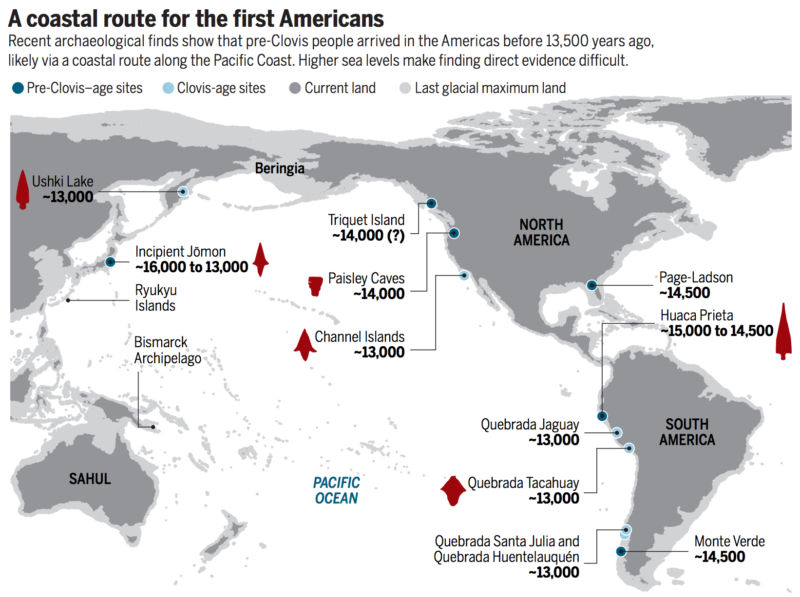
In the 2000s, overwhelming evidence suggested that a pre-Clovis group had come to the Americans before there was an ice-free passage connecting Beringia to the Americas. As Smithsonian anthropologist Torben C. Rick and his colleagues put it, "In a dramatic intellectual turnabout, most archaeologists and other scholars now believe that the earliest Americans followed Pacific Rim shorelines from northeast Asia to Beringia and the Americas."
Now scholars are supporting the "kelp highway hypothesis," which holds that people reached the Americas when glaciers withdrew from the coasts of the Pacific Northwest 17,000 years ago, creating "a possible dispersal corridor rich in aquatic and terrestrial resources." Humans were able to boat and hike into the Americas along the coast due to the food-rich ecosystem provided by coastal kelp forests, which attracted fish, crustaceans, and more.
No one disputes that the Clovis peoples came through Beringia and the ice free corridor. But the Clovis would have formed a second wave of immigrants to the continent.
Despite all the evidence for human habitation, ranging from tools and butchered animal bones to the remains of campfires, scientists are still uncertain who the pre-Clovis peoples were. We have many examples of Clovis technology, with characteristic shapes for projectile points made from bone and stone. But we have no recognizable pre-Clovis toolkit.
That may be about to change, however. The pre-Clovis people traveled along a now-drowned coastline, submerged after the last of the ice-age glaciers melted. New techniques in marine archaeology, ranging from ROVs to underwater lasers, are helping scientists explore ancient submerged villages. A team even turned up a 14,500-year-old campsite in Florida in a blackwater sinkhole last year. [Would these "campers" have travelled from Europe?]
Rick and his colleagues write that the big question now is when pre-Clovis people actually arrived in the Americas. They suggest the arrival could be as early as 20,000 years ago on the verdant kelp highway. Other researchers, however, say people could have arrived during a temperate period about 130,000 years ago. A recent paper in Naturedescribes what appear to be the 130,000-year-old butchered remains of mastodons in California, along with sharp stones used to deflesh the animals. There is plenty of skepticism in the scientific community about this discovery, but the evidence can't be ignored.
To the best of our knowledge, the kelp highway brought humans to the Americas. Using boats and fishing tools, humans made it all the way from Asia to the Americas, founding many coastal communities along the way. And now for the next debate: who were they, and when exactly did they arrive?
Hola everyone! I'm posting this article because it (1) hits on a subject I'm fascinated about - the peopling of the Americas and (2) shows the arrogance and ignorance that can happen in any given field of endeavor at any given time when someone steps outside the accepted limits of "the box" of standard thinking (hint: chess historians, I'm talking about you, not just the archaeologists back in 1913), and (3) Archaeologist Jim Adovasio steps on toes when he talks about the crucial role women played in developing civilizations around the world.
In the heart of the Treasure Coast, a team of archeologists is poring over a 14,000-year-old site that could completely rewrite the prehistory of the state and, to some extent, the prehistory of humankind in the New World.
But it took a last-minute intervention by Florida Atlantic University to assure The Old Vero Man site would be around to reveal its mysteries.
The dig's story began a century ago, with the Indian River Farms Company dredging a canal in a backwater called Vero in 1913 — the actual town of Vero Beach wouldn't exist for another six years. The dredging turned up old bones and other artifacts, which in turn drew the attention of state geologist Elias Sellards. He excavated over the next couple years, turning up more evidence of ancient human habitation.
Given the depth of the artifacts and the layers of rock around them, Sellards put human habitation in the area at 14,000 years ago, and was promptly laughed out of the archaeology business.
Back then, the prevailing thought was that people hadn't been in America before the last Ice Age, had not coexisted in the New World with mammoths, mastodons and other now-extinct Ice Age animals. A few decades later, in the 1930s, arrowheads and other artifacts from what experts called the Clovis culture meant that people had been in America some 11,000 years ago — still not ancient enough for Sellards' theory to hold water.
And so the Old Vero Man site sat largely untouched as Vero Beach grew up around it. It now sits on the south side of the Vero Beach Regional Airport.
In 2009, a proposed storm-water system would have dumped 200 tons of concrete on the site. That's when the Old Vero Ice Age Sites Committee was formed to make sure construction wouldn't destroy a valuable window into antiquity. They found enough to halt construction, but committee chair Randy Old needed to bring in an expert to do the serious digging.
"Because the site had this stigma of was it real or not, we had to get someone in here to do excavation that was beyond reproach," Old said. "So I started asking around, 'If you were going to choose an archaeologist for this site, who would you choose?' And everyone in the field said Jim Adovasio. I asked for second or third choices, and most of the time, the answer was. 'Don't bother.'"
With his squinty gaze, close-cropped gray beard and predilection for safari wear, Jim Adovasio looks like some Hemingway-esque idea of what a rugged field archaeologist should be. And yet, Adovasio has done far more than most in his field to reexamine the role of women in prehistory. He is one of the foremost experts on ancient basketry and textiles in the world, and has written books positing that women are responsible for rope, fishing nets, a great deal of language development — civilization, in other words.
Adovasio also played a large role in overturning the Clovis-came-first idea — the Old Vero Man site is not his first that stretches back more than 11,000 years. Adovasio also worked an area in Pennsylvania that showed humans were there before the Clovis culture could possibly have arrived, and a few more have been found in both North and South America.
Researchers have long wondered how people settled the Americas, particularly the path they took to the new territory and the timing of their expansion. Until recently, archaeologists studying these questions were limited mostly to digging up skeletons and artifacts.
But now scientists have begun extracting DNA from human bones, and the findings are providing new glimpses at the history of the first Americans. On Monday, researchers at the University of Alaska and elsewhere published an important addition to the growing genetic archive.
The archaeological site, near Upward Sun River, was discovered in 2010. Excavations there have revealed that between 13,200 and 8,000 years ago, people visited during the summer, catching salmon and hares. They built tentlike structures where they made fires and slept.
In 2011, archaeologists discovered cremated bones on a hearth at the site. Research revealed that the bones belonged to a 3-year-old child. Below the hearth, the team discovered a burial pit containing the skeletons of two other children.
One of the buried children was an infant who died a few months after birth; the other was likely a late-term fetus. After the baby and the fetus died, their bodies were carefully laid atop a bed of red ocher, surrounded by antlers fashioned into hunting darts. “These things we hardly ever find — it’s a very rare window into the worldview of these people,” said Ben A. Potter, an archaeologist at the University of Alaska Fairbanks who has led the research at Upward Sun River.
Ho ho ho and a gourd of rum, and some chickens, and who knows how long it took, but they got here, they got here. This is a subject I find absolutely fascinating. Enjoy! Oh - ignore the classic come-on about sex -- I saw a faint depiction of what could possibly be a depiction of some sexual activity, but it's so faint one would need special equipment to make it out. Besides, we know that humankind engaged in sexual activity else we wouldn't be here :)
Brasília (AFP) - It's no secret humans have been having sex for millennia -- but recently discovered cave art suggests they were doing it in the Americas much earlier than many archeologists believed.
A new exhibit in Brazil showcases artifacts dating as far back as 30,000 years ago -- throwing a wrench in the commonly held theory humans first crossed to the Americas from Asia a mere 12,000 years ago.
The 100 items on display in Brasilia, including cave paintings and ceramic art, depict animals, ceremonies, hunting expeditions -- and even scenes from the sex lives of this ancient group of early Americans.
The artifacts come from the Serra da Capivara national park in Brazil's northeastern Piaui state, on the border of the Amazon and Atlantic Forests, which attracted the hunter-gatherer civilization that left behind this hoard of local art.
Since the 1970s, Franco-Brazilian archaeologist Niede Guidon has headed a mission to carry out large-scale excavation of Piaui's interior.
"It's difficult to think there exists a site anywhere with a higher concentration of cave art," the 80-year-old Guidon told AFP.
Many paths led to Americas
Other traces of the civilization include charcoal remains of structured fires, explained Guidon, who hails from Sao Paulo.
"To date, these are the oldest traces" of human existence in the Americas, she emphasized.
The widely held theory has suggested human beings only reached the Americas some 12,000 years ago from Asia, crossing the Bering Strait to reach Alaska.
Some archeologists contend flaked pebbles at the Brazilian sites are not evidence of a crude, human-made fire hearth made some 40 millennia ago, but are rather geofacts -- a natural stone formation, not a man-made one.
But Guidon said she believes the Serra dwellers may have come originally from Africa, and she said the cave art provides compelling evidence of early human activity.
The paintings are estimated to date back some 29,000 years, she said, noting: "When it began in Europe and Africa, it did here too."
Other sites, including Valsequillo in Mexico and Monte Verde in Chile, also indicate the presence of communities tens of thousands of years ago. These sites have led archeologists to speculate that peoples traveled various routes to reach the Americas and at different stages, archeologist Gisele Daltrini Felice told AFP.
In search of tourists
UNESCO conferred World Heritage status on the Serra da Capivara in 1991, but tourists remain thin on the ground, which frustrates Guidon.
"After putting in a great amount of effort (to promote the site) we are up to 20,000 visitors a year," the archeologist said.
But "World Heritage sites get millions, and we are prepared to receive millions," she added.
The interior of the Piaui region is marked by widespread poverty, which has much to gain from tourism, Guidon stressed.
But resources are lacking to promote the attractions in a remote corner of the giant nation, she said. The nearest city is the modest town of Sao Raimundo Nonato, which has spent years trying to have an airport built.
The EU is promoting both the new exhibit as well as a swath of conferences on the area under the auspices of UNESCO, Brazil's Institute of Parks and the country's Institute of Historic and Artistic Heritage.
"The idea is to promote cultural, historic and nature-based tourism in order to aid the development of areas adjoining Brazil's major parks -- and especially the Serra da Capivara, which has the most modern infrastructure," with 172 sites to visit, said Jerome Poussielgue, European Union cooperation and development officer for Brazil.
And the foundation behind research into the park is backing development projects -- including a ceramics factory that reproduces images of the cave art, a program aimed at giving local women work experience.
"We would like to help in the development of a region where women suffer hugely from violence," says Guidon.
Migrants came in three distinct waves that interbred once in the New World
By Tina Hesman Saey
Web edition: August 12, 2013
The first people to settle the Americas had a distinctive genetic style, and additional waves of migrants added regional flair, a new analysis of mitochondrial DNA from Native Americans from Canada and the United States suggests.
About 15,000 to 18,000 years ago, the first migrant wave spilled from Asia down the Pacific coast and then pushed inland, eventually peopling the land from “the tip of South America all the way to Hudson Bay,” says Andrew Kitchen, a genetic anthropologist at the University of Iowa who was not involved in the new research. That first migrant wave contained the ancestors of all South and Central American tribes, and North Americans, too. But something different was going on in North America, an international team of researchers has discovered.
The scientists examined the DNA of mitochondria, tiny power plants within cells that get passed down from mother to child. Scientists use mitochondrial DNA from living populations to decipher ancient movements of their ancestors. Most studies have examined only a small part of the mitochondria’s circular piece of DNA. But Antonio Torroni, a geneticist at the University of Pavia in Italy, and his coauthors compiled complete mitochondrial genomes from 41 native North Americans and combined that data with information from previous studies.
The result is the clearest picture yet of the complicated movements of people into the Americas, says Theodore Schurr, a molecular anthropologist at the University of Pennsylvania.
The analysis, published August 12 in the Proceedings of the National Academy of Sciences, supports the widely accepted notion of an initial coastal migration wave. A second wave of migration probably left Siberia only a couple thousand years after the first wave. Instead of trickling down the coast, the second group slipped through an ice-free corridor running from Alaska into what is now southern Canada, the team found. The second wave never made it south of the present-day United States.
The mixture of first-wave and second-wave genetic signatures in some Native Americans today indicates that the newcomers and existing populations interbred.
A third wave of migration started around 4,000 years ago in Alaska and swept mostly eastward across Canada.
Previous studies of human migration into the Americas have sometimes focused on two types of languages that emerged among the tribes: the Na-Dene language family, including Navajo, Apache and Tlingit, and non-Na-Dene languages, including Algonquin, Ojibwe and Chippewa. Scientists had thought the language groups reflected genetic separation, with the second wave being restricted to the Na-Dene language family. But Torroni and his colleagues discovered that second-wave genetic marks occurred in people who spoke languages from both groups. The finding suggests that the languages developed after the people arrived, and gives a more dynamic picture of what was happening in eastern North America, says Kitchen.
And the cultural change could even have happened within a generation, Torroni says. “Language mutates much faster than the DNA.”
***************************************
This information about the language "families" is particularly important, because it demonstrates just how arbitrary such distinctions can be! Here we have genetically related founding populations that probably spoke a mother language at the point of arrival; it mutated over time as the founding population grew and divergerd across the continents.
Geez, are we back once again to Merritt Ruehlen... Oh Yeah!
The largest ever genetic study of native South Americans identified a sub-population in Ecuador with an unexpected link to eastern Asia. The study, published in PLOS Genetics, concluded that Asian genes had been introduced into South America sometime after 6,000 years ago ...
But Lepper doesn't believe it. Well, read the article and judge for yourself. A large DNA study isn't good enough evidence for Bradley Lepper, evidently. What kind of evidence do you require, dude?
Pottery offers a bonanza of information for archaeologists. It represents a revolution in container technology, and the clay from which it is made provides a canvas with many possibilities for self-expression.As a result, differences and similarities in pottery decorations can offer clues about cultural relationships over space and through time.
Residues on pots reveal important clues to how people used their pottery. An international team of scientists reported last month in the journal Nature the results of chemical analyses of the charred gunk on the surfaces of pottery shards from Jomon period sites in Japan. They determined it was composed mostly of the oily residue from cooking ocean fish.
The Jomon culture was mentioned in other news this month. The largest ever genetic study of native South Americans identified a sub-population in Ecuador with an unexpected link to eastern Asia.The study, published in PLOS Genetics, concluded that Asian genes had been introduced into South America sometime after 6,000 years ago — the same time the Jomon culture was flourishing in Japan.
Back in the 1960s, the renowned Smithsonian archaeologist Betty Meggers argued that similarities between the pottery of the contemporaneous Valdivia culture in Ecuador and Japan’s Jomon culture indicated that Japanese fishermen had “discovered” America about 5,000 years ago.
Few archaeologists took this idea seriously. Gordon McEwan and Bruce Dickson, writing in a 1978 issue of American Antiquity, pointed out significant flaws with the hypothesis. [Such as...]
First of all, Pacific Ocean currents did not provide a direct route from Japan to Ecuador. [So they could not possibly have landed in South America and travelled along the coast? Or landed and travelled on land near the coast?] Second, Jomon dugout canoes were unlikely to have been sufficiently seaworthy to allow a crew to survive an extended voyage across the ocean. Finally, food and fresh water would have been difficult to obtain. [After Kontiki and Kontiki II, are you frigging kidding me?]
Writing in 1980, Meggers expressed frustration that transoceanic contact as an explanation for cultural similarities was dismissed by dogmatic colleagues as “cult archaeology,” and she complained that “no amount of evidence” could convince them. [Guess what - she was right, judging by this dude!]
I can appreciate Meggers’ frustration [no you can't], but although it’s likely that no amount of the same type of evidence that she marshaled in support of her original argument could make a thoroughly convincing case, I believe that most archaeologists could be convinced if compelling new evidence for transpacific contact were uncovered. [And what, precisely, would be compelling enough to you to prove that Meggers was correct in her original instincts, hmmmmm?]
The discovery of an apparent genetic link between eastern Asians and Ecuadoran natives provides intriguing independent support for Meggers’ hypothesis. [Apparent genetic link?] Moreover, the fact that Jomon pottery was used predominantly for cooking seafood suggests that Jomon fishermen would have had little trouble feeding themselves on a long ocean voyage.
Transoceanic contact long has been a popular explanation for cultural similarities, such as the occurrence of pyramids in both Egypt and Mexico. Archaeologists have demonstrated, however, that such similarities are largely superficial and meaningless. When closely examined, Egyptian and Mayan pyramids turn out to be fundamentally different things. [And this is what you accept as conclusive evidence that NO Japanese ever stepped foot in South America during the period in question? Bwwwwwaaaaaahhhhaaaaaa! Perfect quote from The Ten Commandments: Ann Baxter as Nefertiri, to Yul Brenner as Ramses: Do you hear laughter, Pharaoh?]
Meggers might prove to have been right after all about the origins of Valdivia pottery, but she was wrong to attribute the rejection of her ideas to scientific dogmatism. [Not wrong, dude. Until you've walked in her shoes, how can you possible make such a silly assertion? How old are you? Twelve?] Meggers simply didn’t have the extraordinary evidence to support her extraordinary claim. [And where is your extraordinary evidence to disprove she was wrong, heh? I think it's quite clear that you have utterly failed to convince me that you are right, but you certainly have convinced me that you are a Schmuck - with a capital "S."]
Bradley T. Lepper is curator of archaeology at the Ohio Historical Society. blepper@ohiohistory.org
When the articles start supporting the groundbreaking work of USA-based archaeologists who have evidence of butchering local fauna dating back at least 50,000 years ago, I'll start paying more attention to all of this hoo-haa about "visitors to South America." But until then, darlings, here you are - I do hope you will yawn with me...
Humans lived in South America at the height of the last ice age, thousands of years earlier than we thought, according to a controversial study. A team claims to have found 22,000-year-old stone tools at a site in Brazil, though other archaeologists are disputing the claim.
Christelle Lahaye of Michel de Montaigne Bordeaux 3 University in France and colleagues excavated a rock shelter in north-east Brazil and found 113 stone tools.
The team dated the sediments in which the tools were buried using a technique that determines when the sediments were last exposed to light. Some tools were buried 22,000 years ago – thousands of years earlier than any known human colonisation of the Americas.
For decades, archaeologists thought that the Clovis people were the first to enter the Americas, 13,000 years ago. But since the 1980s evidence has accumulated for an earlier colonisation, at least 15,000 years ago.
Could humans have been in Brazil 22,000 years ago? "The [dating] tests they present suggest they've got a good signal," says Ann Wintle at the University of Cambridge.
For others, it is the tools that are raising eyebrows. "Rock shelters are difficult to interpret," points out John McNabb of the University of Southampton, UK. Stones falling from above can break, making them look like human-made tools. As a result, McNabb calls the evidence "suggestive but unproven".
Lahaye says the falling-stone scenario is unlikely in this case: the tools are made of a rock not present at the site. "They come from at least 15 kilometres away," she says. Her group is studying tools from nearby sites, which she says show traces of having been used to cut wood and bone.
There have been many claims of an early human presence in South America, but none has proved conclusive, says Silvia Gonzalez of Liverpool John Moores University in the UK. She studied apparent ancient human footprints in Mexico, which turned out not to be footprints.
"We seem to be going around in circles," she says. "Until someone finds a human skeleton, no one is going to believe this."
Brazilian site may have been home to people before the Clovis hunters
By Bruce Bower
Web edition: March 13, 2013
Stone tools unearthed at a Brazilian rock-shelter may date to as early as 22,000 years ago. Their discovery has rekindled debate about whether ancient people reached the Americas long before the famed Clovis hunters spread through parts of North America around 13,000 years ago.
These relics of ancient South Americans add to evidence from nearby sites challenging the longstanding view of Clovis people as the first Americans (SN: 8/11/12, p. 15), a team led by geochronologist Christelle Lahaye of the University of Bordeaux 3 and archaeologist Eric Boëda of the University of Paris X reports March 4 in the Journal of Archaeological Science.
“We have new, strong evidence that the Clovis-first model is out of date,” Lahaye says.
Among other South American locations proposed as human settlements well before North America’s Clovis culture, the most controversial is Brazil’s Pedra Furada rock-shelter. There, archaeologists unearthed burned wood and sharp-edged stones and dated them to more than 50,000 years ago. Pedra Furada’s excavators regard the finds as evidence of ancient human hearths and stone tools. Critics, and especially many Clovis investigators, say the Brazilian discoveries could have resulted from natural fires and rock slides.
The new discovery came at Toca da Tira Peia rock-shelter, which is in the same national park as Pedra Furada. It also has drawn skeptics. The site’s location at the base of a steep cliff raises the possibility that crude, sharp-edged stones resulted from falling rocks, not human handiwork, says archaeologist Gary Haynes of the University of Nevada, Reno. Another possibility is that capuchins or other monkeys produced the tools, says archaeologist Stuart Fiedel of Louis Berger Group, an environmental consulting firm in Richmond, Va.
The age of Toca da Tira Peia artifacts has also drawn debate. Dating the artifacts hinges on calculations of how long ago objects were buried by soil. Various environmental conditions, including fluctuations in soil moisture, could have distorted these age estimates, Haynes says.
But archaeologist Tom Dillehay of Vanderbilt University in Nashville has seen some of the Toca da Tira Peia finds and regards them as human-made implements. Similar tools have been unearthed at sites in Chile and Peru, Dillehay says. His team previously estimated that people settled Chile’s Monte Verde site by 14,000 years ago, and possibly as long as 33,000 years ago.
An absence of burned wood or other finds suitable for radiocarbon dating at Toca da Tira Peia is a problem, because that’s the standard method for estimating the age of sites up to around 40,000 years ago, Dillehay says. But if people reached South America by 20,000 years ago, “this is the type of archaeological record we might expect: ephemeral and lightly scattered material in local shelters.”
Lahaye and Boëda’s team excavated Toca da Tira Peia from 2008 to 2011. Digging turned up 113 stone artifacts consisting of tools and tool debris in five soil layers. Using a technique that measures natural radiation damage in excavated quartz grains, the scientists estimated that the last exposure of soil to sunlight ranged from about 4,000 years ago in the top layer to 22,000 years ago in the third layer.
Lahaye says that 15 human-altered stones from the bottom two soil layers must be older than 22,000 years. The researchers plan to calculate when those artifacts were buried.
Citations
C. Lahaye et al. Human occupation in South America by 20,000 BC: The Toca da Tira Peia site, Piaui, Brazil. Journal of Archaeological Science. Doi: 10.1016/j.jas.2013.02.019. [Go to]
I thought this was funny, The Smithsonian Online doing a gigantic article on a site that is, after all, merely dated 1,000 years before Clovis. I mean - really?
Recent scientific findings date their arrival earlier than ever thought, sparking hot debate among archaeologists
By Guy Gugliotta
Illustration by Andy Martin
Smithsonian magazine, February 2013
Any artifacts that scholars said came before Clovis, or competing theories that cast doubt on the Clovis-first idea, were ridiculed by the archaeological establishment, discredited as bad science or ignored.
Take South America. In the late 1970s, the U.S. archaeologist Tom D. Dillehay and his Chilean colleagues began excavating what appeared to be an ancient settlement on a creek bank at Monte Verde, in southern Chile. Radiocarbon readings on organic material collected from the ruins of a large tent-like structure showed that the site was 14,800 years old, predating Clovis finds by more than 1,000 years. The 50-foot-long main structure, made of wood with a hide roof, was divided into what appeared to be individual spaces, each with a separate hearth. Outside was a second, wishbone-shaped structure that apparently contained medicinal plants. Mastodons were butchered nearby.
The excavators found cordage, stone choppers and augers and wooden planks preserved in the bog, along with plant remains, edible seeds and traces of wild potatoes. Significantly, though, the researchers found no Clovis points. That posed a challenge: either Clovis hunters went to South America without their trademark weapons (highly unlikely) or people settled in South America even before the Clovis people arrived.
There must have been “people somewhere in the Americas 15,000 or 16,000 years ago, or perhaps as long as 18,000 years ago,” said Dillehay, now at Vanderbilt University.
Of the researchers working sites that seemed to precede Clovis people, Dillehay was singled out for special criticism. He was all but ostracized by Clovis advocates for years. When he was invited to meetings, speakers stood up to denounce Monte Verde. “It’s not fun when people write to your dean and try to get you fired,” he recalled. “And then your grad students try to get jobs and they can’t get jobs.”
ScienceDaily (Nov. 30, 2012) — Using genetic analyses, scientists have discovered that Northern European populations -- including British, Scandinavians, French, and some Eastern Europeans -- descend from a mixture of two very different ancestral populations, and one of these populations is related to Native Americans. This discovery helps fill gaps in scientific understanding of both Native American and Northern European ancestry, while providing an explanation for some genetic similarities among what would otherwise seem to be very divergent groups.
This research was published in the November 2012 issue of the Genetics Society of America's journal Genetics.
According to Nick Patterson, first author of the report, "There is a genetic link between the paleolithic population of Europe and modern Native Americans. The evidence is that the population that crossed the Bering Strait from Siberia into the Americas more than 15,000 years ago was likely related to the ancient population of Europe."
To make this discovery, Patterson worked with Harvard Medical School Professor of Genetics David Reich and other colleagues to study DNA diversity, and found that one of these ancestral populations was the first farming population of Europe, whose DNA lives on today in relatively unmixed form in Sardinians and the people of the Basque Country, and in at least the Druze population in the Middle East. The other ancestral population is likely to have been the initial hunter-gathering population of Europe. These two populations were very different when they met. Today the hunter-gathering ancestral population of Europe appears to have its closest affinity to people in far Northeastern Siberia and Native Americans.
The statistical tools for analyzing population mixture were developed by Patterson and presented in a systematic way in the report. These tools are the same ones used in previous discoveries showing that Indian populations are admixed between two highly diverged ancestral populations and showing that Neanderthals contributed one to four percent of the ancestry of present-day Europeans. In addition, the paper releases a major new dataset that characterizes genetic diversity in 934 samples from 53 diverse worldwide populations.
"The human genome holds numerous secrets. Not only does it unlock important clues to cure human disease, it also reveal clues to our prehistoric past," said Mark Johnston, Editor-in-Chief of the journal GENETICS. "This relationship between humans separated by the Atlantic Ocean reveals surprising features of the migration patterns of our ancestors, and reinforces the truth that all humans are closely related."
This is a synopsis of recent research and current thinking on how various peoples arrived in the Americas, and when. Stay tuned for further developments. With new dating techniques now available and local colleges stepping up efforts to continue and begin new excavations in view of the federal government's massive budget cuts that formerly supported archaeological programs around the USA, I've no doubt we'll be reading about new insights and perhaps even paradigm shifts in dating.
Ancient stone projectile points discovered in a Central Oregon cave complex have cast new light on the identity of the first Americans.
While scientists agree they crossed the Bering Strait during an ice age, no one knows the identity of the first people to spread across the North American continent.
For some time, these first Americans were believed to have belong to a single group, called the Clovis culture, named for the New Mexican site where their distinctive, 13,000-year-old projectile points were first found.
However, some have questioned this theory, and these newly discovered projectile points, the sort of stone tips added to spears, appear to add weight to these questions.
These stone points, a type known as Western Stemmed points, are narrower and lack the distinctive flute, or shallow groove, found on Clovis points. Researchers believe the two types of points represent different technologies, produced by different cultures.
"This brings into focus the concept that other people or perhaps even multiple waves of people bringing other technologies were certainly involved in the first colonization [of the Americas]," said researcher Dennis Jenkins, an archaeologist at the University of Oregon, in a podcast issued by the journal Science, where the work is published.
Dating these Western stemmed points accurately was key, since others like them have been found elsewhere; they are common on the U.S. West Coast and in the Great Basin of Nevada, Utah, Idaho, Oregon and California.
These are generally believed to be younger than Clovis points. However, researchers have had difficulty finding materials that can be reliably dated at the Western Stemmed point sites, Jenkins said during a press conference yesterday (July 11).
Archaeologists often look at the decay of radioactive carbon atoms within organic material to determine its age. In Oregon's Paisley Caves, where the four new Western stemmed points showed up, the researchers found some of the ancient organic material they needed, most notably, in coprolites, or dried feces, carrying human DNA.
The coprolites appeared to have been left behind at about the same time as the nearby projectile points.
Radiocarbon dating put the coprolites and other organic samples located near the points at more than 13,000 years old. The team examined the sedimentary layers and the artifacts to determine if the sediment, and as a result the timeline preserved as new layers are laid down, had been disrupted or if the samples had been contaminated.
As a result, they determined that the projectile points — which were broken and appear to have been cast aside as garbage — were as old or older than Clovis points found elsewhere.
"The radiocarbon dates we got have answered the question, are Western stemmed points as old as Clovis. It's been debated since the 1970s, and we have established that fact beyond question," Jenkins said in the podcast. "It certainly reinforces or substantiates, if you will, the concept that there were multiple cultural influences here during the Pleistocene [when the Americas were first colonized]."
The research is detailed in Friday's (July 13) issue of the journal Science.
For decades, scientists thought that the Clovis hunters were the first to cross the Arctic to America. They were wrong — and now they need a better theory
Andrew Curry
The mastodon was old, its teeth worn to nubs. It was perfect prey for a band of hunters, wielding spears tipped with needle-sharp points made from bone. Sensing an easy target, they closed in for the kill.
Almost 14,000 years later, there is no way to tell how many hits it took to bring the beast to the ground near the coast of present-day Washington state. But at least one struck home, plunging through hide, fat and flesh to lodge in the mastodon's rib. The hunter who thrust the spear on that long-ago day didn't just bring down the mastodon; he also helped to kill off the reigning theory of how people got to the Americas.
For most of the past 50 years, archaeologists thought they knew how humans arrived in the New World. The story starts around the end of the last ice age, when sea levels were lower and big-game hunters living in eastern Siberia followed their prey across the Bering land bridge and into Alaska. As the ice caps in Canada receded and opened up a path southward, the colonists swept across the vast unpopulated continent. Archaeologists called these presumed pioneers the Clovis culture, after distinctive stone tools that were found at sites near Clovis, New Mexico, in the 1920s and 1930s.
As caches of Clovis tools were uncovered across North America over subsequent decades, nearly all archaeologists signed on to the idea that the Clovis people were the first Americans. Any evidence of humans in the New World before the Clovis time was dismissed, sometimes harshly. That was the case with the Washington-state mastodon kill, which was first described around 30 years ago1 but then largely ignored.
Intense criticism also rained down on competing theories of how people arrived, such as the idea that early Americans might have skirted the coastline in boats, avoiding the Bering land bridge entirely. “I was once warned not to write about coastal migration in my dissertation. My adviser said I would ruin my career,” says Jon Erlandson, an archaeologist at the University of Oregon in Eugene.
But findings over the past few years — and a re-examination of old ones, such as the mastodon rib — have shown conclusively that humans reached the Americas well before the Clovis people. That has sparked a surge of interest in the field, and opened it up to fresh ideas and approaches.
Geneticists and archaeologists are collaborating to piece together who came first, when they arrived, whether they travelled by boat or by foot and how they fanned out across the New World.
To test their ideas, some researchers are examining new archaeological sites and reopening old ones. Others are sifting through the DNA of modern people and unearthing the remains of those buried millennia ago in search of genetic clues. “There's a powerful meshing of the archaeology we're pulling out of the ground with genetic evidence,” says Michael Waters, a geographer at Texas A&M University in College Station.
Like those original Americans, researchers are exploring new frontiers, moving into fresh intellectual territory after a long period of stasis. “Clovis has been king for 50 years, and now we have to reimagine what the peopling of the New World looked like,” Erlandson says. “If it wasn't Clovis, what was it?
Overthrowing King Clovis
It took a chance finding halfway around the world to set this reappraisal in motion. In the late 1970s, Tom Dillehay, an archaeologist at Vanderbilt University in Nashville, Tennessee, uncovered the remains of a large campsite in southern Chile, close to the tip of South America (see 'Routes to a new world'). Radiocarbon dating of wood and other organic remains suggested that the site was around 14,600 years old, implying that humans made it from Alaska to Chile more than 1,000 years before the oldest known Clovis tools2. But because the remote site was so hard for most researchers to examine, it would take nearly 20 years for Dillehay to convince his collegues.
The case for pre-Clovis Americans has now gained more support, including from analyses of ancient DNA. One of the first bits of genetic evidence came from preserved faeces, or coprolites, that had been discovered in a cave in south-central Oregon by Dennis Jenkins, an archaeologist at the University of Oregon. Radiocarbon dating showed that the coprolites are between 14,300 and 14,000 years old, and DNA analysis confirmed that they are from humans3. The recovered DNA even shared genetic mutations with modern Native Americans.
Since the coprolite evidence emerged, in 2008, ancient DNA has also been used to reconstruct that long-ago mastodon hunt. Radiocarbon studies in the 1970s had suggested that the mastodon pre-dated the Clovis people, but some researchers explained that away by arguing that the animal had died in an accident. However, DNA studies last year4 showed that a fragment of bone embedded in the mastodon's rib had come from another mastodon — strong evidence that it was a spear point made by humans and not a shard that had chipped off a nearby bone in a fall.
The case against Clovis got another major boost last year, when an excavation in Texas unearthed stone tools that pre-dated Clovis-style artefacts by more than a millennium5. “We found a solid site with good context, good artefacts and solid dating,” says Waters.
This slow avalanche of findings has all but buried the Clovis model — the problem now is what to replace it with. The abundant Clovis artefacts and sites discovered over the past century have set a high bar. Telling the story of the first Americans means coming up with a plausible explanation and definitive evidence to support it — a combination that researchers are struggling to achieve.
One idea they are exploring is that a small group of big-game hunters made it into the Western Hemisphere over land — but significantly earlier than previously thought. Another, more popular, theory argues that humans used boats to navigate along the coast of Siberia and across to the Americas.
There is also a controversial variant of the coastal migration model, put forward by archaeologists Dennis Stanford at the Smithsonian Institution in Washington DC and Bruce Bradley at the University of Exeter, UK. Called the Solutrean hypothesis, it suggests that coastal migration from Asia could have been supplemented by parallel migrations across the Atlantic, bringing stone-tool technologies from present-day Spain and southern Europe to eastern North America.
DNA studies argue strongly against this hypothesis, and it gets little support from researchers. But some are hesitant to reject the idea outright, recognizing that the community was once before too conservative. “That's what happened with the Clovis paradigm,” says Dillehay.
To move the field forward, researchers are using as many types of data as possible. Some key clues have emerged from studies of population genetics, in which researchers tallied the number of differences between the genomes of modern Native Americans and those of people living in Asia today. They then used estimates of DNA mutation rates as a molecular clock to time how long the diversity took to develop. That provides an estimate for when people split from ancient Asian populations and migrated to the Americas.
Judging from the limited genetic diversity of modern Native Americans, Ripan Malhi, a geneticist at the University of Illinois at Urbana-Champaign, and others have argued that the founding population was small, perhaps just a few thousand hardy settlers. In a study of mitochondrial DNA from modern Native American and Asian populations, Malhi and his colleagues also found hints that the first American colonists paused on their way out of Asia6, waiting out the peak of the last ice age on the exposed Bering land bridge for perhaps 5,000 years — long enough to become genetically distinct from other Asian populations. When the glaciers blocking their path into North America began to melt around 16,500 years ago, the Beringians made their way south over land or sea, passing those genetic differences on to their descendants in America.
Other researchers say that there is a major problem with relying on population genetics to answer questions about the peopling of the Americas. At least 80% of the New World's population was wiped out by disease, conflict or starvation after Europeans first arrived some five centuries ago. And the genes of many Native Americans today carry European and African markers, which confounds efforts to piece together the migration story. “If we look pre-contact, we're going to find a lot more indigenous diversity,” says Malhi.
That means going back in time, by studying ancient genomes. “You're going to see a lot of ancient-DNA studies coming out, and that's going to tell a powerful story about the first Americans,” says Waters.
The chances of finding well-preserved bones from the first Americans are slim, but valuable information can be pulled from DNA samples that fall in between then and now, argues Eske Willerslev, who studies ancient DNA at the University of Copenhagen. Willerslev and his colleague Thomas Gilbert proved that point in 2010, when they extracted the first complete ancient-human genome from a 4,000-year-old hank of hair found in Greenland that had languished for decades in a museum storeroom in Copenhagen. The DNA helped to show that there had been multiple waves of migration into Greenland, and that modern Greenlanders arrived more recently7. Now, Willerslev's lab is trying to extract similar information about population movements from ancient-human remains from sites all over the Americas.
Joining forces
When paired with sequences from modern populations, ancient DNA can help to refine the calculations made by population geneticists and test the claims made by archaeologists. In 2008, Brian Kemp, now at Washington State University in Pullman, extracted mitochondrial DNA from a 10,300-year-old tooth found in On Your Knees Cave in Alaska. When he compared the DNA sequences with those from modern Native Americans, he found that the mutation rate was faster than previously thought8. The results, he says, effectively rule out the possibility that humans came to North America as early as 40,000 years ago — a date based on equivocal evidence from archaeological sites in the eastern United States. The finding also argues against the idea that people used boats before the thaw to go around the glaciers and come down the coast. Instead, the DNA evidence supports the consensus that people didn't migrate into the Americas — whether by boat or over land — until the end of the last glacial maximum, 16,500 years ago at most.
The DNA told researchers a few more things. The ancient man who died in that Alaskan cave had mitochondrial DNA most closely related to Native American groups living today along the west coast of North America. “Most of the people who descended from that type are still living near the coast,” Kemp says. So the first wave of migrants probably came down the coast and then spread east from there, developing tiny variations in their DNA as they went, Kemp says.
Dennis O'Rourke, a geneticist at the University of Utah in Salt Lake City, is using similar comparisons to fill in the map of ancient migrations in the New World. In the past ten years, dozens of similar studies have established a clear trend — comparisons of DNA from modern people with ancient DNA have shown that the geographic distribution of genetic groups in the Americas has been stable for millennia. “The patterns must have been established more than 4,000 years ago,” he says. That helps to constrain the timing of when people spread across the continent and when they stopped migrating, he says.
In Point Barrow, Alaska, O'Rourke recently began studying human remains from a cliff-top cemetery threatened by coastal erosion, where people have been buried for the past 1,000 years. By comparing the samples from ancient Alaskans to populations from Greenland, eastern Canada and elsewhere, O'Rourke hopes to learn more about the colonization of the Arctic, an environment similar to what the first Americans would have encountered towards the end of the last ice age.
O'Rourke's collaborators are also collecting DNA samples from Inupiat people in northern Alaska. By matching up the modern and ancient DNA sequences from that region, they hope to refine the genetic clock and improve estimates for when people arrived in the Americas. Similar work is going on at a cemetery on Prince Rupert Island off northern British Columbia, where local Tsimshian people are working with archaeologists to gather ancient and modern DNA evidence.
While geneticists open up intellectual frontiers, archaeologists are searching for ways to test the migration theories in the field. Direct evidence for coastal migration will be hard to come by, because a rise in the sea level since the end of the last ice age has flooded the ancient coastlines. But researchers are turning up indirect evidence in many locations. Last year, for example, Erlandson demonstrated that humans lived on California's Channel Islands as far back as 12,200 years ago9, which shows that they must have mastered the use of boats before that time.
And at the Monte Verde site in Chile, researchers have found evidence that the ancient occupants were fans of seafood10. “Monte Verde has ten different species of seaweed at the site,” Dillehay says. “Somebody was intimately familiar with seaweeds and the microhabitats where they could be found.” That lends support to the idea that the earliest Americans were seafarers, he says.
Dillehay's recent findings, which came 30 years after the first excavations at Monte Verde, show that previously studied sites can become potential gold mines, says Waters. Because so many sites were either dismissed or forgotten during the 'Clovis-first' era, Waters says that “the field can really be pushed forward by going back and taking a look at sites that were put up on a shelf”. He is already planning to reopen sites in Tennessee and Florida, where evidence of pre-Clovis mammoth hunting was uncovered in the 1980s and 1990s.
Geneticists and archaeologists agree that the death of the Clovis theory has injected the field with excitement and suspense. “There's a sense that there was something before Clovis,” says Jenkins, whose coprolite study shook the field four years ago. “But what it was and how it led to the patterns that we see in North and South America — that's a whole new ball game.”
I have a problem with the conclusions being drawn in the article from the DNA analyses being done with our current technology, coupled with our built-in prejudices and preconceived ideas -- cultural, political, and academic. We do, indeed, live in interesting times. The DNA evidence mentioned in this article does not support carbon-dated bones of a mammoth, for instance, that was slaughtered out east some 40,000 years ago (was it in Tennessee? I don't recall exactly). According to the article below, however, when measured by our current knowledge of genetic "mutation rates", pre-Clovis people could not have arrived here before 16,500 years ago. But not too long ago it was assumed that humans had been here much much longer than that -- based on our knowledge of genetic "mutation rates." And so it goes, darlings... At best, I consider the DNA studies problematical and would tend to rely more on archaeological evidence and improved techniques now being employed to more accurately pinpoint the age of certain items. CAN THEY BOTH BE RIGHT? We definitely need a new hypothesis to try and reconcile such disparate findings between the alleged time line via DNA evidence of how long people have been here versus the alleged age of certain archaeological sites and artifacts, including slaughtered animal bones, via current improved methods and technologies for radio-carbon dating and other dating techniques.
We are still in the infancy of DNA analysis, we should hold off drawing any conclusions based upon what we think we know right now. Clovis was gospel for 50 years; now it's been relegated to a footnote but back in its heyday, people were WARNED not to challenge Clovis (see article) because to do so would be a career killer! Let's not make the same mistake of jumping to conclusions about what we think DNA may be telling us.
Sooo, here's where we are at right now: DNA evidently is telling us that certain things probably happened a certain way; but the archaeological record suggests a much more complicated, and far older, story about people in the Americas. Just remember - so-called "Neanderthal" man used to be considered a species of "ape man" and if the thought had ever occurred to 18th and 19th and even some 20th century scientists that "Neanderthal" and so-called "modern humans" could or would ever have successfully interbred, they would probably have dismissed any such speculation as pure nonsense. They would have been DEAD WRONG, of course, as we now know.
What will DNA studies be telling us 50 years from now?
SAN DIEGO (AP) — Two skeletons that
rested undisturbed on a San Diego cliff top for nearly 10,000 years are at the
center of a modern court battle.
The University of California, San Diego, had intended to transfer the
skeletons of a man and woman to a American Indian tribe for traditional burial.
But lawsuits are complicating the plan.
The bones were discovered in 1976 during an excavation at University House,
the traditional La Jolla home of the UC San Diego chancellor. The university was
preparing to hand over the bones to the local Kumeyaay tribe when three UC
professors filed a lawsuit Monday in Northern California to block the transfer.
Margaret Schoeninger of UC San Diego, Robert Bettinger of UC Davis and
Timothy White of UC Berkeley argue that the bones are precious research objects
and there is no evidence that they are Native American remains.
In a declaration, Schoeninger said the skeletons were not buried in a way
consistent with ancient Kumeyaay practices and collagen taken from the bones
indicated the two ate ocean fish and mammals different from that of the tribe.
"These are not Native Americans," said James McManis, a San Jose lawyer for
the professors.
"We're sure where they're from," he told U-T San Diego
(http://bit.ly/IgSIwF). "They had primarily a seafood diet, not the diet of any
way of these tribes. They were a seafaring people. They could be traveling
Irishmen who touched on the continent.
"The idea that we're going to turn this incredible treasure over to some local tribe because they think it's
Grandma's bones is crazy."
Respecting Native American preferences, the university has not permitted DNA
testing of the bones, which are being kept at the San Diego Archaeological
Center in Escondido.
In anticipation of the professors' suit, a dozen bands of Kumeyaay filed
their own federal suit earlier this month, demanding transfer of the skeletons.
By law, Native American remains held by federal agencies or institutions
receiving federal funds must be given to Native Americans. That includes
unidentified remains found on aboriginal lands, said Dorothy Alther, an attorney
for the Kumeyaay Cultural Repatriation Committee, which represents the 12 bands.
"A lot of the tribes were concerned that their ancestors were lying around in
the basements of museums and not being properly interred," she said.
"What we're saying is that these are Native American remains," Alther said.
"But even if someone says they are not, they were found on aboriginal lands.
They go to the Kumeyaay."
[So if I go and commit suicide or die of natural causes, undiscovered, on this "aboriginal land", will the Kumeyaay claim me as their own if my bones bleach out in the sun for a couple of years? What about a dog? A donkey? A coyote? A cow? Are they Kumeyaay too? Hey, I've got some coprolites for you - will you claim those as Kumeyaay too?]
The university is aware of the competing lawsuits, spokesman Jeff Gattas said
in a statement.
"We believe the University process has achieved a decision that is in
accordance with both the law and our commitment to the respectful handling of
human remains and associated artifacts," he said.
I hope that attorney representing the attorney chokes on a chicken bone. I wonder if her throat scratches the hell out of her every time she talks out of both sides of her mouth, Oh She Of Forked Tongue and Hypocricy.
In this day and age, when we KNOW that people were travelling here - and possibly even back to the Old World - via water-going craft from both Europe and Asia during the last Ice Age, as well as by foot over the Bering Land Bridge - it is absolutely ridiculous to just assume oh, those MUST be Native American remains. There is a way to settle this - and probably definitely prove one way or another - whether those bones belong to the Kumeyaay tribe. DNA. Because the skeletons haven't been tested, we have no idea, really, who they are or where they came from. The presumption built into this law is WRONG WRONG WRONG. AND, EVEN WORSE, it is deliberately being used by the tribes to block the advancement of scientific, ethnographic, archaeological and anthropological knowledge.
Tribes are using the law as a bludgeon to prevent scientific tests going forth on human remains in order to preserve their myths of being the one and only people who were here first (planted by the gods because, you know, they've ALWAYS been here according to their religious myths) as the one and only truth. It's baloney, of course, but oh, sensibilities must be protected. Yeah, we can stick the equivalent of a cattle prod up the vagina and into the uterus of a woman who wants to get an abortion because she's been raped but we won't DNA test old bones because some Indian tribe - any Indian tribe - objects, and Heaven Forbid we don't want to offend them.
Posted: 04/15/2012 01:00:00 AM MDT
April 17, 2012
12:47 AM GMT
Molly the Columbian mammoth lived, grazed, and died, about 13,000 years ago
near a spring in what is now a fast-developing chunk of Douglas County. Five
thousand years later, early North American humans spent time at the same spring,
where they killed and butchered bison.
We don't know if humans visited the spring at the same time as Molly, but if
the Lamb Spring site produces evidence that they did — and it tantalizes with
hope — the site could rewrite the scientific and cultural history of North
America. And perhaps offer the Denver area a new attraction (see sidebar, Page
8E).
Lamb Spring sits in the Chatfield Basin, between South Platte Canyon Road and
Chatfield Reservoir. "Stand on that site (Lamb Spring) and look around. You
realize you are in the middle of one of the fastest-developing areas in
Colorado," said Jim Walker, southwest regional director for The
Archaeological Conservancy, an Albuquerque nonprofit that buys
archaeologically promising land and safeguards it from development. The
conservancy bought the Lamb Spring site in 1995. "The fact that we were able to
find that site, buy it and preserve it, at the time we did, was a miracle. I'll
bet within 10 years that area is going to be covered in houses."
Walker believes further excavation of Lamb Spring could show human activity
between 13,000 and even 25,000 years ago, in which case "there would be a lot of
rewriting of the peopling of North America."
"I would place Lamb Spring really high, in terms of its importance," he said.
"If I were ranking Lamb Spring among the other 450 preserves we have, it would
be in the top 10."
Evidence of Pleistocene megafauna like mammoths makes the Lamb Spring dig
compelling in its own right, but mammoth sites pepper the West. Early-human
findings, in contrast, are rare. Placing both in the same location sets Lamb
Spring — the largest "mixed dig" in the country — apart.
The findings may do more than just embellish what we already know: that
humans roamed North America as far back as 11,200 years ago. Some archaeologists
believe Lamb Spring could provide solid evidence, instead of just speculation,
that people lived in North America much earlier.
Rancher's surprise find
Today, the Lamb Spring dig amounts to little more than a weed-choked and
trash-sprinkled depression in the ground, a cavity surrounded by 35 acres of
undulating, fenced-in prairie. An informational plaque sits beside the gated
dirt path that leads to the site. Once a month for half the year, people can
watch a video about the site and then follow
a tour guide to the swale to observe the grass.
If it weren't for a rancher's desire for a stock pond 50 years ago, the bones
of Molly and 30 other mammoths — the largest find in Colorado, and the third-
biggest in North America — would likely remain buried. But in 1960 Charles Lamb
decided to use a spring on his land to make a fishing pond, and while digging he
struck some big bones. Geologists identified them as mammoths.
In 1981, Smithsonian Institute archaeologist Dennis Stanford excavated the
site and found many more mammoth bones, as well as camels, horses, sloths,
llamas and wolves.
Stanford also found a 30-pound rock. Marks on the stone suggested it had been
used as a butcher block. Geological forces could not have brought the stone to
the site. Instead, Stanford theorized, early humans must have done it, and based
on its location in the sediment, that could have happened 16,000 years ago. If
the theory can be proved, it will mean humans dwelled at Lamb Spring at least
that long ago.
For North American archaeologists, the faintest whisper of "paleo-Indian"
usually sends hearts racing. Walker said he'll "drop everything" if he hears of
a site that could be purchased. Signs of early humans in North America are
scarce, largely because the population was small and nomadic. Most evidence
amounts to a scrap here, a smidgen there.
But in addition to Lamb Spring's threat to upend the history of the peopling
of North America, it also shows clear signs of a 9,000-year-old "Cody complex"
bison kill, a site, similar to one found in Cody, Wyo., where humans camped,
slaughtered buffalo, cut the meat, and hammered at bone with rocks to withdraw
marrow. That alone makes Lamb Spring beguiling to archaeologists. But Lamb
Spring, too, holds hints that the site was more than a quick way station for
early hunters.
"I think Lamb Spring could yield what would be a jackpot — a campsite or
village," said Walker. "That would be incredible."
"A lot of potential"
"The site tells us about the ancient environment, about the environment of
the Front Range and the foothills, what they were like in the past, how it has
changed, how climate has changed," said James Dixon, a University of New Mexico
anthropology professor who has been active in Lamb Spring. "And it has the
archaeological story, a later chapter. It has a lot of potential."
That potential seems to spread beyond Lamb Spring, too. Just three-quarters
of a mile away, archaeologists from the Denver Museum of Nature and Science are unearthing mammoth
bones and signs of early humans at a site they call Scott Spring.
"It's like a mini-Lamb Spring," said Steven Holen, curator of archaeology for
the museum. "At Scott Spring we are seeing bones even older (than at Lamb
Spring) that appear to have been broken by humans. That's what we are doing
there — looking for evidence of humans older than Clovis (11,200 years
ago)."
The team began excavating the site in 2010, and dug a test bed where a
prairie dog had burrowed down into a mammoth tusk.
"There was ivory lying all around," Holen said. So far, they have identified
a mammoth, a camel and a Pleistocene horse.
"These spring sites have great promise," he said. "They used those springs
and hunted around those springs for thousands of years."
Watch what you say, or they'll be calling you a radical, a liberal, an intellectual, a criminal... The Logical Song (paraphrased), Supertramp, 1979
"We are what we defend, what we stand up for." Da Vinci Code, as spoken by the character Sophie Saunier in the movie version to character Professor Robert Langdon.
2012 Goddesschess Canadian Women's Closed Chess Championship
2014 SPONSORSHIPS
Hales Corners Chess Challenge XIX April 12, 2014 Milwaukee, WI Prizes for female players in Open and Reserve sections and paid entry to next HCCC for top female finisher in each section. This is Goddesschess' 12th HCCC!
2014 Grand Pacific Open Easter Weekend, 2014 Victoria, BC Prizes and sponsorship for chess femmes
Goddesschess Fighting Spirit Award
2013 U.S. Women's Chess Championship
2013 SPONSORSHIPS
Hales Corners Chess Challenge XVIII October 12, 2013 Milwaukee, WI Record prize money awarded to chess femmes - $800! In honor of National Chess Day and the one year anniversary of the passing of our webmaster, researcher and writer, Don McLean, additional prizes of $150 were awarded to the top two male finishers in each Section. Milwaukee Summer Challenge II June 15 - 16, 2013 Milwaukee, WI Prizes for the chess femmes and funding a best game prize
2013 U.S. Women's Chess Championship May, 2013 St. Louis, MO Goddesschess Fighting Spirit Award awarded to Anna Zatonskih Hales Corners Chess Challenge XVII April 13, 2013 Milwaukee, WI Goddesschess prizes totaled $540: $180 paid to female players in the Open $290 paid to female players in the Reserve $70 paid for the top female players' entry to Challenge XVIII in October, 2013
2013 Grand Pacific Open Easter Weekend March 29 - April 1, 2013 Victoria, BC Prizes for female players and additional sponsorship to support appearance of a WGM
Hales Corners Challenge XVI
Prizes for Chess Femmes
2012 Milwaukee Summer Challenge July 14-15, 2012
Prizes for Chess Femmes
Hales Corners Challenge XV
Prizes for the Chess Femmes
2012 Grand Pacific Open
Open Prizes for Top 5 Women
2012 SPONSORSHIPS
Hales Corners Challenge XVI October 20, 2012
2012 Goddesschess Canadian Women's Chess Championship (Zonal) August 4 - 11, 2012
Milwaukee Summer Challenge by Southwest Chess Club July, 2012
91st Montreal Open Chess Championship September 9 - 11, 2011 Montreal, Quebec, Canada 2011 U.S. Women's Chess Championship April 15 - 28, 2011 St. Louis, Missouri, USA
5th Annual Grand Pacific Open April 22 -25, 2011 British Columbia, Canada
Hales Corners Challenge XIII April 16, 2011 Milwaukee, Wisconsin, USA
I'm one of the founders of Goddesschess, which went online May 6, 1999. I earned an under-graduate degree in history and economics going to college part-time nights, weekends and summer school while working full-time, and went on to earn a post-graduate degree (J.D.) I love the challenge of research, and spend my spare time reading and writing about my favorite subjects, travelling and working in my gardens. My family and my friends are most important in my life. For the second half of my life, I'm focusing on "doable" things to help local chess initiatives, starting in my own home town. And I'm experiencing a sort of personal "Renaissance" that is leaving me rather breathless...