Sunday, July 22, 2012

"The Girl from Impanema" - the Real Girl - Now 68

Holy Cow!  Where do the years go?  This is a great story! 

'The Girl from Ipanema' turns 50
By JULIANA BARBASSA
Associated Press / July 21, 2012

RIO DE JANEIRO (AP) — ‘‘Tall and tan and young and lovely...’’ You've heard of her. The Girl From Ipanema.


In this July 3, 2012 photo, Heloisa "Helo" Pinheiro, the woman that inspired the classic bossa nova song, "The Girl From Ipanema," poses for a picture in Sao Paulo, Brazil. The quintessential tune was inspired by Pinheiro when she passed the songwriters in a beachside bar on her way to the sea 50 years ago. To its legions of fans, the decades have only heightened the song's allure, adding a wash of nostalgia to this hymn to passing youth and beauty. At 68, Pinheiro has two TV shows roles and is planning to launch a book in English about her past. (AP Photo/Andre Penner)
You might have come across the bossa nova classic while on hold on the phone, during a long elevator ride, or in a cafe in Beirut or Bangkok — but you've heard it. It’s been recorded by everyone from Frank Sinatra to Amy Winehouse, and survived bad lounge singers and Muzak incarnations to become, according to Performing Songwriter magazine, the second most recorded song in the world.
The quintessential bossa nova tune, inspired by a young woman who passed the songwriters in a beachside bar on her way to the sea, introduced Rio de Janeiro to the world. Now, it’s turning 50, and to its legions of fans, the decades have only heightened its allure, adding a wash of nostalgia to this hymn to passing youth and beauty.
‘‘I love this music, and had been searching for this place,’’ said Venezuelan tourist Xiomara Castillo, who with her husband was taking pictures inside the bar where the song’s authors watched their muse saunter by in the song’s eponymous neighborhood. ‘‘For me, Rio de Janeiro is this song, is bossa nova; the city has this rhythm, this charm, this sensuality.’’
Indeed, the song carries within its chords and lyrics an image of a city that’s light and easy, palm trees and blue sky, a sun-kissed life without care.
Rio is in ‘‘the levity of the song, its absolute elegance, the way it doesn’t take itself seriously’’ said Ruy Castro, a writer and journalist who has chronicled the city, its music and its nightlife.
This girl who ‘‘swings so cool and sways so gently’’ first stepped out in public on August 1962, in a cramped Copacabana nightclub.
On stage together, for the first and only time, were the architects of bossa nova: Tom Jobim on piano and Joao Gilberto on guitar, with help from the poet Vinicius de Moraes, who gave ‘‘The Girl’’ her lyrics. Also performing was the vocal group Os Cariocas.
Bossa nova was still young then, somewhat of a novelty even in Rio. The name meant ‘‘new trend’’ or ‘‘new way,’’ and that’s what it was: a fresh, jazzy take on Brazil’s holiest tradition, the samba.
The rhythm was the same. But where samba was cathartic, communal, built on drums and powerful voices, bossa was intimate, contemplative, just a singer and a song. The melody, on guitar or piano, stepped up to the front. Percussion receded, played sometimes with brushes for a softer texture reminiscent of surf washing on the sand.
The 1962 show at the club Au Bon Gourmet established bossa nova, wrote Castro in his book about the genre. It didn’t just introduce the Jobim-penned ‘‘Girl"; other bossa classics, such as ‘‘So danco samba’’ and ‘‘Samba da bencao,’’ also were played publicly for the first time.
The small club — 20 by 130 feet — sold out every night as patrons realized something extraordinary was happening on the cramped little stage.
Severino Filho was there when it happened. As an original member of Os Cariocas, he was one of the first to ever hear the song.
‘‘Tom and Vinicius had just composed it; it was still on a scrap of paper. Only later did they write it out on a clean sheet,’’ he said. ‘‘At first, people in the audience just listened. But they'd come back, and would start to sing along. After that, bossa nova just exploded.’’
That was also the year most Americans first heard bossa nova. The 1962 record ‘‘Jazz Samba,’’ by Stan Getz and Charlie Byrd, took the sound of Brazil and filtered it through the sensibility of American musicians, making it palatable to the country’s listeners. Although an instrumental jazz album, it remained on the Billboard charts for 70 weeks.
After that, everyone wanted a bit of Brazil. Jazz greats such as Miles Davis, Dizzy Gillespie and Ella Fitzgerald made bossa-inspired recordings. Performing Songwriter magazine says only The Beatles’ ‘‘Yesterday’’ has been recorded more often.
Still, it wasn’t until 1964 that ‘‘The Girl’’ came to the U.S., with its English lyrics written by American Norman Gimbel. The words are different from the original Portuguese ones but remain true to their spirit.
It could have been a dud.
Astrud Gilberto, Joao Gilberto’s then-wife, sang the English words in the album ‘‘Getz/Gilberto.’’ It was her first professional gig. Her voice is young, breathy, but there’s a little hesitation; she trips over her English oh-so-lightly.
As it turns out, she was perfect: exotic but accessible, sultry and innocent at once. Like the girl in the song, Astrud’s voice suggested a beauty that was enticing but just out of reach: ‘‘Each day, when she walks to the sea, she looks straight ahead not at he."

American Tryg Sletteland, for one, fell under the song’s spell from the moment he first heard it while in college in the early 60s, he said during a recent walk along Ipanema beach.

In fact, ‘‘The Girl from Ipanema’’ primed him for romance, Sletteland said amid the beach’s bustle.
When he met Sonia Madeira de Ley, who'd gone from Rio to Vermont to study English, he felt like he'd found his own ‘‘Girl from Ipanema.’’
‘‘She was the embodiment of the song: long dark hair to the middle of her back, big dark eyes, and this ‘morena’ skin,’’ he said. ‘‘And she was so graceful ... She was exotic and beautiful. I'd never met anyone like that.’’
Their whirlwind romance ended when she returned to Rio. More than 30 years later, with help from the Internet, the two reconnected. Now they’re finally together, and split their time between Rio and California.
‘‘He still calls me his Girl From Ipanema,’’ said Sonia, who now goes by her married name, Sletteland.
The ‘‘Getz/Gilberto’’ album eventually won the 1965 Grammy for best album of the year, and suddenly, everyone was talking about ‘‘The Girl.’’
Except the girl herself. Because there was a girl: Heloisa Eneida Menezes Paes Pinto, then 17 years old, known among her friends as Helo.
The teenager’s days were spent between home, school and the beach, a path that often took her by the bar where de Moraes and Jobim spent long hours nursing their drinks. Their eyes would follow Helo when she passed, entranced with her glowing skin and long dark hair.
Helo had no idea. When she first heard the hit on the radio, she liked it. She'd whistle it sometimes. But she never suspected she'd inspired the lyrics.
There were rumors from the guys at the bar, but she wouldn’t believe them. Finally, in 1965, Moraes offered the definitive proof, writing in a magazine that Helo was the beauty behind the song, ‘‘the golden girl, mix of flower and mermaid, full of light and grace, but whose sight is also sad because it carries within it, on the way to the sea, the sense of youth that passes, of beauty that doesn’t belong only to us.’’
In spite of the stir she created, Helo had a traditional upbringing, and the song did little to change that, she said. Between her strict parents and her fiance, then husband, she turned down invitations to do films and shows on TV.
‘‘I was flattered, of course. But it left me wondering, do I really deserve all this?’’ she said. ‘‘It was a weight, trying to please everyone, to show these characteristics that the song called for.’’
Her fiance, who had been her high-school boyfriend, pushed for a quick wedding, and she spent the next decade as a housewife. Now, at 68, she’s far more comfortable with her notoriety, doing two TV shows and planning to launch a book in English about her past.
‘‘Back then, I never thought I'd get old,’’ she said. ‘‘But youth passes. We have to live each moment.’’

© Copyright 2012 Associated Press. All rights reserved.

Saturday, July 21, 2012

New Discoveries in Central America

First, from The National Post:

Mexican archaeologists unearth ancient 1,100-year-old burial chamber

Jul 19, 2012 – 6:02 PM ET


Archaeologists have discovered an ancient 1,100-year-old burial chamber at the archeological site of Atzompa, in the Mexican state of Oaxaca.

The funerary complex, consisting of three burial chambers, is different from the previously discovered finds in the region.

It was located inside a building designed exclusively to house a series of tombs placed vertically, one above another, and unlike the ones found so far, they are not underground, according to the National Institute of Anthropology and History.

That's it for the text.  There are several photographs.

And, from The National Geographic:

"Dramatic" New Maya Temple Found, Covered With Giant Faces

Archaeological "gold mine" illuminates connection between king and sun god.

Ker Than
for National Geographic News
Published July 20, 2012

Some 1,600 years ago, the Temple of the Night Sun was a blood-red beacon visible for miles and adorned with giant masks of the Maya sun god as a shark, blood drinker, and jaguar.
Long since lost to the Guatemalan jungle, the temple is finally showing its faces to archaeologists, and revealing new clues about the rivalrous kingdoms of the Maya.

The Maya sun god as shark-man—one of his several guises on a newfound monument in Guatemala.
Photograph courtesy Edwin Román, Brown University

Unlike the relatively centralized Aztec and Inca empires, the Maya civilization—which spanned much of what are now Guatemala, Belize, and Mexico's Yucatán region (Maya map)—was a loose aggregation of city-states.

"This has been a growing awareness to us since the 1990s, when it became clear that a few kingdoms were more important than others," said Brown University archaeologist Stephen Houston, who announced the discovery of the new temple Thursday.

El Zotz, in what's now Guatemala, was one of the smaller kingdoms, but one apparently bent on making an big impression.

By 2010 archaeologists working on a hilltop near the ancient city center had discovered 45-foot-tall (13-meter-tall) Diablo Pyramid, Atop it they found a royal palace and a tomb, believed to hold the city's first ruler, who lived around A.D. 350 to 400.

Around the same time, Houston and a colleague spotted the first hints of the Temple of the Night Sun, behind the royal tomb on Diablo Pyramid. Only recently, though, have excavations uncovered the unprecedented artworks under centuries of overgrowth.

Rest of article.

Bras Older Than Thought

This discovery has gotten lots of press coverage.  But really, women in many parts of the world have probably been wearing something similar since they started making clothes!
 Discovery in Austrian castle results in a second look at history of clothing


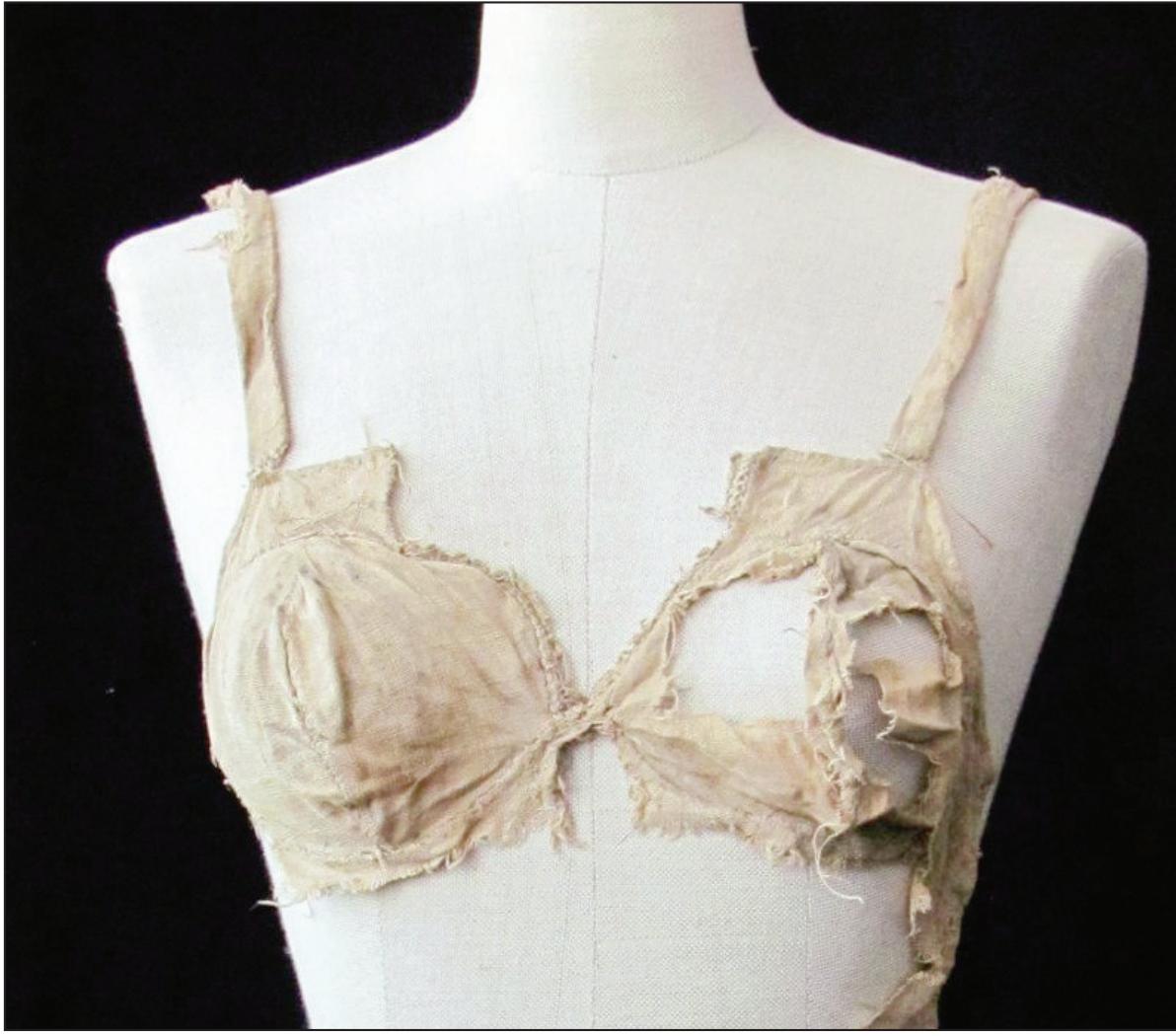
A revolutionary discovery is rewriting the history of underwear: Some 600 years ago, women wore bras.

The University of Innsbruck said that archeologists found four linen bras dating from the Middle Ages in an Austrian castle. Fashion experts describe the find as surprising because the bra had commonly been thought to be only little more than 100 years old as women abandoned the tight corset.

Instead, it appears the bra came first, followed by the corset, followed by the reinvented bra.

One specimen in particular "looks exactly like a [modern] brassiere," said Hilary Davidson, fashion curator for the London Museum. "These are amazing finds."

Although the linen garments were unearthed in 2008, they did not make news until now said Beatrix Nutz, the archeologist responsible for the discovery.  Researching the items and carbon-dating them to make sure they were genuine took some time. She delivered a lecture on them last year, but the information stayed within academic circles until a recent article in the BBC History Magazine.

"We didn't believe it ourselves," she said in a telephone call from Innsbruck. "From what we knew, there was no such thing as bra-like garments in the 15th century."

The university said the four bras were among more than 2,700 textile fragments - some linen, others linen combined with cotton - that were found inter-mixed with dirt, wood, straw and pieces of leather.

"Four linen textiles resemble modern-time bras" with distinct cups, and one in particular looks like today's version, it said, with "two broad shoulder straps and a possible back strap, not preserved but indicated by partially torn edges of the cups onto which it was attached."

And the lingerie was not only functional. The bras were intricately decorated with lace and other ornamentation, the statement said, suggesting they were also meant to please a suitor. [Oh for pete sakes!  What about a woman just pleasing herself by wearing something pretty!]

While paintings of the era show outerwear, they do not reveal what women wore beneath. Davidson, the fashion curator, described the finds as "kind of a missing link" in the history of women's underwear.

Women started experimenting with bra-like garments in the late 1800s, and the first modern brassiere was patented in the early 20th century. It is thought to have been invented by New York socialite Mary Phelps Jacob, who was unhappy with the look of her gown over a stiff corset.

Also found at Lemberg Castle in Tyrol was a linen undergarment that looks very much like a pair of panties. But Nutz said it is men's underwear - women did not wear anything under their flowing skirts back then. [So you say.  You also said bras weren't invented until the 19th century.]

"Underpants were considered a symbol of male dominance and power," she said.

Medieval drawings often show a man and a woman fighting for a pair of underpants in a symbolic battle to see who "wears the trousers" in the family.

Tuesday, July 17, 2012

Girls Just Want to Have Fun...

Taken on the bus ride home from work earlier this evening:

From left to right: Pepper Spray, Thelma, Ginger Snap, and me - Jannibal.
That man on the left turned away from the cell phone cam,pretending not to know us, is Cowboy.
We don't always wear our wax lips or googly-eye glasses.  But we usually are laughing at something or another.  Pepper is always laughing and she makes everyone else laugh around her.  Ginger is the Supreme Leader and Head Trouble Maker.  Thelma is the young apprentice.  Me, I'm the Old Wise One of the group :) 

Pre-Incan Tomb Uncovered in Northern Peru

Ancient pre-Inca tomb found in northern Peru
AFP
July 14, 2012, 8:00 am

LIMA (AFP) - Archeologists said Friday they have discovered a tomb about 1,200 years old, from the pre-Inca Sican era, in northern Peru.

A grave of the Sican pre-Inca culture, dating back 1,200 years, was discovered by a group of archaeologists in the region of Lambayeque, north of Peru. Human remains and jewelry were found July 4 along with the tomb, likely that of a member of the aristocracy of the Sican or Lambayeque elite.

Human remains and jewelry were found July 4 along with the tomb, likely that of a member of the aristocracy of the Sican or Lambayeque elite, head researcher Carlos Wester La Torre told AFP.

A gold earflap, a silver-plated crown, and some 120 silver and copper ornaments that served as emblems of power, along with 116 pieces of pottery and seashells were found in the tomb.

The tomb was located in a burial chamber some six meters (20 feet) deep in the Chotuna-Chornancap sanctuary near Chiclayo, at the same location where the remains of a Sican priestess were found in October.

"This discovery is very important because we now know one of the elite classes of Lambayeque culture," said Wester La Torre, speaking from Chiclayo, capital of the Lambayeque region.

The Sican culture, also referred to as the Lambayeque culture, worshipped the Sican Lord. It emerged between 700 and 750 AD, remaining in force until 1375, reaching its high point between 900 and 1100.

At that time, there were about seven to eight "Sican lords" representing heavenly powers on Earth, complete with masked face, upturned eyes and pointed ears.

Three Kingdoms' Warrior's Tomb Discovered

Three Kingdoms' Tomb Holding Warrior Discovered


About 1,800 years ago, at a time when China was breaking apart into three warring kingdoms, a warrior was laid to rest.
Buried in a tomb with domed roofs, along with his wife, he was about 45 years old when he died. Their skeletal remains were found inside two wooden coffins that had rotted away. Archaeologists don't know their names but, based on the tomb design and grave goods, they believe he was a general who had served one or more of the country's warring lords, perhaps Cao Cao and his son Cao Pi.

His tomb was discovered in Xiangyang, a city that, in the time of the Three Kingdoms, was of great strategic importance. Rescue excavations started in October 2008 and now the discovery is detailed in the most recent edition of the journal Chinese Archaeology. (The report had appeared earlier, in Chinese, in the journal Wenwu.)
Photo By Chinese Archaeology, cropping by Owen Jarus

The rescue operation, carried out by the Xiangyang Municipal Institute of Cultural Relics and Archaeology, uncovered many treasures in the tomb. One of the biggest finds was a life-size bronze horse, the largest ever found in China.It measures 5.3 feet long and by 5.3 feet tall (163 cm by 163 cm). "The horse figurine is in standing posture, has erected ears, protruded eyes, opened mouth, long and broad neck, upright mane and drooped tail," writes archaeologist Liu Jiangsheng. [Photos of Three Kingdoms' Tomb & Grave Goods]
The tomb also held a highly detailed glazed pottery model of a two-story mansion surrounded by an enclosing wall with a gateway. The gate has two main doors, each decorated with a door knocker ring and two "feathered" human figurines. Bear motifs were found in many decorations on the house.
Pottery houses like these are well known from the preceding Han Dynasty, although detailed multi-story houses are rare. Architect Qinghua Guo, a professor at the University of Melbourne, writes that models like these are helpful in reconstructing what houses in ancient China may have looked like.
"Literary descriptions of the buildings of ancient China lead us to believe that it (had) a highly developed architecture, but actual remains are rare and fragmentary," Guo writes in the book "The Mingqi Pottery Buildings of Han Dynasty China 206 B.C. – A.D. 220" (Sussex Academic Press, 2010). "The images of those perished buildings were not totally lost, surviving as miniature models in ancient tombs."

More treasures – beautiful and gross

The treasures found in this tomb go on and on, gold and silver disks, crystal and agate beads, gold bracelets, just to name a few.

Among the finds is a jade pig figurine, his snout finely detailed, the tiny animal having apparently gone to sleep. Another work of art shows a glazed pottery figurine of a dog barking furiously while standing on all fours.
Yet another piece shows a beastly tomb guardian, his long tongue sticking out and, grossly enough, "a crawling animal is attached onto the tip of the tongue," Jiangsheng writes.
There's much more.
A bronze mirror was found with a round knob in the center. The mirror is decorated with elaborate patterns that include depictions of the phoenix and even a kui, or a one-legged demon. Two inscriptions were found on the artifact, one reads (in translation) "To benefit the Descendents Forever," while another reads, "May the Holder Get the Position of the Three Dukes." The Three Dukes were the three most powerful officials, below the emperor, in ancient China.
Like any good warrior, the general made sure he was well equipped for the afterlife. Bronze and iron sabers were found in the tomb along with a bronze crossbow trigger still, after 1,800 years, in good condition.

The Three Kingdoms
The Three Kingdoms period is one of the most celebrated periods of Chinese history. It saw the end of the 400-year-long Han Dynasty and the emergence of the kingdoms of Wei, Wu and Shu.
There are frequent references to it in popular culture. A 14th-century historical novel called "Romance of the Three Kingdoms" is considered one of the most popular works ever written in Chinese. Also movies like "Red Cliff" and a series of video games produced by Koei have brought this period further attention in both China and the West.
While researchers do not know who this general was, or who he fought for, they believe from the artifacts and architecture found that he was laid to rest early in the Three Kingdoms period, which formally started in A.D. 220. Furthermore accounts by historians indicate that Xiangyang where he was buried occupied a strategic area that allowed armies access between northern and southern parts of the country.
Toward the end of the Han Dynasty the city was controlled by Liu Biao, technically a governor of Jing Province, although in practice he was independent of the Han court. He held onto the city until his death in A.D. 208, after which the armies of Cao Cao approached the city and the governorship was surrendered. Cao Cao would then use the city as a base for his drive south, a campaign that would end in his defeat at the hands of Liu Bei and Sun Quan at the Battle of Red Cliffs.

Even after the defeat the city of Xiangyang remained in Cao Cao's hands although an attempt to take it was made in AD 219 by Guan Yu, a Chinese general still revered today.

In A.D. 220 Cao Cao died and was succeeded by his son Cao Pi, who proclaimed himself emperor although his forces did not control the whole country. The fighting between the three kingdoms would go on for several decades more and long after Cao Pi's early death in A.D. 226.
Yet throughout Cao Pi's rule Xiangyang appears to have remained in his hands, leaving open the possibility that the general buried in the newly discovered tomb was one of his retainers, allowed to have a grand tomb, with treasures, for the afterlife.

Sunday, July 15, 2012

2012 Milwaukee Summer Challenge

Final standings are now available for all sections EXCEPT U-2000 - pending.  Chess femmes are in red and Goddesschess prize winners notated at the end of their scores. (Updated about 7:32 p.m. to add U-2000 section):

Master/Expert Cross Table No. Name St Rate Rd 1 Rd 2 Rd 3 Rd 4 Rd 5 Score
NOLAN HENDRICKSON, 1st Place, $300

1. Hendrickson, Nolan (2)........ WI 2202 D8 W13 W10 W3 D2 4.0

ALEXANDER VELIKANOV, 2nd Place, $200
2. Velikanov, Alexander (4)...... WI 2199 W4 D10 D5 W6 D1 3.5

Tie for 3rd Place ($33 each):
3. Williams, William (3)......... WI 2200 W9 W12 -H- L1 D4 3.0
4. Zhou, Jerry Zhexua (11)....... WI 2049 L2 W14 W12 D5 D3 3.0
5. Schneider, Thomas (12)........ WI 2025 D6 W8 D2 D4 D7 3.0

6. Smail, Benedict A (5)......... WI 2143 D5 D7 W13 L2 D9 2.5
7. Jin, David (8)................ WI 2081 L10 D6 W11 D8 D5 2.5
8. Becker, Allen J (9)........... WI 2065 D1 L5 D9 D7 W14 2.5
9. Jing, Aaron (10).............. WI 2056 L3 D11 D8 W14 D6 2.5

10. Santarius, Erik (1)........... WI 2403 W7 D2 L1 -U- -H- 2.0
11. Kinsman, Jim A (13)........... WI 2005 L12 D9 L7 -H- -B- 2.0

12. Breider, Jon P (6)............ WI 2119 W11 L3 L4 -U- -U- 1.0
13. Cen, Kent Y (7)............... IL 2110 W14 L1 L6 -U- -U- 1.0
14. Ellis, James S (14)........... IA 2000 L13 L4 -B- L9 L8 1.0


U2000 Cross Table No. Name St Rate 1 2 3 4 5 Score
RICHARD MARTIN III and TROY ZIMMERMAN, tie for 1st Place, $75 each
1. Martin III, Richard (1)....... WI 1979 W20 D2 W9 W8 D3 4.0
2. Zimmermann, Troy J (8)........ WI 1887 W18 D1 D4 W14 W6 4.0

3. Modes, Daniel R (7)........... IL 1888 D5 W14 -H- W13 D1 3.5
4. Rajendra, Anupama (13)........ WI 1808 W27 D10 D2 D7 W9 3.5 ($100.00)
5. Dreuth, Adam W (21)........... WI 1598 D3 L13 W21 W22 W10 3.5

6. Rajendra, Avinash (3)......... WI 1940 W17 W12 D8 D9 L2 3.0
7. Both, Robert K (5)............ WI 1900 W24 L8 -H- D4 W19 3.0

8. Cardenas, David R (2)......... WI 1975 W16 W7 D6 L1 -U- 2.5
9. Grochowski, Andrew (4)........ WI 1935 W22 W11 L1 D6 L4 2.5
10. Hoffman, Guy G (6)............ WI 1900 W23 D4 D13 D11 L5 2.5
11. Bruch, Robert M (9)........... WI 1837 W25 L9 W17 D10 -U- 2.5
12. Christensen, Wade (10)........ WI 1830 W26 L6 W15 -H- -N- 2.5
13. Ulrich, Rachel J (11)......... WI 1818 D21 W5 D10 L3 D16 2.5
14. Coons, James Jay (12)......... WI 1813 W19 L3 W18 L2 D17 2.5
15. Oberg, John E (15)............ WI 1714 -H- D21 L12 D18 W23 2.5
16. Sagunsky, David L (16)........ WI 1708 L8 L18 W20 W21 D13 2.5
17. Hildeman, Jonathan (17)....... WI 1702 L6 W26 L11 W25 D14 2.5
18. Reinke, Robert T (22)......... WI 1579 L2 W16 L14 D15 W22 2.5
19. Bakalinsky, Jacob (26)........ WI 1223 L14 W24 -H- W23 L7 2.5

20. Pokorski, Jeffrey (14)........ WI 1760 L1 L23 L16 -B- W26 2.0
21. Hegelmeyer, John A (25)....... WI 1507 D13 D15 L5 L16 W25 2.0

22. James, Nikhil (18)............ WI 1627 L9 W25 -H- L5 L18 1.5
23. Monosov, Natanel A (20)....... WI 1608 L10 W20 -H- L19 L15 1.5

24. Wainscott, Chris (19)......... WI 1618 L7 L19 -H- D26 -U- 1.0
25. Sydlewski, Dean Wi (23)....... WI 1571 L11 L22 -B- L17 L21 1.0
26. Ma, Leo (24).................. WI 1567 L12 L17 -H- D24 L20 1.0

27. Bakalinsky, Roman (27)........ WI 964 L4 -N- -N- -N- -N- 0.0

U1500 Cross Table No. Name St Rate 1 2 3 4 5 Score
JACK THAIN, 1st Place, Under 1500, $80
1. Thain, Jack (1)............... IL 1477 W19 W20 W13 W8 D3 4.5


2. Weber, Bryan Scott (15)....... WI 1190 L6 W18 W10 W16 W8 4.0

3. Etzel, Steven W (2)........... WI 1465 -H- D14 W17 W7 D1 3.5
4. Saycocie, Vanisa (19)......... WI 1146 W12 L16 -H- W20 W13 3.5 ($37.50)
5. Ulrich, Anne E (23)........... WI 928 -B- L13 W21 D17 W16 3.5 ($37.50)
6. Kosterman, Dennis (5)......... WI 1407 W2 L8 W22 D13 D7 3.0
7. Huang, Sabrina (13)........... WI 1227 W9 D17 W14 L3 D6 3.0
8. Cai, Haoyu (16)............... WI 1160 W18 W6 W16 L1 L2 3.0

9. Pahl, Sandra R (3)............ WI 1456 L7 W21 W12 -H- -N- 2.5
10. Huang, Alena (4).............. WI 1419 L20 W19 L2 D14 W17 2.5 

11. Buck, Finn (8)................ WI 1357 L17 L15 -H- W23 W20 2.5
12. Breuer, Michael A (9)......... WI 1347 L4 W23 L9 W22 D14 2.5
13. Rasmussen, Kenneth (11)....... WI 1317 W22 W5 L1 D6 L4 2.5
14. Etta, Kevin J (20)............ WI 1098 W21 D3 L7 D10 D12 2.5
15. Bakalinsky, Roman (22)........ WI 964 -N- W11 -H- -N- W21 2.5

16. Wright, Gary M (7)............ WI 1375 W23 W4 L8 L2 L5 2.0
17. Breuer, Ryan M (18)........... WI 1151 W11 D7 L3 D5 L10 2.0

18. Venkat, Abhyudhaya (6)........ IL 1394 L8 L2 -H- L19 W22 1.5
19. Holmes, Russ (12)............. WI 1237 L1 L10 D23 W18 -U- 1.5
20. Mehta, Moulik A (14).......... WI 1223 W10 L1 -H- L4 L11 1.5

21. Khaliq, Abdul (10)............ WI 1342 L14 L9 L5 -B- L15 1.0
22. Landey, Charles N (21)........ WI 1036 L13 -B- L6 L12 L18 1.0

23. Sondhi, Kunal (17)............ WI 1158 L16 L12 D19 L11 -U- 0.5


U1000 Cross Table No. Name St Rate 1 2 3 4 5 Score
RITIKA PANDEY and RUILIN YAN, Tie for 1st Place, Under 1000, $25 each
1. Pandey, Ritika (3)............ WI 885 W4 W8 W9 L2 D3 3.5 ($25.00)
2. Yan, Ruilin (5)............... WI 826 L6 W10 W3 W1 D4 3.5


3. An, Limin (2)................. WI 939 D10 W6 L2 W9 D1 3.0
4. Ma, Angela (9)................ WI 563 L1 W11 -H- W7 D2 3.0
5. Buck, Luke (10)............... WI 562 L7 W12 -H- D8 W9 3.0
6. Iyer, Akshay (11)............. WI 520 W2 L3 -H- W11 D8 3.0

7. Zender-Alexander, Debra (4)... WI 838 W5 L9 -H- L4 W10 2.5
8. Brandt, John (6).............. WI 769 W11 L1 -H- D5 D6 2.5

9. Scalzo II, David A (1)........ WI 973 W12 W7 L1 L3 L5 2.0
10. Snyder, Robert Hug (7)........ WI 669 D3 L2 D12 -B- L7 2.0
11. Burgin, W H (12).............. WI 417 L8 L4 -B- L6 -X- 2.0

12. Pandey, Divya (8)............. WI 570 L9 L5 D10 -H- -F- 1.0

Islamists Busy Destroying More Persian Cultural Relics

From Payvand News
3500-year-old cemetery discovered in southwestern Iran

Source: Tehran Times
A cemetery dating back to 3500 years ago has been discovered in the Taj Amir region near the city of Yasuj in the southwestern Iranian province of Kohkiluyeh-Boyer Ahmad.

Over 20 graves have been excavated so far by an archaeological team in the cemetery, which covers an area of over 60,000 square meters, team director Mohammad Rajabi told the Persian service of IRNA on Friday.

The cemetery is estimated to contain over 500 graves, he added.

Pottery, stone and bronze artifacts have been discovered beside the skeletons unearthed from the graves.  In addition, earrings, rings, daggers, bayonets, coins and pottery jars have been discovered in the graves.

All the artifacts have been transferred to a museum in Yasuj, Rajabi said.

About 8000 square meters of the cemetery have been destroyed by a construction project, which belongs to Yasuj University of Medical Science, he stated.

A total of 70 graves have been totally demolished during the construction project and all artifacts located in the graves have been lost, an expert of the Yasuj Cultural Heritage, Tourism and Handicrafts Department stated.

"The destruction process is still underway," said Rahmani, who gave only his family name.

1800 Year Old Artemis Excavated in Turkey

From Hurriyet News Online
Sculpture found in ancient city
July/12/2012

ÇANAKKALE - Anatolia News Agency A sculpture depicting the goddess Artemis and estimated to be about 1800 years old has been discovered at an excavation site at the ancient city of Parion, near the village of Kemer in the Biga district of the northwestern province of Çannakale.

The excavation is being conducted by Professor Cevat Başaran, an instructor in the archaeology department at Erzurum’s Atatürk University, and is being carried out in six zones of the ancient city.
The marble sculpture was dug out in pieces at Odeion, one of the six excavation sites. Başaran, the head of the excavation, has announced that the sculpture depicts a clothed woman, is 1.70 cm tall and approximately 1,800 years old, and is a high quality sculpture of its kind. The excavators also found marble sculptures depicting animals including sheep and dogs.

“The bow and arrow in her hand indicates that the sculpture belongs to Artemis [Diana], the goddess of hunting, the wilderness and wild animals,” Başaran said.

Pakistani Looters Busted (For Now)

Pakistan police foil huge artefact smuggling attempt
By Jaffer Rizvi, BBC News
6 July 2012
Last updated at 10:32 ET

Photo from Art Daily's report on the bust. 


An attempt to smuggle ancient artefacts, possibly worth millions of dollars, out of the Pakistani port city of Karachi has been foiled, police say.

A top archaeologist has said the goods are at least 2,000 years old and were illegally excavated. Police have called in experts to help assess their value.

Two men caught trying to ship the items have been arrested, police say.

Karachi is often used by smugglers who can get criminal support to take valuable antiquities out of country.

Customs officers in 2005 foiled a similar attempt to smuggle nearly 1,500 artefacts worth more than $10m (£6.4m) out of Pakistan.

Some of the antiquities found in a container marked "furniture" at that time were 7,000 years old, archaeologists said.

'So heavy'
Police Deputy Superintendent Majeed Abbas told the BBC that police conducted the raid in the eastern part of Karachi in the early hours of Friday morning.

The artefacts are thought to have come from the kingdom of Gandhara, which spanned northern Pakistan and parts of eastern Afghanistan.

"These artefacts were loaded in a container... and were so heavy," Mr Abbas said.  "We had to call specific machines and a forklift truck to download them carefully."

Mr Abbas said that the two men arrested told police that the artefacts were brought to Karachi six months ago for a sales deal.

The deal was cancelled and the men told the police they then tried to take the antiquities to Rawalpindi.

"But the papers we've recovered from the vehicle show a different destination. [They suggest that] the vehicle was on its way to Sialkot City of Punjab province, probably for another deal," Mr Abbas said.

"We have a hunch that they were about to deliver it to some buyers on their way," he said.

Meanwhile leading archaeologist Qasim Ali Qasim told Geo TV that the relics were mostly Gandharan art, found in an area near Peshawar.

He said that most of the items depict the early life of Buddha, which added to their value.

************************************************************

And now a fight is on over ownership of these priceless precious objects:

From the Pakistan Daily Times
Sunday, July 08, 2012

* KP authorities demand possession

* Archaeologists say Sindh also has such relics civilization

By Razzak Abro


KARACHI: Antiquities authorities of Sindh on Saturday remained engage in examination and documentation of the antiquities recovered by Karachi police from Landhi.

The final possession of recovered antiquities may cause a row between Sindh and Khyber Pakhtoonkhwa governments as both are claiming the property.

According to Additional Secretary of Culture Department Sindh, Ashfaq Hussain Mausvi, examination of some 180 objects had been done. He said that there were remaining four to five packets which were being examined. He said that the antiquities officials were also making documentation of the objects. Police had recovered antiquities, including ancient idols and statues of Gandhara Civilization, in a raid on container in Landhi which were being transported to Sialkot. According to antiquities department authorities, these antiquities were also brought from Sialkot to finalise custom formalities.

The Khyber Pakhtoonkhwa’s (KP) Culture Minister Syed Aqil Shah told local reporters that his government would formally approach Sindh government authorities for seeking possession of the impounded antiquities. He said that his province had remained centre of the Gandhara Civilization in the country, therefore, those antiquities, would be kept there.

However, the Sindh government authorities as well as archeologists of the province were opposing the demand. Additional Secretary Culture, Ashfaq Mausvi, said that the remains of the Gandhara Civilization were also found in Khirthar range and other parts of the province. However, he added, court would decide the matter. Renowned archeologist, Ishtiaq Ansari, said Sindh had also remained part of the Gandhara Civilization, and human ashes of Gautama Buddha, founder of Buddhism are buried in Kahu Jo Daro, Mirpurkhas. [Are they sure those ashes are still there???] He said that the history shows that Gautama Buddha’s human ashes were initially sent to some eight countries, and later to 84 countries, and the Sindh was also among those areas.

More on the Anglo-Saxon Woman Buried with Cow

From The Daily Mail Online

Who was she? Mystery of the bejewelled Anglo-Saxon woman found buried beside sacrificial cow in unique discovery

  • The female skeleton was found with brooches and hundreds of amber and decorated beads
  • Experts believe that such burial rituals indicate wealth and power
|

2012 Milwaukee Summer Challenge - R3 Standings

Rounds 1 through 3 were held yesterday, Rounds 4 and 5 today.  The Southwest Chess Club blog now has R4 pairings posted.  Here are the standings for all sections after R3.  Chess femmes are highlighted in red:

Master/Expert

  No. Name St Rate Rd 1 Rd 2 Rd 3 Score

1. Hendrickson, Nolan (2)........ WI 2202 D11 W10 W7 2.5
2. Williams, William (3)......... WI 2200 W12 W9 -H- 2.5
3. Velikanov, Alexander (4)...... WI 2199 W5 D7 D6 2.0
4. Smail, Benedict A (5)......... WI 2143 D6 D8 W10 2.0
5. Zhou, Jerry Zhexua (11)....... WI 2049 L3 W13 W9 2.0
6. Schneider, Thomas (12)........ WI 2025 D4 W11 D3 2.0
7. Santarius, Erik (1)........... WI 2403 W8 D3 L1 1.5
8. Jin, David (8)................ WI 2081 L7 D4 W14 1.5
9. Breider, Jon P (6)............ WI 2119 W14 L2 L5 1.0
10. Cen, Kent Y (7)............... IL 2110 W13 L1 L4 1.0
11. Becker, Allen J (9)........... WI 2065 D1 L6 D12 1.0
12. Jing, Aaron (10).............. WI 2056 L2 D14 D11 1.0
13. Ellis, James S (14)........... IA 2000 L10 L5 -B- 1.0
14. Kinsman, Jim A (13)........... WI 2005 L9 D12 L8 0.5


U2000

  No. Name St Rate 1 2 3 Score

1. Martin III, Richard (1)....... WI 1979 W26 D7 W4 2.5
2. Cardenas, David R (2)......... WI 1975 W19 W13 D3 2.5
3. Rajendra, Avinash (3)......... WI 1940 W20 W9 D2 2.5
4. Grochowski, Andrew (4)........ WI 1935 W14 W8 L1 2.0
5. Hoffman, Guy G (6)............ WI 1900 W15 D12 D10 2.0
6. Modes, Daniel R (7)........... IL 1888 D16 W11 -H- 2.0
7. Zimmermann, Troy J (8)........ WI 1887 W21 D1 D12 2.0
8. Bruch, Robert M (9)........... WI 1837 W22 L4 W20 2.0
9. Christensen, Wade (10)........ WI 1830 W25 L3 W18 2.0
10. Ulrich, Rachel J (11)......... WI 1818 D23 W16 D5 2.0 11. Coons, James Jay (12)......... WI 1813 W17 L6 W21 2.0
12. Rajendra, Anupama (13)........ WI 1808 W27 D5 D7 2.013. Both, Robert K (5)............ WI 1900 W24 L2 -H- 1.5
14. James, Nikhil (18)............ WI 1627 L4 W22 -H- 1.5
15. Monosov, Natanel A (20)....... WI 1608 L5 W26 -H- 1.5
16. Dreuth, Adam W (21)........... WI 1598 D6 L10 W23 1.5
17. Bakalinsky, Jacob (26)........ WI 1223 L11 W24 -H- 1.5
18. Oberg, John E (15)............ WI 1714 -H- D23 L9 1.0
19. Sagunsky, David L (16)........ WI 1708 L2 L21 W26 1.0
20. Hildeman, Jonathan (17)....... WI 1702 L3 W25 L8 1.0
21. Reinke, Robert T (22)......... WI 1579 L7 W19 L11 1.0
22. Sydlewski, Dean Wi (23)....... WI 1571 L8 L14 -B- 1.0
23. Hegelmeyer, John A (25)....... WI 1507 D10 D18 L16 1.0
24. Wainscott, Chris (19)......... WI 1618 L13 L17 -H- 0.5
25. Ma, Leo (24).................. WI 1567 L9 L20 -H- 0.5
26. Pokorski, Jeffrey (14)........ WI 1760 L1 L15 L19 0.0
27. Bakalinsky, Roman (27)........ WI 964 L12 -N- -N- 0.0


U1500

  No. Name St Rate 1 2 3 Score

1. Thain, Jack (1)............... IL 1477 W21 W11 W8 3.0
2. Cai, Haoyu (16)............... WI 1160 W19 W6 W7 3.0
3. Huang, Sabrina (13)........... WI 1227 W5 D12 W14 2.54. Etzel, Steven W (2)........... WI 1465 -H- D14 W12 2.0
5. Pahl, Sandra R (3)............ WI 1456 L3 W23 W17 2.0 6. Kosterman, Dennis (5)......... WI 1407 W9 L2 W18 2.0
7. Wright, Gary M (7)............ WI 1375 W22 W13 L2 2.0
8. Rasmussen, Kenneth (11)....... WI 1317 W18 W10 L1 2.0
9. Weber, Bryan Scott (15)....... WI 1190 L6 W19 W16 2.0
10. Ulrich, Anne E (23)........... WI 928 -B- L8 W23 2.011. Mehta, Moulik A (14).......... WI 1223 W16 L1 -H- 1.5
12. Breuer, Ryan M (18)........... WI 1151 W20 D3 L4 1.5
13. Saycocie, Vanisa (19)......... WI 1146 W17 L7 -H- 1.5 14. Etta, Kevin J (20)............ WI 1098 W23 D4 L3 1.5
15. Bakalinsky, Roman (22)........ WI 964 -N- W20 -H- 1.5
16. Huang, Alena (4).............. WI 1419 L11 W21 L9 1.0 17. Breuer, Michael A (9)......... WI 1347 L13 W22 L5 1.0
18. Landey, Charles N (21)........ WI 1036 L8 -B- L6 1.0
19. Venkat, Abhyudhaya (6)........ IL 1394 L2 L9 -H- 0.5
20. Buck, Finn (8)................ WI 1357 L12 L15 -H- 0.5
21. Holmes, Russ (12)............. WI 1237 L1 L16 D22 0.5
22. Sondhi, Kunal (17)............ WI 1158 L7 L17 D21 0.5
23. Khaliq, Abdul (10)............ WI 1342 L14 L5 L10 0.0


U1000

  No. Name St Rate 1 2 3 Score

1. Pandey, Ritika (3)............ WI 885 W7 W6 W2 3.02. Scalzo II, David A (1)........ WI 973 W12 W5 L1 2.0
3. Yan, Ruilin (5)............... WI 826 L9 W10 W4 2.0
4. An, Limin (2)................. WI 939 D10 W9 L3 1.5
5. Zender-Alexander, Debra (4)... WI 838 W8 L2 -H- 1.5 6. Brandt, John (6).............. WI 769 W11 L1 -H- 1.5
7. Ma, Angela (9)................ WI 563 L1 W11 -H- 1.5 8. Buck, Luke (10)............... WI 562 L5 W12 -H- 1.5
9. Iyer, Akshay (11)............. WI 520 W3 L4 -H- 1.5
10. Snyder, Robert Hug (7)........ WI 669 D4 L3 D12 1.0
11. Burgin, W H (12).............. WI 417 L6 L7 -B- 1.0
12. Pandey, Divya (8)............. WI 570 L2 L8 D10 0.5

Eleven chess femmes!  That's good for close to a 15% participation rate and we're very happy about that.  Good luck to all the players in the remaining rounds, and I hope some of the ladies will consider submitting a game for consideration for a best game prize.  It's not just the highest rated players who have a chance to win some best game prize money!

Saturday, July 14, 2012

Possible Temple of Demeter Discovered in Sicily

Archaeologists unearth temple to Demeter in Sicily

11 July, 18:17
Una delle statuette ritrovate
Source
ANSAmed) - Rome, July 11 - Archaeologists have discovered what may be among the oldest remains at the ancient site of Selinunte: an ancient temple.

Inside, fragments have been found that help explain the site's significance: an offering to Demeter, the goddess of grain and agriculture; a small flute, made of bone and dating to 570 BC; a small Corinthian vase.

These findings are critically important in helping archeologists to date the temple where they were found, to around the 6th century BC - possibly the oldest in the archaeological area of Selinunte in Sicily.

They've been unearthed in recent months by a team led by Clemente Marconi of New York University, working with the Department of Culture and Identity in Sicily and Selinunte Archaeological Park Together, they've also identified the remains of a central colonnade and nearby are pottery shards dated from around 650 BC, including a long vessel decorated with grazing animals.

The research confirms assumptions made about the history and age of temple.

Particularly significant, researchers say, was the discovery of the flute, which suggests musical performances and dances related to worship of the goddess Demeter, depicted on a series of Corinthian vases found in the area.

Researchers still hope to better understand the dimensions and the age of the temple, within the context of the full archeological site of Selinunte. (ANSAmed).

ALL RIGHTS RESERVED © Copyright ANSA

Statue picture came from this article in Italian.  Who is She?  Is this an image of Demeter?  All the caption says (translated via Google Translate is "One of the statues found." 

The Peopling of America: Looking at Western Stemmed Points

This is a synopsis of recent research and current thinking on how various peoples arrived in the Americas, and when.  Stay tuned for further developments.  With new dating techniques now available and local colleges stepping up efforts to continue and begin new excavations in view of the federal government's massive budget cuts that formerly supported archaeological programs around the USA, I've no doubt we'll be reading about new insights and perhaps even paradigm shifts in dating.

Identity of First Americans Questioned


Ancient stone projectile points discovered in a Central Oregon cave complex have cast new light on the identity of the first Americans.
While scientists agree they crossed the Bering Strait during an ice age, no one knows the identity of the first people to spread across the North American continent.
For some time, these first Americans were believed to have belong to a single group, called the Clovis culture, named for the New Mexican site where their distinctive, 13,000-year-old projectile points were first found.
However, some have questioned this theory, and these newly discovered projectile points, the sort of stone tips added to spears, appear to add weight to these questions.
These stone points, a type known as Western Stemmed points, are narrower and lack the distinctive flute, or shallow groove, found on Clovis points. Researchers believe the two types of points represent different technologies, produced by different cultures.
"This brings into focus the concept that other people or perhaps even multiple waves of people bringing other technologies were certainly involved in the first colonization [of the Americas]," said researcher Dennis Jenkins, an archaeologist at the University of Oregon, in a podcast issued by the journal Science, where the work is published. 
Dating these Western stemmed points accurately was key, since others like them have been found elsewhere; they are common on the U.S. West Coast and in the Great Basin of Nevada, Utah, Idaho, Oregon and California.

These are generally believed to be younger than Clovis points. However, researchers have had difficulty finding materials that can be reliably dated at the Western Stemmed point sites, Jenkins said during a press conference yesterday (July 11).

Archaeologists often look at the decay of radioactive carbon atoms within organic material to determine its age. In Oregon's Paisley Caves, where the four new Western stemmed points showed up, the researchers found some of the ancient organic material they needed, most notably, in coprolites, or dried feces, carrying human DNA.

The coprolites appeared to have been left behind at about the same time as the nearby projectile points.

Radiocarbon dating put the coprolites and other organic samples located near the points at more than 13,000 years old. The team examined the sedimentary layers and the artifacts to determine if the sediment, and as a result the timeline preserved as new layers are laid down, had been disrupted or if the samples had been contaminated.

As a result, they determined that the projectile points — which were broken and appear to have been cast aside as garbage — were as old or older than Clovis points found elsewhere.
"The radiocarbon dates we got have answered the question, are Western stemmed points as old as Clovis. It's been debated since the 1970s, and we have established that fact beyond question," Jenkins said in the podcast. "It certainly reinforces or substantiates, if you will, the concept that there were multiple cultural influences here during the Pleistocene [when the Americas were first colonized]."
The research is detailed in Friday's (July 13) issue of the journal Science.

Sheboygan's Chess in the Park Hopes to Grow Future GMs

My chess buddy, Ellen Wanek!  Give a shout-out and a hearty round of applause, please!

Article from The Sheboygan Press Online

Of kings, queens and castles: Chess in the Park helps children improve game during summer

11:36 PM, Jul 13, 2012

There's no doubt in Ellen Wanek's mind the popularity of chess has grown in local schools.

So to continue students' excitement about the strategy-filled board game during the summer months, Wanek, the chess coach at four area schools, began a weekly club known as Chess in the Park. Each Monday from 6 to 8 p.m., elementary, middle and high school chess club members bring their families and friends to Vollrath Park to play chess.

Wanek — the chess coach at Lake Country Academy, Lincoln-Erdman Elementary School, Horace Mann Middle School and Sheboygan Christian School — said she promotes chess as much as possible because of the mental development it creates in children who play. She said research has shown that chess improves students' IQ, math skills, reading skills, critical thinking skills and it develops memory.

"But here's something really special," Wanek said. "Chess develops into your thinking that you actually think through the consequences of all your actions. At tournaments, when kids are under a lot of pressure, they're able to develop a sense of self-control and discipline, where they think through the consequences of a multitude of different choices. That's life-changing in the lives of children."

The large crowd (about 30 people usually play each week) at Chess in the Park this past Monday night included players of all ages, between 4 and 61 years old, and was a promising sight for local chess enthusiasts, like Plymouth High School chess coach Stephan Des Moulin.

"There's a lot of schools here in Sheboygan that are getting a good following in the chess clubs," Des Moulin said. "There are some pretty talented young players."

Students from all different schools have a chance to connect at Chess in the Park, along with their parents and siblings. Des Moulin said it's a good way to get kids to view chess as a fun activity, rather than a school-only activity.

(For instance:) Avinash Murthy, a 12-year-old seventh-grader at Lake Country Academy, has been playing chess since he was 3. His grandfather taught him how to play, and this past school year he played competitively as a part of his school's newly formed chess club.

2012 Milwaukee Summer Challenge

Hola darlings!  Taking place right now down at the Wyndham Milwaukee Airport Hotel on Layton just south of Howell Avenue -- a nice playing venue. 

To update, I visited the blog of my adopted chess club, Southwest Chess Club, and as of about 9:30 last night there were 61 pre-registered players.  When official play began this morning, there were 75 PLAYERS!  A fantastic walk-up registration the morning-of and a great turnout for this first-ever Milwaukee event. 

No official results posted yet.  It's going to be a long busy day for the organizers with rounds at 10:00 a.m., 2:30 p.m. and 7:00 p.m.!  EEK! 

I'm not sure how this all works with prizes.  The prizes advertised were for a registration of 40 players.  Since there were nearly double that amount, what does that mean for prizes?  I've no idea.  I should ask! 

I am eager to see if any more chess femmes registered this morning.  I'll let you know as soon as I do.  Stay tuned for more...  Meanwhile, Ellen Wanek and I are mixing up our pawns in a game over at chess.com.  She snatched a pawn from me, curses!  But I have a few tricks up my sleeve, bwaahaahaa!  I won't go down without a nasty bloody fight, Ellen.  You may outrate me by 300 points, but you don't scare me at all.  Ha!  You're just too nice.

Friday, July 13, 2012

2012 Milwaukee Summer Challenge: Prize Update!

You read it here first!  (Sounds like an old International Chessoid headline!)  Yep, Goddesschess is giving an opportunity for some G-chess love to be spread among male and female players alike by increasing the kitty for Best Game Prizes.   More below --

Because we now know that there will not be at least two (or any) females competing in the Master/Expert section of the 2012 Milwaukee Summer Challenge, we have decided to allocate the $100 in prize money set aside for a chess femme prize in that Section as follows:

(1):  U-2000 Section, top female finisher prize is increased by $25 to $100
(2):  U-1500 Section, top female finisher prize remains at $50, and a second place prize of $25 is added
(3):  U-1000 Section, prize qualification ($25 for top female finisher) is reduced to two female players competing in the Section from three

$50 left over from the intended prize for a chess femme competing in the Master/Expert Section has been donated to the Best Game Prizes fund to increase it accordingly.  This is the original Best Game Prizes structure:

Best Game Prizes: Master/Expert Section $50; U2000 Section $25; and U1500 Section $25.)

We at Goddesschess hope that some chess femmes will submit their games - from whatever Section they play in - for consideration as a best game.  We all know that those male chess masters and experts play a lot of boring chess against each other - snore... even if no one is rude enough to mention that fact.  Oops.  Pretend you didn't just read that :)

2012 Milwaukee Summer Challenge

There's still time to register - you can register tomorrow prior to the tournament's start!  There has been a great turn-out for the premiere of this event.  Southwest Chess Club went out on a limb to put this together (they are not a large or particularly well-financed chess club, by any means!) and I'm so happy to see players coming out in support!  With this kind of participation, I hope we will see a 2013 Milwaukee Summer Challenge.

Milwaukee Summer Challenge, July 14-15, 2012

5SS; G/120 with 5 second delay; 4 Sections: Master/Expert (closed), U2000, U1500, and U1000.

Wyndham Milwaukee Airport Hotel, 4747 S. Howell Avenue, Milwaukee, 414-481-8000 (mention Southwest Chess Club for $79 room rate).

EF: $40 All Sections (except U1000); U1000 Entry Fee: $25; all $5 more after 7/11. Prizes based on 40 total entries.
Master/Expert (closed section): 1st-$300, 2nd-$200, 3rd-$100;
U2000: 1st-$150;
U1500: 1st-$80;
U1000: 1st-$50.

Reg: 8:30-9:30; Rds: Saturday, July 14: 10:00am, 2:30pm, and 7:00pm, Sunday July 15: 10:00am and 2:30pm. ENT: Allen Becker, N112 W17033 Vista Court, Apt. D, Germantown, WI 53022; Questions: TD Tom Fogec, 414-405-4207 (cell) (Best Game Prizes: Master/Expert Section $50; U2000 Section $25; and U1500 Section $25.)

REVISED BYE POLICY
You can take one 1/2 point bye in any round. You need to request the bye prior to the start of the tournament. All bye requests are irrevocable (you may not change your mind at a later time).

FLYER


Note: Anupama Rajendra, winner of the National All Girls Championship recently held in Chicago, has entered this weekend's event.

Goddess Chess Prizes for this event:
(1) in Master/Expert, $100 to top scoring female finisher provided at least 2 females play;
(2) in U2000, $75, to top scoring female finisher provided at least 2 females play;
(3) in U1500, $50, to top scoring female finisher provided at least 3 females play;
(4) in U1000, $25, to top scoring female finisher provided at least 3 females play;
There are no tie-breaks; if tie score the prize money is split; and
Must score a draw or win in any section to qualify for prize.

Many thanks to GM Susan Polgar's mighty blog for picking up the story and publishing it for Southwest Chess Club.

Whoop whoop whoop!  So happy about Anupama Rajendra coming to play at the Challenge! 

According to Southwest Chess Club's blog info (I'm writing this at 7:30 p.m. more or less, so there will probably be later updates), current registration:

Master/Expert:  11
U-2000:  22
U-1500:  19
U-1000:  8

Two Huang sisters are playing!  Two Ulrich sisters are playing!  A national female champion is playing! 

Stay tuned -- we're doing some tinkering with the prizes for the chess femmes, but we need to clear things with the organizers first!

Virgin Mary: Limited Time Only, Now Appearing in Tree

From the San Francisco Chronicle Online

Faithful see Virgin Mary in tree, flock to NJ city


WEST NEW YORK, N.J. (AP) — People are flocking to a tree in northern New Jersey where some say they see the image of the Virgin Mary.

Makeshift shrines have sprung up by the tree in West New York. People have been praying, crying and leaving flowers and candles as they look at the small opening where the bark was stripped away.
A fence and other barricades also have been set up around the tree, which is in a sidewalk along a commercial strip.

Newark Archdiocese spokesman Jim Goodness tells The Journal of Jersey City (http://bit.ly/ShP4sI) the image is likely "some discoloration that resembles Our Lady of Guadalupe."
___

 
Some prior Virgin Mary sightings I've reported on -- a note -- Blogger changed its formatting protocols without telling anyone ahead of time in 2008, and so many of my prior posts that used to be perfectly formatted lost ALL of their formatting when the change-over was made.  There are just too many prior posts that have had their formatting destroyed to go back and try to fix them all -- I'm not even going to bother!  So, please bear with the block structure with no paragraph breaks or differentiation for different size/color/types of fonts, etc.


Virgin Mary Sightings to Be Investigated By Vatican
July 3, 2008

Virgin Mary in a Tree Trunk
August 28, 1008

Worship at Site of Virgin Mary Apparition Banned
February 5, 2009

Irish Spot Virgin Mary in Tree Stump, Oy Vey!
July 10, 2009

Donegal Shrine Virgin 'Comes to Life' (not a Virgin in a tree - a Virgin in a statue of the - Virgin!)
October 27, 2009

"Mother of God" Making Miracles Near Green Bay, Wisconsin
July 15, 2011

The Virgin seems to have an affinity for trees and tree stumps, doesn't she.  This could not possibly be because she was a goddess of nature for thousands of years before she was adopted by the Roman Catholic Church as its Mother of God  (Theotokos)-- surely not! 
Related Posts Plugin for WordPress, Blogger...