From Popular Archaeology
Mastodon Kill Site Shows Human Presence in North America Before 13,000 Years Ago
By Dan McLerran Thu, Oct 20, 2011
[Excerpted]Based on new dating results, the tip of a bone point lodged within the rib bone of a mastodon excavated in the 1970's near Manis, Washington, turns out to be about 13,800 years old, say scientists. The finding suggests that hunters who killed the mastodon likely lived in North America before the traditionally accepted dawn of the "Clovis" culture, thought previously by many scientists to be the earliest human culture established on the continent.
Dr. Carl Gustafson of Washington State University, the initial excavator of the mastodon remains more than three decades ago, concluded from radiocarbon dating of charcoal deposits around the remains that it was about 14,000 years old, a conclusion that has been a subject of considerable debate among scholarly critics. Also controversial was his suggestion that the bone point found embedded in the rib bone was an early projectile point, similar to other bone projectile points found at other Paleo-indian sites.
The case was revisited recently when Dr. Michael Waters of Texas A and M University, along with a team of colleagues, used mass spectrometry to date carbon in samples of bone from the rib, a pair of tusks found at the same site, and the embedded point. Results indicated that all of the fossils tested were about 13,800 years old. They also used high-resolution X-ray CT scanning of the embedded bone point to produce a three-dimensional visual study or image. Based on this, they determined that the point was likely at least 27 centimeters long, similar in length to those of later, Clovis-age projectile points that were used in throwing or thrusting weapons made by Paleolithic hunters of North America. Moreover, the team examined the specimen using DNA protein analysis of material from the bone point and the rib in which it was embedded. They concluded that the point itself was fashioned from mastodon bone.
"What that told us", says Waters, "was that these people [who] killed this particular (Manis) mastodon must have killed at least one other mastodon to harvest the bone to make a tool, or at least scavenged some bone from another mastodon to make a tool."
Most significantly, the findings constitute more evidence that Paleo-Indians settled the americas before 13,000 B.P.E., the earliest date that has traditionally been assigned to the emergence of the "Clovis" cultural horizon. The "Clovis" culture is originally derived from archaeological discoveries in the late 1930's at a site near Clovis, New Mexico, where a distinct bifacial, fluted stone projectile point artifact type (pictured left) was found and which became a common find among numerous archaeological sites throughout the American continent. Clovis marked the first presence of humans in North America and was considered ancestral to all Native Americans. Additionally, it has been suggested by some scientists that the hunting practices of the Clovis people may have played a salient role in the extinction of the mastodon, along with other large mammals that roamed North America.
But that theory, popularly known in the scientific world as "Clovis First", has been challenged in recent years by new finds. Among the new discoveries were those of Eske Willerslev, a key lead researcher with Waters on the Manis mastodon study. He conducted Carbon-14 dating and DNA analysis on human remains found in caves in the state of Oregon and concluded that these traces of humans in North America were approximately 14,340 years old. Maintains Willerslev, "our research now shows that other hunters were present at least 1,000 years prior to the Clovis culture. Therefore, it was not a sudden war or a quick slaughtering of the mastodons by the Clovis culture, which made the species disappear. We can now conclude that the hunt for the animals stretched out over a much longer period of time. At this time, however, we do not know if it was the man-made hunt for the mastodons, mammoths and other large animals from the so-called mega-fauna, which caused them to become extinct and disappear. Maybe the reason was something complete different, for instance the climate."
Whether or not the Oregon finds and those at Manis, Washington can be correlated in terms of a new theory on early Paleo-Indians in North America and the extinction of the mastodon, the latest research on the Manis mastodon does open an additional window of consideration on the presence of humans on the American continent.
Says Waters, "We're looking at another pre-Clovis locality in North America where, in this case, bone weaponry was used to hunt mastodons 800 years before Clovis stone weaponry show up on the landscape."
Showing posts with label Clovis. Show all posts
Showing posts with label Clovis. Show all posts
Thursday, October 20, 2011


Friday, June 25, 2010
7,000 Year Old Projectile Points found in Vermont (USA)!!!
From the RutlandHerald.com
Artifacts dating back to 5000 B.C. found in Rutland Town
By PATRICIA MINICHIELLO
STAFF WRITER - Published: June 24, 2010
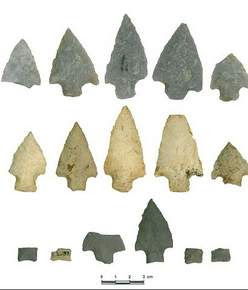 Ancient artifacts dating back roughly 7,000 years ago to 5000 B.C., were found by state archeologists on land near Thomas Dairy in Rutland Town recently.
John Thomas, one of the landowners, said the pointed projectiles looked like arrowheads and were discovered in at least two different locations on his property. (Image: The photo depicts 16 projectiles dating back to 5000 B.C. found on land near Post Road in Rutland Town owned by Orin Thomas and Sons. Northeast Archaeology Research Center)
“One was close to Carey’s Auto and another abuts the development on Blue Ridge acres,” Thomas said Tuesday.
The discovery occurred as a part of an archeological dig — a standard procedure prior to subdivision — by the Vermont Division for Historic Preservation.
Scott Dillon, a survey archeologist with the division, said 16 projectiles were found at one location and appeared to be intentionally buried together in a pit. He said the relics studied by experts from the Northeast Archaeology Research Center Inc. were from the Native American era.
“These findings are quite rare and priceless. They really paint a picture of people living in the Rutland area 7,000 years ago.”
Dillon said the artifacts included stoneworking tools, fire-cracked rock and containers for cooking.
“They would heat up rock and drop the rock into the pot to heat up the food,” Dillon said of the Native American people who used these tools. When asked how much these items are worth, Dillon would not put a price tag on them.
“People do sell projectile points, but their monetary value is insignificant compared to their cultural value,” he said. “Their cultural value far outweighs the possibility of selling an artifact on eBay.”
After the discoveries were made, the state created buffer zones around the sensitive material and put a restriction on the land for anything but agriculture use.
Despite the buffer zone determination, four lots on the Thomas property were subdivided, a portion of which will soon be sold to the federal government to build a 70,000-square-foot Armed Forces Reserve Center.
On Tuesday, an Act 250 permit was granted for the Thomas subdivision, according to Bill Burke from Rutland’s Act 250 office.
Regarding the artifacts, Thomas said although the findings are not a financial burden yet, he feels they could be in the future.
“Anytime anyone encumbers the land, I feel that it could be a problem or expense very easily,” Thomas said.
When asked how he feels about the discovery of ancient relics on his land, Thomas answered bluntly.
“I feel that if these historic preservation people want to preserve these artifacts, they should put them in a museum and leave me alone.”
Artifacts dating back to 5000 B.C. found in Rutland Town
By PATRICIA MINICHIELLO
STAFF WRITER - Published: June 24, 2010

John Thomas, one of the landowners, said the pointed projectiles looked like arrowheads and were discovered in at least two different locations on his property. (Image: The photo depicts 16 projectiles dating back to 5000 B.C. found on land near Post Road in Rutland Town owned by Orin Thomas and Sons. Northeast Archaeology Research Center)
“One was close to Carey’s Auto and another abuts the development on Blue Ridge acres,” Thomas said Tuesday.
The discovery occurred as a part of an archeological dig — a standard procedure prior to subdivision — by the Vermont Division for Historic Preservation.
Scott Dillon, a survey archeologist with the division, said 16 projectiles were found at one location and appeared to be intentionally buried together in a pit. He said the relics studied by experts from the Northeast Archaeology Research Center Inc. were from the Native American era.
“These findings are quite rare and priceless. They really paint a picture of people living in the Rutland area 7,000 years ago.”
Dillon said the artifacts included stoneworking tools, fire-cracked rock and containers for cooking.
“They would heat up rock and drop the rock into the pot to heat up the food,” Dillon said of the Native American people who used these tools. When asked how much these items are worth, Dillon would not put a price tag on them.
“People do sell projectile points, but their monetary value is insignificant compared to their cultural value,” he said. “Their cultural value far outweighs the possibility of selling an artifact on eBay.”
After the discoveries were made, the state created buffer zones around the sensitive material and put a restriction on the land for anything but agriculture use.
Despite the buffer zone determination, four lots on the Thomas property were subdivided, a portion of which will soon be sold to the federal government to build a 70,000-square-foot Armed Forces Reserve Center.
On Tuesday, an Act 250 permit was granted for the Thomas subdivision, according to Bill Burke from Rutland’s Act 250 office.
Regarding the artifacts, Thomas said although the findings are not a financial burden yet, he feels they could be in the future.
“Anytime anyone encumbers the land, I feel that it could be a problem or expense very easily,” Thomas said.
When asked how he feels about the discovery of ancient relics on his land, Thomas answered bluntly.
“I feel that if these historic preservation people want to preserve these artifacts, they should put them in a museum and leave me alone.”
******************************************************************
It will be interesting to see what happens here - the clash among the land owner, the scientists and the preservationists. What I want to know is, from experts' perspective, how do these points compare with "Clovis" technology and the much older Aurignacian period points found in parts of France and Spain? How do they fit in, overall, with the peopling of America?
Friday, February 27, 2009
Mommy, Look What I Found...
 Ohmygoddess! Family discovered 13,000 year old cache of stone-age tools in their front yard!
(This photo release by the University of Colorado on Feb. 26, 2009, shows Douglas Bamforth, Anthropology professor for the University of Colorado at Boulder, left, and Patrick Mahaffy, show a portion of more than 80 artfiacts unearthed about two feet below Mahaffy's Boulder's front yard during a landscaping project this past summer. The artifacts, which may have been made during the Clovis period nearly 13,000 years ago, were neatly arranged in a cache near where this portrait was taken, suggesting that the users of these instruments may have intended to reuse them. (AP Photo by Glenn J. Asakawa/University of Colorado)
13,000-year-old tools unearthed at Colorado home
By ALYSIA PATTERSON, Associated Press Writer Alysia Patterson, Associated Press Writer – Thu Feb 26, 3:34 pm ET
DENVER – Landscapers were digging a hole for a fish pond in the front yard of a Boulder home last May when they heard a "chink" that didn't sound right. Just some lost tools. Some 13,000-year-old lost tools. They had stumbled onto a cache of more than 83 ancient tools buried by the Clovis people — ice age hunter-gatherers who remain a puzzle to anthropologists.
The home's owner, Patrick Mahaffy, thought they were only a century or two old before contacting researchers at the University of Colorado-Boulder.
"My jaw just dropped," said CU anthropologist Douglas Bamforth, who is leading a study of the find. "Boulder is a densely populated area. And in the midst of all that to find this cache."
The cache is one of only a handful of Clovis-age artifacts uncovered in North America, said Bamforth.
The tools reveal an unexpected level of sophistication, Bamforth said, describing the design as "unnecessarily complicated," artistic and utilitarian at the same time.
What researchers found on the tools also was significant. Biochemical analysis of blood and other protein residue revealed the tools were used to butcher camels, horses, sheep and bears. That proves that the Clovis people ate more than just woolly mammoth meat for dinner, something scientists were unable to confirm before.
"A window opens up into this incredibly remote way of life that we normally can't see much of," Bamforth said.
The cache was buried 18 inches deep and was packed into a hole the size of a large shoe box. The tools were most likely wrapped in a skin that deteriorated over time, Mahaffy said.
"The kind of stone that's present — the kind that flakes to a good sharp edge — isn't widely available in this part of Colorado. It looks like they were storing material because they knew they would need it later," said Bamforth.
Bamforth believes the tools had been untouched since the owners placed them there for storage.
Mahaffy's Clovis cache is one of only two that have been analyzed for protein residue from ice age animals, Bamforth said. Mahaffy paid for the analysis by California State University in Bakersfield.
A biotech entrepreneur, Mahaffy is familiar with the process. He is the former president and chief executive officer of Boulder-based Pharmion Corp., acquired by Celgene Corp. for nearly $3 billion in 2007.
Mahaffy wants to donate most of the tools to a museum but plans to rebury a few of them in his yard.
"These tools have been associated with these people and this land for 13,000 years," he said. "I would like some of these tools to stay where they belong." [Talk about an invitation to looters to visit your front yard, yikes!]
Ohmygoddess! Family discovered 13,000 year old cache of stone-age tools in their front yard!
(This photo release by the University of Colorado on Feb. 26, 2009, shows Douglas Bamforth, Anthropology professor for the University of Colorado at Boulder, left, and Patrick Mahaffy, show a portion of more than 80 artfiacts unearthed about two feet below Mahaffy's Boulder's front yard during a landscaping project this past summer. The artifacts, which may have been made during the Clovis period nearly 13,000 years ago, were neatly arranged in a cache near where this portrait was taken, suggesting that the users of these instruments may have intended to reuse them. (AP Photo by Glenn J. Asakawa/University of Colorado)
13,000-year-old tools unearthed at Colorado home
By ALYSIA PATTERSON, Associated Press Writer Alysia Patterson, Associated Press Writer – Thu Feb 26, 3:34 pm ET
DENVER – Landscapers were digging a hole for a fish pond in the front yard of a Boulder home last May when they heard a "chink" that didn't sound right. Just some lost tools. Some 13,000-year-old lost tools. They had stumbled onto a cache of more than 83 ancient tools buried by the Clovis people — ice age hunter-gatherers who remain a puzzle to anthropologists.
The home's owner, Patrick Mahaffy, thought they were only a century or two old before contacting researchers at the University of Colorado-Boulder.
"My jaw just dropped," said CU anthropologist Douglas Bamforth, who is leading a study of the find. "Boulder is a densely populated area. And in the midst of all that to find this cache."
The cache is one of only a handful of Clovis-age artifacts uncovered in North America, said Bamforth.
The tools reveal an unexpected level of sophistication, Bamforth said, describing the design as "unnecessarily complicated," artistic and utilitarian at the same time.
What researchers found on the tools also was significant. Biochemical analysis of blood and other protein residue revealed the tools were used to butcher camels, horses, sheep and bears. That proves that the Clovis people ate more than just woolly mammoth meat for dinner, something scientists were unable to confirm before.
"A window opens up into this incredibly remote way of life that we normally can't see much of," Bamforth said.
The cache was buried 18 inches deep and was packed into a hole the size of a large shoe box. The tools were most likely wrapped in a skin that deteriorated over time, Mahaffy said.
"The kind of stone that's present — the kind that flakes to a good sharp edge — isn't widely available in this part of Colorado. It looks like they were storing material because they knew they would need it later," said Bamforth.
Bamforth believes the tools had been untouched since the owners placed them there for storage.
Mahaffy's Clovis cache is one of only two that have been analyzed for protein residue from ice age animals, Bamforth said. Mahaffy paid for the analysis by California State University in Bakersfield.
A biotech entrepreneur, Mahaffy is familiar with the process. He is the former president and chief executive officer of Boulder-based Pharmion Corp., acquired by Celgene Corp. for nearly $3 billion in 2007.
Mahaffy wants to donate most of the tools to a museum but plans to rebury a few of them in his yard.
"These tools have been associated with these people and this land for 13,000 years," he said. "I would like some of these tools to stay where they belong." [Talk about an invitation to looters to visit your front yard, yikes!]
Saturday, January 17, 2009
The Gault Site
 Until I read this article, I had no idea that the Gault site had been a "pay to dig" site or that it had been subject wholesale to looting. 1929 - this dude Pearce is considered a revered figure in archaeology? More like a looter himself - just like Woolley (Ur) and Carter (King "Tut's" tomb, Egypt) and the other so-called "archaeologists" of that era. They were all out to find gold treasure trove, like Schliemann had a few generations before at Troy. I'm more of an archaeologist than they ever were - and I have no formal training whatsoever! (Image: Clovis point, Gault site)
The second interesting point of this article is that it points to pre-Clovis peoples here in North and South America and, specifically, at the Gault site. Well - duh! Archaeological evidence of this has been uncovered at other sites scattered across North American for at least the past 20 years (maybe even longer than that). However, vested interests and reputations are at stake - it would NOT do to admit one was a bit hasty in interpreting existing evidence at the time, oh no! Can't do that - what would happen to the textbook contract and all the papers written IGNORING all available evidence at the time? In this day and age of the internet and instant communications, can that kind of academic arrogance continue to stand?
The Gault site
Written by Chris Dyer Friday, 16 January 2009
The Gault Site, located northeast of Florence off FM 2843, is considered one of the premier archeological discoveries in North America. James E. Pearce, known as the Father of Texas archeology, excavated the site in 1929. Texas’ first professional archaeologist, Pearce also served as the chairman of the University of Texas’ anthropology department in the 1920s and was instrumental in founding the Texas Memorial Museum in Austin.
Pearce-led excavations, spanning eight weeks at the Gault Site — named because of its original location on the farm of Henry and Jodie Gault — revealed a wealth of information. For the next 60 years, collectors and looters gained access to the site and focused their search for valuable artifacts on the upper deposits. For a while, archaeologists believed that all of the levels of human occupation at Gault had been destroyed.
Up until 1998 the location had been operated, on and off, as a commercial pay-to-dig site where anyone could dig, sometimes for as little as $10 a day. Property ownership changed hands and the pay-to-dig days were over. In 1990, a collector discovered two incised stones sandwiching a Clovis point. Luckily, the looters and collectors had left the site’s deeper layers containing Clovis deposits relatively undisturbed.
Clovis culture defines a period of thousands of years (from 9,000 to 13,500 years ago), and does not just define the people at Gault. The term encompasses all people using Clovis technology, first discovered in Clovis, N.M. The archaeologists at Gault are studying all the different patterns of human activity, which span many thousands of years, and comparing the data to other sites all over the continent to better understand the Clovis culture as a whole.
“The Gault School is interested in the larger question of the peopling of the Americas — who were the first peoples, what were they like and where did they come from?” Clark Wernecke, director of the Gault School of Archaeological Research in Austin, said. “Discoveries at Gault, right here in Central Texas, include 65 percent of all known excavated Clovis materials and play an important part in this discussion. If we were to discover artifacts below the Clovis strata, that part becomes even more important.”
Wernecke said an estimated 1.7 million artifacts, 600,000 of which are Clovis age, have been recovered from Gault.
Archeological evidence reveals that the most common food source at Gault was small amphibians and turtles, and people lived at the site for extended periods of time. This contradicts the idea that all people of the Clovis culture were nomadic and survived solely by following herds of mammoth and other large game across the continent. Remains of mammoth turn up at Gault, but not as frequently as evidence of a host of other food sources.
Archaeologists are focusing their efforts on excavating areas below the Clovis layer and are attempting to determine if Gault will yield evidence of people who lived in Central Texas prior to 13,500 years ago. Deep tests conducted at the site have repeatedly turned up evidence of pre-Clovis occupation.
The Gault Project team wants to construct an interpretive center at the site, complete with walking trails where people can learn about Central Texas’ history and environment.
The site is open by appointment, and Gault staff and volunteers give guided tours. To volunteer or schedule a tour or field trip, visit http://www.gaultschool.org/.
Chris Dyer is the director of The Williamson Museum, 716 S. Austin Ave., Georgetown.
Until I read this article, I had no idea that the Gault site had been a "pay to dig" site or that it had been subject wholesale to looting. 1929 - this dude Pearce is considered a revered figure in archaeology? More like a looter himself - just like Woolley (Ur) and Carter (King "Tut's" tomb, Egypt) and the other so-called "archaeologists" of that era. They were all out to find gold treasure trove, like Schliemann had a few generations before at Troy. I'm more of an archaeologist than they ever were - and I have no formal training whatsoever! (Image: Clovis point, Gault site)
The second interesting point of this article is that it points to pre-Clovis peoples here in North and South America and, specifically, at the Gault site. Well - duh! Archaeological evidence of this has been uncovered at other sites scattered across North American for at least the past 20 years (maybe even longer than that). However, vested interests and reputations are at stake - it would NOT do to admit one was a bit hasty in interpreting existing evidence at the time, oh no! Can't do that - what would happen to the textbook contract and all the papers written IGNORING all available evidence at the time? In this day and age of the internet and instant communications, can that kind of academic arrogance continue to stand?
The Gault site
Written by Chris Dyer Friday, 16 January 2009
The Gault Site, located northeast of Florence off FM 2843, is considered one of the premier archeological discoveries in North America. James E. Pearce, known as the Father of Texas archeology, excavated the site in 1929. Texas’ first professional archaeologist, Pearce also served as the chairman of the University of Texas’ anthropology department in the 1920s and was instrumental in founding the Texas Memorial Museum in Austin.
Pearce-led excavations, spanning eight weeks at the Gault Site — named because of its original location on the farm of Henry and Jodie Gault — revealed a wealth of information. For the next 60 years, collectors and looters gained access to the site and focused their search for valuable artifacts on the upper deposits. For a while, archaeologists believed that all of the levels of human occupation at Gault had been destroyed.
Up until 1998 the location had been operated, on and off, as a commercial pay-to-dig site where anyone could dig, sometimes for as little as $10 a day. Property ownership changed hands and the pay-to-dig days were over. In 1990, a collector discovered two incised stones sandwiching a Clovis point. Luckily, the looters and collectors had left the site’s deeper layers containing Clovis deposits relatively undisturbed.
Clovis culture defines a period of thousands of years (from 9,000 to 13,500 years ago), and does not just define the people at Gault. The term encompasses all people using Clovis technology, first discovered in Clovis, N.M. The archaeologists at Gault are studying all the different patterns of human activity, which span many thousands of years, and comparing the data to other sites all over the continent to better understand the Clovis culture as a whole.
“The Gault School is interested in the larger question of the peopling of the Americas — who were the first peoples, what were they like and where did they come from?” Clark Wernecke, director of the Gault School of Archaeological Research in Austin, said. “Discoveries at Gault, right here in Central Texas, include 65 percent of all known excavated Clovis materials and play an important part in this discussion. If we were to discover artifacts below the Clovis strata, that part becomes even more important.”
Wernecke said an estimated 1.7 million artifacts, 600,000 of which are Clovis age, have been recovered from Gault.
Archeological evidence reveals that the most common food source at Gault was small amphibians and turtles, and people lived at the site for extended periods of time. This contradicts the idea that all people of the Clovis culture were nomadic and survived solely by following herds of mammoth and other large game across the continent. Remains of mammoth turn up at Gault, but not as frequently as evidence of a host of other food sources.
Archaeologists are focusing their efforts on excavating areas below the Clovis layer and are attempting to determine if Gault will yield evidence of people who lived in Central Texas prior to 13,500 years ago. Deep tests conducted at the site have repeatedly turned up evidence of pre-Clovis occupation.
The Gault Project team wants to construct an interpretive center at the site, complete with walking trails where people can learn about Central Texas’ history and environment.
The site is open by appointment, and Gault staff and volunteers give guided tours. To volunteer or schedule a tour or field trip, visit http://www.gaultschool.org/.
Chris Dyer is the director of The Williamson Museum, 716 S. Austin Ave., Georgetown.
*************************
Some information on the Gault Site - and photographs.
Subscribe to:
Posts (Atom)























