Thursday, November 20, 2008
2008 Chess Olympiad
USA Women's Team has moved into 4th place overall after another solid round - holding China to 2:2! Could this team actually pull off a medal? I'd be the first to eat my hat if they do! USA Men's Team is in 9th place. Four rounds left to play.
IM Irina Krush is in contention for an individual medal on Board 1, as is IM Anna Zatonskih on Board 2, WGM Rusudan Goletiani on Board 3 AND WGM Katerine Rohonyan on Board 4!


Wednesday, November 19, 2008
2008 Chess Olympiad
I've been reporting what I consider highlights at Chess Femme News at Goddesschess. Here are the top 20 women by performance rating after Round 6:
1 Tan Zhongyi 2395 China 2946 5,0 5 100,0 5
2 WGM Pogonina Natalija 2474 Russia 2835 4,0 4 100,0 5
3 WGM Zdebskaja Natalia 2419 Ukraine 2808 5,0 5 100,0 5
4 IM Vajda Szidonia 2380 Hungary 2710 4,5 5 90,0 2
5 IM Krush Irina 2452 United States of America 2632 4,5 5 90,0 1
6 GM Cramling Pia 2550 Sweden 2630 4,0 4 100,0 1
7 WGM Calzetta Monica 2328 Spain 2628 4,5 5 90,0 1
8 GM Peng Zhaoqin 2455 Netherlands 2628 4,0 5 80,0 1
9 WGM Goletiani Rusudan 2359 United States of America 2623 5,5 6 91,7 3
10 WGM Munguntuul Batkhuyag 2410 Mongolia 2623 5,0 6 83,3 1
11 WGM Hou Yifan 2578 China 2619 4,5 6 75,0 1
12 IM Zatonskih Anna 2440 United States of America 2615 4,5 5 90,0 2
13 IM Houska Jovanka 2399 England 2611 4,0 5 80,0 1
14 GM Chiburdanidze Maia 2489 Georgia 2589 3,5 5 70,0 1
15 WGM Zhukova Natalia 2488 Ukraine 2570 4,5 6 75,0 2
16 WGM Shen Yang 2450 China 2567 4,0 5 80,0 3
17 WIM Linares Napoles Oleiny 2261 Cuba 2565 5,5 6 91,7 4
18 WGM Voiska Margarita 2318 Bulgaria 2564 5,5 6 91,7 3
19 IM Moser Eva 2376 Austria 2562 4,5 5 90,0 1
20 IM Socko Monika 2434 Poland 2562 3,5 5 70,0 1
Hubei Bronze Horse - A Beauty!
 Real life large bronze horse unearthed in Hubei
WATCH VIDEO
Source: CCTV.com
11-19-2008 09:47
An excavation of a tomb has unearthed the largest bronze horse ever discovered in an ancient ruin. The discovery was made in Xiangfan, in Central China's Hubei province.
The bronze horse was found recently in a tomb from the Eastern Jin Dynasty. The dynasty dates back around 16-hundred years. The life-sized horse wears a spirited expression.
Experts say the piece is beautifully cast. It is a work of primitive simplicity, characterizing the style of the Han dynasty. Although the hind quarters of the statue have been damaged, the work is expected to make an important contribution to the study of the art of its era.
The horse, reportedly is even larger than those unearthed in the tomb where the Terra Cotta warriors were discovered.
Editor:Liu Fang
The Mummies of Urumchi Make the New York Times!
 Great story on one of my favorite subjects: the mummies of Urumchi in the Tarim Basin.
The Dead Tell a Tale China Doesn’t Care to Listen To
By EDWARD WONG
Published: November 18, 2008
URUMQI, China — An exhibit on the first floor of the museum here gives the government’s unambiguous take on the history of this border region: “Xinjiang has been an inalienable part of the territory of China,” says one prominent sign.
But walk upstairs to the second floor, and the ancient corpses on display seem to tell a different story.
One called the Loulan Beauty lies on her back with her shoulder-length hair matted down, her lips pursed in death, her high cheekbones and long nose the most obvious signs that she is not what one thinks of as Chinese.
The Loulan Beauty is one of more than 200 remarkably well-preserved mummies discovered in the western deserts here over the last few decades. The ancient bodies have become protagonists in a very contemporary political dispute over who should control the Xinjiang Uighur Autonomous Region.
The Chinese authorities here face an intermittent separatist movement of nationalist Uighurs, a Turkic-speaking Muslim people who number nine million in Xinjiang.
At the heart of the matter lie these questions: Who first settled this inhospitable part of western China? And for how long has the oil-rich region been part of the Chinese empire?
Uighur nationalists have gleaned evidence from the mummies, whose corpses span thousands of years, to support historical claims to the region. Foreign scholars say that at the very least, the Tarim mummies — named after the vast Tarim Basin where they were found — show that Xinjiang has always been a melting pot, a place where people from various corners of Eurasia founded societies and where cultures overlapped.
Contact between peoples was particularly frequent in the heyday of the Silk Road, when camel caravans transported goods that flowed from as far away as the Mediterranean. “It’s historically been a place where cultures have mixed together,” said Yidilisi Abuduresula, 58, a Uighur archaeologist in Xinjiang working on the mummies.
The Tarim mummies seem to indicate that the very first people to settle the area came from the west — down from the steppes of Central Asia and even farther afield — and not from the fertile plains and river valleys of the Chinese interior. The oldest, like the Loulan Beauty, date back 3,800 years.
Some Uighurs have latched on to the fact that the oldest mummies are most likely from the west as evidence that Xinjiang has belonged to the Uighurs throughout history. A modern, nationalistic pop song praising the Loulan Beauty has even become popular.
“The people found in Loulan were Uighur people, according to the materials,” said a Uighur tour guide in the city of Kashgar who spoke on condition of anonymity for fear of running afoul of the Chinese authorities. “The nationalities of Xinjiang are very complicated. There have been many since ancient times.”
Scholars generally agree that Uighurs did not migrate to what is now Xinjiang from Central Asia until the 10th century. But, uncomfortably for the Chinese authorities, evidence from the mummies also offers a far more nuanced history of settlement than the official Chinese version.
By that official account, Zhang Qian, a general of the Han dynasty, led a military expedition to Xinjiang in the second century B.C. His presence is often cited by the ethnic Han Chinese when making historical claims to the region.
The mummies show, though, that humans entered the region thousands of years earlier, and almost certainly from the west.
What is indisputable is that the Tarim mummies are among the greatest recent archaeological finds in China, perhaps the world.
Four are in glass display cases in the main museum here in Urumqi, the regional capital. Their skin is parched and blackened from the wear and tear of thousands of years, but their bodies are strikingly intact, preserved by the dry climate of the western desert.
Some foreign scholars say the Chinese government, eager to assert a narrative of longtime Chinese dominance of Xinjiang, is unwilling to face the fact that the mummies provide evidence of heterogeneity throughout the region’s history of human settlement.
As a result, they say, the government has been unwilling to give broad access to foreign scientists to conduct genetic tests on the mummies.
“In terms of advanced scientific research on the mummies, it’s just not happening,” said Victor H. Mair, a professor of Chinese language and literature at the University of Pennsylvania who has been at the forefront of foreign scholarship of the mummies.
Mr. Mair first spotted one of the mummies, a red-haired corpse called the Cherchen Man, in the back room of a museum in Urumqi while leading a tour of Americans there in 1988, the first year the mummies were put on display.
Since then, he says that he has been obsessed with pinpointing the origins of the mummies, intent on proving a theory dear to him: that the movement of peoples throughout history is far more common than previously thought.
Mr. Mair has assembled various groups of scholars to do research on the mummies. In 1993, the Chinese government tried to prevent Mr. Mair from leaving China with 52 tissue samples after having authorized him to go to Xinjiang and to collect them.
But a Chinese researcher managed to slip a half-dozen vials to Mr. Mair. From those samples, an Italian geneticist concluded in 1995 that at least two of the mummies had a European genetic marker.
The Chinese government in recent years has allowed genetic research on the mummies to be conducted only by Chinese scientists.
Jin Li, a well-known geneticist at Fudan University in Shanghai, tested the mummies in conjunction with a 2007 National Geographic documentary. He concluded that some of the oldest mummies had East Asian and even South Asian markers, though the documentary said further testing needed to be done.
Mr. Mair has disputed any suggestion that the mummies were from East Asia. He believes that East Asian migrants did not appear in the Tarim Basin until much later than the Loulan Beauty and her people.
The oldest mummies, he says, were probably Tocharians, herders who traveled eastward across the Central Asian steppes and whose language belonged to the Indo-European family. A second wave of migrants came from what is now Iran.
The theory that the earliest mummies came from the west of what is now modern China is supported by other scholars as well. A textile expert, Elizabeth Wayland Barber, in a book called “The Mummies of Urumchi,” wrote that the kind of cloth discovered in the oldest grave sites can be traced to the Caucasus.
Han Kangxin, a physical anthropologist, has also concluded that the earliest settlers were not Asians. He has studied the skulls of the mummies, and says that genetic tests can be unreliable.
“It’s very clear that these are of Europoid or Caucasoid origins,” Mr. Han, now retired, said in an interview in his apartment in Beijing.
Of the hundreds of mummies discovered, there are some that are East Asian, but they are not as ancient as the Loulan Beauty or the Cherchen Man.
The most prominent Chinese grave sites were discovered at a place called Astana, believed to be a former military outpost. The findings at the site span the Jin to the Han dynasties, from the third to the 10th centuries.
Further clouding the picture, a mummy from the Lop Nur area, the 2,000-year-old Yingpan Man, was unearthed with artifacts associated with an entirely different part of the globe. He was wearing a hemp death mask with gold foil and a red robe decorated with naked angelic figures and antelopes — all hallmarks of a Hellenistic civilization.
Despite the political issues, excavations of the grave sites are continuing. Mr. Abuduresula, the Uighur archaeologist, made a trip in late September to the desert site at Xiaohe, where 350 graves have been discovered. The bottom layer of graves dates back nearly 4,000 years. More recent graves point to a matriarchal herding society that worshiped cows, Mr. Abuduresula said.
Somewhere in those sands, he said, archaeologists have discovered a woman as striking as the Loulan Beauty. She is called the Xiaohe Princess, and even her eyelashes are intact.
*****************************
The Xiaohe Princess? When was she discovered? I don't recall reading about her!
Tuesday, November 18, 2008
The Legendary Korchnoi
GM Victor Korchnoi has quite the reputation for hating to lose. He has unleased barbed comments on more than one unsuspecting player through the years. One of the most recent players to experience the lash of Korchnoi's tongue was GM Fabiano Caruana of Italy.
While doing research on a somewhat related topic in answer to an inquiry from one of the few readers of L'eches des Femmes at Chessville, I came across this video at You Tube, showing that The Great One does have a sense of humor and an exquisite sense of irony :) Kudos to Korchnoi! This is no doubt blasphemy to say but in some ways, he reminds me of my Grandpa Newton; I was very close to him as a girl verging on the edge of adolescence in the early 1960's. He didn't let me get away with any crap when we played poker, checkers or cribbage!
Found: An Ancient Monument to the Soul
Story from The New York Times
By JOHN NOBLE WILFORD
Published: November 17, 2008
In a mountainous kingdom in what is now southeastern Turkey, there lived in the eighth century B.C. a royal official, Kuttamuwa, who oversaw the completion of an inscribed stone monument, or stele, to be erected upon his death. The words instructed mourners to commemorate his life and afterlife with feasts “for my soul that is in this stele.”
University of Chicago archaeologists who made the discovery last summer in ruins of a walled city near the Syrian border said the stele provided the first written evidence that the people in this region held to the religious concept of the soul apart from the body. By contrast, Semitic contemporaries, including the Israelites, believed that the body and soul were inseparable, which for them made cremation unthinkable, as noted in the Bible.
Circumstantial evidence, archaeologists said, indicated that the people at Sam’al, the ancient city, practiced cremation. The site is known today as Zincirli (pronounced ZIN-jeer-lee).
Other scholars said the find could lead to important insights into the dynamics of cultural contact and exchange in the borderlands of antiquity where Indo-European and Semitic people interacted in the Iron Age.
The official’s name, for example, is Indo-European: no surprise, as previous investigations there had turned up names and writing in the Luwian language from the north. But the stele also bears southern influences. The writing is in a script derived from the Phoenician alphabet and a Semitic language that appears to be an archaic variant of Aramaic.
The discovery and its implications were described last week in interviews with archaeologists and a linguist at the University of Chicago, who excavated and translated the inscription.
“Normally, in the Semitic cultures, the soul of a person, their vital essence, adheres to the bones of the deceased,” said David Schloen, an archaeologist at the university’s Oriental Institute and director of the excavations. “But here we have a culture that believed the soul is not in the corpse but has been transferred to the mortuary stone.”
A translation of the inscription by Dennis Pardee, a professor of Near Eastern languages and civilization at Chicago, reads in part: “I, Kuttamuwa, servant of [the king] Panamuwa, am the one who oversaw the production of this stele for myself while still living. I placed it in an eternal chamber [?] and established a feast at this chamber: a bull for [the god] Hadad, a ram for [the god] Shamash and a ram for my soul that is in this stele.”
Dr. Pardee said the word used for soul, nabsh, was Aramaic, a language spoken throughout northern Syria and parts of Mesopotamia in the eighth century. But the inscription seemed to be a previously unrecognized dialect. In Hebrew, a related language, the word for soul is nefesh.
In addition to the writing, a pictorial scene chiseled into the well-preserved stele depicts the culture’s view of the afterlife. A bearded man wearing a tasseled cap, presumably Kuttamuwa, raises a cup of wine and sits before a table laden with food, bread and roast duck in a stone bowl.
In other societies of the region, scholars say, this was an invitation to bring customary offerings of food and drink to the tomb of the deceased. Here family and descendants supposedly feasted before a stone slab in a kind of chapel. Archaeologists have found no traces there of a tomb or bodily remains.
Joseph Wegner, an Egyptologist at the University of Pennsylvania, who was not involved in the research, said cult offerings to the dead were common in the Middle East, but not the idea of a soul separate from the body — except in Egypt.
In ancient Egypt, Dr. Wegner noted, the human entity has separate components. The body is important, and the elite went to great expense to mummify and entomb it for eternity. In death, though, a life force or spirit known as ka was immortal, and a soul known as ba, which was linked to personal attributes, fled the body after death.
Dr. Wegner said the concept of a soul held by the people at Sam’al “sounds vaguely Egyptian in its nature.” But there was nothing in history or archaeology, he added, to suggest that the Egyptian civilization had a direct influence on this border kingdom. [What? Like these people would have neve heard of the Egyptians or their religious beliefs? That's a lot of baloney! They haven't found the proof yet - may never do so - that doesn't mean contact and cultural blending did not happen, it just means we can't prove it. We know it happens today; people haven't changed since the beginning of human history, the same things happened back then as today. As the writer of the biblical book of Ecclesiastes succinctly wrote: There is nothing new under the sun.]
Other scholars are expected to weigh in after Dr. Schloen and Dr. Pardee describe their findings later this week in Boston at meetings of the American Schools of Oriental Research and the Society of Biblical Literature.
Lawrence E. Stager, an archaeologist at Harvard who excavates in Israel, said that from what he had learned so far the stele illustrated “to a great degree the mixed cultural heritage in the region at that time” and was likely to prompt “new and exciting discoveries in years to come.”
Gil Stein, director of the Oriental Institute, said the stele was a “rare and most informative discovery in having written evidence together with artistic and archaeological evidence from the Iron Age.”
The 800-pound basalt stele, three feet tall and two feet wide, was found in the third season of excavations at Zincirli by the Neubauer Expedition of the Oriental Institute. The work is expected to continue for seven more years, supported in large part by the Neubauer Family Foundation of Chicago.
The site, near the town of Islahiye in Gaziantep province, was controlled at one time by the Hittite Empire in central Turkey, then became the capital of a small independent kingdom. In the eighth century, the city was still the seat of kings, including Panamuwa, but they were by then apparently subservient to the Assyrian Empire. After that empire’s collapse, the city’s fortunes declined, and the place was abandoned late in the seventh century.
A German expedition, from 1888 to 1902, was the first to explore the city’s past. It uncovered thick city walls of stone and mud brick and monumental gates lined with sculpture and inscriptions. These provided the first direct evidence of Indo-European influence on the kingdom.
After the Germans suspended operations, the ruins lay unworked until the Chicago team began digging in 2006, concentrating on the city beyond the central citadel, which had been the focus of the German research. Much of the 100-acre site has now been mapped by remote-sensing magnetic technology capable of detecting buried structures.
This summer, on July 21, workers excavating what appeared to be a large dwelling came upon the rounded top of the stele and saw the first line of the inscription. Dr. Schloen and Amir Fink, a doctoral student in archaeology at Tel Aviv University, bent over to read.
Almost immediately, they and others on the team recognized that the words were Semitic and the name of the king was familiar; it had appeared in the inscriptions found by the Germans. As the entire stele was exposed, Dr. Schloen said, the team made a rough translation, and this was later completed and refined by Dr. Pardee.
Then the archaeologists examined more closely every aspect of the small, square room in which the stele stood in a corner by a stone wall. Fragments of offering bowls to the type depicted in the stele were on the floor. Remains of two bread ovens were found.
“Our best guess is that this was originally a kitchen annexed to a larger dwelling,” Dr. Schloen said. “The room was remodeled as a shrine or chapel — a mortuary chapel for Kuttamuwa, probably in his own home.”
They found no signs of a burial in the city’s ruins. At other ancient sites on the Turkish-Syrian border, cremation urns have been dated to the same period. So the archaeologists surmised that cremation was also practiced at Sam’al.
Dr. Stager of Harvard said the evidence so far, the spread of languages and especially the writing on stone about a royal official’s soul reflected the give-and-take of mixed cultures, part Indo-European, part Semitic, at a borderland in antiquity.
****************************
Well, I think that last paragraph is baloney too, because if I remember my history correctly, Indo-European speaking peoples invaded Persia and India about 1,000 years before, and I'll eat my wool beret if it took 1,000 years for the intermixture of language, writing and culture to occur in this dynamic region.
Monday, November 17, 2008
Ancient Jewelry: Earrings
 Ancient earrings found in Jumilla By h.b. - Nov 16, 2008 - 9:29 AM
The 2,300 year earrings found in Jumilla - Photo EFE
Their grape design confirms the tradition of wine making in the area.
Some earrings in the form of grapes and thought to date from 2,300 years ago have been found in Jumilla, Murcia. They are being used to confirm the wine-making tradition and activities in the area. The find came as excavation work continues at the necropolis at Coimbra del Barranco Ancho. Work at the site continues.
Sunday, November 16, 2008
Illegal Antiquities in Chicago - Or Not...
From The Chicago Tribune
Loot! Chicago at center of battle between archeologists, collectors
A 4,000-year-old artifact turns up at O'Hare. Stolen property or museum piece?
By Tom Hundley
November 9, 2008
On April 11, 2003, three days after American tanks rumbled into Baghdad and the day after looters swarmed the Iraq National Museum like a plague of locusts, Donald Rumsfeld and the Pentagon press corps enjoyed a little laugh at the expense of Iraq's catastrophe. "The images you are seeing on television you are seeing over and over and over, and it's the same picture of some person walking out of some building with a vase, and you see it 20 times and you think, 'My goodness, were there that many vases?' Is it possible that there were that many vases in the whole country?" the defense secretary asked with mock astonishment. This was vintage Rumsfeld, and the journalists chuckled appreciatively. The looting would continue for two more days.McGuire Gibson, a man who may know as much about ancient Mesopotamian archeology as anyone on the planet, was horrified by the events in Baghdad and by Rumsfeld's cavalier attitude, but he wasn't particularly surprised. In the months leading up to the U.S. invasion, the distinguished University of Chicago scholar had repeatedly warned the Pentagon and State Department about the likelihood of looting. n The warnings fell on deaf ears. n I had been hearing about the legendary Mac Gibson for years, but I did not meet him until a month after the ransacking of the museum, when I was in Baghdad as a Tribune correspondent and he traveled to that benighted city to inspect the damage for himself.Glass from shattered display cases crackled underfoot as we walked the museum's devastated galleries, Gibson with the aid of a cane, which he occasionally used as a pointer."This chunk of rock is extremely important. We were very worried about it," he said, indicating a 5,000- year-old carved frieze that the looters had ignored. "It shows a guy killing a lion with a bow and arrow. It's important because it is one of the earliest examples of someone acting like a king. All through history, this is what kings do. They hunt," he explained.
Gibson, who is 69 and can sometimes come across as ornery, has been sifting through the ruins of Iraq's ancient civilizations for more than four decades. He is president of the American Academic Research Institute in Iraq. His first dig in the country was in 1964, and he has been back pretty much every year since then.After the walk-through, Gibson pronounced his verdict: "We dodged a bullet."This didn't appear to jibe with the mess that I had just seen, but at the time Gibson knew much more about the precarious state of Iraq's archeological heritage than the media or the general public. He knew, for instance, that some of the museum's most precious treasures had been stored for more than a decade in the basement vaults of Iraq's Central Bank. He also knew that something far worse was afoot, that the sack of the National Museum was only a symptom of a much more serious crisis that had been building for more than a decade, ever since Saddam Hussein's defeat in the first Persian Gulf War, a crisis that would soon reach a new crescendo.At the close of the war in 1991, as Saddam fought off insurrections from the Kurds in the north and the Shiites in the south, the U.S. government imposed a no-fly zone over large swaths of Iraq. This, along with strict UN trade sanctions, created a kind of perfect storm. With the weakened Baghdad regime unable to control large parts of the country, impoverished Iraqi villagers—often with the blessing of village elders—turned to the only source of income available to them: scavenging the hundreds of archeological sites that dot the landscape between the Tigris and Euphrates rivers.In some areas, the trade in looted antiquities accounted for almost 85 percent of local economic activity. Meanwhile, a weak U.S. economy at the end of George H. W. Bush's presidency was encouraging the truly rich to look for alternatives to stocks and bonds. Art and antiquities fit the bill. As supply obligingly met demand, the market for Mesopotamian antiquities blossomed. Within months of the war's end, a treasure trove of Mesopotamian antiquities began to show up in the gilded display rooms of auction houses in London and New York, no questions asked."In the 1990s, you couldn't buy a bag of dates from Iraq, but you could buy almost any antiquity you wanted," Gibson said during a recent interview at his musty, book-cluttered office on the second floor of the University of Chicago's Oriental Institute.In the years since the first Gulf War, the ransacking of Iraq's archeological heritage has proceeded at a breathtaking pace. If it has slowed slightly in the last year or so, it is only because the market has become saturated. Archeologists have decried this as a terrible loss to all humanity. Museum directors, whose institutions are the repositories for the most important archeological finds, agree. But a war of words has broken out between the two camps. Archeologists argue that major museums and the wealthy private collectors who often sit on their boards have hastened the destruction of archeological sites by their willingness to pay high prices for objects that have almost certainly been looted. The museum directors and private collectors contend that by rescuing these artifacts from the vicissitudes of the black market they are giving safe shelter to the historical patrimony of all mankind.The high-end trade in illegal antiquities is centered in New York and London, but Chicago has emerged at the vortex of the debate. Earlier this year, the Oriental Institute mounted an important exhibition called "Catastrophe! The Looting and Destruction of Iraq's Past." It will run through the end of the year. On the other side of the argument, James Cuno, director of the Art Institute of Chicago, has recently published a book called "Who Owns Antiquity? Museums and the Battle over Our Ancient Heritage." In it, Cuno reflects on the meaning and origins of culture, and attempts by government to manipulate culture for political advantage. He also suggests that archeologists are a self-interested group guilty of working all-too-cooperatively with the dodgy regimes that happen to rule the territory where some of the world's most significant archeological sites are located.As president and director of the Art Institute, Cuno presides over a world-class art collection that cuts across the centuries from the ancient to the modern. With thousands of masterpieces to choose from, one of Cuno's favorites is a 14th-Century German monstrance, an 18-inch-tall silver reliquary whose design resembles a Gothic church. Its focal point is an exquisite rock crystal bottle that contains a tooth said to belong to John the Baptist. The bottle, made in medieval Egypt during the Fatimid Caliphate, was originally a vessel for perfume. With the collapse of the Fatimids, it probably ended up in Constantinople, and from there was carried off to northern Europe after Crusaders sacked Byzantium—a textbook example of cultural cross-fertilization producing an artistic masterpiece."Here you have a secular object, made in a Muslim context, transformed into a sacred reliquary for the holiest of Christian saints," explains Cuno.The lesson, he says, is that culture doesn't occur in a vacuum. Items such as the monstrance demonstrate what he describes as the "hybridity and interrelatedness" of the world's cultures."My argument is that there is no such thing as autonomous culture," he says. "Culture has never been ethnically pure; culture is not national."Cuno, 57, is a compact man who inhabits a spacious and tastefully decorated office at the Art Institute. Soft-spoken and solicitous, he carries himself with the air of a slightly distracted Ivy League professor. He arrived in Chicago four years ago after stints as director of the Harvard University art museums and the University of London's prestigious Courtauld Institute of Art.Earlier this year, Cuno was on almost everyone's shortlist to become the next director of New York's Metropolitan Museum of Art after the aristocratic and long-reigning Philippe de Montebello announced that he was stepping down. Although the Met ultimately picked one of its own curators for the post in September, Cuno's book, which features a photo of the heavily guarded entrance of the Baghdad Museum on the front cover and a ringing endorsement from de Montebello on the back, was seen by some as a not-so-subtle pitch for the job. As it turned out, the controversy that has grown up around book may have hurt his chances.The book is a spirited attack on what Cuno calls "nationalist retentionist cultural property laws." These are the laws that virtually every country in the world uses to protect its archeological sites and claim sovereignty over culturally significant artifacts on its territory. Most of these laws are based on the 1954 Hague Convention on the Protection of Cultural Property in the Event of Armed Conflict, which has been signed and ratified by 93 nations (but not the U.S.), and the 1970 UNESCO Convention on the Means of Prohibiting and Preventing the Illicit Import, Export and Transfer of Ownership of Cultural Property, signed and ratified by 111 nations (including the U.S.).Cuno argues that cultural property laws are chauvinistic and elitist, and that governments use these laws to impose a bogus national identity on cultural objects. The result, he says, is that the world's ancient artistic legacy is in danger of being held hostage to the nationalist agendas of petty tyrants.
Rest of article.
2008 Chess Olympiad
USA Results:
Bo. 32 Moldova (MDA) Rtg - 7 United States of America (USA) Rtg 1 : 3
16.1 IM Petrenko Svetlana 2285 - IM Krush Irina 2452 0 - 1
16.2 WGM Smokina Karolina 2235 - IM Zatonskih Anna 2440 ½ - ½
16.3 WGM Partac Elena 2168 - WGM Goletiani Rusudan 2359 0 - 1
16.4 WIM Bulmaga Irina 2287 - WGM Rohonyan Katerina 2334 ½ - ½
Bo. 4 Azerbaijan (AZE) Rtg - 10 United States of America (USA) Rtg 3 : 1
6.1 GM Radjabov Teimour 2752 - GM Kamsky Gata 2729 1 - 0
6.2 GM Mamedyarov Shakhriyar 2731 - GM Nakamura Hikaru 2704 1 - 0
6.3 GM Gashimov Vugar 2703 - GM Onischuk Alexander 2644 ½ - ½
6.4 GM Huseynov Gadir 2650 - GM Shulman Yuri 2616 ½ - ½
2008 Chess Olympiad
 Photo: Round 4, from official photos, two chess legends: GM Susan Polgar and GM Maia Chiburdanidze
Some results from Round 4. I am watching the Packers/Bears game on television right at the moment, I wil be doing an update of the Round 4 results at Chess Femme News later this afternoon (after a nice long nap).
Indian Women defeat the German Women:
IM Harika Dronavalli 2462 - IM Paehtz Elisabeth 2471 ½ : ½
IM Tania Sachdev 2425 - IM Kachiani-Gersinska Ketino 2371 1:0
WGM Swathi Ghate 2320 - WGM Michna Marta 2399 ½ : ½
WGM Gomes Mary Ann 2298 - WFM Hoolt Sarah 2274 1:0
 Photo: Round 4, from official photos, GM Polgar, GM Aronian, GM Shirov.
Korchnoi, the old warrior playing for Switzerland on Board 1, lost to GM Caruna of Italy, but I don't know what colors they were playing (I'm not following the games live, just logging in to various websites and reading what is being posted). Caruna had a rough start the first couple of rounds, but seems to be finding his stride.
China shows muscle against the Armenian Women's Team, with Mkrtchian on Board 2 (she had a very impressive result at the Women's World Chess Championship earlier this year):
WGM Hou Yifan 2578 - IM Danielian Elina 2513 1 : 0
GM Zhao Xue 2518 - IM Mkrtchian Lilit 2443 *
WGM Shen Yang 2450 - WGM Aginian Nelly 2325 1 : 0
Tan Zhongyi 2395 - WIM Galojan Lilit 2305 1 : 0
D'Artagnan Buried in The Netherlands?
Only goes to show, the old saying is true: I learn something new every day! I thought the "The Three Musketeers" (plus one, sometimes) were purely fictional characters! Wrong! Dumas based his novel on a biography of a real D'Artagnan written about 25 years after his death. This is a fascinating story.
Story from the Ottawa Citizen (Canada)
Musketeer D'Artagnan's grave in Netherlands, historian says
Adam Sage, The Ottawa CitizenPublished: Saturday, November 15, 2008
PARIS - A five-year quest to locate the tomb of d'Artagnan -- the inspiration for Alexandre Dumas's novel The Three Musketeers -- has led to a small Dutch church where new research suggests the swashbuckling hero is buried.
Charles de Batz de Castelmore d'Artagnan died during the Siege of Maastricht on June 25, 1673, and, according to a leading French historian, was laid to rest only few kilometres away at Saint Peter and Paul Church in Wolder.
"The trail is very precise," said Odile Bordaz, the author of several works on the musketeer.
Ms. Bordaz discounted theories that d'Artagnan's body was brought back to France, and is pressing the Dutch authorities and the Catholic Church to approve an archaeological dig of the site.
"I would rate the chance of success at 50/50," she said. "But it would be wonderful to find him. It's like a police inquiry."
Dumas wrote The Three Musketeers in 1844 after reading about d'Artagnan's exploits in Les Memoires de Monsieur d'Artagnan, which was published almost 150 years earlier. Although he brought the action forward by 15 years and invented much of the storyline, the main characters are rooted in history.
D'Artagnan was born in southwestern France between 1611 and 1615 and became a member of the King's musketeers by the age of 20. Athos, Porthos and Aramis were among his comrades. He engaged in cloak-and-dagger operations for Louis XIII and then for Louis XIV, the Sun King, who appointed him to lead the musketeers in 1658.
Ms. Bordaz said that his reputation as a lady-killer was justified: "The musketeers and their officers led joyous lives and multiple conquests not only on the battlefield but also in the secret of the alcoves."
D'Artagnan was killed during a charge led by the Duke of Monmouth, who was at the head of an English contingent allied to France. For decades, historians assumed that his body had been repatriated but Ms. Bordaz said she could find no trace of his tomb in France. She argued that because the hot, humid weather in June 1673 would have caused corpses to putrify rapidly, embalming would have been too costly and time-consuming.
During the siege the bodies of French officers were buried in the nearest Catholic church and recently discovered documents revealed that d'Artagnan's camp was close to Wolder. This almost certainly meant that he was buried in Saint Peter and Paul Church, Ms. Bordaz said.
Rev. Peter van der Aart, the parish's priest, said that there was a good possibility d'Artagnan was buried in or near the church, but said that an excavation would only be authorized if historians could be sure of the exact location of the tomb. "I don't think we could dig up everything to look for him."
© The Ottawa Citizen 2008
Cleopatra: Last Queen of Egypt
Book review.
Who was Cleopatra? British historian Joyce Tyldesley tries to tell us.
By Randy Dotinga November 14, 2008 edition
With the help of everyone from William Shakespeare to Elizabeth Taylor, history has found plenty of ways to depict the ancient world’s most famous woman. Who was Cleopatra? Take your pick: Fearless leader. Sly seductress. Brazen hussy.
Separating the truth from myth about Cleopatra is no easy matter. British historian Joyce Tyldesley makes a valiant attempt in her new biography, Cleopatra: Last Queen of Egypt, but she has trouble giving us a full portrait of this most mysterious of monarchs.
The challenge lies in the scarcity of reliable accounts of Cleopatra’s life, including her flings with Julius Caesar and Mark Anthony, two of the most powerful men on earth. Much of what we think we know about Cleopatra comes from Roman historians with axes – or asps – to grind.
“There are simply too many details missing” to write a conventional biography of Cleopatra’s life, Tyldesley admits.
Even so, Tyldesley notes that some basic facts of the queen’s life seem clear, although perhaps not well-known amid two millennia of speculation about her love life.
Cleopatra was “ambitious and ruthless,” as Tyldesley puts it; she most likely had two of her siblings killed. Smart and savvy, and hardly the emotion-driven female of history, she ruled as a living incarnation of the goddess Isis. And while she’s known for her supposed lusty liaisons, it appears she had no intimate relations with men other than Caesar and Anthony.
There are other surprises. It turns out that the queen probably wasn’t much of a looker; depictions on coins show a woman lacking natural beauty by ancient or current standards. But she was rich, intelligent, and powerful, and all these things made her irresistible.
While Tyldesley provides occasional doses of wit, “Cleopatra: Last Queen of Egypt” is a bit of a slog at times, especially when Tyldesley delves into the complicated politics of ancient Egypt. Readers must cope with 15 Egyptian kings named Ptolemy – Cleopatra alone co-ruled with three of them – and a slew of royals also named Cleopatra. (The queen in question was No. VII.)
Tyldesley is careful to avoid turning Cleopatra into a doomed romantic, noting that it’s impossible to know whether she and Anthony shared “genuine passion.” But this cautious approach saps life from the Queen of the Nile, turning her into an interesting but remote character, one whose motivations may be forever veiled by time and myth.
Ultimately, the most vivid and fascinating version of Cleopatra will always be found in our imaginations.
Randy Dotinga is a freelance writer in San Diego.
Saturday, November 15, 2008
Treasure Trove in The Netherlands!
 Ancient Celtic coin cache found in Netherlands
By TOBY STERLING Associated Press Writer © 2008 The Associated Press
Nov. 13, 2008, 12:22PM
(Photo: This hand out image made available by Amsterdam's Free University or VU and the city of Maastricht, Netherlands, Thursday Nov. 13, 2008, shows gold and silver coins. A hobbyist with a metal detector has found a cache of ancient Celtic and Germanic coins in a cornfield in the southern city of Maastricht. The city says the trove of 39 gold and 70 silver coins are dated to the middle of the first century B.C. The hobbyist, Paul Curfs, 47, found several coins this spring and called attention to the find, which eventually led to an archaeological investigation by Amsterdam's Free University. (AP Photo/ VU/Gemeente Maastricht, HO)
AMSTERDAM, Netherlands — A hobbyist with a metal detector struck both gold and silver when he uncovered an important cache of ancient Celtic coins in a cornfield in the southern Dutch city of Maastricht.
"It's exciting, like a little boy's dream," Paul Curfs, 47, said Thursday after the spectacular find was made public.
Archaeologists say the trove of 39 gold and 70 silver coins was minted in the middle of the first century B.C. as the future Roman ruler Julius Caesar led a campaign against Celtic tribes in the area.
Curfs said he was walking with his detector this spring and was about to go home when he suddenly got a strong signal on his earphones and uncovered the first coin.
"It was golden and had a little horse on it — I had no idea what I had found," he said.
After posting a photo of the coin on a Web forum, he was told it was a rare find. The following day he went back and found another coin.
"It looked totally different — silver, and saucer-shaped," he said. Curfs notified the city of his find, and he and several other hobbyists helped in locating the rest of the coins, in cooperation with archaeologists.
Nico Roymans, the archaeologist who led the academic investigation of the find, believes the gold coins in the cache were minted by a tribe called the Eburones that Caesar claimed to have wiped out in 53 B.C. after they conspired with other groups in an attack that killed 6,000 Roman soldiers.
The Eburones "put up strong resistance to Caesar's journeys of conquest," Roymans said.
The silver coins were made by tribes further to the north — possible evidence of cooperation against Caesar, he said.
Both coin types have triple spirals on the front, a common Celtic symbol.
The two other known caches of Eburones coins have been found in neighboring Belgium and Germany.
Maastricht city spokeswoman Carla Wetzels said the value of the coins is not known — their worth is primarily historical. The Belgian cache of similar size was estimated at around 175,000 euros ($220,000).
The farmer who owned the land agreed to sell his interest to the city for an undisclosed sum.
Curfs, a teacher at a nearby junior college, continues to own the 11 coins he found, but has lent them to the City of Maastricht on a long-term basis. The coins will go on display at the Centre Ceramique museum in Maastricht this weekend.
Curfs said he considers his metal detector habit a meditative hobby and not an obsession.
"I have advice for anybody hoping to get rich like this," Curfs said. "Forget it."
Viva Las Vegas!
With this horrid recession digging in for what looks like a long stay (would not be surprised at all, darlings, to see unemployment reach 10.5% in six-seven months), I have been reading article after article about the big hit that Las Vegas has taken -- tourists aren't visiting! Well, hell, who has the money?
This is worrying to me, though, because our Goddesschess partner Isis and, of course, our fabulous friends the Las Vegas Showgirls (Bambi Darlin and Candy Kane), live in Las Vegas. Hotels and casinos have been cutting hours and staff. Tips are way down (dealers in many of the hotels make mininum wage, relying on tips to earn a living wage, the same holds true for housekeeping help and other hotel staff). Building projects have sputtered to a halt; large condos have gone off the board and those underway are being pummeled by worried buyers demanding back their downpayments. Because of the credit freeze, commercial project financing is more scarce than water on the Sun. The Wall Street suits (and criminals - one in the same if you ask me) who run the mega-conglomerates that now own most of Las Vegas and BIG gambling all around the world are actually worried! Of course, they are mostly insulated - suits don't generally lay off other suits - and they inflict the most pain on those far down the economic ladder from where they perch. When I practiced law these types of people were called New York snakes. Gave snakes a bad name.
delion and I last visited Las Vegas in November, 2003. We were planning a trip to visit our friends NEXT November (2009). But after being bombarded the past couple of weeks with emails from Travelocity advertising cheap airfares and hotel deals to LV, I spent most of last night checking out hotel room rates and "last minute" airfares to Las Vegas. I started at Travelocity but soon moved to Kayak to check out the airfares, and then direct-shopped the hotels on the Strip to see what rates were being offered.
The upshot is that dondelion and I will be headed to Vegas, Baby, for Christmas, arriving on 12/24 and departing on 12/26. We'll visit our friends Isis and Michelle and check out the latest changes since our 2003 visit. At least three major new hotels/resorts have opened up along the Strip since our last visit - plenty to see and do and cram into our short time in LV. We're not gamblers, we may plug some nickles into the slots if we can find nickle slots anywhere on-Strip (the last time we played nickle slots was at the Westward Ho in November, 2003, now torn down and replaced by an expensive mega resort).
Unbelievable room rate for a "deluxe" (i.e., standard room with two queen sized beds) obtained at the Imperial Palace of $35 and $39 special online rate a night for the two nights we'll be in town. Also got a decent round trip airfare on AirTran (but I would not consider it "fantastically cheap") although AirTran did charge me $6 extra for each seat for selecting online seat assignments for dondelion and I! RIP OFF! That added $24 to our round trip fare total. Yeah, I'm a cheapskate! Times are tough! Money is tight! You know things must really be tough in LV when the reservations clerk at a giant hotel (Imperial Palace is part of the Harrah's franchise) chats you up like you're a long-lost friend! I do have to say that she was very sweet and friendly, and I enjoyed talking with her a lot.
So, I envision dondelion and I sharing a quiet steak and turkey dinner at the Sahara steak house with Isis and Michelle on Christmas day, and driving their neighborhood nuts by going around singing Christmas carols off-key while dressed in shorts (where we're coming from, 50 degrees in LV will feel positively tropical!)
Viva Las Vegas, Baby! I just love that city. It energizes me just like New York does.
2008 Chess Olympiad
Hola! No posts last night, I was just too tired after spending some time reporting on Round 2 of the Olympiad at Chess Femme News. I just concluded updating Chess Femme News with Round 3 information - on the link above click on November, 2008 and then click on November II for the latest news.
There are plenty of photographs available through links at Susan Polgar's blog, there is also lots of photos at Chessdom and Chessbase.
I find the level of press coverage on this Olympiad has been - quite frankly - remarkable! I've been writing about the chess Olympiads for years, in current and defunct websites and I've never seen this level of interest before. I have no explanation for it - perhaps something is going on behind the scenes with Susan Polgar (in charge of English-speaking press relations and serving as an Ambassador at Large for the Dresden organizers) pushing for coverage in the international media.
In any event, the Associated Press has been publishing stories every day (thus far); press in India always follows events where they're countrymen and women are participating closely (USA papers could take a lesson from the Indian chess coverage); press in the Philippines is eagerly following young GM Wesley So's and their national team's progress. Jamaica has press coverage. So does Indonesia. A young Indonesian female player, Irene Kharisma Sundakar, is a star in her home country and has generated lots of interest in the Olympiad.
The UK; Azerjaiban; Armenia; etc.
Thursday, November 13, 2008
Record Oracles Bones Discovered in China
Dem bones, dem bones...
Story from China Daily
Record find of oracle bones in Shaanxi
By Ma Lie (China Daily)Updated: 2008-11-12 07:10
XI'AN -- Archaeologists in Shaanxi province have unearthed more than 1,100 oracle bone characters, shedding new light on the number of such inscriptions in existence.
The find was made at a cluster of tombs in Qishan county that date back to the Western Zhou Dynasty (c. 11th century-771 BC).
Lei Xingshan, head of the dig team, said in Xi'an yesterday: "Prior to our discovery at the Temple of Duke Zhou, less than 1,100 Chinese characters written on pieces of bone and tortoiseshell had ever been found."
Members of the team have been unearthing scripts almost every day since the excavation began on Sept 1, and there are now more than 1,100 readable words, which is a new record, he said.
Among the finds is the character for "king", which could help archaeologists learn more about the lives of the Zhou kings and the region in which they lived, Lei said.
Also, after excavating more than 100 commoners' tombs in the area around the duke's temple, the team has built up a large collection of pottery and bronze ware that will help paint a better picture of the lives of ordinary people during the Western Zhou period, he said.
"Coincidentally, we also found several items from the Yangshao period of the neolithic era (5,000-7,000 years ago); the first time such relics have been found near the Temple of Duke Zhou," he said.
Zhou Chunmao, a researcher with the Shaanxi archaeology research institute, told China Daily Tuesday that the discovery of the new oracle bone scripts has great significance for the understanding of the formation of the Western Zhou dynasty and the structure of society at that time.
Since the first oracle bones were found in 1898, Chinese archaeologists have unearthed more than 100,000 pieces of bone and tortoiseshell inscribed with characters.
Archaeologists' interest in the area around the Temple of Duke Zhou was aroused in December 2003, after a team led by Peking University Professor Xu Tianjin found two inscriptions featuring 55 characters there.
Prior to the record haul by Lei's team, 760 inscriptions dating from the Western Zhou Dynasty had been found in the area.
Duke Zhou was the fourth son of the founding King Wenwang of the Western Zhou Dynasty, and regent to to his nephew King Chengwang.

***************************

Divination may be at the root of the earliest forms of "board" games. Chess historians pay scant attention to this aspect of the development of games, seeming to insist that chess is somehow "different" (hint: it's not, darlings). Theory suggests that the earliest "boards" were drawn in the earth with a stick or a finger. The shamans of the Dogon to this day continue to construct complex board-like structures by drawing in the earth in preparation for divination. Another line of thought traces the earliest development of "board" games to the development of agriculture - it is fascinating to see depictions of "fields" and the layout of entire towns along "chessboard" like grids that date back to 8000 years ago.
Women Gain in Education but Not Power
New study.
By REUTERS
Published: November 12, 2008
GENEVA (Reuters) — Women still lag far behind men in top political and decision-making roles, though their access to education and health care is nearly equal, the World Economic Forum said Wednesday.
In its 2008 Global Gender Gap report, the forum, a Swiss research organization, ranked Norway, Finland and Sweden as the countries that have the most equality of the sexes, and Saudi Arabia, Chad and Yemen as having the least.
Using United Nations data, the report found that girls and women around the world had generally reached near-parity with their male peers in literacy, access to education and health and survival. But in terms of economics and politics, including relative access to executive government and corporate posts, the gap between the sexes remains large.
The United States ranked 27th, above Russia (42nd), China (57th), Brazil (73rd) and India (113th). But the United States was ranked below Germany (11th), Britain (13th), France (15th), Lesotho (16th), Trinidad and Tobago (19th), South Africa (22nd), Argentina (24th) and Cuba (25th).
“The world’s women are nearly as educated and as healthy as men, but are nowhere to be found in terms of decision-making,” said Saadia Zahidi of the World Economic Forum
Middle Eastern and North African countries received the lowest ratings over all. The rankings of Syria, Qatar, Bahrain and Saudi Arabia declined in 2008. The report said the inequalities in those countries were so large as to put them at an economic disadvantage. [Heh heh, they think their oil will last forever, foolish men.]
“A nation’s competitiveness depends significantly on whether and how it educates and utilizes its female talent. To maximize its competitiveness and development potential, each country should strive for gender equality.”
Population Control in the 21st Century
We'll just choke the "excess population" to death with pollution. I mean, who gives a flying rip, right?
Report Sees New Pollution Threat
By ANDREW JACOBS
Published: November 13, 2008
BEIJING — A noxious cocktail of soot, smog and toxic chemicals is blotting out the sun, fouling the lungs of millions of people and altering weather patterns in large parts of Asia, according to a report released Thursday by the United Nations.
The byproduct of automobiles, slash-and-burn agriculture, cooking on dung or wood fires and coal-fired power plants, these plumes rise over southern Africa, the Amazon basin and North America. But they are most pronounced in Asia, where so-called atmospheric brown clouds are dramatically reducing sunlight in many Chinese cities and leading to decreased crop yields in swaths of rural India, say a team of more than a dozen scientists who have been studying the problem since 2002.
“The imperative to act has never been clearer,” said Achim Steiner, executive director of the United Nations Environment Program, in Beijing, which the report identified as one of the world’s most polluted cities, and where the report was released.
The brownish haze, sometimes in a layer more than a mile thick and clearly visible from airplanes, stretches from the Arabian Peninsula to the Yellow Sea. In the spring, it sweeps past North and South Korea and Japan. Sometimes the cloud drifts as far east as California.
The report identified 13 cities as brown-cloud hot spots, among them Bangkok, Cairo, New Delhi, Tehran and Seoul, South Korea.
It was issued on a day when Beijing’s own famously polluted skies were unusually clear. On Wednesday, by contrast, the capital was shrouded in a thick, throat-stinging haze that is the byproduct of heavy industry, coal-burning home heaters and the 3.5 million cars that clog the city’s roads.
Last month, the government reintroduced some of the traffic restrictions that were imposed on Beijing during the Olympics; the rules forced private cars to stay off the road one day a week and sidelined 30 percent of government vehicles on any given day. Over all, officials say the new measures have removed 800,000 cars from the roads.
According to the United Nations report, smog blocks from 10 percent to 25 percent of the sunlight that should be reaching the city’s streets. The report also singled out the southern city of Guangzhou, where soot and dust have dimmed natural light by 20 percent since the 1970s.
In fact, the scientists who worked on the report said the blanket of haze might be temporarily offsetting some warming from the simultaneous buildup of greenhouse gases by reflecting solar energy away from the earth. Greenhouse gases, by contrast, tend to trap the warmth of the sun and lead to a rise in ocean temperatures.
Climate scientists say that similar plumes from industrialization of wealthy
countries after World War II probably blunted global warming through the 1970s. Pollution laws largely removed that pall.
Rain can cleanse the skies, but some of the black grime that falls to earth ends up on the surface of the Himalayan glaciers that are the source of water for billions of people in China, India and Pakistan. As a result, the glaciers that feed into the Yangtze, Ganges, Indus and Yellow Rivers are absorbing more sunlight and melting more rapidly, researchers say.
According to the Chinese Academy of Sciences, these glaciers have shrunk by 5 percent since the 1950s and, at the current rate of retreat, could shrink by an additional 75 percent by 2050. [I fully intend to live this long - I will be 99 years old in 2050].
“We used to think of this brown cloud as a regional problem, but now we realize its impact is much greater,” said Veerabhadran Ramanathan, who led the United Nations scientific panel. “When we see the smog one day and not the next, it just means it’s blown somewhere else.”
Although the clouds’ overall impact is not entirely understood, Mr. Ramanathan, a professor of climate and ocean sciences at the University of California, San Diego, said they might be affecting precipitation in parts of India and Southeast Asia, where monsoon rainfall has been decreasing in recent decades, and central China, where devastating floods have become more frequent.
He said that some studies suggested that the plumes of soot that blot out the sun have led to a 5 percent decline in the growth rate of rice harvests across Asia since the 1960s.
For those who breathe the toxic mix, the impact can be deadly. Henning Rodhe, a professor of chemical meteorology at Stockholm University, estimates that 340,000 people in China and India die each year from cardiovascular and respiratory diseases that can be traced to the emissions from coal-burning factories, diesel trucks and wood-burning stoves. “The impacts on health alone is a reason to reduce these brown clouds,” he said.
Andrew C. Revkin contributed reporting from New York.
$250,000 Chess Program - Out of Business
Ohmygoddess! How low-life can you get - ripping off parents and kids who just want to play chess. Where is the money?
Families Duped Out of Money
Popular After-School Chess Program Suddenly "Checks Out"
November 13, 2008
FREMONT, CA (KGO) -- Parents from as many as three dozen Bay Area schools are wondering tonight if they'll ever get the estimated $250,000 they're owed from an afterschool program. A popular children's chess program has suddenly closed up shop.
Know Chess rented space from public and private schools in the East Bay, South Bay and the Peninsula. The closures came without warning.
Shubham Mandal of Palo Alto enjoys a game of chess with his dad. The 8-year old is one of an estimated 1,300 Bay Area children enrolled this semester in Know Chess.
But the afterschool program suddenly closed down a few weeks ago.
"It feels bad because I like chess a lot and they're stopping it," said Mandal.
The closure left parents like Michelle Biche disappointed for her child and wondering about a refund of her $204 tuition payment.
Her son Owen attends first grade at Delaine Easton in Union City.
"I want to get better and beat my dad once," said Michelle's son Owen Biche.
"I hope other people see this, and other people get involved. And that this woman doesn't go on and continue to do this because it's just going to disappoint children," said Michelle Biche.
The Know Chess' office in Fremont appears closed. A neighbor says he hasn't seen anyone there in a month. Calls and e-mails by parents to Know Chess have gone unreturned. So 7 On Your Side went to owner Angela Hughes' condo in Fremont.
There, we found a Know Chess parent also looking for Hughes. We followed her to Hughes front door. Hughes refused to open the door, but later told 7 On Your Side she's been busy responding to e-mails and phone calls and promised refunds in six to eight weeks.
"It sounds like she's trying or wants to refund people their money. I'm not sure she knows when that's going to happen, and that's causing the anxiety," said Suzanne Ogawa.
Meanwhile back at Delaine Easton, Know Chess is being replaced by a competing program, U.S. Chess Mates.
The school district's nonprofit foundation has stepped in to cover the tuition for parents.
"It's the right thing to do. Our job as a foundation is to work with the community to provide access to extracurricular, pro-curricular activities," said the president of the New Heaven School Foundation Phillip Crosby.
We were the first to break the news to some of the parents.
"This is nice. It's nice to see that you know our district cares as much about the kids that they say," said Michelle Biche.
The donation covers children at Delain Easton. But the parents of 1,200 other children are still waiting for their refunds. We'll keep you posted.
(Copyright ©2008 KGO-TV/DT. All Rights Reserved.)
2008 Chess Olympiad
I've put up a brief report on the chess femmes Round 1 results at Chess Femme News at Goddesschess (find it on the navigation bar).
Both American Teams won their respective matches today, hooray. After a quick perusal, it appears that the favorites did what they were advertised to do. I saw that GM Wesley So of the Philippines won his game behind the black pieces against a much higher rated player. The official website is a hopeless mess - I got my news directly from Susan Polgar's blog and chess-results.com. I just do not understand how a website cannot offer current results! I don't want to see "live" games 12 hours after they were held! I want to see the team match-ups and the scores! Is that too much to ask, Dresden organizers? Whatever you have paid your web designer, it's too much!
Wednesday, November 12, 2008
First Edition of "My 60 Memorable Games" Discovered
I was visiting YouTube tonight and did a search under "chess" when up pops this video, about a fellow's visit to a "dollar" store, where he visits the used books shelves and discovers a nearly pristine first edition of Bobby Fischer's "My 60 Memorable Games." I don't know if it is for real or not but it was interesting! He paid $1.00 for the book. Yes, that is One Dollar American. Amazing, absolutely amazing.
Egyptian Goddess - Who Knew?
Intellectual Property Watch
12 November 2008
Egyptian Goddess Puts Teeth Back In US Industrial Design Rights
Posted by William New @ 5:17 pm
By Steven Seidenberg for Intellectual Property Watch
For the past two decades, industrial design rights have received little respect in the United States. But no longer.
The recent court ruling in Egyptian Goddess, Inc v Swisa, Inc has dramatically strengthened industrial design rights in the US, bringing the country’s protections for these rights back into line with international standards, according to many experts.
Please note: this article is password protected and only available for IP-Watch Subscribers.
Well, I'm not a member of IP-Watch Subscribers but I did read the decision simply by clicking on it and voila! There it was in PDF! Ah, it brought back pleasant memories of the days of my own brief writing and oral argument! Of course, the opinion is boring as hell and after having been out of it for over 20 years, it took a bit to track, but I guess once a lawyer, always a lawyer. Damn!
2008 Chess Olympiad
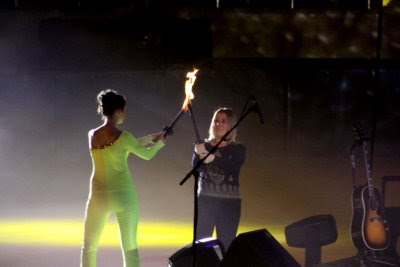 I'm impressed - AP has actually put out a press release on the opening of the event! Of course, it's only about the men's teams (they euphimistically call them "open" teams now, but we all know they're men's teams, with an occasion chess femme thrown in for a little spice) but it's international press coverage.
The Indian press is already putting out articles - here's one from the English-language The Hindu: New format to help India in Chess Olympiad. The Indian women's team is very strong: reigning World Junior girls champion Dronavalli Harika,Tania Sachdev, Swati Ghate, Nisha Mohota and Mary Ann Gomes. The Indian Women's Team finished in 12th place at the Turin Olympiad in 2006.
Tonight is the grand opening. GM Susan Polgar was the torch lighter for this Olympiad. Here is a photo from her blog, which I presume was taken by Paul Truong, who is acting as the official photographer for the Olympiad. Truong has taken many of those great photos at SP's blog.
Tuesday, November 11, 2008
Chess News
Hola! L'echecs des Femmes November 1st column is now up and running at Chessville. dondelion has posted a brand new Random Round-up (right hand column, scroll down to RR) at Goddesschess, and I've done some updating of October and November news at Chess Femme News. Enjoy!
The 2008 Olympiad opens tomorrow in Dresden with play starting 11/13. GM Susan Polgar is acting as a sort of ambassador at large and the English-language news liason with the press and I understand she'll be publishing a daily review in Dresden's largest newspaper and also doing a daily television spot (this is per the Parrot at Chessville).
Katherine Neville "The Fire": Another Review
I've lost count!
Book - The Fire: A Novel
By Elizabeth de Jager Nov 11, 2008, 9:20 GMT
Twenty years ago, Katherine Neville's book, The Eight was published to great acclaim. It defied genre - it was a swashbuckling adventure, it had romance, the epic worldwide settings, intricate mysteries, strong female characters and sexy Russian chess masters.
I have tried reading The Eight at least once every two years since I first picked it up in high school. If I had to choose a book that changed the way I saw authors and their skill, it would be The Eight. Because of The Eight, I learned to play chess (badly), my love for adventure and mystery novels were born, and importantly my obsession with quest novels - I can't get enough of them.
The long wait for the sequel has been worth it. We are introduced, from the very first pages, to Alexandra, Cat and Sasha's daughter. Through Alexandra we take each step forwards to uncovering the mystery surrounding her mother's disappearance. The Game has begun again - pieces of the mysterious and beautiful Montglane Service has reappeared, triggering the start of a new adventure for the various players.
The author deftly describes far-flung places as if it is her habit to take weekend jaunts there. She pulls us effortlessly into the past and history comes to life as she uses real events to elaborate on her storyline.
Ms. Neville has always excelled in drawing vibrant characters and in The Fire she reprises the roles of many of the characters from The Eight. Favourites are Lily Rad, Alexandra's one-time chess tutor and the other is Ladislaus Nim, Alexandra's uncle, enigmatic recluse and computer genius.
Ms. Neville is also one of the best dialogue writers I've ever seen. The dialogue rolls and characters' stories are told in flashbacks that do not detract from the existing urgency in the novel - and that in itself is hard to do! (Read ANY book on writing and you will see that they warn aspiring writers about flashbacks/back stories - they slow the story down, they are boring and should be used sparingly, etc. etc. ) Ms. Neville flies in the face of all of this and comes out trumps.
The action is relentless. Intermingled with chess analogies you are taught bits of history, alchemy, the occult, poetry, religion and cooking and you are never bored by any of the characters as they all manage to hold their piece of stage by being plotted and created with a deft hand. If you've not had the chance to read The Eight, but you would like to get stuck into The Fire, do so - although it would be an advantage to have read The Eight, The Fire is very much its own creature and stands alone very nicely.
The Fire is a feast - it delves deep into mythology and legend and demands your attention - there are no skipping scenes here, because if you do, you will miss crucial information to help uncover the new players of The Game. The story is multi-layered and it a strong compelling read.
2008 Chess Olympiad
Here is the Indonesian Women's Team:
Sebastian Simanjuntak heads the women's team, which consists of Irene Kharisma Sukandar, Evi Lindiawati, Kadek Iin Dwijayanti, Desi Rachmawati and Dewi Citra.
Irene Kharisma Sukandar is one to watch. She has been playing against male players in various events in addition to women-only events and has been sharpening her skills.
Full article.
2008 Chess Olympiad
Here is the Azerbaijani Women's Team:
Zeynab Mammadyarova, Turkan Mammadyarova, Nargiz Umudova, Narmin Kazimova (the main staff) and Khayala Iskandarova (a reserve player) will perform within the Azerbaijani female combined team.
Anar Allahverdiyev is the chief coach of the women’s combined team.
Full article.
I'll be keeping my eye on Narmin Kazimova. She had some sparkling moments at the 2008 European Individual Women's Chess Championship.
Monday, November 10, 2008
Our Lady of Kazan: Another Black Madonna
 I read about this Marian icon of Kazan earlier this evening in Katherine Neville's "The Fire." This image is from Wikipedia - see entry below.
She is one of the "black" Madonnas - so-called both because of the often dusky color of their skin (in some cases, after cleaning, attributed to the accumulation of generations of soot from candles burnt under the images) and because in many cases they were either excavated from underground ruins or were originally worshipped in underground caverns, perhaps due to Marian persecutions.
A famous Black Madonna around these parts is "Our Lady of 'Chestakowa' (spelled phonetically), revered by generations of Polish Catholic immigrants - Milwaukee's south side was originally settled by Polish immigrants and the grand basilica of St. Josephat's on South 6th Street and West Lincoln Avenue stands as a testimony to their dedication to the Roman Catholic Church. There is a Roman Catholic Church on the corner of South 6th Street and West Mitchell Street (don't know the name), with a large mosaic representation of Our Lady of 'Chestakowa' on its south side, just around the corner from the main entranceway stairs.
Here is information from Wikipedia on the Black Madonna of Kazan:
Our Lady of Kazan, also called Theotokos of Kazan (Russian: Казанская Богоматерь), is a holy icon of the highest stature within the Russian Orthodox Church. It has been considered a palladium of Russia for centuries. Two major Kazan Cathedrals, in Moscow and in St Petersburg, are consecrated in her name, as are numerous churches throughout the land. Her feast days are July 21 and November 4, (which is also the Day of National Unity).
The icon was credited by the Russian commanders - Dmitry Pozharsky and Mikhail Kutuzov - with helping the country to repel the Polish invasion of 1612, the Swedish invasion of 1709, and Napoleon's invasion of 1812.
The icon was discovered on July 8, 1579, underground in the city of Kazan, after the Theotokos, the Blessed Virgin Mary, in a Marian apparition revealed its location to a little girl, Matrona. The original icon was kept in one of the monasteries in Kazan, whereas its ancient and venerated copies [my emphasis added] have been displayed at the Kazan Cathedral of Moscow, at Yaroslavl, and at St. Petersburg.
In the night on June 29, 1904 the icon was stolen from a cathedral in Kazan where it had been kept for centuries. Thieves apparently coveted the icon's golden setting, which featured many jewels of highest value. When several years later Russian police finally apprehended the thieves and recovered the precious setting, they declared that the icon itself had been cut to pieces and burnt. The Orthodox church interpreted the disappearance of the icon as a sign of tragedies that would plague Russia after the Holy Protectress of Russia had been lost.
After the Russian Revolution of 1917, there were plenty of theories speculating that the original icon was in fact preserved in St. Petersburg and later sold by the Bolsheviks abroad. Although such theories were not credited by the Russian Orthodox church, one of several reputed originals [this should be - copy] (dated by experts to ca. 1730) was acquired by the Blue Army of Our Lady of Fatima and enshrined in Fátima, Portugal in the 1970s.
In 1993, the icon was given to Pope John Paul II, who took it to the Vatican and had it installed in his study, where it was venerated by him for eleven years. In his own words, "...it has found a home with me and has accompanied my daily service to the Church with its motherly gaze."[1] John Paul II wished to visit Moscow or Kazan in order to return the icon to the Russian Orthodox Church. When these efforts were blocked by the Moscow Patriarchate, the icon was presented to the Russian Church unconditionally in August 2004. On August 26, 2004 it was exhibited for veneration on the altar of St. Peter's Basilica and then delivered to Moscow.
On the next feast day of the holy icon, July 21, 2005, Patriarch Alexius II and Mintimer Shaymiev, the President of Tatarstan, placed it in the Annunciation Cathedral of the Kazan Kremlin.
The icon is enshrined in the Church of the Elevation of the Holy Cross, the site where the original icon of Our Lady of Kazan was found. Plans are underway to make the monastery where the icon was found into an international pilgrimage center.
References
"Liturgy of the Word in honour of the Icon of the Mother of God of Kazan - August 25, 2004". Retrieved on 2008-10-13.
External links
John Paul delivers Our Lady of Kazan to the russian church, july 18 2005
(English) Rediscovered Holy Treasure.
(English) Ikons: Windows into Heaven.
(English) The Miraculous Icons—an entry on Our Lady of Kazan at OrthodoxWorld.ru.
(English) OrthodoxWiki entry on Our Lady of Kazan.
2008 Chess Olympiad
Here is the Philippines Women's Team:
Catherine Perena
Shercila Cua
Daisy Rivera
Cheradee Chardine Camacho
Christy Lamiel Bernale
The 60th ranked 2006 Team finished in 23rd place (a very good showing), composed of the following players:
Sherrie Joy Lomibao
Sherily Cua
Beverly Mendoza
Catherine Perena
Full article.
More Ancient Coins Discovered
 Treasure trove!
From BBC News
Page last updated at 13:59 GMT, Monday, 10 November 2008
700-year-old coins found in field
Three 700-year-old coins which were found in a field have been declared treasure by a coroner at Flint.
The silver pennies date back to between 1307 and 1314, to the reigns of both Edward I and his son Edward II.
Archaeology enthusiast Peter Jones, from Holywell, found a coin in 2006, then returned to the same spot a year later, when the other two were found.
The coins were analysed by experts at Cardiff's National Museum of Wales who discovered they were 90% silver.
Mr Jones regularly scours a field owned by his friend Ron Davies, for pre-historic items.
He said he has found hundreds of old tools, made from flint, some of which dated back thousands of years before Christ.
He told the inquest he did not usually use a metal detector and found the first coin in 2006 just "lying on the surface".
The following year he took a metal detector to the same spot, and again found two similar coins on the surface.
He said: "I just rubbed them with my hand and they came clean."
John Gittins, Deputy Coroner for North East Wales, declared the coins treasure under the Treasure Act 1996.
He said the coins were now the property of both Mr Davies and Mr Jones, and they were entitled to have them back.
The inquest heard there was also interest from the Flintshire County Museum Service to put them on public display.
Mr Jones, who is still deciding where the coins should go, said after the hearing: "Back in those days, this would have been a couple of days' wages for a soldier.
"Whoever lost them would not have been happy."
The inquest was not told where the coins were found, although Mr Jones described it as a "cracking site".
Breathtaking Pearl and Gem Earring Discovered
 This was all over the news today - with good reason. This earring is a timeless creation, breathtakingly beautiful. Imagine wearing a pair of these beauties - the hair would have been up-swept or swept away from the face so that the earrings would be clearly visible; they would have dangled against the wearer's jawline.
I love pearls - these, of course, are all-natural pearls from a time way before cultured salt and freshwater pearls were invented. I'm not an emerald fan - but these emeralds are not faceted (I believe they did not have the technology back then to facet gemstones like emeralds, sapphires, rubies, diamonds, etc.) and the color reminds me a lot of the semi-precious stone malachite, which has a rich varigated/streaked green color that I find irresistible -- like grass and budding leaves in spring.
November 10, 2008
2,000-year-old gold earring found in Jerusalem
By SHAWNA OHM – 11 hours ago
JERUSALEM (AP) — Israeli archeologists have discovered a 2,000-year-old gold earring beneath a parking lot next to the walls of Jerusalem's old city, the Israel Antiquities Authority said Monday.
The discovery dates back to the time of Christ, during the Roman period, said Doron Ben-Ami, director of excavation at the site. The piece was found in a Byzantine structure built several centuries after the jeweled earring was made, showing it was likely passed down through generations, he said.
The find is luxurious: A large pearl inlaid in gold with two drop pieces, each with an emerald and pearl set in gold.
"It must have belonged to someone of the elite in Jerusalem," Ben-Ami said. "Such a precious item, it couldn't be one of just ordinary people."
In a statement released Monday, the authority said the piece of jewelry was "astonishingly well-preserved." Finds from the Roman period are rare in Jerusalem, Ben-Ami said, because the city was destroyed by the Roman Empire in the first century A.D.
Shimon Gibson, an American archaeologist who was not involved in the dig, said the find was truly amazing, less because of its Roman origins than for its precious nature.
"Jewelry is hardly preserved in archaeological context in Jerusalem," he said, because precious metals were often sold or melted down during the many historic takeovers of the city.
"It adds to the visual history of Jerusalem," Gibson added, saying it brings attention to the life of women in antiquity.
Though Gibson dates the piece slightly later than the antiquities authority, to sometime between the second and fourth centuries A.D., he said its quality and beauty were impressive.
Ben-Ami added that he expects more small, luxury items to turn up in future excavations.
Earrings similar to this one have been found at archaeological sites throughout Europe, Ben-Ami said, where the Roman Empire also flourished. The authority said the earring to be crafted using a technique similar to that depicted in portraits from Roman-era Egypt.
Copyright © 2008 The Associated Press. All rights reserved.
Sunday, November 9, 2008
The Bend and Snap
I'm rolling on the floor right now watching "Legally Blonde" - the 2001 movie that I laughed my way over the Atlantic Ocean watching on our flight to Amsterdam a few months after 9/11 in 2001.
Elle gave a lesson at the beauty salon on the "bend and snap" maneuvere. Check it out - good for what ails you, darlings! I particularly appreciated the male hairdressers getting into the spirit of the moment...
Review of Katherine Neville's "The Fire"
Another review of "The Fire."
I'm a little more than half-way through the book now, savoring a section of a chapter at a time, usually wrapped in an afghan with a glass of wine near by, late at night, when the house is creaking and groaning with noises you never hear during the day. Great read - and, yes, even more complex as far as "puzzle" and working one's way through the symbolism to get to the truth of the matter. Neville is a few years older than I am and may want to retire - can she write a sequel to the sequel? I'm not ready to say goodbye to this "never-ending" game on the global chessboard and the unique insights she brings to her readers! Please, KN, bring us more!
'Fire' more complicated than 'Eight'
By OLINE H. COGDILLSouth Florida Sun-Sentinel
Published: November 09. 2008 12:01AM
Before "The Da Vinci Code," there was Katherine Neville's "The Eight."
More than 20 years ago, this ambitious debut by a computer consultant mixed a magical chess set dating back to Charlemagne with mythology, music and math. Set during 1972 and 1790, "The Eight" flitted from New York and Algeria back to the French Revolution. It featured more than 60 characters, many of them historical figures such as Robespierre and Napoleon.
With such far-flung settings and a plot that at first blush would seem to be a mess, "The Eight" should not have worked. Yet it became a cult classic, one of the finest, most original examples of historical thrillers, opening the door for novels steeped in mythology, before it all got tangled up with Dan Brown.
While Neville has written two other novels, "The Fire" (Ballantine Books, $26) is the long-awaited sequel to "The Eight." Just as ambitious and far-reaching as its predecessor, Neville re-creates her fresh approach to storytelling.
In "The Fire," the search for the chess set is now up to Alexandra Solarin, the daughter of "The Eight's" heroine Catherine Velis, and her mother's best friend, Lily Rad. The story smoothly moves from contemporary Colorado, Washington, D.C., Russia and Algeria, then back to the 1800s Rome, the Loire Valley and Morocco. Lord Byron, Keats and Napoleon make cameo appearances.
A chess set has never been more exciting than this one created by Neville. Characters and the scenery are vividly portrayed.
However, "The Fire" is even more complicated than "The Eight" and it is easy to get lost in the story's various mythologies and myriad of characters. The plot lags in the middle before Neville gets her elaborate chess game back on track.
A 20-year wait for a sequel is too long, though "The Fire" nicely wraps up some secrets and twists that were never solved in "The Eight." Readers will want to first learn what "The Eight's" fuss was all about before tackling "The Fire."
The Phoenix
 Here is a beautiful example of cross-cultural influence on artwork in ancient Persia (Iran) after the Mongol invasion - evidence that Islam did not prohibit the production of images of living beings in art and artifact; indeed, Islamic artists were masters at producing beautiful works of art incorporating elements of eastern and western design, depicting animal and human figures and along with intricately composed geometric patterns.
This piece was featured today at the Metropolitan Museum of Art's website. here are the particulars about the piece:
Tile, frieze, ca. 1270–80; Ilkhanid period (1206–1353)
Made in Probably Kashan, IranFritware, molded, painted in luster and blue under a transparent glaze; H. 14 3/4 in. (37.5 cm) W: 14 1/4 inl (36.2 cm)Rogers Fund, 1912 (12.49.4)
Description
This tile, with its bold design of a phoenix soaring on a background of cloud bands and its lotus border, is an excellent example of the Chinese influence on Iranian iconography following the thirteenth-century Mongol conquest. The tile, one of a long frieze with alternating phoenixes and dragons, most likely was once set on the walls of the Ilkhanid summer palace known as Takht-i Suleiman ("The Throne of Solomon") in northwestern Iran, built in the 1270s.
Provenance
Takht-i Sulaiman, Iran
Subscribe to:
Posts (Atom)