Thursday, July 29, 2010

Large Exhibition of Taosi Site Objects in Beijing

"Gear-wheel shaped bronze wear
(01 M11:2)
Middle to late period Taosi culture (c. 2100 BC - 1900 BC)
Unearthed from Taosi site, Xiangfen, Shanxi province
This ware was found with a jade bi piling up on the small tomb owner's arm.  The 29 teeth of the ware drew experts' attention that some guessed it might be related to the cycle of dates of month.  Others also think that it may be a bracelet."

Some bracelet!  The translation to English leaves much to be desired.  Was the object actually found AROUND the wrist or arm of the tomb owner?  Was it laying ON TOP OF the arm of the tomb owner?  A bi, as I understand it, is meant to be worn around the neck, suspended from a silk or leather cord. Perhaps this piece was meant to be worn similarly?  Or perhaps it's not a piece of jewelry at all but is something else entirely -- a piece of something that was used to tell time in some way, perhaps?  The 29 "cogs" that appear to be evenly spaced around the outer rim of the circle are highly suggestive of a lunar month, for instance.

Or perhaps it was used for divination somehow, in conjunction with other pieces of equipment that disintegrated over the thousands of years of burial?  For that matter, would not a cord of silk or leather also have disintegrated away after 3000 plus years? 

This object is one of many currently on exhibit at the Capital Museum in Beijing:

China's biggest ever archaeological exhibition is held at the Capital Museum in Beijing on Thursday, July 29, 2010.
"The archaeological finds of the Taosi Site in Xiangfen County of Shanxi Province rewrite history and prove that the beginning of Chinese civilization should be at least 4200 years ago, not 3700 years ago as previously suggested." an expert said during the opening ceremony of China's biggest ever archaeological exhibition in Beijing on Thursday.

The exhibition of over 400 cultural relics, held in the Capital Museum from July 29 to October 10, includes more than one hundred of the earliest archeological finds in China, such as cultivated rice from 10,000 years ago, panicum from 8000 years ago and an ancestor of domestic pigs. Over 70% of the cultural relics are open to the public for the first time.
*****************************************************************
I'm not saying there is any relationship - but the number 29 reminded me of the very old game of Yut or Nyout, which also involves 29 "points" arranged either in a circle or in a square. Here is an example of a Yut or Nyout arrangement. (R.C. Bell, "Board and Table Games from Many Civilizations.")  It is still played in Korea although the origins of the game have been lost in the mists of time and it is supposed that most people no longer really understand the significance of the fact that, for instance, each "point" has its own name. Some people think that the outer rim in Yut/Nyout represents "Heaven" and the inner portion (the 'cross,' around which a square can be drawn) represents "Earth." In the very old old days, long before China was China, this concept of Heaven/Earth was represented by a circle ("Heaven") superimposed over a flat, square plane ("Earth").

I believe the tradition has evolved to Nyout mostly being played on Korean New Year's Day, when one's "fortune" can be told by playing the game -- I have yet to come across an article that explains just how this is done, though. According to Stewart Culin, Nyout was one of several games that embodied a method of divination in which several two faced staves are tossed and numerical counts attributed to their various falls. [T]he game of Nyout is a striking and typical example. In Nyout, as in many similar games of the same order, direction or place is determined by counting around a diagram which may be regarded as representing the world and its quarter.

I suppose, therefore, that in order to determine one's fortune, one would throw the sticks to get a count and move a piece onto the "board", and this process would be repeated several times, depending on how many pieces one had to "play." The final result would be "read," i.e., interpreted, based upon which "points" the playing pieces landed on the "board."

The interpretation might get a lot more complicated, though, if more than one person was placing pieces on the "board", perhaps taking turns tossing the sticks to get a count. For instance, if another person's piece landed on your same point - what would happen? Would you have to start over? Would you incur a penalty of some kind (go back five spaces, move to "x" space), perhaps even "death?"

An alternative explanation to divining one's fortune by playing Nyout (or perhaps any similar game, because the roots of all circle and cross games may stem from a single origin) as proposed by Culin is discussed at Board Game Geek:

"Regarding the game of Nyout, Culin writes about how the game can be related to the I Ching. During a special holiday time of the year in Korea, Nyout is played and a special book is used called the zhìchéngfǎ (掷成法-"Toss-win-way"). He also includes an exerpt from the book titled zhìsìzhān (掷柶占-"Toss-spoon-divine"). He makes a connection between this book and the I Ching in that there are 64 possible combinations that can result from the throw of the Nyout blocks and that there are 64 possible forturnes that may result."


While short blocks, pam-nyout, are used by children, and gamblers in cities, in the country, long blocks, called tiyang-tjak-nyout (Chinese, cheung cheuk sz' (長斫柶-cháng zhuó sì-"Long Chop Spoon")) or "long-cut nyout" are emplyed. . . . It is customary in Korea to use the long blocks at the 15th of the first month for the purpose of divination. Early in this month a small book is sold in the markets of Seoul to be used in connection with the blocks. The players throw the sticks three times, noting the number that is counted for the throw at each fall. The series of three numbers is then referred to the book, upon the several pages of which are printed in Chinese characters all the various permutations of the numbers, taken three at a time, Korean text explanatory of their significance. . . . The Chinese Book of Divination consists of 64 diagrams, Kwa (卦-guà-diviniatory trigrams), composed of combinations of unbroken ------- with broken lines --- ---, six being taken at a time, and the resulting diagrams being known as the Sixty-four Kwa (卦). Each of these 64 hexagrams is designated by a name and is accompanied by a short explanatory text. Now the Sixty-four Hexagrams are regarded as an expansion of the Eight Trigrams, called the Pat Kwa (八卦-bāguà-eight trigrams), or "Eight Kwa (卦)," formed by combining the same unbroken and broken lines three at a time. The unbroken lines in the diagrams are called yeung (陰-yīn), "masculine," and the broken lines, yam (陽-yáng), "feminine." It is apparent that if the two sides of the Korean blocks be regarded as representing the unbroken, or masculine, lines and the broken, or feminine, lines, the trigrams will form a record of the throws when three blocks are used, and the hexagrams when six blocks are taken. This I believe to have been their original purpose. I regard the diagrams as records of possible throws with two-faced staves, and the text that accompanies the hexagrams in the Yih King, (易经-yìjīng-The Book of Changes) to be explanatory . . . The Korean game of Nyout may be regarded as the antetype of a large number of games which exist throughout the world. Thus the diagram of the Hindu game known as Pachisi, or Chausar . . . will be seen to be an expansion of the Nyout circuit with its internal cross.


From "Games of the Orient" (AKA Korean Games) by Stewart Culin (pg 70-74)
********************************************************************
So, this means that if there was no longer anyone who understood the 'rules' to enable the book to be published each year that interpreted the positions where one's pieces ended up on the Nyout board -- and here I am assuming that the book would be customized depending upon the position of the stars, for instance, or related to the greater zodiacal positions -- one would no longer be able to tell one's fortune using that particular method. 

But both the point-marked Nyout board shown above and the standardized trigrams of the I Ching (which have established meanings) could still be used to provide a fortune reading. In the former method, a marked board would be necessary and one's pieces would have to be placed on the board according to one's throws of the sticks; in the latter, all that would be necessary would be to record the way the sticks landed a certain number of times in order to construct the trigrams.  Interpretation would then flow from the trigrams. 

Of course, this supposes that the meanings of the points on the Nyout board and the meanings of the trigrams recorded in the I Ching will never be lost.  Unfortunately, we know from history that such knowledge can be and has been lost with respect to other board games and divinatory practices, and once lost, can often never be reconstructed.

Discoveries from Yet Another English Henge

This one is Marden Henge -- you can find a model here. It's located about halfway between Avebury and Stonehenge.  The diagram below is from The Modern Antiquarian. 

Feast of finds at Marden
12:14pm Thursday 29th July 2010
by Lewis Cowen

Archaeologists have unearthed a prehistoric henge at Marden, near Devizes, where worship, business and feasting would have gone on 5,000 years ago.

The discovery at Hatfield Farm, never before investigated, has excited the world of archaeology and is more impressive than the recent finds at Stonehenge.

The area under investigation comprises a circular bank and ditch, the distinctive indications of a henge, built by neolithic people between 2500BC and 2300BC, contemporary with Stonehenge, Avebury and Durrington Walls.

The team led by English Heritage archaelogist Jim Leary have been bowled over by their discoveries.

Mr Leary said: “All the literature on this area would lead you to believe it was ploughed out but in fact it has never been ploughed.”

The excavation on top of the bank has unearthed the foundations of a rectangular building with chalk walls.

Mr Leary said: “This would not have been a residence. It could have been a place of worship or a communal building.”

The team also discovered a midden, or rubbish tip, with evidence of great feasting. The 5,000-year-old bones of pigs, some still attached to each other, have been found in perfect condition.

TV archaeologist Phil Harding of Channel Four’s Time Team, who visited the site on Friday, said: “This is amazing. You can see it all there. It accentuates how valuable the work going on here really is.”

Artefacts discovered include a perfect flint arrow head, a stone hammer or pestle and a small red stone worn very smooth, thought to have been used to work leather or burnish pottery.

At the centre of the site, about 200 metres from the henge, the team are having slightly less success with the area where a mound claimed to have been 15 metres high, half the height of Silbury Hill, existed until the early 19th century.

Mr Leary said: “William Cunnington and Henry Colt-Hoare, who were among the first archaeologists in Wiltshire, drove a shaft straight down the centre of it in 1806.”

Two days later the shaft collapsed. An antiquarian writer passing a few years later was distressed to see the farmer had levelled the site.

But the English Heritage team are still finding valuable information from the trench they have dug.

Archaeologists believe the finds are far more significant than the wooden henge discovered at Stonehenge last week. They say that, far from Stonehenge existing in glorious isolation, it has long been known it was part of much larger complex of henges and burial sites.
***********************************************************
More info in an article by Maeve Kennedy at The Guardian:
Was Marden Henge the builder's yard for Stonehenge?
July 28, 2010

Wednesday, July 28, 2010

Fund Raiser Set to Aid Yucatan Champion Chessplayer

Story at The Daily Athenaeum (West Virginia University)

Friends organize ‘Salsa for Sussi’
Lizard hosts dance to benefit WVU grad’s surgery
By Mackenzie Mays

Published: Tuesday, July 27, 2010
Updated: Wednesday, July 28, 2010

A benefit will be held at De Lazy Lizard tonight at 8 to raise money for a West Virginia University grad’s necessary surgery in the form of her favorite hobby: a Latin dance party.

Susana Villanueva, known by her friends as Sussi, graduated from WVU last spring with a Master’s in Foreign Languages as an international student from Yucatan, Mexico, who dedicated her time to volunteering and served as vice president of Sigma Delta Pi, the Spanish honorary while holding a 4.0 GPA.

She is known most for her energetic personality and love for hosting dances and sharing a piece of her culture with the Morgantown area.

Last semester, Villanueva began having difficulties walking due to a problem in her spine and what appeared as a minor back problem developed into intense pain and impaired mobility, according to her friend Gary Laruta, a legal studies student at WVU and president of the International Students Organization.

"Because of her back problems, she struggled a lot to complete the master’s program and teach as a Spanish TA at the same time, but she successfully finished strong and graduated," Laruta said. "But of course it was very upsetting for her friends to not see her anymore at gatherings dancing."

Villanueva needs a $15,000 correctional spine operation called Spinal Normalisation, which uses new technology called a "Device for Intervertebral Assisted Motion (DIAM)" to treat back problems by allowing flexibility without the need for spinal fusion.

This perseverance is what has inspired friends of Villanueva’s like Jason Staples, a Training and Development Specialist with WVU’s Division of Human Resources who met her in 2008 during Diversity Week where she was volunteering to promote multi cultural awareness, to do their part in helping with her condition.

"Her desire to succeed and pursue her dream to graduate even when facing obstacles that would make most people give up is what has inspired me to take part," Staples said. "At the end of the Spring 2010 semester, even though she was in a lot of pain day and night and even though she was in a wheel chair and on crutches, she never quit smiling and she never gave up."

Villanueva graduated on time in May with the rest of her class and attended the graduation ceremony in her wheel chair and told Staples she didn’t want to miss out on the cultural experience of graduating as a Mountaineer.

Villanueva is modest about her accomplishments, like being named the national Mexican chess champion at the age of 13 and participating in the World Chess Championships in Linares, Spain, Bratislava, Slovakia and Brazil and is the first in her family to attain a bachelor’s degree, master’s degree and learn a foreign language, and this humble attitude is what has attracted caring friends who want to help her to continue her success.

"She is truly very loving, friendly, helpful and bright. She has always worked hard for everything she’s accomplished even though she doesn’t talk much about her accomplishments," Staples said. "Sussi plans to continue to achieve her goals but this all depends on the surgery and her recovery."

Villanueva has received a scholarship to Texas Tech University in Lubbock, Texas, to continue her education with a PhD in Modern Languages and Literature in the Fall.

"Morgantown is not a big city and that becomes a plus in terms of building a close community, a community that is there for each other and I guess that the message here," Laruta said. "Sussi has been responsible for many fun and happy memories for all of us, and even though she can’t currently do something that she loves to do like dance, we are going to salsa for Sussi."

The Salsa for Sussi benefit will take place in the VIP room of De Lazy Lizard at 8 p.m. All proceeds will be donated to the financial costs of her surgery.
******************************************************************
At first I thought it might be a chess scholarship, but it doesn't seem so --

I found the following information about Ms. Villaneuva at chess femme Claudia Munoz's website (translated to English by Google) - thanks Claudia for publicizing Ms. Villaneuva's plight:

SUMMARY OF COMPETITIVE HISTORY OF CHESS IN YUCATAN

-- First female youth player to participate and excel in chess tournaments at the level of adults and youth in state history in the Yucatan 1989

-- 4 years consecutive gold medals brought Yucatan national chess champion. 1991-1994 1991-1994

-- Representative of Mexico's Olympic team in the world in Linares, Spain, 1992

-- Representative of Mexico at the world championships in Bratislava, Czechoslovakia, 1993

-- Representative of Mexico at the Pan American Games in Brazil two consecutive years, 1994 and 1995

-- First woman to win the state award of the sport in 1993 Yucatán

-- First Yucatan in serving as arbitrator interpreter translator bilingual teachers and international players in the International Chess Tournament "Carlos Torre Repetto" in Merida, 2003 and 2004

Assam, India to Host Large Women's Championship

From the Assam Tribune
Top players for nat’l chess
Sports reporter

GUWAHATI, July 28 – The All Assam Chess Association is bracing up to hold the 37th Women Challenger Chess Championship.

The championship will be organised at the Silpagram, near Srimanta Sankaradeva Kalakhetra here from August 20 to 28.

The organisers have informed that leading players of the country like Swati Ghate, Swati Mehta, Amruta Mukal, Vijay Lakshmi are likely to take part in the championship which has been counted as one of the most important women’s chess tournament in the country. About 150 players will vie for the title.

The players will be accommodated in and around the competition venue. MP Ranee Narah will be the chief guest in the inaugural function.

It is for the first time that the State chess body is organising such a important chess tournament of national circuit for women.

Illinois Kids Teach Rehab Patients How to Play Chess

A lovely story!

From the Daily Herald (suburban Chicago)
Youngsters teach patients chess at South Elgin rehab center
By Eileen O. Daday, staff writer
July 28, 2010

An articulate group of children mixed with adult patients last week at the South Elgin Rehabilitation and Health Care Center. Their medium: chess, and it turned out to be a heck of an icebreaker.

The children ranged in age from kindergartners to fifth-graders. They were coming off a week of Chess Without Borders summer camp at Barrington High School, led by the 2008 U.S. champion Yury Shulman.

A similar camp takes place next week at Quest Academy in Palatine, when Shulman presents his unique approach to learning chess, complete with four grand masters on the staff.

The camps are an outgrowth of after-school programs run by Shulman in Barrington, Palatine, Cary, Fox River Grove and Glendale Heights.

"I remember when I was young and playing in masters tournaments with players from around the world," Shulman said. "None of us spoke the same language, but after the games, we'd have no trouble communicating about chess."

That philosophy continues to drive his camps, where chess instruction is the hook, but a broader approach to serving others is incorporated.

Earlier this month, campers learned about the Citizens for Conservation Corps in Barrington before making a donation. Another camper, Joseph Jazwinski, 10, of Cary led his peers in a project that collected care packages for troops in Afghanistan.

On this particular day, however, they arrived to share their chess know-how with these unsuspecting adults.

Peter Abrahamson, 11, of Lake Barrington and Jack Bradley, 6, of Barrington both wanted to play Mike Trojanowicz at the center, who already knew how to play the game, and they had no hesitation in approaching him.

"I usually start by helping them open with better moves," Peter said. "Then, I try to get them to think ahead, to see where they are threatened."

Jack says he plays regularly with his grandfather, Paul Petraitis of Barrington Hills, both in person and online.

Petraitis was on hand for the rehab center visit, where he continued to marvel at the youngsters and their confidence in teaching the game.

"I hadn't played chess in 35 years," Paul Petraitis said. "Now, I'm hooked. For an older person, you learn concentration and thinking ahead. For the kids, I see how it develops their logic and strategy."

One of those on hand from the chess club was Fremd High School junior Sujit Johnston, 16, of Rolling Meadows, who is serving as an intern with the group.

He started playing chess in fifth grade before attending one of the Chess Without Borders camps and playing in its tournaments. Last winter, he placed fifth at the IHSA state chess finals.

"The camps had a lot of drills and we'd go through games of former grand masters," Sujit said. "But I liked how they brought in service, and helping people all around the world."

Lucy Abrahamson, 9, watched both her older brothers play chess and she wanted to learn herself. After attending one of the camps, she says, she now feels enough confidence to teach adults.

"I just try and explain all of the pieces and what moves it takes to capture someone," Lucy explained.

Her opponent at the rehab center, Glenda Parker, conceded she had minimal knowledge of the game and kept reverting back to her knowledge of checkers.

"She's teaching me where to place these pieces and how to jump," Parker said. "It's hard, but I'm getting it. I like the fact that I'm still learning."

For more details about Chess Without Borders, visit shulmanchess.com.

Two New U.S. Chess Champions, Two Diverging Paths

From Gambit, The New York Time's chess blog by Dylan Loeb McClain
Published: July 24, 2010

(Excerpted)
The two newest United States champions have very different future plans.

On Monday [July 19], Irina Krush, 26, won the women’s championship for the third time, earning $16,000, her biggest payday. Krush said of her prospects of earning a living as a professional player, “I am actually at the stage where I am going to get into it more than ever.”

Samuel Shankland, 18, who won the junior championship in a playoff on Tuesday [July 20], plans to quit playing professionally for the time being, and perhaps for good. He is beginning studies at Brandeis University in Boston in the fall. “I’m going to go down the other road and see where it goes,” he said.

Krush, who also won in 1998 and 2007, finished a half-point ahead of Anna Zatonskih, the 2006, 2008 and 2009 champion, and Tatev Abrahamyan. The rivalry between Krush and Zatonskih has become quite intense, partly because of the playoff between the two that decided the 2008 title. Krush said of the rivalry, “There is nothing too friendly about it.” But she added that they were on speaking terms. “It is important to me that things are cordial,” she said.

Krush said that she had worked hard over the last 18 months with her coach, Giorgi Kacheishvili, and that the work was bearing fruit. “I am trying to play more dynamic chess,” she said. Krush, an international master, said her immediate goal was to become a grandmaster — she already has one of the three norms needed for the title.

For Shankland, who is also an international master, the obstacles to becoming a grandmaster are one reason he is quitting. He has two norms, but said he had two other tournament performances that would have been norms, except for technical issues. He said of becoming a grandmaster, “Everybody says it is not supposed to be easy, which is fine by me. But it is supposed to be fair.”

Not being a grandmaster has hurt him financially. Shankland estimated that he has earned one-third less than he would have if he had the higher title.

Though Shankland’s victory qualifies him for the world junior championship, which begins Aug. 2 in Poland, he said he was not going. “I’m not turning my life upside down on such short notice,” he said.

5,000 Year Old Artifact Uncovered in Sidon Dig

It's an intriguing little piece - unfortunately I could not find a better photo of it, and I do not know if it is a female or a male.

From the Lebanon Daily Star
Dig unearths 5,000-year-old artefact in Sidon
By Mohammed Zaatari
Daily Star staff
Wednesday, July 28, 2010

(excerpted) SIDON: The British Museum delegation announced on Tuesday that it has discovered significant archeological remains in Sidon, during the 12th year of excavation project.

The delegation has been working on the College excavation site in the southern coastal city of Sidon for 12 years, with the cooperation of the Department of Antiquities of Lebanon. It has recently uncovered new items that link various historic eras together.

“In this small site we have a chronological succession of various eras … Each year we discover new rooms,” said the head of the delegation Claude Serhal.

Work carried out since June 19 of this year has uncovered two new rooms in a 10-room building dating back to the third millennium BC. In one of these chambers the team found a small figurine and a small container with a broken handle.

The statuette of a human figure represented in prayer had special importance, according to Serhal, because it was “the first time we found a complete statue of a worshiper dating back to the third millennium BC.”

The figure was wearing a long dress, with hair indicated by incised lines. Its arms were bent in front of the body suggesting a respectful pose.

“This is a major discovery because we’re learning more about the third millennium BC,” Serhal said, adding that pictures of gods were also found.

4,000 Year Old Russian Tombs Discovered

Archeologists Discover 4000-Year-Old Tombs A sad story - unfortunately these tombs were looted.  No way of knowing what may have been removed.

From russia-ic.com
Archeologists Discover 4000-Year-Old Tombs
28.07.2010

Remnants of early people of the Neolith epoch have been discovered near Shagara Lake, Klepikov District of the Ryazan Region. The entombments are already 4 thousand years old.

Digging works go on there now. There could have been more archeological sensations there, but for the “black diggers”, researchers say.

Chisels, hatchets, scrapers, arrowheads, crocks of vessels – these things can be found nearby the graves.

Archeologists have found out big holes that adjoin the last year's archeological pits. They had been scooped mainly orthogonally, with the cultural layer spoilt and, most likely, plundered.

Source: rzn.info

Tuesday, July 27, 2010

The Circle of Ancient Iranian Studies Makes Strong Statement --

We all know what's going on in Iran with respect to the wholesale looting by the regime of pre-Islamic Iranian antiquities (and the destruction of sites that they cannot figure out a way to make quick money on).  This doesn't get much (if any) coverage in the mainstream press, but the systematic destruction of everything in Iran that is pre-Islamic is a fact of life.  The idiots who were in this country didn't know what they were destroying back in the 18th, 19th and early 20th centuries when they plowed over Indian mounds or blew them up to make "skyscrapers" (the same cannot be said for developers today, as I try to point out by publishing articles here) -- but the dudes who are running things in Iran right now - they DO know. Oh yeah. 

CAIS has the guts tell it like it is -- they did so once again in this article:

An Ancient Subterranean Secret Complex Discovered in Hamadan Province
Tuesday, 27 July 2010 04:14

LONDON, (CAIS) -- An ancient network of secret tunnels and dwellings has been discovered in Hamedan Province.  The Iranian province lies in an elevated region, with the 'Alvand' mountains, running from the north west to the south west.

The discovered complex is located near the village of Arzanfud, 25 kilometres southeast of the provincial capital-city of Hamedan, the Hamedan Cultural Heritage, Tourism and Handicrafts Department (HCHTHD) announced Saturday in a press release.

The complex is comprised of 25 rooms connected to each other by several tunnels, had been excavated beneath a stone mound extending deep into the earth at a depth of 4 to 6 meters.

The complex is believed to have been used by habitants as a shelter during wars.

The entrance to the subterranean complex which is hidden or disguised yet to be discovered, but at the moment it is accessible through an original ventilation shaft, widened by HCHTHD’s experts for access.

There are holes carved in the walls, which had been made to hold early light fixtures. A cot has also been identified in the structure.

A number of stone rings and clasps have also been among the discovered artefacts.

According to initial studies, the city likely dates back to the first Iranian dynasty, the Medes (728-550 BCE) or much later to the Parthian dynasty (248 BCE – 224 CE).

No more details were released by the government-controlled organisation about the discovery.

Since March 2009, Iranian archaeologists are banned giving interviews or reveal any information about the ICHTHO or the status of Iranian archaeology. By implementing such a ban the theocratic-totalitarian regime has closed the only reliable avenue for obtaining the accurate information about the status of the archaeological discoveries and the cultural treasures recovered from the sites. [Emphasis added by Jan]

By some reports, the number of priceless artefacts passed to the Iranian museums by ICHTHO, especially those made of precious metals recovered from the sites have been fallen drastically.

The illicit antiquities trade and selling Iranian historical relics to the European markets and private collectors worldwide has become one of the most lucrative revenues for the ruling clerics and their families.

Since the rise of the Islamic Regime to power in 1979, not only the smuggling and looting of Iranian art and antiquity, but a deliberate destruction, mainly Iran’s pre-Islamic heritage have been systematic and widespread. These destructions have been increased since the appointment of Mahmood Ahmadinajad as the president by the Ali Khamanei, the regime's Spiritual Leader.

Historical background:

Hamedan province is one of the most ancient parts of Iran and its civilisation. Today's it capital city of same name, is the remains of the ancient Ecbatana.

According to historical records, there was once a castle in this city by the name of Haft Hessar (Seven Walls) which had a thousand rooms and its grandeur equalled that of the Babylon Tower.

The foundation of city are related to Diya Aku, a the first Iranian historical King, who founded the first Iranian dynasty, the Medes.

During the third Iranian dynasty, the Parthians, Ctesiphon was chosen as the political and winter capital of the empire and Hamedan became the summer capital and residence of the Arasacid King of Kinds. After the the fall of Parthian dynasty, the Sasanian dynasty (224-651 CE) constructed their summer palaces in Hamedan as well.

After the battle of Nahavand in 642 CE, Hamedan fell to the hands of the invading Arabs; the city was pillaged, the most of the inhabitants were massacred and the survivors forced to accept Islam.

Avicenna (c. 980 - 1037 also Pur Sina, Ibn Sina), the foremost Persian physician, philosopher and one of the world's greatest polymath is buried in that city.

Fragment of Hammurabi-Like Code Found in Israel

Guess I'll file this under biblical archaeology :)  What absolutely amazes me is how they can tell so much from such a tiny little piece of piece! 

From Israel National News
Tablet Discovered by Hebrew U Matches Code of Hammurabi
Published: 07/26/10, 2:40 PM / Last Update: 07/26/10, 3:56 PM
by INN Staff courtesy of Hebrew University

For the first time in Israel, a document has been uncovered containing a law code that parallels portions of the famous Code of Hammurabi. The code is written on fragments of a cuneiform tablet, dating from the 18th-17th centuries B.C.E in the Middle Bronze Age, that were found in Hebrew University of Jerusalem archaeological excavations this summer at Hazor, south of Kiryat Shmonah, in northern Israel.

The Hazor excavations, known as the Selz Foundation Hazor Excavations in Memory of Yigael Yadin, are under the direction of Prof. Amnon Ben-Tor and Dr. Sharon Zuckerman of the Hebrew University Institute of Archaeology. Previous excavations were directed at the site by the late Prof. Yigael Yadin in the 1950s and 1960s.

The fragments that have now been discovered, written in Akkadian cuneiform script, refer to issues of personal injury law relating to slaves and masters, bring to mind similar laws in the famous Babylonian Hammurabi Code of the 18th century B.C.E. that were found in what is now Iran over 100 years ago. The laws also reflect, to a certain extent, Biblical laws of the type of “a tooth for a tooth,” say the researchers.

The Hazor law code fragments are being prepared for publication by a team headed by Prof. Wayne Horowitz of the Hebrew University Institute of Archaeology. Thus far, words that have been deciphered include “master,” “slave,” and a word referring to bodily parts, apparently the word for “tooth.” The style of the text is similar to that of the Hammurabi Code, said Prof. Horowitz.“At this stage, it is difficult to determine whether this document was actually written at Hazor, where a school for scribes was located, or brought from somewhere else,” said Prof. Horowitz. He said that this latest discovery opens an interesting avenue for possible further investigation of a connection between Biblical law and the Code of Hammurabi.

These two fragments are the 18th and 19th cuneiform finds from the Hazor excavations, which now form the largest corpus of documents of cuneiform texts found in Israel. Previous documents dealt with such subjects as the dispatch of people or goods, a legal dispute involving a local woman, and a text of multiplication tables. “These tablets point to Hazor’s importance as a major center for administration and scholarship in the Middle and Late Bronze Ages,” said Prof. Ben-Tor.

The Hazor excavations, sponsored by the Hebrew University and the Israel Exploration Society, take place within the Hazor National Park. The archaeological team is presently about to begin uncovering a monumental building dating to the Bronze Age, where they expect to recover additional tablets.

Rummage Sale Buy May Be Worth $200 Million

'Sis sent me the link to this very early this morning (or very late last night, Las Vegas time) -- Here's one of the stories:

From CNN News:
Experts: Ansel Adams photos found at garage sale worth $200 million
By Alan Duke, CNN
July 27, 2010 9:01 p.m. EDT

Los Angeles, California (CNN) -- Rick Norsigian kept two boxes he bought at a garage sale under his pool table for four years before realizing they may be too valuable to store at home.

The Fresno, California, commercial painter learned this week that what was in those boxes he paid $45 dollars for a decade ago could be worth more than $200 million.

"When I heard that $200 million, I got a little weak," Norsigian said at a Beverly Hills art gallery Tuesday.

Art, forensic, handwriting and weather experts teamed up to conclude the 65 glass plates in the boxes were photographic negatives created more than 80 years ago by Ansel Adams, the iconic American photographer whose images of the West inspired the country.

Arnold Peter, the lawyer who led the effort to authenticate that the negatives were made by the man known as the father of American photography, said their approach was "to put these negatives on trial."

Experts, including a former FBI agent and a U.S. attorney, "came to the conclusion that, based on the evidence which was overwhelming, that no reasonable person would have any doubt that these, in fact, were the long-lost images of Ansel Adams," Arnold said.

The photographs were from the early career of the famed nature photographer, a period that is not well documented since a 1937 darkroom fire destroyed 5,000 of his plates, Arnold said.

"It truly is a missing link of Ansel Adams and history and his career," said Beverly Hills appraiser and art dealer David W. Streets.

The photographs were taken between 1919 and the early 1930s at locations familiar to Adams, mostly around Yosemite, California, Streets said.

"This is going to show the world the evolution of his eye, of his talent, of his skill, his gift, but also his legacy," Streets said.

"And it's a portion that we thought had been destroyed in the studio fire."

Norsigian, who scours garage sales for antiques, was looking for a barber chair when he spotted to two deteriorated boxes in the spring of 2000.

"When I pulled on of those glass negatives out, I seen Yosemite," he said. "As a young man, I worked at Yosemite quite a bit. So, right away I recognized it as Yosemite."

He bickered with the seller, finally negotiating down from $70 to $45 for the boxes. The owner said he bought them in the 1940s at a warehouse salvage in Los Angeles. He bickered the price down from $70 to $45.

It would be two years before he realized they photos may be from Adams, he said. After four years, he had done enough research to realize the plates could be valuable. He moved them from under his pool table and placed them in a bank vault.

How these 6.5 x 8.5 inch glass plate negatives of famous Yosemite landscapes and San Francisco landmarks -- some of them with fire damage -- made their way from Adams collection 70 years ago to a Southern California garage sale in 2000 can only be guessed.

Photography expert Patrick Alt, who helped confirm the authenticity of the negatives, suspects Adams carried them to use in a photography class he was teaching in Pasadena, California, in the early 1940s.

"It is my belief that he brought these negatives with him for teaching purposes and to show students how to not let their negatives be engulfed in a fire," Alt said. "I think this clearly explains the range of work in these negatives, from very early pictorialist boat pictures, to images not as successful, to images of the highest level of his work during this time period."

Alt said it is impossible to know why Adams would store them in Pasadena and never reclaim them.

The plates were individually wrapped in newspaper inside deteriorating manila envelopes. Notations on each envelope appeared to have been made by Virginia Adams, the photographer's wife, according to handwriting experts Michael Nattenberg and Marcel Matley. They compared them to samples provided by the Adams' grandson.

While most of the negatives appear never to have been printed, several are nearly identical to well-known Adams prints, the experts said.

Meteorologist George Wright studied clouds and snow cover in a Norsigian negative to conclude that it was taken at about the same time as a known Adams photo of a Yosemite tree.

In addition to Yosemite -- the California wilderness that Adams helped conserve -- the negatives depict California's Carmel Mission, views of a rocky point in Carmel, San Francisco's Fisherman's Wharf, a sailing yacht at sea and an image of sand dunes.

"The fact that these locations were well-known to Adams, and visited by him, further supports the proposition that all of the images in the collection were most probably created by Adams," said art expert Robert Moeller.

Moeller said that after six months of study, he concluded "with a high degree of probability, that the images under consideration were produced by Ansel Adams.

Silver tarnishing on the negatives also helped date the plates to around the 1920s, Alt said.

"I have sent people to prison for the rest of their lives for far less evidence than I have seen in this case," said evidence and burden of proof expert Manny Medrano, who was hired by Norsigian to help authenticate them. "In my view, those photographs were done by Ansel Adams."

Arnold, the lawyer, said they presented their evidence to descendants of Adams, but they've not heard back.

Norsigian, who is 64, still works for the Fresno school system, but he may retire this year.

It could be a while before he sees the profits from the sale of prints from the negatives, but Streets estimates over the next 25 years it could mean over $200 million for Norsigian.

For now, the photos will go on a tour of universities and museums, starting in October at Fresno State University, Norsigian said,

"I just hope everybody enjoys them," he said.

He's not spoken with the man who sold him the two boxes a decade ago.

"If he's still around, I'm afraid he may come looking for me," he said.
******************************************************
Great story!  But there is a BUT --

From AP at Yahoo News:
Adams heirs skeptical about lost negatives claim
By CHRISTINA HOAG, Associated Press Writer Christina Hoag, Associated Press Writer – 2 hrs 6 mins ago
BEVERLY HILLS, Calif. – A trove of old glass negatives bought at a garage sale for $45 has been authenticated as the lost work of Ansel Adams and worth at least $200 million, an attorney for the owner said Tuesday, but the iconic photographer's representatives dismissed the claim as a fraud and said they're worthless.

Arnold Peter, who represents Fresno painter and construction worker Rick Norsigian, said a team of experts who studied the 65 negatives over the past six months concluded "beyond a reasonable doubt" that the photos were Adams' early work, believed to have been destroyed in a 1937 fire at his Yosemite National Park studio.

Adams is renown for his timeless black-and-white photographs of the American West, which were produced with darkroom techniques that heightened shadows and contrasts to create mood-filled landscape portraits. He died in 1984 at 82.

His photographs today are widely reproduced on calendars, posters and in coffee-table books, while his prints are coveted by collectors. His print "Clearing Winter Storm, Yosemite National Park" fetched $722,500 at auction last month in New York, a record for 20th century photography.

Norsigian, who works for the Fresno Unified School District, is already planning to capitalize on his discovery. He's set up a website to sell prints made from 17 negatives from $45 for a poster to $7,500 for a darkroom print with a certificate of authenticity. A documentary on his quest to have the negatives authenticated is in the works, as well as a touring exhibition that will debut at Fresno State University in October.

Representatives of Adams, however, said they're not buying Norsigian's claims.

"It's an unfortunate fraud," said Bill Turnage, managing director of the Ansel Adams Publishing Rights Trust. "It's very distressing." Turnage said he's consulting lawyers about possibly suing Norsigian for using a copyrighted name for commercial purposes. He described Norsigian as on an "obsessive quest."

"We've been dealing with him for a decade," he said. "I can't tell you how many times he's called me."

Adams' grandson, Matthew Adams, who heads the Ansel Adams Gallery in San Francisco, said he reviewed Norsigian's authentications last fall and thinks they're stretches. Many photographers took pictures of the same places Adams did in that era, he said.

"There is no real hard evidence," he said. "I'm skeptical."

Norsigian bought the negatives from a man who said he had purchased the box from a Los Angeles salvage warehouse in the 1940s, bargaining the price down from $70 to $45. He saw they were views of Yosemite but never suspected they might be Adams' works until someone mentioned they resembled the famed photographer's shots.

"We got a laugh out of that," Norsigian said.

But the idea stuck with Norsigian, and he started researching the photographer, eventually concluding they were Adams' work.

The shots are of places Adams frequented and photographed. Several shots contain people identified as Adams associates. Adams taught at the Pasadena Art Center in the early 1940s, which would account for the negatives being in Los Angeles. The negatives are the size Adams used in the 1920s and '30s and several have charred edges, possibly indicating the 1937 fire.

"You keep adding bits and pieces," Norsigian said.

For years, he tried to get them officially verified, taking them to experts at the Smithsonian Institution, the Getty Center and others, but no one would venture to authenticate them.

Three years ago, he met Beverly Hills entertainment lawyer Peter, who assembled a team of experts to review the negatives.

Rest of article...

Well, darlings, looks like the fight is on!

Major Mummy Exhibition Coming to Milwaukee Public Museum!!!

Milwaukee Public Museum to host world's largest traveling mummy exhibit
By Jackie Loohauis-Bennett of the Journal Sentinel

Posted: July 27, 2010 10:34 a.m.

The Milwaukee Public Museum said Tuesday it will display the largest temporary exhibit of mummies and related artifacts ever assembled in the world when the museum opens a new exhibit starting Dec. 17.

The exhibit, "Mummies of the World," will include more than 150 real human and animal mummies from around the globe.

The [Milwaukee Public] museum is only the second venue to host the traveling exhibit.
**********************************************************************
The first U.S. stop for the exhibit is the California Science Center, which will host it through the end of summer.  (Photo from Guardian.co.uk article).

It then travels to Milwaukee -- I imagine it will take over the space temporarily in the Tells, Temples and Tombs permanent exhibit space. 

This is a real coup for Milwaukee.  How well I remember the fantastically wonderful "The Quest for Immortality" exhibit back in 2004 - the Museum scored record crowds and had a packed lecture hall most evenings as Milwaukeeans and people from Chicago, Minneapolis, Indianapolis and elsewhere either drove to or flew into Milwaukee to see the rare exhibit.  To score another great event like this is so exciting for the city.  I know Milwaukeeans will turn out for the exhibit. 

Of course, it is not just Egyptian mummies featured in this one-of-a-kind exhibit.  There are, literally, mummies from all over the world, all different places, all different times and conditions.  Which makes it even more remarkable and a once in a lifetime opportunity to see it in my own home town!  Check out the photo exhibition in the article at the Guardian to get an idea of the scope of what will be presented.  Amazing, absolutely amazing.

Monday, July 26, 2010

2010 Nana Aleksandria Cup

Held in Poti, Georgia, July 9 - 19, 2010.  The Cup is named after the much loved Nana Aleksandria, a Georgian chessplayer who vied several times for the Women's World Chess Champion title and won many individual Olympiad medals, accolodades and honors during her active playing career.  English website.  The Nana Aleksandria Cup is part of a very large international chess festival that includes Boys and Girls U8, U10, U12, and U14 events. 

The final standings from the Open:

Rk. Name FED Rtg Pts. TB1
1 GM Shanava Konstantine GEO 2556 7,5 39,5
2 GM Pantsulaia Levan GEO 2586 7,0 36,5
3 IM Azaladze Shota GEO 2443 6,5 36,5
4 Mammadov Zaur Fazahir Oglu AZE 2302 6,5 36,0
5 IM Benidze Davit GEO 2508 6,5 32,0
6 WIM Mikadze Miranda GEO 2360 6,5 31,5
7 IM Nigalidze Gaioz GEO 2478 6,0 34,0
8 Javakhadze Zurab GEO 2354 6,0 31,0
9 IM Shalamberidze Akaki GEO 2348 6,0 28,5
10 Shengelia Nikoloz GEO 1929 6,0 27,0
11 Zarkua Davit GEO 2350 5,5 30,5
12 FM Al-Ali Hussein Ali Hussein IRQ 2373 5,5 30,0
13 Gelazonia Parmen GEO 2313 5,5 29,5
14 IM Lomineishvili Maia GEO 2370 5,5 28,5
Lortkipanidze Nodar GEO 2211 5,5 28,5
16 WIM Arabidze Meri GEO 2286 5,5 26,5
17 Nikolashvili Giorgi GEO 2302 5,0 27,0
WGM Guramishvili Sopiko GEO 2298 5,0 27,0
FM Gamzardia Giorgi GEO 2188 5,0 27,0
20 Makharadze Jambul GEO 2392 5,0 26,0
21 WFM Bokuchava Madona GEO 2120 5,0 24,0
22 Tsomaia Sergo GEO 1989 5,0 21,0
23 Tsereteli Kakhaber GEO 1977 5,0 20,5
Modebadze Tariel GEO 1915 5,0 20,5
Tsomaia Merab GEO 1897 5,0 20,5
26 Lomsadze Davit GEO 2364 4,5 29,0
27 WGM Khmiadashvili Tamar GEO 2171 4,5 24,0
Khelaia Giorgi GEO 2115 4,5 24,0
29 Pipia Beka GEO 1962 4,5 23,5
30 Shurghulaia Giorgi GEO 2097 4,5 22,5
31 Kilasonia Levan GEO 2073 4,5 20,5
Kobeshavidze Lika GEO 1929 4,5 20,5
33 Anakidze Nino GEO 1965 4,5 20,0
34 IM Maghalashvili Davit GEO 2465 4,0 26,0
35 Kumsiashvili Nikoloz GEO 1969 4,0 23,0
36 Ammar Abdul Jabbar Aliwy IRQ 2181 4,0 22,0
37 Hamandi Mohammed Nawfel Karim IRQ 2258 4,0 21,0
38 Rizhamadze Patman GEO 2037 4,0 19,0
39 Mangiashvili Otar GEO 1806 4,0 15,0
40 FM Ali Ghassan M IRQ 2138 3,5 23,0
41 FM Ali Layth Ahmed IRQ 2296 3,5 22,0
42 Bibilashvili Lali GEO 2001 3,5 17,5
43 WFM Kharatyan Anahit ARM 2080 3,5 17,0
44 Gorduladze Giorgi GEO 1812 3,5 15,5
Tedoshvili Dimitri GEO 1808 3,5 15,5
46 Kosashvili Otar GEO 1812 3,5 15,0
47 Madoyan Iolanta GEO 1748 3,5 14,5
48 Chachibaia Parviz GEO 0 3,5 13,0
49 Malania Vakhtang GEO 0 3,5 9,0
50 GM Kotanjian Tigran ARM 2551 3,0 22,0
51 Svanidze Tamaz GEO 0 3,0 13,0
52 Tsirekidze Giorgi GEO 1836 3,0 10,5
53 Vasiltseva Mariam GEO 0 2,5 15,5
54 Kashia Vakhtang GEO 1720 2,5 14,0
55 Petriashvili Elene GEO 0 2,0 9,0
56 Khutsishvili Levan GEO 0 1,5 7,5
57 Benidze Koba GEO 0 1,0 7,0

Turkish Women's Chess Championship

July 8 - 15, 2010 Konya, Turkey
Organized by the Turkish Chess Federation
A very large event for a national championship - 55 players!  Several of the players came to the Championship with no ELO!  The championship was won by WIM Betul Cemre Yildiz with 8.5/9.  Here are the final standings from the official website:

Sira SNo. isim NRtg IRtg FED Puanlar BH. BH. SB.


1 2 WIM Yildiz Betul Cemre 2264 2235 TUR 8½ 46 41½ 47,25  (photo of the winner)
2 4 Kaya Emel 2009 2015 TUR 7 50 45 40,00
3 9 Patel Yesim 1847 1806 TUR 7 43½ 39 36,00
4 1 WIM Ozturk Kubra 2130 2286 TUR 6½ 49½ 44½ 37,75
5 5 Sop Selen 2014 1988 TUR 6½ 49 44½ 35,00
6 6 Sasmazel Burcu 2006 1876 TUR 6 51 45½ 34,25
7 10 Cemhan Kardelen 1909 1777 TUR 6 46 41½ 30,00
8 14 Ozturk Hilal 1710 1671 TUR 6 41 37 27,75
9 15 Şahin Handenur 1610 1669 TUR 6 40 36 27,25
10 11 Abdimanoglu Beste Basak 1780 1765 TUR 5½ 49½ 44½ 26,75
11 7 Menzi Nezihe Ezgi 1978 1851 TUR 5½ 47 42½ 27,25
12 8 Durmaz Ayca Fatma 1953 1807 TUR 5½ 46 41 27,00
13 3 WFM Yanik Süral Emine 1826 2037 TUR 5½ 43½ 38½ 26,50
14 13 Borekcioglu Zeynep Dilara 1804 1673 TUR 5½ 42 38 24,00
15 23 Isparta Sevim 1751 1605 TUR 5½ 41½ 38 24,00
16 21 Nurlu Selin 1700 1616 TUR 5½ 37 34 19,00
17 20 Firat Deniz 1657 1621 TUR 5 43 39 20,50
18 18 Yolal Sena Gokcen 1703 1662 TUR 5 42½ 38½ 22,25
19 16 Oney Gülümser 1789 1665 TUR 5 40½ 36½ 20,50
20 28 Gundogan Sinem Cagla 1644 0 TUR 5 39 36 19,00
21 30 Alic Gunseli 1585 0 TUR 5 39 35½ 18,50
22 22 Ulusoy Nisan 1622 1613 TUR 5 39 34½ 21,75
23 31 Karsiyaka Simge 1580 0 TUR 5 38½ 35 17,50
24 19 Akgul Beyza 1657 1641 TUR 5 37½ 34 16,50
25 33 Aksoy Ayça 1558 0 TUR 5 36½ 33½ 16,50
26 24 Aslan Cagla Yaren 1652 1572 TUR 5 35½ 32½ 18,50
27 17 Keskin Suara 1712 1662 TUR 4½ 44 40½ 18,50
28 26 Tandogan Buket 1717 1545 TUR 4½ 43 39 20,50
29 12 Sanal Suna 1780 1713 TUR 4½ 38 34 19,50
30 29 Sahin Hatice 1599 0 TUR 4½ 37 34 15,75
31 25 Alev Gonulden Seda 1682 1565 TUR 4½ 36½ 33 18,75
32 42 Kadiroğlu Ekinsu 1294 0 TUR 4 37 34 14,50
33 43 Hereklioğlu Sude 1226 0 TUR 4 36 33 15,00
34 27 Yilmaz Fatma Zumrut 1580 1532 TUR 4 35½ 32 14,50
35 36 Onur Çiğdem 1440 0 TUR 4 35 32 13,00
37 Yassibağ İpek 1341 0 TUR 4 35 32 13,00
37 40 Okuyaz Duru 1318 0 TUR 4 34½ 31½ 13,50
38 55 Özer Remziye 0 0 TUR 4 34½ 31½ 13,50
39 38 Çelik Eda 1324 0 TUR 4 33 30 12,50
40 46 İlter Nilay 1110 0 TUR 4 31 28 11,50
41 34 Ozel Zeynep 1508 0 TUR 3½ 38 35 12,25
42 32 Ozel Meryem 1565 0 TUR 3 39½ 36 11,50
43 52 Söyümez İlayda 0 0 TUR 3 33 30 8,50
44 39 Gökçen Feyza Gül 1320 0 TUR 3 32½ 29½ 9,00
45 41 Çevik Pınarsu Emre 1313 0 TUR 3 32 29 8,00
46 45 Başpınar Lara 1148 0 TUR 3 31 28 8,00
47 47 Keskin Isra Damla 1068 0 TUR 3 30 27 7,00
48 53 Turan Mürşide 0 0 TUR 3 29 27 7,50
49 51 Söyümez Fatma 0 0 TUR 3 26½ 25½ 4,00
50 54 Turan Nefise 0 0 TUR 3 26½ 24½ 5,00
51 44 Veske Ceylan 1205 0 TUR 2 29 28 2,00
52 49 Atalay Merve 0 0 TUR 2 25½ 24½ 2,00
53 50 Atalay Şeyma 0 0 TUR 1½ 24½ 23½ 5,00
54 48 Ar Leylahan 0 0 TUR 1½ 24 23 5,00
55 35 Arkan Yaren 1476 0 TUR 0 36 31½ 0,00

3rd Maria Abulet Memorial

Information from The Week in Chess
The 3rd edition of the "Maria Albulet" Memorial Romanian International Tournament for women took place in the Theater of Braila (port on the Danube) July 15 - 21, 2010. Elena-Luminita Cosma won with 6.5/9 a point clear of the field.

Maria Albulet Mem Braila ROU (ROU), 15-21 vii 2010
1 2 3 4 5 6 7 8 9 0
1. Cosma, Elena-Luminita wg ROU 2337 * ½ 1 ½ ½ ½ ½ 1 1 1 6½ 2363
2. Genova, Lyubka wm BUL 2209 ½ * ½ ½ 1 ½ ½ 1 ½ ½ 5½ 2292
3. Traistaru, Teodora ROU 2194 0 ½ * ½ ½ 1 ½ 1 ½ 1 5½ 2293
4. Makropoulou, Marina wg GRE 2245 ½ ½ ½ * ½ 1 ½ ½ 0 1 5 2251
5. Toma, Katarzyna wm POL 2261 ½ 0 ½ ½ * 0 1 1 ½ 1 5 2249
6. Worek, Joanna wm POL 2232 ½ ½ 0 0 1 * ½ 0 1 1 4½ 2209
7. Partac, Elena wg MDA 2149 ½ ½ ½ ½ 0 ½ * 0 1 0 3½ 2138
8. Uta, Adeline-Ramona ROU 2076 0 0 0 ½ 0 1 1 * 1 0 3½ 2146
9. Sgircea, Silvia-Raluca wf ROU 2199 0 ½ ½ 1 ½ 0 0 0 * ½ 3 2088
10. Dragomirescu, Angela wm ROU 2215 0 ½ 0 0 0 0 1 1 ½ * 3 2086

Sunday, July 25, 2010

Ohhh, I Want To Go to London...

Hmmm, is there a song with that title? 

LOL!  Just a few more photos from that brief visit to London in October, 2002 ...

Not the most flattering photo of me, but what the heck - it's London Town! London, oh London...  Does anyone recall the great stage show number that Petula Clark did in the great MGM remake of "Good Bye, Mr. Chips"?  I think Clark went through at least four costume changes in that on-screen musical extravaganza, which catapulted the story of the shy school master and his once-in-a-lifetime-love-affair into 1920's London, transformed into a grand high budget musical with, of all people, Peter O'Toole as Mr. Chips!  I mean, darlings, the IRONY! 

But it was a grand movie, updated into an early 20th century love story between the Mr. Chips character as portrayed by Peter O'Toole (and he was a hunk back then, I have to say, and I believe he received an Oscar nomination for that performance), and Petula Clark, who was a pixy middle-class girl with a Giant's Voice!  The song she did at the - actually filmed onsite - Temple of Apollo - I have not forgotten yet.  It was "Apollo"  and morphed into "And the Sky Smiled Too."

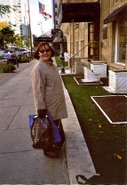
There I am with my folding umbrella and my indestructible Laura Ashley bag (I've still got that bag, LOL!) -- Mr. Don insisted that I do this sort of "TA DA!" out of the phone booth, and I more or less obliged him. Long before Harry Potter, mind you!  It's not really visible in this photo but in the background was the Trocadero Club - I mean, the HISTORIC Tracadero Club, the one that set the mode for all the other Tracadero Clubs all around the world.

During the approximately 8-hour flight over to London from Montreal I'd taken off my shoe-boots as we settled in for dinner, a movie, and then fitful sleep.  My feet had swollen up so much during the "over night" flight that the next morning as we were approaching Heathrow to land, I could not get the damn shoe boots back on my feet!  Finally, shoving and mightily heaving and with some assistance from Mr. Don, I was able to get them back on, but not laced up.  The laces came out, and stayed out until 24 hours after we landed in Madrid.  During the long flight back to Montreal which was, I believe, a direct flight, no transfer in London (I was sick on the way back and do not remember much as I was mostly flopped over Mr. Don who carried me around until we got back to Montreal, by which time I was miraculously restored to health -- but that's another story...) 

[Photo: buses lined up near the Tracadero Club.]  Of course, we wouldn't be Goddesschess folk if we didn't find evidence of the Goddess throughout our trek, which we did, in plenty.  During our brief sojourn in London Town, we came across Charing Cross Station.  I believe there is some legend that has something to do with a King leaving a sign at a crossroads for his beloved "Cher Regina" which eventually became "Charing."  But I don't believe that for a second - it's just a paternalistic 19th century gloss passing as romanticism.  The original spot was undoubtedly a site of ancient Goddess worship, complete with a temple, sacred mound in the near distance and a sacred spring.  It was a cross-roads from early on because it attracted pilgrims to the holy site from all around England, long before the Romans came and long before the English (actually Norman, and later German) kings and queens were instituted.  The photo (right) is of a lampstand at the parking area right outside Charing Cross Station (which is actually located underneath a hotel, at least it was back in October, 2002).  Notice the "globus cruciger" shape - an ancient Goddess symbol that was later co-opted by the local "God-of-the-Day."  The ancient Goddess symbolism refused to die, however.  For instance, there are many depictions of the Virgin Mary, the Mother of God, standing upon such a symbol.  There are also many depictions of Jesus Christ, the Son of God, holding such an artifact in the palm of his - I believe left hand - whilst sitting on the 'The Mother of God's' lap. 

Last, but not least, is this great pic of a horse sculpture captured outside an art gallery near Trafalgar Square.  It was a larger than life bronze, and I was absolutely captivated by it.  Mr. Don took the photo.  It was modelled after one of the famous horses taken from the Elgin Marbles - a large frieze removed in pieces from the Parthenon, perhaps the most famout of Athena's Temples, at Athens, Greece, in the 19th century CE.  A bit of chess history - the "classic" Staunton knight piece, with the horse's lips turned back revealing teeth ready to bite during the heat of battle, with which we are so familiar, was modelled by Staunton's artist after the horses depicted on the Elgin Marbles. 

I Want to Go to London...

Back in October 2002 enroute to Madrid, Mr. Don and I had about an 8-hour layover in London.  We arrived there about 7 a.m. in the morning - on a weekday.  Eventually, after some arguments and a comedy of errors involving Customs, we figured out where to catch the "Tube" that would take us to Picadilly - PICADILLY! 

A few stops after Heathrow, which back then was in the midst of major renovations (I don't think it's ever NOT been in the midst of major renovations, come to think of it...) people going to work starting piling on.  But Mr. Don and I were firmly ensconced on a sort of mod-print purple seats and the Tube obligingly announced it stops and also showed them in digital displays hanging in the center of the cars above everyone's heads.  It was a smooth, inexpensive ride (I'd been willing to fork over 70 pounds for a train ride into and back but Mr. Don insisted there must be a cheaper way to get to "downtown" London, and he was right).  I found the trip absolutely fascinating.  It was so surreal sitting there, watching these people dressed in work clothes pile on to the Tube while Mr. Don and I were tourists.  Near the end of the trip it got a bit crowded but everyone was extremely polite (is that the English way coming to the fore?) and the Tube car itself was spotless and had no unpleasant smells emanating from any obscure corners or from any person en route.  Thank Goddess! 

About 9 a.m. we exited Picadilly and wound our way up some stairs that took us to stret level.  It was drizzling outside, but not overly cold.  OHMYGODDESS, we were there!  I, prepared as always (ahem), pulled out my trusty fold-up umbrella.  Mr. Don, unfortunately, had no hat, no hoody and no umbrella, so he got wet. We'd had an inadequate breakfast at some fast food restaurant or other at the airport while we were arguing about the best way to proceed.  [Photo: A shot of Picadilly Tube station as we were looking around after emerging.]  Above and beyond the absolutely amazing sight of Picadilly Circle itself, the first thing we spotted, in unison, as we turned around to take it all in, smiling hugely at each other, was a STARBUCKS!  LOL!

I don't remember any discussion about it, I believe we headed as one toward that Starbucks, both because we were running on empty and needed some coffee as much as needing a place to sit down and study the maps we'd picked up in the Underground and also to receive some local advice about how to navigate about for our hours in town before we would head back to the airport for our 4:00 p.m. flight. 

We took in as much as we could.  [Photo: St. Martin's Church, outside the Art Museum fronting on Trafalgar Square.]  We'd predetermined that we would need to head back to the airport about 1:00 p.m. for the hour long ride, that would give us 2 hours to clear customs and security.  As it turned out, I do not believe we had to do anything with customs, and security back then was still patchy at best.  We didn't have our shoes off back then and if I did walk through a metal detector I sure don't remember it.  We didn't have any luggage with us - everything had been checked through to our Madrid flight.  As it turned out, we didn't need to get back so early.  And, unfortunaely, our flight was delayed MORE THAN FOUR FRICKING HOURS.  We didn't leave London until about 8:00 p.m. for the 2 hour or so flight to Madrid.  That's another story entirely --

Oh, I so want to go back.  Just the wee small part we saw of London was so wonderful.  We spent a good hour at least in the National Gallery, for instance, and could well have spent a couple of days there.  Mr. Don was able to take several photos but that was in the pre-digital camera days and since we weren't able to use our flashes none of those photos turned out - it was just too dark.  That's too bad because there were some extraordinary paintings in that museum.

We strolled across Trafalgar Square and I took a photo of Mr. Don by one of the large lions of the Trafalgar Monument.  We strolled down historic streets, including past Scotland Yard, which I got a real kick out of doing.  We headed toward Parliament and Big Ben which we had square set in our sights in the distance, but had to turn around to go back to the Picadilly Tube station at 12:50 p.m. (There's Scotland Yard!)

Female Imams in China Forge a New Way

But will they survive?

July 21, 2010
National Public Radio
Female Imams Blaze Trail Amid China's Muslims
by Louisa Lim

It is 5:50 in the morning, and dark shadows scurry through narrow alleys to the mosque, as the call to prayer echoes from a minaret in Kaifeng. This city in central China's Henan province has an Islamic enclave, where Muslims have lived for more than 1,000 years.  [Photo: Ariana Lindquist for NPR

Yao Baoxia is a female ahong, or imam, at Wangjia Hutong Women's Mosque in Kaifeng, in central China. She sits alongside believers during prayers, not in front of them like male imams. She believes male and female imams are equal in their role as teachers and leaders of prayers.]

In an alleyway called Wangjia hutong, women go to their own mosque, where Yao Baoxia leads prayers. For 14 years, Yao has been a female imam, or ahong as they are called here, a word derived from Persian.

As she leads the service, Yao stands alongside the other women, not in front of them as a male imam would. But she says her role is the same as a male imam.

"The status is the same," Yao says confidently. "Men and women are equal here, maybe because we are a socialist country."

China has an estimated 21 million Muslims, who have developed their own set of Islamic practices with Chinese characteristics. The biggest difference is the development of independent women's mosques with female imams, something scholars who have researched the issue say is unique to China.

Yao studied to become an imam for four years, after being laid off from her job as a factory worker. First she studied under a female imam, then with a male imam alongside male students.

Her main role is as a teacher, she says.

"When people come to pray, they don't know how to chant the Quran, so my job is teaching people about Islam, helping them to study one line at a time and leading the prayers," she says.

Mosques Began As Quranic Schools

The modest courtyard of Wangjia Hutong Women's Mosque contains within it the entire history of China's mosques for females. It's the oldest surviving women's mosque in China, with one gray plaque high up on a wall dating back to 1820.

Like other women's mosques, it began as a Quranic school for girls. These sprang up in the late 17th century in central China, including Shanxi and Shandong provinces. They morphed into women's mosques about 100 years ago, starting in Henan province.

Remembering her own childhood, 83-year-old Tang Guiying says even then the women's mosque was the only place a girl could receive education.

"I didn't go to school when I was small," she chuckles. "We were all too poor; none of us girls studied. But I came here to play and study. The old imam was very, very old — she was 80-something, and she had bound feet."

Tang is sitting in the mosque's washroom as she talks. This is where women conduct ritual ablutions before prayer. This space — and the mosque itself — doubles as a social center for these women, the heart of a community.

In Kaifeng, there are 16 women's mosques, one-third the number of mosques for males.

A Unique Chinese Tradition

Shui Jingjun, of the Henan Academy of Social Sciences and co-author of a book on the phenomenon, says that so far there are no women's mosques in other countries. In most of the Muslim world, women pray behind a partition or in a separate room, but in the same mosque as men.

Shui points out that the women's mosques in China are administered independently, by women for women, in addition to being legally separate entities in some cases.

"After reform and opening up [in 1979], some female mosques registered independently, which shows the equality of male and female mosques," she explains.

Controversy still rages in the Muslim world about whether women can be imams. In 2006, Morocco became the first country in the Arab world to officially sanction the training of female religious leaders.

China is the only country to have such a long history of female imams. However, there are things that, according to the customary practices of Chinese Muslims, female imams can't do.

They can't, for instance, lead funeral rituals or wash male corpses.

Forty miles away in the provincial capital of Zhengzhou, white-sashed mourners wail as they process through the streets carrying the coffin from a mosque. No female imams are participating.

Opposition Still Exists To Women's Roles

In central China, most Muslims support the female mosques, but there is some resistance closer to China's border with Pakistan and Afghanistan, closer to the harder-line Wahhabi and Salafi influences.

"Historically in northwestern China, there were no female mosques," says Shui, the researcher. "There was resistance because people thought that building female mosques was against the rules of religion. But in central China and most provinces, people think it's a good innovation for Islam."

In the past decade, some women's mosques have been established in northwest China. The phenomenon appears to be spreading, helped politically by the Islamic Association of China, a state-controlled body that regulates Islam and issues licenses to practice to male and female imams alike.

This is part of the anomaly that is religion in China — the atheist Chinese authorities are endorsing a practice some Muslims find unacceptable.

While there is broad support among Kaifeng's Muslims for female mosques and imams, there is also some opposition.

"The education of Islamic women is a very important job," says Guo Baoguang, of the Islamic Association of Kaifeng. But he admits that he has been criticized for organizing religious education forums for Muslim men and women to take part in together.

"There were some criticisms that women ought to be in the home, and ought not take part in social activities. I think these criticisms are too conservative, and don't account of the importance of women's education in Islam," he says.

Guo believes that when it comes to female imams, China is leading the way.

"Given the fast development of China's economy, and as its political status rises, I think Chinese Islam will become more important in the Islamic world," Guo says. "The developments Chinese Islam has made, like the role played by Chinese women, will be more accepted by Muslims elsewhere in the world."

Greatest Challenge Is Economic

In the women's mosques, most of the faithful are elderly. Young women with families often don't have the time to worship, especially given the lengthy purification rituals several times a day.

Third-generation imam Sun Chengying, who has been practicing for 21 years, worries about the future.

"I haven't had any students since 1996," she says, shaking her head. "Women don't want be imams anymore, because the salaries in the mosques are too low. No one is willing to do it."

Female imams sometimes earn as little as $40 a month, one-third of what can be earned in other jobs. Younger women need to earn more to support their families.

And so it appears the future of female imams in China is threatened — not by the state, not by resistance from inside Islam, but by the forces of market economics.

Cucumbers Originated Not In Africa But In the Eastern Himalayas!

I am a long-time cucumber lover.  I can make an entire meal out of a couple of large cukes.  My favorite recipe is dill cucumbers, thinly sliced, soaked in a mixture of sour cream and mayonaise with fresh chopped dill.  Yum!  Nothing takes the heat of the day away like cold fresh cucumber, simply sliced and lightly dressed with salt and some black pepper!  I also make an excellent cucumber sandwich -- I won an award with it for best hors d'ouerves during our annual Christmas Cooking Contest!  I'm not much of a veggy eater, but any platter that holds cucumbers at a party is promptly raided by yours truly :)

I can say confidently that I've never turned my mind to the origins of the cucumber.  If asked, I might have guessed South America.  But the eastern Himalayas!  Wow!  This just fascinates me.  Who knew?  I'd love to see a Burt Wolf show on this!

From physorg.com
Where the wild veggies are: Cultivated cucumber and melon originated in Asia and Australia
July 20, 2010

Sites of origin and regions of domestication of many of our most important cultivated plants are still unknown. The botanical genus Cucumis, to which both the cucumber (Cucumis sativus) and the honeydew melon (C. melo) belong, was long thought to have originated and diversified in Africa, because many wild species of Cucumis are found there.

"A molecular genetic analysis has now shown that the wild populations that gave rise to melons and cucumbers originated in Asia", says LMU botanist Professor Susanne Renner. "In addition, we have found that 25 related species which have never been formally described are found in Asia, Australia and regions around the Indian Ocean." Future genetic studies on C. sativus and its wild relatives should therefore focus on Asia and Australia. The new results are important because the garden cucumber is one of the most widely cultivated vegetable crops, and the species is among the few flowering plants whose genomes have been fully sequenced.

According to Renner, "Our study would not have been possible without the resources of the Munich herbarium and Botanical Garden. A large fraction of the plants we have been able to sequence was collected in India, Vietnam and Australia during the 19th century, and most were then forgotten in herbaria, that is, collections of dried plant specimens. Many of these come from locations that no longer have natural vegetation, for example, because they were collected at sites that now lie in built-up areas of cities like Hanoi." (PNAS online, July 2010)

The family Cucurbitaceae includes crop plants, such cucumbers, melons, loofah, and pumpkins. In terms of its economic importance, the cucumber is among the top ten crop plants cultivated worldwide, and the related honeydew melon is also of considerable agronomic significance. Species that belong to the genus Cucumis are also popular with botanical researchers. Indeed, the domestic cucumber was the seventh species of flowering plant to have its genome sequenced completely, being preceded by such agricultural heavyweights as rice and grapevine. Over the past 10 years, thousands of scientific papers on the biology of cucumbers and melons have appeared.

Many of these studies have used these species as model systems to investigate the mechanism of sex determination during floral development. The question of the genetic origins of the genus Cucumis, on the other hand, has received comparatively little attention (the business about the Romans cultivating cucumber is wrong; I can send you a paper on this topic if you are interested). The general consensus among botanists has been that the melon originated in Africa, because putative wild ancestors of the cultivated variety had been identified there. It now turns out that none of these forms is ancestral to the melons we find in our markets and shops.

"We analyzed specific segments of the genetic material from herbarium specimens of more than 100 Cucumis species. The samples we used had been collected at various locations in Africa, Australia and Asia", reports Patrizia Sebastian, who is the first author on the new study. "It turned out that the closest living wild relative of the cultivated melon is a native of Australia. The two lines diverged about 3 million years ago, and they last shared a common ancestor with their more distant relatives in Asia and Australia about 10 million years ago." The total number of Cucumis species found in Asia and Australia is now around 25, and they branched off from their African relatives some 12 million years ago.

Nine of the 25 species were identified for the first time in the new study. Renner and her colleagues are preparing formal systematic descriptions of the new species for a specialized journal. Taken together, the results argue that the common ancestor of cucumber and melon originated on the continent of Asia. Possible ancestral populations from which the domesticated forms derive have been localized in the Himalayas. The genetic diversity of the varieties of C. melo that occur in India and China is particularly striking. "Our data also prove that the closest living relative of our garden cucumber is the species C. hystrix, which is found in the Eastern Himalayas", says Renner. "Future investigations of the phylogeny of Cucumis should therefore focus on Asia and Australia."

The new findings once again emphasize the great significance for modern botanical research of the herbarium materials that have been assembled over centuries and are now held in institutions like herbarium of the Bavarian Natural History Collections and the LMU's own herbarium. "Many of the plants we examined in this study were collected in the course of the 19th century, and most were then ignored and forgotten", says Renner, who is Director of these herbaria and the Munich Botanic Garden. "In many ways, this material represents an irreplaceable treasure, because the habitats in which much of it was collected no longer exist. Cucumis debilis, for instance, no longer grows at the location from which it was last collected in 1931. The site is now a suburb of Hanoi."

More information: Cucumber (Cucumis sativus) and melon (C. melo) have numerous wild relatives in Asia and Australia, and the sister species of melon is from Australia, Patrizia Sebastian, Hanno Schaefer, Ian R. H. Telford, and Susanne S. Renner, PNAS online, week of July 19 2010.

Provided by Ludwig-Maximilians-Universität München

Chinese Civilization Older Than Previously Supposed

It seems I have reported on this story already - but, just in case --

From People's Daily Online
Evidence suggests Chinese civilization even more ancient
15:53, July 23, 2010

Objects from the Taosi ruins in Shanxi Province that suggest Chinese civilization began around 4200 B.C., 500 years earlier than scholars had previously believed, will be displayed in the Capital Museum from July 29 to Oct. 10.

The Capital Museum and the Archaeology Institute of the Chinese Academy of Social Sciences will hold an archaeological exhibition containing the major achievements of the Archaeology Institute in the past 60 years and 70 percent of the content will be exhibited to the public for the first time.

It is generally believed that Chinese civilization began with the Xia Dynasty. However, recent archaeological discoveries at the Taosi ruins in Xiangfen County, Shanxi Province suggest the elements that form a civilization, including written characters, bronze ware and cities, all emerged as early as the Yao Dynasty.

Wangwei, director of the Archaeology Institute of the Chinese Academy of Social Sciences, said the recent archaeological achievements at the Taosi ruins will be displayed in the exhibition, and as one of the projects that retraces the origins of Chinese civilization, those discoveries will "change history."

Source: Beijing Times, Translator: Ye Xi
Related Posts Plugin for WordPress, Blogger...