Thursday, February 21, 2008

I Wish It Was Friday!

So, here I've been noshing the past 20 minutes on Fritos and green olives - a big honking dish of Fritos and green olives. No - not all mixed up together (LOL) - the Fritos are on one side of the bowl, the olives on the other. I guess I must be craving salt... And fat! I haven't been near the scale in weeks (don't want it to go KA BOING!!!, poor scale).

Goddess, it's been so fricking cold here I can't stand it anymore - I'm surprised half the city hasn't committed hari kiri. How many layers of clothes can a person wear and still walk (sort of)? How many times can a person ice skate a mile to the bus stop on a sidewalk that isn't built for iceskating? But - today - finally, it actually got up to 20 degrees F. Tomorrow it will be even "warmer" - and by Monday - 38 degrees F with snow and rain mixed. Oh crap - here we go again! Later next week the nasty nasty cold cold unrelenting merciless cold strikes again. Will we ever see the 30's again??? I am so sick of knocking icicles off my gutters, of shoveling, of climbing over mile-high frozen-solid and icy snowbanks and holding my breath every time I take step on the never-ending treks to and from the bus stops! I'm oxygen deprived! No wonder my fingers are blue.

Okay, enough bitching about the crappy weather here. In August I'll be bitching about 90 degrees and 200% humidity.

Last night I watched the first episode of the new "America's Next Top Model" and had a blast; after that, I watched the repeat of the Pussycat Dolls' "Girlicious" and had a blast. I don't have any favorites on the programs yet, but I do have a couple of beyatches that I'd wish had been sent home - and weren't! Oh, how I wish they'd had stuff like this back when I was in my prime. Oh well, I wouldn't have gone to try out anyway :)

Hey, anyone out there looking for a 5 foot 3 and 3/4 inches tall "middle-aged" model with minimal wrinkles but in need of some strategic liposuction? My alter-ego is JanXena (hint hint).

Tonight's posts are a mix (as per usual); I'm now watching the Donald's TV show and that smarmy Englishman lost! I sure hope Trump fires his butt this time - he is utterly insufferable - even worse than that O woman on the other team!

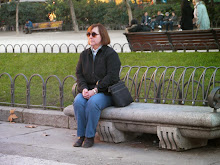
Hope you like the pic. You may have seen it before - it's a classic. It makes me think of 110 degree F days in August in Las Vegas, chugging Gatorade and ducking into casinos to play nickle slots to get out of the sun. Ahhhhh.....

Goddess Sammakka

From The Times of India (Hyderabad): Sea of humanity at Medaram Jatara 22 Feb 2008, 0327 hrs IST,TNN MEDARAM (WARANGAL): It was a sea of humanity as over 25 lakh people swarmed the 'gaddelu' or platforms at the jatara site to have a glimpse of Sammakka goddess on Thursday even as lakhs of women and young girls swathed in turmeric danced in a trance. The deity of Sammakka was brought from the Chilkalgutta hillock in the deep forest area by the tribal priests in the evening and placed by the side of Sarakka on the gaddelu as the devotees jostled with one another to pay reverence to the goddess. While the deities of Sammakka's husband Pagididda Raju was brought from Poonugondla of Kothaguda mandal, Sarakka's husband Govindarajulu was brought from Kondai of Eturunagaram mandal amid drum beats and placed along side the goddesses. Superintendent of police Soumya Mishra fired three rounds in the air to signal the arrival of Sammakka from the forest area. With Sammakka and Sarakka deities mounted on the platforms, devotees' joy knew no bounds as they swayed to the folk songs and raucous drum beats. The pilgrim rush which was around 20 lakh on Wednesday reached its peak with almost 40-45 lakh congregating at the jatara site on Thursday evening. Millions of devotees, who waited in serpentine queues for the arrival of Sammakka, sang hymns in praise of the deities even as shrieks of 'Sammakka-Sarakka thalli... mammamalanu kapadu thalli (save us mother)' reverberated the area. Even as the literate and illiterate, young and old and men and women made a beeline to the gaddelu, young girls ran after 'Shiva Sathis' and 'Devara Lakshmis' to seek their blessings. According to reports, 12 persons, including four policemen, were injured at mela on Thursday. Nearly 100 people were affected due to diarrhoea. Collector K Damayanthi, joint collector K S Srinivasa Raju and the SP monitored the arrangements and allayed the pilgrims' fears saying sufficient health camps have been set up to take care of patients.

2008 Aeroflot

Standings after Round 8 (Women): Group A1: 28 WGM Hou, Yifan 4.5 CHN 2527 40 IM Sebag, Marie 4.0 FRA 2510 According to Susan Polgar's blog, both of these chess femmes are on pace to score a GM norm. Group A2: 36 IM Ovod, Evgenija 4.5 RUS 2386 45 IM Ushenina, Anna 4.0 UKR 2484 53 Ju, Wenjun 4.0 CHN 2360 66 WGM Mongontuul, Bathuyag 3.5 MGL 2389 71 IM Kovalevskaya, Ekaterina 3.0 RUS 2455 78 IM Tairova, Elena 3.0 RUS 2386 82 IM Harika, Dronavalli 2.5 IND 2455 (Dronavalli has not played in the last 3 rounds, she must have dropped out of the tournament). Group B (Final standings, after Round 9): 8 WFM Gunina, Valentina 6.5 RUS 2295 2531 +2.86 14 IM Vasilevich, Irina 6.0 RUS 2378 2430 +0.60 16 WGM Romanko, Marina 6.0 RUS 2322 2408 +1.01 18 WFM Paikidze, Nazi 6.0 GEO 2311 2470 +1.92 31 Zhang, Xiaowen 5.5 CHN 2309 2415 +1.34 38 WGM Kovanova, Baira 5.5 RUS 2348 2328 -0.22 65 WGM Kursova, Maria 4.5 RUS 2333 2272 -0.75 70 WIM Yanjindulam, Dulamsuren 4.5 MGL 2256 2353 +1.19 73 Zenyuk, Iryna 4.5 USA 2227 2317 +1.11 75 WIM Charochkina, Daria 4.5 RUS 2383 2306 -0.96 77 WFM Bodnaruk, Anastasia 4.5 RUS 2317 2296 -0.24 79 WIM Tarasova, Viktoriya 4.5 RUS 2267 2230 -0.44 100 WIM Kashlinskaya, Alina 3.5 RUS 2276 2245 -0.40 103 WIM Iljushina, Olga 3.5 RUS 2268 2227 -0.52 106 WIM Kharashuta, Ekaterina 3.5 RUS 2222 2225 +0.02 110 WFM Nikolaeva, Alexandra 3.5 RUS 2201 2218 +0.19 114 WFM Gasik, Anna 3.0 POL 2200 2168 -0.37 116 WFM Kineva, Ekaterina 3.0 RUS 2204 2147 -0.65 133 Lestari, Baiq Vina 1.0 INA 2263 1891 -3.73 Group C (Final standings, after Round 9): 24 Kushka, Alena 6.0 RUS 2052 2206 +1.50 40 WFM Fakhretdinova, Margarita 5.5 RUS 2160 2150 -0.01 52 Jussupow, Ekaterina 5.0 GER 2030 2144 +1.24 54 WIM Grigorova, Irina 5.0 RUS 2143 2084 -0.53 61 Batzaya, Yanjav 5.0 MGL 2039 2093 +0.37 63 Chkartina, Gerhana 4.5 INA 0 2095 2095 69 Gvilava, Maya 4.5 RUS 2039 1945 -0.66 80 Kuznetsova, Tatiana 4.0 RUS 2051 2092 +0.28 83 Korytina, Natalia 4.0 KAZ 1995 1802 -1.29 84 Yakupova, Aysyla 4.0 RUS 2003 1978 -0.23 101 Tomnikova, Lidia 3.5 RUS 1888 1929 +0.24 102 Severina, Maria 3.5 RUS 1918 1954 +0.15 113 Mukhina, Marina 3.5 RUS F 1872 1829 -0.16 118 Golban, Ludmila 3.0 MDA 1910 1895 -0.20 126 Estheria, Liana 2.5 INA 0 1778 1778 127 Artemenko, Rimma 2.5 RUS 1571 1602 +0.18 129 Abdumalik, Zhansaya 2.5 KAZ 0 1692 1692 130 Tikhomirova, Vera N. 2.5 RUS 1702 1317 -0.33 134 Duc, Marie 2.0 FRA 0 1639 1639 135 Zheleva, Milena 2.0 BUL 0 937 937 136 Valeva, Zlatina Hristova 2.0 BUL 0 1155 1155

Star Wars and Science Exhibit!

How cool is this! I remember standing in line in 1977 with four other friends at 3 in the morning to see the very first Star Wars movie. The wait was worth it. I remember being totally blown away by what came on the screen - and the story grabbed me from the very first moment. What femme did NOT want to be Princess Leia, and the young hung, Han Solo (played by Harrison Ford, who is now 65, eek!). My old grainy, bootlegged copies of the VHS tapes of Star Wars III, IV and V still give me a thrill. Oh, those were the days, my friends, those were the days... The Franklin Institute Science Museum (Philadelphia, Pennsylvania) is hosting a special exhibit entitled "Star Wars - Where Science Meets Imagination," February 9 - May 4, 2008.

Iran's National Museum and the British Museum Team Up on “Sasanian Coins”

Information from Circle of Ancient Iranian Studies (CAIS):

LONDON, (CAIS) -- The first volume of the catalogue titled “Sasanian Coins” will be published in the near future in a collaborative effort by Iran’s National Museum and the British Museum.

Iran’s National Museum’s Curator of Coins Marzieh Elaheh Asgari and Vesta Sarkhosh Curtis, the Curator of Islamic and Iranian Coins, in the department of Coins and Medals at the British Museum, have studied more than 5000 coins in the collections in Tehran and London.

The results of Sasanian Coin Project will be published in three volumes according to a Memorandum of Understanding which was signed between the museums 10 years ago.

Sasanian coins present the political, social and cultural conditions of the dynasty, and these volumes will be a valuable resource for the academic community and cultural enthusiasts. Each coin will be illustrated and described in the catalogue and the information will also go online. The following volumes are due to be published next summer.

Vesta Sarkhosh Curtis is responsible for the British Museum’s collection of pre-Islamic Iranian coins (from the third century BCE until the middle of the seventh century CE), which includes both Parthian and Sasanian dynastic coins. She also looks after coins of the Islamic era beginning with the Samanid and Buyid, Seljuk, Ilkhanid and Timurid, Safavid and Qajar dynasties of Iran.

Dr Curtis apart from the Sasanian Coin Project, she is also involved in a major Parthian Coin Project, which is a multi-institutional project with will catalogue coins of the third century BCE to the third century CE in Vienna, Tehran, Paris and Berlin.

The fourth Iranian dynasty, the Sasanians came to power in 224 CE, when Ardashir, a local king from Pars in southern Iran, seized the crown and became the new King of Kings of Iran. The Sasanians remained the most powerful empire in the ancient Near East until the advent of Islam and the Arab invasion of Iran in 651 CE.

Sasanian coins:
Sasanian coins are an important primary source for the history, economics and religion of this dynasty. From the beginning, the image of the king with his elaborate crown appears on the front and a Zoroastrian fire altar is shown on the back. The crowns incorporate symbols, such as wings, which are associated with the Zoroastrian religion and idea of kingship. The coin inscriptions, which are in Middle Persian (Sasanid-Pahlavi), give the king’s name, his religious affiliation as a worshipper of Ahuramazda, the Zoroastrian Wise Lord.

From the sixth century onwards, important information on the mint and date within the king’s reign appears on the back. More than fifty mint centres are known through abbreviations in Middle Persian but not all can be identified with certainty. Sasanian were minted in gold, silver, bronze and occasionally lead. There were two women sovereigns in the Sasanian period. These were Boran (Purandokht) (r. 630-31) and Azarmidukht (r. 631). Both were daughters of emperor Khosrow II Parviz (r. 591-628).
**********************************************************************************
The image (top) is from the CAIS article and is labeled "Two of King Ardashir's coins." Ardashir was the founder of the Sasanian Dynasty and ruled 224-241 CE. The top coin is interesting for the skull on top of the King's crown! The second coin is interesting because that looks like a cornucopia tower incorporated into the center portion of the king's crown.

Ancient American Magazine

Ancient American has a new issue available, Volume 12, Issue Number 76: Feature Article Tomb of the Embarras: Excavation Has Begun Secret Among the Trees Darrick Dean Ancient Stone Faces of New Port Richey Florida Archie Eschborn Crystal Pyramid Found in Wisconsin's Rock Lake Frank Joseph The Legendary Azgens: A White People in Prehistoric Kentucky William D. Conner Preserving Wisconsin Mounds Frank Arial Flower Giants of the Ancient Ohio Valley Ross Hamilton The Discovery of Three Continents (2300 B.C.) Dr. R. M. de Jonge Crossing the Labrador Sea (1600 B.C.) Dr. R. M. de Jonge & J.S. Wakefield Letters to the Editor A Cry of Outrage: A Friend of the Serpent Mound Oxford University News Release Spruce Hill News Epigraphy: Burrows Cave Script David Grant Stewart, Sr. Senate Bill Could Return Kennewick Man Bones to Native Tribes Annette Cary A.A.A.P.F. Conference Report Tomb of the Embarras: Excavation has Begun Columns Revealed: America's Oldest Painted Temple Letters to the Editor Answers from Antiquity Colette Thomas Smith A 1 year subscription (US) is $32.95 (6 issues), 2 years (12 issues) is $59.95. I don't have a subscription but I have purchased some back issues containing items I have an interest in, and the quality of the magazine is great - this isn't some hack cranking out junk on a mimeograph machine! A few items, though, were photocopies because all back issues had been sold out. This has also happened to me, though, when ordering back articles and/or issues of Biblical Archaeology Review, so it's probably not unusual.

Wednesday, February 20, 2008

Mysterious Pyramid Complex Discovered In Peru

From National Geographic: Kelly Hearn in Buenos Aires, Argentina for National Geographic News February 20, 2008 The remnants of at least ten pyramids have been discovered on the coast of Peru, marking what could be a vast ceremonial site of an ancient, little-known culture, archaeologists say. In January construction crews working in the province of Piura discovered several truncated pyramids and a large adobe platform (see map). Officials from Peru's National Institute of Culture (INC) were dispatched to inspect the discovery. Last week they announced that the complex, which is 2 miles (3.2 kilometers) long and 1 mile (1.6 kilometers) wide, belonged to the ancient Vicús culture and was likely either a religious center or a cemetery for nobility. The Vicús was a pre-Hispanic civilization that flourished in Peru's northern coastal desert from 200 B.C to 300 A.D. and is known for its decorated ceramics. Experts say little is known about the culture, because its sites have been heavily looted over the years. "We found several partial pyramids, at least ten," said César Santos Sánchez, chief archaeologist for INC's Piura division. "We also found a large adobe platform that we speculate could have been used for burial rituals. But we cannot know without further testing." Skull Fragments The platform, measuring 82 feet (25 meters) by 98 feet (30 meters), was found alongside one of the larger pyramids in the complex. Another of the larger pyramids contained some artifacts as well as bone fragments from a human skull. The fact that the skull fragments were found several meters below the surface, indicating a deep grave that took much time to dig, prompted researchers to theorize that the individual buried there had high social status. Santos added that the complex is surrounded by four large hills: Pilán, Vicús, Chanchape, and Tongo. "We think that because of its geographic location the complex could have been a place of strategic value," Santos said. The area containing the pyramids is surrounded by a cemetery that has been looted by grave robbers. "But the complex itself is intact," Santos said. Who Were the Vicús? "The Vicús are very interesting but so poorly understood, given that most of what we know about them is through looted ceramic art," said Steve Bourget, an archaeologist at the University of Texas at Austin. "This could be an important find, because it is one of the few with monumental architecture. But it is too soon to tell." Experts say the Vicús ceramic style is similar in some respects to that of the Moche, a fact that has spawned research on the relationship between the two cultures. The Moche civilization flourished in areas south of the Vicús from around A.D. 100 to 750, producing intricately painted pottery as well as gold ornaments, irrigation systems, and monuments. The two cultures thrived within a relatively short distance of each other—less than that between Los Angeles and San Francisco—experts point out. "It is possible that the Vicús for part of its history was closely affiliated with the Moche culture," said Joanne Pillsbury, an archaeologist at the Washington, D.C.-based Dumbarton Oaks, a research institute affiliated with Harvard University. The discovery of the Vicús pyramids comes as perceptions about the Moche have shifted, she added. "It was once thought that Moche was a single monolithic state, but people don't think that is true anymore," Pillsbury said. "It was likely a series of regional or multi-valley kingdoms that shared a broader culture. And Vicús was probably part of that sphere of interaction."

Baby Squirrels Rescued

From Mysuncoast.com
Sarasota Mayor rescues baby squirrels
Posted:
Feb 18, 2008 04:29 PM CST
Updated:
Feb 18, 2008 10:12 PM CST

SARASOTA - Sarasota City Mayor Lou Ann Palmer spent her President's Day rescuing some furry residents.

The mayor was in her backyard when she came across two baby squirrels. She felt the tiny rodents were in distress, so she called the Wildlife Center of Venice.

They just happened to receive a call from another person in Sarasota with a similar situation, so the mayor went to pick up that squirrel as well.

They are on their way to the wildlife center to be checked out.

2008 Aeroflot

Standings after Round 7 (Women): Group A1: 26 WGM Hou, Yifan 4.0 CHN 2527 40 IM Sebag, Marie 3.5 FRA 2510 Group A2: 24 IM Ovod, Evgenija 4.5 RUS 2386 40 IM Ushenina, Anna 3.5 UKR 2484 54 Ju, Wenjun 3.5 CHN 2360 69 WGM Mongontuul, Bathuyag 3.0 MGL 2389 70 IM Tairova, Elena 3.0 RUS 2386 72 IM Harika, Dronavalli 2.5 IND 2455 73 IM Kovalevskaya, Ekaterina 2.5 RUS 2455 Group B (after Round 8): 5 IM Vasilevich, Irina 6.0 RUS 2378 17 WFM Paikidze, Nazi 5.5 GEO 2311 18 WFM Gunina, Valentina 5.5 RUS 2295 22 WGM Kovanova, Baira 5.0 RUS 2348 26 WGM Romanko, Marina 5.0 RUS 2322 29 Zhang, Xiaowen 5.0 CHN 2309 56 WIM Yanjindulam, Dulamsuren 4.5 MGL 2256 60 WIM Charochkina, Daria 4.0 RUS 2383 69 WGM Kursova, Maria 4.0 RUS 2333 81 Zenyuk, Iryna 4.0 USA 2227 86 WFM Bodnaruk, Anastasia 3.5 RUS 2317 91 WIM Tarasova, Viktoriya 3.5 RUS 2267 94 WFM Nikolaeva, Alexandra 3.5 RUS 2201 104 WIM Iljushina, Olga 3.0 RUS 2268 112 WIM Kharashuta, Ekaterina 3.0 RUS 2222 119 WIM Kashlinskaya, Alina 2.5 RUS 2276 127 WFM Kineva, Ekaterina 2.0 RUS 2204 128 WFM Gasik, Anna 2.0 POL 2200 133 Lestari, Baiq Vina 1.0 INA 2263 Group C (after Round 8): 15 WFM Fakhretdinova, Margarita 5.5 RUS 2160 31 WIM Grigorova, Irina 5.0 RUS 2143 38 Kushka, Alena 5.0 RUS 2052 56 Chkartina, Gerhana 4.5 INA 0 70 Kuznetsova, Tatiana 4.0 RUS 2051 72 Batzaya, Yanjav 4.0 MGL 2039 74 Jussupow, Ekaterina 4.0 GER 2030 76 Korytina, Natalia 4.0 KAZ 1995 87 Gvilava, Maya 3.5 RUS 2039 89 Yakupova, Aysyla 3.5 RUS 2003 92 Severina, Maria 3.5 RUS 1918 93 Tomnikova, Lidia 3.5 RUS 1888 105 Golban, Ludmila 3.0 MDA 1910 119 Mukhina, Marina 2.5 RUS 1872 120 Tikhomirova, Vera N. 2.5 RUS 1702 121 Artemenko, Rimma 2.5 RUS 1571 122 Abdumalik, Zhansaya 2.5 KAZ 0 124 Estheria, Liana 2.5 INA 0 130 Duc, Marie 2.0 FRA 0 134 Valeva, Zlatina Hristova 2.0 BUL 0 135 Zheleva, Milena 2.0 BUL 0

Tuesday, February 19, 2008

Goddess Mariyamma

I believe I once read that India is the land of a thousand goddesses - and it certainly seems so. Mariyamma is a goddess whom I had not heard of before. The temple is very brightly decorated with lights and the street around the temple is crowded with people celebrating this feast. I wonder - is the temple always so brightly lit up at night?

Mangalore: Goddess of wealth - Annual Feast of Shri Mariyamma Temple
Daijiworld Media Network [MM]Pics;
Dayanand Kukkaje
February 20, 2008

The annual feast of Shri Mariyamma Temple located at Urva was held on Tuesday, February 19. This temple is regarded to be one of the oldest temples situated in Mangalore. Thousands of devotees residing in and around Mangalore paid their respects and offered their prayers in the temple. Goddess Mariyamma, also referred to as the goddess of wealth is largely worshipped here.

Meanwhile, Gopalkrishna Suvarna, managing trustee of the temple, announced that the managing committee has decided to establish a golden 'Kalasha,' which would include 400 sovereigns of gold. “The faithful have already started to donate gold and cash for this purpose,” he informed.

“The temple is also involved in imparting education to needy children and bears the forefront for many social causes “ he added.
**********************************************************************************

What's a "kalasha?" I did a bit of quick research on the internet. It seems that a gold kalasha is a pot (bowl) made out of gold that may hold sacred ingredients that are offered to a goddess or god during a ceremonial ritual.

So, is this temple now collecting gold sovereigns in order to melt them down to create a kalasha? Or are the sovereigns going to be spent to buy a gold kalasha? Or are the sovereigns intended to fill the kalasha (that will be provided from another source) in order to enable the temple to carry out the "education of the needy children" and be in the "forefront for many social causes?"

Lakshmi Back in the News - Update

The sweet little girl with the sunny dispostion and sunshine smile is back in the news. There is an update on her progress since the surgery she had in November to remove her extra limbs - and several photos. From The Telegraph.co.uk Eight-limbed girl 'will always be a Goddess' By Megan Levy Last Updated: 8:43am GMT 19/02/2008 Lakshmi's dad says: For as long as she is alive, until my dying day, I will believe she is the goddess.

When she was born, the inhabitants of her village believed she was a gift from God and christened her Lakshmi, after the four-armed Hindu goddess of wealth.

However, her mother, Poonam, and father, Shambu Tatma, both in their twenties and earning about 50p a day as casual labourers, rejected the opportunity to exhibit her to pilgrims as a lucky charm and instead sought treatment.

Tomorrow's programme [a documetary] examines Indian attitudes to disability and the difficulties faced by the rural poor in overcoming deeply help superstitious beliefs.

"What mustn't happen is that Lakshmi is taken away and sold to a circus," the leader of Lakshmi’s village elders told the documentary's makers. "She could have been exhibited like a freak here and earned us a fortune but we never wanted to do that and neither did the parents."

Entire article.

New Hope for Autism?

I don't have a date for this story, the link was reported at The Daily Grail today. It's an amazing story and I sure do hope that the treatment it discusses is shown to work "scientifically" - what a hope this could be for the hundreds of thousands of children now being diagnosed with autism every year: Lorenzo's Oil for Autism Written by Danny Penman Rob Nijssen sits hunched over a set of scales in his homebuilt laboratory. He's weighing out herbs, oils and powders, and combining them with the skills of a practiced craftsman. With the mischievous look in his eye, he could be a gifted academic, a drug peddler or an alchemist. He is, in fact, a man trying to save his son from a lifetime of pain and suffering. And Rob believes he's done just that. Five years ago his son, Frederick, was diagnosed with autism. The doctors told him there was no cure and warned him to prepare for a lifetime of struggle. But he refused to give up. As a fervent believer in the power of natural remedies, he decided to develop his own autism treatment. In a story that closely mirrors Lorenzo's Oil, doctors will soon begin testing Rob's autism treatment in a major clinical trial. It's a story that will give hope to the parents of tens of thousands of autistic children across the UK. "Most people think that autism is a mental disease," says Rob. "But I believe that it's caused by parasites which take root in the body because of a weakened immune system." "My treatment works by clearing out all of the toxins from the body, killing off invading microbes, and then strengthening the immune system. It works with the body to help it heal itself. Once the body is healed, then the brain can start to recover." Although it's still very early days, some doctors believe that Rob may have stumbled upon a new and potentially powerful way of helping the autistic. Dr Robert Trossel, a consultant at the Preventative Medical Centre in London, says: "We've seen dramatic improvements in some of our patients. Some began responding within days." Like many children who later go on to develop autism, Frederick was a precocious and gifted child. He was into everything. His bright blue-grey eyes followed his parents everywhere. His face constantly beamed happiness and joy. "In so many ways he was the perfect child," says Rob. "He was always happy. He was very social and always clowning around. Frederick had no serious illnesses. If anything, he was healthier than normal." But all that changed dramatically after Frederick received his MMR jab when he was 30 months old. His health quickly deteriorated and it seemed to Rob that he never quite managed to shake off the after-effects of the vaccination. Persistent colds and ear infections were the first signs that something was wrong. Then his skin erupted with rashes and he developed terrible stomach problems. For week after week, Frederick's health would spiral downwards, only to partially recover again, before weakening once more. "There's nothing worse than having a child with health problems," says Rob. "You want to take on their pain yourself so that you can stop their suffering. You feel it more than they do." Rob soon began suspecting that his son was suffering from something far worse than a persistent head cold, but the doctors dismissed his fears. And as the weeks passed, Rob became increasingly alarmed. Frederick - once an irrepressible bundle of joy - began withdrawing into himself. He became increasingly short-tempered and would often fly into a rage at the slightest provocation. His grasp of speech, which once marked him out as a gifted child, evaporated. He smiled rarely and began endlessly repeating the same things over and over again. One day, when the young family was at the beach, it dawned on Rob that Frederick was seriously ill. Frederick repeatedly picked up a stone, placed it in a plastic bucket before removing it again. He endlessly repeated this obsessive act, over and over again. Each time his parents tried to distract him, he would become confused, angry and upset. Soon afterwards, Frederick was referred to a specialist and diagnosed with autism. "The paediatrician was casual about it," says Rob. "He told us there were no cures or effective treatments available. He simply warned us that we faced a lifetime of struggle. And that was it." "In that moment I decided I'd do my best to try and develop a cure for my son." Rob had heard of the story of Lorenzo's Oil and was determined to achieve something similar for autism. And the parallels are remarkable. As you will recall, Lorenzo was a six-year-old child diagnosed with adrenoleukodystrophy (ALD), a rare genetic disorder that affects the nervous system of boys who have the gene. They are in perfect health until they are five or six, when the first symptoms appear. In the space of a few months, ALD robs its victims of their sight, hearing, and the ability to walk and to swallow. Within two years of diagnosis, the child is usually dead. But Lorenzo's parents refused to give up and spent years developing a treatment based upon the essential oils found in olive and rapeseed. The doctors scoffed but Lorenzo survived. His parents were eventually proved right when the medical establishment was forced to accept that the oils could indeed stave off the disease. Like Lorenzo's parent's, Rob had the resources needed to spend several years developing the treatment. He ran a company selling earth moving equipment outside the Dutch city of Eindhoven. With a turnover of £8 million a year, Rob knew he at least had the money - if not the time - to develop the treatment. Rob moved quickly. He spent 90 hours a week studying autism. He became a regular fixture at scientific conferences around the world and marked himself out by constantly badgering the experts. As a trained engineer he brought a refreshingly different approach to treating autism. Instead of simply trying to cope with the symptoms, he decided to ferret out the root causes of the disease and treat those instead. As a result of his research, Rob became convinced that autism results from a malfunctioning immune system. Correct this, he thought, and the body will begin to recover. It's a theory that is still hotly contested by the experts. Despite his own experiences with the MMR vaccine, he dismisses its links with autism. "MMR doesn't cause autism but it may trigger it," claims Rob. "The real cause is a weakened immune system. Once your immune system begins to fail then the whole body becomes weaker and weaker. It becomes colonised by bacteria, fungi and viruses. If that happens, is it any surprise that the brain and nervous system begins to collapse?" Rob's highly unorthodox treatment works by bolstering the immune system. It uses a combination of natural remedies, herbs, essential oils, honey, probiotics (or ‘friendly' bacteria), as well as vitamins and minerals. They are all given in a precise sequence to first cleanse the body, kill off invading parasites, and then to fortify the immune system. Clearly the treatment is unlikely to do any harm but can it do any good? Rob is convinced that the treatment works - and so do many parents who've used it on their children. Within months of beginning treatment, Rob claims his son began making progress. First of all his digestion improved. Then his moods became more stable and he began sleeping better and regaining his strength. Slowly, step by step, Rob and Anita's son is returning to them. Frederick's improving health was soon noticed by other parents at his special needs school in Weert, 100 miles to the south west of Amsterdam. Word spread rapidly from parent to parent and through the Internet. It wasn't long before Rob was asked to treat other children and has now begun supplying parents across Europe via his website. John Hufkens is one of the recent converts. He claims his 13-year-old daughter, Lianne, is making rapid progress after using Rob's treatment for six months. Crucially for him, his daughter is starting to express and discuss her emotions. One of the main features of autism is its destruction of the emotional bond between sufferers and other people. The autistic often feel that they are the only ones in the world who are fully alive and conscious. In their world, people and animals are no different to objects such as tables and chairs. But in Lianne's case this emotional connection is returning, says her father. When we meet, Lianne appears to be a typical 13-year-old girl. She's bright, bubbly and keen to try out her English. Like any other 13-year-old she alternates between childhood curiosity and adolescent shyness. "I can sleep better now," says Lianne. "I feel different to before but I can't say in what way. I'm less anxious. I used to be allergic to cheese, butter and sugar but now I can eat them. I like them." Such apparently small things as stomaching normal food and being able to understand and express emotions such as fear and anxiety are hugely significant changes, says her father. "She's genuinely making progress," he says. "She now realises that she's part of a group not just an isolated individual. I hope that one day she'll be able to live on her own, have a job and a relationship with a man." Word of Rob's treatment has now spread to Britain, where it's being used by Dr Robert Trossel, a consultant at the Preventative Medical Centre in London. Dr Trossel has a lifelong interest in alternative therapies and often prefers them to more orthodox treatments. But even he was initially sceptical of the claims being made for Rob's autism treatment. Now, after prescribing it for a handful of patients, he says he's impressed. "It doesn't work for everyone but when it does it's very powerful," says Dr Trossel. "Several patients have responded within days. "Patients sleep better, they're better emotionally balanced, less anxious, have fewer bowel problems, and can concentrate better. In my experience it's not a miracle cure. The patients have a lot of catching up to do. But the important thing is that they have started learning again." Despite the involvement of Dr Trossel, the new treatment is still regarded as highly speculative. For it to move towards the mainstream, solid scientific proof is needed. The testimonies provided by the numerous parents who've used the treatment on their autistic children are not enough. Even the evidence provided by practicing doctors such as Trossel in London is insufficient to sway the medical establishment. After all, many of Rob's claims go against the current evidence. Dr Tony Charman, of the Institute of Child Health in London, sums up the attitude of the medical establishment: "The claims for alternative treatments for autism are generally not borne out in the long run. Parents often think that their child has improved but that's frequently down to their perception. When you look at it scientifically then the claims prove to be incorrect. This is unlikely to [be] another Lorenzo's Oil story." But Rob is hopeful that he'll soon have the proof he needs. Dr Ton Haagen, a paediatrician at the Viecurie Medical Centre, one of the Nederland's main hospitals, will soon begin testing the new treatment. Clinical trials are due to begin within months at the hospital. "I think that Rob's view that autism results from immune system problems is right," says Dr Haagen. "I think his way of treating these children is correct too. We now want to assess scientifically whether Rob's supplements are useful in treating autism. One way or the other, definitive proof is unlikely to be available for several more years. But Rob is convinced that the treatment is helping his son. Ironically if it does work, like Lorenzo's Oil, it will be most effective in treating children in the earliest stages of the disease. Frederick, who is now eight, has many, many lost years to make up. "I don't expect my son to be a professor," says Rob. "I want him to be happy and content in his own way. I want him to be accepted by society for what he is and on his own terms."

Monday, February 18, 2008

2008 Aeroflot

Standings after Round 5 (Women): Group A1: 40 WGM Hou, Yifan 2.5 CHN 2527 43 IM Sebag, Marie 2.5 FRA 2510 Group A2: 27 IM Ushenina, Anna 3.0 UKR 2484 35 IM Ovod, Evgenija 3.0 RUS 2386 50 IM Harika, Dronavalli 2.5 IND 2455 56 Ju, Wenjun 2.5 CHN 2360 63 IM Kovalevskaya, Ekaterina 2.0 RUS 2455 82 WGM Mongontuul, Bathuyag 1.5 MGL 2389 83 IM Tairova, Elena 1.5 RUS 2386 Group B (after Round 6): 8 IM Vasilevich, Irina 4.5 RUS 2378 11 WGM Kovanova, Baira 4.5 RUS 2348 12 WGM Romanko, Marina 4.5 RUS 2322 14 WFM Paikidze, Nazi 4.5 GEO 2311 31 WFM Gunina, Valentina 4.0 RUS 2295 43 WGM Kursova, Maria 3.5 RUS 2333 47 Zhang, Xiaowen 3.5 CHN 2309 51 WIM Yanjindulam, Dulamsuren 3.5 MGL 2256 57 WIM Charochkina, Daria 3.0 RUS 2383 79 WIM Kharashuta, Ekaterina 3.0 RUS 2222 90 WFM Bodnaruk, Anastasia 2.5 RUS 2317 95 WIM Kashlinskaya, Alina 2.5 RUS 2276 99 Zenyuk, Iryna 2.5 USA 2227 112 WIM Iljushina, Olga 2.0 RUS 2268 113 WIM Tarasova, Viktoriya 2.0 RUS 2267 125 WFM Nikolaeva, Alexandra 1.5 RUS 2201 126 WFM Gasik, Anna 1.5 POL F 2200 129 Lestari, Baiq Vina 1.0 INA 2263 133 WFM Kineva, Ekaterina 1.0 RUS 2204 Group C (after Round 6): 4 WFM Fakhretdinova, Margarita 5.0 RUS 2160 26 WIM Grigorova, Irina 4.0 RUS 2143 36 Kushka, Alena 4.0 RUS 2052 67 Kuznetsova, Tatiana 3.0 RUS 2051 69 Batzaya, Yanjav 3.0 MGL 2039 70 Gvilava, Maya 3.0 RUS 2039 72 Jussupow, Ekaterina 3.0 GER 2030 73 Yakupova, Aysyla 3.0 RUS 2003 76 Golban, Ludmila 3.0 MDA 1910 89 Korytina, Natalia 2.5 KAZ 1995 92 Tomnikova, Lidia 2.5 RUS 1888 97 Chkartina, Gerhana 2.5 INA 0 108 Severina, Maria 2.0 RUS 1918 114 Tikhomirova, Vera N. 2.0 RUS 1702 115 Artemenko, Rimma 2.0 RUS 1571 118 Duc, Marie 2.0 FRA 0 127 Mukhina, Marina 1.5 RUS 1872 128 Abdumalik, Zhansaya 1.5 KAZ 0 135 Estheria, Liana 1.0 INA 0 138 Valeva, Zlatina Hristova 1.0 BUL 0 139 Zheleva, Milena 1.0 BUL 0

An OY VEY Story!

A true ohmygoddess story - not for the weak of stomach. From The Telegraph.co.uk. Abbey body identified as gay lover of Edward II By Laura Clout Last Updated: 3:49pm GMT 18/02/2008 A mutilated body found in an abbey graveyard has been identified as that of a notorious medieval villain rumoured to have been the gay lover of Edward II. The remains, which bear the hallmarks of having been hanged, drawn and quartered, are thought to be those of Sir Hugh Despenser the Younger, who was executed as a traitor in 1326. Sir Hugh had been favourite of Edward II - who was widely believed to have been homosexual - but was brutally executed before a mob after the king was ousted from the throne. The decapitated remains, buried at Hulton Abbey, Staffs, have intrigued experts since they were uncovered during the 1970s and now Mary Lewis, an anthropologist, says she has uncovered compelling evidence of their true identity. The manner of execution, carbon-dating of the bones, and the absence of several parts of the body all point towards Sir Hugh being the victim, she said. "If the remains are those of Sir Hugh Despenser the Younger, then this is the first time such an execution victim has been identified," she added. Sir Hugh insinuated himself into the king's favour by backing him in his battles with the barons. Through a series of ruthless deals, he consolidated a huge fortune, winning himself a legion of enemies in the process, including Edward's wife, Queen Isabella. His downfall came when the queen and her ally, Roger Mortimer, deposed the king in 1326. Sir Hugh was judged a traitor and a thief. He was hanged and, still conscious, castrated, disembowelled and then quartered before his head was displayed on London Bridge. Miss Lewis, a biological anthropologist at the University of Reading, found that the Staffordshire skeleton had been beheaded and chopped into several pieces with a sharp blade, suggesting a ritual killing. There was also evidence of a stab wound to the stomach. She said: "This form of public execution was high theatre that aimed to demonstrate the power of government to the masses. High treason dictated that the perpetrator should suffer more than one death." Radiocarbon analysis dated the remains to between 1050 and 1385 and subsequent tests suggested that the male was over 34 years old. Sir Hugh was 40 when he was killed. "Dating of the Hulton Abbey skeleton indicates that he died no later that 1385, when this brutal and very public form of execution was handed out only to the most notorious political prisoners. This suggests that the skeleton at Hulton Abbey was a well-known political figure," Miss Lewis added. Sir Hugh's wife asked for his bones to be buried on his family's Gloucestershire estate but only the head, a thigh bone and a few vertebrae were returned to her. These are the bones that are missing from the Hulton Abbey skeleton. In addition, the abbey formed part of the estate of Sir Hugh's brother-in-law, Hugh Audley, and it is thought the family may have chosen to bury what remained of their disgraced relative there.

A Female Guard of Pharaoh Teti

Whoa! Okay, called me warped. Tonight is the grande finale of Bruno and Carrie Ann's Dance Wars, oooohhhh hhhaaaaa! And later, Pussycat Dolls start a new show "Girlicious". How can I resist? I've got a ham bone a mile long, always to be on the stage but I have absolutely no talent for dancing and, at my age darlings, I'm excusing myself from being sexy. Spunky is mostly what I manage these days...

So, tonight I'm splitting my time between doing the blog, research, and watching the shows.

BUT - you've just got to read this. I came across it entirely by accident as I was looking for information on Arabian battle queens. It's from Ancient Times Discussion Board under the topic Women in the Ancient World/ancient women and professions (this part of the Board hasn’t had a new post since 2005):

The latest Bulletin from the Australian Centre for Egyptology arrived today. It includes a little article that’s just right for this thread. This is the story of a woman of the Egyptian Old Kingdom who held a job not usually associated with women until the 20th Century CE. It’s also a story that might involve treason, retribution and a reward for loyalty. Does it sound interesting? Before we can get to the story of our lady we have to talk about the Old Kingdom in Egypt. Hang on. I think you’ll be happy.

Teti was the first King of Dynasty 6. Around his tomb he established a small but elite cemetery for members of his court. High position wouldn’t necessarily get a courtier a place in Teti’s cemetery. Loyal, personal service to the Royal Family just might do it. That seems to be the case of a humble lady known as Merinebti.

In the whole Teti cemetery uncovered so far, only 3 women have tombs of their own. One is Nedjetempet whose son married the King’s daughter. Another woman with a private tomb is a priestess of Hathor who was probably buried later that Teti’s time. It’s easy to see how Nedjetempet rated a tomb of her own. Merinebti’s tomb is a different story. The highest title the lady ever held was ‘guard’. The mystery is compounded by the fact that her tomb was taken from a man of much higher position.

The Old Kingdom title ‘guard wasn’t a high position but it was an honorable one. It isn’t clear exactly what their duties were but the term may refer to bodyguards for the royal family. In such a position it’s likely that royalty and humble folk saw each other on a daily basis. Perhaps the King could relax with his guard. He had to know them well. They were responsible for his life. They very well may have exchanged jokes.

As in modern law enforcement, the position of guard tended to run in families. Old Kingdom titles weren’t hereditary but we know of fathers and sons or groups of brothers who were all guards. We even know of one, Khufuankh, whose parents were both guards. Not many women held the position but female guards did exist.

We know nothing about Merinebti’s family or life except that she was probably in her 50s when she died. Why should an obscure female guard be given a coveted place in Teti’s cememtery? Why was her tomb taken from someone else?

The tomb in which Merinebti was buried originally belonged to Mereri, who held such titles as "overseer of weapons" and "Superintendent of the King’s house". He must have been a powerful man. He also must have done something horrible to have his tomb taken from him and his name erased. In the same area of the cemetery the tomb of the Vizier Hesi suffered a similar fate. Could both men have been involved in the same disgrace?

A key may be Mereri’s title "overseer of weapons". In the Old Kingdom there was no real army to speak of. In time of need local nobles were expected to provide troops for the King. Weapons were fairly rare. Even scenes of the King hunting in the desert show his bodyguards armed with sticks instead of something more lethal. An overseer of weapons could do a lot of mischief if he so chose.

Manetho claims that Teti was assassinated by his bodyguards. There’s really nothing to support this but it helps our story. Say Teti really was assassinated by plotters supplied with arms by Mereri and supported by the Vizier Hesi. Teti’s son Pepi I exacts justice with an iron hand. He imposes the worst possible punishment on the murderers of his father by depriving them of their tombs and obliterating their names. Perhaps Merenibti was the one who uncovered the plot. What better thanks than to reward her with the Overseer of weapons’ tomb?

Of course, we’ll never know. That little scenario is pure speculation. All we have is the tantalizing fact of a humble female guard buried in a tomb taken from a man of very high status. Ain’t speculation grand?

This post is a recap of : Kanawati, Naguib. "A Female Guard Buried in the Teti Cemetery" IN: BULLETIN OF THE AUSTRALIAN CENTER FOR EGYPTOLOGY. V.12 (2001) p.65-70.
****************************************************************************************

I tried to locate further information online about Merinebti, but I found no images and no details from the excavation. I did find this:

From Wikipedia:

Dr. Naguib Kanawati is the founder, in 1989, of the Australian Centre for Egyptology, which coordinates all Australian excavations in Egypt with the Egyptian Supreme Council of Antiquities.

Reports: 17) Naguib Kanawati & Mahmoud Abder-Raziq, with contributions by L. Horácková, Ann McFarlane, T.H. Schmidt-Schultz, M. Schultz, Sameh Shafik, Eugen Strouhal, Elizabeth Thompson, Naguib Victor and Roxie Walker, The Teti Cemetery at Saqqara, Volume VII: The Tombs of Shepsipuptah, Mereri (Merinebti), Hefi and Others, (Warminster, 2001). ISBN 0-85668-806-1.

I also found this fascinating bit of information about a lady I assume is Mereri's wife (the disgraced official who gave up his tomb to Merinebti). Now, it could be that this is a different Mereri - on the other hand, the website I got this information noted that the tomb was from the Old Kingdom. Teti was the first Pharaoh of Dynasty 6 of the Old Kingdom and his son, Pepi, was one of the longest ruling Pharaohs ever. This Mereri's wife was a priestess of Hathor. I don't think it's a coincidence:

The red scarf was worn as a part of the costume for priestesses of Het-Hert during the Old Kingdom. It is a long, narrow piece of fabric that is tied around the neck with its ends trailing down the back like streamers. It was also worn by dancers, though draped in a different way.

Outside the Old Kingdom mastaba tomb of Mereri at Saqqara there is a false door of his wife Nebet (aka Ibi), a priestess of Het-Hert. The false door of a tomb is the place where the Seen and Unseen Worlds connect, allowing the ka of the deceased to partake of the offerings placed there by loving relatives.

The carved relief from this false door shows Nebet wearing a long scarf and carrying two cloth sacks and two sistra (one of which is sticking out of the sack on the right). It looks as if she also might be wearing a menat necklace around her neck. One of her titles was "Priestess of Het-Hert in all Her Places."

It seems that Pharaoh Pepi was merciful and did not have the name of Mereri's wife erased from eternity forever, as he might have done as a punishment for Mereri. (By the way, I believe the red scarf on the false door carving was emphasized by Photoshopping).

Sunday, February 17, 2008

TLV Mirror

From the Met's archives of special exhibits (Art and Oracle, related objects): Mirror with TLV PatternChina, Han dynasty (206 B.C.–A.D. 220)BronzeRogers Fund, 1917 (17.118.42)

The so-called TLV pattern, which resembles the three Roman letters, is commonly seen on the back of bronze mirrors of the Han dynasty. This sign, thought to have cosmological significance, also appears on other Han dynasty works, including diviners' plates, sundials, and the playing surfaces of the board game known as liubo, said to be a favorite of immortals.

Are Americans Hostile to Knowledge?

From The New York Times: Dumb and Dumber: Are Americans Hostile to Knowledge? By PATRICIA COHEN Published: February 14, 2008 A popular video on YouTube shows Kellie Pickler, the adorable platinum blonde from “American Idol,” appearing on the Fox game show “Are You Smarter Than a 5th Grader?” during celebrity week. Selected from a third-grade geography curriculum, the $25,000 question asked: “Budapest is the capital of what European country?” Ms. Pickler threw up both hands and looked at the large blackboard perplexed. “I thought Europe was a country,” she said. Playing it safe, she chose to copy the answer offered by one of the genuine fifth graders: Hungary. “Hungry?” she said, eyes widening in disbelief. “That’s a country? I’ve heard of Turkey. But Hungry? I’ve never heard of it.” Such, uh, lack of global awareness is the kind of thing that drives Susan Jacoby, author of “The Age of American Unreason,” up a wall. Ms. Jacoby is one of a number of writers with new books that bemoan the state of American culture. Joining the circle of curmudgeons this season is Eric G. Wilson, whose “Against Happiness” warns that the “American obsession with happiness” could “well lead to a sudden extinction of the creative impulse, that could result in an extermination as horrible as those foreshadowed by global warming and environmental crisis and nuclear proliferation.” Then there is Lee Siegel’s “Against the Machine: Being Human in the Age of the Electronic Mob,” which inveighs against the Internet for encouraging solipsism, debased discourse and arrant commercialization. Mr. Siegel, one might remember, was suspended by The New Republic for using a fake online persona in order to trash critics of his blog (“you couldn’t tie Siegel’s shoelaces”) and to praise himself (“brave, brilliant”). Ms. Jacoby, whose book came out on Tuesday, doesn’t zero in on a particular technology or emotion, but rather on what she feels is a generalized hostility to knowledge. She is well aware that some may tag her a crank. “I expect to get bashed,” said Ms. Jacoby, 62, either as an older person who upbraids the young for plummeting standards and values, or as a secularist whose defense of scientific rationalism is a way to disparage religion. Ms. Jacoby, however, is quick to point out that her indictment is not limited by age or ideology. Yes, she knows that eggheads, nerds, bookworms, longhairs, pointy heads, highbrows and know-it-alls have been mocked and dismissed throughout American history. And liberal and conservative writers, from Richard Hofstadter to Allan Bloom, have regularly analyzed the phenomenon and offered advice. T. J. Jackson Lears, a cultural historian who edits the quarterly review Raritan, said, “The tendency to this sort of lamentation is perennial in American history,” adding that in periods “when political problems seem intractable or somehow frozen, there is a turn toward cultural issues.” But now, Ms. Jacoby said, something different is happening: anti-intellectualism (the attitude that “too much learning can be a dangerous thing”) and anti-rationalism (“the idea that there is no such things as evidence or fact, just opinion”) have fused in a particularly insidious way. Not only are citizens ignorant about essential scientific, civic and cultural knowledge, she said, but they also don’t think it matters. She pointed to a 2006 National Geographic poll that found nearly half of 18- to 24-year-olds don’t think it is necessary or important to know where countries in the news are located. So more than three years into the Iraq war, only 23 percent of those with some college could locate Iraq, Iran, Saudi Arabia and Israel on a map. Ms. Jacoby, dressed in a bright red turtleneck with lipstick to match, was sitting, appropriately, in that temple of knowledge, the New York Public Library’s majestic Beaux Arts building on Fifth Avenue. The author of seven other books, she was a fellow at the library when she first got the idea for this book back in 2001, on 9/11. Walking home to her Upper East Side apartment, she said, overwhelmed and confused, she stopped at a bar. As she sipped her bloody mary, she quietly listened to two men, neatly dressed in suits. For a second she thought they were going to compare that day’s horrifying attack to the Japanese bombing in 1941 that blew America into World War II: “This is just like Pearl Harbor,” one of the men said. The other asked, “What is Pearl Harbor?” “That was when the Vietnamese dropped bombs in a harbor, and it started the Vietnam War,” the first man replied. At that moment, Ms. Jacoby said, “I decided to write this book.” Rest of article.

The Never Ending Debate About Draws in Chess

Former Florida chess champion Bill Cornwall is a national award-winning chess trainer and columnist. Here is his column today from the Sun-Sentinel.com: Chess: A Knight's Tour: Draws threaten chess success February 17, 2008 The great draw debate: Chess spectators "gather" online in the thousands to watch their favorite stars in action. They see live and recorded videos from the playing sites while listening to color commentary from famous grandmasters (GMs). They follow move-by-move as their heroes do battle, and they discuss the tactics and strategies they imagine are being employed. They also engage in an important ongoing debate about the negative impact of drawn games and what to do about them. With chess becoming more of a spectator sport and attracting advertising and serious sponsors, it is possible for professionals to make a real living and for top champions to become millionaires. Quick agreed-upon draws threaten this Camelot. Baseball has extra innings, football has overtime, and tennis has sudden death. Imagine if the Super Bowl, the World Series or Wimbledon were to end in ties or if the preliminary games were to be drawn. Even worse, imagine if both sides agreed to early draws before a real contest occurred. Presto, no spectators; presto, no sponsors; presto, no money. Currently, a majority of games played in top events are drawn. One of the strongest tournaments ever played was just completed in Wijk aan Zee, the Netherlands. Containing most of the top-10 GMs, including world champion Viswanathan Anand and his predecessors, Vladimir Kramnik and Veselin Topalov, the competition nevertheless saw only 31 decisive encounters with 60 draws. Almost half of the draws were in less than 30 moves. In the end, teen wonder Magnus Carlsen (17) tied for first with World Cup champion Lev Aronian with, sadly, no playoff for the title. Debated quick fixes: 1. Motivate players to win by making draws worth less than a half-point so that a win is worth more than two draws. 2. Reward players financially with bonuses for winning games. 3. Don't allow draws to be accepted unless the board position is adjudicated truly drawn. 4. Make playoff games required for matches and titles.

An Interview with GM Koneru Humpy

She is such a centered, focused young woman, and I admire her (and her chess accomplishments) tremendously. This is one of my favorite photographs of Koneru, receiving the Padma Shri award from A. P. J. Abdul Kalam, President of India, in 2007. She looks lovely - serene, comfortable and confident.

Here is an interview I missed from December 11, 2007 at Latest Chess (there are many photographs too):

Grandmaster Koneru Humpy holds the record for the youngest woman ever to become a Grandmaster, she achieved the GM title when she was 15 years, beating Judit Polgar's previous record by 3 months! She crossed 2600 ELO rating in October 2007 FIDE rating list, presently she is at number two in the world for women (behind Judit Polgar), breaking the record of 2577 set by Susan Polgar for the second highest ranked female player in Chess history.

In this interview with Konery Humpy, she tells us about her recent performances, her views on Indian women's Olympiad chess team, women-only chess events, importance of physical fitness. She also talks about the importance of encouragement and support from family, role of parents. She considers Hou Youifan of China as the best upcoming player who can possibly match with Judith Polgar...We hope our readers would enjoy reading the interview with interesting snaps and famous games of Grandmaster Koneru Humpy.

LatestChess:- Hello Humpy, We are glad to have you on LatestChess. Congratulations for crossing 2600+ ELO rating, you performed very well in European Team Championships and Asian indoor games as well. You must be very happy with your performances.
Koneru Humpy:- Thank you, I'm happy with my performance in European Club Cup. I scored 5.5 out of 6 games with a performance rating of 2800. However, I had mixed results in Asian Indoor Games. I知 not satisfied with my performance in rapid & classical. But, winning against Zhu Chen in the finals and taking Gold Medal in Blitz is satisfactory.

LatestChess:- You almost got selected in the last years India men's chess team for Olympiad, this year if you qualify, would you prefer to play in men's team or considering your need for the women's team, you would play in women's team?
Koneru Humpy:- In case, I get a chance to play in men's team, I'd prefer to play in men's chess only. There is no point in expecting to win a medal in Women Olympiad unless we have players with 2500+ rating.

LatestChess:- According to a study done in London, women chess players play worse against their male counterparts. The survey suggests that Women feel inferior when they play chess against men. We are sure you wont agree with this survey, what are your views on this?
Koneru Humpy:- As you said, I definitely won't agree with this survey. Number of players in women's section is insignificant when compared to men. This number should increase, so that there will be more competition that will enable to strengthen women's chess. As you can observe, now there are more women players with rating around 2500. Earlier we barely had one or two players at that rating level. I'm sure, we can find more women players at 2600 level in future.

LatestChess:- Do you think our culture will be able to make it more conducive for girls to stay in chess as they get older? What's needed to accomplish this?
Koneru
Humpy:- In my opinion chess game is more advantageous than outdoor games for girls. Excessive physical fitness is not required in chess as in case of other games. So, girls will be more comfortable to play irrespective of their age. Encouragement and support from family is necessary to continue their career.

LatestChess:- Judit Polgar is famously known for avoiding women-only chess tournaments. Have you ever thought of doing likewise?
Koneru Humpy:- My concentration will be more on men's events. However, I'll continue to play selectively in some official events in the Women's section. Probably Women world Championship will be my next tourney in women's arena.

LatestChess:- What are your views on women-only chess events? Are they useful for encouraging more women to participate?
Koneru Humpy:- Now-a-days, women's events are also gaining popularity. In the recent times, more invitation tournaments like North Urals Cup are being organized in the women's section. Women-only events help a lot. They will encourage more young girls to play chess.

LatestChess:- In India, Many young chess players are ready to take a break in the education and they are fully focused on chess preparations. What are your views?
Koneru Humpy:- I don't think that taking up chess as a career and completely neglecting studies will be necessary at earlier stage. After getting certain level in the game, they themselves should decide their preferences i.e. whether to play seriously or not.

LatestChess:- What big DO or DON'T advice would you offer parents of enthusiastic and talented chess children?
Koneru Humpy:- Parents shouldn't compel children to play chess. If children are genuinely interested in the game, they should encourage them. But, they shouldn't hurry to get results.

LatestChess:- How often do you exercise? Do you think daily physical exercise can help a chess player to cope with pressure and increase brain's ability to concentrate?
Koneru Humpy:- I spend around one hour per day on physical exercise. Exercise is a must for every chess player. As the proverb says, "a sound mind in a sound body", exercise shows a lot of impact on brain.

LatestChess:- Who do you consider the best up coming young female players in the world, aside from yourself? Do you think, any of the current young crop can match with Judith Polgar?
Koneru Humpy:- I consider Hou Youifan of China as the best upcoming player. She is performing outstandingly for her age. If she improves further and shows stability, she can possibly match with Judith Polgar.

LatestChess:- You are the only one who is much closer to the strongest female chess player in the world. What feeling do you get when you are described as one of the best female chess players of all time?
Koneru Humpy:- Being a woman I'm enjoying my status as one of the best female players. But I'll be happy if I am successful among men.

LatestChess:- Could you tell us a few words about you most important career achievements?
Koneru Humpy:- Winning World Junior in 2001 at the age of fourteen and becoming Grandmaster in 2002 at the age of fifteen are important achievements. I consider winning two International Open tournaments in Europe as my best performance so far.

LatestChess:- Where do you see yourself in next one year? What are your expectations?
Koneru Humpy:- My next target is to win Women world Championship. As far as rating is concerned I want to cross 2650.

2008 Aeroflot

Standings after Round 4 (Women): Group A1: 42 WGM Hou, Yifan 2.0 CHN 2527 44 IM Sebag, Marie 2.0 FRA 2510 Group A2: 26 IM Ushenina, Anna 2.5 UKR 2484 36 IM Ovod, Evgenija 2.5 RUS 2386 49 IM Harika, Dronavalli 2.0 IND 2455 58 Ju, Wenjun 2.0 CHN 2360 66 IM Kovalevskaya, Ekaterina 1.5 RUS 2455 73 WGM Mongontuul, Bathuyag 1.5 MGL 2389 83 IM Tairova, Elena 1.0 RUS 2386 Group B (After Round 5): 3 WFM Paikidze, Nazi 4.5 GEO 2311 11 WFM Gunina, Valentina 4.0 RUS 2295 16 IM Vasilevich, Irina 3.5 RUS 2378 21 WGM Kovanova, Baira 3.5 RUS 2348 23 WGM Kursova, Maria 3.5 RUS 2333 25 WGM Romanko, Marina 3.5 RUS 2322 35 WIM Charochkina, Daria 3.0 RUS 2383 62 WFM Bodnaruk, Anastasia 2.5 RUS 2317 66 Zhang, Xiaowen 2.5 CHN 2309 71 WIM Kashlinskaya, Alina 2.5 RUS 2276 75 WIM Yanjindulam, Dulamsuren 2.5 MGL 2256 80 Zenyuk, Iryna 2.5 USA 2227 101 WIM Kharashuta, Ekaterina 2.0 RUS 2222 116 WFM Nikolaeva, Alexandra 1.5 RUS 2201 122 WIM Iljushina, Olga 1.0 RUS 2268 123 WIM Tarasova, Viktoriya 1.0 RUS 2267 125 Lestari, Baiq Vina 1.0 INA 2263 131 WFM Kineva, Ekaterina 1.0 RUS 2204 132 WFM Gasik, Anna 1.0 POL 2200 Group C (After Round 5): 6 WFM Fakhretdinova, Margarita 4.0 RUS 2160 41 WIM Grigorova, Irina 3.0 RUS 2143 52 Kushka, Alena 3.0 RUS 2052 53 Kuznetsova, Tatiana 3.0 RUS 2051 55 Gvilava, Maya 3.0 RUS 2039 57 Jussupow, Ekaterina 3.0 GER 2030 58 Golban, Ludmila 3.0 MDA 1910 73 Korytina, Natalia 2.5 KAZ 1995 77 Tomnikova, Lidia 2.5 RUS 1888 79 Chkartina, Gerhana 2.5 INA 0 89 Batzaya, Yanjav 2.0 MGL 2039 90 Yakupova, Aysyla 2.0 RUS 2003 95 Severina, Maria 2.0 RUS 1918 101 Artemenko, Rimma 2.0 RUS 1571 115 Tikhomirova, Vera N. 1.5 RUS 1702 125 Mukhina, Marina 1.0 RUS 1872 127 Duc, Marie 1.0 FRA 0 128 Estheria, Liana 1.0 INA 0 135 Valeva, Zlatina Hristova 1.0 BUL 0 136 Zheleva, Milena 1.0 BUL 0 137 Abdumalik, Zhansaya 0.5 KAZ 0

Major Minoan Art Exhibit

From ArtDaily.org
Posted February 16, 2008
Ancient Minoan Culture Comes To Life At The Onassis Cultural Center
(The article was evidently copied from another website without all of the embedded graphics - you'll see as you read where they are referenced. The bull's head rhyton image: Late Minoan IB, Palace at Zakros, West Wing. Herakleion Archaeological Museum).

NEW YORK.-On March 13, 2008, more than 280 artifacts from the ancient land of Crete, most of which have never been shown outside of Greece, will be on view at the Onassis Cultural Center. From the Land of the Labyrinth: Minoan Crete, 3000 – 1100 BC features a wide range of rare objects revealing the history of Crete’s luminous Minoan civilization, the first fully-developed culture to establish itself on European soil. On view through September 13, 2008, the exhibition uses ancient artifacts and works of art to reveal aspects of daily life in the Minoan civilization—including social structure, communications, bureaucratic organization, religion and technology—during the second and third millennia B.C.

The exhibition will chronologically map in 11 thematic sections covering the establishment and great achievements of the Minoan culture. As the first advanced civilization to arise in the European region, the exhibition explores the historical and cultural context of this celebrated society, and sheds light on its mystery. Information gathered from studies of the Early, Middle, and Late Minoan periods—also referred to as the Prepalatial, Protopalatial, Neopalatial and Postpalatial periods—is derived mostly from objects excavated from the island’s burial grounds and settlements. It is known that Minoan civilization was named after the legendary King Minos of Knossos , who commissioned the Labyrinth, a mazelike structure made famous in Greek mythology. Through each themed-section, the exhibition will piece together the culture’s past with objects—such as the gold jewelry deposited in the rich tombs of the elite, the inscribed clay tablets that disclose the fundamentals of the Minoan economy, ceremonial vessels found in the palaces and tombs, and votive figures of clay as symbolic offerings to protective deities—on loan exclusively from the archaeological museums in Crete, in collaboration with the Hellenic Ministry of Culture.

The island of Crete is equidistant from its three surrounding continents of Africa, Asia, and the rest of Europe . As a result of this advantageous location, the Minoans experienced a period of active trade with the other civilizations around the Mediterranean basin and maintained control over the sea routes. Exports consisted of timber, foodstuffs, cloth, and olive oil, while Cretans imported tin, copper, silver, emery, fine stones, and some manufactured objects. For their basic needs, however, the Minoans were self-sufficient.

The archaeological evidence from the Prepalatial period reveals great changes taking place in the social structure of the Early Minoan society, including the rise of local elite populations that tended to invest in self-promotion and to display their social identity and rank. Social differentiation gradually led to the formation of a palatial society during the Middle Minoan or Protopalatial period around 1900 BC. Urbanization and increasing economic wealth brought about bureaucratic change, including the powerful rise of social classes and ruling groups. Major palaces were built at Knossos and Malia in the northern part of Crete , at Phaistos in the south, and at Zakros in the east. These palaces were large building complexes that were the centers of religious, economic, and social life for their inhabitants. The architecture and layout of the palaces communicate a dynastic message through objects and symbols of the ruler’s power and prestige.

With the palaces came the development of writing, probably as a result of the new record-keeping demands of the palace economy. The Minoans used two types of scripts, a hieroglyphic script most likely influenced by Egypt, and a linear script, Linear A, perhaps influenced by the language of the eastern Mediterranean, which has yet to be deciphered. In Scripts and Weights, examples of this mysterious script will be displayed, including this example, Linear A Tablet. This sun-dried clay slab is from the end of the Late Minoan I period and exemplifies the administrative records—that recorded products, goods and people—scripted on similar objects. Inscriptions are also on various important objects, such as double-sided axes, pottery, seals, and stone vessels. The exhibition also includes tablets in Linear B script, deciphered in the 1950s by M. Ventris and J. Chadwick. Although borrowed by the Linear A, the symbols of this script render an early form of the Greek language, spoken by the Myceneans that had already reached Crete.

The Religion and Ritual section of the exhibition reveals one of the most important and fascinating aspects of the Minoan culture. The figure of a female goddess, the protector of nature and fertility, occupies the predominant place in the hierarchy of deities. Common sacred symbols of Minoan religion include the bull, such as the chlorite Bull’s Head Rhyton found at Zakros, and double axes made of bronze, silver or gold placed in areas of worship, such as this Votive Axe found in the Arkalochori cave. Numerous figurines depict worshipers, whereas animal figurines were symbolic offerings to deities.

The Colorful World of Murals section presents another form of communication developed in the Aegean by the Minoans—the art of large-scale wall paintings known as frescoes. Minoan painters covered the walls of palaces and urban mansions with images of the Cretan life around them or of special ceremonies. Using the fresco technique—applying earthy colors to wet surfaces that even today retain their vivid quality—iconic murals like the Partridge Fresco illustrate the animals, plant life, and people that surrounded them.

Workshops specialized in the production of palatial or personal items and luxurious objects, such as jewelry, seals, miniature artwork, and inlays for implements and furniture. Great strides were made in jewelry making, seal engraving and pottery production. As shown in the Pots and Potters, Seal Engraving: Great Art in Miniature and Jewels for Life and Death sections, artistic works of this period indicate advances made in specialized workshops. Exquisite filigree technique, granulated jewelry, and carved seal stones reveal their sensitivity to materials, which included clay, gold, stone, ivory, and bronze. A related section, Masterpieces in Stone, demonstrates the Minoan’s command over stoneworking, which resulted in an expanse of quality stone artifacts. Labor-intensive objects—sophisticated saucers, bowls, and bottles—were constructed with the use of progressive devices such as drills and polishing tools. Even everyday objects such as the Beekeping Vessel displayed in the section Alimentation and Aromatics, brings another dimension to this exhibit, bringing the viewer into the everyday activities of the ancient Minoan.

In the Final Palatial or Late Minoan III A-B period, the arrival of the Mycenaeans produced a shift in central power and the founding of a new dynasty. This represents the period of a change in the Minoan civilization with the establishment of the Mycenaean bureaucracy. The exhibition demonstrates that the serious changes brought about by this power shift are evident in new pottery shapes, well-constructed vaulted tombs, and the appearance of Linear B script. Lavishly decorated swords and a rare Boar’s Tusk Helmet such as those displayed in the Warriors and Weaponry section, along with other precious metals and jewelry, are evidence that a proud and ostentatious military class developed in Crete after the appearance of the Mycenaeans, from about 1450 to 1300 B.C.

Federal Agents Accuse Antiquities Smuggler

From the Las Cruces Sun News Federal agents accuse smuggler of stealing N.M. artifacts The Associated Press Article Launched: 02/10/2008 12:48:27 PM MST SANTA FE—A ceramic pot and a 1,000-year-old ladle looted from New Mexico's El Malpais National Monument are among the stolen artifacts identified in a five-year federal investigation into the smuggling of Asian and American Indian antiquities. Dozens of federal agents raided a Los Angeles gallery and four museums in Southern California, including the Los Angeles County Museum of Art, searching for artifacts taken from protected archaeological sites in Thailand, Myanmar, China and New Mexico. "There's no question there is a problem," said Eric Blinman, head of the Museum of New Mexico's Office of Archaeological Studies. "There is so much public land, and there are so few enforcement officials in any of the federal agencies. People can get away with looting, at least for the short term." Robert E. Olson, a 79-year-old dealer from Cerritos, Calif., was targeted in the latest raid, according to a search warrant. He allegedly told an undercover National Park Service agent in 2003 that he had removed archaeological resources from National Park Service and U.S. Bureau of Land Management lands, the search warrant for his home showed. Olson allegedly said he had arranged for buyers to contribute some of these artifacts to museums to claim fraudulent tax deductions, the warrant showed. Olson reportedly told the agent he had the largest collection of Native American ladles in the world—seven of which were from Chaco Culture National Historical Park in northwestern New Mexico, the warrant showed. Olson also reportedly told the agent a museum owner who regularly looted Anasazi sites took him to El Malpais National Monument near Grants, where they found a ceramic storage jar, the warrant said. The next day, Olson reportedly said he returned to the site and noticed something white in a crack in the cliff, reached in and pulled out a ladle that was 1,200 years old, according to the warrant. Removing archaeological resources from public lands without a permit is a violation of the 1979 Archaeological Resources Protection Act. The United States is one of few countries in the world where antiquities can be privately owned, Blinman said. "People have a finders-keepers attitude toward any neat stuff. Archaeological stuff qualifies," he said. Phil Young, a former federal enforcement agent, said the location of "ruins" are marked on old U.S. Geological Survey maps. "The word gets out as far as where archaeological resources and artifacts can be found. And it only takes one bad actor to destroy the contextual and scientific information for everyone else," he said. Tim Maxwell, an archaeologist who formerly headed the Museum of New Mexico's archaeology office, said, "people see Mimbres pots in art catalogs. They see the prices. That certainly gets people motivated economically." Kayci Cook Collins, the superintendent at El Malpais, said the 115,000-acre monument has thousands of archaeological sites ranging from the archaic period to Spanish colonial contact. The monument staff gets some help from volunteers with the state Historic Preservation Division's site watch program, but "it's hard to be everywhere at once," she said. She said it's important to not remove antiquities from their context. "There's nothing wrong with being delighted at seeing a potsherd on the ground. But how much better it is to put it down so the next person will be delighted in the same way," she said.

Related Posts Plugin for WordPress, Blogger...